
Forum Replies Created
-
AuthorPosts
-
May 4, 2017 at 10:19 pm in reply to: Video breakdown of Wade Phillips' defense & more discussion of the transition #68379
 znModerator
=
good read from 2016 on Wade’s defense
==
How the Broncos’ defense upended the NFL by moving past X’s and O’s to something more simple
“We’re different — a lot different,” Sylvester Williams said.Aug. 15, 2016
link: http://www.denverpost.com/2016/08/20/broncos-defense-upended-nfl-simple/
It is the Broncos’ “Bear” call. Sylvester Williams, a hulking, 313-pound nose tackle, the largest player on Denver’s defensive line, a guy who gets paid to get in the way, drops into pass coverage.
“That ain’t normal,” Williams said. “But that’s one of my favorite plays.”
His job on this play is to keep a running back from catching the ball. No defense ever asks a nose tackle to play like a cornerback. The Broncos are not like everyone else.
“We’re different — a lot different,” he said.
When the Denver defense lines up next month to open the season in a rematch against Carolina quarterback Cam Newton and the Panthers, it will be trying to duplicate one of the most impressive playoff showings of all time, capped by a brilliant Super Bowl. In that game, Denver sacked Newton six times, intercepted one of his passes, scored a touchdown and nearly scored another. It put that defense in a discussion among the great defenses of the past 30 years.
But the league does not quite know what it sees in the Denver D. The Broncos are an outlier in the staid NFL. They confuse fans and hardcore insiders. With defensive coordinator Wade Phillips, a football lifer who learned from his dad, Bum, the Broncos are conservative radicals, a stick-to-basics defense that bucks the trend of complicated schemes in favor of beautiful simplicity.
The best defense in the NFL plays in plain sight. And nobody can pin it down.
“They say they know what we’re going to do,” Phillips said, “but can they stop us?”
JUST GO PLAY
To borrow a board game tagline, the Broncos’ defense takes a minute to learn and a lifetime to master. Bum Phillips upset the defensive order in the 1950s when he was coaching small town high school football in East Texas. He developed a way to number defensive lineman to make it easy for kids to know their roles. And he introduced a 3-4 defense — three linemen up front, four linebackers in the middle. His ideas trickled up the ladder.
Paul “Bear” Bryant borrowed Bum’s ideas at Texas A&M in the late ’50s. The NFL, with many teams still using five-man fronts built to stop the run and ignore the pass, soon followed. And the 3-4 defense began to take hold.
Wade Phillips, who also came up through the Texas high school ranks, spun the 3-4 even further. He recognized that the 3-4 can be the most adaptable defense in football. It’s built to let players do what they can do best. If a linebacker is good at coverage, let him cover. If a cornerback can rush the passer, cut him loose. And if a 313-pound nose tackle is quick enough to chase a running back, go for it.
“That’s our philosophy. Just do what the guy can do,” Phillips said. “I can think of a lot of different defenses. But it’s about what the players can do. I’ve always thought that way. When I coached in high school, some guys can’t play very well at all and you have to get by with what they can do. Maybe I got that from my dad. But when I started coaching, it just made sense to me that way.”
But the Broncos can play very well. They can do just about everything. So the simple structure of the 3-4 allows them to be unpredictable. Positions and roles are only words for roster sheets. In theory, the Xs and Os are starting points. In practice, players play everywhere.
“It is simple. That’s Wade’s goal. It allows you to just play,” Broncos cornerback Bradley Roby said. “The best defenses that I’ve seen, and the research that I’ve done, the common thing I get is they’re simple. Everybody knows their job, everybody knows their adjustments and everybody plays together. Wade’s defense, being simple, it allows our athletes to just go play.”
PLAYING TAG TEAM
This moldability allowed the Denver defense to baffle offenses last season. After the Broncos held Cincinnati to 200 yards passing in an overtime victory in late December, the Bengals’ receivers could not agree on what defeated them. The Broncos played a zone defense. No, it was man-to-man. No, they switched at halftime. No one seemed sure.
The truth is between the lines. Bill Green, a legend in Indiana high school basketball, developed a hybrid defense in the late 1960s and ’70s, that starts as a zone and morphs into man-to-man. Instead of defending one-on-one everywhere, a player defends face-to-face in his area, then withdraws if that player crosses a boundary.
Phillips loves this idea. If Broncos cornerback Chris Harris starts on the right side covering A.J. Green, for example, he can follow him around like a jacket until Green wanders too far, then Aqib Talib takes over.
“We play a matchup zone,” Phillips said, not afraid to reveal his playbook. “It looks like man until you pass him off to somebody else. We started it from basketball, way, way back. Everybody was playing 2-1-2 zone and if the ball went to one side, they stayed in place. But then later on they started moving over. We thought, “Well, we can do that. We’ve got five receivers going out, that’s the same concept as basketball.’ ”
The Broncos’ defense is a tag-team. It plays one-on-one until it decides to play two-on-one. This helped them hold opponents to the fewest yards and the fourth fewest points in the NFL last season.
“It’s simple, but it’s not easy,” Roby said. “There’s a lot of pressure. The heat is on. But that pressure is what makes us work at our best. We’re used to being in man coverage when the game is on the line. When I was younger, in college, any time I’d get a man call, I’d be nervous. But not now.
“In the end, it’s a one-on-one league. As a defense, we win those battles the majority of the time. If it’s a left tackle one-on-one with Von Miller, he’s winning that in two seconds. Teams have to catch us slipping, really.”
Even longtime veterans of the game get confused by Denver’s defense. During the Broncos’ first preseason game, at Chicago, former safety and now broadcaster John Lynch commented about how aggressive Denver was blitzing the quarterback. This set off a battle of semantics after the game.
Phillips retorted on Twitter, saying the Broncos never blitzed. They rushed four defenders, sometimes five, but they never blitzed. A rush is not a blitz. When a defense blitzes the quarterback, they are sacrificing numbers in the secondary in order to add an advantage at the line of scrimmage. It’s a gamble.
“The true meaning of a blitz in football is six guys are rushing and five guys are covering five receivers,” Phillips said. “If a backer or a safety gets a sack, they usually say it’s a blitz. And there’s nothing wrong with that. But a dog (rush) is five people. And a four-man rush or a three-man rush is different.”
Under Phillips, the Broncos rarely blitz. They don’t need to. They can send a four-man rush with Williams and defensive end Derek Wolfe and two linebackers, maybe Miller and Brandon Marshall, or two linebackers and two corners, or a corner and a safety with a lineman and a backer. The combinations are endless. It’s all a rush. And the Broncos can just as easily get to the quarterback without gambling on a blitz.
That way, they can keep their numbers advantage in coverage and still pressure the quarterback. Between options A and B, the Broncos choose all of the above.
“It’s simple — get to the ball,” Williams said. “That’s Wade’s No. 1 rule. Get to the ball. At the end of the day, if you get to the ball, you make plays, you do your job.”
Defenses are necessarily reactive. The offense possess the ball. It dictates the terms. It moves first. The Broncos’ defense, though, is impatient. It doesn’t want to wait for the other team to act first. So Denver often makes the first move.
“We’re a play-making defense,” Williams said. “We’re designed to get up the field. We’re not holding up blocks. We’re not two-gap. We’re making plays. I love this defense.”
SIMPLY CRAZY
Phillips, who was out of football and semi-retired in 2014 before he returned to the Broncos, waited a lifetime for a defense to match his philosophy. He was Denver’s defensive coordinator from 1989-92, then head coach in ’93-94. The Broncos reached the Super Bowl once in that span, in 1990, a blowout loss to the 49ers. His defenses were good. But they weren’t great.
This defense is great. The difference now is personnel. The Broncos have one of the best defenders in the league, in Von Miller, and the best cornerbacks, in Roby, Harris and Talib, and they have defensive linemen who can play in pass coverage and linebackers, such as Brandon Marshall, who can cover ground like a sprinter.
And unlike many other teams, the Broncos’ defensive playbook is thin. The scheme is straightforward. Players play. Chase the ball. Get it done. Phillips figured this out over decades. His idea is to turn over the defense to the guys on the field.
“He’s got a lot of swag,” Williams said. “We have very few calls. He says to the defense, ‘Just make plays!’ That’s his mindset. He’ll call the call, then let us play football. It’s a player’s defense.
“Coach Wade is a genius, man. We trust him because he trusts us.”
May 4, 2017 at 10:16 pm in reply to: Video breakdown of Wade Phillips' defense & more discussion of the transition #68378znModeratorRams DC Wade Phillips sees more flexibility, deception in 3-4 defense
By Alden Gonzalez
THOUSAND OAKS, Calif. — Wade Phillips played in a 4-3 defensive scheme in college, as a linebacker at Houston in the 1960s. But he went on to become a defensive coordinator who would specialize in implementing the 3-4 scheme, one he will transition the Los Angeles Rams to in 2017.
He just thinks it’s a better defense.
“When you have a 4-3, you have four linemen, those are the four guys that are rushing,” Phillips said. “When you have a 3-4, you have three linemen and somebody else is coming from somewhere because it’s going to be a four-man rush most of the time. It gives an advantage of them not knowing, protection-wise. I think it helps you, pass defense-wise. If you look at our pass defenses over the years, you look at our sacks over the years, they’ve all been top of the league. And I think that’s the key to beating people is stopping the passing game in this league. That’s why I’ve stuck with the 3-4.”
Phillips has presided over 20 top-10 defenses since joining the NFL in 1976. The Broncos unit he oversaw was the game’s best each of the last two years, benefiting from a lockdown secondary and a devastating pass rush that didn’t require blitz packages to get to the quarterback. Phillips, 69, has incorporated concepts of the 4-3 and the 46 defense over the years, but all within the structure of a 3-4 set.
His defense isn’t expected to change much for the Rams’ players, even though they used four down linemen and mostly five defensive backs under former coordinator Gregg Williams, a master at disguising pass rushes.
Aaron Donald will remain a three-technique, and though veteran defensive end Robert Quinn may no longer operate out of a three-point stance, he’s still expected to spend most of his time getting around the edge to pressure the quarterback. New defensive line coach Bill Johnson, most recently with the Saints, was with the Falcons when Phillips converted their defense from a 4-3 to a 3-4 in 2002. He remembers there being a lot of angst about the transition, but the Falcons went from 26th to 12th in defensive DVOA in Phillips’ first season.
The 3-4 defense will only provide “more multiplicity,” Johnson believes.
“Really and truly, to me, it’s techniques,” Johnson said. “They [the four down linemen from the 4-3 scheme] are going to be playing the very same techniques. And I sort of had the same thing in Atlanta — this is a four-man front, how are we going to fit these players?
“I learned that you can be more multiple and you can attack protections better. I learned a lot of football with Wade that first time. And I think the advantage is we’ll be able to take our players and match them up in different positions that give us even better matchups.”
May 4, 2017 at 10:16 pm in reply to: Video breakdown of Wade Phillips' defense & more discussion of the transition #68376znModeratorWHY RAMS’ SCHEME CHANGE WON’T AFFECT AARON DONALD
With Wade Phillips in as the Rams’ new defensive coordinator, Sam Monson explores the impact of a defensive scheme change.https://www.profootballfocus.com/pro-why-rams-scheme-change-wont-affect-aaron-donald/
Nothing causes hysteria and concern among a fanbase like a new coaching hire that brings with it the prospect of a change in defensive scheme up front.
This offseason, Wade Phillips was let go as defensive coordinator in Denver following the head-coaching change there, and was quickly snatched up by the Los Angeles Rams, replacing the departing Greg Williams in the same role. That means a switch in scheme for Los Angeles between 4-3 and 3-4 defensive fronts, which immediately raises questions about whether the Rams have the personnel for that change, and what it means for star defensive tackle, Aaron Donald, a player that has ranked first and second in PFF’s Top 101 player list over the past two years, respectively.
The answer to that last question: almost nothing.
In reality, there isn’t much distinction between 3-4 and 4-3 schemes today the way there once was.
When the 3-4 was first in vogue back in the 1990s, it was a two-gap system, where giant behemoths on the D-line played head-up over their blockers, defending the gap to either side of them and occupying space for the linebackers behind them to make plays uncontested. 4-3 defenses were typically one-gap schemes with smaller bodies up front that attacked gaps and won with penetration, while the 3-4 was a system where the linebackers, not the defensive linemen, were the stars, and the big bodies up front controlled multiple gaps without overcommitting to either one.

Today’s 3-4 defenses are very different animals, and predominantly one-gap systems, just like the 4-3. The NFL is generally a one-gap league these days, and there is very little two-gapping deployed as the league has trended towards smaller, quicker players across the board. Gargantuan nose tackles of the past like Ted Washington, Gilbert Brown and Grady Jackson have been eased out in favor of more athletic players that can move down the line, rush the passer, and not just occupy space. Sub 300-pound defensive tackles are not uncommon, and you will even find 3-4 nose tackles that barely tip the scales at over 300 pounds.
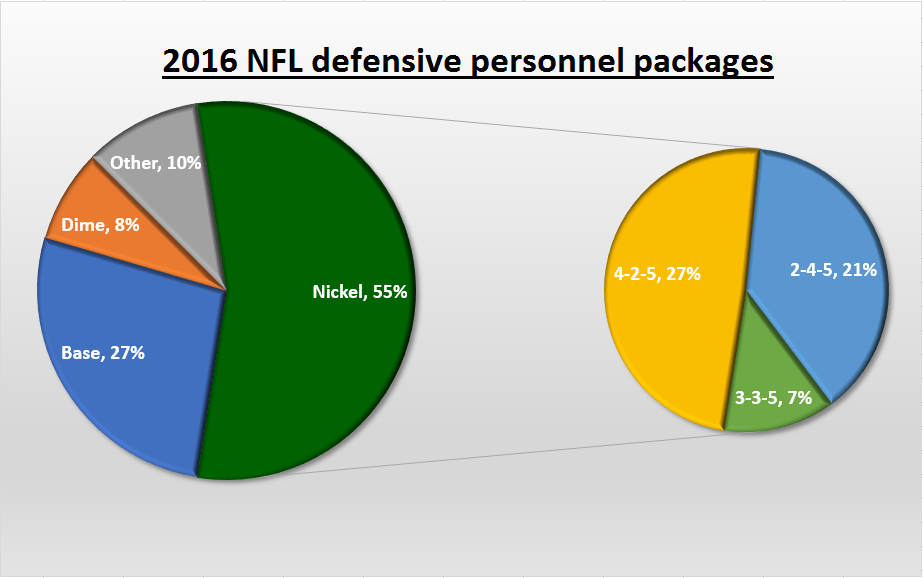
The real driving force behind the adjustments in scheme is the passing game. The NFL is a passing league and now lives in nickel defense, not base. Most teams run with three wide receivers on offense instead of a fullback or second tight end, so defenses have countered with an extra defensive back. Last season, base 4-3 and 3-4 defenses combined (with just four defensive backs on the field) accounted for only 27 percent of defensive snaps, while nickel defense (five defensive backs) was at 55 percent, and dime (six defensive backs) another 10.
What used to be your every-down defense is now being used on average only a quarter of the time. Even if two teams have dramatically different base defensive alignments, they are in sub packages far more often, and those sub packages are much more uniform in structure. Base defenses can see significant differences in alignment, but while the 55 percent of snaps the league spends in nickel defense breaks down into a few different personnel groupings, most of them are essentially different ways of achieving the same alignment.
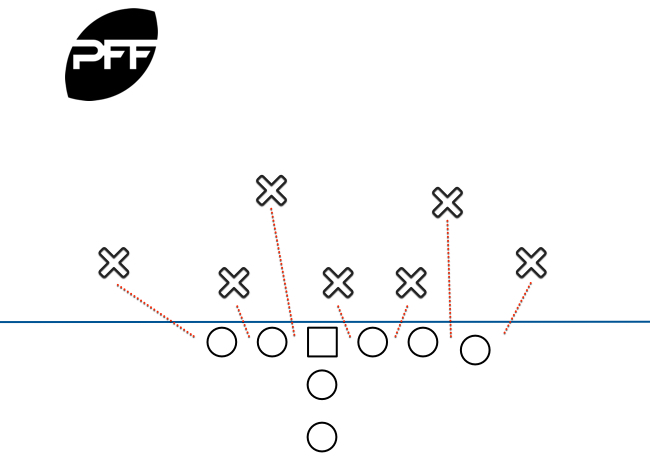
Whether you are a 3-4 or 4-3 base defense, moving to a nickel personnel grouping takes somebody out of the front-seven and adds a player to the secondary. When that happens, most teams deploy the remaining six players up front in more or less the same way because it is the most efficient way of accounting for every gap along the line.
The first guy to get sacrificed is the big nose tackle for 3-4 teams. Linemen that weigh 320-plus pounds may still be great run defenders, but they tend to offer little as pass-rushing threats. 4-3 teams typically lose one of their three linebackers, leaving both schemes with two edge defenders, two interior defenders and two off-the-ball linebackers to go along with their five defensive backs. The only difference is exactly how those edge defenders stand when they line up. Whether you’re a 3-4 or 4-3 base team, the alignment of the front four in nickel and dime defense tends to wind up the same, but is still differentiated by anachronistic position designations that no longer make sense as descriptive tools.
This image shows Denver’s defense under Wade Phillips and the Rams’ defense under Greg Williams from last year, superimposed into one image.
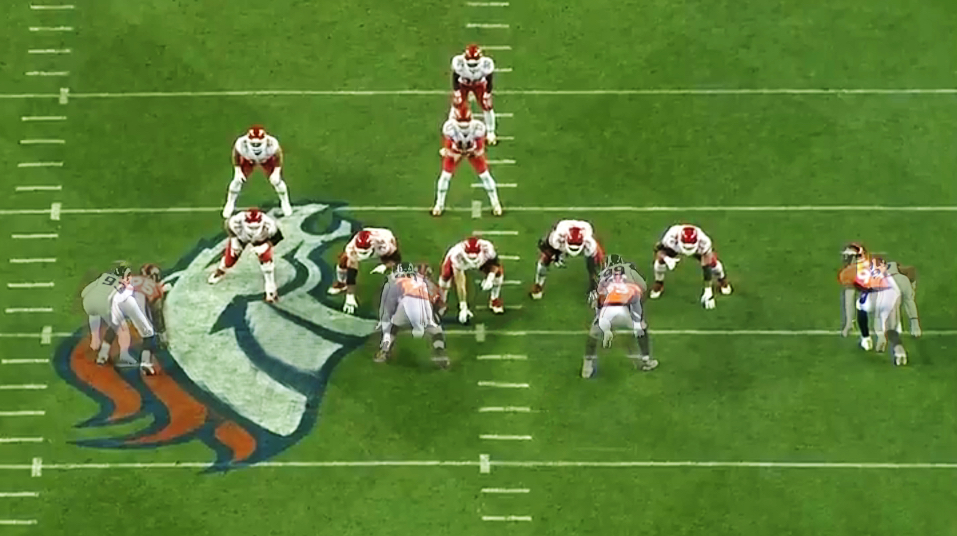
The teams were both facing near enough the same offensive formation, and they deployed their front four in identical gap alignments. The only difference between the two was that the player furthest to the right side playing on the edge was an outside linebacker for the Broncos (DeMarcus Ware) who rushed from a two-point stance, but for the Rams, that player was a defensive end that had his hand in the dirt (Eugene Sims).
Those players are listed at different positions on the roster, but have identical roles from the exact same alignment on the play in this situation. The distinction between linebacker and defensive end is far less meaningful in the world of nickel defense than that between edge defender, interior defender and off-the-ball linebacker, which is why the Pro-Bowl ballot will remain broken until it adopts that shift in player designation.
The difference in the stance of the edge defender between two-point and hand in the dirt may not even be a team-prescribed technique. There are teams in the league (the Patriots, being one) that allow their edge defenders to choose which they feel more comfortable with on any given play, effectively leaving the designation of that defensive front to one player’s whim each snap (if all you care about is how many players have their hand in the ground). As long as he is lined up in the right spot, those teams don’t care if he is in a two- or three-point stance, so the label of linebacker or defensive end is entirely meaningless and arbitrary for that player on that play.
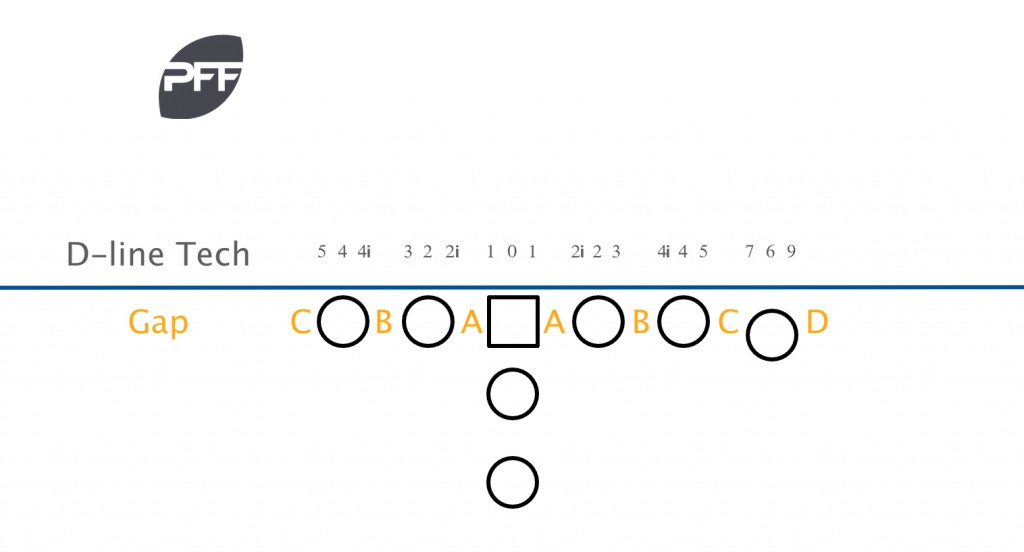
The same thing is true for interior defenders, too. Aaron Donald is known as a 3-technique defensive tackle, or “under-tackle” in a 4-man defensive-line scheme. 3-technique is simply the name of the defensive-line technique that sees a player lined up over the outside shoulder of the guard, ready to attack the gap to his outside. Most pass-rushing defensive tackles primarily play in that specific technique, but so do most pass-rushing 3-4 defensive ends. Calais Campbell, in Arizona’s 3-4 scheme, plays more 3-technique than any other technique—and more than many defensive tackles—but is listed as a defensive end on the roster. Donald’s alignment distribution in 2016 almost exactly matches that of Denver’s defensive ends, Derek Wolfe and Jared Crick.
The defense that Wade Phillips runs does have some eccentricities compared to other systems in the league—they tend to stay in base defense longer than most teams and then leap straight to six defensive backs, bypassing the nickel packages of five DBs altogether. Even in base defense, though, it is very much like a 4-3 scheme from an alignment standpoint.
When looking at the alignment distribution of Wolfe against Donald last year, the only difference between the two is a small spike for Wolfe in the 4-technique spot, the technique that plays head up over the tackle (the original 3-4 two-gap style alignment we mentioned earlier). There will be plays where we see Donald lined up in this spot, but Wolfe played there less than half as often as he played in the 3-technique spot that Donald usually occupied, and even in that alignment, he is going to be tasked with shooting a gap and defeating that tackle with quickness and hand speed rather than trying to eat up space and two-gap either side of him. In Phillips’ scheme, it is more of a disguise measure than it is a statement of two-gapping intent.
We are going to see Aaron Donald and the rest of the Rams’ defense lining up in a new defensive front under Wade Phillips in 2017, but if you can look beyond how many players have their hand in the ground, operating from a three-point stance, you’ll see that the alignment of those players has changed little despite the shift from 4-3 to 3-4. That once was a seismic shift that required a complete retooling of your defensive personnel to make it work, but in today’s NFL, it’s just a different way to shuffle the same cards. Aaron Donald may now be labelled as a 3-4 defensive end, but he will be the same destructive force as an interior defender as he has been over the past couple of seasons.
May 4, 2017 at 10:15 pm in reply to: Video breakdown of Wade Phillips' defense & more discussion of the transition #68375znModeratorWade Phillips’ 3-4 scheme might not be a big adjustment for Rams
By Alden Gonzalez
LOS ANGELES — Wade Phillips wore his Super Bowl ring as he made the rounds in Houston last week. As he did interviews, Phillips explained that the Denver Broncos, his former team, were defending champions right up until the end of Super Bowl LI. And though their one-year reign ended with the Patriots, who beat the Falcons by orchestrating the greatest comeback in Super Bowl history, Phillips is bringing a championship pedigree with him to the West Coast, as the Los Angeles Rams’ new defensive coordinator.
Phillips, 69, was the first hire made by 31-year-old rookie head coach Sean McVay. Phillips has nine seasons as a full-time head coach and was a defensive coordinator for 25 other seasons. Since joining the NFL in 1976, Phillips has been part of 20 top-10 defenses and coached 30 Pro Bowlers, five of whom are in the Hall of Fame. And in each of his last six stops as a defensive coordinator, Phillips has overseen drastic improvement. When he took over the Broncos the first time, they went from 27th to fourth in DVOA in one season. The Bills went 19th to 10th; the Falcons: 26th to 12th; Chargers, 30th to 13th; and Texans: 31st to sixth.
In his second stint with the Broncos, they went from fourth to first.
Phillips’ Broncos were the NFL’s best defense each of the last two seasons, one of which ended in that Super Bowl 50 title. Though perhaps not as dynamic and deep, Phillips inherits another solid defense with the Rams, led by arguably the game’s best interior lineman in Aaron Donald. Phillips will convert the unit from a 4-3 to a 3-4, but it might not be all that different.
We’ll isolate three key traits from Phillips’ defense in Denver in 2015 to ’16. You can find the same for McVay’s offense with the Washington Redskins in this post.
A 3-4 that acts like a 4-3
A lot has been made about the Rams going from four down linemen to three under Phillips, but Phillips himself has stressed that “those who can rush are going to rush.”
Under Phillips these last two years, the Broncos used three pass-rushers on only 41 offensive snaps, lower than all but four teams during that time. ESPN Stats & Info has the Broncos ranking fourth in the amount of times they utilized five pass-rushers during that stretch, slightly more than Gregg Williams’ defense with the Rams. But ESPN Broncos reporter Jeff Legwold, who charts every defensive play, will tell you that Phillips used four pass-rushers the vast majority of the time, continually varying which linebacker he used to get to the quarterback.
For the Rams, it seems like that extra rusher will mainly be Robert Quinn, a two-time Pro Bowler who will probably transition from defensive end to outside linebacker. In all likelihood, Quinn will still spend most of his time trying to get around the edge to get to the quarterback. And nothing will change for Donald; he will remain a three-technique, which means he will continue to line up on the outside shoulder of the opposing guard.
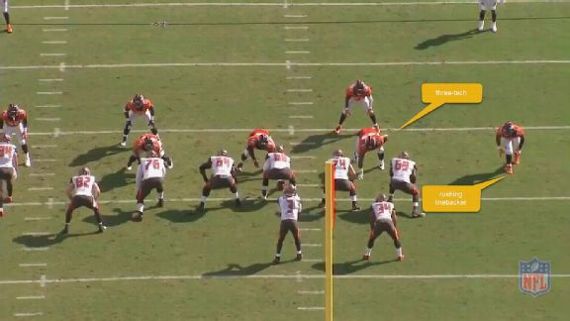
Below are a couple of looks at how Phillips lined his defense up early in Week 4 against the Buccaneers this past season. The first is a first-down situation early in the game, where you’ll notice a three-technique down lineman and two outside linebackers at the line of scrimmage ready to rush (or, because it eventually became a run to the outside, contain the outside).
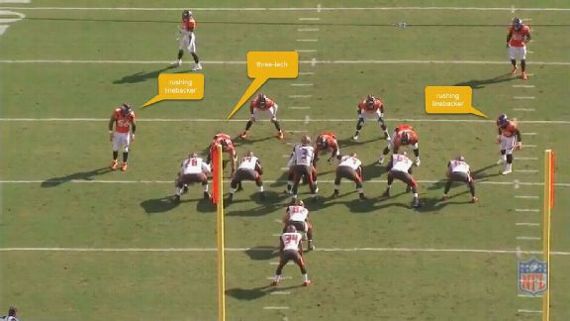
It’s pretty easy to picture the four to the left being Quinn, Donald, Michael Brockers and William Hayes, respectively. On the very next play, 2nd-and-9, Bucs quarterback Jameis Winston lined up in the shotgun and Phillips used one of his linebackers in coverage. He still had a rushing linebacker, a three-technique and two other down linemen, essentially serving the purpose of a 4-3.
Lots of man coverage
The main reason Phillips was able to be so aggressive and unpredictable with his pass-rush was because he had the defensive backs who could play man coverage and at times be left on an island. Phillips would be inclined to mix in zone concepts at various places on the field if he didn’t have the cover corners, but most of the time — with Aqib Talib and Chris Harris Jr. on the outside — he did.
The Broncos were one of only three teams — along with the Texans and Vikings — to allow just one regular-season game of 300 or more passing yards over the last two seasons. They ranked first in DVOA against the pass in each of those seasons. The Rams, who mainly used five defensive backs, slipped to 20th in 2016. Their top three cornerbacks outside of Trumaine Johnson, a pending free agent, are no taller than 5-foot-10.
Phillips might have to play a lot more zone in L.A.
Adjusting to the opponent
The Broncos won it all last year largely because of the way Phillips adjusted. It’s evident in the way he navigated the last two games, the AFC Championship against the Patriots and the Super Bowl against the Panthers.
The Broncos couldn’t have faced two more different offenses.
The Patriots focused mostly on Tom Brady getting rid of the football quickly, using an assortment of short to intermediate routes that gained chunk yardage. The Panthers featured a dynamic running game — with running back Jonathan Stewart and quarterback Cam Newton — and also liked to throw the ball downfield, often using max protection to give Newton enough time in the pocket.
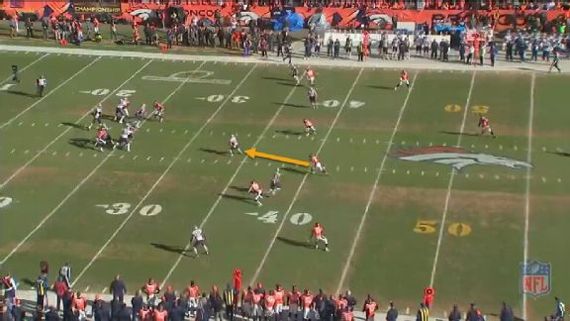
Against the Patriots, Phillips disguised pass rushes without being so aggressive that his defensive backs were too often in space. On Cover-2 looks, his safeties were aggressive attacking short throws, which allowed them to sustain the Patriots’ assortment of pick plays, as pointed out by Cian Fahey in this Football Outsiders post. Below is an example of a second-down stop on a short route that eventually led to a punt, with the safety’s pursuit highlighted …
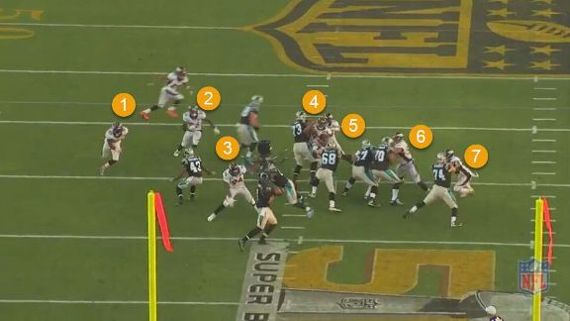
In the Super Bowl, Phillips got aggressive. Newton is probably the NFL’s most athletic quarterback, but Phillips noticed that he would rather sit in the pocket than scramble, as noted by Andy Benoit of MMQB.com. His biggest decision was what to do with his extra defender, who would be on either a tight end or a fullback who would be used frequently to help an inadequate offensive line. Phillips decided to blitz that extra defender, putting constant pressure on Newton and allowing some of his best pass rushers — Von Miller, for example — to go up against man-to-man coverage.
The Broncos hit Newton 13 times in that game, and below is a look at just how many pass-rushers they used at times …
 May 4, 2017 at 9:55 pm in reply to: Video breakdown of Wade Phillips' defense & more discussion of the transition #68374znModerator
Blue and Gold wrote:
Wade said that he’s going to keep Aaron Donald as a pure 3-tech, so he will go from side to side, depending on the line call. Brockers will remain a 1-tech(shade) on the center. So, the tackles will not change. The player opposite Donald will usually be in a 5-tech (maybe a tight 5) or sometimes A 4-tech (head up on the tackle).
Easley can back up the 5-tech and 3-tech and maybe even spell Brockers on the nose, though that’s not his forte. They sigend a kid from 49ers who will have chance to be backup to Brockers.
Westbrooks, I think, is penciled in as the 5-tech and he will have to switch sides, go the opposite side as Donald.
the LBers, one will be a DE on any given play and one will be a LBer and that can switch given the call.
In nickel both OLBer will be DEs and Donald will be one DT, I’d guess Easley will be the other, but the 4 best pass rushers will have their hands in the dirt..so if Westrbooks steps up he could secure a spot in the nickel DL
znModeratora nonstop ball of butcher knives
Good enough for me.
I’m sold.
My only question is: How can you NOT draft a player described as a “nonstop ball of butcher knives?”
Did all the teams that passed on him not see that quote?
lol…that was my feeling as well.
That quote has shot up my list as all time favorites from the draft.
Edit to add…I guess we can now call him ‘Sam the butcher’….for all you old timers (like me) what show did that come from…it’s an easy one.
The (almost) historian in me is compelled to say, I have heard that phrase before.
In Year Whatever, Rick Venturi, in an ESPN 101 segment, described I Forget Which Player as a “rolling ball of butcher knives.”
So methinks it’s a thing coaches say.
.
znModeratorRams claimed NT Mike Purcell off waivers from 49ers.
==
49ers roster breakdowns, 90-in-90: DT Mike Purcell
Breaking down the 90 players on the 49ers offseason roster in 90 posts (over 90 or so days). We move on to defensive tackle Mike Purcell.
Jun 6, 2016
http://www.ninersnation.com/2016/6/6/11869354/49ers-roster-breakdowns-90-in-90-dt-mike-purcell
Each year, we run a series of post called “90-in-90” here at Niners Nation. The idea is that we’ll take a look at every single player on the roster, from the very bottom to the top and break them down a few different ways. This is to help give everyone a basic understanding of a roster. Of course, this roster will change, and some days we’ll have more than one so it’s not strictly one per day but you get the idea.
The San Francisco 49ers have an extremely talented nose tackle in the form of Ian Williams. He earned more playing time in sub packages last year, but this offseason, the big red mark on his career popped up again. Williams had to have surgery on his ankle, with reports suggesting multiple surgeries. He played an entire 16-game schedule, but the surgeries are a big concern.
Enter Mike Purcell. The 49ers signed Purcell as an undrafted free agent in 2013. He spent the 2013 season and most of the 2014 season on the practice squad. The team promoted him to the 53-man roster on December 19, 2014. He finished out the season on the roster, and then earned a spot on the roster in 2015 training camp. He was inactive for the 49ers first eight games, but then was quickly worked into the rotation in Week 9. He got his promotion into game-day action before Glenn Dorsey tore his ACL, but added further snaps after Dorsey got hurt. He finished the season with 15 tackles and one sack.
Basic info
Age: 25Experience: 3 seasons (2 on the practice squad, 1+ on the 53-man roster)
Height: 6’3
Weight: 303 lbs
Contract status
Purcell signed a three-year deal when he was promoted from the practice squad in late 2014. He is entering the final year of that deal. If he makes the 53-man roster, he will have a base salary and cap hit of $525,000. He would then be an exclusive rights free agent after the season.Why he might improve
Last year marked Purcell’s first consistent playing time in the NFL (aside from the preseason). After sitting the first eight games, Purcell got more and more playing time over the final eight games. If he is going to take a step forward, it will be in part because of that significant opportunity. He did some good things in those eight games, and while he was not a star by any means, it was a step forward. He could see more playing time because of injuries to Ian Williams and Glenn Dorsey. If he can consistently get on the field, he could get a chance to put it all together.Why he might regress
Purcell sometimes feels like one of those players that home team fans love, but also probably overrate. He’s not a bad player, but it’s possible we have seen his ceiling. Considering the 49ers are implementing the philosophy of a new coaching staff, it’s hard to say what any of this means. However, Purcell can be re-directed at times, and so consistency is going to be something to watch.Odds of making the roster
The 49ers added a lot of defensive line talent this offseason, drafting DeForest Buckner and Ronald Blair, and signing Demetrius Cherry and Darren Lake. Purcell is likely strong bubble at worst, and considering he is getting first team work in place of injured Ian Williams and Glenn Dorsey, I imagine some might argue he is a lock. His role this fall remains up for debate though. If both Williams and Dorsey are unable to play Week 1, I would be surprised if anybody but Purcell was the starting nose tackle. Darren Lake is talented, but I see him most likely spending this season on the practice squad. There is some suggestion of Quinton Dial at nose tackle. We could very well see that, but open practices have seen him at defensive end in the 3-4.Purcell’s playing time will be something to track once Ian Williams is healthy. Barring any setbacks, Williams would seemingly return to the starting nose tackle role. Purcell could find himself in a tough position competing for playing time at defensive tackle. The 49ers will need the depth given the injuries that have taken down Glenn Dorsey and/or Ian Williams in recent years. But once Williams (and then Dorsey) are healthy, what exactly is Purcell’s role? Is he the new Tony Jerod-Eddie?
znModeratorBucky Brooks
..
znModeratorhttp://www.nfl.com/videos/nfl-network-path-to-the-draft
—
Rampage2K- wrote:
Cooper Kupp on Path to the Draft today. Good stuff….
Ran Carthon (Rams former director of player personnel) was on there going over the draft grades for the division ….quick hits on Everett “our Jordan Reed type” “Kupp best hands in the draft and a guy who will always be where he’s supposed to be” he also wanted to mention Samson Ebukam about how excited he was to get him…”explosive” gets to sit and learn behind some of the best in Barwin and Quinn. Cooper will be star if he can play like he did in college….got some swag.
Good show today with lots of Rams stuff…check it out if you can!!!
znModeratorBonifayRam wrote:
Jamon Brown is a compact large thick OL’er @ 6-4/325 pounds. JB has long arms (34 1/2) that he used effectively when he played OT in College. My big hope is he can ascend to match Saffold level play @ left OG. I maintain that JB should be a very good LG in the NFL. In my mind JB can play center without any problems. JB has shown he can play all four OL positions & there is NO reason he could not make it five.
Cody Wichmann is the bigger of these 3 OL’er in this center discussion. CW can get much thicker & stronger of all the 2015 class. It would not surprise me if CW’s over 6-5 frame is close to 330 pounds of good muscle when we see him in camp. CW also should be a serious solid candidate for starting center too. CW is a true phone booth dominator but has negative issues playing when hurt. But high ankle sprains will degrade most players & he had had back to back seasons with this issue. CW has proven he can be versatile in playing left or right. CW played OT in college too.
Andrew Donnal is a leaner type body frame of the three over 6-6 approx 316 pounder but gets lower & bends much better than JB & CW. AD was the most advanced technically sound of the four of the 2015 draft selections when the 2016 season concluded. AD was able to process through the offense better than any other OL’er & continued to improve even though he had a badly injured hip that required surgery in January. AD does not generate the power of the other 2 but is building a nice good size bag of tricks & uses his brain more than his brawn. AD is the most versatile of the 3 having played 4 of the 5 positions in NFL games. I bet AK wants to add to AD bag of tricks real bad.
There’s a reason that Snead did not utilize any of his valuable 2017 draft picks on the troubled OL. The above three are entering their 3rd seasons & have seen a ton of action in starts amongst them so they know what needs to be done to be effective wherever they end up playing.
znModeratorRams restock offense, drafting pass-catchers Everett, Kupp
PFWeekly
LOS ANGELES – Even without a first-round pick, the Los Angeles Rams are finding ways to bolster the NFL’s worst offense around Jared Goff.
The Rams chose South Alabama tight end Gerald Everett with the 44th overall pick Friday after retreating seven spots in a trade with the Buffalo Bills. Los Angeles then grabbed Eastern Washington receiver Cooper Kupp with its third-round pick before using the 91st overall choice acquired from Buffalo on Boston College safety John Johnson.
The Rams didn’t have a first-round pick after last season’s trade to snag Goff at No. 1 overall, but they addressed three clear areas of need on the second day of the draft.
The Rams’ first pick in Sean McVay’s tenure was Everett, a tight end who should fit well in the new coach’s offense.
Everett starred at South Alabama for the past two seasons after leaving UAB when the school shut down its football program. He is a standout pass-catcher who has been criticized for his blocking acumen, yet he was still one of the top talents in a draft class that is deep at his position.
“I think I bring the complete package of a tight end,” Everett said. “Definitely a vertical threat first, but also being a willing blocker in the run game, just being able to create that mismatch at any point of time in the game.”Everett should team with second-year pro Tyler Higbee to provide a solid threat at tight end for the Rams, who had the NFL’s worst offense last season for the second consecutive year. McVay’s offenses in Washington used tight ends extensively, and he is likely to do the same in Los Angeles.
Everett already met Goff during his pre-draft visit to the Rams, and the quarterback immediately welcomed Everett on Twitter.
“I’m ecstatic,” Everett said. “I can’t wait to get out there in OTAs and get used to the rhythm and run routes with Jared and the rest of the receivers and tight ends for the Rams.”
Kupp is another highly regarded pass-catcher from a small school. He set college football receiving records with 428 catches for 6,464 yards and 73 touchdowns with the FCS Eagles, who won three Big Sky titles.
Kupp will be a third-generation NFL player, and he has made up for his lack of exceptional speed with strong routes and great hands. That describes much of the Rams’ current receiving corps, which lacks a large target for Goff or incredible speed outside of Tavon Austin.
“I think I bring versatility,” Kupp said. “A guy that’s going to know the offense inside and out. A guy that’s going to be ready to go Day One. I pride myself on that, on learning the offense. I know exactly what I need to be a guy that can be reliable and be able to get first downs. The ability to create in multiple different ways, play wherever you need me to play, I think that’s something that I bring that a lot of receivers can’t.”
Johnson should have a chance to play immediately in the Rams’ depleted secondary, and many draft observers think the 6-foot defensive back has the coverage skills to do it. The Rams have only two safeties with significant experience, and Johnson also could fill in as a slot cornerback for Lamarcus Joyner, who is moving to safety.znModeratorPARAM wrote:
No OL taken in the top 15 for the first time in the “common draft era”.
33 OL taken in 2017
41 in 2016
47 in 2015
45 in 2014
42 in 2013
45 in 2012In fact I was listening to Mike Sando and he said:
33 lineman drafted is lowest since 1967…..
10 in the first three rounds is the lowest since 1984…..
(We’re talking 5 decades and 3 decades here)
He also said, OL $$ is being spent in free agency.
From the Rams:
After minicamp they didn’t think OL as big a need (as playmakers on both O and D, I assume).
They have 6 OL on the roster drafted in the previous 3 seasons, half of them in the 3rd round or higher. Should have at least had a hit or two. Perhaps they want to see what they can do with them. If they only have 1 or 2 from that group capable, then they have 7 picks next year and another free agency period to acquire more lineman. I think they “knew” they needed TEs and WRs.
If there weren’t many guys in this draft who projected as upgrades, why waste a draft pick that could be used elsewhere? Besides that the two UDFA lineman signed both seem targeted for OC
znModeratorpoplarbluffman, aka thehammer wrote:
just jumps out at you..all high character guys..obviously that was theme in this draft
Gerald Everett 5th highest sparq at te..Engram 4th Jonnu Smith 6th OJ Howard 8th never been a afan of JC kids they tend to have a very high bust rate but Everett scored avery high 24 on the wonderlic..almost shy in interviews. expect Engram was plan A and Everett plan B..had Jonnu Smith 205th nevr could warm up to him
MCvay got his H-back..might take a year for him to learn the playbook but very solid upside
Cooper Kupp has a HOF work ethic along with a chest filled with records…looking forward to seeing him at the Senior Bowl and his combine workout..really flashes as a wr/person…1st player I thought of when watching him was Jerry Rice..ok a white Jerry Rice
posted this dec 1.. super smart workaholic.tested as one of fastest players at the senior bowl on the field during practice..doesn’t play that fast a McVay type..will kill zones..instant production bad part never makes a db miss, easily tackled, not overly physical but you have to start somewhere
John Johnson team captain, all academic, very smart, articulate…looked like a 4.55-4.6 guy from film and ran 4.61 at combine Patriots took a high pick cb bust in Eric Rowe and used him successful in sub packages vs te’s. Good athlete 22 out of 234 safeties highest sparq score
Johnson impressed me at the SB practices. Has very good tape, but the coverage he showed in practice was impressive. Easy mover, CB type. I think Phillips will be looking for a totally different breed of safety, you need to cover first, hit later. He’s not just looking for guys to simply keep the play in front of them and lower the boom, but instinct in coverage that’ll produce INTs. I like Johnson in that regard. Doesn’t bode well for Alexander or Brian Rudelph long term but guys like Joyner, Isaiah Johnson and Marqui Christian should be able to fit very well.
GW used the interchangeable safety concept to disguise the pressure/blitz package. Phillips disguises 4th pass rusher. Creates a lot of opportunities for interceptions and why he prefers the athletic db’s who coverage/ball skills are more desirable than lowering the boom (not that phillips does not appreciate the big hit)
After seeing MO at FS last season, unsure he has the coverage skills for Phillips schemes, amazing closing speed but struggles with double moves/change of direction
Samson Ebukam LB Eastern Washington Mayock said stiff, Jeremiah said very stiff I might say very, very stiff but again team captain all academic type very high sparq hard worker nees upper body strength but should be a core st guy solid backup guy…Rams lacked backups for both Quinn and Barwin..think they overdrafted Ebukam because of the need and were lucky to het Price in 7th
big fan of Reynolds..tested as the best wr vs db’s at senior bowl practice week…just jumps out at you when watch him play….realy understands dangles and fights for the ball does a great job with his hand vs smaller cb’s creating space
next to Price Robinsons is my favorite player in this draft…born to play wr.
Tanzel Smart Tulane 6’1 296 uber productive 3 tech 18.5 tfl as a senior and 15 as a junior Senior and Shrine game little Engine that could non quit motor…Dline had the fewest bodies and had to be addressed…similar type player as Donald Rams scouted pre draft..nice backup type does Easley hold up at 5 tech?
http://prod.www.saints.clubs.nfl.com/media-center/videos/Tanzel-Smart-Senior-Bowl-Interview-/59fa0028-ec3a-468b-88e0-8e9cca0225ecnice interview…
Price 7th in the nation last year in sack, 5th in career sacks and 6th career tfl per game..almost unblockable at Pitt 5’11 with real bend/quickness OT’s simply couldn’t reach him. elite 6.98 3 cone attests to his quickness. team captain, elite character Had him much higher then everyone else but really liked him
znModeratorInside the Draft Room: Trading Back and Getting their Targets
Myles Simmons
After functioning largely as spectators on the first night of the 2017 NFL Draft, the Rams figured to be a heavy player on the second — particularly because of the club’s early second-round pick.
General manager Les Snead would tell the media at the end of the night he anticipated teams trying to move up given his previous experience. And with the Rams carrying the fifth pick of the night — No. 37 overall — there were surely clubs that had identified a target for the late 30s.
And so about 10 minutes before the second round is set to begin, Snead, EVP of football operations Kevin Demoff, and senior assistant Tony Pastoors are engaged in a discussion about potential trades. After a few minutes, Snead returns to his seat next to head coach Sean McVay, filling him in. A smile comes across McVay’s face. At some point soon, he’ll make his first phone call welcoming a drafted player to Los Angeles.
It’s 4:04 pacific when NFL commissioner Roger Goodell comes on the TV screen and asks the Philadelphia crowd for a moment before they continue booing, eliciting some laughter from the Rams’ draft room. That cuts through some of the nervous energy between the four walls. The selections haven’t started, but it’s certainly more tense than it was on Thursday night.
Once the Packers are on the clock at No. 33, the phones begin to ring — just as Snead expected. Many of the calls go to Demoff or Pastoors, which means Snead and McVay are probably wearing out the patch of carpet between the tables as they go to hear details.
Seattle’s pick comes in at No. 35, and two minutes later, scouting assistant Michael Pierce — on headset with the Rams’ representatives at the draft in Philadelphia — tells the room Arizona has traded with Chicago to move up to No. 36. Snead and McVay both get out of their seats, eager to hear details.
Pierce announces the pick — Washington safety Budda Baker — and the Rams are on the clock. Will they make a pick?
Clearly, the answer is no. Snead gets on the phone — with the Bills, as we’ll all soon find out — and says, “OK, let’s do it.” From there, Pastoors calls the league to make the deal official. At that point, McVay comes over to Pierce, confirming that there will be a trade. Pierce tells those in Philadelphia there’s no need to turn in a card.
“I think they’re going to pick Zay,” McVay says. And he’s right — Buffalo selects East Carolina wide receiver Zay Jones.
And now the waiting game begins. L.A. gained an extra third rounder pick by trading No. 37 and No. 149 for No. 44 and No. 91, but there are seven more picks before the club can select its first player of this draft.
In that time, there are plenty of conversations — both in the room and on the phone. Snead is fielding calls and messages, but also asks Jake Temme of the Rams data and analytics department — better known as the “Nerd’s Nest” — to come over for discussion.
The phones in the room continue to ring, particularly as the picks reach No. 43. “What’s Philly waiting for?” jokes an eager McVay. It seems like there are options on the table once the Rams come on the clock. But then the decision is made: The Rams aren’t trading the pick.
At that point, Rams director of Player Personnel Taylor Morton comes over to Pierce and gives him the name: Gerald Everett, tight end, South Alabama.
Pierce relays the information over to Philadelphia, where the representatives get the card ready. At the same time, Snead dials Everett’s number form the draft room’s land line. Everett answers, Snead lets him know who’s calling, and Morton motions it’s time to turn the card in.
The Rams have a new tight end.
“I think he’s going to be a great compliment to a room that’s already full with some great young players,” tight ends coach Shane Waldron says just after the phone call. “I think he’s got wiggle and that natural ability at the top of the route to separate. And then with the ball in his hands, he can make people miss and he can break tackles and create yards on his own — which is an important part.”
There are handshakes, back slaps, and bro hugs abound. McVay comes to the back of the room, congratulating one of the club’s area scouts. Everyone seems pleased to have their desired target plus another third rounder after the trade back.
The draft room slows down for a bit from there, with the Rams next pick not coming until the top of the following round. At about 6:30, when it begins, the phone rings. Demoff answers, telling whoever is on the other end, “We can try” — presumably to make a trade. But nothing comes of it.
At this point, Snead is spending plenty of time with director of college scouting, Brad Holmes. Holmes’ seat is just behind Snead’s and next to Morton’s in the draft room, so there’s a lot of moving back and forth between the two rows.
When the Rams are on the clock, there’s still discussion still going on between the decision-makers in the front row, perhaps about a potential trade. But with 1:40 left for the club to make its selection, Morton tells Pierce to have the representatives in Philadelphia turn in the card: Cooper Kupp, wide receiver, Eastern Washington.
On the phone, Snead asks Kupp, “You want to be a Los Angeles Ram?”
“Man, nothing would make me happier,” Kupp replies.
About a half hour later, with Los Angeles’ extra third-round pick from Buffalo about 10 selections away, most of the team’s defensive staff enters the draft room — coordinator Wade Phillips, assistant head coach/linebackers coach Joe Barry, cornerbacks coach Aubrey Pleasant, and safeties coach Ejiro Evero. It’s a pretty clear indication the Rams are planning to go defense with their third pick of the night.
The discussion between the coaches and those in personnel goes on for a half-hour, with everyone paying close attention to who comes off the board. But the Rams nevertheless get their target, John Johnson, a safety from Boston College.
Phillips gets on Johnson’s draft call after McVay and tells him, “We really love the way you play.”
“Talk a player that is very tough — very physical for a converted corner. Has very good coverage skills because he’s a converted safety. And a great above-the-neck player,” Evero says after speaking to Johnson himself. “We’re really excited to get him here and get him competing with us.”
Speaking to the media after the conclusion of the third round, McVay said the Rams “know we got better with three spots.”
But there would be plenty more work to do the next day. And with quick turnaround, too. Snead and McVay’s press conference ended just after 9 p.m. Day 3’s events were set to begin 12 hours later.
znModeratorPFF sez: Smart ranked 16th in the nation with a grade of 86.7 against the run, and his 87.4 pass-rush grade ranked fourth (seven sacks, seven QB hits, and 33 hurries on 400 rushes) in 2016
link: http://theramshuddle.com/topic/reporters-on-the-rams-draft/#post-68301
znModeratorfrom PFF’S 2017 NFL DRAFT RECAP FOR ALL 32 TEAMS
2 (44) (from Buffalo) Gerald Everett, TE, South Alabama
3 (69) Cooper Kupp, WR, Eastern Washington
3 (91) (from Arizona via Kansas City) John Johnson, S, Boston College
4 (117) (from Chicago via Buffalo) Josh Reynolds, WR, Texas A&M
4 (125) (from New York Jets via Tampa Bay) Samson Ebukam, Edge, Eastern Washington
6 (189) Tanzel Smart, DI, Tulane
6 (206) (from Miami) Sam Rogers, FB, Virginia Tech
7 (234) (from Baltimore) Ejuan Price, Edge, PittsburghDay 1: No picks
Day 2: The Rams added weapons for QB Jared Goff on Day 2, starting with Everett who led all tight ends in forced missed tackles in each of the last two years. He is an over-sized receiver who can develop as a blocker in more of an H-back role. Kupp adds another receiving option and he projects as a possession receiver at the next level, most likely working out of the slot. He doesn’t have great speed, but he’s a good route runner who got open consistently during the week of practice at the Senior Bowl. Johnson had the fourth-best tackling efficiency among draft class safeties, missing one out of every 14.6 tackle attempts.
Day 3: Reynolds adds a potential downfield threat after using his long frame to catch 11 deep passes for 450 yards last season. Ebukam picked up 11 sacks, 10 QB hits, and 42 hurries on 397 rushes last season and he could find his niche as a situational rusher early on for the Rams. Smart ranked 16th in the nation with a grade of 86.7 against the run, and his 87.4 pass-rush grade ranked fourth (seven sacks, seven QB hits, and 33 hurries on 400 rushes) in 2016. Price is an undersized pass-rusher who ranked 13th in the country with an 87.7 pass-rush grade last season, picking up 16 sacks, 13 QB hits, and 39 hurries on his 498 rushes.
znModeratorRams have their reasons for not drafting offensive linemen
Alden Gonzalez
The Los Angeles Rams fielded what was widely considered one of the NFL’s worst offensive lines this past season, but did not select a single offensive lineman in this year’s draft.
What gives?
It makes a lot more sense once you dive deeper.
First, consider their free-agent signings. They splurged on a left tackle, as they should, signing Andrew Whitworth to a three-year contract that guaranteed him $15 million. They released center Tim Barnes, but replaced him with John Sullivan, a six-year fixture on the Vikings’ offensive line until back issues crept up in 2015. Whitworth, however, is 35, his window closing. Sullivan, 31, came over on only a one-year contract. And the Rams still don’t have a young, long-term solution at left tackle or center.
But this didn’t seem like the draft to get one.
It was deep at several different positions, but offensive linemen certainly was not one of them. For the first time in the common draft era, which dates back to 1967, no offensive linemen were taken within the top 15. Only two were taken in the entire first round. And only one, Garett Bolles at 20th overall to the Broncos, went within the top 31. The draft was especially devoid of left tackles. It had some intriguing centers for the middle and late rounds, but the Rams instead signed a couple of undrafted free agents — Jake Eldrenkamp out of Washington and Anthony McMeans out of New Mexico State — who will work out at center for them.
Last year’s Rams offensive line was rated 27th by Pro Football Focus. Behind it, Jared Goff absorbed 25 sacks over his last six games and Todd Gurley averaged the second-fewest yards before first contact. But there’s a key reason the Rams didn’t address it in the draft, outside the lack of talent available and the free agents they signed: new offensive line coach Aaron Kromer wants to mold the linemen he inherits.
“There are a lot of guys in our group that he wanted to work with and felt like they may be better than some of the rookies in this draft class,” Rams general manager Les Snead told reporters from the team facility on Saturday night.
“We really wanted a close look. ‘Do we need offensive linemen or do we not?’ Because if you go back, we had the ‘16 season and we had the ‘15 season. The ‘15 season, we’re probably a top-five rush team, we’re a top-five sacks-per-play-allowed team. Then, you go to ‘16 and we’re basically bottom 30 in both of those categories with probably the same starting lineup. So at some point, between ‘15 and ‘16, you’re on opposite ends of the spectrum. But these guys were young, got experience, and we felt like there was some upside there.”
One of the most appealing aspects of this job for Kromer was his ability to develop. He talked about it shortly after being hired, saying: “I’m excited about this group, and the reason is the youth. When you look at it, there’s not many offensive lines in the league that have second- and third-year players across the board.”
It’s a result of the Rams drafting seven offensive linemen from 2014 to ’15, six of whom remain on the roster.
Greg Robinson, the No. 2 overall pick in 2014 who will not have his fifth-year option exercised, will transition from left tackle to right tackle. Rob Havenstein, a second-round pick in 2015, is moving from right tackle to right guard. Jamon Brown, Andrew Donnal and Cody Wichmann, all headed into their third year, will get reps at different positions in hopes of finding their best fits. Aside from Whitworth and left guard Rodger Saffold, the Rams’ best lineman last season, starting spots are up for grabs.
“We feel good,” first-year Rams head coach Sean McVay said of his offensive linemen. “I think coming out of that minicamp really enabled us to have a better feel for our depth up front.”
znModeratorOh, and another biggie for us back then? This was in the 1970s . . . you should never sell your paintings to a bank. Seeing it there, well, that was a sure sign you had sold out. No banks. Not ever. Never. And not just for the obvious reasons of it being a bank and all, and the apotheosis of capitalist power. Really, it was more a “taste” thing. As in, people who owned and ran banks had no taste, no aesthetic sense to speak of . . . and were barely above someone with a black velvet painting of Elvis in their basement. And they didn’t have the “class” thing going against them, etc.
I miss those days of such certainty and intellectualized scorn, that Us against the World camaraderie, in a context of heightened aesthetic awareness.
Then again, we may, um, well, have been a bit full of ourselves.
;>)
Have you ever seen Simon Schama’s The Power of Art?
It’s a great documentary. Several episodes, an hour each, on a different painting. That is they do the artist but the episode revolves around a particular painting and its place in that artist’s history.
The episode on Rothko centers around his decision whether or not to accept a commission from a trendy, upscale NY establishment restaurant (Seagrams).
Here’s part of it.
May 2, 2017 at 9:04 am in reply to: Biggest post-draft questions still to be answered by the Rams #68282znModeratorAre Cory Harkey’s days with the Rams over?
I hope not. I’m a fan of Harkey and the role that he plays on he Rams. Harkey had a slower 40 time than Rogers, but I like that he outweighs Rogers by nearly 30lbs.
I like Harkey as well but I just don’t see them keeping 2 FB’s.
Rogers also is known as a very good ST’s player and if I remember correctly, I don’t believe Harkey was in on the ST’s.
Harkey’s a favorite of mine too. He may be a “new system” victim. Meaning, bound for New England or Green Bay.

Special teams? I will look! Cause I don’t know without looking.
According to this (below), he had more special teams snaps than offensive snaps. Probably on blocking units, such as for punts and extra points. So maybe they still see him as having value there. But then they now have Everett, Mundt, Higbee, Harkey, and Hemingway. They would keep I would think at most 4? Or even more likely, 3.
 znModerator
Wasn’t Apocalypto the film that showed why the brutal and corrupt Mayans needed to be saved from themselves by the Christian Conquistadors?
I didn’t see it that way, myself.
znModeratorOkay. I liked Apocalypto though. And, I have no plans to buy any Bush paintings.
I never heard of Apocalypto. Was he a Spanish Surrealist?
In a way.
znModeratorI’m sorry. I know it’s petty and silly and ridiculous of me, but Mel Gibson is dead to me.
To quote Bladerunner, he’s done…questionable things.
But he can be a very good director.
And George Bush has developed into an artist of some skill.
I’m not buying one of his paintings, though.
Okay. I liked Apocalypto though. And, I have no plans to buy any Bush paintings.
znModeratorLBRamsFan wrote:
After the Rams drafted so many Senior Bowl participants, I went back and watched the broadcast on the game.
During the broadcast, about 3 minutes into the second quarter, they interview Phil Savage who runs the event and used to work for the Ravens and Browns. The interviewer asked Phil who has impressed him that week. PS mentioned Zay Jones and Cooper Kupp as the two guys who stood out the most.
The interviewer then asked him if there was a Zak Prescott in this group, a player that may not be as heralded as others but that he thinks could be a star in the NFL. Savage says that there are no quarterbacks that fit this category, but the one player he did say could be a star in the NFL was GERALD EVERETT. So out of the three guys that caught his eye, the Rams drafted two of them.
znModeratorI’m sorry. I know it’s petty and silly and ridiculous of me, but Mel Gibson is dead to me.
To quote Bladerunner, he’s done…questionable things.
But he can be a very good director.
znModeratormerlin wrote:
Jerry Reese [Giants GM] on Sirius
He was asked about the OL and fact that they didn’t pursue the position in the draft, and his response was this particular class was lacking overall in power/strength and they didn’t feel the need to reach for the position like they would have needed to when they weren’t necessarily any better than some of their options in-house.
He also went on to discuss Flowers, and that in spite of everyone hating on the pick how he’s had a couple of redshirt years and they expect him to continue improving. Went on from there about college OL nowadays being harder than ever to evaluate due to them not doing the things they need to see, and how they’re just going to need more time to develop than they used to because of it.
The hosts after the interview pointed out how many O-line free agents signed quickly for big money….that was an indicator of how the league viewed the O-line draft class.
Reece’s comments had me thinking of our OL, and how it’s kind of a similar deal in that they have guys who have been developing so to speak and didn’t see the upgrades in the draft that the fans and media saw. And btw Reese isn’t the first guy outside the Rams I’ve heard this discussion from, I just can’t recall specific names, but it’s a pretty commonly-held view.
Point is that it seems there’s a chance the Rams saw this thing the right way, that maybe they played the draft correctly.
..
znModerator"I've got Cooper as No. 1 [receiver]. His 'Kupp' is never empty."
High praise from @89SteveSmith pic.twitter.com/jH6fha1eWU
— Los Angeles Rams (@RamsNFL) May 1, 2017
znModeratorfrom 2017 NFL Draft: Quick-snap grades for all 32 teams
Chad Reuter
Los Angeles Rams
Draft picks: Gerald Everett (No. 44 overall), Cooper Kupp (No. 69 overall), John Johnson (No. 91 overall), Josh Reynolds (No. 117 overall), Samson Ebukam (No. 125 overall), Tanzel Smart (No. 189 overall), Sam Rogers (No. 206 overall), Ejuan Price (No. 234 overall)
Day 1 grade: C
Day 2 grade: B+
Day 3 grade: A
Overall grade: B-
The skinny: Tight end was a need position for the Rams, and Gerald Everett’s ability to get off the line smoothly is quite impressive. They might consider him a receiver. It might have been a tick early for him, however — not unlike when they chose Lance Kendricks a bit early in 2011. Cooper Kupp’s feet are as quick as any in the draft, even if his 40 time wasn’t great. Third-round safety John Johnson is liked by scouts for his ability to handle multiple roles in the secondary.The Rams couldn’t help but build up their offense with a solid receiver in Josh Reynolds, and got a potential pass-rush specialist in Samson Ebukam — two solid picks. Getting fullback Sam Rogers in the sixth will help Todd Gurley and the special teams units. The Rams needed to find a cornerback (or two), but couldn’t meet all their needs in eight picks. Jared Goff will be given the opportunity to excel with this talent around him.
znModeratorI’m not sold on Boo as since the injuries so decimated them they didn’t really have the next guy up….
SB, to be clear, this is my view: no one–no team–has the next guy up when OLs get THAT injured. In fact I consider it a myth that it’s even possible.
As a rule thoughtout the NFL if your OL gets injured past the critical mass point, then, no one can repair it in season. That’s just the nature of NFL OL play. You whack the OL with extensive multiple simultaneous injuries and it has a direct bad effect. The rare exceptions, as I said, are teams with qbs who can still play under those conditions (I named Brady and Wilson…some add Roethlisberger).
It’;s not just a matter of having bodies. After a while if the injuries are extensive enough, you lose cohesion and communication no matter what.
And since the cap/free agency era, it looks to be virtually impossible to have the kind of OL depth that lets teams handle multiple OL injuries. For example, like in the 1st half of 2012, when the positions from center to left OT played 9 different guys.
Predictably they were better in the 2nd half of 2012 when they got most of their starters back and really had to cope with only 1 injury (Dahl).
I have never seen an argument anywhere on the net that led me to doubt any of the above.
That’s just where I stand.
And Boudreau had some great lines in his past. Sometimes manufactured out of nothing.
He wasn’t much help in 2016, but then in 2016 so much went wrong that it just plain does not reduce to 1 or 2 things.
znModeratorThey had a veteran minicamp before the draft. Kromer had a chance to see how his young center prospects are looking. That was apparently enough of an indication for them to take OL off the board when the draft came up.
That’s the key for me…and I don’t think they were sold on the depth of the O-line in this draft.
All that said….I agree, it has to work and hope the curse of the O-line has been wiped out by McV and Kromer.
About that. My view:
1. The Rams had decent OLs and good OL coaching from 2012-2015, but what hurt them was injuries. I mean massive, extensive injuries. Sometimes this gets responded to with people saying “well all teams have injuries”—and no, not all teams have unit killing multiple extensive simultaneous injuries to their OLs. And the ones that do generally suffer (unless they have a qb who can still excel in those conditions, like Brady or Wilson).
2. In fact when the Rams OLs were relatively healthy from the 2nd half of 2012 through 2013, they did fine. When they were multiply injured and/or very inexperienced (2015) they predictably did not do as well.
3. They were awful in 2016 but that came from a lot of causes. To me 2016 was a perfect cluster storm of multiple things all going wrong at once. I think 2016 was unique.
4. 2016 is over, Kromer has a nice history, and he has indicated that in fact in Buffalo he was looking at some of the guys the Rams drafted in 2015. So he thinks there’s guys to work with. We agree they better be right, but still. Plus of course they added Whitworth and Sullivan (I am one of those who believes Sullivan has already shown he can still play). SO it is possible that they could get back to being decent. I absolutely would not rule that out, though of course, I ain’t committing to full optimism on this until we have visible on the field evidence.
znModeratorThis guy might consider doing voiceover and not putting himself in the picture.
It was late and there wasn’t anything else on.
I like him. He’s good. Thanks for posting it.
But it’s hard to watch his facial ticks and twitches. If that sounds harsh…but still!
So he might consider just doing a voiceover.
-
AuthorPosts