
Forum Replies Created
-
AuthorPosts
-
June 7, 2017 at 2:19 pm in reply to: Would a Tavon Austin for Eric Decker trade make sense for Rams, Jets? #69789
 znModerator
I wonder where Cooper, Marquez and Thomas fit into McVay’s plans. They were on the roster when he was hired
Cooper, Thomas, Marquez, and Spruce too.
I’ve said this before but it seems to me 4 are set. Tavon, Kupp, Woods, and Reynolds.
That probably leaves the 4 we just listed battling for 2 spots.
One early favorite (so far anyway) appears to be Thomas.
Here’s a thread on that: http://theramshuddle.com/topic/does-mike-thomas-have-a-shot/
June 7, 2017 at 11:28 am in reply to: Would a Tavon Austin for Eric Decker trade make sense for Rams, Jets? #69780znModeratorThis one’s easy. Simple answer: no.
Rams take an impossible cap hit if they trade Tavon. If you add it up it’s more than 16 M. On top of it you add Decker’s 7+ M. So combined that’s more than a 23 M cap hit.
Decker is not all that and Woods provides the same things IMO.
Jack—the Rams are done picking up people, unless it’s a low level cut or bargain free agent. They have to extend Tru and AD AND THEN Ogletree, and are tight against the 2017 cap as it is.
And frankly there’s no one worth that much trouble out there.
June 7, 2017 at 10:52 am in reply to: players appreciative for the infusion of vet players this offseason #69778znModeratorAnd in talking to some people, I’m not necessarily sure the Rams previous regime understood or respected or was comfortable or inclined to give willing leaders the green light to lead.
Well we know THAT’S bs. Jake Long? Wells? Jackson was regarded as a leader and very actively so. Hayes? Chris Long? Laurinaitis?
The problem was some of the signings, who were not leadership quality. At least not in the right sense. Finnegan? Cook? Britt?
Which is to take nothing away from guys like Whitworth, Sullivan, and Woods, who clearly fit the “leader” role quite nicely.
znModeratorLamarcus Joyner on bigger role with Rams: ‘A dream come true’
By Alden Gonzalez
THOUSAND OAKS, Calif. — Practice was over, several of his teammates had showered up and driven away, and Lamarcus Joyner remained on the field, all alone, jogging laps, dripping sweat. After three years of proving himself in a part-time role, the Los Angeles Rams are finally giving Joyner the opportunity he always wanted — to be on the field at all times, as both a free safety and a slot corner.
Joyner calls it “a dream come true.”
“A lot of people make it to the league,” he said upon finally coming off the field on Monday. “Some guys don’t pan out; some guys never get what they want. And to be in the driver’s seat of what you want to do as a professional football player, that’s really a dream come true.”
Lamarcus Joyner was able to impress in 2016 despite playing for much of the season with a broken toe. Keith Birmingham/Zuma Press/Icon Sportswire
Joyner is only 5-foot-8 and 190 pounds, but few are tougher; few are more passionate about football.The Rams drafted him 41st overall out of Florida State in 2014 and steadily grew to love him as a slot corner. But Joyner wanted to be more than a guy who played in sub packages. At one point during training camp last year, he skipped a workout and threatened to quit because he was dissatisfied with his role. Former head coach Jeff Fisher had to talk Joyner out of it by convincing him of how important an elite slot corner was to his defense. It was caught on HBO’s “Hard Knocks.”
“A lot of people may have looked at that wrong,” Joyner said, “but I don’t think a guy going to his boss wanting to play more, the way he’s putting in work, is disrespectful or arrogance or anything wrong. It’s just passion. It’s a guy that loves football and wants to help the organization that drafted him to win.”
Joyner played safety as a sophomore and junior for the Seminoles, a two-year stretch that was sandwiched between time at corner. Joyner often told Fisher and former defensive coordinator Gregg Williams that he wanted to also help at safety, “But the scheme didn’t allow it,” Joyner said. “I had to master nickel in that scheme. That’s what I did.”
Joyner played in 1,349 snaps over the past two years, fifth-most among Rams defensive players and trailing only Trumaine Johnson among cornerbacks. But that was largely due to Joyner’s own durability and stability, not necessarily the magnitude of his role. Last year, Joyner finished 30th among 111 qualified corners by Pro Football Focus despite playing most of that season with a broken toe. When it was over, the Rams grew motivated to open up more playing time for him.
T.J. McDonald was allowed to leave via free agency, which moved Maurice Alexander to strong safety.
The plan now is for Joyner to play free safety in base sets and go back to his role as a slot corner on nickel downs. But nothing is guaranteed. The Rams also signed Nickell Robey-Coleman, another excellent slot corner. And they drafted John Johnson, who excelled as a high safety and and in man coverage at Boston College. Joyner can’t let up.
“The difference between the league and high school and college is availability, accountability and dependability,” Joyner said. “Some guys get fed with the golden spoon, some guys don’t. Unfortunately, I had to take the path where I had to prove myself year in and year out. It’s been paying off.”
It could pay off even bigger. The Rams are trying to figure something out with star defensive tackle Aaron Donald, who hasn’t shown up for organized team activities while hoping for a restructured contract. But they also have several defensive players who are only one season away from free agency. The priorities among that group — even more so than Trumaine Johnson, who is set to play under his second consecutive franchise tag — are inside linebacker Alec Ogletree and Joyner.
The Rams are confident Joyner can take to free safety and impact their defense on every snap, a responsibility that he is embracing.
It’s been long enough.
“A career in the NFL is like a lion,” Joyner said. “It’s vigorous and violent, but it’s short-lived. Glory don’t last that long in the league. That’s just the nature of the beast. So, three years is a long time off my career to be waiting. But patience is everything.”
znModeratorBrockers has risen his overall PFF grade each of the past three seasons.
..
Blue and Gold wrote:
For years book on Rams was pound the A gaps and Brockers was drafted (and Langford signed) to stop that, and they have. Look at the chart below and notice all the red before 2012…this is Football Outsiders grades on run stopping. Since 2012 Rams have been in top 8 every year (highlighted in yellow) and especially good up the middle.
Football Outsiders has good and interesting metrics…and they show Brockers is very valuable.
Also, all one needs do is watch him play. He lands his blow and controls his man.
He’s a fine shade tackle, commonly known as a nose tackle. And does a good job. And he is part of reason the A-Gaps have been shut since 2012. So back to Football Outsiders. Since 2012 A-Gaps have been shut. Before they were sh/t
 znModerator
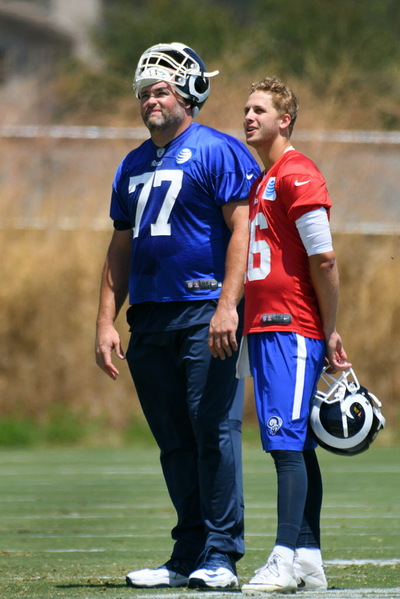
Whitworth knows that the Rams’ success will be tied to Goff’s play — and the performance of the offensive line.
Some say, they wish the Rams had taken Jake Matthews in 2014 instead of Robinson. Objectively, Matthews has done better than Robinson. But then, right now, I would rather have Whitworth than Matthews. Whitworth is better than Matthews would have been. That’s 6.6, 308 pounds v. 6.7, 325 pounds (a bigger line suits Kromer), and 7 penalties and 5 sacks allowed last year (JM) v. 5 penalties and zero sacks last year (AW).
Now it is also true that they will have to replace Whitworth in a year or 2 or 3. And an interesting thing about that. If you look back at Kromer LOTs, they are not high-picked draft buzz types. Oakland: UDFA Barry Sims. New Orleans then Chicago: 4th round pick Bushrod. Buffalo: 2nd round pick Cordy Glenn. He didn’t personally pick any of those guys but they did play well for him and so it seems like he can get decent results from LOTs who are not high-buzz 1st round types.
.
znModeratorIn Andrew Whitworth, the Rams are getting much more than a new left tackle
VINCENT BONSIGNORE
THOUSAND OAKS — It was a simple gesture, nothing more than a few words of instruction from one player to another. But the poignancy and significance of the moment weren’t lost on Rob Havenstein upon getting a quick visit recently from new Rams left tackle Andrew Whitworth.
The unsolicited manner in which Whitworth approached Havenstein was incredibly telling, and that stood out to Havenstein. As it should for the rest of the offensive line and the Rams in general, for that matter.
See, there are multiple reasons the Rams targeted Whitworth, 35, in free agency this offseason – above and beyond his All-Pro caliber play, which will be a revelation to a young, struggling offensive line – and reeled him in with a three-year, $36 million contract.
The qualities the Rams coveted in Whitworth extend beyond his personal performance, which is rated among the best at his position in the NFL. Chief among them are his veteran leadership, work ethic and the non-threatening manner in which he serves up wisdom and perspective in easy-to-swallow spoonfuls rather than forcing it down someone’s throat.
Whitworth is, as one Rams executive recently pointed out, exactly what the youngest locker room in the NFL needed.
And some of the dynamics have already begun to surface.
“It is early but you see it right away,” new Rams coach Sean McVay said. “You get around him – even for me when you’re talking to him from a player’s perspective, on some of the things that you want to handle with the team. He’s been a great sounding board for me. Just watching the way he communicates with his teammates. How receptive he is to Coach (Aaron) Kromer’s techniques. He certainly knows what it looks like. He’s played at a Pro Bowl level the last couple years. We feel very fortunate to have him. His presence has definitely been felt on our offense.”
As Havenstein recently discovered.
The Rams were going through a practice during Organized Team Activities, and after a complete overhaul of the coaching staff from last year, veterans and rookies alike were trying to get a handle on their new responsibilities. Whitworth included, given his newness to the franchise and learning to play left tackle in McVay’s offense.
In other words, Whitworth had plenty stacked up on his own plate, let alone keeping a watchful eye on his linemates. And on this particular day, the move Havenstein is making from right tackle to right guard was getting the best of him.
Little did he know, he wasn’t fighting this battle alone. A few feet to his left, Whitworth detected the frustration and anxiousness in his new teammate.
“And without me even asking, (he) came over to me and (said): ‘Hey, think about this: As soon as you set, think about this, and that will put you in the right position to then do what you need to do rather than thinking about 100 things at once,’” Havenstein remembered Whitworth telling him.
Simple. But powerful.
“And that’s without me even asking him,” Havenstein said, appreciatively.
And it perfectly sums up the attributes the Rams went looking for this offseason in bringing in a handful of veteran players through free agency.
On paper, Robert Woods, John Sullivan, Connor Barwin, Lance Dunbar and Whitworth all provide upgrades at positions that desperately needed enrichment.
But their presence will also be felt in the much murkier world of intangibles, as they’ll serve as veteran mentors in a young locker room that, as willing as it is to establish a winning culture, still needs role models to lead the way.
“If you carry yourself the right way, do things the right way, guys will notice it quick,” Whitworth said.
That’s already happening with the Rams.
“Just having older guys in the locker room, you just get more people who are doing the right thing all the time. And people can see that,” guard Rodger Saffold said. “Not just from one person that they consider a ‘try hard guy” Now they have seven or eight veterans all doing it the right way. And that becomes contagious.”
No one is more appreciative of the veteran additions than Saffold, who was the lone graybeard on an impossibly young offensive line the last two years. Saffold, like Whitworth and Sullivan, is a willing tutor but at times last year he felt overwhelmed trying to excel at his job – which included playing three positions – and being a sounding board for his young linemates.
“A lot of times I was trying to help everybody, and there was just too much going on at one time,” Saffold said.
Into that classroom steps Whitworth, a 6-foot-7, 330-pound mountain of a man whose physical stature is matched by his credentials.
The 12-year-veteran has been to the Pro Bowl three of the last five years and been named All-Pro the last two seasons. Last year, Pro Football Focus ranked him first among all left tackles.
He’s also a three-time state champion in high school whose recruiting class at LSU won the most games in school history – including a national championship – and was a key player in the Cincinnati Bengals’ climb from cellar-dweller to playoff contender.
That includes helping the Bengals bridge the transition from veteran quarterback Carson Palmer to rookie Andy Dalton, a role he will play again with Jared Goff in Los Angeles.
“Andy and I were very close and spent a lot of time trying to pull that thing and get us to be a winner year in and year out,” Whitworth said. “I welcome that (kind of) relationship with Jared.”
From high school to the NFL, Whitworth has lived the good and bad and been part of the transformation from one to the other. And that makes him uniquely qualified to help the Rams as they try to end a 13-year string of non-winning seasons.
He doesn’t just welcome the challenge that comes with that, he purposely left his comfort zone he built for himself in Cincinnati seeking it.
“I really had an easy situation in Cincinnati as a player,” Whitworth said. “The kind of situation a lot of players sit around thinking: ‘Man I wish I could have it like that.’” But I wanted the challenge. I wanted the opportunity to go do something that people say can’t be done. I’m excited and I’m loving it. I’m welcoming the adversity and everything that comes with it. I am, because I truly believe in the power of mentality and strength and believing in yourself. And hopefully we can all pull that way and do something special.”
The Rams have been dreadful at left tackle the last three years waiting for Greg Robinson to emerge as the player they envisioned upon drafting him second overall in 2014. His failure to do so – coupled with injuries and inexperience – caused a disastrous domino effect along an offensive line that ranked last in the NFL in 2016.
The chain reaction that resulted was an offense unable to run the ball effectively – Todd Gurley went from 1,106 yards and 10 touchdowns in 2015 to 885 yards and six touchdowns in 2016 – and quarterbacks Case Keenum and Goff spent far too much time under duress rather than operating in clean pockets.
The results were disastrous.
Whitworth is being counted on to stabilize the unit by locking down the left tackle spot and allowing Robinson or Jamon Brown to shift to right tackle, Havenstein to settle in at right guard and Saffold to remain at left guard rather than sliding up and down the line as he did last year.
If Sullivan can stay healthy at center, what was an eyesore last year can at least be league average in 2017. And that changes everything.
Nearly as importantly, Whitworth will be an example and sounding board for a young offensive line in need of positive mentors.
“Sometimes people misconstrue it a little bit. Most of this line is really young,” Whitworth said. “The reality for me is just being here and being an encourager and help them when they’re doing something positive or pulling them aside and saying ‘Hey you’re doing a good job of that.’ Or if there’s something I feel, (saying) ‘Hey man I’ve done it a different way or seen it a certain way and this is what I feel (the coaches) are telling you what to do.’
“I feel like that’s kind of what I’m expected to do, just be a extra person in their ear telling them something positive or let’s take steps towards his direction and let’s let this be our new standard.”
znModeratorMCVAY’S OFFENSE SHOULD HELP GURLEY FOCUS ON RUNNING THE BALL
Gurley saw a dip in his production last year, as his role in the pass game increased.
https://www.profootballfocus.com/pro-mcvays-offense-should-help-gurley-focus-on-running-the-ball/
Los Angeles Rams RB Todd Gurley’s rushing production dropped off in his second year in the league, the same year his role in the passing game increased. However, new Rams head coach Sean McVay used his backs for specific roles in the last two seasons, that applied to their individual strengths.
Redskins RB Chris Thompson was used as the receiving threat out of the backfield, as he led McVay’s backfield in targets over the last two seasons, but his rush attempts were at least 100 less than the lead back.
Never really known as a pass-catcher, before his injury in 2014, Gurley saw only 12 targets in six games at the University of Georgia.
The Rams brought in Lance Dunbar during free agency, who has seen more passing targets than rushing attempts over the last two seasons.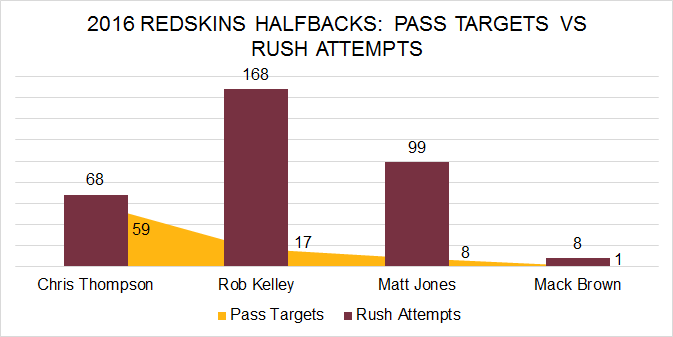 znModerator
JAMON BROWN VYING FOR STARTING ROLE AT RIGHT TACKLE WITH THE RAMS
Brown has played exclusively at guard with the Rams since being drafted, however has shifted to tackle during OTAs.
The Los Angeles Rams had T Jamon Brown working with the first team at right tackle during organized team activities while T Greg Robinson worked with the second. Brown has played only guard since being drafted.
In 2014, PFF’s first season tracking college football, Brown graded out as the 25th overall tackle out of 297 qualified tackles while at Louisville, splitting time on both the left and right side.
His run blocking grade ranked 17th in the nation while his pass blocking ranked 64th.
Of the 20 total QB pressures that Brown gave up that, eight came when at the right tackle position.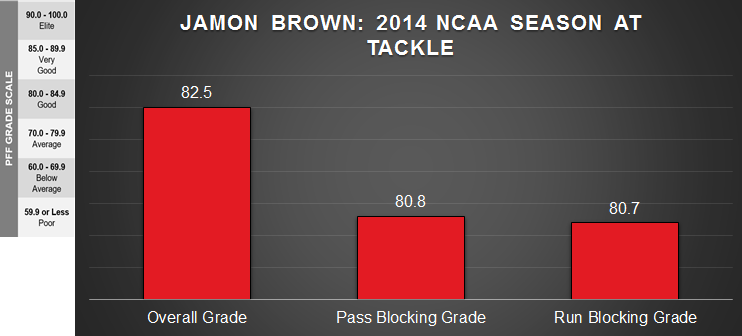 znModerator
RAMS DT MICHAEL BROCKERS’ GRADE ON THE RISE FOR THIRD STRAIGHT SEASON
After a career-low grade in 2013, Brockers has risen his overall PFF grade each of the past three seasons.
In 2016, Los Angeles Rams DT Michael Brockers was one-of-six interior defenders who played more than 400 snaps and did not miss a tackle.
Brockers’ 2016 run defense grade of 79.5 was 19th best among 117 interior defenders.
He also earned a 71.9 pass rush grade, which was ranked 35th out of 118 interior defenders.
Both of Brockers’ two highest graded seasons have come during years in which he logged the two lowest total snaps so far during his career.
After a career-low grade in 2013, he has risen his overall PFF grade each of the past three seasons.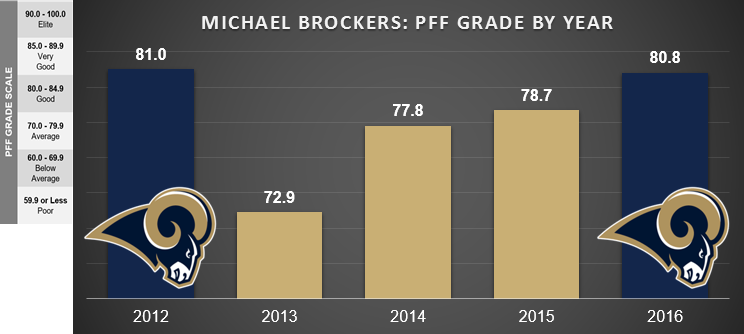 znModerator
Gramsci is always good stuff.
.
June 6, 2017 at 10:11 am in reply to: 2017 NFL Draft Wrap-Up Series: Los Angeles Rams (Breakdown of Each Player Select #69750znModeratorI always liked him.
.
June 6, 2017 at 9:51 am in reply to: Goff's ninth game? articles on Goff in OTAs & mini-camp & up to training camp #69749znModeratorJared Goff shows he’s growing into role of Rams quarterback
By Alden Gonzalez
THOUSAND OAKS, Calif. — Jared Goff stepped up in the pocket and fired a bullet, roughly 30 yards down the field, right into the hands of Robert Woods on a post route. Earlier, he hit Nelson Spruce for a long touchdown. And leading up to that impressive throw to Woods, he made crisp, accurate passes to Tyler Higbee and Cooper Kupp as part of a two-minute drill.
It’s only organized team activities, which means players are not in pads and live contact is not permitted, but Goff looked good on Monday.
Rams rookie coach Sean McVay is nonetheless reserving judgement.
“Until you’re actually live as a quarterback, that’s when you truly get challenged,” McVay said. “You’re having to move with the rush, avoid guys that can really tackle you. That’s always the best evaluator. I think he has done a nice job improving every single day, and that’s what’s going to give us a chance.”
Goff, with a 22.2 Total QBR in his brief NFL career, began his offseason by receiving instruction from noted quarterback guru Tom House. And ever since the official offseason program began, the 22-year-old has immersed himself in McVay’s offense, spending almost every possible waking minute at the Rams’ facility. McVay said he has been “very pleased” with what Goff has done “above the neck.”
His teammates have noticed more confidence, more conviction.
“You can tell, especially just starting with the command of the offense, him being able to take that and control the huddle and get guys lined up, and keep that poise when things aren’t going well and when things are going well,” said Higbee, Goff’s roommate throughout training camp last year. “He looks good.”
“More confident, more relaxed, more poised in the pocket” is how second-year receiver Mike Thomas compared this year’s Goff to last year’s Goff. “Letting the game come to him and taking his time, being patient on the field.”
Goff is benefiting from having an entire NFL season under his belt and knowing from the start that he will be the starting quarterback — but he must perform in order to keep his job.
McVay wasn’t around when the Rams moved up 14 spots to draft Goff No. 1 overall last spring, and thus has no real loyalty to Goff, who struggled mightily over the course of seven rookie starts, all of them losses. If Goff doesn’t show signs that he is making significant strides toward at least becoming a reliable starting quarterback for the foreseeable future, McVay probably won’t have a hard time turning to his backup, Sean Mannion, a third-round pick in 2015 who hasn’t seen much playing time yet.
McVay often has said he and his staff will “constantly evaluate guys.”
Starting fresh allows him to keep an open mind at every position, including quarterback.
“Jared is our guy; we have a lot of confidence in what he’s done,” McVay stressed after Monday’s practice. “But we have confidence in Sean as well. … We’re going to play the guys that give us the ability to win football games and the guys that are competing at the highest level. Clearly, Jared has done that so far. It’s a one-day-at-a-time process, but what he has done is just pick things up. He’s getting better every single day, and he has definitely commanded that role. He did that again today.”
znModeratorRams Head Coach Sean McVay – – June 5, 2017
(On CB Trumaine Johnson returning to practice)
“Yeah, Trumaine’s back. We talked with him last week after that first absence – had some things going on. He clearly communicated that to us and it was good to get him back in the building today and working on the field with the guys.”(On the quarterback competition and what was made of it nationally following last week’s comments)
“We talk about we’re going to constantly evaluate guys. (QB) Jared (Goff) is our guy. We have a lot of confidence in what he’s done. But, we have confidence in (QB) Sean (Mannion) as well. It was certainly just what we preach to our team about – we’re going to play the guys that give us the ability to win football games and the guys that are competing at the highest level. Clearly, Jared has done that so far. It’s a one day at a time process, but what he has done is just picking things up. He’s getting better every single day and he’s definitely commanded that role. He did that again today. I think you guys saw how well he performed in a lot of the different situations. It’s encouraging and that’s why we can’t wait to go back and look at this tape.”(On how Goff has done compared to McVay’s expectations coming into OTAs)
“It’s hard until you actually work with a guy. You evaluate the traits and the characteristics, but I think what he’s done above the neck in terms of the way that he’s handled the different things and situations that we’ve put him in, been very pleased so far. We know that game-like atmosphere, you try to create that so that you can mimic and emulate those situations in practice. But, until you’re actually live as a quarterback, that’s when you truly get challenged. You’re having to move with the rush, avoid guys that can really tackle you. That’s always the best evaluator. I think he has done a nice job improving every single day and that’s what’s going to give us a chance.”(On OL Greg Robinson’s absence)
“Greg communicated he had something going on. We knew that he was not going to be here today. He let us know and we knew that he was not going to be here. He did a nice job of letting us know about that.”(On if Robinson will return this week)
“Yeah, he’ll be back later this week. He had some things he had to take care of and he let us know awhile in advance about that.”(On the competition level of both the offense and defense at practice)
“It’s been great. I think the guys have done a nice job of responding. Practicing smart, but also, we’re getting great competitive situations. Anytime that there’s a winner and there’s a loser in these situations the guys get amped up about it. It’s been a nice balance. Today was one of those situations where we let (Special Teams Coordinator John Fassel) ‘Bones’ make some of those decisions, so I don’t have a bias towards the offense. He said it wasn’t a fumble, we kept it rolling and then (WR) Robert (Woods) did a nice job of making a play down the sideline, Jared did a good job finding him.”(On an update to Johnson’s absence)
“Yeah, he just had some things going on that he had to take care of. But, he let us know about that after that absence on Monday. We appreciate him communicating that to us and we knew he was going to be back ready to roll today.”(On WR Tavon Austin and how he fits in the wide receiver competition)
“I think it is very competitive. I think you’ve seen some guys that have been here do a nice job adjusting to some of the new verbiage, the new system that we’re putting in place. You bring in a free-agent acquisition like Robert Woods, he’s been exactly what we had hoped. And then these rookies are doing a nice job stepping up. I think Cooper Kupp’s done some really good things being consistent day-in and day-out. You’re seeing improvement from Josh Reynolds. I think with what he can control in the framework of his injury, Tavon is doing really a nice job. He’s active on the sidelines, you see that he’s continuing to try to just perfect his craft with being able to run routes, work on his hand-eye coordination while he can’t fully utilize that wrist. He’s been engaged in meetings. We wish he had him available right now, but I think he’s doing a nice job being able to control what he can and he’s getting better within the framework of that.”(On what Woods is doing to enhance the competition within the receivers’ room)
“Anytime that you have guys that have had success in this league, they come in and they kind of set the standards with the way that they practice, the way that they prepare, the way they approach every single day as a pro. I think he’s done a really nice job. Then you see it translate where he’s making plays out here consistently, moving around the formations. He’s doing what we had hoped. And I think he’s doing a nice job setting the example for the younger guys around him in that room to show what it looks like.”(On WR Nelson Spruce and what he’s capable of doing)
“You see a natural football player. He’s got a good feel for the game. I think he’s got good aggressive hands. He was a little bit limited earlier this offseason with some things where we were just being careful with him. Now that he’s been back and he’s moving around, you can see why he was able to make the plays that he did last year. It’s good to see Nelson (Spruce) out here.”(On his impressions of OL Jamon Brown at the right tackle position)
“I think he’s done a good job. I he’s think an aggressive, physical player. He’s got good athleticism for the position. So, I think his ability to be able to compete in the run and the pass game. Just continuing to get comfortable playing outside. Played inside mostly last year, but he does have some experience playing at that right tackle position where he really played right and left (tackle) at Louisville. He’s a guy that’s really taken in to consideration all of the little things that (Offensive Line) Coach (Aaron) Kromer’s talking about with the technique and you’re seeing it translate and we’ve been pleased with Jamon so far.”(On Brown remaining at right tackle heading into training camp)
“Yeah, I think so. I think he’s done a nice job and we’re continuing to try to find what the best five guys and what that combination will be. He certainly has put himself in the mix and he’s playing at a very high level right now and we’ve been pleased with what we’ve seen from him.”(On his impressions of WR Michael Thomas)
“What you like about Mike (Thomas) is he’s a competitive player. He’s got some speed. You’ve got the ability to push the ball down the field with him. I think he’s getting more and more confident with his hands and just becoming a more polished player – with just his routes and increasing that route versatility. What we’ve seen from Mike so far has been encouraging and he’s made plays down the field. You can feel him, he’s got some speed that gives you the ability to stretch the top-shelf of the defense and that’s what he’s done so far.”(On the potential for growth for a player like Thomas from year one to year two as a wide receiver)
“I think a lot of it is predicated on the experience that you gain and what you’re able to get out of these practices and things like that. Not to mention some of the things that you can do on your own when we’re away from these players before training camp. I can’t speak to last year, but I know in the short amount of time having been around Mike, he’s taking everything that (Wide Receivers) Coach (Eric) Yarber and (Assistant Wide Receivers) Coach (Zac) Taylor are preaching with him and then you see it translate from the meeting room on the field. What we’ve seen from Mike has been good stuff and you really like his demeanor and his disposition. He’s been a joy to be around so far.”(On how it’s been dealing with player absences as a head coach versus a coordinator)
“I think the biggest thing is that you just want to make sure that there’s clear and open communication. Those guys that have missed, sometimes it’s been exactly what we wanted, sometimes it hasn’t. I think we just keep communicating with the player our expectations, our standards. For the most part, all of these guys have really done a great job with that. As a coach, you’re always going to want the guys here, but you also understand the framework of the way that some of this stuff is setup in the offseason program. I think the guys have really done a good job of kind of understanding, ‘If I’m not here because of some other things that do come up, let’s let it be known.’ We’re flexible with these guys as well. I think each situation kind of dictates a different response. All things being equal, you’d love to say, ‘Let’s get everybody here so that you can get all of the work that you want and guys aren’t missing out on information that’s given.”(On OLB Connor Barwin’s absence from OTAs)
“(OLB Connor) Barwin has been excellent. I think he’s very similar to kind of what we were saying about Robert Woods and (T) Andrew Whitworth and (C) John Sullivan – a pro’s pro. Had a lot of experience in this league, ultra-conscientious with the way that he takes care of his body. He got married this offseason. He’s got some things going on where we knew that he had communicated that he was going to take care of something just to make sure that he’s ready to roll for training camp and be at his optimal shape. Nothing’s wrong with him, he’s in good shape. It’s just all being really smart and taking care of himself. We knew that was going to be the situation where he wasn’t going to be here today.”(On his confidence level that he will have full participation in next week’s minicamp)
“I think you always hope for it. Certainly, I think each day you’re kind of ready to take on new challenges and things come up. But, that’s our hope, that’s our expectation and I guess we’ll find out next week.”znModerator“…Only 10% of people were aware that more than 90% of climate scientists are convinced that global warming is human-caused. The vast majority of people that answered the survey did not think the climate crisis would directly affect them or their families…”
 znModerator
The Intercept Discloses Top-Secret NSA Document on Russia Hacking Aimed at US Voting System
The report details an operation targeting voter registration in 2016.http://www.motherjones.com/politics/2017/06/intercept-nsa-document-russia-hack
On Monday, the Intercept published a classified internal NSA document noting that Russian military intelligence mounted an operation to hack at least one US voting software supplier—which provided software related to voter registration files—in the months prior to last year’s presidential contest. It has previously been reported that Russia attempted to hack into voter registration systems, but this NSA document provides details of how one such operation occurred.
According to the Intercept:
The top-secret National Security Agency document, which was provided anonymously to The Intercept and independently authenticated, analyzes intelligence very recently acquired by the agency about a months-long Russian intelligence cyber effort against elements of the US election and voting infrastructure. The report, dated May 5, 2017, is the most detailed US government account of Russian interference in the election that has yet come to light.
While the document provides a rare window into the NSA’s understanding of the mechanics of Russian hacking, it does not show the underlying “raw” intelligence on which the analysis is based. A US intelligence officer who declined to be identified cautioned against drawing too big a conclusion from the document because a single analysis is not necessarily definitive.
The report indicates that Russian hacking may have penetrated further into US voting systems than was previously understood. It states unequivocally in its summary statement that it was Russian military intelligence, specifically the Russian General Staff Main Intelligence Directorate, or GRU, that conducted the cyber attacks described in the document:
Russian General Staff Main Intelligence Directorate actors … executed cyber espionage operations against a named U.S. company in August 2016, evidently to obtain information on elections-related software and hardware solutions. … The actors likely used data obtained from that operation to … launch a voter registration-themed spear-phishing campaign targeting U.S. local government organizations.
Go read the whole thing. https://theintercept.com/2017/06/05/top-secret-nsa-report-details-russian-hacking-effort-days-before-2016-election/
znModeratorRams coach Sean McVay still waiting on full attendance at OTAs
Alden Gonzalez
THOUSAND OAKS, Calif. — Trumaine Johnson, the Los Angeles Rams’ franchise cornerback, returned to practice Monday after missing organized team activities last week. But defensive tackle Aaron Donald remained absent, while hoping for a restructured contract. And right tackle Greg Robinson, who was taking second-team snaps at right tackle last week, was also not present, though Rams coach Sean McVay said Robinson’s absence was excused and he’s expected back later this week.
OTAs are voluntary, and only Donald’s absence seems to have a real motivation behind it.
But the Rams have an entirely new coaching staff implementing an entirely new system on both sides of the ball, so it is no small thing when key players miss what few practices are scheduled. The three-day, mandatory minicamp takes place next week, running from Tuesday to Thursday, and McVay is hoping everybody is accounted for.
“You always hope for it,” McVay said. “Each day, you’re kind of ready to take on new challenges and things come up. That’s our hope, that’s our expectation, and I guess we’ll find out next week.”
Johnson will play the 2017 season under a $16.74 million franchise tag unless he and the Rams agree to an extension by July 15. The Rams, though, have stated that they want to first see if Johnson can be a fit under new defensive coordinator Wade Phillips’ system. Johnson doesn’t believe that will be an issue.
“I can play man, I can play off, I can play zone, I can play waterboy,” he said. “I can play anything y’all want to play, man.”
His absence, however, was “not at all” contract related.
“I had a personal situation I needed to handle,” Johnson said. “That’s about it.”
Johnson missed the second week. Robinson was joined by outside linebacker Connor Barwin and outside corner E.J. Gaines in missing the start of the third week. Donald, by far the game’s best interior pass-rusher, has missed OTAs in their entirety. And it is no certainty that he will show up next week, though Donald would face about a $75,000 fine for missing the three-day minicamp.
“Real tough,” Johnson said of being without Donald. “There’s a business side of football too, but we’d love to have him back.”
McVay’s hope during this voluntary period is simply that “there is clear and open communication.” Johnson failed to communicate the first time he was absent on Tuesday, but said he reached out to McVay and his teammates the following day.
“As a coach, you’re always going to want the guys here,” McVay said. “But you also understand the framework of the way this stuff is set up in the offseason program.”
znModeratorThere is a genuine debate here. I take the admonishment to be more constructive about it seriously. Given that here are some ideas I happen to share, from the articles I posted.
Russia fears the total collapse of the Syrian state, which would end a decades-old alliance and threaten its strategic position in the Middle East. And it views Islamic insurgents as not only a threat to Assad, but also a potential threat at home.
The Kremlin’s involvement in Ukraine and Syria seems to be motivated partly by its aversion to democratic regimes, in particular the so-called color revolutions that have sprung up in the Middle East and in Georgia and Ukraine. The Arab Spring came only half-heartedly to Syria, with the democratic uprising soon overtaken by armed conflict. But this does not rule out, from the Kremlin’s point of view, the possibility of insurgent groups unfriendly to Russia eventually taking over the country. The breakup of Syria, or the replacement of the Assad regime by a government more aligned with the Sunni Arab world, would leave Russia without a client state in the Middle East.
We don’t have to choose between critiquing our own foreign policy and opposing unjust foreign governments. Sure, the west’s attitude towards Putin is hypocritical. When Putin prosecuted his savage war in Chechnya, there was none of the western outrage later meted out when the Russians annexed the Crimea. Bill Clinton once lavished Putin for having “enormous potential”; Tony Blair, meanwhile, continues to call for the west to work with Putin against Islamic fundamentalism and last year attended a Putin “vanity summit”.
But for the left, opposition to Putin should go without saying
We should express our solidarity with Russia’s embattled democrats and leftists. We don’t have to choose between critiquing our own foreign policy and opposing unjust foreign governments. In a sense, critics of western foreign policy have more of a responsibility to speak out. While supporters of, for example, the Iraq calamity can be more easily batted away by Putin apologists, nobody can accuse people like me of hypocritically failing to critique western foreign policy. Russia is ruled by a human rights abusing, expansionist, oligarchic regime. The Russian people – and their neighbours – deserve better. And the western left is surely duty-bound to speak out.
each state’s propaganda machine, with patriots believing their own country’s talking points and dissidents believing the other’s, obscuring what out to be the glaringly obvious fact that neither nation-state is motivated by any principle in domestic or global affairs more honorable than “what’s good for our oligarchs,” who even live in the same parts of Manhattan.
Of course one of the reasons for even the start of this conflict was that Russia was concerned about the expansion of NATO, which happened during the last decade. Also it was the question, you could say, of the “domestic” area of Russian imperialism, which is the post-Soviet space – the idea that the post-Soviet space, maybe including the Baltic states, should be space where nothing can be decided politically without the participation of Russia. So you can’t change the government without agreement from Russian society. That is something that led to the conflict with Georgia in 2008 and that is something that led to the conflict with Ukraine, because it’s just simply a question of the master or owner of this space, who is the main person who should be asked about everything.
Russia in its English-language media, such as Russia Today, portrays Russia’s actions as basically just a response to U.S. imperialism, as if Russia itself is not imperialist but rather an anti-imperialist power
Russian foreign policy is not a policy based on any kind of view of how the world should look. There’s no kind of our own “Pax Americana” or something like this. In this sense, Russia is not the Soviet Union because the Soviet Union had a kind of project for the world; a clear alternative to the values and ideas [of the West]. There is nothing like this in Russian foreign policy. … Russia as a realist, cynical world force, wants to discuss its place in the world: the size of their piece of the cake. That’s the explanation you always hear from Putin . . . that everyone has their interests in this world, everyone wants to benefit from everything, so we want to understand the rules of the game.
I mean, if the left are ready to support this kind of logic, even if this kind of logic in some ways confronts American imperialism, I probably don’t agree with this left in a very fundamental way. I think that one of the main mistakes of a very big part of the left for years was the idea that imperialism can only be American; that if you talk about imperialism, we mean the United States, because there are not any other imperialist powers. But if we look back at the Marxist definition of imperialism we will find that imperialism, it’s always a conflict. It’s a conflict between states, between capitalist interests, and it always leads to a kind of military confrontation with the blocs of interests, like it was in the first world war. . . . So you should simply recognize that yes, even if we have no justification for American imperialism, we should recognize that there are other imperialisms. And you can’t find among these imperialisms something that is more progressive or objectively progressive than the other.
For the American left, of course for them only American imperialism exists, yes? I can’t understand it. . . . In Russia, there are a lot of leftists who also believe that Russia is the main evil in the world, it’s a reactionary empire, and it should be destroyed. Or, at the same time, you have a lot of leftists who believe somehow Russia is resisting American imperialism [and] who support these “republics” in the East of Ukraine.
But you have a huge provincialization of the left as a whole because they can’t even understand each other and every leftist community, they believe in their own national reality. And that’s why they can be so easily manipulated. By whom? By Russia Today? I think it’s a very pitiable situation because the Russian propaganda machine, which is not the most clever, not so smart . . . it can so easily manipulate such a big sector of the Western left. It points to the problem of the Western left itself, but not the strength of Russia Today.
znModeratorPutin is a human rights abusing oligarch. The left must speak out
Owen Jones
For those of us who believe democracy and social justice are universal principles, it’s clear why we should express our solidarity with Russia’s embattled leftists
A rightwing authoritarian leader who attacks civil liberties, stigmatises lesbian, gay, bisexual and transgender people, indulges in chauvinistic nationalism, is in bed with rapacious oligarchs, and who is admired by the European and American hard right. Leftwing opposition to Vladimir Putin should be, well, kind of an obvious starting point. Now BBC One’s Panorama has broadcast allegations that the Russian leader has secretly amassed a vast fortune. However accurate, there is no question that Putin is close to oligarchs such as Roman Abramovich, who profited as post-Soviet Russia collapsed into economic chaos thanks to western-backed “shock therapy”.
After Litvinenko, more sanctions against Russia would be pointless – and hypocritical
Simon Jenkins
Read more
Last week, a British public inquiry concluded that ex-Russian spy Alexander Litvinenko was likely to have been murdered at the personal behest of Putin. We don’t know exactly who is behind all the murky killings of journalists in Russia, but we know that some of those critical of the government – like Anna Politkovskaya, who courageously opposed Putin’s war in Chechnya – met violent ends.Putin has become something of an icon for a certain type of western rightwinger. Donald Trump is a fan: when Putin called the rightwing demagogue a “very colourful, talented person”, Trump called it a “great honour” and described Russia’s strongman as “a man highly respected within his own country and beyond”. When challenged on the alleged role of Moscow in the murder of journalists, Trump engaged in what is typically known as “whataboutery” (or the “look over there!” approach to debate), responding: “Our country does plenty of killing also.” Last year, a delegation of French rightwing MPs visited Russia to fight “disinformation from western media”, and Marine Le Pen, leader of the far-right National Front which was given a multimillion-euro loan from a Russian bank – is a Putin fan. Our own Nigel Farage assailed opposition to Russia’s invasion of Ukraine, suggesting Putin was “on our side” in the war against terrorism, while Ukip MEP Diane James celebrated him as a strong leader and for being “very nationalist”.
We don’t have to choose between critiquing our own foreign policy and opposing unjust foreign governments
Sure, the west’s attitude towards Putin is hypocritical. When Putin prosecuted his savage war in Chechnya, there was none of the western outrage later meted out when the Russians annexed the Crimea. Bill Clinton once lavished Putin for having “enormous potential”; Tony Blair, meanwhile, continues to call for the west to work with Putin against Islamic fundamentalism and last year attended a Putin “vanity summit”.Sign up for the Guardian Opinion email
Read more
But for the left, opposition to Putin should go without saying. Those who claim the left as a whole is soft on Putin are disingenuous at best: as, indeed, this article illustrates. But why are some silent, or even indulgent? Firstly, some profess a fear that – by critiquing those who are already supposedly bete noires of the west – the left will provide cover for western military expansionism. We become cheerleaders for western foreign policy, in other words, feeding the demonisation of foreign foes that is a necessary precondition for conflict. Secondly, it is seen as hypocritical: look at, say, the calamities of Iraq or Libya. Should we not focus on what our governments get up to, rather than what foreigners get up to elsewhere, which is in any case well covered by the mainstream press and political elite?Yes, there is something rather absurd about the baiting of the anti-war left for not protesting against, say, Putin or North Korea. The baiters are always free to organise their own demonstration (I would be happy to join), and protest movements can only realistically aspire to put pressure on governments at home, whether it be on domestic policies or alliances with human rights abusers abroad (whether that be, say, the head-chopping Saudi exporters of extremism, or Israel’s occupation of Palestine). In democracies, protests that echo the official line of governments are rare. If the west was actively cheering Putin on and arming him to the teeth, we might expect more vociferous opposition.
But for universalists – those of us who believe democracy, freedom, human rights and social justice are universal principles that all humans should enjoy, irrespective of who or where they are – that shouldn’t be good enough. We shouldn’t have to wait for a possible western-Russian alliance in, say, Syria to speak out. We should express our solidarity with Russia’s embattled democrats and leftists. We don’t have to choose between critiquing our own foreign policy and opposing unjust foreign governments. In a sense, critics of western foreign policy have more of a responsibility to speak out. While supporters of, for example, the Iraq calamity can be more easily batted away by Putin apologists, nobody can accuse people like me of hypocritically failing to critique western foreign policy. Russia is ruled by a human rights abusing, expansionist, oligarchic regime. The Russian people – and their neighbours – deserve better. And the western left is surely duty-bound to speak out.
===
“We should recognize that there are other imperialisms”: A Marxist dissident explains what the left gets wrong about Russia
CHARLES DAVIS
Charles Davis is a writer and producer in Los Angeles whose work has been published by outlets including Al Jazeera
Russia today is not as depicted on Russia Today, the English-language news network established by the Russian government in 2005 that paints a capitalist state led by a right-wing nationalist in pseudo-left colors: the anti-America, almost, where the poor are always fed – not just shot dead by racist police – and foreign policy is motivated not by cynical self-interest, but a dogged, one might even say principled determination to stand athwart U.S. imperialism and yell “stop!” The critiques the network airs of poverty in the United States and Washington’s bloody wars abroad are an amusing, completely fair rejoinder to the State Department’s habit of pointing out the human rights hypocrisy of everyone else, but the implication that things are any better in Moscow is no less amusing to leftists in Russia who are aware an Occupy Red Square, like Occupy Wall Street, would be crushed with all the skull-cracking efficiency a state can muster.
Russia is also not the Russia we read about in the West’s corporate tabloids, its long-time leader, Vladimir Putin, cast as an irrational psychopath bent on eliminating all who oppose him, at home and in Eastern Europe and maybe even the United States too if he wakes up cranky. The truth, as is so rarely the case, lies somewhere in the middle: The truth is Russia is a nation-state and an imperial power that may not be any better than the United States, but also isn’t really any worse. When it comes to being terrible, the competition is actually pretty close: The only country that sells more arms to repressive regimes than Russia is the United States of America, though the former has actually been stealing some market share by capitalizing on the instability caused by the latter (they also frequently arm the same people). When it comes to imprisoning the highest percentage of its own population, the USA is still number one, but Russia is again number two.
The United States plays up its devotion to “liberty,” appealing to Russian liberals whose Skype conversations with Western NGOs are recorded by the NSA, while Russia appeals to Western leftists (and Eastern Ukrainians) by capitalizing on nostalgia for the Soviet Union and the idea, more propagandistic than realistic, that state capitalism is markedly superior to the liberal variety. Too often, however, this is what defines the debate: each state’s propaganda machine, with patriots believing their own country’s talking points and dissidents believing the other’s, obscuring what out to be the glaringly obvious fact that neither nation-state is motivated by any principle in domestic or global affairs more honorable than “what’s good for our oligarchs,” who even live in the same parts of Manhattan.
If there is to be a new Cold War, the left should reject the temptation of reducing evil in the world to the actions of one’s own government and recognize that imperialism, like capitalism, is a global phenomenon for which one can blame more than one villain. Are there differences between the powers? Sure, just as there are differences between Republicans and Democrats – and they are significantly less profound than the partisans of either faction would have us believe, having more to do with who has power than what one does with it. Russia sending billions of dollars worth of weapons to the Assad regime in Syria, for instance, is no less evil, nor fundamentally different, than the United States arming the brutal regimes of Bahrain and Saudi Arabia. We on the left can explain why imperialists do what they do and how it’s not irrational but makes total sense according to the logic of capitalist nation-sates, but we shouldn’t confuse an explanation with justification or accept that logic as our own. We should focus on the crimes of the empire we know best, perhaps, but we shouldn’t just dismiss the crimes of others or else we’ll find we lost our moral credibility and swapped mindless patriotism for useful idiocy. The left is at its best when it doesn’t allow skepticism and solidarity to stop at a national border – and just applying a cookie-cutter analysis to events abroad, it actually communicates with its comrades in other countries.
Ilya Budraitskis is an activist, writer and student at the Russian Academy of Science in Moscow who edits the socialist website, OpenLeft.ru, and serves as a spokesperson for the Russian Socialist Movement, which he described to me as a “Marxist, anti-establishment organization.” Founded in 2011, when Russia saw massive street protests over allegations of vote-rigging by the government – the largest demonstrations since the collapse of the Soviet Union – the group is deeply critical of both Putin and his liberal opposition, demanding the nationalization of major industry and worker control over the workplace while warning that anyone expecting serious change to come from establishment politicians through a corrupt electoral process is going to be sorely disappointed. “Now the streets must become the arena of political struggle,” the group said in a 2011 appeal, arguing that if the left wants to change Russia it must not sit back in the name of unity or pragmatism and cede the political arena to “the rich bastards who have commissioned the hideous farce known as Russian politics!”
I spoke with Ilya about the opposition to Putin – who’s leading it, as well as who’s going to these demonstrations and why – the effect the conflict in Ukraine has had on Russia’s political culture, who killed Boris Nemstov, and whether Russian imperialism is a necessary evil in a world that could use a check on the ambitions of the American empire.
Obviously the biggest story in Russia and here in the United State is the recent assassination of Boris Nemstov. Here in the West, Russia right now is portrayed as sort of a police state – people are afraid to express dissent. Is there any truth to that? Can you describe what the climate is like in the wake of this assassination? Is there fear among the opposition or is that overstated in the corporate media?
I will say that the fear in the opposition came much earlier. It came after we faced repression after the rise of the protest movement in 2011-2012. Maybe you hear about this 6th of May affair – it was a huge police provocation at the anti-Putin demonstration in 2012, just the day before his inauguration as president. So you can say this atmosphere of fear and the atmosphere of repression towards the opposition they were growing during these years. Of course, last year was very difficult and very crucial in this sense because it was the year when the war with Ukraine was started and the confrontation that had existed before in this society became much more harder.
You can say that from the beginning of last year the main fear in the internal politics for power, for the government, became the shadow of Maidan [Square, the Kiev center where protesters helped topple the Russian-backed Ukrainian government]; that something that happened in Ukraine could also be possible in Russia. So even if there is no real reasons exactly for the moment to have something… in Russia this shadow of Maidan became a paranoid idea for the government and also it became a very good instrument for criminalization of any kind of protest. So even now if you have some local protest or some strike or some kind of action which is not exactly political – it can be immediately identified as a kind of Maidan attempt.
So there is an atmosphere of paranoia which is very much distributed and of course which is very much in the interest of not only the president, but every local power on any level. So during all this era, from the beginning of the Ukrainian conflict, [we have been subjected to] extreme media propaganda. This propaganda was very much focused on the idea of the internal enemy: that we have this “fifth column.” And even the term, fifth column, came from a Vladimir Putin speech a year ago, a very famous speech, when he announced the annexation of Crimea, and he also [claimed] that we have a group of national traitors inside the country and we have a fifth column. So if you look at Boris Nemstov, he was one of the figures who were presented as this fifth column during the last year mostly. So you can see the logic that stands behind this murder.
I do not totally agree with people who blame Putin for this murder. I’m not sure he has an interest in it. I will say that he probably has no interest in this kind of murder. When it happened it was clear that the media or government, they were very much confused.
So you don’t think Putin would have ordered this himself because, obviously, this politician wasn’t really a threat to his power. But would you agree with the argument that this atmosphere, this talk of “fifth columns” and “traitors,” contributed to this murder? Or is this too much speculation at this point?
It was not in the clear interest of Putin because the picture of Russian life and Russian politics that he wants to create and his media wants to create is a picture of national unity and stability. And his fight against a possible Russian Maidan is a fight in the name of stability. When you have this kind of murder very openly, just a few hundred meters from the Kremlin, it totally contradicts the idea of stability. It’s a break with stability. And this break comes not from the opposition, but it seems like from their opposite – from people who call themselves ‘specialists.’ It’s quite clear that those who tried to destabilize the internal situation, they’re not part of the opposition, but they’re like enemies of the opposition. And that completely destroys this propaganda [that it’s the opposition destabilizing the country].
Second thing, of course it’s an open challenge to the Russian police and security service, because it clearly shows that they don’t control the situation; they even don’t control the most central, important part of the city and they’re also probably not interested in this kind of events for even the bureaucratic reaction [i.e., taking the blame for letting it happen].
The third thing is that all these . . . these organizers of the anti-Maidan movement [in Russia], all these ‘patriotic groups’ around the government, who are probably feted by the government, they are now very much discredited because what kind of reaction [their rhetoric] now should produce.
All the levels of this official Putin political machine, you have problems with this murder. To say that he wants to frighten opposition, well it’s real effect was the opposite: Because the demonstration which [followed], my impression was that it was one of the most massive demonstrations that you have in the last year and it was clear that this murder touched a lot of people who before were not politically active. You had a lot of very new people at this demonstration.
What kind of people are showing up to these demonstrations? And how would you describe the opposition in Russia? Is it mostly neoliberals like Nemstov or is it more diverse than that?
I can’t say that it’s just middle class because you have a lot of middle class who are totally loyal and you have a lot of people who do not belong to belong to the middle class who are on the side of the opposition. But it’s mostly cultural, educational markers – you can say that it’s some people who connect with the Soviet intelligentsia tradition. Maybe some of them are teachers or professors, some of them are small businessmen, but they have the same background, the same more or less level of education, and the same tradition of disagreement. And disagreement, more ethical than political disagreement. So these people, of course they’re very politicized, but at the same time their level of political consciousness is [rather] primitive.
I mean that, for example, with the poor, they don’t analyze their exact social interest or they don’t connect their social interest with their political expression. So that’s why for them, people like Nemstov, who as you said was openly neoliberal, as are a lot of people in the top of this opposition, who – despite the very just critiques of Vladimir Putin’s politics in Ukraine or lack of freedom of speech – openly say that hospitals should be privatized, that we should be more aggressive in austerity in Russia, and should privatize the state property and things like this. Their position is somehow not so much discussed among their supporters, because for them it’s something secondary, something not in their core of their nature of support, because the most important thing with them is ethical support – they see these people as the good people, the educated people, the people who talk to them using their language, but not people who have some exact social and economic program which confronts their own interest.
Right, so they’re motivated more by issues like freedom of speech than free markets – that’s the position of the elites, but not what gets these people out to demonstrations.
Yes, you can say that.
What do they not like about the Putin government? Is it a sense that there’s a crackdown on civil liberties? The state of the Russian economy, which makes people unhappy with the leader?
Right now the main issue for people is they feel [there are] so much lies from the government. They are so angry about the propaganda over what has happened in Ukraine. Because what you have now in Russian media, it’s unbelievable. It’s never ever happened, even in Soviet times, I mean this level of aggression and in a very crazy kind of style. If you even look at the Russian TV you understand that the third world war has already started and you are a soldier in this war. And what has happened in Ukraine is already a third world war war against, I don’t know, Barack Obama . . . on one side acting against Russia. And so I think that it’s mostly a reaction to these lies, but not a reaction to some real, economic or social problems that we now face in Russia. But those problems, they are really serious and they touch a much broader part of the population than this strata that are politically active and visit these kind of demonstrations.
The main question for this opposition is if they are satisfied with this ethical position and in fact isolation from the majority of the population . . . or if they want somehow to break with these constructions, and if they want to break they should also change their social agenda, radically change it, because right now you have an ongoing economic crisis in Russia, you have huge inflation, and you have the very clear answer of the government and this answer is extremely anti-social, it is extremely neoliberal. Putin’s answer is the increase of the pension age, a lack of indexation [increasing pension payments to match price increases] in a situation where inflation is going on – in reality, 15 percent or even more – and you have no opportunities for people who are losing their workplaces
They’re [the opposition] not able to attract a real big number of people from that part of society which is not already involved in the opposition. So I mean the situation is kind of a dead end. You have 50,000 or even more people in Moscow in commemoration of Boris Nemstov, this is the kind of force that is able to mobilize – this number of people again and again, but there is no chance to build a kind of more broad movement based on the interests of the majority.
Why do you think given Russia’s history there isn’t more of a class consciousness among the working class in Russia today?
Now you don’t have the same working class as you did in the Soviet Union because of the total destruction of Soviet industry . . . and Boris Nemstov was a part of that process. And what was the real price of it? It was the lumpenization of a big part of the working class on one side, and on the other side it was the feeling of hopelessness on [the part of] working class people that any kind of collective struggle can work effectively. And you have very, very tiny independent unions in Russia and these independent unions, they became even weaker from the start of the economic crisis. And also, of course . . . their [the working class] main fear is still instability . . . and that’s why they’re still ready to basically support the current government who [they believe can] somehow prevent the situation which happened in the 90s.
Alexander Dugin has written that the annexation of Crimea marks “Russia’s return to history.” Do you think that “return to history” and this idea of restoring Russia’s greatness on the world scene – that that’s what’s appealing to a lot of Russians? And that this current war climate is basically co-opting people who would otherwise be critics of Putin’s economic policies?
Yes, of course. These kind of ideas always work, everywhere. If you make a promise to people to bring them back to history, whatever it means, it always works as rhetoric. But I think, for most people, for them it’s unclear what is the real picture of the situation in Ukraine. The majority still believe there is a just struggle between . . . our brothers and a fascist Ukrainian army.
You say a lot of people buy into the Russian government’s propaganda on Ukraine. Here in the United States some parts of the left seem to have bought into this too. They think Maidan was basically a Nazi coup backed by Europe and the United States and they kind of ridicule the idea that Russia has inflamed the conflict by supporting the separatists in the East. Can you comment on that?
Of course, both the pictures of what is happening there are very simplified. So firstly, it’s not true that it was a fascist coup in Ukraine because a “coup” is an action of a small, organized, armed group of people. [In Ukraine] the “coup” . . . had the clear support of hundreds of thousands of people. Even if you don’t like it you should recognize that it was a real huge movement with the big support of the population of Ukraine. I have no sympathy with the Ukrainian government that you have now, but for me it’s quite clear it can’t be reduced just to a Western plot. There were some deep social contradictions in Ukrainian society that led to this moment.
Of course, in any situation like this you have the interests: American interests, European interests, Russian interests, and so on. But these interests can work effectively only if you already have some problems within the country. And that is true also for Crimea and the East of Ukraine; you also can’t say that it’s just the result of Russian military intervention. I knew very well even a few years ago what kind of feelings most people in Crimea had toward Russia. So for me it was clear that a total majority of them want to be part of Russia. It was clear for everyone 10 years ago, even 15 years ago, that you have some serious cultural split in Ukraine between the West and East.
And of course what happened after Maidan with this language law from the new government, it was a kind of provocation. But at the same time you can’t imagine that this kind of terrible military confrontation that you have in Eastern Ukraine was possible without Russian participation. For those on the American Left who believe that there is some “anti-fascist” partisans operating in the East of Ukraine, I really recommend reading some books about other guerrilla movements, like Che Guevara or whatever they like. It’s the first [anti-fascist] partisan movement in the history, in Eastern Ukraine, which has more arms and more modern arms than the army who they confront.
Is it a common belief in Russia that these arms are coming from the Russian state?
There is a lot of evidence . . . . that there are thousands of soldiers or weapons and so on sent to the East Ukraine. I think that the reason why it’s still not recognized officially by the West, it’s not because the West has no evidence, but because the West is trying to find a compromise. If they recognize it, if they say openly that Russia is in fact in a state of war in Ukraine, it means it will be much more difficult to somehow find a diplomatic solution. So I think that’s the only explanation.
What do you think motivates the separatists in Ukraine? Is it just the language issue and identifying as Russian or is there something else? “Luhansk People’s Republic” – “people’s republic” sounds to my ears as if there’s some socialist motivation. Is economics and socialism at all a part of this or is it all identity?
These slogans are not just socialist, but mostly Soviet slogans, which refer to a kind of Soviet nostalgia – and they mix openly with Russian chauvinism. A lot of people are fighting not for the Soviet Union, but for Russian empire, and deny even the existence of Ukraine as a nation. And these people are at the top of the movement. They act like the ideologists of this movement, like Igor Strelkov, who was one of the first leaders of this kind of uprising in the East of Ukraine who was a Russian from Moscow who came there with clear identification, historical reference to the White Army during the Civil War, the White Army who fought against he Red Army and who fought against the Ukrainian nationalists for the Great Russia. So I mean if you look at many, many [news] sources of the separatists, you find a lot of Russian chauvinist propaganda, the ideas of Russian empire and so on, which is very much mixed with Stalinism – but Stalinism mostly understood as the idea of the great state, but not as a kind of socialist order of things.
They’re not motivated necessarily by a workers’ state, but the idea of a strong, powerful state that the rest of the world respects.
And which can confront the West. And also another very important idea is anti-Semitism. For this movement in the East Ukraine, the idea that Maidan was a Jewish plot and all this kind of thing, they are very distributed. You can find it in thousands of publications. I don’t want to say all people who participate in this movement are a bunch of anti-Semites, fascists and Stalinists, because on the side of Ukraine you also have open Nazis and anti-Semites as well as . . . just normal people who just want to save the independence of the country. And I also can understand their way of thinking, their feelings, and their fears – it’s understandable. In Ukraine, you really have a lot of people for whom the question of the existence of Ukraine is very important. And they really feel that there is a fear for the independence of the country itself; it’s not just the question of East Ukraine, but the right of the state to exist.
What do you think motivates the Russian government? Is Putin also interested in restoring this Russian empire? Because we also hear that Russia is afraid of NATO expansion and that NATO expansion is what is motivating it to take on a greater role in Ukraine. Is that just an excuse?
Of course one of the reasons for even the start of this conflict was that Russia was concerned about the expansion of NATO, which happened during the last decade. Also it was the question, you could say, of the “domestic” area of Russian imperialism, which is the post-Soviet space – the idea that the post-Soviet space, maybe including the Baltic states, should be space where nothing can be decided politically without the participation of Russia. So you can’t change the government without agreement from Russian society. That is something that led to the conflict with Georgia in 2008 and that is something that led to the conflict with Ukraine, because it’s just simply a question of the master or owner of this space, who is the main person who should be asked about everything. Of course after what happened in Ukraine, for Putin it was another clear evidence that Russia somehow was out of the decision-making process. And I think there was also a third reason . . . the internal situation. What kind of political example could Maidan give to Russian society?
As in Putin was fearful of the same thing happening in Russia?
Yes. What has happened in Ukraine, there was a foreign policy element in it, but it was also a big challenge for the internal policy.
Russia in its English-language media, such as Russia Today, portrays Russia’s actions as basically just a response to U.S. imperialism, as if Russia itself is not imperialist but rather an anti-imperialist power; supporting the Assad government in Syria, for instance. And that’s portrayed as a check on U.S. hegemony. Do you share that view? Do you think, whatever your view of Putin domestically, that overall Russia does serve as a necessary check on the U.S.’s agenda or does it serve as a negative influence in the world?
Russian foreign policy is not a policy based on any kind of view of how the world should look. There’s no kind of our own “Pax Americana” or something like this. In this sense, Russia is not the Soviet Union because the Soviet Union had a kind of project for the world; a clear alternative to the values and ideas [of the West]. There is nothing like this in Russian foreign policy. Russian foreign policy is a realistic policy. As Obama has pointed out a couple times, there are no ideological problems with Russia. . . . Russia as a realist, cynical world force, wants to discuss its place in the world: the size of their piece of the cake. That’s the explanation you always hear from Putin . . . that everyone has their interests in this world, everyone wants to benefit from everything, so we want to understand the rules of the game.
I mean, if the left are ready to support this kind of logic, even if this kind of logic in some ways confronts American imperialism, I probably don’t agree with this left in a very fundamental way. I think that one of the main mistakes of a very big part of the left for years was the idea that imperialism can only be American; that if you talk about imperialism, we mean the United States, because there are not any other imperialist powers. But if we look back at the Marxist definition of imperialism we will find that imperialism, it’s always a conflict. It’s a conflict between states, between capitalist interests, and it always leads to a kind of military confrontation with the blocs of interests, like it was in the first world war. . . . So you should simply recognize that yes, even if we have no justification for American imperialism, we should recognize that there are other imperialisms. And you can’t find among these imperialisms something that is more progressive or objectively progressive than the other. That should be a kind of rule, like in the conflicts you have in Ukraine: You have no good side; no progressive side. Of course, you have fascists on both sides. Of course, you have imperialist interests on both sides. And any kind of support of one or another side from the left simply strengthens one of the sides, but weakens the left.
I read your piece, “Intellectuals and ‘The New Cold War,’” and you talk of the appeal of this kind of black-and-white worldview – of the “imposed choice between two ‘camps,’ the West and Russia” – has to many intellectuals, not just in Russia but here in the United States. What do you think is the problem with that view and also what do you think is so attractive about it?
It’s attractive because it touches some structures of consciousness which were developed during the decades in the time of the Cold War, so it acts like a kind of reflex for many on the left to find some good, “progressive” side. And also of course it represents a lack of general picture of the world from the left. Even a hundred years ago one of the most important and strong points of the left was that they have the explanation of not just some basic laws of capitalism, but also the understanding of what is going on now in the world. They had a kind of complex picture of it. And now the left today they have no picture. They are very fragmented. They are very localized in their own countries, in their own situations. And it’s kind of a paradox because the world became more global and the left became more provincial.
For the American left, of course for them only American imperialism exists, yes? I can’t understand it. . . . In Russia, there are a lot of leftists who also believe that Russia is the main evil in the world, it’s a reactionary empire, and it should be destroyed. Or, at the same time, you have a lot of leftists who believe somehow Russia is resisting American imperialism [and] who support these “republics” in the East of Ukraine.
But you have a huge provincialization of the left as a whole because they can’t even understand each other and every leftist community, they believe in their own national reality. And that’s why they can be so easily manipulated. By whom? By Russia Today? I think it’s a very pitiable situation because the Russian propaganda machine, which is not the most clever, not so smart . . . it can so easily manipulate such a big sector of the Western left. It points to the problem of the Western left itself, but not the strength of Russia Today.
znModeratorTranscript–Farr/Simmons
Farr: One difference this year is that they’re settled, the move is over, they don’t have to adjust to that.
Likes the energy he sees. If you’re walking you’re wrong.
Smart play, on target passes, no drops.
Coaching changes brings energy.
You can see the base structure of the offense.
Who has impressed the most? Kupp. And, Whitworth. Also Everett. If Everett comes through he is a born match-up problem.
Likes Alexander at safety. By the end of the year he looked as good as any safety in the league. Likes Joyner at FS. Joyner is a defensive weapon. Can be special.
Could be that Spruce/Kupp is a great “get first downs” combo.
ROT? If they had their druthers it would be GR. He’s a monster. That’s the ideal ROT. Big, strong, fast. Have to get him going. Brown looks good if you can’t get GR going.
Quinn? If healthy he will be good at OLB. He rushes the passer whether his hand is in the dirt or he’s standing, but standing he can see more of the field and the offense, so could be that works even better than DE. When healthy and on the field he has a big impact.
You have to catch passes in this offense, even the RBs. Not just screens for the RBs, but routes.
Will Ebukam play this year? Phillips uses his depth and rotation guys. Don’t know really about him yet cause they have not seen anyone in pads. Will size make a difference? Is Ebukam undersized?
June 4, 2017 at 10:59 pm in reply to: at a pivotal point w/ our democracy & how we think, read, and make choices #69718znModeratorThe great British Brexit robbery: how our democracy was hijacked
A shadowy global operation involving big data, billionaire friends of Trump and the disparate forces of the Leave campaign influenced the result of the EU referendum. As Britain heads to the polls again, is our electoral process still fit for purpose?by Carole Cadwalladr
In June 2013, a young American postgraduate called Sophie was passing through London when she was called up by the boss of a firm where she’d previously interned. The company, SCL Elections, went on to be bought by Robert Mercer, a secretive hedge fund billionaire, renamed Cambridge Analytica, and achieved a certain notoriety as the data analytics firm that played a role in both Trump and Brexit campaigns. But all of this was still to come. London in 2013 was still basking in the afterglow of the Olympics. Britain had not yet Brexited. The world had not yet turned.
“That was before we became this dark, dystopian data company that gave the world Trump,” a former Cambridge Analytica employee who I’ll call Paul tells me. “It was back when we were still just a psychological warfare firm.”
Was that really what you called it, I ask him. Psychological warfare? “Totally. That’s what it is. Psyops. Psychological operations – the same methods the military use to effect mass sentiment change. It’s what they mean by winning ‘hearts and minds’. We were just doing it to win elections in the kind of developing countries that don’t have many rules.”
Why would anyone want to intern with a psychological warfare firm, I ask him. And he looks at me like I am mad. “It was like working for MI6. Only it’s MI6 for hire. It was very posh, very English, run by an old Etonian and you got to do some really cool things. Fly all over the world. You were working with the president of Kenya or Ghana or wherever. It’s not like election campaigns in the west. You got to do all sorts of crazy shit.”
On that day in January 2013, Sophie met up with SCL’s chief executive, Alexander Nix, and gave him the germ of an idea. “She said, ‘You really need to get into data.’ She really drummed it home to Alexander. And she mentioned to him a firm that belonged to someone she knew about through her father.”
Who’s her father?
“Eric Schmidt.”
Eric Schmidt – the chairman of Google?”
I had been speaking to former employees of Cambridge Analytica for months and heard dozens of hair-raising stories, but it was still a gobsmacking moment. To anyone concerned about surveillance, Palantir is practically now a trigger word. The data-mining firm has contracts with governments all over the world – including GCHQ and the NSA. It’s owned by Peter Thiel, the billionaire co-founder of PayPal and major investor in Facebook, who became Silicon Valley’s first vocal supporter of Trump.
In some ways, Eric Schmidt’s daughter showing up and referring to Palantir is just another weird detail in the weirdest story I have ever researched.
A weird but telling detail. Because it goes to the heart of why the story of Cambridge Analytica is one of the most profoundly unsettling of our time. Sophie Schmidt now works for another Silicon Valley megafirm: Uber. And what’s clear is that the power and dominance of the Silicon Valley – Google and Facebook and a small handful of others – are at the centre of the global tectonic shift we are currently witnessing.
It also reveals a critical and gaping hole in the political debate in Britain. Because what is happening in America and what is happening in Britain are entwined. Brexit and Trump are entwined. The Trump administration’s links to Russia and Britain are entwined. And Cambridge Analytica is one point of focus through which we can see all these relationships in play; it also reveals the elephant in the room as we hurtle into a general election: Britain tying its future to an America that is being remade – in a radical and alarming way – by Trump.
There are three strands to this story. How the foundations of an authoritarian surveillance state are being laid in the US. How British democracy was subverted through a covert, far-reaching plan of coordination enabled by a US billionaire. And how we are in the midst of a massive land grab for power by billionaires via our data. Data which is being silently amassed, harvested and stored. Whoever owns this data owns the future.
My entry point into this story began, as so many things do, with a late-night Google. Last December, I took an unsettling tumble into a wormhole of Google autocomplete suggestions that ended with “did the holocaust happen”. And an entire page of results that claimed it didn’t.
Google’s algorithm had been gamed by extremist sites and it was Jonathan Albright, a professor of communications at Elon University, North Carolina, who helped me get to grips with what I was seeing. He was the first person to map and uncover an entire “alt-right” news and information ecosystem and he was the one who first introduced me to Cambridge Analytica.
He called the company a central point in the right’s “propaganda machine”, a line I quoted in reference to its work for the Trump election campaign and the referendum Leave campaign. That led to the second article featuring Cambridge Analytica – as a central node in the alternative news and information network that I believed Robert Mercer and Steve Bannon, the key Trump aide who is now his chief strategist, were creating. I found evidence suggesting they were on a strategic mission to smash the mainstream media and replace it with one comprising alternative facts, fake history and rightwing propaganda.
Mercer is a brilliant computer scientist, a pioneer in early artificial intelligence, and the co-owner of one of the most successful hedge funds on the planet (with a gravity-defying 71.8% annual return). And, he is also, I discovered, good friends with Nigel Farage. Andy Wigmore, Leave.EU’s communications director, told me that it was Mercer who had directed his company, Cambridge Analytica, to “help” the Leave campaign.
The second article triggered two investigations, which are both continuing: one by the Information Commissioner’s Office into the possible illegal use of data. And a second by the Electoral Commission which is “focused on whether one or more donations – including services – accepted by Leave.EU was ‘impermissable’”.
What I then discovered is that Mercer’s role in the referendum went far beyond this. Far beyond the jurisdiction of any UK law. The key to understanding how a motivated and determined billionaire could bypass ourelectoral laws rests on AggregateIQ, an obscure web analytics company based in an office above a shop in Victoria, British Columbia.
It was with AggregateIQ that Vote Leave (the official Leave campaign) chose to spend £3.9m, more than half its official £7m campaign budget. As did three other affiliated Leave campaigns: BeLeave, Veterans for Britain and the Democratic Unionist party, spending a further £757,750. “Coordination” between campaigns is prohibited under UK electoral law, unless campaign expenditure is declared, jointly. It wasn’t. Vote Leave says the Electoral Commission “looked into this” and gave it “a clean bill of health”.
How did an obscure Canadian company come to play such a pivotal role in Brexit? It’s a question that Martin Moore, director of the centre for the study of communication, media and power at King’s College London has been asking too. “I went through all the Leave campaign invoices when the Electoral Commission uploaded them to its site in February. And I kept on discovering all these huge amounts going to a company that not only had I never heard of, but that there was practically nothing at all about on the internet. More money was spent with AggregateIQ than with any other company in any other campaign in the entire referendum. All I found, at that time, was a one-page website and that was it. It was an absolute mystery.”
Moore contributed to an LSE report published in April that concluded UK’s electoral laws were “weak and helpless” in the face of new forms of digital campaigning. Offshore companies, money poured into databases, unfettered third parties… the caps on spending had come off. The laws that had always underpinned Britain’s electoral laws were no longer fit for purpose. Laws, the report said, that needed “urgently reviewing by parliament”.
AggregateIQ holds the key to unravelling another complicated network of influence that Mercer has created. A source emailed me to say he had found that AggregateIQ’s address and telephone number corresponded to a company listed on Cambridge Analytica’s website as its overseas office: “SCL Canada”. A day later, that online reference vanished.
There had to be a connection between the two companies. Between the various Leave campaigns. Between the referendum and Mercer. It was too big a coincidence. But everyone – AggregateIQ, Cambridge Analytica, Leave.EU, Vote Leave – denied it. AggregateIQ had just been a short-term “contractor” to Cambridge Analytica. There was nothing to disprove this. We published the known facts. On 29 March, article 50 was triggered.
Then I meet Paul, the first of two sources formerly employed by Cambridge Analytica. He is in his late 20s and bears mental scars from his time there. “It’s almost like post-traumatic shock. It was so… messed up. It happened so fast. I just woke up one morning and found we’d turned into the Republican fascist party. I still can’t get my head around it.”
He laughed when I told him the frustrating mystery that was AggregateIQ. “Find Chris Wylie,” he said.
Who’s Chris Wylie?
“He’s the one who brought data and micro-targeting [individualised political messages] to Cambridge Analytica. And he’s from west Canada. It’s only because of him that AggregateIQ exist. They’re his friends. He’s the one who brought them in.”
There wasn’t just a relationship between Cambridge Analytica and AggregateIQ, Paul told me. They were intimately entwined, key nodes in Robert Mercer’s distributed empire. “The Canadians were our back office. They built our software for us. They held our database. If AggregateIQ is involved then Cambridge Analytica is involved. And if Cambridge Analytica is involved, then Robert Mercer and Steve Bannon are involved. You need to find Chris Wylie.”
I did find Chris Wylie. He refused to comment.
Key to understanding how data would transform the company is knowing where it came from. And it’s a letter from “Director of Defence Operations, SCL Group”, that helped me realise this. It’s from “Commander Steve Tatham, PhD, MPhil, Royal Navy (rtd)” complaining about my use in my Mercer article of the word “disinformation”.
I wrote back to him pointing out references in papers he’d written to “deception” and “propaganda”, which I said I understood to be “roughly synonymous with ‘disinformation’.” It’s only later that it strikes me how strange it is that I’m corresponding with a retired navy commander about military strategies that may have been used in British and US elections.
What’s been lost in the US coverage of this “data analytics” firm is the understanding of where the firm came from: deep within the military-industrial complex. A weird British corner of it populated, as the military establishment in Britain is, by old-school Tories. Geoffrey Pattie, a former parliamentary under-secretary of state for defence procurement and director of Marconi Defence Systems, used to be on the board, and Lord Marland, David Cameron’s pro-Brexit former trade envoy, a shareholder.
Steve Tatham was the head of psychological operations for British forces in Afghanistan. The Observer has seen letters endorsing him from the UK Ministry of Defence, the Foreign Office and Nato.
SCL/Cambridge Analytica was not some startup created by a couple of guys with a Mac PowerBook. It’s effectively part of the British defence establishment. And, now, too, the American defence establishment. An ex-commanding officer of the US Marine Corps operations centre, Chris Naler, has recently joined Iota Global, a partner of the SCL group.
This is not just a story about social psychology and data analytics. It has to be understood in terms of a military contractor using military strategies on a civilian population. Us. David Miller, a professor of sociology at Bath University and an authority in psyops and propaganda, says it is “an extraordinary scandal that this should be anywhere near a democracy. It should be clear to voters where information is coming from, and if it’s not transparent or open where it’s coming from, it raises the question of whether we are actually living in a democracy or not.”
Paul and David, another ex-Cambridge Analytica employee, were working at the firm when it introduced mass data-harvesting to its psychological warfare techniques. “It brought psychology, propaganda and technology together in this powerful new way,” David tells me.
And it was Facebook that made it possible. It was from Facebook that Cambridge Analytica obtained its vast dataset in the first place. Earlier, psychologists at Cambridge University harvested Facebook data (legally) for research purposes and published pioneering peer-reviewed work about determining personality traits, political partisanship, sexuality and much more from people’s Facebook “likes”. And SCL/Cambridge Analytica contracted a scientist at the university, Dr Aleksandr Kogan, to harvest new Facebook data. And he did so by paying people to take a personality quiz which also allowed not just their own Facebook profiles to be harvested, but also those of their friends – a process then allowed by the social network.
Facebook was the source of the psychological insights that enabled Cambridge Analytica to target individuals. It was also the mechanism that enabled them to be delivered on a large scale.
The company also (perfectly legally) bought consumer datasets – on everything from magazine subscriptions to airline travel – and uniquely it appended these with the psych data to voter files. It matched all this information to people’s addresses, their phone numbers and often their email addresses. “The goal is to capture every single aspect of every voter’s information environment,” said David. “And the personality data enabled Cambridge Analytica to craft individual messages.”
Finding “persuadable” voters is key for any campaign and with its treasure trove of data, Cambridge Analytica could target people high in neuroticism, for example, with images of immigrants “swamping” the country. The key is finding emotional triggers for each individual voter.
Cambridge Analytica worked on campaigns in several key states for a Republican political action committee. Its key objective, according to a memo the Observer has seen, was “voter disengagement” and “to persuade Democrat voters to stay at home”: a profoundly disquieting tactic. It has previously been claimed that suppression tactics were used in the campaign, but this document provides the first actual evidence.
But does it actually work? One of the criticisms that has been levelled at my and others’ articles is that Cambridge Analytica’s “special sauce” has been oversold. Is what it is doing any different from any other political consultancy?
“It’s not a political consultancy,” says David. “You have to understand this is not a normal company in any way. I don’t think Mercer even cares if it ever makes any money. It’s the product of a billionaire spending huge amounts of money to build his own experimental science lab, to test what works, to find tiny slivers of influence that can tip an election. Robert Mercer did not invest in this firm until it ran a bunch of pilots – controlled trials. This is one of the smartest computer scientists in the world. He is not going to splash $15m on bullshit.”
Tamsin Shaw, an associate professor of philosophy at New York University, helps me understand the context. She has researched the US military’s funding and use of psychological research for use in torture. “The capacity for this science to be used to manipulate emotions is very well established. This is military-funded technology that has been harnessed by a global plutocracy and is being used to sway elections in ways that people can’t even see, don’t even realise is happening to them,” she says. “It’s about exploiting existing phenomenon like nationalism and then using it to manipulate people at the margins. To have so much data in the hands of a bunch of international plutocrats to do with it what they will is absolutely chilling.
“We are in an information war and billionaires are buying up these companies, which are then employed to go to work in the heart of government. That’s a very worrying situation.”
A project that Cambridge Analytica carried out in Trinidad in 2013 brings all the elements in this story together. Just as Robert Mercer began his negotiations with SCL boss Alexander Nix about an acquisition, SCL was retained by several government ministers in Trinidad and Tobago. The brief involved developing a micro-targeting programme for the governing party of the time. And AggregateIQ – the same company involved in delivering Brexit for Vote Leave – was brought in to build the targeting platform.
David said: “The standard SCL/CA method is that you get a government contract from the ruling party. And this pays for the political work. So, it’s often some bullshit health project that’s just a cover for getting the minister re-elected. But in this case, our government contacts were with Trinidad’s national security council.”
The security work was to be the prize for the political work. Documents seen by the Observer show that this was a proposal to capture citizens’ browsing history en masse, recording phone conversations and applying natural language processing to the recorded voice data to construct a national police database, complete with scores for each citizen on their propensity to commit crime.
“The plan put to the minister was Minority Report. It was pre-crime. And the fact that Cambridge Analytica is now working inside the Pentagon is, I think, absolutely terrifying,” said David.
These documents throw light on a significant and under-reported aspect of the Trump administration. The company that helped Trump achieve power in the first place has now been awarded contracts in the Pentagon and the US state department. Its former vice-president Steve Bannon now sits in the White House. It is also reported to be in discussions for “military and homeland security work”.
In the US, the government is bound by strict laws about what data it can collect on individuals. But, for private companies anything goes. Is it unreasonable to see in this the possible beginnings of an authoritarian surveillance state?
A state that is bringing corporate interests into the heart of the administration. Documents detail Cambridge Analytica is involved with many other right-leaning billionaires, including Rupert Murdoch. One memo references Cambridge Analytica trying to place an article with a journalist in Murdoch’s Wall Street Journal: “RM re-channeled and connected with Jamie McCauley from Robert Thomson News Corp office,” it says.
It makes me think again about the story involving Sophie Schmidt, Cambridge Analytica and Palantir. Is it a telling detail, or is it a clue to something else going on? Cambridge Analytica and Palantir both declined to comment for this article on whether they had any relationship. But witnesses and emails confirm that meetings between Cambridge Analytica and Palantir took place in 2013. The possibility of a working relationship was at least discussed.
Further documents seen by the Observer confirm that at least one senior Palantir employee consulted with Cambridge Analytica in relation to the Trinidad project and later political work in the US. But at the time, I’m told, Palantir decided it was too much of a reputational risk for a more formal arrangement. There was no upside to it. Palantir is a company that is trusted to handle vast datasets on UK and US citizens for GCHQ and the NSA, as well as many other countries.
Now though, they are both owned by ideologically aligned billionaires: Robert Mercer and Peter Thiel. The Trump campaign has said that Thiel helped it with data. A campaign that was led by Steve Bannon, who was then at Cambridge Analytica.
A leading QC who spends a lot of time in the investigatory powers tribunal said that the problem with this technology was that it all depended on whose hands it was in.
“On the one hand, it’s being done by companies and governments who say ‘you can trust us, we are good and democratic and bake cakes at the weekend’. But then the same expertise can also be sold on to whichever repressive regime.”
In Britain, we still trust our government. We respect our authorities to uphold our laws. We trust the rule of law. We believe we live in a free and fair democracy. Which is what, I believe, makes the last part of this story so profoundly unsettling.
The details of the Trinidad project finally unlocked the mystery that was AggregateIQ. Trinidad was SCL’s first project using big data for micro-targeting before the firm was acquired by Mercer. It was the model that Mercer was buying into. And it brought together all the players: the Cambridge psychologist Aleksandr Kogan, AggregateIQ, Chris Wylie, and two other individuals who would play a role in this story: Mark Gettleson, a focus group expert who had previously worked for the Lib Dems. And Thomas Borwick, the son of Victoria Borwick, the Conservative MP for Kensington.
When my article linking Mercer and Leave.EU was published in February, no one was more upset about it than former Tory adviser Dominic Cummings, the campaign strategist for Vote Leave. He launched an irate Twitter tirade. The piece was “full of errors & itself spreads disinformation” “CA had ~0% role in Brexit referendum”.
A week later the Observer revealed AggregateIQ’s possible link to Cambridge Analytica. Cummings’s Twitter feed went quiet. He didn’t return my messages or my emails.
Questions had already been swirling about whether there had been any coordination between the Leave campaigns. In the week before the referendum, Vote Leave donated money to two other Leave groups – £625,000 to BeLeave, run by fashion student Darren Grimes, and £100,000 to Veterans for Britain, who both then spent this money with AggregateIQ.
The Electoral Commission has written to AggregateIQ. A source close to the investigation said that AggregateIQ responded by saying it had signed a non-disclosure agreement. And since it was outside British jurisdiction, that was the end of it. Vote Leave refers to this as the Electoral Commission giving it “a clean bill of health”.
On his blog, Dominic Cummings has written thousands of words about the referendum campaign. What is missing is any details about his data scientists. He “hired physicists” is all he’ll say. In the books on Brexit, other members of the team talk about “Dom’s astrophysicists”, who he kept “a tightly guarded secret”. They built models, using data “scraped” off Facebook.
Finally, after weeks of messages, he sent me an email. We were agreed on one thing, it turned out. He wrote: “The law/regulatory agencies are such a joke the reality is that anybody who wanted to cheat the law could do it easily without people realising.” But, he says, “by encouraging people to focus on non-stories like Mercer’s nonexistent role in the referendum you are obscuring these important issues”.
And to finally answer the question about how Vote Leave found this obscure Canadian company on the other side of the planet, he wrote: “Someone found AIQ [AggregateIQ] on the internet and interviewed them on the phone then told me – let’s go with these guys. They were clearly more competent than any others we’d spoken to in London.”
The most unfortunate aspect of this – for Dominic Cummings – is that this isn’t credible. It’s the work of moments to put a date filter on Google search and discover that in late 2015 or early 2016, there are no Google hits for “Aggregate IQ”. There is no press coverage. No random mentions. It doesn’t even throw up its website. I have caught Dominic Cummings in what appears to be an alternative fact.
But what is an actual fact is that Gettleson and Borwick, both previously consultants for SCL and Cambridge Analytica, were both core members of the Vote Leave team. They’re both in the official Vote Leave documents lodged with the Electoral Commission, though they coyly describe their previous work for SCL/Cambridge Analytica as “micro-targeting in Antigua and Trinidad” and “direct communications for several PACs, Senate and Governor campaigns”.
And Borwick wasn’t just any member of the team. He was Vote Leave’s chief technology officer.
This story may involve a complex web of connections, but it all comes back to Cambridge Analytica. It all comes back to Mercer. Because the connections must have been evident. “AggregateIQ may not have belonged to the Mercers but they exist within his world,” David told me. “Almost all of their contracts came from Cambridge Analytica or Mercer. They wouldn’t exist without them. During the whole time the referendum was going on, they were working every day on the [Ted] Cruz campaign with Mercer and Cambridge Analytica. AggregateIQ built and ran Cambridge Analytica’s database platforms.”
Cummings won’t say who did his modelling. But invoices lodged with the Electoral Commission show payments to a company called Advanced Skills Institute. It takes me weeks to spot the significance of this because the company is usually referred to as ASI Data Science, a company that has a revolving cast of data scientists who have gone on to work with Cambridge Analytica and vice versa. There are videos of ASI data scientists presenting Cambridge Analytica personality models and pages for events the two companies have jointly hosted. ASI told the Observer it had no formal relationship with Cambridge Analytica.
Here’s the crucial fact: during the US primary elections, Aggregate IQ signed away its intellectual property (IP). It didn’t own its IP: Robert Mercer did. For AggregateIQ to work with another campaign in Britain, the firm would have to have had the express permission of Mercer. Asked if it would make any comment on financial or business links between “Cambridge Analytica, Robert Mercer, Steve Bannon, AggregateIQ, Leave.EU and Vote Leave”, a spokesperson for Cambridge Analytica said: “Cambridge Analytica did no paid or unpaid work for Leave.EU.”
This story isn’t about cunning Dominic Cummings finding a few loopholes in the Electoral Commission’s rules. Finding a way to spend an extra million quid here. Or (as the Observer has also discovered )underdeclaring the costs of his physicists on the spending returns by £43,000. This story is not even about what appears to be covert coordination between Vote Leave and Leave.EU in their use of AggregateIQ and Cambridge Analytica. It’s about how a motivated US billionaire – Mercer and his chief ideologue, Bannon – helped to bring about the biggest constitutional change to Britain in a century.
Because to understand where and how Brexit is connected to Trump, it’s right here. These relationships, which thread through the middle of Cambridge Analytica, are the result of a transatlantic partnership that stretches back years. Nigel Farage and Bannon have been close associates since at least 2012. Bannon opened the London arm of his news website Breitbart in 2014 to support Ukip – the latest front “in our current cultural and political war”, he told the New York Times.
Britain had always been key to Bannon’s plans, another ex-Cambridge Analytica employee told me on condition of anonymity. It was a crucial part of his strategy for changing the entire world order.
“He believes that to change politics, you have to first change the culture. And Britain was key to that. He thought that where Britain led, America would follow. The idea of Brexit was hugely symbolically important to him.”
On 29 March, the day article 50 was triggered, I called one of the smaller campaigns, Veterans for Britain. Cummings’s strategy was to target people in the last days of the campaign and Vote Leave gave the smaller group £100,000 in the last week. A small number of people they identified as “persuadable” were bombarded with more than a billion ads, the vast majority in the last few days.
I asked David Banks, Veterans for Britain’s head of communications, why they spent the money with AggregateIQ.
“I didn’t find AggegrateIQ. They found us. They rang us up and pitched us. There’s no conspiracy here. They were this Canadian company which was opening an office in London to work in British politics and they were doing stuff that none of the UK companies could offer. Their targeting was based on a set of technologies that hadn’t reached the UK yet. A lot of it was proprietary, they’d found a way of targeting people based on behavioural insights. They approached us.”
It seems clear to me that David Banks didn’t know there might have been anything untoward about this. He’s a patriotic man who believes in British sovereignty and British values and British laws. I don’t think he knew about any overlap with these other campaigns. I can only think that he was played.
And that we, the British people, were played. In his blog, Dominic Cummings writes that Brexit came down to “about 600,000 people – just over 1% of registered voters”. It’s not a stretch to believe that a member of the global 1% found a way to influence this crucial 1% of British voters. The referendum was an open goal too tempting a target for US billionaires not to take a clear shot at. Or I should say US billionaires and other interested parties, because in acknowledging the transatlantic links that bind Britain and America, Brexit and Trump, so tightly, we also must acknowledge that Russia is wrapped somewhere in this tight embrace too.
For the last month, I’ve been writing about the links between the British right, the Trump administration and the European right. And these links lead to Russia from multiple directions. Between Nigel Farage and Donald Trump and Cambridge Analytica.
A map shown to the Observer showing the many places in the world where SCL and Cambridge Analytica have worked includes Russia, Lithuania, Latvia, Ukraine, Iran and Moldova. Multiple Cambridge Analytica sources have revealed other links to Russia, including trips to the country, meetings with executives from Russian state-owned companies, and references by SCL employees to working for Russian entities.
What Brexit should have taught us about voter manipulation
Article 50 has been triggered. AggregateIQ is outside British jurisdiction. The Electoral Commission is powerless. And another election, with these same rules, is just a month away. It is not that the authorities don’t know there is cause for concern. The Observer has learned that the Crown Prosecution Service did appoint a special prosecutor to assess whether there was a case for a criminal investigation into whether campaign finance laws were broken. The CPS referred it back to the electoral commission. Someone close to the intelligence select committee tells me that “work is being done” on potential Russian interference in the referendum.
Gavin Millar, a QC and expert in electoral law, described the situation as “highly disturbing”. He believes the only way to find the truth would be to hold a public inquiry. But a government would need to call it. A government that has just triggered an election specifically to shore up its power base. An election designed to set us into permanent alignment with Trump’s America.
Martin Moore of King’s College, London, pointed out that elections were a newly fashionable tool for would-be authoritarian states. “Look at Erdoğan in Turkey. What Theresa May is doing is quite anti-democratic in a way. It’s about enhancing her power very deliberately. It’s not about a battle of policy between two parties.”
This is Britain in 2017. A Britain that increasingly looks like a “managed” democracy. Paid for by a US billionaire. Using military-style technology. Delivered by Facebook. And enabled by us. If we let this referendum result stand, we are giving it our implicit consent. This isn’t about Remain or Leave. It goes far beyond party politics. It’s about the first step into a brave, new, increasingly undemocratic world.
June 4, 2017 at 10:55 pm in reply to: at a pivotal point w/ our democracy & how we think, read, and make choices #69717znModeratorInside Russia’s Social Media War on America
http://time.com/4783932/inside-russia-social-media-war-america/
On March 2, a disturbing report hit the desks of U.S. counterintelligence officials in Washington. For months, American spy hunters had scrambled to uncover details of Russia’s influence operation against the 2016 presidential election. In offices in both D.C. and suburban Virginia, they had created massive wall charts to track the different players in Russia’s multipronged scheme. But the report in early March was something new.
It described how Russia had already moved on from the rudimentary email hacks against politicians it had used in 2016. Now the Russians were running a more sophisticated hack on Twitter. The report said the Russians had sent expertly tailored messages carrying malware to more than 10,000 Twitter users in the Defense Department. Depending on the interests of the targets, the messages offered links to stories on recent sporting events or the Oscars, which had taken place the previous weekend. When clicked, the links took users to a Russian-controlled server that downloaded a program allowing Moscow’s hackers to take control of the victim’s phone or computer–and Twitter account.
As they scrambled to contain the damage from the hack and regain control of any compromised devices, the spy hunters realized they faced a new kind of threat. In 2016, Russia had used thousands of covert human agents and robot computer programs to spread disinformation referencing the stolen campaign emails of Hillary Clinton, amplifying their effect. Now counterintelligence officials wondered: What chaos could Moscow unleash with thousands of Twitter handles that spoke in real time with the authority of the armed forces of the United States? At any given moment, perhaps during a natural disaster or a terrorist attack, Pentagon Twitter accounts might send out false information. As each tweet corroborated another, and covert Russian agents amplified the messages even further afield, the result could be panic and confusion.
Russia Red Square White House Time Magazine Cover Illustration by Brobel Design for TIME
For many Americans, Russian hacking remains a story about the 2016 election. But there is another story taking shape. Marrying a hundred years of expertise in influence operations to the new world of social media, Russia may finally have gained the ability it long sought but never fully achieved in the Cold War: to alter the course of events in the U.S. by manipulating public opinion. The vast openness and anonymity of social media has cleared a dangerous new route for antidemocratic forces. “Using these technologies, it is possible to undermine democratic government, and it’s becoming easier every day,” says Rand Waltzman of the Rand Corp., who ran a major Pentagon research program to understand the propaganda threats posed by social media technology.
Current and former officials at the FBI, at the CIA and in Congress now believe the 2016 Russian operation was just the most visible battle in an ongoing information war against global democracy. And they’ve become more vocal about their concern. “If there has ever been a clarion call for vigilance and action against a threat to the very foundation of our democratic political system, this episode is it,” former Director of National Intelligence James Clapper testified before Congress on May 8.
Play Video
If that sounds alarming, it helps to understand the battlescape of this new information war. As they tweet and like and upvote their way through social media, Americans generate a vast trove of data on what they think and how they respond to ideas and arguments–literally thousands of expressions of belief every second on Twitter, Facebook, Reddit and Google. All of those digitized convictions are collected and stored, and much of that data is available commercially to anyone with sufficient computing power to take advantage of it.
That’s where the algorithms come in. American researchers have found they can use mathematical formulas to segment huge populations into thousands of subgroups according to defining characteristics like religion and political beliefs or taste in TV shows and music. Other algorithms can determine those groups’ hot-button issues and identify “followers” among them, pinpointing those most susceptible to suggestion. Propagandists can then manually craft messages to influence them, deploying covert provocateurs, either humans or automated computer programs known as bots, in hopes of altering their behavior.
That is what Moscow is doing, more than a dozen senior intelligence officials and others investigating Russia’s influence operations tell TIME. The Russians “target you and see what you like, what you click on, and see if you’re sympathetic or not sympathetic,” says a senior intelligence official. Whether and how much they have actually been able to change Americans’ behavior is hard to say. But as they have investigated the Russian 2016 operation, intelligence and other officials have found that Moscow has developed sophisticated tactics.
In one case last year, senior intelligence officials tell TIME, a Russian soldier based in Ukraine successfully infiltrated a U.S. social media group by pretending to be a 42-year-old American housewife and weighing in on political debates with specially tailored messages. In another case, officials say, Russia created a fake Facebook account to spread stories on political issues like refugee resettlement to targeted reporters they believed were susceptible to influence.
As Russia expands its cyberpropaganda efforts, the U.S. and its allies are only just beginning to figure out how to fight back. One problem: the fear of Russian influence operations can be more damaging than the operations themselves. Eager to appear more powerful than they are, the Russians would consider it a success if you questioned the truth of your news sources, knowing that Moscow might be lurking in your Facebook or Twitter feed. But figuring out if they are is hard. Uncovering “signals that indicate a particular handle is a state-sponsored account is really, really difficult,” says Jared Cohen, CEO of Jigsaw, a subsidiary of Google’s parent company, Alphabet, which tackles global security challenges.
Like many a good spy tale, the story of how the U.S. learned its democracy could be hacked started with loose lips. In May 2016, a Russian military intelligence officer bragged to a colleague that his organization, known as the GRU, was getting ready to pay Clinton back for what President Vladimir Putin believed was an influence operation she had run against him five years earlier as Secretary of State. The GRU, he said, was going to cause chaos in the upcoming U.S. election.
What the officer didn’t know, senior intelligence officials tell TIME, was that U.S. spies were listening. They wrote up the conversation and sent it back to analysts at headquarters, who turned it from raw intelligence into an official report and circulated it. But if the officer’s boast seems like a red flag now, at the time U.S. officials didn’t know what to make of it. “We didn’t really understand the context of it until much later,” says the senior intelligence official. Investigators now realize that the officer’s boast was the first indication U.S. spies had from their sources that Russia wasn’t just hacking email accounts to collect intelligence but was also considering interfering in the vote. Like much of America, many in the U.S. government hadn’t imagined the kind of influence operation that Russia was preparing to unleash on the 2016 election. Fewer still realized it had been five years in the making.
In 2011, protests in more than 70 cities across Russia had threatened Putin’s control of the Kremlin. The uprising was organized on social media by a popular blogger named Alexei Navalny, who used his blog as well as Twitter and Facebook to get crowds in the streets. Putin’s forces broke out their own social media technique to strike back. When bloggers tried to organize nationwide protests on Twitter using #Triumfalnaya, pro-Kremlin botnets bombarded the hashtag with anti-protester messages and nonsense tweets, making it impossible for Putin’s opponents to coalesce.
Putin publicly accused then Secretary of State Clinton of running a massive influence operation against his country, saying she had sent “a signal” to protesters and that the State Department had actively worked to fuel the protests. The State Department said it had just funded pro-democracy organizations. Former officials say any such operations–in Russia or elsewhere–would require a special intelligence finding by the President and that Barack Obama was not likely to have issued one.
After his re-election the following year, Putin dispatched his newly installed head of military intelligence, Igor Sergun, to begin repurposing cyberweapons previously used for psychological operations in war zones for use in electioneering. Russian intelligence agencies funded “troll farms,” botnet spamming operations and fake news outlets as part of an expanding focus on psychological operations in cyberspace.
FIVE BEST IDEAS
How Schools Can Tackle Their Equity Problem
It turns out Putin had outside help. One particularly talented Russian programmer who had worked with social media researchers in the U.S. for 10 years had returned to Moscow and brought with him a trove of algorithms that could be used in influence operations. He was promptly hired by those working for Russian intelligence services, senior intelligence officials tell TIME. “The engineer who built them the algorithms is U.S.-trained,” says the senior intelligence official.
Soon, Putin was aiming his new weapons at the U.S. Following Moscow’s April 2014 invasion of Ukraine, the U.S. considered sanctions that would block the export of drilling and fracking technologies to Russia, putting out of reach some $8.2 trillion in oil reserves that could not be tapped without U.S. technology. As they watched Moscow’s intelligence operations in the U.S., American spy hunters saw Russian agents applying their new social media tactics on key aides to members of Congress. Moscow’s agents broadcast material on social media and watched how targets responded in an attempt to find those who might support their cause, the senior intelligence official tells TIME. “The Russians started using it on the Hill with staffers,” the official says, “to see who is more susceptible to continue this program [and] to see who would be more favorable to what they want to do.”
On Aug. 7, 2016, the infamous pharmaceutical executive Martin Shkreli declared that Hillary Clinton had Parkinson’s. That story went viral in late August, then took on a life of its own after Clinton fainted from pneumonia and dehydration at a Sept. 11 event in New York City. Elsewhere people invented stories saying Pope Francis had endorsed Trump and Clinton had murdered a DNC staffer. Just before Election Day, a story took off alleging that Clinton and her aides ran a pedophile ring in the basement of a D.C. pizza parlor.
Congressional investigators are looking at how Russia helped stories like these spread to specific audiences. Counterintelligence officials, meanwhile, have picked up evidence that Russia tried to target particular influencers during the election season who they reasoned would help spread the damaging stories. These officials have seen evidence of Russia using its algorithmic techniques to target the social media accounts of particular reporters, senior intelligence officials tell TIME. “It’s not necessarily the journal or the newspaper or the TV show,” says the senior intelligence official. “It’s the specific reporter that they find who might be a little bit slanted toward believing things, and they’ll hit him” with a flood of fake news stories.
Russia plays in every social media space. The intelligence officials have found that Moscow’s agents bought ads on Facebook to target specific populations with propaganda. “They buy the ads, where it says sponsored by–they do that just as much as anybody else does,” says the senior intelligence official. (A Facebook official says the company has no evidence of that occurring.) The ranking Democrat on the Senate Intelligence Committee, Mark Warner of Virginia, has said he is looking into why, for example, four of the top five Google search results the day the U.S. released a report on the 2016 operation were links to Russia’s TV propaganda arm, RT. (Google says it saw no meddling in this case.) Researchers at the University of Southern California, meanwhile, found that nearly 20% of political tweets in 2016 between Sept. 16 and Oct. 21 were generated by bots of unknown origin; investigators are trying to figure out how many were Russian.
As they dig into the viralizing of such stories, congressional investigations are probing not just Russia’s role but whether Moscow had help from the Trump campaign. Sources familiar with the investigations say they are probing two Trump-linked organizations: Cambridge Analytica, a data-analytics company hired by the campaign that is partly owned by deep-pocketed Trump backer Robert Mercer; and Breitbart News, the right-wing website formerly run by Trump’s top political adviser Stephen Bannon.
The congressional investigators are looking at ties between those companies and right-wing web personalities based in Eastern Europe who the U.S. believes are Russian fronts, a source familiar with the investigations tells TIME. “Nobody can prove it yet,” the source says. In March, McClatchy newspapers reported that FBI counterintelligence investigators were probing whether far-right sites like Breitbart News and Infowars had coordinated with Russian botnets to blitz social media with anti-Clinton stories, mixing fact and fiction when Trump was doing poorly in the campaign.
There are plenty of people who are skeptical of such a conspiracy, if one existed. Cambridge Analytica touts its ability to use algorithms to microtarget voters, but veteran political operatives have found them ineffective political influencers. Ted Cruz first used their methods during the primary, and his staff ended up concluding they had wasted their money. Mercer, Bannon, Breitbart News and the White House did not answer questions about the congressional probes. A spokesperson for Cambridge Analytica says the company has no ties to Russia or individuals acting as fronts for Moscow and that it is unaware of the probe.
Democratic operatives searching for explanations for Clinton’s loss after the election investigated social media trends in the three states that tipped the vote for Trump: Michigan, Wisconsin and Pennsylvania. In each they found what they believe is evidence that key swing voters were being drawn to fake news stories and anti-Clinton stories online. Google searches for the fake pedophilia story circulating under the hashtag #pizzagate, for example, were disproportionately higher in swing districts and not in districts likely to vote for Trump.
The Democratic operatives created a package of background materials on what they had found, suggesting the search behavior might indicate that someone had successfully altered the behavior in key voting districts in key states. They circulated it to fellow party members who are up for a vote in 2018.
hacking-democracy-inside-russia-social-media-war-america-2Former Director of National Intelligence James Clapper calls Russian cyber influence operations a threat to democracy Brendan Smialowski—AFP/Getty Images
Even as investigators try to piece together what happened in 2016, they are worrying about what comes next. Russia claims to be able to alter events using cyberpropaganda and is doing what it can to tout its power. In February 2016, a Putin adviser named Andrey Krutskikh compared Russia’s information-warfare strategies to the Soviet Union’s obtaining a nuclear weapon in the 1940s, David Ignatius of the Washington Post reported. “We are at the verge of having something in the information arena which will allow us to talk to the Americans as equals,” Krutskikh said.
CYBER CRIME
Why a Global Cyber Crisis Stalled-This Time
But if Russia is clearly moving forward, it’s less clear how active the U.S. has been. Documents released by former National Security Agency contractor Edward Snowden and published by the Intercept suggested that the British were pursuing social media propaganda and had shared their tactics with the U.S. Chris Inglis, the former No. 2 at the National Security Agency, says the U.S. has not pursued this capability. “The Russians are 10 years ahead of us in being willing to make use of” social media to influence public opinion, he says.
There are signs that the U.S. may be playing in this field, however. From 2010 to 2012, the U.S. Agency for International Development established and ran a “Cuban Twitter” network designed to undermine communist control on the island. At the same time, according to the Associated Press, which discovered the program, the U.S. government hired a contractor to profile Cuban cell phone users, categorizing them as “pro-revolution,” “apolitical” or “antirevolutionary.”
Much of what is publicly known about the mechanics and techniques of social media propaganda comes from a program at the Defense Advanced Research Projects Agency (DARPA) that the Rand researcher, Waltzman, ran to study how propagandists might manipulate social media in the future. In the Cold War, operatives might distribute disinformation-laden newspapers to targeted political groups or insinuate an agent provocateur into a group of influential intellectuals. By harnessing computing power to segment and target literally millions of people in real time online, Waltzman concluded, you could potentially change behavior “on the scale of democratic governments.”
In the U.S., public scrutiny of such programs is usually enough to shut them down. In 2014, news articles appeared about the DARPA program and the “Cuban Twitter” project. It was only a year after Snowden had revealed widespread monitoring programs by the government. The DARPA program, already under a cloud, was allowed to expire quietly when its funding ran out in 2015.
In the wake of Russia’s 2016 election hack, the question is how to research social media propaganda without violating civil liberties. The need is all the more urgent because the technology continues to advance. While today humans are still required to tailor and distribute messages to specially targeted “susceptibles,” in the future crafting and transmitting emotionally powerful messages will be automated.
The U.S. government is constrained in what kind of research it can fund by various laws protecting citizens from domestic propaganda, government electioneering and intrusions on their privacy. Waltzman has started a group called Information Professionals Association with several former information operations officers from the U.S. military to develop defenses against social media influence operations.
Social media companies are beginning to realize that they need to take action. Facebook issued a report in April 2017 acknowledging that much disinformation had been spread on its pages and saying it had expanded its security. Google says it has seen no evidence of Russian manipulation of its search results but has updated its algorithms just in case. Twitter claims it has diminished cyberpropaganda by tweaking its algorithms to block cleverly designed bots. “Our algorithms currently work to detect when Twitter accounts are attempting to manipulate Twitter’s Trends through inorganic activity, and then automatically adjust,” the company said in a statement.
In the meantime, America’s best option to protect upcoming votes may be to make it harder for Russia and other bad actors to hide their election-related information operations. When it comes to defeating Russian influence operations, the answer is “transparency, transparency, transparency,” says Rhode Island Democratic Senator Sheldon Whitehouse. He has written legislation that would curb the massive, anonymous campaign contributions known as dark money and the widespread use of shell corporations that he says make Russian cyberpropaganda harder to trace and expose.
But much damage has already been done. “The ultimate impact of [the 2016 Russian operation] is we’re never going to look at another election without wondering, you know, Is this happening, can we see it happening?” says Jigsaw’s Jared Cohen. By raising doubts about the validity of the 2016 vote and the vulnerability of future elections, Russia has achieved its most important objective: undermining the credibility of American democracy.
For now, investigators have added the names of specific trolls and botnets to their wall charts in the offices of intelligence and law-enforcement agencies. They say the best way to compete with the Russian model is by having a better message. “It requires critical thinkers and people who have a more powerful vision” than the cynical Russian view, says former NSA deputy Inglis. And what message is powerful enough to take on the firehose of falsehoods that Russia is deploying in targeted, effective ways across a range of new media? One good place to start: telling the truth.znModeratorWho is Kyle Kulinsky anyway? I saw the entire discussion between Kasich and Sanders previously and watch this segment again. First he didn’t “rip apart” the female host at all. Essentially he said lets get back to the issues and not worry who is going to run again or not. Moreover Sanders comments were clearly directed at the media in general and not this particular host. Bernie didn’t “rip apart” anyone. Pure hyperbole. Kulinsky also said it was more a debate than a town hall meeting. Hardly. They both agreed on just about everything.
Yeah the title is misleading. Agreed.
znModerator<
I don’t think you understand Syria if you listen to Putin. Try reading some genuinely informed critiques of Putin in Syria, instead of the Putin PR machine.
Putin is a right-wing autocrat. Those guys don’t suddenly start offering englightment and truth because they entered a foreign civil war.
Starting with readings from 2015.
——————
Well thats mildly insulting. You are assuming i haven’t read what YOU call ‘informed critiques’. I have. And i have read the Putin stuff. And i dont think you get a clear picture unless you read ALL of it.
We just disagree on this. I think the Putin take on Syria is much closer to the truth than the corporotacracy stuff.
So lets just let each other believe what we will, without the personalizing of it.
w
vFirst I don’t mean to be insulting. I wasn’t personalizing though I see why you say that now that it’s pointed out. You though, I think, assumed I (among others) didn’t know what Putin says. But yeah I did know that.
I will though say what my view is. Putin IS corporotacracy. He’s just the especially brutal face of it. IMO he’s Pinochet, basically. Just an anti-american version thereof.
At least in the USA things are confused enough, because we are less directly autocratic, that you can get alternative views.
For the record I personally do not think there is a single grain of truth in the Russian public explanation of Syria. Mostly I marvel and how well they’ve sold it through a sophisticated use of modern social media and internet outlets. Since the world obviously isn’t binary, that doesn’t mean I buy into the opposite lies. It just means not liking lies either way. That’s honestly how I see it.
It’s a difference of views, not a personal slam. That is, we just approach the entire thing differently. When you post stuff, though, it’s not your fault that Putin pisses me off as much as Trump does. So I lash out. I was never very good with things that piss me off.
…
znModeratorRams Insider Myles Simmons and Rams radio personality D’Marco Farr answer your questions
Believe it or not, though some people find Simmons irritating, this is pretty good. Just look past Simmons…it’s a good discussion, primarily of course because of D’Marco.
znModerator“And yet this is the country that denies climate change”
I doubt anyone anymore realistically denies climate change.
It’s just shorthand. When I say “denies climate change” it always only means “human caused and progressing because of human actions.” As I said, shorthand. I figure when I am here I don’t have to literally spell that out every post.
znModeratorEXPOSING THE APOLOGETICS FOR ASSAD AND PUTIN
Ahnaf Kalam
https://areomagazine.com/2016/12/16/exposing-the-apologetics-for-assad-and-putin/
Eva Bartlett, an ‘independent’ Canadian journalist, stole the hearts of the anti-war Left in her account of what was really happening in Syria in a now-viral video clip from a UN press conference. Maintaining, among other things, that Syrian civilians overwhelmingly support Syrian President Bashar al-Assad and that the mainstream media’s account of the Syrian Civil War is simply pro-regime change propaganda, her position — and her condescending attitude — reflect the moral failings of the prevalent libertarian and anti-war Left movements when faced with humanitarian disasters.
The UN event where Bartlett made her statements, however, wasn’t a General Assembly meeting or anything remotely as significant, it was a panel hosted by the Hands Off Syria Coalition and the US Peace Council –– two anti-Western nonprofit organizations. Fewer than a dozen people were in attendance.
Bartlett is also not an “independent” journalist: she is a contributor to RT, the state-sponsored news network of Russia. On her personal blog, she explicitly professes her support for the Assad regime:
“I SUPPORT SYRIA AGAINST A ‘CIVIL’ WAR THAT IS FUNDED, ARMED AND PLANNED BY THE WESTERN POWERS AND THEIR REGIONAL ALLIES WITH A VIEW TO WIPING OUT ALL RESISTANCE TO IMPERIALISM IN THE MIDDLE EAST…”
Not only does she conveniently brush aside, as though they were fringe details, Russia’s leveling of hospitals in Aleppo, its decimation of UN aid convoys, and Bashar al Assad’s use of chemical weapons against civilians, she further goes on to claim that there are no international organizations on the ground in Syria, that the civilian victims in Aleppo are “recycled actors,” and that the Al-Quds hospital, which had been bombed in the Spring of 2016, had not actually been bombed, despite the incident having been confirmed in a report by Doctors Without Borders, who have been working closely on the ground in Syria with the Al-Quds Hospital for over four years. Snopes also put out a recent piece, branding Barlett’s claims as “false.”
It is very telling that Bartlett is not only suspiciously selective in her narrative, but completely denies reality. The amount of mental gymnastics necessary to convince herself that Bashar al Assad and Vladimir Putin are not the bad guys is astonishing. Bartlett has resorted to claiming that the countless civilian children in Aleppo are simply actors, notwithstanding the fact that “Aya” is a very common name in Syria. She has denied well-documented accounts from international organizations (who she maintains are not even there in the first place) as to the unending list of crimes committed by Russia and Syria. She doesn’t even so much as raise an eyebrow at the fact that Mr. Assad won the recent elections in Syria — and only in government-controlled parts of Syria — with almost 90% of the vote, and instead, assumes that to mean that he is a favorable leader. She would likely be shocked to learn what was in store for the people who didn’t vote for Assad.
Further, Bartlett attempts to preemptively administer culpability to the United States for the chaos in Syria. Not for its inaction or its failure to intervene, which would have been a fair criticism to make, but for actions and mistakes it has yet to even make. To Bartlett and other so-called “anti-imperialist” Assad apologists, massacring hundreds of thousands of civilians, torturing and executing dissidents, and destroying entire cities is preferable to the United States and the West even doing so much as looking in the direction of Syria.
Though hardly anybody was in attendance at the actual press conference, Bartlett’s sentiments don’t fall on deaf ears. Having gone a step further than simply voting against a hawkish Hillary Clinton, many have internalized Donald Trump’s prospective plans to reconcile our relationship with Russia and have become complacent with the idea of joint cooperation with the Kremlin.
Over the last several years, Putin has been quietly testing the waters. Having invaded Crimea in 2014, flattened hospitals in Aleppo, and allowed his friend Mr. Assad to murder his own people with chemical weapons, he has taken notice of the fact that Washington has hardly lifted a finger in response, thus enabling him to keep doing what he is doing. For Mr. Putin, the election of Trump could not have come at a better time, as he now effectively has a free pass to call the shots in Syria without reprimand from the US as long as Trump believes that Russia is helping him kill ISIS terrorists. Like Mr. Trump, a striking number of Americans believe that ISIS is the biggest cause for the instability in Syria, and so to them, an alliance with Russia actually sounds like a good thing.
znModeratorI think its useful to listen to Putin’s critiques of the corporotacracy’s positions on foreign policy,
I just see that as part of the Putin PR move where they do this shallow and obvious pandering to the western left. It’s just PR. While I might add violently disallowing similar kinds of dissidence at home.
I don’t think you understand Syria if you listen to Putin. Try reading some genuinely informed critiques of Putin in Syria, instead of the Putin PR machine.
Putin is a right-wing autocrat. Those guys don’t suddenly start offering englightment and truth because they entered a foreign civil war.
Starting with readings from 2015.
===
Why Russia Needs Syria
Amy Knight
Russia’s entry into the Syrian conflict has fundamentally changed the dynamic of the four-and-a-half-year-old war there. With a bombing campaign that now includes launching cruise missiles into Syria from Russian warships in the Caspian Sea, the Kremlin is gambling that it can preserve the weakened Assad regime. The move brings Russia into a costly and intractable civil war, raises the threat of terrorism by Islamist groups in Russia, and puts Russian forces in direct confrontation with the US-led coalition that is arming moderate Syrian rebels and fighting ISIS.
So the question arises: Why is Russia doing this now? According to a high-level source in the Kremlin, the decision to intervene in Syria was urged on Putin this summer by three senior members of his team: Sergei Ivanov, head of the Russian Presidential Administration, Minister of Defense Sergei Shoigu and Nikolai Patrushev, former head of the FSB and now the leader of the Russian Security Council. Assad’s regime was increasingly in danger, facing not only ISIS, but al-Nusra, and holding, by some estimates, less than 17 percent of Syria’s territory. Even members of Syria’s Alawite minority, to which the Assad family belongs and which are a crucial base of his support, had begun fleeing the country. With the conflict in Ukraine still unresolved and Putin increasingly isolated by the West, intervention in the Middle East was intended to reassert Russia as a major world power and act as a counterforce to Western support for the Ukrainian government in Ukraine.
It was no surprise that the principal targets of Russian bombing raids in Syria have not been ISIS, but rather other rebel groups that the US and its Western allies support. (Though Russian cruise missiles have now also been directed as ISIS targets.) Putin, in his appearance at the UN in late September, stated unequivocally that Russia was committed to keeping the Assad regime in power, and from the Kremlin’s point of view, this makes sense. Russia fears the total collapse of the Syrian state, which would end a decades-old alliance and threaten its strategic position in the Middle East. And it views Islamic insurgents as not only a threat to Assad, but also a potential threat at home.
It is important to note that Russia has a long history with Syria, dating back to the immediate post-World War II period. The Soviet Union signed a secret pact with Syria in 1946, promising political and military support to Syria’s national army, followed four years later by a non-aggression treaty. The 1955 Baghdad Pact, an agreement among Britain, Iran, Iraq, Turkey, and Pakistan to prevent Soviet expansion in the Middle East, led to further rapprochement between Syria and the Soviet Union. The alliance was strengthened during the Suez crisis of 1956, which brought the two countries together in backing Egypt.
Syria, at this time, had the largest Communist Party in the Arab world and significant oil and gas reserves, which offered the Soviets an opportunity to provide technological support to its energy ventures. The geo-strategic position of Syria became even more important to the Soviets in 1971, when they leased a naval base at Tartus, on Syria’s Mediterranean coast. Tartus hosts the fleet of ten Russian warships and auxiliary vessels in the area. Given that Russia’s Mediterranean fleet is so distant from home, this base is crucial to Russian military interests.
This is not to mention the income Russia has received from selling arms to Syria. Russia has been Syria’s major arms supplier for decades, accounting now for over three quarters of Syria’s arms purchases, including in August, a package of YAK-130 attack jets and MiG-29 fighters. Since Damascus is now essentially bankrupt, Moscow has had to write off much of the debt from the Soviet era, but that has not stopped the continuation of arms contracts with Russian firms.
All of which has provided a strong incentive for Russia to prevent the collapse of the Assad regime. Kremlin decision-making is always an enigma, but the comments of Dmitry Rogozin, deputy Russian prime minister in charge of the defense industry and one of the architects of the Crimean invasion, who is on the EU sanctions list, suggest that Putin’s close advisors are in unison on Syria. Rogozin directs an economic cooperation committee between Russia and Syria established this year by Putin. After Russia began bombing in Syria last week, he posted this on Facebook: “Our guys in Syria are suppressing a war against Russia on distant plains. Anyone who does not understand is a fool or an enemy.” This is as clear a statement yet of Russian motivations, however irrational and short-sighted they may seem to the West.
A more important question is how Russia’s new military involvement in Syria will play out with the Russian population. The chairman of the Russian State Duma Committee for International Affairs, Alexei Pushkov, has said that Russia’s air campaign in Syria would continue for two to three months, but he could not exclude the possibility that it would last longer. Meanwhile, Russia has said it plans to send ground troops, claiming of course that they are “volunteers,” as it has done with Ukraine. As yet, there is no confirmation of any major deployment in Syria. But if the Kremlin does carry out such a plan, what happens when body bags start to arrive home? 75 percent of over 50,000 responders to a recent poll by the independent radio station Ekho Moskvy were against Russia deploying ground forces in Syria. This audience represents a select group that reaches beyond state-controlled television for its news, but a poll by the authoritative Levada Center in Moscow showed that 69 percent of respondents opposed Russia introducing troops to support Assad. Russian journalist Gamid Gamidov, predicting that Russia will be mired in the Syrian conflict for a long time, observed that “a war on foreign territory, at a time of deepening financial crisis, means increasing the likelihood of more dissatisfaction…on the side of [Russia’s] population. The idea that ‘we have nothing to eat here and they are throwing all the money on a war in Syria’ will gain momentum and discontent with the [Kremlin] regime could bring it to an end.”
Putin has justified the Russian incursion in Syria as a fight against global terrorism, warning that Russian militants fighting against Assad could come back home and carry out terrorist attacks. But it seems far more likely that Russia’s own involvement in Syria will encourage, rather than contain, such threats. Russia has a population of over 15 million Muslims, most of them Sunnis. And there are millions more in the neighboring republics of the former Soviet Union. While Russia has a history of militant and terrorist attacks, until now, there have not been incidents tied to ISIS or the war in Syria. However, the Kremlin’s attacks on Sunni strongholds in Syria could well produce a backlash and radicalize these Muslim populations, particularly in the North Caucasus.
Putin may hope that Russians will come to view the Kremlin’s Syrian venture as they have its involvement in Ukraine. In contrast to Syria, the Ukraine intervention continues to have broad public support. A Levada poll in June revealed that a majority of Russians backed the annexation of Crimea and saw the war in Ukraine as a result of the US and its allies’ efforts to undermine Russia. According to Russian sociologist Denis Volkov, “Russian television’s portrayal of Ukraine as a failed and disintegrating state overrun by nationalist forces has mostly had the desired effect.”
While the Western press has been preoccupied with Syria, Russia has continued its activities in Ukraine. In early October, Putin had talks with the leaders of Ukraine, France, and Germany in Paris, the first meeting since a peace deal was signed in Minsk in February. Russia agreed to persuade Ukrainian separatists in Eastern Ukraine to postpone their plans to hold their own elections this month, which Kiev and its Western allies have opposed. But a disturbing report by the OSCE (Organization for Security and Cooperation in Europe) last week about a new and highly destructive Russian weapons system—the so-called Buratino multiple rocket launcher—appearing in Eastern Ukraine raises doubt about Russian intentions.
A larger question, however, is whether the serious decline in the Russian economy could erode support for these military ventures. The plunge in oil prices, together with Western economic sanctions, have caused real incomes in Russia to fall significantly, with inflation reaching more than 15 percent. According to the independent Russian newspaper Novaya gazeta, Russian expenditures on the Syrian military effort are so far within the bounds of the country’s budget, and much less than the estimated $9.9 million a day that the US and its allies are spending there in bombing attacks. The Russians are using airplanes and ammunition that have long been paid for. But the price will rise significantly if Russia introduces ground troops into Syria or its bases are attacked by militants. According to Russian military analyst Pavel Felgenhauer, “Serious spending will begin when losses have to be replenished—damaged ammunition, motor vehicles and maybe aircraft.” All this will add to Russia’s budget deficit, which is projected to be 3 percent this year and next. It may be only a matter of time until Russians begin questioning Russia’s involvement in Ukraine along with Syria.
The Kremlin’s involvement in Ukraine and Syria seems to be motivated partly by its aversion to democratic regimes, in particular the so-called color revolutions that have sprung up in the Middle East and in Georgia and Ukraine. The Arab Spring came only half-heartedly to Syria, with the democratic uprising soon overtaken by armed conflict. But this does not rule out, from the Kremlin’s point of view, the possibility of insurgent groups unfriendly to Russia eventually taking over the country. The breakup of Syria, or the replacement of the Assad regime by a government more aligned with the Sunni Arab world, would leave Russia without a client state in the Middle East.
As for Ukraine, it is dangerously close both to Russia and to countries belonging to the European Union and NATO. At the UN in late September, Putin mentioned how difficult it has been for Russia, after the fall of the Soviet Union, to contend with the expansion of NATO to countries along its border. This may explain why Russia has been increasingly aggressive in violating NATO airspace in the Baltics, just as it has recently violated the airspace of Turkey, a NATO member.
In both the Ukrainian and Syrian conflicts, the Kremlin is trying to provide a counterweight to NATO. Yet while Russia has managed thus far to hold its own in Ukraine, the Syrian gambit is far riskier. In the words of the prominent Russian journalist Yulia Latynina: “The Islamists, including ISIL, are operating in this war with much longer experience and more successfully than the Kremlin…The scandals over Guantanamo and Abu Ghraib will seem like kindergarten in comparison to what in a month the western media will be saying about Russian involvement in Syria.”
znModeratorSome NFL observers predict big things for former Eastern Washington receiver Cooper Kupp
http://www.spokesman.com/stories/2017/jun/03/some-nfl-observers-predict-big-things-for-former-e/
The Cooper Kupp controversy is in full swing in Southern California.
That should surprise his many fans at Eastern Washington, where in five years the most audacious thing Kupp did was grow a beard.
But that was all in fun. The NFL is all business, including the serious business of predicting Kupp’s future before he even plays a down for the Los Angeles Rams.
The spotlight has shone brighter after the Rams picked Kupp in the third round of the NFL Draft. The reviews were positive, but now they border on gushing after Kupp performed well in rookie camp.
In a recent “bold predictions” segment on the NFL Network morning show, Good Morning Football’s Peter Schrager said Kupp will be the most prolific rookie wide receiver in the league this year.
“This is the cat that I’m excited for,” Schrager said. “I don’t care that he went in the third round, I don’t care that everyone’s ‘oohing’ and ‘aahing’ over Corey Davis and John Ross and Mike Williams and Zay Jones and JuJu and all these guys.”
“I’m going to even throw a number out there,” Schrager said. “I think he’s going to have 70 catches this year.”
That’s a big number, one that’s been reached by only 16 rookies in NFL history.
Schrager tries to back up his prediction by pointing out that Kupp will be the “perfect safety net” for second-year quarterback Jared Goff.
“He’s not gonna screw up that route. He’s gonna make the play,” Schrager says of Kupp, who will need to make a lot of them to hit 70 catches.
That won’t happen, writes Sosa Kremenjas of Turfshowtimes.com, a Rams social media and news website. Kremenjas points out that the Bleacherreport.com ranks the Rams receiving corps third-worst in the league post-draft.
That’s actually one spot better than last year, when the Rams finished just ahead of San Francisco. It doesn’t help that most experts rank the Rams quarterbacks – Goff and Sean Mannion – fourth-worst in the NFL.
Of the most recent players to get 70 receptions in their rookie season – Keenan Allen, Kelvin Benjamin, Amari Cooper, Jarvis Landry, Odell Beckham – all had proven “home run” ability before their first game.
In other words, Kremejas says, Kupp will have to prove he’s long-ball worthy to increase his time on the field.
znModeratorThe Rams made Johnson available for trade after they put the franchise tag on him but apparently could find no takers or could not work out a deal.
Ick. Know the team if you;re going to report on it. The Saints offered a 2nd round pick but Johnson wouldn;t take the deal. He has power in this situation because unless he agrees to a new contract, the trading team has to pay him the tag amount. All he has to say is “I won’t do a deal with them” and it;s no trade.
.
-
AuthorPosts