
Forum Replies Created
-
AuthorPosts
-
 znModerator
The leftist sees capitalism as a horror, and believes that so long as money and profit rule the earth, human beings will be made miserable and will destroy themselves.
That’s one version of the left.
As a description of the left in general I find it to be something of a caricature.
..
znModeratorSo his snap count decreased because…. everybody else was better. I’m not exactly brimming with confidence.
Well except it was a great secondary. So IMO that doesn’t tell us anything about him either way.
znModeratorJEREMY CORBYN’S ACHIEVEMENT
John Cassidy
By the time that Jeremy Corbyn, the leader of the Labour Party in the United Kingdom, arrived at the vote count in his Islington North constituency, in the small hours of Friday morning, it was clear that something historic had taken place in British politics. Thursday’s snap general election, which Theresa May, the Conservative Prime Minister, had called to bolster her party’s slim minority in the House of Commons, had turned into something of a calamity for her party and a humiliation for her personally. The outcome was also a stunning vindication for Corbyn, who had defied the predictions—some of them offered by his own colleagues at Westminster—that he would lead the Labour Party to a crushing defeat.
On Thursday, after the polls closed at 10 p.m., a network exit poll projected that the Conservative Party, far from improving its position in the Commons, would fail to gain an over-all majority–an outcome that virtually nobody predicted a month ago. As the results filtered in from around the country, they confirmed the exit-poll projection. On Friday, with all but one of the six hundred and fifty seats in the House of Commons accounted for, the Conservatives were projected to win three hundred and eighteen seats—thirteen fewer than the Party won in the 2015 general election, and eight votes shy of a majority. Labour won two hundred and sixty-one votes, a gain of twenty-nine. Later on Friday, May said that she would form a new government with the support of the Democratic Unionist Party in Northern Ireland, which won ten seats. But there was a lot of speculation about a possible leadership challenge to her in the Conservative Party, and even talk of another election sometime soon.
Corbyn kept his own seat, which he has held since 1983, by a record majority—a fact he pointed out in his acceptance speech. He also thanked the police for the work they have done over the past couple of weeks, which have seen two deadly terrorist attacks, in Manchester and London. Then he gave his owns analysis of the election outcome. “You know what?” he said. “Politics has changed, and politics isn’t going back into the box where it was before.”
“Because what’s happened is people have said they have had quite enough of austerity politics,” he went on. “They have had quite enough of cuts in public expenditure, underfunding our health service, underfunding our schools and our education service, and not giving our young people the chance they deserve in our society. . . . And I’m very proud of the results that are coming in all over the country tonight, of people voting for hope, voting for hope for the future and turning their backs on austerity.”
Corbyn, who also called on May to resign, had ample grounds for celebrating. Labour entered the six-week election campaign trailing by twenty points or more in opinion polls. On Thursday, according to the BBC’s vote tally, Corbyn’s party came within 2.4 percentage points of matching the Tory vote share of 42.4 per cent, which suggests that an unprecedented swing took place during the campaign.
In many different parts of the U.K., Labour exceeded expectations. In northern England, May had targeted Labour’s traditional working-class base with promises of restrictions on immigration and a “hard” break from the European Union. But Labour held onto most of its seats in the region, and even picked some up, such as in Leeds North West and Warrington South. In Scotland, Labour made up some of the ground it lost to the Scottish National Party in 2015. In Greater London, Labour picked up three seats from the Conservatives, as many affluent pro-E.U. voters turned against the government. (One seat in London, South Kensington, is still too close to call.) And in other bits of southern England, it won in places that had long been considered parts of the Tory heartland, such as Canterbury.
How did it happen? Corbyn ran in opposition to the Conservatives’ long-standing austerity policies, and after years of being told that there was no alternative to shutting down libraries, cutting benefits, raising tuition fees, and starving public projects of investment, large sections of the British public apparently had simply had enough. In its election platform, Labour promised to spend more on the health service, schools, higher education, and care for the elderly. The Party said that it would raise the extra money by increasing taxes on rich households and big corporations. Labour also pledged to bring the water-supply industry and the railways, which are very unpopular, into public ownership.
But there was more to the result than voters rejecting the economic legacy of George Osborne, the former Chancellor of the Exchequer, and David Cameron, the former Prime Minister—though such a rejection was important and welcome. By design or good fortune, Corbyn and his Labour colleagues also managed to turn the Brexit debate to their advantage. In 2015, the Labour Party, which was pro-E.U., lost a significant number of its working-class voters to the U.K. Independence Party, which held anti-E.U. and anti-immigrant positions. In calling an early election this year, May was betting that many of these same people would vote Conservative this time. The plan didn’t work out.
Last year, after the Brexit vote, Corbyn publicly accepted the result of the referendum—against the wishes of some Europhile Labour M.P.s—and said that Labour, which had long championed European integration, would seek to restrict the movement of workers across borders. But Corbyn also pledged to pursue a “soft Brexit,” and stressed the importance of continued access to the European single market, thus distancing himself from May, who is committed to a “hard Brexit” that could see Britain crashing out of the E.U. with no exit agreement at all. “What is remarkable about Corbyn’s achievement is that he is getting Remain votes in London, and he’s getting ukip voters in the rest of the country,” Nigel Farage, the former leader of ukip, who is no fan of Corbyn, noted in admiration as the vote tallies came in. “He kind of boxed off Brexit as an issue for ukip voters.”
Farage also complimented Corbyn’s campaigning skills, saying, “He looked comfortable in his skin. He seemed to be enjoying himself. The Prime Minister came across as insincere, and frankly robotic.” Certainly, May, if she is forced to resign, will have played a large part in her own downfall. By calling a third national vote in three years, she irked many voters and portrayed herself as an opportunist. By constantly falling back on stilted sound bites, she failed to give the voters much of a positive reason to vote Conservative. And by refusing to debate with Corbyn and the other Party leaders, she gave the impression that she was trying to hide. (What role was played by her awkward embrace of Donald Trump, who is extremely unpopular in Britain, it is hard to say, but it certainly didn’t help matters.)
Corbyn, by contrast, dived into the campaign. As I noted a few days ago, there were echoes of Bernie Sanders‘s insurgent Presidential campaign in Corbyn’s approach. To circumvent a largely hostile print media, he relied on social media and television appearances. That didn’t prevent the Tory newspapers from trying to smear him. On the day before the election, the Sun’s front-page headline was “jezza’s jihadi comrades.” The Daily Mail ran a front-page photograph of Corbyn and two of his close colleagues under the headline “apologists for terror.”
In defying such gutter tactics, Corbyn demonstrated the limits of Fleet Street’s influence in a fractured media age. Wherever he went during the campaign, he stuck rigidly to his message and avoided any ostentation. The Sanders comparison, however, shouldn’t be pushed too far. Many of the policies that Corbyn promoted over the past few weeks, such as higher taxes on the wealthy and stronger labor laws, he has supported for decades. But, like Sanders, Corbyn mobilized countless young people, who saw in his campaign something fresh and hopeful.
Ever since the 2010 election, when the Conservatives and Fleet Street successfully portrayed Labour as spendthrift and economically irresponsible, many of Corbyn’s colleagues in the Labour Party had been scared of advocating a sharp break with Tory austerity policies. Corbyn took on this task and didn’t suffer the electoral consequences that many of his internal critics had feared. “You can argue that public resources should be in public ownership,” Tom Watson, the deputy leader of the Labour Party, who has had his differences with Corbyn, said as Labour’s gains came in. “You can argue that we should spend more on public service. You can argue that we should spend more on giving people a start in life.”
In a country where, in the past decade, political debate has been denuded of some of its substance, this was an important achievement on Corbyn’s part. While he didn’t do well enough to form a government, he defied the political, media, and economic establishments to breathe fresh life into a politics that had become stale, formulaic, and moribund. Whatever happens over the next hours and days, this achievement will hopefully be one of the more lasting consequences of the 2017 election.
June 10, 2017 at 9:20 pm in reply to: black holes, gravitational waves, n other stuff like that #69891znModeratorSwift kick from a supernova could knock a black hole askew
Gravitational wave detection hints at unexpected power from star explosionhttps://www.sciencenews.org/article/swift-kick-supernova-could-knock-black-hole-askew
Gravitational waves are providing new hints about how black holes get their kicks.
The Advanced Laser Interferometer Gravitational-Wave Observatory’s detection of spacetime ripples from two merging black holes on December 26, 2015, indicated that one black hole was spinning like a tilted top as it orbited with its companion (SN: 7/9/16, p. 8). That off-kilter spin could mean that the stellar explosion that produced the black hole gave it a strong kick, physicist Richard O’Shaughnessy and colleagues report in a paper in press in Physical Review Letters.
Scientists aren’t sure how black holes like those detected by LIGO pair up (SN Online: 6/19/16). Two neighboring stars may have obliterated themselves in a pair of explosions called supernovas, producing two black holes. But that scenario should lead to black holes that spin in the same plane as their orbit. It would take a sizeable jolt from the supernova, of about 50 kilometers per second, to account for the cockeyed spin, the researchers conclude.
Computer simulations of supernovas predict smaller black hole boosts, making for a cosmological conundrum. “This will be a serious challenge for supernova modelers to explain,” O’Shaughnessy, of the Rochester Institute of Technology in New York, said June 5 in a news conference in Austin, Texas, at a meeting of the American Astronomical Society.
znModeratorYeah, one of my female-friends saw it and liked it. She thought it was the first time Hollywood has done a decent female-super-hero character.
I have no desire to see it though. I’m boycotting super-hero movies until Hollywood makes a marxist super-hero.
w
vDiana (the character’s name in the movie) IS marxist.
It;s the first time a woman director had made a film about a female superhero.
Broadening the genre definition, I think it;s only the 2nd time a woman director has made a big budget action film.
This one works because the writing is smart, and the lead actors just plain hit homeruns with the characters.
There’s all these minor things in it. For example at one point the 2 leads (Gadot and Pine) are travelling to get behind German lines during WWI. They have brought with them 3 men to assist. One is a scottish marksman. We find out in the course of events he can’t bring himself to shoot anyone. He is clearly wrapped up in shell shock–in fact they drive that home. He makes up for that by using his scope to see things the others can’t. At one point Diana asks one of the other companions why they brought the scot along with them. The guy she asks is a Moroccan who is there because he’s a natural con-man and master of spy techniques though doesn’t belong to any actual government agency, he just improvises. He answers, we cannot all be what we want. Look at me, I always wanted to be an actor, but I’m just the wrong color (he’s clearly north African arab). So just in a couple of small details that could go right by if you didn;t notice, you see Dianna learning all the complexity of a world she never knew (she was raised on a hidden utopian island by amazons…which btw sounds ridiculous when I write it but they sell it and make it work).
Just detail after detail like that and in each case the key actors just nail it.
.
znModerator. It was on the question of feminism, and I never got any answers, so I think I have to see it for myself.
By all means go see it because if nothing else the 2 central actors (Gadot and Pine) just nail it.
But ask any question you have here.
The film has caused some controversies on that front, though a lot of them come from the fact that feminism is not one thing so it has stirred different feminisms to debate one another.
znModeratorLos Angeles Rams quarterback Jared Goff, coming off a trying rookie season, has been working with noted quarterback coaches Tom House and Adam Dedeaux.
House and Dedeaux run 3DQB, a quarterback training facility based in Los Angeles. And one of their many notable clients is reigning MVP Matt Ryan.
—
Pitching guru Tom House also tutors top NFL quarterbacks
LOS ANGELES — Tucked away behind the third-base dugout of USC’s Dedeaux Field lies a modest green rectangular structure that looks ordinary from the outside. Fans of all ages come to watch the USC baseball team without a second glance in its direction. But inside those walls is the Rod Dedeaux Research and Baseball Institute, a state-of-the-art facility (eight cameras rolling at 1,000 frames-per-second, three-dimensional analysis) that has attracted some of the NFL’s most notable quarterbacks.
It is run by Tom House, a former pitching coach in the major leagues and at USC. That’s right: Drew Brees, Tom Brady, Carson Palmer, Matt Cassel, Alex Smith and Tim Tebow have all paid a visit to USC this offseason to work with a pitching coach.
House’s contributions are widely recognized in baseball circles. The 65-year-old spent eight years pitching in the big leagues, compiling a 3.79 ERA. But he left his greatest mark as a pitching coach, tutoring Hall of Famers Randy Johnson and Nolan Ryan, among others. Ryan praised House’s work with the Texas Rangers in the mid-1980s.
“Tom is a coach that is always on the cutting edge,” Ryan said during his Hall of Fame speech in 1999. “And I really enjoyed our association together, and he would always come up with new training techniques that we would try and see how they would work into my routine.”
That sentence could be repeated by any of the quarterbacks who roll through House’s office these days.
“I’m a rotational-athlete evaluator,” House said. “Pitching, quarterbacking, tennis, golf, hitting … all rotational athletes have the same timing, the same kinematic sequencing — hips, shoulders, arms and implement. And depending on the verbiage, the same mechanics as each other. It’s all the same, in order of importance: timing, sequencing and mechanics.”
For more than 20 years, House and his staff collected data on the throwing motion of elite quarterbacks such as Dan Marino and Joe Montana without knowing how to use it. Then in 2004, San Diego Chargers offensive coordinator Cam Cameron recommended that Brees see his friend House to help with some struggles. Today, House and Brees are neighbors in Del Mar, Calif., and Brees works out with House just about every offseason. Brees’ workout opened a new line of opportunity for House, who also has a Ph.D. in psychology. He proceeded to draft a five-day program for quarterbacks that combines physical and biomechanical coaching with nutritional and mental/emotional instruction.
House drew up the program based on quarterbacks’ demand for him, not vice versa. He says all of his NFL business is generated by word of mouth: Brees tells Smith; Cameron joins the Baltimore Ravens and tells his new quarterback Joe Flacco (who missed his annual visit this year as fatherhood came calling); Palmer and Cassel hear about it when they return to their alma mater; Cassel tells his former teammate Brady; and it goes on.
“All this recent activity with quarterbacks is because of Drew,” House said. “They all come for different reasons, but they all get the best information we have to make them better physically, mechanically, nutritionally and emotionally.”
House’s decades of experience with pitchers, combined with his rare high-tech equipment, help him detect and correct even the tiniest inaccuracies. He captures all the data by sticking tiny sensors all over the quarterback’s body. When the quarterback throws, a computer is able to render a three-dimensional stick-figure representation detailing every phase of his motion, and the 1,000-frame-per-second cameras help both player and coach see what happens in a nanosecond.
“That’s what probably gets their attention the most,” House said. “It’s not what my eyes are seeing. It’s what the cameras are seeing. … It’s not what we think we see. It’s what is actually being done.”
This helped House point out to Smith that he was using his head as a lever trying to generate arm speed, thus creating shoulder ailments. It also helped him caution Brady (who had sought out his help) to keep his non-throwing elbow up during his delivery.
Smith has likened House’s expertise to that of a pitching coach in football. In baseball, coaches work specifically with pitchers and their delivery. In football, very few coaches focus solely on the biomechanics of the throw.
“These guys are already pretty good and they’re trying to get better,” House said. “That surprised me on their burning desire to get better. That’s unique.”
House isn’t planning on giving up his primary job with baseball, but said he will continue to provide instruction and analysis to quarterbacks as long as they ask for it.
“It’s a niche,” House said. “I’m proud of what we do and I think we’re making a difference with all these guys.”
June 9, 2017 at 9:45 pm in reply to: vet interviews 6/1: Mack, Harrah, Cromwell, Slater, Holt…+ J.Everett, Pace #69866znModeratorRams Legends Reunion Recap
Relive the Los Angeles Rams alumni weekend reunion.
http://www.therams.com/videos/videos/Rams-Legends-Reunion-Recap/0e1cba4f-a3fa-4040-b88c-9f4bfa6b2ddd
znModeratorWhy The Rhetoric Used To Question Comey Sounded So Familiar To Women
“You said… ‘I don’t want to be in the room with him alone again,’ but you continued to talk to him on the phone.”On Thursday morning, former FBI Director James Comey testified about his interactions with President Trump at great length in front of the Senate Intelligence Committee. As tough and pointed questions were asked of him by the senators on the committee, some Twitter users who were watching the testimony on TV noticed a parallel: The tenor of the questions that some senators asked ― as well as Comey’s responses ― sounded eerily like the back and forth many victims of sexual harassment, sexual assault and domestic violence are subjected to.
Throughout the course of his 2+ hour testimony, Comey was asked why he didn’t stop President Trump from making inappropriate comments (“You’re big. You’re strong…There is a certain amount of intimidation. But why didn’t you stop and say, Mr. President, this is wrong. I cannot discuss this with you.”); why he didn’t report the comments (”Did you tell the White House counsel it’s not an appropriate request? Someone needs to tell the president he can’t do these things.”); why he continued to take the president’s calls even after asking not to be left alone with the president (”You said…I don’t want to be in the room with him alone again, but you continued to talk to him on the phone. What is the difference in being in the room alone with him and talking to him on the phone alone?”); whether he found it odd that Trump asked him to have dinner one-on-one (”How unusual is it to have a one-on-one dinner with the president? Did that strike you as odd?”); whether he initiated the dinner (”Did you in any way initiate that dinner?”); and whether the President of the United States saying that he “hopes” something occurs is akin to giving a directive (”You may have taken it as a direction but that’s not what he said.”).
Women on Twitter took notice of the rhetorical devices at play in these particular exchanges as well as the testimony as a whole, because those devices felt… familiar.
Liz Gumbinner ✔ @Mom101
This is like a sexual harassment suit: Why didn’t you quit? Why were you alone with him? Have you been alone with other presidents? #ComeyAndrea Chalupa ✔ @AndreaChalupa
Comey is getting a little glimpse of what it feels like to be a woman trying to report a rape or sexual harassment: https://twitter.com/AndreaChalupa/status/872837255160897537 …Corrine McConnaughy @cmMcConnaughy
Can’t help thinking of sexual harassment cases watching this #ComeyHearing.
It only happened a couple times.
He didn’t order you to do it.emily nussbaum ✔ @emilynussbaum
So much of Comey’s dinner story echoes accounts of FOX sexual harassment. It’s hard to miss the weird parallels, including documentation.Chloe Angyal ✔ @ChloeAngyal
The point is not that how Trump treated Comey is like sexual harassment. It’s that *sexual harassment is like how Trump treated Comey.*There are, of course, crucial differences in these situations: James Comey was not sexually harassed or assaulted by President Trump. It’s not unreasonable for a senator to question the way the FBI Director responded to the President of the United States or whether he found a particular action to be odd. FBI Director Comey was in a significant position of power ― a position that most survivors of assault and harassment are not in. And the trauma a victim of sexual violence, harassment or abuse experiences when their narrative and motives are questioned by an authority figure is not the same as what Comey experienced testifying under oath.
The reaction to a woman who says her superior sexually harassed her and the reaction to a man who says the president asked him to drop an FBI investigation are only similar insofar as they both activate entrenched power structures that are designed to protect the most powerful among us. This is the larger truth that the reaction on Twitter speaks to ― a truth that most women are forced to learn over the course of their lives.
Women inherently understand the thorny implications of being left alone in a room with a powerful man. We know that if we accuse that powerful man of wrongdoing, sexual or otherwise, our motives are likely to be questioned, and the blame will likely be shifted onto us rather than the alleged abuser. As my colleague Chloe Angyal pointed out on Twitter Thursday, crimes like sexual assault and sexual harassment are about power more than sex ― as are attempts to discredit the victims of these crimes.
The reaction to a woman who says her superior sexually harassed her and the reaction to a man who says the president asked him to drop an FBI investigation are only similar insofar as they both activate entrenched power structures that are designed to protect the most powerful among us.
This reality is reflected when alleged victims of sexual harassment or assault are asked things like: Are you sure he meant that the way you interpreted it? Why did you agree to be alone with him? Why did you continue talking to him after the incident occurred? Why didn’t you report the incident earlier?At their core, these lines of inquiry are designed to undercut the victim’s story, and to place the responsibility for what happened onto the victim’s shoulders rather than the aggressor’s. (If you want an example of these power structures at play within the context of workplace sexual harassment, take Anita Hill’s 1991 testimony to the Senate Judiciary Committee about Clarence Thomas.)
When power is asserted in inappropriate ways ― whether by a sleazy, run-of-the-mill boss or a President of the United States who is nervous about the “cloud” an investigation has cast over his administration ― the mechanisms at play to protect the more powerful party are ultimately the same.
This is why women, watching Comey be questioned by a panel of powerful men and a few select powerful women, found the whole scenario so devastatingly familiar. When a power structure springs into action to protect itself, some form of victim-blaming will inevitably follow. The crimes or transgressions may be very different, but the lesson remains: Power protects power, and if you got hurt, well, didn’t you kind of bring that on yourself?
znModeratori’m guessing this offense will be unlike the washington offense in many ways.
Well if Hav is their ROG you have to figure they are going to do a power running scheme not zone.
.
znModeratorHow pundits twisted James Comey’s testimony
http://www.politifact.com/punditfact/article/2017/jun/09/how-pundits-twisted-james-comeys-testimony/
It seems like everyone in Washington tuned in for ousted FBI Director James Comey’s June 8 Capitol Hill hearing.
But watching pundits, reading hot-takes and browsing Twitter afterward can make you wonder: Did we all watch the same hearing?
“In some sense, I thought it was a good day for the president,” said John Brabender, a political strategist and President Donald Trump supporter, on MSNBC’s Hardball with Chris Matthews June 8.
Conservative Washington Post columnist Jennifer Rubin countered, “Actually, I thought it was a devastating day for the president.”
We found many more specific points of contention between pundits about what Comey said, instances in which opposing sides presented drastically different versions of the same reality.
Here are four notable disagreements over Comey’s testimony, put in the context of what Comey actually said during the hearing and his prepared remarks.
Whether Trump directed Comey to drop the investigation into ousted national security adviser Michael Flynn
One of the most significant allegations against Trump is that he pressured Comey to let go of the FBI’s criminal investigation into Flynn’s financial dealings with foreign entities.
News outlets and pundits disagreed about whether Comey’s testimony cleared Trump of these charges.
“COMEY: I SAW TRUMP’S FLYNN REQUEST AS A DIRECTIVE,” read an MSNBC chyron banner.
But the Chyron on Fox News said, “COMEY: PRES DID NOT ORDER ME TO LET FLYNN PROBE GO.”
The reality is that both of these takes are somewhat correct, though they omit some key information.
According to Comey, Trump got him alone in the Oval Office and said, “I hope you can see your way clear to letting this go, to letting Flynn go. He is a good guy. I hope you can let this go.”
Comey told Congress that he believes Trump’s intention was to get the FBI to back off from the Flynn investigation. But when senators specifically asked Comey if Trump directed him or ordered him to back off, he said “Not in his words, no.”
“I mean, this is a president of the United States with me alone saying, ‘I hope this,’ ” Comey said, “I took it as, this is what he wants me to do. I didn’t obey that, but that’s the way I took it.”
Whether Trump wanted to stop an FBI investigation
Along the same lines, some Trump sympathizers heard Comey say that Trump actually wants the FBI investigation into Russia’s election meddling to continue, while Trump opponents took Comey’s remarks as evidence that Trump wants to obstruct it.
“Not only did he not encourage Comey to stop, he encouraged him to go forward with the investigation,” said Fox News’ Sean Hannity.
Compare that to this comment from MSNBC’s Rachel Maddow: “The FBI director being fired by the president to try to change or stop an FBI investigation into the president’s campaign and his top staffers, that is a big freaking deal.”
Hannity has a point in that Comey said Trump told him it “would be good” to find out if any of his associates were involved with Russia in a nefarious way. But according to Comey, this comment came in the middle of an attempt by Trump to get Comey to “lift the cloud” of the Russia investigation off of the Trump administration.
Maddow, in contrast, is correct that Comey believes Trump fired him over the way he was handling the Russia investigation, based on Trump’s own comments. But Comey didn’t say Trump fired him specifically to curtail the Russia investigation beyond ousting Comey as the leader, and he did tell Congress that Trump never specifically asked him to back up the investigation into Russia’s role in the election.
“I don’t remember any conversations with the president about the Russia election interference,” Comey said.
Whether Trump is in the clear in terms of being under investigation
In his testimony, Comey corroborated Trump’s claim that he wasn’t under any sort of FBI investigation and that Comey told him so multiple times.
For Trump supporters, that means Trump is in the clear. For his detractors, there’s still a possibility Trump will come under investigation down the line.
“I think the most important thing coming out of former Director Comey’s testimony today was Donald Trump was never under investigation,” said former Trump campaign manager Corey Lewandowski on For the Record with Greta on MSNBC. “He informed then President-Elect Trump and also President Trump that there was no investigation, and that is a very important factor which is being pushed by the mainstream media aside, but the fact is Donald Trump was never under investigation from the FBI.”
Later on Greta Van Susteren’s show, conservative pundit Bill Kristol said this doesn’t rule out the possibility of future investigations centered on Trump and compared the current situation to the Watergate scandal under President Richard Nixon.
“And this talking point now about, wow, he wasn’t under direct investigation,” Kristol said. “What does that mean? Richard Nixon was not under investigation originally…. Then it turned out, guess what? They looked at the documents. They put people under oath, and Richard Nixon ended up being under investigation.
As Lewandowski said, Comey did tell Congress that Trump wasn’t personally under any sort of FBI investigation throughout the transition or his presidency up until the day he fired Comey May 9. But Lewandowski’s comment doesn’t capture the fact that Trump’s campaign overall was under investigation.
Additionally, Comey said in the hearing he is “sure” Robert Mueller, the special counsel overseeing the Russia investigation, will look into whether Trump tried to obstruct the Flynn investigation.
Whether the allegations Trump or his associates colluded with the Russians during the elections are dead
To some pundits, Comey’s testimony ended the idea that there was any tie between Trump’s administration and the Russians. But to others, Comey’s remarks indicate that there’s still more to uncover.
For example, according to Ned Ryun, a former writer for George W. Bush and the CEO of American Majority, Comey’s testimony killed the Russian collusion story.
“The Russian collusion fairytale that you know I like to talk about died yesterday,” Ryun said during a panel discussion on MSNBC.
Panel member and former Hillary Clinton campaign spokesperson Jennifer Palmieri disagreed with Ryun’s assessment, saying that Comey’s specific word choice leaves the possibility of collusion open.
“That guy knows what he’s doing,” she said. “The fact that he said when he got asked about Trump’s involvement whether he may have colluded with Russia, he said, ‘I can’t answer that here. I need to do it in a closed session.’ ”
Palmieri’s statement refers to Comey’s reluctance to answer specific questions about whether Trump himself colluded with Russia. Instead of answering the question, Comey shied away, telling Sen. Tom Cotton, R-Ark., that, “That’s a question I don’t think I should answer in an opening setting.”
In his testimony, Comey called a New York Times article from February that contended that Trump associates had direct contact with Russian officials prior to the election, “not true.”
Still, with multiple investigations going on — between the FBI, other intelligence agencies, and congressional committees — it’s likely we’ll be finding out more about Russian interference in the election.
June 9, 2017 at 3:53 pm in reply to: Scientist Attacked for Proving GMO Dangers Wins Defamation Suit in French Court #69853znModeratorznModeratorJune 9, 2017 at 2:59 pm in reply to: Scientist Attacked for Proving GMO Dangers Wins Defamation Suit in French Court #69850znModeratorSeralini came under fire because his study was so flawed
No matter how hard you try to hide it, your biases are obvious.
Look, dude…we KNOW a Patriots fan when we see one.
Why the pretense.
znModeratorfrom PFF: THE TOP 50 NFL PLAYERS FOR 2017
https://www.profootballfocus.com/pro-the-top-50-nfl-players-for-2017/
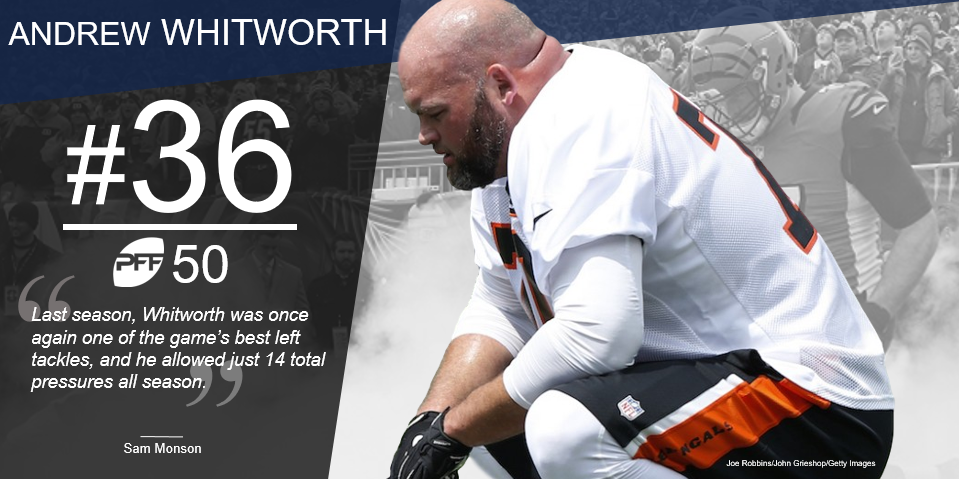
The only thing keeping Whitworth from being higher on this list is the fact that he is 35 years old and the inevitable knowledge that sooner or later he has to begin to display that reality on the field. Last season, Whitworth was once again one of the game’s best left tackles, and he allowed just 14 total pressures all season. Whitworth has allowed 44 total pressures over the past three seasons combined, which is 23 fewer than Chris Clark allowed for Houston last year alone.
June 9, 2017 at 1:46 pm in reply to: standard weekly praise for Donald (PFF's top ranked player for 2017) #69845znModeratorfrom PFF: THE TOP 50 NFL PLAYERS FOR 2017
https://www.profootballfocus.com/pro-the-top-50-nfl-players-for-2017/
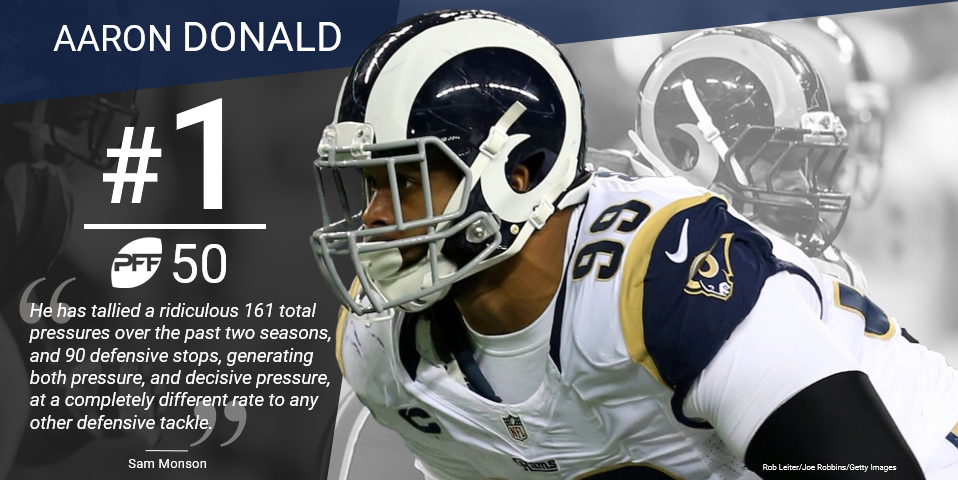
With J.J. Watt injured in 2016, there has been no more consistently dominant force in the NFL over the past couple of seasons than Donald. The Rams defensive lineman has been a one-man wrecking crew inside whether against the run or as a pass-rusher. He has tallied a ridiculous 161 total pressures over the past two seasons, and 90 defensive stops, generating both pressure, and decisive pressure, at a completely different rate to any other defensive tackle.
June 9, 2017 at 10:39 am in reply to: latest young receivers thread…Reynolds, Thomas, what Holt sez, etc. #69843znModeratorMike Thomas, Tyler Higbee look to move up Rams’ depth chart
By Alden Gonzalez
THOUSAND OAKS, Calif. — Tavon Austin remained off to the side, running routes and catching tennis balls while wearing a guard on his surgically repaired left wrist, and Mike Thomas was on the field with his teammates, taking snaps with the Los Angeles Rams’ first-team offense on Monday afternoon. The Rams have 17 pass-catchers on their roster, 14 of whom are heading into their first or second season in the NFL.
In other words, they’re young at the position.
And while Austin and free-agent addition Robert Woods will serve as the two primary receivers, the Rams must still figure out how the second-year players will mix in with the rookies. It’s an interesting dynamic because of the sheer volume, and it’s fascinating because Sean McVay, the Rams’ rookie coach, only hand-picked about half of them.
Suddenly a group that includes Pharoh Cooper, Tyler Higbee and Thomas, among others, is competing against Gerald Everett, Cooper Kupp and Josh Reynolds, all of whom were acquired in this year’s draft.
Kupp, like Cooper, profiles as a slot receiver.
Everett, like Higbee, is a pass-catching tight end.
Reynolds, like Thomas, is a deep threat.
“We’re looking to find the best combination of guys that can make plays,” McVay said after a recent practice. “We want to be an offense that gives the quarterback answers.”
McVay, who will host a three-day, mandatory minicamp next week, mixed up the way he dispersed reps during organized team activities, with Woods seemingly the only mainstay. Sometimes it’s Everett with Kupp and Reynolds; sometimes it’s Higbee and Thomas with Nelson Spruce, a ballyhooed undrafted free agent from 2016 who never stepped on the field. Thomas has been the one getting most of Austin’s reps.
He believes he has made “tremendous growth” since his rookie season.
“My rookie year, I was a little hesitant,” Thomas said. “I wasn’t feeling myself as far as playing fast. But now, I know what to expect.”
Thomas, a sixth-round pick out of Southern Mississippi, made critical mistakes in the scant playing time he received last season. Against the Falcons in Week 14, he fumbled the opening kickoff. Against the Seahawks in Week 15, he dropped a well-placed deep pass from Jared Goff while wide open. But the Rams badly need a deep threat. At 5 foot 8, Austin may be too small and Reynolds may be too raw. Thomas could emerge in that role this season.
“I feel like they see my potential in this offense, and Coach Bones [special teams coordinator John Fassel] sees my potential on special teams,” Thomas said. “You can’t really define a player off his mistakes; you’ve just got to define him off how he comes back from those mistakes. I feel like I came back pretty well, and I didn’t let that get to me. Last year, my rookie year, I feel like I got all my mistakes in on the field. I got them out of the way.”
Thomas is among 12 receivers; Higbee is among five pass-catching tight ends.
Higbee’s primary competition is Everett, the 44th overall pick who built a name for himself as an athletic pass-catcher who can stretch the deep middle of the field. Higbee, a fourth-round pick out of Western Kentucky in 2016, seemed destined for a primary role in Jeff Fisher’s offense last summer. But the 6-foot-6, 257-pound Higbee was targeted only seven times in the first seven games and only 29 times all season.
“It was a coaching decision,” Higbee said. “Whatever they thought was best, that’s what they did.”
In the offseason, the Rams thought it best to let veteran Lance Kendricks leave via free agency and stay young at tight end. Temarrick Hemingway, a sixth-round pick in last year’s draft, and Travis Wilson, the former Utah quarterback who recently made the transition to tight end, could factor into the mix. But it figures to be mainly Higbee and Everett at the position, and both could play a big role.
“You see what Coach McVay’s done in Washington with those tight ends,” Higbee said, alluding to a 2016 Redskins team that led the NFL in tight end receiving yards. “He had two great guys with Vernon Davis and Jordan Reed over there. Not saying we have a Jordan Reed/Vernon Davis over here, but I think we’re going to be all right.”
znModeratorsome combination of the bills running game with some of mcvay’s own concepts.
Don’t forget LaFleur, who comes in from Atlanta, where they had a top running game too (12th in attempts, 5th in yards).
Kromer prefers a power scheme so yes it will be interesting to see how McVay collaborates with him.
.
znModeratorNice summary.
…
WestCoastRam wrote:
Kromer has installed a system ever since he’s been with the Saints that values guard higher than tackle. His lines have been built from guard out (see how Chicago put Kyle Long at guard instead of tackle when they drafted him – he easily could have been one of their top tackles). He values interior linemen with high football IQ, which is why their blocking assignments tend to be more demanding.
I think the idea is that by negating the pass rush up the middle, you can help the tackles with backs, formations and tight ends along with allowing the QB to step up into a developing pocket. Additionally, having your more dominant players at guard allows them to use their talent in the run game. Kromer wanted his better, more dominant player at guard. That’s probably a combo of athleticism, power, IQ and whatnot.
—
PHDram wrote:
thinking about it this way, hav didnt really get a “demotion” at all. rather, it would seem that kromer values him quite a bit by putting him in a position of importance.
znModeratorRob Havenstein knew something was up when he got the call, but the news could have been worse
VINCENT BONSIGNORE
Rob Havenstein knew something was up when he got called into the Rams hierarchy offices shortly after the conclusion of last season and the hiring of new head coach Sean McVay.
After concluding his second year as the Rams starting right tackle, the young lineman from Wisconsin had starter clout and a positive film foundation going for him. But with a new coach and a new vision and only a pair of seasons playing on one of the worst offensive lines in the NFL, Havenstein was taking nothing for granted upon getting the call to come meet with the new staff.
And he braced for whatever the news might be.
Turns out McVay and his staff wanted to move Havenstein from right tackle to right guard. It was a dramatic change – from a position standpoint – but it also resulted in a sigh of relief from Havenstein.
Afterall, sliding over a few feet to his left is a whole lot different than packing his belongings and moving to Green Bay or Jacksonville or the waiver wire,
“They wanted to me to move to guard rather than going somewhere else,” a relieved Havenstein remembered. “I was like, anywhere I can play anywhere I can help I’m for it. Me not having played guard before doesn’t matter. I’m taking the same approach.”
And as he gets acclimated to his new position, he understands it’s in the same world he’s used to.
“I’m still playing offensive line. I’m not playing the X Receiver position or anything,” he pointed out, laughing. “It’s just a little bit different, but as they approached me I was very receptive. If that’s how they felt I could help the team, I’m 100 percent in.”
Nevertheless, there are subtle differences in the two positions. And misconceptions can result to the uneducated eye.Like, say, what might look as the guard position being more attack oriented and the tackle spot more reactionary.
Aggression, Havenstein says, is constant in both positions even if it might not look like it on film.
It’s all in the assignment. And it’s a fine line.
‘“Whether we want to go out and get on guys or we got slide help or something like that, or a double team or we’re kinda on our own, it’s just going to be where we can control our aggression,” he said. “Where we can be aggressive and know we have help and go after guys, or we can still be aggressive but we can’t over do it where we get beat right away and we’re kind of (screwed). So, tackle (to) guard, things are just going to happen faster. It might look more aggressive because, let’s say me and (Jamon Brown) are going against someone, I’m going to get on him way faster than JB is on (someone like) Robert Quinn running up field as fast as he can, which is pretty darn fast. So it’s gonna happen for me a lot faster then it might look – like I’m being more aggressive – but the actual (way we’re being taught) it’s about when we can control it and when we have help.”
June 9, 2017 at 1:21 am in reply to: latest young receivers thread…Reynolds, Thomas, what Holt sez, etc. #69825znModeratorHolt Likes What He Sees from Rams Rookie WRs
By Myles Simmons
Between 2000 and 2009, no one in the NFL caught more passes or recorded more yards receiving than former Rams wide receiver Torry Holt. With 920 career receptions for 13,382 yards and 74 touchdowns, Holt clearly knows a thing or two about being a successful wideout.
And so when Holt says he likes what he’s seen from Los Angeles’ two 2017 draftees at his position, that carries weight.
Holt was around the Rams’ facility last week during the club’s legends reunion, and had the opportunity to watch practice film and chat with some of the players. With 11 years of playing experience, Holt had plenty to share.
“I was talking to Cooper Kupp and Josh Reynolds, when they were playing in college it was natural, it was comfortable, it was instinctive,” Holt said. “Well, how can you get to that quickly as a rookie? You’ve got to know the playbook, you’ve got to be out on the football field, you’ve got to be healthy. And you’ve got to keep your mouth closed and do what you’re told as a rookie.”
“And we talked a lot about patience and trust in the process,” Holt added. “Trusting your coaches. Getting familiar or getting as comfortable as you can as a rookie with the playbook, with your contract situation, with your living arrangements. Making sure that is in tact as quickly as possible so you can get to some normalcy — and that’s playing the game and doing it naturally.”
Holt was able to make that kind of smooth transition his rookie year in 1999, making 52 receptions for 788 yards and six touchdowns, helping the Rams win Super Bowl XXXIV.
So what did Holt think of Kupp and Reynolds’ practice film?
“I saw some attention to detail,” Holt said. “They — so far — have got a pretty good understanding of what’s asked of them on the offensive side of the ball.”
Overall, Holt seems to feel the two rookies are set up for success. But they’ll have to work at it in order to make it happen.
“With the way [head coach Sean] McVay puts in the offense, the way they talk offensive philosophy, Todd Gurley and the way he works, Tavon [Austin] and the way he works — there’s veteran guys that they can lean [on] and see what the example should be every single day,” Holt said.
June 9, 2017 at 1:21 am in reply to: latest young receivers thread…Reynolds, Thomas, what Holt sez, etc. #69824znModeratorThomas Feeling Confident Heading into Year 2
By Myles Simmons
For many NFL players, one of the most significant jumps comes between Year 1 and Year 2.
There are plenty of reasons for it. From a comfort standpoint, most rookies are just 21 or 22 years old and entering a high-stress, competitive workplace. Plus, through no fault of their own, these players are behind in learning the playbook because they don’t get drafted until teams’ offseason programs are well underway.
And so for someone like wide receiver Mike Thomas, there’s a much different feel to his second OTAs.
“Honestly, just the experience — the experience of how players move, how players play on the field, how the game speed is,” Thomas said on Tuesday. “I feel like I caught up with the tempo of practice and the game. And I’m just playing fast without thinking and just trying to seize every opportunity that comes my way.”
With wide receiver Tavon Austin unable to fully participate in OTAs after undergoing surgery, Thomas has received more practice snaps. And he’s taken advantage of them, having made a number of downfield and contested receptions. Head coach Sean McVay said this week he’s been impressed with Thomas’ speed.
“He’s a competitive player,” McVay said. “I think he’s getting more and more confident with his hands and just becoming a more polished player — with just his routes and increasing that route versatility.
“You can feel him,” McVay continued. “He’s got some speed that gives you the ability to stretch the top-shelf of the defense and that’s what he’s done so far.”
Thomas’ specialty was being a downfield threat at Southern Miss, where he averaged 19.6 yards per reception and caught 14 touchdowns in his senior season. But as a sixth-round pick in the 2016 draft, Thomas was mainly a special teams contributor as a rookie, making only three receptions in his limited offensive snaps.
“Your rookie year is always a little hesitant coming off college — different speed, different tempo. You’re playing with grown men now and that’s a lot on this level,” Thomas said. “So coming in for Year 2, like I said, you adapt to it. You know what to expect. You know how to prepare for games. You know how to prepare for practice and training camp. So it’s only right that you come in confident knowing what to expect.”
Thomas spent a lot of time working on his craft in the offseason, he said, catching plenty of balls and running numerous of routes. And the wideout trained with quarterback Jared Goff to improve their rapport.
“This offseason we connected well. We were doing a lot of routes together — throwing, catching, learning together,” Thomas said. “At the end of the day, we both came in as rookies, and we’re learning a new offense together, so it’s only right that we all get better together.”
With a new playbook to learn, Thomas has been working with Goff to master it both on the field and in the classroom.
“We ask questions. I ask a lot of questions and when I have a question, I go right to Jared because at the end of the day he has to know it, too,” Thomas said. “We’ve just been trying to get the chemistry to 100 percent.”
What’s likely aided in that process is the way McVay and his staff have installed the offense. Thomas said he feels like the unit has picked it up quickly and well, in part because everyone has a complete picture of the scheme.
“The way they’re teaching it is incredible. Everybody’s getting it fast,” Thomas said. “It’s all about concepts. And when you know what everybody else is doing on the field, it makes you play way faster because you know what I have at the end of the day, and what the tight end and the other receivers have.”
Armed with that knowledge, Thomas has been working to take advantage of every opportunity during the offseason program. Given the way he’s performed on the field, combined with the feedback from his coaches, Thomas has reason to be confident heading into Year 2.
“What we’ve seen from Mike has been good stuff and you really like his demeanor and his disposition,” McVay said. “He’s been a joy to be around so far.”
“Now I know what to expect,” Thomas said. “I adapted to it — to the speed of the game, practice — and I’m coming out strong and confident.”
June 9, 2017 at 1:20 am in reply to: latest young receivers thread…Reynolds, Thomas, what Holt sez, etc. #69823znModeratorThomas has a good shot for two reasons
3. He’s good on special teams coverage units.
June 9, 2017 at 1:20 am in reply to: latest young receivers thread…Reynolds, Thomas, what Holt sez, etc. #69822znModeratorMcVay on Mike Thomas from: http://theramshuddle.com/topic/mcvay-vid-65/#post-69740
think he’s getting more and more confident with his hands and just becoming a more polished player – with just his routes and increasing that route versatility. What we’ve seen from Mike so far has been encouraging and he’s made plays down the field. You can feel him, he’s got some speed that gives you the ability to stretch the top-shelf of the defense and that’s what he’s done so far….What we’ve seen from Mike has been good stuff and you really like his demeanor and his disposition. He’s been a joy to be around so far.
…
…Flipper336 wrote:
Thomas has a good shot for two reasons
1. He’s talented. One of my favorites in the draft last year.
2. Rams need an X receiver to show up. They are stacked at slot and have Woods basically locked in as the starter at Z, need someone to beat CBs at the line.
znModeratorGetting to know Rams linebacker and NFL hipster Connor Barwin
Alden Gonzalez
THOUSAND OAKS, Calif. — Connor Barwin, the Los Angeles Rams’ new outside linebacker, doesn’t fit the mold of your stereotypical football player. He is environmentally conscious, prefers getting around on his road bike, loves watching local bands, wears V-neck T-shirts and appreciates a good pourover coffee.
He is, in many ways, a hipster (though hipsters never really admit to being hipsters).
Barwin compiled 46 sacks while playing in all 96 regular-season games from 2011 to ’16. He spent his first four years with the Houston Texans and his next four with the Philadelphia Eagles, who released Barwin after the 2016 season and paved the way for his one-year deal with the Rams in the middle of March. Before all that, he was raised alongside three brothers in Hazel Park, Michigan, just north of Detroit. His parents stressed the need for balance in one’s life.
“Sports were never a huge focus,” Barwin said. “There was never anything that was really a big focus. Well, maybe school. But it was school, sports, learn an instrument. It was kind of this idea that you had to be a well-rounded person. The best citizen was a well-rounded individual.”
Barwin didn’t completely take to that, because regardless of his outside interests, he’s still all-in on this football thing. He loves the game, loves working out, loves all of the details that go into training. You can’t do the things he has in this game without a mindset like that. But Barwin, 30, and newly married, is also all about the local scene. In Philadelphia, he started the Make The World Better Foundation. It began by refurbishing an abandoned basketball court — now a big hit in the community — and will announce plans for a fourth project later this summer.
Barwin wants to contribute on the West Coast, too, but two things need to happen: He needs to sign an extension, and he needs to settle in. He’s still living out of a hotel in Westlake Village, which is in many ways the anti-L.A. But soon Barwin and his wife will settle into a rented house in Malibu — 20 miles from Thousand Oaks, where the Rams train, and 40 miles from Silver Lake, where the hipsters hang.
“I gotta kind of ingrain myself in the community here before I’m ready to take that on,” Barwin said. “I just got here. I’m super focused on this season, because it’s right here in front of us. But that would be something that I would really kick into gear come February — after the season is over and we get a couple of down months, and I kind of know my way around L.A. a little bit more.”
Barwin sat down with ESPN late last week to talk about his outside interests, the hipster label and the one job he cares most about. The interview has been edited for brevity.
Based on all I’ve read about you, it seems like L.A. is really your scene. Am I wrong about that?
(laughs) I don’t know because I’ve only been out here two months, and we’re out here in Thousand Oaks [part of Ventura County, just north of the County of Los Angeles]. I don’t know if that’s L.A. But on the weekends I’ve gotten around a little bit. I’ve kind of gone back and forth. It seems like I’m on vacation every weekend.
Because of the weather?
I don’t know what it is. Probably mostly the weather and the water, I guess. But I’m excited to be here.
I know you like to ride your bike almost everywhere. Can you do that out here?
That will be harder here, yeah. Surprisingly it was cool to see how much public transit L.A. had. But riding your bike for functional use isn’t going to happen here.
So instead you have your Tesla (he has a Model X out here and a Model S in Philly). Do you own the only Tesla in the players’ parking lot?
Yep.
Has that always been the case?
Yep. Always the case. But guys are into Teslas now. When I drove a Prius in Houston, that was really out there. It was before driving electric was cool.
You’ve been to Coachella a lot (five times). Do you have a favorite Coachella moment or year?
For me, Coachella — this year was probably my last one. But every year, it’s gotten better. I mean the music is always great. There’s obviously some highs and lows in some of the shows you see, but I feel like when you go to Coachella — you can go to Coachella every year, and every year [you will see something new]. … It’s a huge production. You gotta know how to do it, so to speak.
Like, what to do when you’re camping out?
Well, if you know how to do it, you know you don’t camp out (laughs). So, we rent a house. We always get a better house every year. You get one close to the venue, and you learn how to go through that weekend. Me and my group of friends who always go have got it down pretty good. Every year it gets better.
So you have mastered Coachella, and now you’re retiring from it?
Yeah, I think so. When you’re my age, you retire. I’m married, you know. It’s done. I’m done.
Burning Man?
That’s for after I’m done playing football, because that’s in September. So I’ll do that when I’m done. Maybe I’ll do that when I’m done.
Have you thought about how much longer you want to play?
Yeah, I think I want to play 12 years. This will be nine, so I think I have four more. I’d like to do three stints of four – Houston, Philly and L.A.
So, four with the Rams?
Yeah, that’d be great. I gotta get to that new stadium [in 2020].
Is that the goal?
That’s the goal.
What to do you think playing in Wade Phillips’ system will do for what remains of your career?
It was definitely part of my decision. I loved playing for Wade [while with the Texans in 2011-12], just in general. But I think playing in this system will be good for me to keep playing for a couple more years because it takes advantage of what I do well. It allows me to still play every single snap. Play first down, second down, rush the passer on third down. But be able to cover guys when I need to — tight ends, running backs, that sort of thing.
What’s your favorite Wade Phillips story?
It’s just the way he is with words. … I mean he’s very subtle in some of the things he says, but you always have to pay attention, because everything he says is usually pretty damn important. My favorite Wade Phillips line, back in Houston, is, ‘Good times and hard work go together. But hard work always comes first.’ It’s one of my favorite sayings of all time. But he’s got dozens of those.
So how do you feel about the term ‘hipster football player’?
(laughs) I don’t know. I don’t really have any feeling about it. … I’m fine with it, I guess. But no one calls me that around here, in the locker room or anything like that. I mean I guess they did a little bit in Philly. …
Well, they don’t really know you here yet.
Yeah, I guess they don’t know me yet (laughs). But I don’t mind. I embrace it. I embrace the kind of things that I’m interested in outside of football. I think it’s important. And for me, that’s always been a fun part is kind of introducing guys in the locker room to some of that stuff. Whenever I’ve done that, guys have always enjoyed it. And that’s been a cool part for me.
June 9, 2017 at 1:06 am in reply to: standard weekly praise for Donald (PFF's top ranked player for 2017) #69816znModeratorfrom Prisco’s Top 100 Players of 2017: Tom Brady is the GOAT, but he’s not No. 1
Pete Prisco
3 Aaron Donald
L.A. RAMS DT
It’s too bad the Rams haven’t been good in his time with the team. He’s a force on their line who doesn’t get the due he deserves.znModeratorEXCERPTS FROM JAMES COMEY’S OPENING STATEMENT TO THE SENATE INTELLIGENCE COMMITTEE OR FROM KAZUO ISHIGURO’S THE REMAINS OF THE DAY?
1. “It turned out to be just the two of us, seated at a small oval table in the center of the Green Room. Two Navy stewards waited on us, only entering the room to serve food and drinks.”
2. “There was not a soul to be seen… apart from a hammering noise echoing from somewhere distant, and an occasional coughing in a room to the back of the house.”
3. “I didn’t move, speak, or change my facial expression in any way during the awkward silence that followed. We simply looked at each other in silence. The conversation then moved on, but he returned to the subject near the end of our dinner.”
4. “The directness of the inquiry did, I admit, take me rather by surprise. ’It’s rather a hard thing to explain in a few words, sir,’ I said. ‘But I suspect it comes down to not removing one’s clothing in public.’”
5. “He said he had nothing to do with Russia, had not been involved with hookers in Russia, and had always assumed he was being recorded when in Russia.”
6. “By the very nature of a witticism, one is given very little time to assess its various possible repercussions before one is called to give voice to it, and one gravely risks uttering all manner of unsuitable things if one has not first acquired the necessary skill and experience.”
7. “My instincts told me that the one-on-one setting, and the pretense that this was our first discussion about my position, meant the dinner was, at least in part, an effort to have me ask for my job and create some sort of patronage relationship.”
8. “I believe I have a good idea of what you mean by ‘professionalism.’ It appears to mean getting one’s way by cheating and manipulating. It appears to mean serving the dictates of greed and advantage rather than those of goodness and the desire to see justice prevail in the world. If that is the ‘professionalism’ you refer to, sir, I don’t care much for it and have no wish to acquire it.”
9. “He said he would do that and added, ‘Because I have been very loyal to you, very loyal; we had that thing you know.’ I did not reply or ask him what he meant by ‘that thing.’”
10. “He prodded once more his attaché case – which I felt inclined to keep my eyes averted from – and said: ‘I suppose you’ve been wondering why I never let go of this case. Well, now you know. Imagine if the wrong person opened it.’ ‘That would be most awkward, sir.’”
11. “The term – honest loyalty – had helped end a very awkward conversation and my explanations had made clear what he should expect.”
12. “For it is, in practice, simply not possible to adopt such a critical attitude towards an employer and at the same time provide good service.”
13. “He said that was what he would do and the call ended.”
14. “Indeed — why should I not admit it? — in that moment, my heart was breaking.”
Comey: 1, 3, 5, 7, 9, 11, 13
The Remains of the Day: 2, 4, 6, 8, 10, 12, 14znModeratorStupid bastard establishment dems.
.
znModeratorGood article.
I have a statue of Putin on a white horse in front of my house, btw.
w
vSeems like a lot of work to make a statue of a house with a man in front of it.
znModeratorStatement for the Record
Senate Select Committee on Intelligence
James B. Comey
June 8, 2017
Chairman Burr, Ranking Member Warner, Members of the Committee.
Thank you for inviting me to appear before you today. I was asked to testify today
to describe for you my interactions with President-Elect and President Trump on
subjects that I understand are of interest to you. I have not included every detail
from my conversations with the President, but, to the best of my recollection, I
have tried to include information that may be relevant to the Committee.
January 6 Briefing
I first met then-President-Elect Trump on Friday, January 6 in a conference
room at Trump Tower in New York. I was there with other Intelligence
Community (IC) leaders to brief him and his new national security team on the
findings of an IC assessment concerning Russian efforts to interfere in the
James Comey testimony: Trump asked me to let Flynn investigation go
James Comey testimony: Trump asked me to let Flynn investigation go
election. At the conclusion of that briefing, I remained alone with the President Elect
to brief him on some personally sensitive aspects of the information
assembled during the assessment.
The IC leadership thought it important, for a variety of reasons, to alert the
incoming President to the existence of this material, even though it was salacious
and unverified. Among those reasons were: (1) we knew the media was about to
publicly report the material and we believed the IC should not keep knowledge of
the material and its imminent release from the President-Elect; and (2) to the
extent there was some effort to compromise an incoming President, we could blunt
any such effort with a defensive briefing.
The Director of National Intelligence asked that I personally do this portion
of the briefing because I was staying in my position and because the material
implicated the FBI’s counter-intelligence responsibilities. We also agreed I would
do it alone to minimize potential embarrassment to the President-Elect. Although
we agreed it made sense for me to do the briefing, the FBI’s leadership and I were
concerned that the briefing might create a situation where a new President came
into office uncertain about whether the FBI was conducting a counter-intelligence
investigation of his personal conduct.
2
It is important to understand that FBI counter-intelligence investigations are
different than the more-commonly known criminal investigative work. The
Bureau’s goal in a counter-intelligence investigation is to understand the technical
and human methods that hostile foreign powers are using to influence the United
States or to steal our secrets. The FBI uses that understanding to disrupt those
efforts. Sometimes disruption takes the form of alerting a person who is targeted
for recruitment or influence by the foreign power. Sometimes it involves
hardening a computer system that is being attacked. Sometimes it involves
“turning” the recruited person into a double-agent, or publicly calling out the
behavior with sanctions or expulsions of embassy-based intelligence officers. On
occasion, criminal prosecution is used to disrupt intelligence activities.
Because the nature of the hostile foreign nation is well known, counterintelligence
investigations tend to be centered on individuals the FBI suspects to
be witting or unwitting agents of that foreign power. When the FBI develops
reason to believe an American has been targeted for recruitment by a foreign
power or is covertly acting as an agent of the foreign power, the FBI will “open an
investigation” on that American and use legal authorities to try to learn more about
the nature of any relationship with the foreign power so it can be disrupted.
In that context, prior to the January 6 meeting, I discussed with the FBI’s
leadership team whether I should be prepared to assure President-Elect Trump that
we were not investigating him personally. That was true; we did not have an open
counter-intelligence case on him. We agreed I should do so if circumstances
warranted. During our one-on-one meeting at Trump Tower, based on President Elect
Trump’s reaction to the briefing and without him directly asking the
Intelligence chiefs won't say if Trump asked them to downplay Russia probe
Intelligence chiefs won’t say if Trump asked them to downplay Russia probe
question, I offered that assurance.
I felt compelled to document my first conversation with the President-Elect
in a memo. To ensure accuracy, I began to type it on a laptop in an FBI vehicle
outside Trump Tower the moment I walked out of the meeting. Creating written
records immediately after one-on-one conversations with Mr. Trump was my
practice from that point forward. This had not been my practice in the past. I
spoke alone with President Obama twice in person (and never on the phone) —
once in 2015 to discuss law enforcement policy issues and a second time, briefly,
for him to say goodbye in late 2016. In neither of those circumstances did I
memorialize the discussions. I can recall nine one-on-one conversations with
President Trump in four months — three in person and six on the phone.
January 27 Dinner
The President and I had dinner on Friday, January 27 at 6:30 pm in the
Green Room at the White House. He had called me at lunchtime that day and
3
invited me to dinner that night, saying he was going to invite my whole family, but
decided to have just me this time, with the whole family coming the next time. It
was unclear from the conversation who else would be at the dinner, although I
assumed there would be others.
It turned out to be just the two of us, seated at a small oval table in the
center of the Green Room. Two Navy stewards waited on us, only entering the
room to serve food and drinks.
The President began by asking me whether I wanted to stay on as FBI
Director, which I found strange because he had already told me twice in earlier
conversations that he hoped I would stay, and I had assured him that I intended to.
He said that lots of people wanted my job and, given the abuse I had taken during
the previous year, he would understand if I wanted to walk away.
My instincts told me that the one-on-one setting, and the pretense that this
was our first discussion about my position, meant the dinner was, at least in part,
an effort to have me ask for my job and create some sort of patronage relationship.
That concerned me greatly, given the FBI’s traditionally independent status in the
executive branch.
I replied that I loved my work and intended to stay and serve out my tenyear
term as Director. And then, because the set-up made me uneasy, I added that
I was not “reliable” in the way politicians use that word, but he could always count
on me to tell him the truth. I added that I was not on anybody’s side politically
and could not be counted on in the traditional political sense, a stance I said was in
his best interest as the President.
A few moments later, the President said, “I need loyalty, I expect loyalty.”
I didn’t move, speak, or change my facial expression in any way during the
awkward silence that followed. We simply looked at each other in silence. The
conversation then moved on, but he returned to the subject near the end of our
dinner.
At one point, I explained why it was so important that the FBI and the
Department of Justice be independent of the White House. I said it was a paradox:
Throughout history, some Presidents have decided that because “problems” come
from Justice, they should try to hold the Department close. But blurring those
boundaries ultimately makes the problems worse by undermining public trust in
the institutions and their work.
Near the end of our dinner, the President returned to the subject of my job,
saying he was very glad I wanted to stay, adding that he had heard great things
4
about me from Jim Mattis, Jeff Sessions, and many others. He then said, “I need
loyalty.” I replied, “You will always get honesty from me.” He paused and then
said, “That’s what I want, honest loyalty.” I paused, and then said, “You will get
that from me.” As I wrote in the memo I created immediately after the dinner, it is
possible we understood the phrase “honest loyalty” differently, but I decided it
wouldn’t be productive to push it further. The term — honest loyalty — had helped
end a very awkward conversation and my explanations had made clear what he
should expect.
During the dinner, the President returned to the salacious material I had
briefed him about on January 6, and, as he had done previously, expressed his
disgust for the allegations and strongly denied them. He said he was considering
ordering me to investigate the alleged incident to prove it didn’t happen. I replied
that he should give that careful thought because it might create a narrative that we
were investigating him personally, which we weren’t, and because it was very
difficult to prove a negative. He said he would think about it and asked me to
think about it.
As was my practice for conversations with President Trump, I wrote a
detailed memo about the dinner immediately afterwards and shared it with the
senior leadership team of the FBI.
February 14 Oval Office Meeting
On February 14, I went to the Oval Office for a scheduled counterterrorism
briefing of the President. He sat behind the desk and a group of us sat in
a semi-circle of about six chairs facing him on the other side of the desk. The
Vice President, Deputy Director of the CIA, Director of the National CounterTerrorism
Center, Secretary of Homeland Security, the Attorney General, and I
were in the semi-circle of chairs. I was directly facing the President, sitting
between the Deputy CIA Director and the Director of NCTC. There were quite a
few others in the room, sitting behind us on couches and chairs.
The President signaled the end of the briefing by thanking the group and
telling them all that he wanted to speak to me alone. I stayed in my chair. As the
participants started to leave the Oval Office, the Attorney General lingered by my
chair, but the President thanked him and said he wanted to speak only with me.
The last person to leave was Jared Kushner, who also stood by my chair and
exchanged pleasantries with me. The President then excused him, saying he
wanted to speak with me.
When the door by the grandfather clock closed, and we were alone, the
President began by saying, “I want to talk about Mike Flynn.” Flynn had resigned
5
the previous day. The President began by saying Flynn hadn’t done anything
wrong in speaking with the Russians, but he had to let him go because he had
misled the Vice President. He added that he had other concerns about Flynn,
which he did not then specify.
The President then made a long series of comments about the problem with
leaks of classified information — a concern I shared and still share. After he had
spoken for a few minutes about leaks, Reince Priebus leaned in through the door
by the grandfather clock and I could see a group of people waiting behind him.
The President waved at him to close the door, saying he would be done shortly.
The door closed.
The President then returned to the topic of Mike Flynn, saying, “He is a
good guy and has been through a lot.” He repeated that Flynn hadn’t done
anything wrong on his calls with the Russians, but had misled the Vice President.
He then said, “I hope you can see your way clear to letting this go, to letting Flynn
go. He is a good guy. I hope you can let this go.” I replied only that “he is a good
guy.” (In fact, I had a positive experience dealing with Mike Flynn when he was a
colleague as Director of the Defense Intelligence Agency at the beginning of my
term at FBI.) I did not say I would “let this go.”
The President returned briefly to the problem of leaks. I then got up and
left out the door by the grandfather clock, making my way through the large group
of people waiting there, including Mr. Priebus and the Vice President.
I immediately prepared an unclassified memo of the conversation about
Flynn and discussed the matter with FBI senior leadership. I had understood the
President to be requesting that we drop any investigation of Flynn in connection
with false statements about his conversations with the Russian ambassador in
December. I did not understand the President to be talking about the broader
investigation into Russia or possible links to his campaign. I could be wrong, but I
took him to be focusing on what had just happened with Flynn’s departure and the
controversy around his account of his phone calls. Regardless, it was very
concerning, given the FBI’s role as an independent investigative agency.
The FBI leadership team agreed with me that it was important not to infect
the investigative team with the President’s request, which we did not intend to
abide. We also concluded that, given that it was a one-on-one conversation, there
was nothing available to corroborate my account. We concluded it made little
sense to report it to Attorney General Sessions, who we expected would likely
recuse himself from involvement in Russia-related investigations. (He did so two
weeks later.) The Deputy Attorney General’s role was then filled in an acting
capacity by a United States Attorney, who would also not be long in the role.
6
After discussing the matter, we decided to keep it very closely held, resolving to
figure out what to do with it down the road as our investigation progressed. The
investigation moved ahead at full speed, with none of the investigative team
members — or the Department of Justice lawyers supporting them — aware of the
President’s request.
Shortly afterwards, I spoke with Attorney General Sessions in person to
pass along the President’s concerns about leaks. I took the opportunity to implore
the Attorney General to prevent any future direct communication between the
President and me. I told the AG that what had just happened — him being asked to
leave while the FBI Director, who reports to the AG, remained behind — was
inappropriate and should never happen. He did not reply. For the reasons
discussed above, I did not mention that the President broached the FBI’s potential
investigation of General Flynn.
March 30 Phone Call
On the morning of March 30, the President called me at the FBI. He
described the Russia investigation as “a cloud” that was impairing his ability to act
on behalf of the country. He said he had nothing to do with Russia, had not been
involved with hookers in Russia, and had always assumed he was being recorded
when in Russia. He asked what we could do to “lift the cloud.” I responded that
we were investigating the matter as quickly as we could, and that there would be
great benefit, if we didn’t find anything, to our having done the work well. He
agreed, but then re-emphasized the problems this was causing him.
Then the President asked why there had been a congressional hearing about
Russia the previous week — at which I had, as the Department of Justice directed,
confirmed the investigation into possible coordination between Russia and the
Trump campaign. I explained the demands from the leadership of both parties in
Congress for more information, and that Senator Grassley had even held up the
confirmation of the Deputy Attorney General until we briefed him in detail on the
investigation. I explained that we had briefed the leadership of Congress on
exactly which individuals we were investigating and that we had told those
Congressional leaders that we were not personally investigating President Trump.
I reminded him I had previously told him that. He repeatedly told me, “We need
to get that fact out.” (I did not tell the President that the FBI and the Department
of Justice had been reluctant to make public statements that we did not have an
open case on President Trump for a number of reasons, most importantly because
it would create a duty to correct, should that change.)
The President went on to say that if there were some “satellite” associates
of his who did something wrong, it would be good to find that out, but that he
7
hadn’t done anything wrong and hoped I would find a way to get it out that we
weren’t investigating him.
In an abrupt shift, he turned the conversation to FBI Deputy Director
Andrew McCabe, saying he hadn’t brought up “the McCabe thing” because I had
said McCabe was honorable, although McAuliffe was close to the Clintons and
had given him (I think he meant Deputy Director McCabe’s wife) campaign
money. Although I didn’t understand why the President was bringing this up, I
repeated that Mr. McCabe was an honorable person.
He finished by stressing “the cloud” that was interfering with his ability to
make deals for the country and said he hoped I could find a way to get out that he
wasn’t being investigated. I told him I would see what we could do, and that we
would do our investigative work well and as quickly as we could.
Immediately after that conversation, I called Acting Deputy Attorney
General Dana Boente (AG Sessions had by then recused himself on all Russiarelated
matters), to report the substance of the call from the President, and said I
would await his guidance. I did not hear back from him before the President
called me again two weeks later.
April 11 Phone Call
On the morning of April 11, the President called me and asked what I had
done about his request that I “get out” that he is not personally under investigation.
I replied that I had passed his request to the Acting Deputy Attorney General, but I
had not heard back. He replied that “the cloud” was getting in the way of his
ability to do his job. He said that perhaps he would have his people reach out to
the Acting Deputy Attorney General. I said that was the way his request should be
handled. I said the White House Counsel should contact the leadership of DOJ to
make the request, which was the traditional channel.
He said he would do that and added, “Because I have been very loyal to
you, very loyal; we had that thing you know.” I did not reply or ask him what he
meant by “that thing.” I said only that the way to handle it was to have the White
House Counsel call the Acting Deputy Attorney General. He said that was what
he would do and the call ended.
That was the last time I spoke with President Trump.
# # # -
AuthorPosts