
Forum Replies Created
-
AuthorPosts
-
March 24, 2017 at 10:05 pm in reply to: Senate vote allows hibernating bears and cubs to be hunted in their dens #66655
 znModerator
Where’s the sport in that?
I think it’s being done to decrease predators and increase the numbers of trophy animals for tourist hunters.
The state of Alaska, especially since the enactment of the Intensive Management Act, has been on a crusade to use well-heeled trophy hunters and state agents to drive down the numbers of grizzly bears, black bears, and wolves, in order to create more moose and caribou for hunters to shoot. In pursuit of this goal, it’s authorized all manner of appalling practices, including hunting and killing methods forbidden by the FWS rule on their lands.
znModeratorRams see a role for previously underused Lance Dunbar
Alden Gonzalez
LOS ANGELES — Sean McVay’s words resonated with Lance Dunbar.
The free-agent running back was in Southern California for a visit last week and sat down with McVay, the Los Angeles Rams’ rookie head coach, who walked Dunbar through his potential role in the offense. McVay wound up describing the way Dunbar always saw himself while buried in the Dallas Cowboys’ depth chart. He illustrated Dunbar’s traits the way Dunbar himself would recount them to someone else.
“He had me going,” Dunbar said. “He had me ready to play.”
Dunbar ultimately signed with the Rams on a one-year contract that could pay him up to $3 million. He will be the Rams’ change-of-pace running back, a complement for the power game of Todd Gurley, and he will also be an option in the passing game. The name “Chris Thompson” came up during Dunbar’s meeting with McVay, which makes sense.
Over the past two years, while McVay called plays as the Washington Redskins’ offensive coordinator, Thompson found a way to be productive despite finding himself behind backs such as Alfred Morris, Robert Kelley and Matt Jones in rushing attempts. From 2015 to 2016, Thompson rushed for 572 yards on 103 attempts and caught for 589 yards on 84 catches.
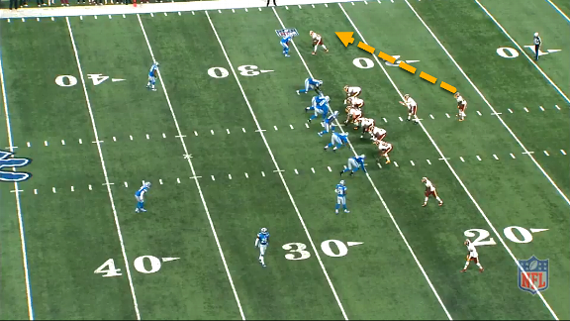
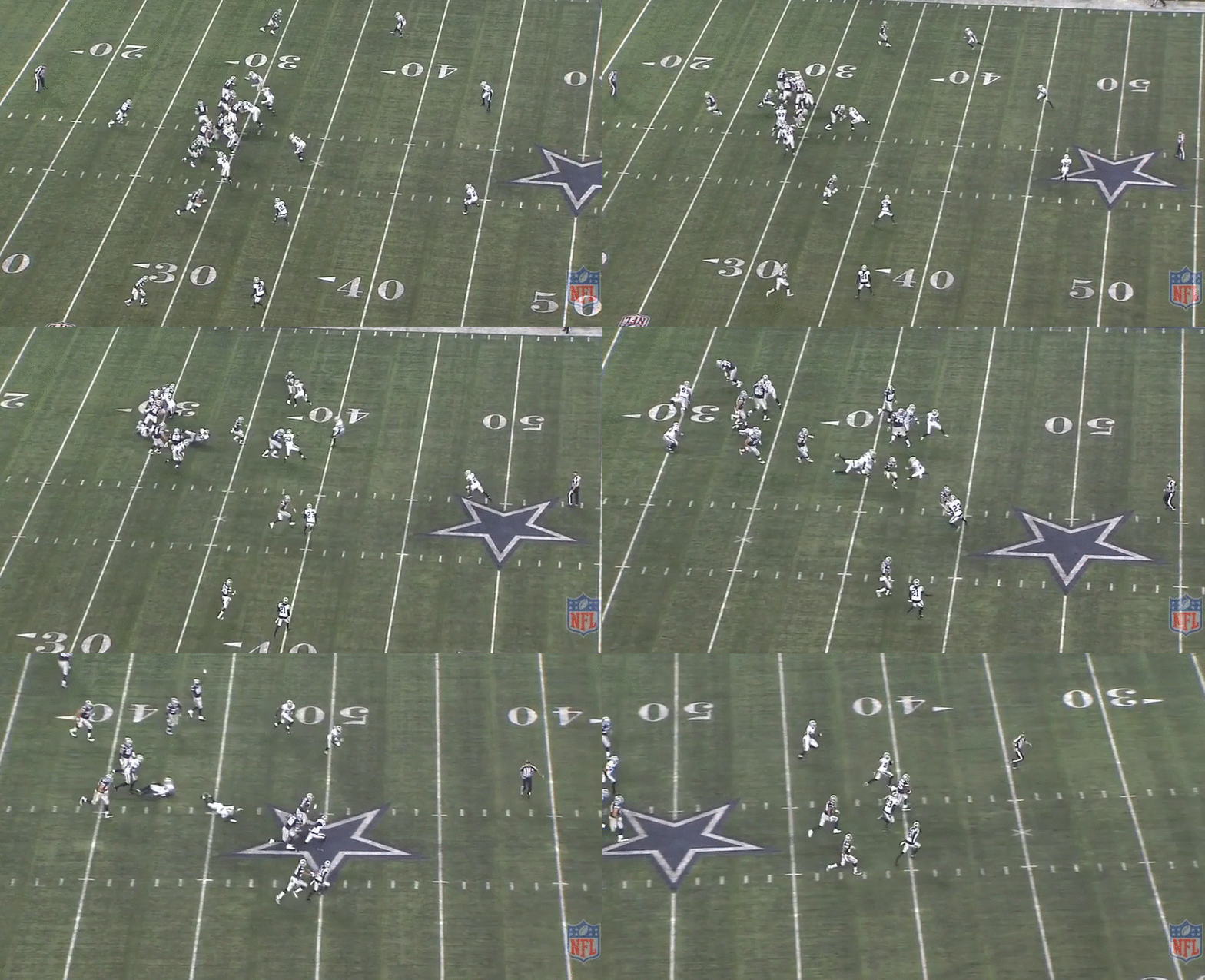
Thompson, like Dunbar, boasts blazing speed, so the Redskins frequently ran him to the outside. Like on the play below, out of the pistol formation against the Detroit Lions, when Thompson ultimately got around the edge for a 16-yard gain:
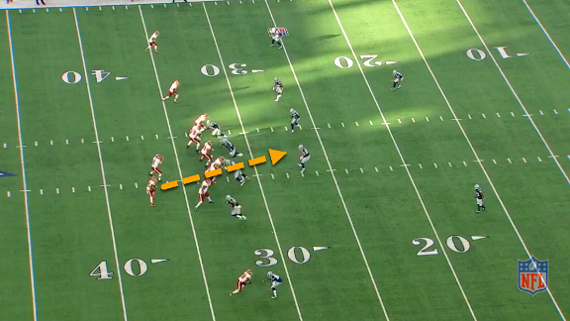
Sometimes, the Redskins would also spread the field out wide and have him run up the middle on shotgun sets, like on this delayed handoff against the Cowboys, which resulted in a 6-yard gain:
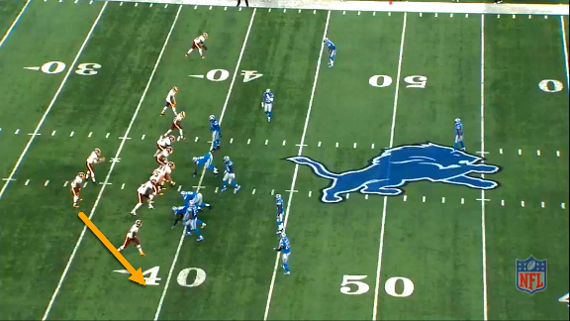
But just as big a weapon were quick passes that got Thompson the ball in open space. Below is the beginning of a play that has Thompson run out to the flat. Redskins quarterback Kirk Cousins picked up a blitz and got rid of it quickly to Thompson, who picked up 11 yards before getting pushed out of bounds:
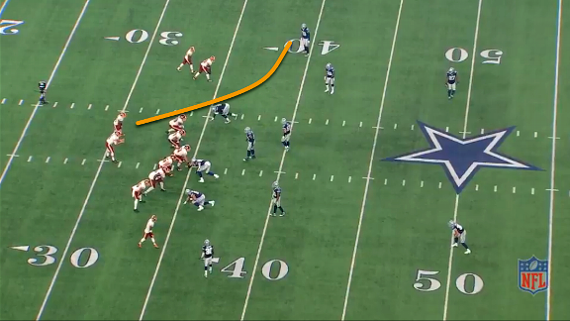
And here, once again against the Cowboys, Thompson didn’t have anybody to block, so he eventually ran to the outside and picked up 9 yards through the air:
“We were in the same division, so I’ve seen those guys [the Redskins] play, and I’ve seen Chris play,” Dunbar said. “We are very similar. I catch the ball in the backfield. I can run routes. I can run the ball. To see him do those things gave me a little bit more confidence and more belief in [McVay], that he will allow me to do those things.”
Dunbar made the Cowboys’ roster as an undrafted free agent in 2012. He had a breakout game against the Oakland Raiders late in 2013, rushing for 82 yards on 12 carries, but also sustained a knee injury that forced him to miss the final four games. He was on his way toward carving out a role in 2015, with 21 receptions for 215 yards through the first three games, but he tore his ACL, MCL and patellar tendon on a kickoff return.
“It was really hard,” Dunbar said. “Just throughout my career, every time I got an opportunity — and I made the best of it — something bad goes wrong.”
Dunbar was ready to go by the start of the 2016 season, returning a lot sooner than expected, but he never felt right. He admitted to rushing his way back and said he didn’t really feel right until about midway through the season. By then, Ezekiel Elliott was well on his way toward a dominant rookie season and the Cowboys’ offense was rolling without him. Dunbar never had a chance, and now he’s starting fresh.
He believes his style can complement Gurley.
“My style is different than his,” Dunbar said. “I’m more of a slasher, making guys miss, catching the ball out of the backfield. We have two different styles. If you mix my style with his style, it brings a lot to the table. It’s hard for people to keep switching up, switching up, because it’s very different. In-game, when I come in, you’re going to have to adjust. And it’s kind of hard to adjust in-game.”
znModeratora chronic problem with learning the Rams O………..Perhaps the teachers sucked at instructing the students……
That could be. But either way you had a first time coordinator with 3 new positions coaches (WR, RB, TE) installing a revised offense (his first installation) during a move. All without a veteran starting caliber qb.
So you know, if wasn’t one thing, it was another.
.
znModeratorenh.
Seems like a big waste of money. I think they could draft somebody in the 5th round who would produce as much. In fact, I like what they already have on their roster better.
As per stuff in this thread, I think that Dunbar gives McVay an option that reproduces what he did in Washington with Chris Thompson. That would be an experienced change of pace back who can catch and has real open field moves, as opposed to BC, who was a decent third down back but was much more of just a north/south runner and didn’t have the same kind of open field chops. It means on third down for example you have a guy who can maybe create some open field action rather than (like Cunnningham) just simply get the down without the big play possibilities.
They can still draft a back lower, but it would probably be a different kind of back, not a veteran 3rd down jitterbug like Thompson was in Washington and Dunbar is supposed to be in LA.
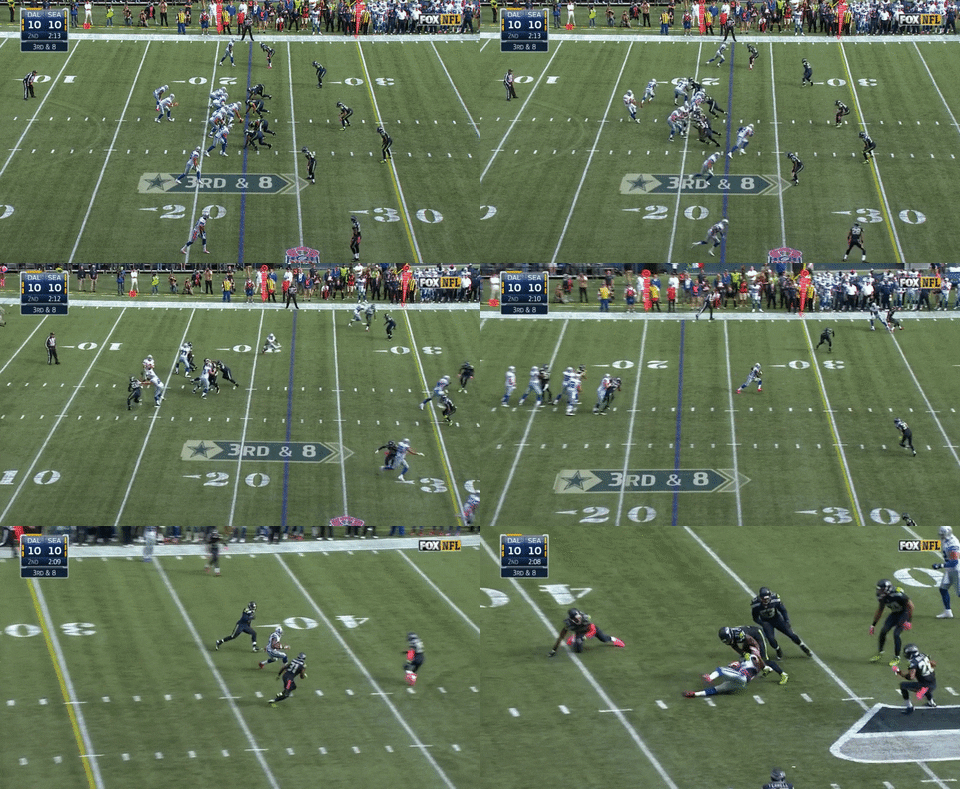
Dunbar:
 znModerator
How many people did that put out of work.
znModerator znModerator
Bootstrap myth exposed: White inheritance key driver in racial wealth gap
Blacks/Latinos/non-whites don’t value education like whites do. They don’t work as hard as whites do. They spend more than whites do on junk,” says your standard white guy at the end of the bar dissecting the large racial wealth gap in the United States. “They just need to get off their butts and bootstrap it up like I did!”
However, the old tried-and-true American bootstrap lore took a big hit this month with a study that shows most families living with the material comfort and range of opportunities normally associated with middle-class status have obtained them the old-fashioned way: inheritance. The racial and wealth gap in the United States is as large as ever and “The Asset Value of Whiteness: Understanding the Racial Wealth Gap,” shows that inheritance plays a huge factor in that gap.
“For centuries, white households enjoyed wealth-building opportunities that were systematically denied to people of color. Today our policies continue to impede efforts by African-American and Latino households to obtain equal access to economic security,” Amy Traub, report co-author and associate director of policy and research at Demos said in a statement. “When research shows that racial privilege now outweighs a fundamental key to economic mobility, like higher education, we must demand our policymakers acknowledge this problem and create policies that address structural inequity.”
In short, the study found that white people inherit stuff and have inherited stuff for generations. And that gives them a supreme advantage. The report shows that typical markers of success in white households – and the chosen interventions in the lives of others – are not translating into lasting wealth and security in households of color.
From the report:
“Research probing the causes of the racial wealth gap has traced its origins to historic injustices, from slavery to segregation to redlining. The great expansion of wealth in the years after World War II was fueled by public policies such as the GI Bill, which mostly helped white veterans attend college and purchase homes with guaranteed mortgages, building the foundations of an American middle class that largely excluded people of color. The outcomes of past injustice are carried forward as wealth is handed down across generations and are reinforced by ostensibly “color-blind” practices and policies in effect today. Yet many popular explanations for racial economic inequality overlook these deep roots, asserting that wealth disparities must be solely the result of individual life choices and personal achievements. The misconception that personal responsibility accounts for the racial wealth gap is an obstacle to the policies that could effectively address racial disparities.”
Professor Thomas Shapiro, who directs the Institute on Assets and Social Policy and is the Pokross Professor of Law and Social Policy at The Heller School for Social Policy and Management at Brandeis University, has been studying this topic since the early 1990s. He was one of the co-authors of the study.
“We know, with a lot of empirical rigor, why the racial wealth gap exists in the United States,” Shapiro told Madison365. “We’ve got the dimensions down. We know that looking at different national databases that whites have about eight times as much financial wealth as African-American families and about eight times as much as the typical Hispanic family has, as well. And we know what the drivers of those things are.
“We know that it is the wealth that is produced through home ownership. We know it’s about the kind of work that people have that ties them into wealth escalators that is a robust pension benefit scheme,” he said. “In this piece, we were trying to say: Let’s take some of the so-called popular explanations and explore them.”
The report found, specifically, that:
◆ Attending college does not close the racial wealth gap.
◆ Raising children in a two-parent household does not close the racial wealth gap.
◆ Working full time does not close the racial wealth gap.
◆ Spending less does not close the racial wealth gap.
“The data says that African Americans and Hispanic families have the same amount of wealth as white families that are high school dropouts,” Shapiro said. “The racial wealth gap – that huge marker of racial inequality – cannot be closed by college going and college degree rates.”
Shapiro co-authored the report along with Laura Sullivan and Tatjana Meschede of Brandeis University and Traub of public policy nonprofit Devos. Issues of racial inequity are increasingly at the forefront of America’s public debate and probing the causes of the racial wealth gap has been becoming increasingly important.
“A lot of what drives the racial wealth gap is inheritance and the transmission of finances between generations,” Shapiro said. “Whites inherit five times more often than blacks and Hispanics. When money gets passed along to whites, it’s about 10 times as much.”
The term “racial wealth gap” is used to describe the difference in accumulated wealth that white households enjoy versus their counterparts of color. Researchers have long tried to attribute the contemporary differences — which are rooted in discriminatory legacies from slavery to housing segregation — to so-called life choices, including education and single parenthood. But this new study says that “individual choices are not sufficient to erase a century of accumulated wealth: structural racism trumps personal responsibility.”
“We hear that the racial wealth gap from people online and in comment sections who say ‘those people have children before they are married. If only, African Americans and Hispanics would have two-parent families, a lot of inequality will go away,’” he said. “How much wealth does a single-parent white family with children have compared to a two-parent family with children either African American or Hispanic? The answer is the white single-parent family has more wealth.”
So then the study looked at work and the narrative that African American and Latinos are lazy. “If only they would buckle down, as people sometimes say, racial equality would be greatly reduced,” Shapiro said. “Here’s what the data tells us: Whites working part-time under the age of 55 or unemployed have more wealth at the medium than African-Americans and Hispanics working full time, that’s 40 or more hours a week.”

The report looked at the last complaint: “If only ‘they’ would be thriftier and not waste money on clothes and sneakers….” And drawing on data from the 2013 and 2014 Consumer Expenditure Surveys, they found that the average white household actually spends 1.3 times more than the average black household of the same income group.
But don’t misinterpret the report, Shapiro said. Education does pay off. It just won’t come close to closing a racial wealth gap that is a century or two in the making.
“Having said this, there’s an important qualifier. For everybody, the lifetime earnings of a college-educated person versus a high school dropout is tremendous,” Shapiro said. “From an individual and ability point of view, it’s longstanding good advice to get the kind of education that will allow you to get the skills that will pay off in higher lifetime earnings.”
Still, white adults who drop out before finishing high school, have children out of wedlock and work part-time jobs have greater wealth (defined as assets minus debt) than black and Latino adults who completed more schooling, raise their families in a two-parent home and work full time.

“If we were trying to deconstruct ‘lift yourself up by your bootstraps,’ it’s really bedrock to the American ideology. That’s part of what we were trying to interrogate with this study,” Shapiro said. “At the end of the day, people who get an education do better, people who work two jobs do better than somebody working one job or part-time, being thrifty leaves more resources in the bank today. That person or family is undoubtedly better off than they would have been had they not done these things.”
But….
“But, while they are individually better off, it does not come close to closing the racial wealth gap,” Shapiro said. “The racial wealth gap goes back centuries and is reinforced by policies. It’s maintained by attitudes. There’s a lot about racial inequality that is in the picture here.”
So, that bootstrap we talk about is not the same bootstrap for people color at all.
“God, no. It’s not. There’s a study done by close colleagues of ours called, ‘Umbrellas don’t make it rain’ and in a different way they hit some of the same themes that we do in this narrative brief, as well,” Shapiro said.
To be sure, when we talk of inheritance, we are not always talking about huge sums of money. Even modest gifts at opportune moments can be huge – going to college, buying a first home, enrolling a child in private school. The previous generations have used the fruits of their own life’s work to safeguard a middle-class existence for offspring who have not yet earned it on their own.
Shapiro has a book coming out next month called “Toxic Inequality” that he hopes will break new ground as it follows a set of nearly 200 families between 1998 and 2011, following the kids from kindergarten to high school graduation. “About half black, half white. Half middle class, half working class, half urban and half suburban …. And seeing what happens to them over these 12 years,” Shapiro said. “There’s a lot of those stories that I will pull out in the book ‘Toxic Inequality.’”
What would Shapiro recommend for the city of Madison, a city dealing with a large racial wealth gap of its own? (Note: Originally from southern California, Shapiro is an alumnus of UW-Madison. “I was a buddy of Mayor Soglin when he was still a graduate student,” he laughs.)
“I think on a local, regional, and state level, there are different levers that we have to work with. I think on a local level, housing markets are the real key. I think attempting to break down racial segregation as much as possible in a community really serves the sustainable long-term interests,” Shapiro said. “It’s residential segregation that really drives the way that housing equity is color-coded and it’s abundantly clear from any study that’s ever looked at data.”
The study closes with a push for policymakers to evaluate proposed policies for their potential to shrink the wealth gap between races in America. Shapiro said he is optimistic about the progress he has seen recently.
“Five years ago, there were five people in the world that when you said ‘racial wealth gap’ that they would know what you meant,” said Shapiro, admitting that he might be going over the top a little bit with his numbers. “That’s no longer the case. There’s been a lot of empirical work about what the racial wealth gap is. There are a lot of folks who are working on it, studies on it. I dare say that the phrase ‘racial wealth gap’ has been sort of branded, at least in some of the public’s mind. They know what it is already.
“There was a certain symbolic value when at the 50th anniversary of the March on Washington for Justice and Freedom, President Obama got up there and said, ‘We know a gap between African Americans and whites exist,’” Shapiro said. “You can’t say that unless there is enough consciousness and pressure and staff knowing about it. While I’m not going to say it came from one of our studies, it certainly came from a study of people working in the same circle I am. Several universities and advocates of grassroots organizations across the country have been involved in a movement called ‘The Initiative to Close the Racial Wealth Gap.’ So that was kind of cool that the president said that.”
===
THE ASSET VALUE OF WHITENESS: UNDERSTANDING THE RACIAL WEALTH GAP
http://www.demos.org/publication/asset-value-whiteness-understanding-racial-wealth-gap
Issues of racial inequity are increasingly at the forefront of America’s public debate. In addition to urgent concerns about racial bias in law enforcement and the criminal justice system, activists highlight deeply connected issues of economic exclusion and inequality. No metric more powerfully captures the persistence and growth of economic inequality along racial and ethnic lines than the racial wealth gap. According to data from the Survey of Consumer Finances, the median white household possessed $13 in net wealth for every dollar held by the median black household in 2013. That same year, median white households possessed $10 for each dollar held by the median Latino/a household.
Research probing the causes of the racial wealth gap has traced its origins to historic injustices, from slavery to segregation to redlining.1 The great expansion of wealth in the years after World War II was fueled by public policies such as the GI Bill, which mostly helped white veterans attend college and purchase homes with guaranteed mortgages, building the foundations of an American middle class that largely excluded people of color. The outcomes of past injustice are carried forward as wealth is handed down across generations and are reinforced by ostensibly “color-blind” practices and policies in effect today. Yet many popular explanations forracial economic inequality overlook these deep roots, asserting that wealth disparities must be solely the result of individual life choices and personal achievements. The misconception that personal responsibility accounts for the racial wealth gap is an obstacle to the policies that could effectively address racial disparities.
This paper explores a number of these popular explanations for the racial wealth gap, looking at individual differences in education, family structure, full- or part-time employment, and consumption habits. In each case, we find that individual choices are not sufficient to erase a century of accumulated wealth: structural racism trumps personal responsibility. Drawing on data from the 2013 Survey of Consumer Finances, we find that white adults who don’t graduate high school, don’t get married before having children, and don’t work full time still have much greater wealth at the median than comparable black and Latino adults—and often have more wealth than black and Latino households that have married, completed more education, or work longer hours. Differences in consumption habits also cannot explain the wealth gap; we look at academic research finding that white households spend more than black households of comparable incomes, yet still have more wealth.
The racial wealth gap matters because of the central role wealth plays in enabling families to both handle current financial challenges and make investments in their future. Families that have accumulated some wealth are better equipped to manage unanticipated expenses like an emergency medical bill, or disruptions in household income such as a layoff, without falling into debt or poverty. Over the longer term, wealth can expand the prospects of the next generation, helping to pay for college, provide a down payment for a first home, or capitalize a new business. As long as a substantial racial wealth gap persists, white households will continue to enjoy greater advantages than their black and Latino neighbors in meeting the financial challenges of everyday life and will be able to make greater investments in their children, passing economic advantages on. We can only create a more equitable future by confronting the racial wealth gap and the public policies that continue to fuel and exacerbate it.
This report analyzes data on white, black, and Latino households. The terms black and white are used to refer to the representative respondents of a household who identified as non-Latino black or white in the Survey of Consumer Finances (SCF).2 Latinos include everyone who identified as Hispanic or Latino and may be of any race.
Throughout this report, we use the term “racial wealth gap” to refer to the absolute differences in wealth (assets minus debt) between the median black and white households as well as between the median Latino and white households. All dollar figures are in 2013 dollars.
Attending college does not close the racial wealth gap.
Higher education is associated with greater household wealth for Americans of every race and ethnicity, yet going to college isn’t enough to overcome racial disparities in wealth.3 Among households under age 55, the median white high school dropout has similar wealth to the median black adult who graduated high school and attended at least some college, according to data from the Survey of Consumer Finances.4 Similarly, the median Latino adult who attended college has similar wealth to the median white high school dropout.
In effect, to gain wealth comparable to white high school dropouts, black and Latino students must not only complete high school, but also attend college.5 Higher education is valuable—but when it comes to wealth, white privilege is equally, if not more valuable.
Attending college is associated with wealth in a number of ways. A college education has long been heralded as a ladder of social mobility: graduates who earn a bachelor’s degree or other college certification are more likely to be employed and generally have higher earning power than high school graduates or dropouts; they can use their higher incomes to build savings and wealth.
Indeed, research consistently finds that college graduates of every race and ethnicity have greater income and wealth than their counterparts who did not graduate college.6 Yet wealth also plays a role in determining who attends college in the first place, and how much debt students must take on to get a degree.7 In effect, education can generate a “wealth feedback loop,” as parents’ level of education and wealth significantly predicts the level of education their children will complete.8 Thus, the educational and wealth-building opportunities directly denied to people of color in past generations continue to reverberate in the lives of their children, even those whose educational achievements open up opportunities for well-paid employment opportunities.
Having left high school without a diploma and never pursued further education, white dropouts do not gain the wealth-building opportunities offered by a college education. Yet, advantages such as greater access to gifts and inheritances offer white households more opportunities to gain and build wealth, even when they have completed less education. Because white families accumulated more wealth over a history in which black and Latino families were excluded from many wealth-building opportunities through discriminatory policies in housing, banking, education and other areas, white families today have, in general, greater resources to pass on to their offspring. As a result, white families are 5 times more likely than black or Latino families to receive large gifts and inheritances, and the amounts they receive are far greater.9 An analysis of data from the Panel Study of Income Dynamics finds that white recipients collect $5,013 more than black families on average over a two-year period.10 Not only do these funds add up to a substantial amount over time, but they can also be used to jump-start further wealth accumulation, for example, by enabling white families to buy homes and begin acquiring equity earlier in their lives and to make larger down payments on a first home, reducing interest rates and lending costs.11
For black and Latino households with at least some college education, the high cost of college is another reason why pursuing higher education—and even attaining a degree—is not more effective at reducing the racial wealth gap. Our earlier research finds that even if black and Latino students graduated college at the same rate as white students, the reduction in the racial wealth gap would be modest: cut by just 1 to 3 percent at the median.12 Because of the existing racial wealth gap, white college students disproportionately come from wealthier family backgrounds than black and Latino students. As a result, the research finds that black students borrow at much higher rates, and in higher amounts, to receive the same college degrees as their white counterparts.13 The higher rate of borrowing may in turn contribute to other disparities, including college dropout and completion rates. With less student loan debt to pay off over their working years, the typical white college graduate has a head start on building wealth compared to their black peers. The picture is different for Latino households, which attend and graduate from college at lower rates than both black and white households. Evidence suggests that Latino students may be more averse to taking on student loans even when they face substantial financial need for school.14
The result is that whites with little formal education still benefit disproportionately from social networks that help them to attain jobs, and inheritances and gifts that help them to build wealth. Black and Latino households that have pursued higher education often lack access to these networks and resources, but black college- goers in particular carry a disproportionate burden of student loan debt that saps their resources and diminishes their ability to build wealth. While attending and graduating college is associated with greater wealth for all American households and is a boost to lifetime earnings and wealth, it’s not enough to overcome historic and accumulated white advantages in building wealth. An individual’s striving to get a degree is not sufficient to close the racial wealth gap.
Raising children in a two-parent household does not close the racial wealth gap.
Raising children is expensive. The high cost of child care and difficulty of supporting a family on a single income make it particularly difficult for single parents to get by, much less build wealth. Not surprisingly, single parent households have much higher poverty rates and significantly lower wealth than two-parent households. Yet, raising children in a two-parent household isn’t enough to overcome racial disparities in wealth. According to data from the Survey of Consumer Finances, the median white single parent has 2.2 times more wealth than the median black two-parent household and 1.9 times more wealth than the median Latino two-parent household.
In 1965, Senator Daniel Patrick Moynihan’s report, The Negro Family: The Case for National Action, attributed racial inequality as well as poverty and crime in the black community to family structure, particularly the prevalence of families headed by single mothers.16 Not only did research at the time cast doubt on this causality, but evidence over the last the 50 years demonstrates that rates of child poverty, educational attainment, and crime do not track rates of single parenthood.17 Thus, even though the share of children living with a single mother rose for all racial and ethnic groups through the mid-1990s and has remained high since then, school completion and youth arrests for violent crimes have declined significantly, while poverty rates have fluctuated according to economic conditions. Family structure does not drive racial inequity, and racial inequity persists regardless of family structure. The benefits of intergenerational wealth transfers and other aspects of white privilege discussed above benefit white single mothers, enabling them to build significantly more wealth than married parents of color.
Working full time does not close the racial wealth gap.
Full-time work is critical to the economic security of most American households. Full-time jobs generally pay more per hour than comparable part-time work and are more likely to offer benefits such as employer-provided health coverage, paid sick time, and workplace retirement plans that can provide greater opportunities for employees to build wealth. At the median, households in which at least 1 member works full time (35 or more hours per week) have greater wealth than households where the only jobs held are part-time positions (less than 35 hours per week). But working full time isn’t enough to close the racial wealth gap. According to data from the Survey of Consumer Finances, the median white household that includes a full-time worker has 7.6 times more wealth than the median black household with a full-time worker. The median white household that includes a full-time worker also has 5.4 times more wealth than the median Latino household with a full-time worker. Even white households that include only part-time workers—with at least 1 person in the household employed but not working more than 35 hours a week—have statistically indistinguishable levels of wealth as black households with a member employed full-time.18
Americans of all races and ethnicities work hard: among working white, black, and Latino households with a head under age 55, all work at least 40 hours a week at the median and 80 percent or more have an adult employed full-time.19 Yet work effort does not pay off equally: in 2012, white workers employed full time earned a median wage of $792 a week, compared to $621 for African Americans and $568 for Latinos. Considering gender makes the pay disparities even more glaring: Latina women employed full time earned median weekly wages equal to just 59 percent of the wages earned by white males, while black women earned just 68 percent as much.20 However, even if households earned the same income, the racial wealth gap would persist. Previous research from Demos and Institute on Assets and Social Policy at Brandeis University finds that if the distribution of incomes for black and Latino Americans was similar to that of white households (with a median equal to $50,400 in 2011), the wealth gap between black and white households would shrink just 11 percent at the median and the wealth gap between Latino and white households would shrink just 9 percent. An individual’s striving to get a higher paid job or work more hours is not enough to close the racial wealth gap.
Spending less does not close the racial wealth gap.
Personal finance experts abound with advice on how to build wealth by moderating personal spending and shifting a greater share of income into savings and investment. Yet, evidence from a recent Duke University study suggests that reduced spending is not enough to close the racial wealth gap between black and white households. Drawing on data from the 2013 and 2014 Consumer Expenditure Surveys, researchers find that the average white household spends 1.3 times more than the average black household of the same income group.21 In general, little research has been published on racial and ethnic differences in spending patterns and no findings were available on consumer spending among Latino households.
The Duke study divided households into low-, medium-, and high-income groups and found that white households in every income group spent more on average than black households in the same group. On average, white households spent $13,700 per quarter, compared to $8,400 for black households. Even after accounting for factors such as family structure, income, occupation, and geography, as well as wealth and homeownership, white households at all income levels continued to spend more than comparable black households, with low-income white households spending $1,200 more per quarter than low-income black households and high-income white households spending $1,400 more than their black counterparts.
The study also looked at specific categories of spending, finding that white households spend about twice as much as black households on entertainment among all income groups and that white households, especially those with low incomes, spend more than black households on cars. The researchers note that “for clothing, jewelry, personal care, entertainment, eating out, and other non- essential spending, our findings show that black consumers in fact spend the same or much less than whites, at all income levels.”22 The only category in which black households were found to consistently spend more was for utilities, including payments for electricity, heating fuel, water, sewer and telephone service; this may be due to the common utility company practice of risk-based pricing, which requires a deposit or other form of additional payment from customers with low credit scores, without stable employment, or with criminal records. While technically color-blind, risk-based pricing can have a disproportionate impact on black consumers, causing them to be charged more than white households for the same service.23
Differences in spending habits cannot explain the racial wealth gap: white households spend more than black households with similar incomes, yet also have more wealth. While spending less and saving more may be excellent advice for individuals, the evidence suggests that personal spending habits are not driving the racial wealth gap and cannot succeed in closing it.
Conclusion
In order for our nation to begin addressing disparities in wealth and opportunity, we must recognize that the racial wealth gap exists and clearly understand its causes. Public polling data suggest that there remains much work to be done. When asked in a 2016 opinion survey to assess “the financial situation of blacks compared with whites today,” just half of Americans (including 47 percent of white respondents, 58 percent of black respondents, and 49 percent of Latino respondents) recognized that white households were better off financially.24 No comparable question was asked comparing the finances of Latino and white households. Similarly when the same survey asked about “reasons why black people in our country may have a harder time getting ahead than whites,” majorities of black, white and Latino Americans endorsed explanations such as “lack of motivation to work hard” and “family instability”—factors which the data reveal cannot account for the growth and persistence of the racial wealth gap. Although 77 percent of respondents also identified “racial discrimination” as a reason that black Americans might have a harder time economically, 66 percent asserted that “discrimination that is based on the prejudice of individual people” was a greater problem than “discrimination that is built into our laws and institutions.”
Racial inequality in wealth is rooted in historic discrimination and perpetuated by policy: our analyses show that individual behavior is not
the driving force behind racial wealth disparities. Typical black and Latino households that attend college and live in two-parent households still have much less wealth than similarly situated white households. Black and Latino households that include a full-time worker have much less wealth than white households with a full-time worker, and only slightly more wealth
at the median than white households where the only person employed works part time. Differences in spending habits also fail to explain wealth disparities between black and white households.Building a more equitable society will require a shift in focus away from individual behavior towards addressing structural and institutional racism. To aid in that effort, the Institute on Assets and Social Policy developed the Racial Wealth AuditTM as a framework to evaluate public policy proposals for their potential to reduce the racial wealth gap. When policymakers explicitly consider the racial wealth gap in developing policy, the Racial Wealth Audit can provide information to achieve greater racial wealth equity.
znModeratorBasically this is a “coach signing.”
Walker came into the league in 2012 in New Orleans, when the Saints DL coach was Bill Johnson.
Who is now the Rams DL coach.
So Walker is to Johnson as Romberg was to Boudreau back in 2006. It’s that kind of thing.
…
.
znModeratorGoodell wants to strip commercialization and promos from game broadcasts
Mike Florio
Goodell wants to strip commercialization and promos from game broadcasts
Commissioner Roger Goodell’s well-publicized, and curiously-timed, letter to fans focused on a variety of intriguing topics. On some, he was clear. On one he was vague.
“We . . . know that you feel there are too many elements in the broadcast that aren’t relevant to the play on the field,” Goodell wrote. “With our partners, we will be looking to instead focus on content that is most complementary and compelling to you — whether that is analysis, highlights or stories about our players. All of these changes are meant to give you more of what you want: a competitive game with fewer interruptions and distractions from the action.”
Appearing on Thursday’s Mike & Mike, Goodell elaborated on his point.
“It could be commercial related, it could be an advertisement for selling a jersey, it could be a promo for something that the network’s running that week,” Goodell said. “And frankly, to be blunt about it, it’s like an intrusion on the game. And I sense that. I’ve felt the increased commercialization.”
While I personally can’t recall any in-game “advertisement for selling a jersey” (other than the Nike ad necessarily contained on every jersey) promotions “for something that the network’s running that week” have been part of the game broadcasts for decades.
It’s one of the reasons why the networks pay billions-with-a-b for the rights to broadcast the games. Indeed, it’s one of the reasons networks have justified taking a net loss on their NFL deals; they make it back by pumping up the rest of the network’s offerings.
When the game is happening, there are few diversions from the explanation of the play and the reaction to it. Promos happen during the lulls in the action, or when the game returns from a commercial break.
In recent years, the most notable intrusion on the game has been the ongoing effort to wedge the Microsoft tablet into the broadcast. And with the looming changes to the replay system, there will be more — not fewer — shots of the tablet, which the league gets hundreds of millions to promote.
So if “increased commercialization” is a problem, it needs to be scrutinized in all forms. And it presumably rules out for good conclusively potential innovations/intrusions like the inevitable (in the minds of some) expansion of uniform advertisement from the logo of the company that made the jersey.
znModeratorGoodell hints at substantive changes to game broadcasts
Mike Florio
Goodell hints at substantive changes to game broadcasts
Apart from an effort to speed up the pace of the game, the NFL apparently plans to explore strategies for altering the manner in which the game is presented to its fans.
“We . . . know that you feel there are too many elements in the broadcast that aren’t relevant to the play on the field,” Commissioner Roger Goodell said in his Wednesday letter to fans.
“With our partners, we will be looking to instead focus on content that is most complementary and compelling to you — whether that is analysis, highlights or stories about our players. All of these changes are meant to give you more of what you want: a competitive game with fewer interruptions and distractions from the action.”
That’s a broad statement, and it suggests that the league will be mandating changes to the manner in which games are televised. It’s unclear where or how an enhanced focus on “analysis, highlights or stories about our players” will fit into the presentation of a football game, since there currently aren’t many spots for doing anything other than reacting one play at a time to the things happening on the field.
It’s also unclear what Goodell means when he says there are “too many elements in the broadcast that aren’t relevant to the play on the field.”
A cynic could view that statement as part of a broader effort to ensure that the broadcasts will focus only on positive storylines, with negative aspects that may nevertheless be newsworthy or compelling receiving less emphasis in the name of taking even greater advantage of the three-hour infomercial for which the league gets paid billions every year.
This particular cynic will withhold judgment on that point until more details emerge regarding the changes that will be made.
znModeratorRoger Goodell explains to fans how new replay system will work
Mike Florio
Roger Goodell explains to fans how new replay system will work
March 22, 2017
In a move that feels a lot like a President making his case for legislative change to the people before the House or the Senate cast a vote, Commissioner Roger Goodell has sent a letter to fans outlining various changes that will be considered by the owners next week in Arizona.
The letter from Goodell with the salutation “Dear Fans” presents the proposals in a way that suggests the changes are a done deal, even though the changes won’t be finalized until at least 24 owners vote in favor of them.
This means either that Goodell has polled enough owners to conclude that at least 24 votes are coming — or that he has concluded that enough owners are on the fence to justify an effort to work the public in advance of the vote.
Why else, frankly, would he feel compelled to tell the fans about the changes only one week before the changes become actual changes?
As it relates to the centralization of replay review, a topic that has been a sore point for multiple coaches and team executives who worry that this will allow the league office to make decisions aimed at reaching outcomes desired by 345 Park Avenue, Goodell outlined the new procedure that would be adopted:
“Instead of a fixed sideline monitor, we will bring a tablet to the Referee who can review the play in consultation with our officiating headquarters in New York, which has the final decision. This should improve consistency and accuracy of decisions and help speed up the process.”
It also should allow Microsoft to get even more bang for its product-placement buck, with the peep-show approach replaced by an official using the official tablet of the National Football League, complete with that distinctive electric blue case.
Apart from the obvious change to the appearance of the replay review process, the new approach would result in the referee losing final say over the outcome, with the league office having the power to overrule the ruling on the field.
So why involve the referee at all? Doing so eliminates the sense that the decision is being made remotely (and possibly arbitrarily). In fairness to the league, it also allows for an extra set of eyes, which is never a bad thing.
And, as mentioned above, it provides for greater integration of the Microsoft tablet into the presentation of the game. Which makes that partnership even more valuable to the league.
Especially when the time comes to put the official tablet sponsorship out for bidding.
znModeratorBenching struggling Tyrunn Walker was ‘best decision’ for Lions
November 20, 2016
http://www.mlive.com/lions/index.ssf/2016/11/benching_struggling_tyrunn_wal.html
DETROIT — The Lions have been patient with Tyrunn Walker, their talented but struggling defensive tackle. But that patience has run out.
Walker was benched for Sunday’s 26-19 win against Jacksonville, and the reasoning was simple.
“Just like anything else, we look at who we’re playing, schemes that we’re going to have to deal with, and make the best decisions for us,” coach Jim Caldwell said.
For the first since since signing with Detroit in 2015, the best decision for the Lions was to bench Walker.
The Detroit Lions beat the Jacksonville Jaguars 26-19 on Sunday at Ford Field. Here are some quick observations from the victory, Detroit’s fifth in six games.
He signed here loaded with potential, a powerful player who was a bad fit for New Orleans’ 3-4. He looked like he was starting to really turn it on, too, when he broke his leg in a Week 4 game against Seattle.
Walker said he felt he was primed for an even bigger season in 2016, now that he spent so many months studying the playbook and understanding the nuance of Detroit’s 4-3 scheme. But that has not translated to the field.
He has three tackles for loss, but no sacks, no fumbles forced and no fumbles recovered. He has 18 tackles overall. His most notable play actually came on special teams, where he blocked a field-goal attempt in the overtime win against Minnesota.
So with players such as Khyri Thornton, Stefan Charles and A’Shawn Robinson all playing well, he became the odd man out against Jacksonville. Thornton got the start in Walker’s place — his second in a row — and Charles played well again in a reserve role, including dropping Chris Ivory for a 5-yard loss on the Jaguars drive that was sandwiched between Detroit’s go-ahead drive, and that 15-play drive that iced the game.
“(Charles) made a lot of plays for us, really tough in the middle,” Caldwell said. “He’s a powerful man, glad to see he keeps coming along. He and Khyri both are playing well, obviously Haloti (Ngata) made some plays in there. That front is a very active front.”
znModeratorDetroit Lions 2016 roster review: Tyrunn Walker’s future with Lions depends on other moves Detroit’s depth along the interior of its defensive line wasn’t enough in 2016 and is a place for the team to upgrade this offseason.
Tyrunn Walker
Expectations before 2016
One of the few players on the roster that flew under a lot of people’s radars was Tyrunn Walker. Indirectly, however, the expectations for him led for many to believe the defensive line was the biggest strength of Detroit’s defense going into 2016.Alongside Haloti Ngata, Walker started the first four games of 2015 before his season ended prematurely; a cheap shot during Week 4 against Seattle led to a broken leg, and all of the promise he showed in 2014 as a member of the Saints was brought to an abrupt halt.
Heading into 2016, the hope was a now healthy Walker would get back to where he was before the injury and provide Detroit with what made him so promising in New Orleans: an effective pass rusher who utilized his length and power to cause disruption.
Actual role in 2016
2016 stats: 15 games (8 starts) | 15 tackles, 11 assists, 1 fumble recoveryAfter the Lions made moves to cut players like Caraun Reid, it was pretty apparent the team was going to give Walker a lot of play. From Weeks 1-8, Walker played in no less than 20 snaps in a game on defense, and was consistently one of the most utilized players on the interior. However, little production from Walker led to an even distribution of snaps and opportunities for guys like Stefan Charles, Khyri Thornton and A’Shawn Robinson.
Then, in Week 11’s matchup with the Jaguars, Walker was a healthy inactive. It seemed as though the play of rookie A’Shawn Robinson, along with Walker’s lack of production, had earned Robinson a spot alongside Ngata in the Lions base defensive set.
Walker finished the season with a 46.4 grade from Pro Football Focus, which ranked him 78th among 127 qualifying interior defenders. According to PFF, Walker was rather effective as a pass rusher, an obvious strength of his when he arrived from New Orleans in 2014: His 70.4 grade in pass rush ranked him 38th among 118 qualifying interior defenders.
Outlook for 2017
Contract status: Unrestricted free agentDetroit has quite the list of needs to fill this offseason and some are more pressing than others. While Walker did provide some push in the way of a pass rush, the Lions are at a bit of a crossroads when it comes to the makeup along the interior of their defensive line, and a lot of pieces to the puzzle will fall into place before the team decides if they value Walker enough to bring him back.
Veteran Haloti Ngata is 33 years old with just one year remaining on his deal, and it’s possible the Lions either restructure his current contract or outright release him to save money and increase their wallet for this offseason. With A’Shawn Robinson’s promising play, and both of them serving a similar role, a move like this could make sense for Detroit.
If the team does decide to go with the latter route, the team would create roughly $5.5 million in cap space to re-sign a player like Walker, who could provide depth as a rotational guy, and coming in on passing downs while the team tries to find a more versatile and permanent fixture next to Robinson.
znModeratorhttp://www.gq.com/story/russia-donald-trump-cnn-report
The reports won’t stop coming.
Donald Trump is in the middle of a non-stop waking nightmare. Every single day finds the nation’s most powerful conspiracy theorist at the center of what might be the biggest conspiracy in our nation’s history. And unlike the theories Trump likes to push (Obama having Trump’s “wires tapped,” Obama not being born in America, etc.), more and more this one seems like the real deal.
Yesterday reports came out that former Trump campaign chairman Paul Manafort had worked for a Russian oligarch with the intention of furthering Vladimir Putin’s interests in the United States. That alone would usually make for the latest in a long line of bad weeks for the administration. Not unlike the week where Michael Flynn was fired because of his failure to disclose his Russian connections or the week where attorney general Jeff Sessions had to recuse himself from any Russia investigation due to his lying under oath about his own contact with Russian officials during the campaign. Yes, if that was the last bad news for the administration on the Russia front, it would already have been a shitty week…
It was not the last bad news for the administration on the Russia front.
Last night CNN reported that it looks like the FBI’s investigation into whether or not the Trump campaign colluded with Russia to swing the election may be looking bad for Donald Trump.The FBI has information that indicates associates of President Donald Trump communicated with suspected Russian operatives to possibly coordinate the release of information damaging to Hillary Clinton’s campaign, US officials told CNN.
This is partly what FBI Director James Comey was referring to when he made a bombshell announcement Monday before Congress that the FBI is investigating the Trump campaign’s ties to Russia, according to one source.Now at this moment, the investigation is still ongoing and that evidence is not yet conclusive, so we don’t know exactly what happened. But we do know that the deeper everyone (the press and the intelligence community alike) dig into this story, the more and more shady shit they find. And not just that, each revelation has been more damning than the last. If this pattern continues we may be witnessing the beginning of the end of Donald Trump’s presidency.
Look, I can hear some of you calling me a cuck and a snowflake and saying that this is all circumstantial evidence, and sure, that’s fair. But there are two important things to remember about that. The first is that “where there’s smoke, there’s fire” may be a tired metaphor, but that doesn’t mean that it’s not true. The second is that The White House’s posture in all of this has not been to vindicate itself. Rather, Donald Trump and Sean Spicer have repeatedly lied openly and tried to distract the press with garbage theories and doublespeak. And the closer this investigation gets, the more desperate they’ve become.znModeratorScouting report and random facts about new Detroit Lions DT Tyrunn Walker
March 13, 2015
http://www.mlive.com/lions/index.ssf/2015/03/scouting_report_and_random_fac.html
Tyrunn Walker
Height / Weight: 6-foot-3, 294 pounds
College: Tulsa
Draft: Undrafted in 2012Interesting tidbits:
– Prior to transferring to Tulsa in 2010, Walker was a junior college first-team All-American for Jones County (Miss.). He had nine college offers, including Louisville and Mississippi State.
– He averaged 16 points and 10 rebounds for his high school basketball team that won the 2007 Louisiana state championship.
– His first name is pronounce Ty-run, rhyming with Byron. His teammates often call him Big T, but he picked up the nickname Clyde in New Orleans because defensive line coach Bill Johnson couldn’t get the lineman’s name right.
– Remember when the “Harlem Shake” was a thing? Me neither. But here’s a video of Walker dancing with a kid in a purple spandex body suit on his shoulders.
– Saints defensive coordinator Rob Ryan described Walker as “not the prettiest guy” but “a hell of a football player.”
MLive scouting report: If the Lions are seeking a versatile lineman, they’ve found it in Walker. Playing in New Orleans’ 3-4 defensive scheme, he played every alignment from nose tackle to 5-technique (to the outside shoulder of the tackle), getting a surprising amount of work playing directly over center.
Walker is a quality pass-rusher. He gets off the ball quickly, but shows discipline. He’s never been hit with an encroachment or offside penalty in his brief career.
The pass-rush repertoire is simple, yet effective. He showcases an excellent bull rush, staying low and maintaining leverage out of his stance. Walker utilizes his length to get into the chest of opposing lineman and drive them back into the pocket. His above-average quickness is also apparent as he slides laterally down the line at the snap and knifes through A and B gaps with ease, narrowing his frame and bending around blockers.
As a run defender, Walker is inconsistent. He’s often overpowered by double-teams and can have trouble shedding blocks to make a stop. He does flash the ability to use his length and strength to direct blockers, but needs to prove he can disengage and finish more consistently.
He’s a high-energy defender. Walker’s motor runs hot at all times. He keeps his head up and eyes on the target, typically tracking the ball with relentless pursuit until the whistle. He doesn’t always show the best balance in traffic, losing his footing and going to the ground too often.
While only a rotational player in New Orleans, Walker looked impressive in his one start, last season’s finale. He’ll get beat on some run assignments to his gap and will likely continue to struggle with doubles, but he’s certainly capable of handling a bigger role than the 19 snaps per game he played last season.
znModeratorI can point to one difference between BC and LD. LD is much more of a change of pace, smaller, elusive back type than BC. So my little theory is that LD gives McV a guy who is like Chris Thompson in Washington. Thompson had a role in that offense and I just think McV wants to reproduce that with a similar style back.
Turns out that’s probably right.
… http://www.latimes.com/sports/rams/la-sp-rams-dunbar-barwin-20170322-story.html
“I’m more of a slasher — make guys miss, catch the ball out of the backfield,” Dunbar said. “We have two different styles. … It’s hard for people to defend, switching up.”
He said McVay, the Washington Redskins’ offensive coordinator the last three seasons, spoke about utilizing him in a way similar to how the Redskins deployed running back Chris Thompson last season. Thompson rushed for 68 yards and three touchdowns and caught 49 passes, two for touchdowns.
“We’re very similar,” Dunbar said. “I catch the ball out of the backfield. I can run routes. I can run the ball.
“I’ve seen [McVay] let him do those things. It gave me a little more confidence and more belief in him that he will allow me to do those things.”
March 23, 2017 at 2:09 am in reply to: Connor Barwin visited Rams on Wednesday…signs on Thursday #66608znModeratorPriced out in Philadelphia, linebacker Connor Barwin banking on fresh start with Rams
VINCENT BONSIGNORE
http://www.ocregister.com/articles/barwin-747286-eagles-phillips.html
In a perfect world, Connor Barwin would still be with the Philadelphia Eagles, preparing to master his second season as a 4-3 defensive end.
Even if it meant taking a pay cut, something he was willing to do to stay in Philadelphia and help the Eagles rebuild to the next level.
The NFL is hardly a perfect world, though.
More specifically, the unforgiving salary cap system in which teams too often are forced to make decisions based on number-crunching rather than performance.
Barwin being a case in point, lest you think the still-productive edge pass-rusher just showed up three weeks ago on the open market for any old reason.
Or why the Rams, looking for an outside linebacker to play in new defensive coordinator Wade Phillips’ 3-4 defense, quickly swooped in to secure the 30-year-old to a one-year contract worth $6.5 million.
The Rams and Barwin are a marriage made in football heaven.
But only the result of a divorce provoked by fiscal convenience rather than a falling out.
The Eagles, in need of skill players and protection for young quarterback Carson Wentz but with only $7 million in cap space, desperately needed to create financial wiggle room as they approached free agency.
Their focus immediately turned to the defensive line, where an inordinate amount of cap space was devoted.
Barwin, a veteran pass-rusher whose numbers dipped last season after the Eagles switched from a 3-4 scheme to a 4-3 – and who was about to enter the final two years of a back-loaded contract – was an easy target.
After unsuccessfully trying to trade him, the Eagles approached him about restructuring his contract. Barwin was receptive, but not to the extent the Eagles needed. Out of options and desperate for cap flexibility, the Eagles released him.
In doing so, they created a $7.75 million windfall to devote to free agency.
As for Barwin, he was just collateral damage in an imperfect NFL world.
Sans the hard feelings.
“There’s a lot of money in that defensive line room in Philadelphia,” he said. “And I think they wanted to use that money, probably smartly, to help out Carson Wentz and load up on some wide receivers and offensive linemen.”
That door closed, two others soon opened.
One offered a pathway back to Southern Ohio, where Barwin first emerged as an NFL prospect 10 years ago as a college star at Cincinnati.
The other was in Los Angeles, where the Rams dangled a chance to reunite with Phillips, who coached Barwin in Houston from 2011-12, and an opportunity to switch back to the more comfortable upright outside linebacker position he previously flourished in.
Two of Barwin’s best seasons came while lining up as a 3-4 Sam ‘backer, posting 11.5 sacks under Phillips in 2012 and 14.5 with the Eagles in 2014.
Nostalgia can be a powerful persuader, which is why Barwin gave the Bengals serious consideration.
But the chance to re-connect with Phillips trumped a return to his old college stomping grounds.
“Ultimately, I felt it was the better opportunity for me to be in L.A.,” Barwin said. “Being in a defense I’ve been successful in and a defense Wade’s had a ton of success with in this league.”
The presence of Phillips being a significant factor.
Barwin first crossed paths with Phillips in 2011 after playing his first two NFL seasons as a defensive end. The Texans defense was among the worst in the league at the time, but with Phillips implementing his highly successful 3-4 scheme – moving Barwin to linebacker in the process – Houston immediately grew into one of the best defenses in the NFL and Barwin emerged as a pass-rushing force.
Five years later, Barwin is eager to reunite with a coach he credits with pointing his career in the right direction.
“I’m excited, I’m really excited,” Barwin said. “Obviously Wade did a lot for my career in the two years I was with him in Houston. He taught me so much about being a pro, enjoying being around the game every single day, and really from a football standpoint, he really elevated my game as a pass-rusher.”
And it’s obvious how much better Barwin is in the 3-4 as opposed to the 4-3.
In three seasons playing linebacker in the Eagles’ 3-4, Barwin had 26.5 sacks, 184 tackles, five forced fumbles and 24 pass deflections.
But when new Eagles defensive coordinator Jim Schwartz moved Barwin to right defensive end last year in a 4-3 scheme – where he lined up in a three-point stance – the numbers dipped to 34 tackles, five sacks, two pass deflections and one forced fumble.
Barwin is naturally protective of his performance, pointing out the move from the left side to the right posed more problems than the actual position change, and that the Eagles defense as a whole was still adjusting to a new system.
“There were a lot of reasons why we didn’t get as much pressure as we would have liked,” he said. “And I think that front in Philadelphia is going to be a lot better. It’s going to be Jim Schwartz’s second year, Chris Wilson’s second year as the D-line coach. I think if I would have stayed I would have be better as well.”
Perhaps.
But the reality is, at 6-foot-3 and 253 pounds, he’s simply better-suited playing outside linebacker. From his Sam ‘backer spot – and still blessed with above-average athletic ability – Barwin has the versatility to rush the passer or drop back in coverage either as a zone defender or in man-to-man. And when Phillips gets creative, Barwin is a piece he can confidently move up and down the line of scrimmage to create confusion for the opposing offense.
Just as importantly, when down and distance forces the Rams into nickel coverage – meaning Barwin lining up in a three-point stance at end – he’ll do so from the more comfortable left side with Aaron Donald and Robert Quinn to his right.
Point being, he’s a perfect fit for what Phillips is asking of a defense that’s been the strength of the Rams the last two seasons.
And one Barwin is eager to supplement.
“It’s already a defense that shows up on film the last couple years that plays really hard,” Barwin said. “And I pride myself on being a guy that plays hard every single play so I’ll fit right in with the group.”
znModeratorJust some info. So if people want they can read more than one take.
===
The Korean War
Summary and Keywords
On June 25, 1950, North Korea’s invasion of South Korea ignited a conventional war that had origins dating from at least the end of World War II. In April 1945, President Harry S. Truman abandoned a trusteeship plan for postwar Korea in favor of seeking unilateral U.S. occupation of the peninsula after an atomic attack forced Japan’s prompt surrender. Soviet entry into the Pacific war led to a last minute agreement dividing Korea at the 38th parallel into zones of occupation. Two Koreas emerged after Soviet-American negotiations failed to agree on a plan to end the division. Kim Il Sung in the north and Syngman Rhee in the south both were determined to reunite Korea, instigating major military clashes at the parallel in the summer of 1949. Moscow and Washington opposed their clients’ invasion plans until April 1950 when Kim persuaded Soviet Premier Joseph Stalin that with mass support in South Korea, he would achieve a quick victory.
At first, Truman hoped that South Korea could defend itself with more military equipment and U.S. air support. Commitment of U.S. ground forces came after General Douglas MacArthur, U.S. occupation commander in Japan, visited the front and advised that the South Koreans could not halt the advance. Overconfident U.S. soldiers would sustain defeat as well, retreating to the Pusan Perimeter, a rectangular area in the southeast corner of the peninsula. On September 15, MacArthur staged a risky amphibious landing at Inchon behind enemy lines that sent Communist forces fleeing back into North Korea. The People’s Republic of China viewed the U.S. offensive for reunification that followed as a threat to its security and prestige. In late November, Chinese “volunteers” attacked in mass. After a chaotic retreat, U.S. forces counterattacked in February 1951 and moved the line of battle just north of the parallel. After two Chinese offensives failed, negotiations to end the war began in July 1951, but stalemated in May 1952 over the issue of repatriation of prisoners of war. Peace came because of Stalin’s death in March 1953, rather than President Dwight D. Eisenhower’s veiled threat to stage nuclear strikes against China.
Scholars have disagreed about many issues surrounding the Korean War, but the most important debate continues to center on whether the conflict had international or domestic origins. Initially, historians relied mainly on U.S. government publications to write accounts that ignored events prior to North Korea’s attack, endorsing an orthodox interpretation assigning blame to the Soviet Union and applauding the U.S. response. Declassification of U.S. government documents and presidential papers during the 1970s led to the publication of studies assigning considerable responsibility to the United States for helping to create a kind of war in Korea before June 1950. Moreover, left revisionist writers labeled the conflict a classic civil war. Release of Chinese and Soviet sources after 1989 established that Stalin and Chinese leader Mao Zedong approved the North Korean invasion, prompting right revisionist scholars to reassert key orthodox arguments. This essay describes how and why recent access to Communist documents has not settled the disagreements among historians about the causes, course, and consequences of the Korean War.
Keywords: 38th parallel, border clashes, North Korea’s attack, Pusan Perimeter, Inchon Landing, Chinese intervention, truce talks, prisoner repatriation, left revisionism, right revisionism
Popular wisdom dates the start of the Korean War on June 25, 1950, when a North Korean Communist army invaded South Korea. Another assumption holds that the Soviet Union ordered the attack as part of its plan to use military means to achieve global conquest. President Harry S. Truman provided support for this perception just two days after the hostilities began. On June 27, he told the American people that North Korea’s attack on South Korea demonstrated that world “communism has passed beyond the use of subversion to conquer independent nations and will now use armed invasion and war.”1 This assessment reflected Truman’s conviction that North Korea, like the nations of Eastern Europe, was a puppet of the Soviet Union and its leader Kim Il Sung was acting on instructions from Moscow. Top administration officials, as well as the general public, fully shared these assumptions.2 Prior to the 1970s, few histories of the war challenged this traditional explanation, providing only brief, if any, coverage of events in Korea before the day of North Korea’s attack. Once scholars began to gain access to primary sources, however, they reached a firm consensus that the origins of the Korean War date from at least the end of World War II. Moreover, the new evidence revealed that developments inside Korea were as important as international factors in determining the causes, course, and consequences of the conflict.
Origins of the Korean War
Japan’s annexation of Korea in 1910 created the circumstances that led ultimately to the Korean conflict. As a result of Japan’s conquest, Korea’s liberation necessarily became an objective of the Allies in World War II. Before Japan attacked Pearl Harbor, the United States had no vital interests in this remote East Asian country and was largely indifferent to its fate, although it had been the first Western nation to sign a treaty with Korea in 1882. After December 7, 1941, however, President Franklin D. Roosevelt, recognizing the importance of this strategic peninsula for the preservation of future peace in the Pacific, advocated a postwar trusteeship to achieve Korea’s independence. At the end of the Cairo Conference in December 1943, Roosevelt, British Prime Minister Winston Churchill, and China’s Jiang Jieshi announced that the Allies, “mindful of the enslavement of the people of Korea, are determined that in due course Korea shall become free and independent.”3 Some writers have faulted Washington for not supporting Korean exiles in China and recognizing their Korean Provisional Government (KPG), but others argue that the United States was realistic in promoting a multinational trusteeship to manage Korea’s postwar transition to independence.4
Korea would not regain its sovereignty after World War II. For years after the Korean War began, the standard narrative was that at the Yalta Conference early in 1945, Roosevelt struck a deal with Soviet Premier Joseph Stalin to divide Korea.5 In fact, at that meeting, the president gained Stalin’s endorsement for his four-power trusteeship plan to avert a revival of past Sino-Russian competition for control over the peninsula. The emerging Soviet-American rivalry, however, would produce a different and unfortunate outcome. When Harry S. Truman became president after Roosevelt’s death in April 1945, he expected Soviet actions in Korea to mirror Stalin’s expansionist policies in Eastern Europe. Almost immediately, he began to search for an alternative to trusteeship that would remove any chance for a repetition of “sovietization.” The atomic bomb seemed to offer a solution. Japan’s prompt surrender after an atomic attack would preempt Soviet entry into the Pacific war and allow the United States to occupy Korea unilaterally. But Truman’s gamble failed. When the Soviet Union declared war on Japan on August 8 and sent the Red Army into Korea before U.S. leaders expected Moscow to do so, Truman proposed and Stalin accepted Korea’s division into Soviet and American zones of military occupation at the 38th parallel.6
U.S. military occupation of southern Korea began on September 8, 1945. Historians continue to debate whether the U.S. Army deserves either direct or indirect responsibility for the violent clashes that disrupted the U.S. zone for five years after the end of World War II. Without much preparation, the War Department had redeployed the XXIV Corps under the command of Lieutenant General John R. Hodge from Okinawa to Korea to accept the surrender of Japanese forces. While the hasty U.S. occupation was a tactical military success, the U.S. government’s failure to provide Hodge with a specific plan for reunification and civil administration contributed to creating conditions resulting in the emergence of a Korean civil war. Comprised of approximately forty-five thousand soldiers who were ignorant about Korea’s history or culture, the U.S. occupation force was unable to maintain order because Koreans wanted independence, rather than occupation. But the onset of the Cold War in Europe, historians agree, raised the odds against realizing the U.S. objective of creating the foundation for postwar prosperity and democracy in a united Korea.
Studies of the American occupation of southern Korea from 1945 to 1948 have advanced very different assessments of the performance of the U.S. military. Hodge’s defenders blame his failures on U.S. officials in Washington, who waited until nine months after arrival before providing him with detailed instructions to govern his operations. Moreover, despite very limited resources, the U.S. Army Military Government in Korea (USAMGIK) was successful in its efforts to relieve human suffering, revive the economy, and introduce an administrative infrastructure. In addition, the USAMGIK promoted land reform, while American military advisors built a constabulary force after 1946 that became the nucleus for a future national army.7 Some scholars, however, fault the USAMGIK for not acting promptly to bring the KPG back from exile in China and placing it in power in the south alone. The United States then could have avoided the ill-advised decision to resurrect a trusteeship that ignited internal warfare among the people of southern Korea.8
Serious mistakes, however, would have a greater impact than the USAMGIK’s positive accomplishments. For example, the U.S. military established in southern Korea an authoritarian government that imitated the Japanese colonial model. American occupation officials also relied for advice on rich landlords and businessmen who could speak English, leading to appointment of them to top positions in an interim government. Many of these individuals had collaborated with the Japanese and were insensitive to the demands of Korean peasants and workers for economic and social reforms.9 Ultimate responsibility for the failures of the occupation rests with Hodge as a consequence of his administrative inexperience, instinctive anti-communism, and fixation with maintaining security. Sharing his fears, U.S. military advisors recruited rightwing extremists who had served in the Japanese army as officers in the Korean constabulary army. Determination to build an anti-Communist bulwark in South Korea explained the USAMGIK’s toleration of rightist paramilitary groups waging a reign of terror against leftist politicians and alleged supporters.10
Meanwhile, Soviet military forces in northern Korea, after initial acts of rape, looting, and petty crime, acted purposefully to build popular support. U.S. government publications for two decades after World War II emphasized that the Soviet Union had entered Korea with a pre-conceived plan to create in northern Korea a Stalinist state modeled after those it was installing in Eastern Europe. Adding to this orthodox interpretation, initial historical accounts would define Stalin’s postwar goals in Korea as first to realize an historic Russian objective of acquiring warm-water ports and second to create a buffer zone against an expected revival of Japanese aggression.11 Subsequent release of Soviet documents showed, however, that Stalin had not developed plans for postwar Korea because he did not expect to occupy the country.12 Upon arrival, Soviet occupation officials, in contrast to their American counterparts, recognized the authority of local people’s committees that the Koreans had formed after Japan’s surrender. But they also put selected leaders in places of national authority, notably wartime guerrilla leader Kim Il Sung.
During the fall of 1945, Soviet occupation officials rejected U.S. requests for cooperation and coordination across the 38th parallel. Deterioration of Soviet-American relations in Europe reinforced Moscow’s determination to consolidate Communist control in northern Korea. Hoping to prevent Korea’s permanent division, the United States persuaded the Soviet Union to accept a revived trusteeship formula at the Moscow Conference in December 1945. Bilateral negotiations in the spring of 1946 in Korea’s capital at Seoul failed to reach an agreement on a representative group of Koreans to form a provisional government, primarily because Moscow refused to allow and Washington insisted upon consultation with anti-Soviet politicians who opposed trusteeship. Talks adjourned in early May with neither side willing to acquiesce in an agreement that might strengthen its adversary in Korea. By then, Soviet occupation officials, partnering with Korean Communists, implemented comprehensive political, social, and economic changes. The reform program included expropriation of land that belonged to Japanese collaborators, large landlords, and the church. In addition to nationalization of all industry, transportation, communications, and banking, it also mandated an eight-hour workday and declared sexual equality.
Two Koreas in Conflict
Reform measures in northern Korea had a dramatic negative impact on southern Korea, as members of the propertied classes fled southward and added to escalating distress in the U.S. zone. Unable to halt political and economic deterioration, U.S. occupation officials strongly urged Washington to order prompt withdrawal. Intensifying pressure on the United States to leave was a steady decline in defense spending as part of postwar demobilization. In September 1947, the Joint Chiefs of Staff (JCS) added weight to the argument for withdrawal when, in response to a State Department request, they advised that Korea had little strategic significance for the United States. But with Communist power growing in China, the Truman administration was reluctant to desert southern Korea, fearful of political criticism at home and damage to U.S. credibility abroad. Seeking an answer to its dilemma, the United States decided to refer the Korean dispute to the United Nations in September 1947, which resulted in passage of a resolution on November 14 calling for reunification of Korea after internationally supervised nationwide elections.
Predictably, the Soviet Union refused to cooperate with this plan, denying UN access to northern Korea. The Truman administration anticipated this action, having shifted its policy after Soviet-American negotiations to reunite Korea collapsed in August 1947 to pursuing formation of a separate government in southern Korea ultimately capable of defending itself. While the United States provided military and economic assistance, a stamp of legitimacy from the United Nations would enhance further South Korea’s prospects for survival. Bowing to intense American pressure, the United Nations supervised and certified as valid elections in the south alone during May 1948, resulting in formation of the Republic of Korea (ROK) in August. The Soviet Union followed suit, sponsoring creation in September of the Democratic People’s Republic of Korea (DPRK). And so the postwar great powers created two Koreas. In the south, President Syngman Rhee built a repressive, dictatorial, and anti-Communist regime, while Kim Il Sung emulated the Stalinist model for political, economic, and social development in the north.
These events amplified the need for prompt U.S. withdrawal, as did a UN request for both occupiers to leave Korea. Stalin raised the ante when he announced that Soviet troops, fulfilling a DPRK request, would leave the north by the end of 1948. The Truman administration already had taken steps to provide the ROK with the ability to defend itself against anything less than a full-scale invasion. U.S. military advisors had supervised the formation and training of a National Police Force in South Korea. Also, a U.S. Army advisory team had trained and equipped an army cadre of twenty-five thousand men. Despite these internal security forces and the continuing presence of U.S. troops, Rhee’s new government faced violent opposition within weeks after its creation, climaxing in October 1948 with the Yosu-Sunchon Rebellion. U.S. military advisors played a central role in helping purge leftists from South Korea’s military. The Korean Military Advisory Group (KMAG), comprised of about five hundred U.S. officers and enlisted men, then supervised a dramatic improvement in the ROK Army before and after the departure of U.S. forces. Postponing plans to leave South Korea at the end of 1948, U.S. military withdrawal did not occur until June 29, 1949.
KMAG training of the ROK Army succeeded in building confidence among South Korean officers, who unfortunately began to stage aggressive assaults northward across the 38th parallel during the summer of 1949. These attacks ignited a number of clashes with North Korean forces that often saw fighting between battalion-sized units. Warfare between the Koreas therefore was already underway before June 1950 when North Korea’s invasion started the conventional phase of the conflict. Fearful that Rhee might initiate an offensive to achieve reunification, the Truman administration denied ROK requests for tanks, heavy artillery, and warplanes. Many writers have claimed that the U.S. failure to build a stronger South Korean military force invited an attack from North Korea.13 Others counter that limited resources required Washington to implement a policy of qualified containment in Korea. Rather than shirking its responsibilities in South Korea, the Truman administration had undertaken a commitment to train, equip, and supply a security force strong enough to maintain internal order and deter an attack from the north. It also submitted to Congress a three-year program of economic aid for recovery and self-sufficient growth.14
On January 12, 1950, Secretary of State Dean G. Acheson attempted to generate support in Congress for the Korean assistance package during an address before the National Press Club where he offered an optimistic assessment of the ROK’s future. Six months later, critics charged that his exclusion of South Korea from the U.S. “defensive perimeter” in the Pacific gave a “green light” to the Communists to launch an invasion. Defenders of the Truman administration at that time stressed as more important initial congressional rejection of the Korean aid bill as a more influential motivator, while other observers noted Democratic Senator Tom Connally’s publicized comment in May that the demise of the ROK was certain. Nevertheless, many historians persist in highlighting Acheson’s Press Club speech as a key trigger for the Korean War, while countless South Koreans accept this explanation as an article of faith. Soviet documents have confirmed, however, that Acheson’s words had almost no impact on Communist planning for the invasion.15
Stalin in fact was worried throughout 1949 about South Korea’s threat to North Korea’s survival. Consequently, he consistently refused to approve Kim Il Sung’s persistent requests to authorize an attack on the ROK. Developments in South Korea during the first six months of 1950 provided additional justification for the Soviet leader to be concerned, as the U.S. policy of containment in Korea through economic means appeared to be experiencing marked success. The ROK had acted vigorously to halt spiraling inflation and genuinely free elections in May gave control over the legislature to Rhee’s opponents. Just as important, the ROK Army virtually had eliminated guerrilla operations disrupting domestic order, causing the Truman administration to consider a significant increase in military aid. While Washington was willing to wait for Moscow’s artificial client state in the north to collapse, Rhee publicly stated his intention to pursue military reunification. Given its rising strength, the ROK posed a real threat to the DPRK’s survival.
By early 1950, Communist victory in the Chinese Civil War the prior fall placed pressure on Stalin to support a similar outcome in Korea. Late in January, he discussed with Kim Il Sung in Moscow plans for an invasion, but the Soviet dictator still withheld final consent. However, he did approve a major expansion of the DPRK’s military capabilities. At another Moscow meeting in late April, Kim Il Sung persuaded Stalin, who feared U.S. intervention, that a military victory would be quick and easy because of southern guerilla support and an anticipated popular uprising against Rhee’s regime. The Soviet leader authorized the attack, but on the condition that the People’s Republic of China (PRC) also agreed. In May, Kim Il Sung went to Beijing and obtained Chinese leader Mao Zedong’s reluctant approval, who had no choice but to support Stalin’s decision and Communist “liberation” of Korea. Like Stalin, he expected the United States would act to defend South Korea, threatening his aspirations to establish Chinese regional hegemony. Then, on the eve of the attack, fear that the war might not be won fast enough to avert U.S. entry led Stalin to modify the invasion plan that provided for a limited strike to provoke a counterattack before a full-scale invasion. On June 21, word that the ROK had learned of the impending attack caused Stalin to approve Kim’s proposal to launch the massive, tank-led assault that would cause U.S. and West European leaders to equate it with Nazi Germany’s attacks igniting World War II.
Koreans Invade Korea
Truman and Acheson gave no thought to the domestic origins of North Korea’s decision to invade South Korea. Cold War assumptions governed the immediate reaction of the president and his advisors, as they instantly concluded that Stalin had ordered the invasion as the first step in his new plan for military conquest of the world. “Communism,” Truman explained later in his memoirs, “was acting in Korea just as [Adolf] Hitler, [Benito] Mussolini, and the Japanese had acted ten, fifteen, and twenty years earlier.”16 Acting on the history lesson learned in the 1930s, Truman concluded that inaction would constitute appeasement and only encourage more Soviet-inspired aggression. Early accounts of the war would heap praise on the president for acting with swiftness and courage to halt the Communist invasion, but he in fact delayed for a week before committing U.S. ground forces after U.S. aerial attacks on invading army proved ineffectual. Instead, Truman referred the matter to the UN Security Council. At a meeting with his top advisors on June 25, 1950, to consider the Korean crisis, he approved air support for evacuation of Americans from Korea, sending a survey team, and shipment of more military supplies to the ROK Army, which he hoped could repel the North Koreans on its own.
On June 25, the UN Security Council passed its first resolution, calling upon North Korea to halt its invasion, accept a ceasefire, and withdraw from South Korea, but the Korean People’s Army (KPA) continued its advance. Two days later, a second resolution requested that member nations provide support for the ROK’s defense. On June 29, Truman, still optimistic that he could avoid full military intervention, agreed during a press conference with a newsman’s description of the conflict as a “police action.” His actions were consistent with the policy in place of seeking to block Communist expansion in Asia without using U.S. military power, thereby avoiding enlarged defense expenditures. General Douglas MacArthur, the U.S. occupation commander in Japan, provided support for the president in his desire to stay the course when, after a visit to the Korean battlefield on June 29, he reported that the ROK Army had regrouped and was fighting effectively. But early the next day, Truman reluctantly approved deployment of U.S. ground troops to Korea after MacArthur advised in a new report that not doing so guaranteed Communist destruction of the ROK.
On July 7, 1950, the UN Security Council passed a resolution providing for creation of the United Nations Command (UNC) and authorizing Truman to appoint the UNC’s commander, who immediately selected MacArthur. The resolution required the UNC commander to submit periodic reports to the United Nations on developments in the war. Truman had vetoed a proposal for the formation of a UN committee that could contact the UNC commander directly, instead adopting a procedure whereby U.S. Army Chief of Staff General J. Lawton Collins would convey instructions to MacArthur and receive reports from him on behalf of the Joint Chiefs of Staff (JCS). Since MacArthur’s reports to the United Nations required U.S. government approval, they in practice were after-action summaries of information that was common knowledge because newspapers already had printed coverage of the same developments. Although the UNC would consist of military units from fifteen other nations, the United States and the ROK contributed 90 percent of the manpower. Moreover, the United States provided the weapons, equipment, and logistical support to save South Korea.
On June 27, the KPA occupied Seoul, located thirty miles below the 38th parallel. On July 5, the KPA routed U.S. forces in their first military engagement, initiating a string of humiliating defeats. By July 20, the North Korean invaders had shattered five U.S. battalions and moved one hundred miles south of Seoul. Six days later, MacArthur went to Korea to deliver an ultimatum to Lieutenant General Walton H. Walker, commander of the U.S. Eighth Army, that further retreat was unacceptable. In response, Walker issued a “stand or die” order to his troops, but the KPA’s advance continued. As the United States delivered more troops, equipment, arms, and supplies, U.S. forces established defensive positions along the Pusan Perimeter, a rectangular area in the southeast corner of the peninsula. By then, Walker was the target of blame for battlefield defeats. Later historians instead would fault MacArthur for sending into battle untrained and poorly armed troops who suffered from low morale and had no sense of purpose. Furthermore, they criticized him for running the war by “remote control” from Tokyo and not relieving ineffective officers.17
Despite the UNC’s seemingly desperate situation in July, MacArthur devised plans during that month for a counteroffensive in coordination with an amphibious landing behind enemy lines. The JCS had serious reservations about his intention to land at the coastal port of Inchon, twenty miles west of Seoul, because of its narrow access, high tides, mudflats, and seawalls. MacArthur insisted that surprise alone guaranteed success. Justifying his optimism, the Inchon Landing on September 15 was a stunning triumph that reversed the course of the Korean War. It allowed Walker’s forces to break out of the Pusan Perimeter and advance north to join with the X Corps, liberating Seoul two weeks later and forcing a routed KPA to retreat above the parallel. Orthodox writers would credit MacArthur’s brilliance for the success at Inchon. Since the landing—labeled “Operation Common Knowledge” in press reports at the time—was no secret, they insist that this military victory was the direct result of the superior planning, leadership, courage, determination, and luck of MacArthur.18 More recently, scholars have dismissed as exaggerated claims that the operation was risky, while maintaining that MacArthur crushed an already beaten enemy.19
During the last week of September 1950, UNC forces were in position to advance across the 38th parallel. Historians concur that the subsequent UNC offensive into North Korea was an extraordinary blunder because it provoked Chinese intervention. Truman administration officials later tried to shift blame to MacArthur for the disastrous consequences of invading North Korea, which transformed a three-month war into one lasting three years. Early writers would attribute the U.S. decision to cross the parallel to “military momentum” and “a surge of optimism” after the exhilarating Inchon Landing.20 Scholars now blame Truman. Some identify a political motivation, arguing that the president was hoping to boost his party’s prospects in the November elections.21 For others, the motive was to score a geopolitical victory in the Cold War.22 One more reason was maintaining U.S. credibility, which required pursuit of Korea’s reunification.23 Finally, Truman’s decision may have been the result of his belief that eliminating the DPRK would allow a united Korea to choose freely to follow the U.S. model of economic, social, and political development.24
To be sure, MacArthur was determined to “compose and unite” Korea. However, several State Department officials had begun to lobby during July for forcible reunification once the UNC had pushed Communist forces back into North Korea. They advocated pursuit and destruction of the North Korean army, which then would allow the United Nations to sponsor free elections for a government to rule a united Korea. On July 17, Truman instructed his staff to consider what to do when UNC forces reached the border at the 38th parallel. Acheson, who initially had defined the U.S. goal as restoring the prewar status quo, soon endorsed an offensive into North Korea. U.S. military leaders, however, were hesitant to support this drastic change in war aims, worrying that it would trigger Soviet intervention. But after defensive lines in Korea stabilized, the JCS advised Truman on July 31 that occupying North Korea would be desirable. During early August, Truman authorized the development of plans to achieve forcible reunification. On August 17, Warren R. Austin, in a speech at the United Nations where he was U.S. ambassador, asked this question: “Shall only a part of this country be assured that freedom?” His answer was “I think not!”25
An Entirely New War
U.S. leaders realized that extending hostilities northward risked Soviet or Chinese entry and possibly a global war. Therefore, the U.S. plan for elimination of the DPRK, which Truman approved on September 1, 1950, included two significant precautions. First, only Korean forces would occupy the most northern provinces. Second, Washington would obtain explicit UN support for reunification. Perhaps unwittingly, General George C. Marshall, newly appointed secretary of defense, proceeded to undermine the Truman administration’s emphasis on a cautious approach. On September 27, he sent an ill-advised cable to MacArthur affirming his orders to invade North Korea. Marshall then elaborated that his superiors “want you to feel unhampered strategically and tactically to proceed north of the 38th parallel.” He advised MacArthur against advance announcements that might precipitate a premature vote in the United Nations. After the DPRK refused to surrender, the United Nations passed a resolution of October 7, providing specific authorization for MacArthur to “ensure conditions of stability throughout Korea.”26
China considered U.S. actions in Korea a serious threat to its national security. Worse, on June 27, Truman moved the Seventh Fleet into the Taiwan Strait, preventing the PRC from destroying its Guomindang rival on Taiwan. MacArthur visited the island in late July and stated plans to strengthen the military capabilities of Jiang Jieshi’s regime. Much to Truman’s chagrin, the militant anti-Communist general then sent a message to the Veterans of Foreign Wars, which seemed to threaten China. Nevertheless, Beijing attempted to avoid war. On October 2, Foreign Minister Zhou Enlai warned the Indian ambassador that China would join the fighting in Korea if U.S. forces entered North Korea. U.S. officials thought the Chinese were bluffing. At a meeting on Wake Island on October 15, MacArthur assured Truman that China would not intervene. Four days later, the Chinese People’s Volunteers Force crossed the Yalu. Even after the first clash between UNC troops and Chinese forces later that month, MacArthur remained supremely confident.
Early in November, the PRC delivered a final warning when Chinese forces launched a sharp attack against advancing UNC and ROK units, then broke contact and retreated into the mountains. In response, MacArthur ordered air assaults on the bridges over the Yalu without seeking approval from Washington. Upon learning this, the JCS suspended the decision until Truman gave his approval. MacArthur then asked permission for U.S. pilots to engage in “hot pursuit” of enemy aircraft fleeing from Korea into Manchuria. After MacArthur predicted that allowing the enemy free movement of men and supplies into North Korea risked destruction of his forces, Truman approved the strikes, but only against the Korean side of the bridges. Strenuous opposition from U.S. allies, however, led to dropping the “hot pursuit” proposal over the objections of U.S. military leaders. These decisions infuriated MacArthur. Desperate to avoid a total war with China, Britain advanced a “buffer zone” proposal that would halt the UNC offensive short of the Yalu. MacArthur was livid when informed of what he judged a proposal for appeasement.
On November 24, MacArthur launched his “Home by Christmas Offensive” to the Yalu with U.S. troops in the vanguard. The JCS questioned, but did not countermand, the general’s breech of Truman’s instructions. The Chinese then counterattacked in force with an estimated 300,000 troops, sending UNC forces into helter skelter retreat southward. On November 28, the National Security Council met to consider what MacArthur reported was “an entirely new war” and Truman decided to pursue a ceasefire. At a press conference two days later, the president, responding to a newsman’s question, divulged that his civilian and military advisors had use of atomic bombs in Korea under consideration since the outset of the war. MacArthur, he elaborated, would decide whether to use these weapons against the Chinese. Truman’s comments ignited panic among U.S. allies who feared nuclear war was at hand. British Prime Minister Clement Attlee hurried across the Atlantic to Washington to express European anxieties that use of atomic weapons in Korea would widen the conflict. Attlee suggested ending the war through negotiations with Moscow and Beijing resulting in a UN seat for the PRC, a proposal that Truman flatly rejected. Attlee left with only the promise from the president that he would try to consult with U.S. allies before ordering any escalation.
During early December 1950, MacArthur publicly defended his advance to the Yalu as a “reconnaissance in force” that had exposed a Communist trap and averted a military disaster. He also complained about the extraordinary limits on his command, highlighting his inability to attack sanctuaries in Manchuria. Truman later explained that he should have fired MacArthur at that juncture, but did not want to embarrass the general in the aftermath of defeat. Amid deep pessimism, he sent General Collins to Korea to provide him with a firsthand assessment. Upon his return, Collins reported that the UNC would halt the enemy’s advance. Truman now thought that he could fight a “limited war” in Korea to restore the prewar status quo. As for MacArthur, he approved issuance on December 6 of a directive, clearly aimed at the general, that informed all U.S. officials that State Department approval was required for any public comments about the war.
On December 29, the JCS sent new instructions to MacArthur to retreat to defensible positions with the goal of avoiding evacuation of the peninsula. In reply, MacArthur pressed for adoption of his “Plan for Victory” that called for blockading China’s coast, air assaults on military installations in Manchuria, deploying Chinese Nationalist ground troops in Korea, and assaulting China’s mainland from Taiwan. Despite later denials, the JCS seriously considered implementing MacArthur’s proposals. In fact, on January 12, 1951, they finished a draft memorandum listing possible future courses of action that included all these recommendations. In its response to MacArthur, however, the JCS only repeated the most recent directive, advising him that he would receive no reinforcements. On January 10, MacArthur had shifted responsibility back to Washington, stating that complying with these instructions was impossible without lifting the “extraordinary limitations” on his command. He insisted that escalation or evacuation were the only options in Korea.
Meanwhile, in Korea, Lieutenant General Matthew B. Ridgway, having replaced Walker who died in a jeep accident late in December, was displaying astonishing leadership in restoring the discipline and fighting spirit of American forces. After ending “bug-out fever” and halting the UNC retreat, he ordered the first counterattacks. At the end of February, UNC forces were near reoccupying Seoul. Truman no longer faced a choice between abandoning Korea or escalation of the war, but instead could focus on punishing the enemy to force it to accept a ceasefire. The president also could ignore the now discredited “Sage of Inchon.” Indeed, from this point onward, the JCS contacted Ridgway directly about the conduct of the war. Then, on March 7, Ridgway staged a major offensive that pushed enemy forces above the parallel. Truman and his advisors saw this as creating the opportunity to achieve an armistice. The administration’s preparations to end the Korean War short of total victory set the stage for Truman’s final clash with MacArthur.
Talking and Fighting for Peace
On April 11, 1951, Truman relieved MacArthur of his commands in Korea and Japan in response to two acts of insubordination. On March 20, the general’s issuance to the Chinese of a demeaning public ultimatum demanding their immediate surrender scuttled Truman’s planned peace initiative. Then, two weeks later, Republican Congressman Joseph W. Martin Jr. read a letter from MacArthur on the floor of the U.S. House of Representatives charging the Truman administration with appeasement in Korea. This directly violated the December 6, 1950, directive requiring clearance for public comments on the war. Historians reached an early consensus that still commends Truman for preserving the constitutional principle of civilian control over the military.27 But more important reasons related to military strategy and alliance politics. The Joint Chiefs of Staff (JCS) wanted to make atomic weapons available to the commander of the United Nations Command (UNC) to counter a major enemy escalation in Korea, but feared that MacArthur might provoke an incident to widen the war. Also, U.S. allies never would consent to providing the UNC commander with discretion to order atomic retaliation so long as MacArthur held the position.
MacArthur’s recall ignited a firestorm of public criticism against Truman and the war. The general returned home to ticker-tape parades and, in a televised address before a joint session of Congress, defended his actions, declaring that there was “no substitute for victory.” Republicans and critics of Truman’s China policy demanded an investigation that resulted in a hearing before members of two Senate committees. The first witness on May 3, 1951, was MacArthur himself, who testified for three days. He insisted that the JCS was in full agreement with him on policy, but Truman and Acheson had made it impossible to win the war. Thereafter, six administration witnesses, including Marshall and the members of the JCS, refuted his testimony, emphasizing the importance of fighting a limited war in Korea and the necessity for civilian control over the military. U.S. Army General Omar N. Bradley, the JCS chair, stated succinctly that doing what MacArthur advocated would lead to “the wrong war, in the wrong place, at the wrong time, and with the wrong enemy.”
In April and May 1951, the UNC repulsed two massive Chinese offensives, establishing defensive positions just north of the 38th parallel. The ensuing military stalemate on the battlefield persuaded the combatants to seek an armistice. On June 23, two days before the conclusion of the MacArthur Hearings, Soviet UN Ambassador Jacob A. Malik advocated in a radio address a ceasefire in the Korean War. Armistice negotiations opened on July 10 at Kaesong, just north of the 38th parallel. The Truman administration was determined to limit the discussions to military matters alone, thus preventing the PRC from exploiting the talks to gain admission to the United Nations or control over Taiwan. As a consequence, the belligerents appointed military officers, rather than diplomats, as the main negotiators, reducing prospects for flexibility and compromise. Archival records demonstrate that both sides arrived at Kaesong expecting rapid achievement of a settlement. Instead, the negotiations would be highly rancorous, resulting in regular temporary adjournments. More than two years would pass before an armistice ended the Korean War.
There were several reasons for the failure to reach a prompt agreement on the terms for peace. First, the main belligerents had no direct contact between governments. Second, the conference site was isolated and austere. Third, cultural and ideological differences contributed to misperceptions and distrust. Fourth, domestic politics on both sides restricted options. Most important, sharply divergent national interests made compromise difficult. The Communist side created an acrimonious atmosphere at the outset with efforts to humiliate its adversary, but the United States raised the first major roadblock when it proposed a demilitarized zone extending deep into North Korea. The Communists suspended the talks in August after fabricating a UNC violation of the neutral zone. Two months later, talks resumed at Panmunjom, six miles east of Kaesong, after Ridgway demanded a new negotiating site. Expeditious agreement followed that the line of battle would divide the center of the demilitarized zone. Negotiators then approved inspection procedures to enforce the cease-fire and a postwar political conference to arrange for withdrawal of foreign troops and reunification. Ten months after talks began, negotiators reached a deadlock on repatriating prisoners of war (POWs), preventing them from signing an armistice.
For Americans who served on the UNC delegation, negotiating with the Communists at the Korean armistice talks was an exasperating experience. Without exception, they condemned the Chinese and North Koreans for tenacious rigidity in delaying a settlement. In his account of the negotiations, Vice Admiral C. Turner Joy, chief UNC negotiator until May 1952, also criticized the Truman administration for instructing him to make needless concessions at the truce table. Other U.S. participants shared Joy’s disgruntlement, blaming Washington for imposing limitations both on the negotiators and on the battlefield that prevented a more aggressive stand against the Communists, preventing an early settlement and unnecessarily prolonging the war.28 Rosemary Foot, in her authoritative account, exposes these assessments as exaggerated, describing how the Communists made many major concessions. She instead characterizes the United States as obstreperous because, accustomed to total victory, it had no interest in serious negotiations with an enemy that had demonstrated its ability to resist U.S. military power. Raising a different issue, other historians have faulted the United States for ignoring the United Nations in determining both the conduct of military operations and the course of the peace negotiations in Korea.29
Events at the armistice negotiations influenced how U.S. civilian and military leaders made decisions about conducting the war. For example, after the Communist side adjourned the talks in August 1951, Washington ordered U.S. B-29 bombers to stage mock atomic bombing test flights over North Korea in September and October to scare Communist negotiators into resuming negotiations and accepting UNC demands. For its part, the PRC began to publicize accusations early in 1952 that the United States was waging bacteriological warfare in Korea. Secretary of State Acheson vehemently denied these allegations and demanded an international investigation, but North Korea and China stymied International Red Cross efforts to do so. Historians initially endorsed as accurate U.S. denials of the Communist accusations that the UNC was using both biological and chemical warfare, but some later scholars pointed to evidence of American guilt.30 Soviet documents have shown, however, that China’s germ warfare charges were false. Moscow even told its Korean and Chinese allies to cease making unsubstantiated accusations.
Truman was responsible for the UNC delegation assuming an inflexible position against forcing unwilling Communist POWs to return to China or North Korea, arguing that humanitarian principles required providing them with asylum. Orthodox works on the Korean War judged his decision as correct and his justification as sincere. More recent writers, however, have asserted that the president’s main goal was to win a propaganda victory in the Cold War, which required misrepresenting the facts. Voluntary repatriation directly contradicted the Geneva Convention, which mandated, as the Communist side demanded, return of all POWs. Far worse, the Truman administration encouraged the belief that those Communist prisoners rejecting repatriation were defecting to the “Free World.”31 In fact, thousands of Chinese prisoners were Nationalist soldiers trapped in China who now had the chance to escape to Taiwan. As for the North Korean POWs, a large majority were actually South Koreans who either had joined the KPA voluntarily or been conscripted. U.S. supervisors at UNC camps also allowed Chinese Nationalist guards to wage a terrorist “reeducation” campaign to force POWs to refuse repatriation, beating or killing resisters. Non-repatriates even tattooed prisoners wanting to return home with anti-Communist slogans.
A Substitute for Victory
Stalemate in the truce tent and at the fighting front in Korea frustrated U.S. leaders. In May 1952, the UNC’s brutal suppression of a Communist prisoner uprising at the UNC’s Koje-do POW compound seemed to substantiate the Communist side’s charges of inhumane treatment. That summer, massive UNC bombing raids devastated North Korea, but brought no changes in the Communist negotiating position at Panmunjom. Despite intense efforts at the United Nations, the armistice talks adjourned in October 1952. The next month, angry American voters elected Dwight D. Eisenhower president largely because they expected him to end what had become the very unpopular “Mr. Truman’s War.” Fulfilling a campaign promise, the general visited the Korean battlefront in December, concluding that a new ground offensive would be pointless. Meanwhile, the UN General Assembly passed a resolution proposing the formation of a neutral commission to resolve the prisoner dispute. Rather than support the plan, Eisenhower, after assuming office in January 1953, seriously considered staging nuclear strikes on China to force a settlement.
Eisenhower initiated a new confrontational approach toward China on February 2 when he ordered the U.S. Seventh Fleet to withdraw from the Taiwan Strait, implying that he supported a Guomindang attack on the mainland. What influenced China more was the devastating domestic impact of the war. By summer 1952, the People’s Republic of China (PRC) faced enormous internal economic problems and probably had decided to seek peace after Truman left office. Major food shortages and physical devastation motivated Pyongyang to advocate an armistice even earlier. But Stalin ordered his allies to continue fighting because the war weakened the United States. By early 1953, however, both China and North Korea were ready to resume the truce negotiations, although they wanted the Americans to initiate the process. That came on February 22 when the UNC, reviving a Red Cross proposal of the previous fall, suggested exchanging sick and wounded POWs.
A critical turning point arrived on March 5 when Stalin suddenly died. His successors, in a policy reversal, urged the Chinese and North Koreans to act on their desire for peace. On March 28, Communist negotiators accepted the UNC proposal. Two days later, Zhou Enlai publicly proposed that a neutral state assume responsibility for POWs rejecting repatriation. On April 20, Operation Little Switch, the exchange of sick and wounded prisoners, began and six days later negotiators reconvened at Panmunjom. Pointed differences then emerged about the final details of the truce agreement. Late in May, Secretary of State John Foster Dulles allegedly told India’s Prime Minister Jawaharlal Nehru that unless there was progress toward peace, the United States would end the existing limitations on its conduct of the war. Some historians still accept as valid Eisenhower’s claim later that the Chinese, in response to this veiled nuclear threat, agreed to an armistice on U.S. terms, although no documentary evidence currently exists to validate his assertion. Nehru, for his part, denied that he conveyed the U.S. warning to the Chinese.
Washington and Beijing moved toward ending the Korean War in the spring of 1953 for a number of reasons. First, they both had grown weary of the economic burdens and military losses, as well as the political and military constraints ruling out options to break the deadlock. Second, they worried about the consequences of accidentally expanding the war. Third, pressure from allies and the world community pushed the belligerents toward ending the unpopular conflict. For the United States, continuation of the Korean War threatened to inflict irrevocable damage on its relations with allies in Western Europe and non-aligned members of the United Nations. Most recently, in May 1953, there was an outburst of world criticism in reaction to U.S. air assaults on North Korea’s dams and irrigation system. Later that month and early in June, Chinese forces staged powerful attacks against ROK defensive positions. Far from being intimidated, Beijing thus displayed its persistent resolve, utilizing military means to convince its adversary to make concessions on the final terms. Before the belligerents could sign the agreement, Rhee released twenty-seven thousand North Korean POWs in an attempt to bulldoze the impending truce. Eisenhower bought Rhee’s acceptance of the armistice with promises of financial aid and a mutual security pact.
Many historians consider the conflict in Korea the most important event in world affairs after World War II because it dramatically altered the course of the Cold War. In response, U.S. leaders implemented enormous increases in defense spending, strengthened the North Atlantic Treaty Organization militarily, and pressed for rearmament of West Germany. In East Asia, it prevented the demise of Jiang Jieshi’s regime on Taiwan and made South Korea a long-term client of the United States. U.S. relations with the PRC were hostile for two decades, especially after Washington persuaded the United Nations on February 1, 1951, to condemn China as an aggressor in Korea. Ironically, the war aided Mao’s regime in consolidating control in China, while elevating its regional prestige. U.S. leaders, acting on what they thought was Korea’s primary lesson, resorted to military means to meet this emerging challenge, leading infamously to the disastrous intervention in Vietnam.
Discussion of the Literature
Harry S. Truman explained in his memoirs that North Korea’s attack on June 25, 1950, “was a new and bold Communist challenge” because “for the first time since the end of World War II, the Communists openly and defiantly embarked upon military force and invasion.”32 For the next twenty years, nearly every study of the Korean War endorsed the president’s description of the reasons for the conflict. Cold War assumptions influenced these authors in affirming the traditional interpretation of the Korean War prior to the declassification of archival documents. During the first decade after the armistice, accounts of the conflict congratulated the United States for acting to halt Soviet-inspired Communist expansionism.33 T. R. Fehrenbach established the initial interpretive baseline in 1963 when he argued in his account that the United States was not prepared militarily or mentally to fight a limited war in Korea. Nevertheless, he applauded military intervention as necessary to preserve U.S. credibility and prestige. British historian David Rees conducted research in documents available at the time to publish in 1964 what would be the standard history of the conflict for two decades. He praised the Truman administration for successfully waging a limited war that defeated aggression.34 During the next decade, histories of the Korean War affirmed conventional wisdom, as writers seemed to think that they had received the last word on the reasons for the conflict, as Korea earned its nickname as the forgotten war.35
Surprisingly, a few writers during the Korean War rejected the Truman administration’s description of the conflict’s origins. One dissenter claimed that North Korea “jumped the gun” and attacked South Korea before the date the Soviet Union had selected for the invasion. For proof, he pointed to the Soviet boycott of the UN Security Council that prevented Moscow from blocking UN measures to defend the ROK. I. F. Stone, the famous leftist journalist, published a book in which he charged that Rhee purposely had initiated a border clash to provoke a North Korean retaliatory attack. He depicted the orderly retreat of South Korean forces as a military debacle to dupe the United States into saving his corrupt regime.36 Revival of these arguments came after former Soviet Premier Nikita Khrushchev reported in 1970 that Stalin approved the invasion with great hesitancy because he feared U.S. intervention.37 A new study soon claimed that Moscow and Pyongyang had decided on August 15, 1950, as an invasion date, but the attack came two months earlier because of a power struggle in North Korea. Some writers even boldly charged that South Korea struck first and North Korea counterattacked in self-defense.38 Lack of supporting primary source evidence weakened the validity of these first revisionist accounts.
Early histories of the Korean War devoted little attention to discussing events prior to the North Korean invasion of South Korea because authors assumed that Stalin made the decision to attack for reasons having nothing to do with Korea. Historical explanations for the Korean War would experience a fundamental shift in the 1970s, as classified U.S. documents for the prewar years through 1950 became available. Soon, scholars were asserting that the origins of the war dated from at least the start of World War II, emphasizing the centrality of domestic factors in fueling an existing conflict. Rejecting Truman’s characterization of North Korea’s attack as the result of external aggression, Bruce Cumings insisted that in 1945, the United States intruded on a civil war in the first postwar act of containment, preventing the triumph of a leftist revolution on the peninsula and then imposing a reactionary regime on southern Korea, which would lead to the conventional war that started on June 25, 1950.39 Others writers who reassessed postwar U.S. policy toward Korea arrived at less harsh conclusions. Referencing U.S. documents, they wrote detailed studies of U.S. involvement in Korea from the start of World War II to the North Korean invasion that dismissed Truman’s simplistic description of the causes of the Korean War.40
During the 1980s, many historians, after reading new primary sources, agreed with Cumings that the Korean conflict was a classic civil war. Several writers published histories of the war stressing its domestic origins, as well as insisting that North Korea made the decision to attack South Korea.41 In 1988, Cumings and coauthor Jon Halliday, reviving Stone’s argument, made the provocative claim that South Korea attacked northward across the parallel first to incite a Communist invasion that would prompt U.S. intervention and open the way for its conquest of North Korea. Two years later, Cumings described this “trap theory” in more detail in the second volume of his The Origins of the Korean War.42 Release of Soviet documents after 1991 revealed, however, that contrary to these left revisionist claims, Stalin played a central role in approving and supporting North Korea’s attack. Almost immediately, a right revisionist perspective on the Korean War emerged which reemphasized the significance of international factors, resulting in a revival of key orthodox arguments. For these writers, domestic causes were less important than Stalin’s obsession with aggressive expansion in explaining the origins of the conflict.43 But other scholars who read the same sources disagreed. They insisted that Kim Il Sung made the decision to attack. An unenthusiastic Stalin gave his consent after concluding that any further delay only would lead to the emergence of a South Korea strong enough to absorb North Korea.44
During the 1980s, scholars armed with primary sources wrote new histories of the Korean War challenging orthodox judgments about the conventional phase of the conflict from June 25, 1950, to July 27, 1953. British historians Callum MacDonald, Max Hastings, and Rosemary Foot discredited the traditional portrayal of it as an example of the United States using its power with wisdom and restraint to prevent Communist expansion.45 Later writers also questioned accounts that either lauded MacArthur for his success at Inchon or damned him for his reckless advance to the Yalu and insubordination in trying to escalate the war.46 That MacArthur no longer occupies a central place in histories of the Korean War constitutes a significant shift in the literature on the conflict. But China’s rationale for entering the Korean War has emerged as a subject of intense debate, with recent studies minimizing Allen S. Whiting’s traditional explanation that preserving national security was the main motivation. Chinese scholars instead emphasize Mao’s desire to display ideological purity, consolidate domestic authority, and assert regional hegemony, as well as to repay the North Koreans for their help in the Chinese Civil War.47 Whether Eisenhower’s atomic threat ended the war remains contested terrain, but recent studies have advanced alternate reasons for an armistice.48 Publication of two new histories of the Korean War in 2014 and 2015 indicates that scholars have not reached a consensus on explanations for most of the events and issues in the conflict.49
Primary Sources
Historians have an enormous array of primary sources available to them in the English language to explain the origins of the Korean War, as well as specific issues and events during the conflict. Unquestionably the most important collections are located at National Archives II in College Park, Maryland, which houses U.S. government documents. The records of the State Department, U.S. Army, Defense Department, and Central Intelligence Agency in descending order have the highest valuable. Rebecca L. Collier has compiled a comprehensive guide that describes all holdings related to the Korean War at National Archives II.50 Much more accessible are a selection of these same U.S. government documents that the U.S. State Department has reprinted in Foreign Relations of the United States (FRUS). Annual volumes for Korea, China, and the East Asia region present cables, policy papers, and meeting minutes primarily from State Department records that relate to U.S. policy toward Korea from 1941 to 1951, with documents on Korea for the last two years of the war reprinted in a single volume. The University of Wisconsin Library had made available electronic access to these FRUS volumes.
Manuscript collections of the central U.S. decision makers during the Korean War are located at the presidential libraries of Harry S. Truman and Dwight D. Eisenhower in Independence, Missouri, and Abilene, Kansas, respectively. In addition to the papers of each president, holdings include the records of the National Security Council and major foreign policy advisors. Selected documents and other primary sources are accessible electronically at both repositories.51 The private papers of several influential U.S. military officers who commanded troops in the Korean War are located at the U.S. Army War College in Carlisle, Pennsylvania. Of particular value are the manuscript collections at the Douglas MacArthur Memorial Library in Norfolk, Virginia. In addition, the Hoover Institution at Stanford University in Palo Alto, California, holds useful personal papers of individuals involved with U.S. policy toward Korea from 1941 to 1953. British archives at Kew Garden in London contain the most valuable primary sources among other nations who participated in the conflict.
Researchers also will find helpful the multivolume official U.S. Army history of the Korean War, which references primary documents related to the conduct of military operations. Two initial volumes provide coverage of the first five months of the Korean War from different perspectives, the first describing the military engagements and the second explaining the development and direction of U.S. military strategy. A third book traces events during the next nine months of the war. The last volume covers the war’s final two years, discussing the truce talks and continued intense fighting at the front.52 Another U.S. Army publication provides details on the activities of the Korean Military Advisory Group in training South Korea’s army before and after the North Korean invasion.53 Also featuring citations of primary documents are the official histories that describe the contributions of the U.S. Navy and U.S. Air Force, as well as the military operations of the U.S. Marines.54 Historians still find useful the third volume of the official history of the Joint Chiefs of Staff, which exceeds the U.S. Army studies in value because it references a fuller array of primary sources. A volume in the official history of the Office of Secretary of Defense also cites key telegrams and policy papers in presenting a different perspective on mainly the first year of the Korean War.55
Writers of the early histories of the Korean War had to rely on published primary sources that remain valuable for those researching the conflict. The State Department, for example, published several pamphlets presenting narratives describing the events leading to North Korea’s attack from the U.S. government’s perspective, often including a selection of reprinted documents. Perhaps the most insightful of these publications is North Korea: A Case Study in the Techniques of Takeover, which presented evidence allegedly proving that North Korea was a Soviet satellite.56 Before and during the war, the U.S. Department of State’s Bulletin reprinted speeches, meetings summaries, and policy decisions related to Korea. Similarly, the annual volumes of the Public Papers of the Presidents contain reprints of Truman’s and Eisenhower’s presidential addresses and transcripts of their press conferences. Finally, contemporary newspapers, especially the New York Times, are a valuable source of primary information, reporting events in Korea before the North Korean attack and on the course of the war thereafter.
Access to Soviet and Chinese primary sources about the Korean War are far more limited, while North Korea has released none at all. The ROK government has published a three-volume history of the Korean War that includes references to South Korean documents.57 The PRC government has published in the Chinese language a selection of archival documents concerning its involvement in a number of official collections that include reprints of telegrams, letters, and the minutes of meetings. Firsthand accounts are available in the published memoirs of Chinese directly involved in the war, some in English translations.58 With the fall of the Soviet Union in 1991, the Russian government began releasing documents confirming Stalin’s direct involvement in planning the North Korean invasion.59 In June 1994, Russian President Boris Yeltsin presented to the ROK government a collection of additional Soviet documents related to the Korean War. The next year, the Russian government allowed the Cold War International History Project (CWIHP) at the Woodrow Wilson International Center for Scholars and Columbia University’s Korea Research Center to obtain copies of approximately twelve hundred pages of high-level documents on the war, which was twice as large as the Yeltsin gift. The CWIHP has printed English translations of the most important of these documents in its Bulletin. These primary sources are essential for understanding the Korean War.60
znModeratorLance Dunbar believes he can bring much-needed versatility to Rams’ offense
RICH HAMMOND
http://www.ocregister.com/articles/dunbar-747250-rams-season.html
Listed at 5-foot-8, 195 pounds, Lance Dunbar won’t physically be a big part of the Rams’ offense in 2017, but Dunbar’s versatility should allow him to play an important role.
Dunbar signed a one-year contract with the Rams this month that could be worth up to $3 million, and it seems to be a good free-agency fit. The Rams need Dunbar, 27, to be their backup running back, a pass-catching threat out of the backfield and a kickoff returner. And in a way, Dunbar needs the Rams.
Less than two years ago, Dunbar, then with Dallas, suffered a massive knee injury. He returned in 2016, ahead of schedule, but admittedly didn’t put forth his best showing. Dunbar touched the ball only 27 times last season, but new Rams coach Sean McVay apparently has some big ideas for Dunbar.
“He talked to me about what they were looking for, the reason they wanted to bring me in,” Dunbar said Wednesday. “They look at me the same way I look at myself, the kind of player I am. That meant a lot to me, coming from Dallas where I was a third-down back. I want to show the world what I can do.”
Dunbar understands his limits. His size always has been a negative, and largely contributed to him being undrafted out of North Texas in 2012 and signing with Dallas. He’s not an every-down power back.
But the Rams already have one of those, in Todd Gurley. They needed a complement, and perhaps an upgrade from incumbent backup Benny Cunningham, who signed with Chicago this week. That should be Dunbar, and McVay already has a specific role in mind.
McVay previously worked as offensive coordinator in Washington, where he utilized versatile back Chris Thompson. Last season, Thompson had 68 carries, 49 receptions and returned 17 kickoffs. Dunbar has a similar skill set, and is the exact same listed height and weight as Thompson.
It’s no surprise that, in McVay’s meeting with Dunbar this month, Thompson’s name got mentioned.
“The fact that I’ve seen (McVay) let (Thompson) do those things,” Dunbar said, “it gave me a little more confidence, and belief in him, that he will allow me to do those things.”
Dunbar’s return to complete health also will be a positive. Dunbar had just started to establish himself as an NFL player when, four games into the 2015 season, he tore knee ligaments and his patellar tendon during a kickoff return.
Dunbar’s rehabilitation went far faster than expected — he returned for the latter part of last season’s training camp — but the Cowboys clearly had made contingency plans. Dunbar had a low spot on the depth chart, behind backs Ezekiel Elliott, Alfred Morris and Darren McFadden.
Limited mostly to a third-down role in 2016, Dunbar had nine carries for 31 yards and 16 receptions for 122 yards.
“I wasn’t myself at the beginning of the season,” Dunbar said. “I was just jumping in. I had to get comfortable again and get my feet under me and get trust in my knee. It took a while, but midway through the season I started feeling like myself again.”
That feeling could get tested further in 2017, because Cunningham also served as the Rams’ primary kickoff returner. Pharoh Cooper had some success in that role last season, but Dunbar also would seem to be a candidate for kickoff returns.
Dunbar said he hadn’t yet talked to McVay about returning kicks, but expressed no trepidation.
“Whatever they need me to do,” Dunbar said. “I know I got injured on kickoff return, but that didn’t scare me away from kickoff return. I’m a football player and I love making plays.”
March 22, 2017 at 8:09 pm in reply to: Billy asked about "Iron Fist". What other shows are you watching? #66604znModeratorWell I kind of don’t watch tv. It’s more like I watch tivo. I will tivo a coupla series and then binge watch. BUT what I usually tivo is documentaries. History and science docs. Like Air Disasters. I like the forensic feel of Air Disasters. And How the Universe Works.
znModeratorYou mentioned the “warmongering north” got what it deserved. But, again, the south, at the time, was at least equal in matters of “warmongering.” From my readings, it was worse, in fact. It committed worse atrocities, again, at the time. So, if “warmongering” is the factor/rationale/variable that makes the war justifiable, America should have fought against both governments, north and south — which, of course, is kinda crazy. So that wasn’t a real option. Staying out of the entire thing made far more sense — at the time.
I don’t buy that. Fwiw. The north got tanks, soviet and chinese advanced okays and complicity, and invaded. If it’s short of invasion I don’t call it warmongering. What I mean by warmongering is invasion. So just call it invasion. Like the soviets in hungary, the north lined up tanks and invaded the south. And they were not bringing liberation. I am just not open to any POV that downplays that in any way shape or form.
They drove the tanks south and invaded. There’s just no “worse” than that.
And so yeah I think they got what they deserved.
…
znModeratorOkay. Fair enough. But, remember, I asked you to imagine taking the North’s side, or staying out of the war entirely, in the context of 1950 and before. Not in today’s context, looking backwar
And I did do that. I DID answer in terms of the the context of 1950. That’s precisely what I was talking about. As far as I am concerned the warmongering north got what it deserved. If only that had happened to the USSR in Hungary.
You’re trying too hard to “persuade.” That asks me to spend energy on this topic I don’t have for this topic. Better to approach this the way I do–it’s an informal poll vote, with some degree of reasoning behind the vote. Otherwise we fall for the fallacy that if someone just puts up enough articles, the other side changes their vote–if they have the energy to read it all. Well, no. I have had discussions about the Korean war all my life since I was 15 or 16 or so because for years it was always important to distinguish Korea and Vietnam. In fact at one point it was of vital importance to do that. But now, no one is going to find “the article” that will seriously change my view–if I even have the time and energy right now to read it. So, when it comes to discussing it with me anyway, just speak for yourself. You vote x way for y reasons. That kind of thing.
znModeratorCome on, ZN. No one here is “defending totalitarian North Korea.” Not in any way, shape or form. And it’s a cheap shot for you to throw that out there.
You misread that. YOu asked if I could imagine the USA taking the North’s side in that war. My emphatic answer was no, they were always totalitarian.
I am not quite sure how you misconstrued that. But you did. No one said you personally were defending totalitarian anything.
You ask, can you imagine taking the north’s side back then.
My answer is no, I can’t imagine taking the side of the THEN totalitarian north.
That’s all I said.
BT, every single time you have accused me of a cheap shot, it was just an ordinary misread. So I ask you in advance to give me some credit and just assume that I don’t do that.
znModeratorI get the vote thing. But would you admit that we’ll never know what would have become of Korea if we had chosen the North instead,
Well it doesn’t interest me to speculate about that. Though I can’t imagine a world where anything ever associated with totalitarian North Korea is considered worth defending.
I also don’t approach these things as herd board style debates where someone keeps going at it cause they actually think they can win. That requires a level of energy I am just not interested in investing in this topic.
I think the history says it was justifiable. You don’t. So, that’s 2 different votes in the informal poll.
znModeratorWell, I see the sloganizing coming from the “official” line that says it was justified
I don’t care about the “official line.” So much so that I could not actually tell you what it is. The idea that it was justifiable is my own determination.
The “sloganizing” comment was aimed at the original article starting this thread. I don’t care, I don’t like that kind of stuff. When the left dumbs down. And I wasn’t debating that, I was declaring a vote. That’s how I vote on that kind of writing. If someone votes different good for them.
znModeratorI would say the Korean was entirely justifiable and that the South Korean leadership at the time is irrelevant. As events have shown, South Korea was redeemable. North Korea never was and never will be. I have no complaints about bombing North Korea because they started the war—it was a flat out invasion that came just short of succeeding. If Korea because a Stalin proxy that entire region would be far less stable and Japan would have been forced to be an adversarial military state locked in local conflict.
3 million died and that included South Koreans killed by North Korean forces. This is one reason I never buy into the left-wing upside down versions of right-wing propaganda pieces. I prefer the real way of wide-ranging historical sources and real historical analysis, not commie kids camp sloganizing.
Sloganizing is just regressive no matter who does it. I always prefer real analysis. My view on that has always been and always will be this–sloganizing is just the worst of the right turned upside down.
.
znModeratorSuper Bowl experience a ringing endorsement for new Rams cornerback Kayvon Webster
By RICH HAMMOND
http://www.ocregister.com/articles/webster-747130-rams-cornerback.html
Kayvon Webster is a potential starter at cornerback and a special-teams contributor for the Rams, but when Webster signed with the team this month, he also brought something important.
A Super Bowl ring.
A Rams team that hasn’t made the playoffs in more than a decade, and finished 4-12 last season, needs an infusion of winning attitude, and Webster should bring it. Webster, who signed a two-year contract, spent the previous four seasons with Denver and won Super Bowl 50 as a part-time player.
Webster also has deep familiarity with new Rams defensive coordinator Wade Phillips, who filled the same role in Denver for part of Webster’s stay.
“When I was on the Broncos, I had the chance to be around a bunch of great guys,” Webster said Tuesday on a conference call with local reporters. “It’s not going to be hard to transition to somewhere like the Rams, because of the professionalism that was on the Broncos. It kind of rubbed off on me.”
The Rams expect Webster, who played in two Super Bowls with the Broncos, to bring leadership and experience. The question is whether he’s ready to become a full-time starter at cornerback.
Webster, 26 and listed at 5-foot-11, 198 pounds, primarily was a special-teams player during his four seasons with the Broncos. He appeared in 54 of a possible 64 games but started only two on defense, both in his rookie season, which also is when he recorded his only NFL interception.
That doesn’t mean Webster isn’t ready for more. The Broncos had, during that time, an impressive group of cornerbacks that included, at different times, Aqib Talib, Chris Harris, Dominique Rodgers-Cromartie and Champ Bailey.
Webster played when and where he could, which also helped him develop as a cornerback who could cover receivers on the outside and also play in the slot.
“I just had to kind of take a back seat and learn,” Webster said, “and just kind of take my opportunity as it came, whether it was on special teams or whatever. I had to make sure I was on top of my game. It’s kind of hard when you’re in that role, because you’ve got to know all these spots, and you’ve got to be ready if somebody goes down. So I think I’m ready for that role and I’m just ready to play football.”
It’s clear the Rams, and new Coach Sean McVay, wouldn’t have signed Webster without Phillips’ approval, so the defensive coordinator must believe Webster can contribute immediately.
Phillips’ aggressive 3-4 defensive system puts an emphasis on solid play from the secondary, and while Webster said he is open to continuing to play on special teams for the Rams, he wants to be a starter at cornerback.
That’s possible. The Rams have a clear No. 1 cornerback in Trumaine Johnson, but then the position opens up. E.J. Gaines is talented but prone to injuries. Lamarcus Joyner is effective, must mostly as a nickelback. Troy Hill and Mike Jordan had good moments in 2016 but largely are unproven.
So, Webster has a chance. He has experience, familiarity with Phillips’ system and, perhaps most importantly, a background of winning.
“I bring leadership and hard-working ability,” Webster said. “In order for us to win, we’ve all got to be a family. Put away the selfishness and put the team goals first, before the personal goals, because once you put the team goals first, you will reach all your personal goals.”
znModeratorPFF: RANKING THE TOP 15 EDGE DEFENDER PROSPECTS OF 2017
Former Texas A&M star Myles Garrett tops PFF’s 2017 edge defender prospect rankings.https://www.profootballfocus.com/draft-ranking-top-10-edge-defender-prospects-of-2017/
Arguably the deepest position group in the entire country, I listed 15 edge defenders below and didn’t even make it through all the players Pro Football Focus’ analysts have with Day 1 or Day 2 grades. It’s a loaded field that could see double-digit names come off the board in Round 1.
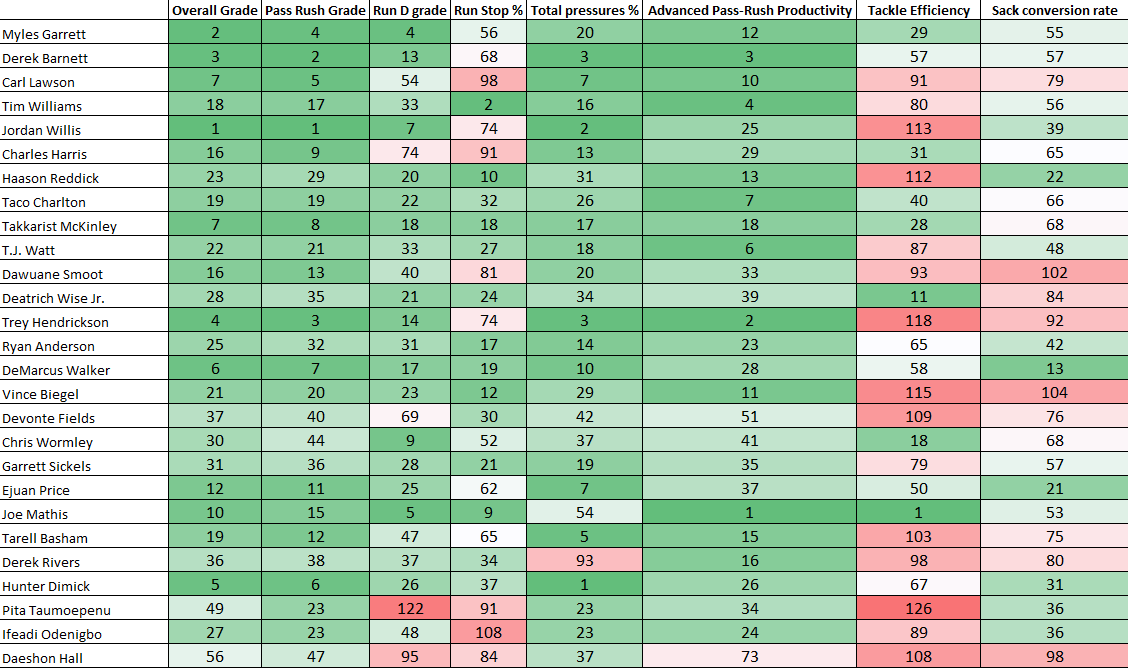
2017 Edge Class Rankings
Rankings
1. Myles Garrett, Texas A&MMyles Garrett is the unquestioned top edge prospect in this class. The biggest criticism I’ve seen of Garrett is that he didn’t record enough sacks in SEC play. If you don’t think he was productive against the SEC the past three seasons, however, you simply didn’t watch the games. Garrett is a freak of nature physically who is still only scratching the surface of his potential.
Pro Football Focus ✔ @PFF
“If Michelangelo were sculpting the perfect edge rusher, he’d likely come up with something like Myles Garrett” http://bit.ly/2l8tom42. Derek Barnett, Tennessee
Athletically, Barnett is the antithesis of Garrett. Production-wise, he’s the only player in the class that can compare to Garrett over the course of their careers. Barnett’s 37 combined sacks and hits this past season were far and away the most in college football. He also has 20 total sacks in SEC play the past two seasons. The only concern is his top-tier athleticism, but with the way Barnett wins—with power and hands—that’s not a big issue for me.
3. Carl Lawson, Auburn
The pass-rushers in the SEC last season kept a good number of quarterbacks up late on Friday nights. Lawson registered nine sacks, 13 hits, and 42 hurries in 2016 on only 364 pass-rushing snaps. Lawson wins the edge on offensive tackles as much as anyone in this class and makes them worry about getting out of their stance quickly with his first step. He pairs that up with some of the strongest hands I’ve seen in the class that keep him in control of interactions.
4. Solomon Thomas, Stanford
Thomas’ true position in the NFL is still up in the air, and he could very well play a number of different techniques depending on the situation. He was most often utilized on the interior, with 90.6 percent of his snaps coming inside the tackles a season ago. But at 272 pounds, he might have to play on the edge in the NFL. Still, no player in college football graded out better against the run than Thomas. He also has the freakish athleticism at his size that could translate as a pass-rusher.
5. Tim Williams, Alabama
On a snap-for-snap basis, Williams has been the most effective pass-rusher in the nation over the past three seasons. The issue is that even over those three seasons, he’s only accumulated 685 snaps (485 as a pass-rusher). While he’s notched a ridiculous 22 sacks, 19 hits, and 83 hurries on those plays, it’s still concerning that he couldn’t see the field more. While Williams looks like one of the most athletic edge rushers in the class on tape, his combine performance was lackluster.
6. Jordan Willis, Kansas State
As owner of the highest overall grade of any edge player in the country a season ago, Willis absolutely dominated the Big 12. Then he went to Indianapolis and put up the most impressive combine performance of any edge prospect in the class. So if you’re looking for a player who checks the production and athleticism boxes, Willis is your guy. His biggest issue was level of competition faced. The Kansas State defensive end looked far more pedestrian in one-on-one’s at the Senior Bowl, but come actual game time in Mobile, and Willis registered two sacks and three hurries.
7. Haason Reddick, Temple
Haason Reddick is another player who may not end up on the edge at the next level, but this time for different reasons. Reddick’s athleticism and size could end up moving him to an off-ball linebacker spot at the next level, where he would obviously be a devastating weapon as a blitzer. Reddick was utilized in a true 3-4 outside linebacker role at Temple, dropping into coverage on 74 of his 322 passing snaps last season. That means that his 43 QB pressures last season came on only 248 pass rushes, a ridiculous rate. Reddick is the ultimate Swiss Army knife for defensive coordinators in the NFL.
8. Charles Harris, Missouri
Harris is the undisputed king of the spin move in this class, and has some freakish balance for a 253-pound man. His 28 combined sacks plus hits in 2016 were the fifth-most of any edge player, and he has a penchant for winning quickly. His poor combine will drop him down some boards, but the pass-rushing production is there in spades.
9. T.J. Watt, Wisconsin
The biggest concern with Watt is whether or not he’s a one-year wonder. Physically, though, there’s not much he can’t do. At 6-foot-4, 252 pounds, Watt put up fantastic explosive and change-of-direction numbers at the combine. That meshes with what we saw of him at Wisconsin, where he was arguably the most impressive of anyone in this class at closing on ball carriers in space. He’s still raw as a pass-rusher, as a good deal of his 56 QB pressures a season ago came unblocked, but the ability is there.
10. Taco Charlton, Michigan
Charlton is a physical specimen who simply overpowered college offensive tackles on the edge last season. Standing a legit 6-foot-6, 277 pounds, Charlton was a forced to be reckoned with as a bull-rusher and somehow had one of the most effective spin moves in the country at that size. He registered 18 combined sacks and hits last year, despite rushing the passer only 251 times.
11. Takkarist McKinley
McKinley has some of the best straight-line explosiveness in this class, and was too much physically for many college offensive tackles. He was responsible for one of projected first-round OT Garett Bolles’ three sacks allowed this season, and recorded 20 total sacks plus hits on the year. The biggest concern for the former Bruin was his disappearance in certain games. Stanford and Washington State both held McKinley in check for much of their games.
12. Deatrich Wise Jr., Arkansas
Another “tweener,” Wise’s best position is likely as a 3-4 defensive end. He had some issues holding up to double teams at Arkansas that limited his playing time, but he was incredibly productive on the 488 snaps he saw see as a senior. Then at the East-West Shrine Game, he utterly dominated, racking up two sacks, a hit, and five hurries. He’s still very raw, but Wise has some freakish tools to work with in the NFL.
13. Dawuane Smoot, Illinois
Smoot is one of the few pass-rushers on this list with an already-refined rip move. He also has the bend that makes one think that will translate to the next level. It’s a little concerning that his junior season—60 total QB pressures—greatly outshined his senior year (53 pressures). Smoot’s two-year production as a pass-rusher, however, is still among the 10 best in this class.
14. Trey Hendrickson, Florida Atlantic
Hendrickson was by far the most productive pass-rusher outside the Power-5 conferences. His 20.5 pass-rushing productivity led the entire nation as he racked up 78 QB pressures, second-most in the nation. This comes a year after he finished second in the country with 15 sacks in 2015. Hendrickson’s only knock is level of competition. That concern wasn’t eased at all by an average showing in the Shrine game after the season.
15. Ryan Anderson, Alabama
Anderson may not be what the NFL is looking for on the edge from a size and athleticism standpoint, but he simply gets the job done repeatedly. The Alabama outside linebacker ranked sixth and fifth the past two seasons among SEC edge players despite playing only 670 and 361 snaps respectively in those seasons. He’s already incredibly advanced with his hands and does a great job of keeping his body clean despite limited length.
Class superlatives
Best pure pass-rusher: Myles Garrett, Texas A&M
There’s a reason why Garrett is nearly a lock to go No. 1 overall. He earned a top-three pass-rushing grade as a freshman and sophomore before injuries limited him this past season to only seventh-best in the country.
Best against the run: Solomon Thomas, Stanford
Thomas’ 12.0 run-stop percentage was eighth-best among all defensive linemen in the country last year. I legitimately believe that even at 272 pounds, Thomas could be a full-time 3-technique if he wanted to be. That’s how stout he is versus the run.
Best at winning outside: Derek Barnett, Tennessee
This one may surprise some, but there is far more to winning the edge as a pass-rusher than simply burst off the line of scrimmage. Barnett is excellent at pacing his attack at an offensive tackle and baiting his opponent into getting flat-footed at the top of his set. After Barnett swats away the blocker’s hand, he has enough bend to consistently win the corner.
Best at winning inside: Haason Reddick, Temple
With the juice Reddick has off the edge, college tackles absolutely flew out of their stances against him. Any sort of inside counter or slant wreaked havoc for opposing offensive lines, as he possesses the ability to stop on a dime and duck inside.
Best bull-rusher: Myles Garrett, Texas A&M
272 pounds running a 4.64-second 40-yard dash with ridiculous burst off the line of scrimmage and 35¼-inch arms coming at you is a terrifying package. It’s no surprise that Garrett is the biggest bull-rush threat in this class.
Best spin move: Charles Harris, Missouri
Harris executing his spin is akin to the running back spin move in NFL Blitz. It all happens in the blink of an eye, and while he’s spinning, no one can touch him. No prospect in this class can rival the ease and frequency with which Harris pulled the move off.
March 21, 2017 at 11:00 pm in reply to: Connor Barwin visited Rams on Wednesday…signs on Thursday #66551znModeratorznModeratorThis spate of atomic diplomacy coincided with the end of the role played by Douglas MacArthur. After MacArthur had publicly and repeatedly differed with the president over military strategy in Korea, Truman replaced him with General Matthew Ridgway, who was given “qualified authority” to use the bombs if he felt he had to.
Still too much missing but better than this:
“…brought the peninsula to the brink of nuclear conflagration, if American generals had their way at the time.”
-
AuthorPosts