Forum Replies Created

Viewing 30 posts - 3,901 through 3,930 (of 8,029 total)
  • Author
    Posts
  • in reply to: Reasons why Romney believes Trump will win #118352
    Avatar photoZooey
    Moderator

    I saw that article yesterday, and I don’t think much of Romney’s argument. It’s really so flimsy, I wonder what he is up to in publishing it.

    in reply to: Biden, Trump, the left, elections… #118333
    Avatar photoZooey
    Moderator

    in reply to: Biden, Trump, the left, elections… #118332
    Avatar photoZooey
    Moderator

    in reply to: Biden, Trump, the left, elections… #118316
    Avatar photoZooey
    Moderator

    I agree with all that, Billy.

    in reply to: Biden, Trump, the left, elections… #118303
    Avatar photoZooey
    Moderator

    in reply to: Biden, Trump, the left, elections… #118302
    Avatar photoZooey
    Moderator

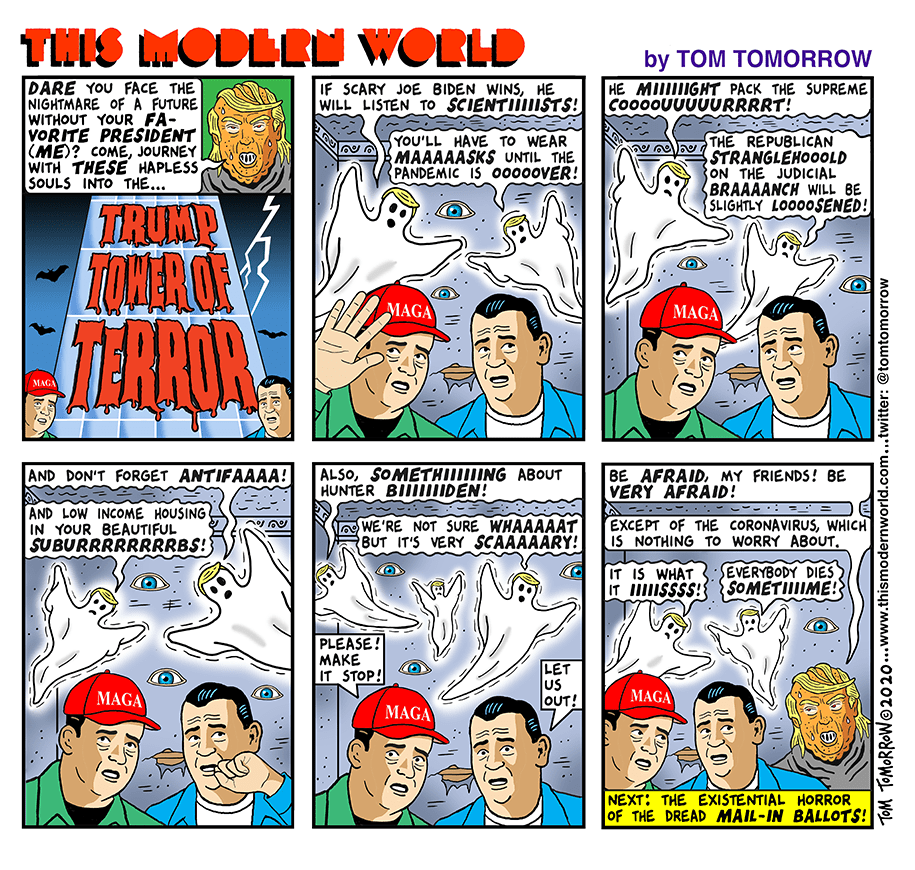
    in reply to: Tom Tomorrow #118235
    Avatar photoZooey
    Moderator

    in reply to: For those contemplating sitting out November elections #118223
    Avatar photoZooey
    Moderator

    Here is a somewhat sobering add-on to that.

    Yeah…there is literally nothing to stop the boogaloo boys and all the neo-nazis from just going into protests and throwing people into vans and driving off. We’ve seen pretty clearly this summer that the actual cops are totally down with white supremacists. What would stop them from doing this?

    in reply to: Biden, Trump, the left, elections… #118218
    Avatar photoZooey
    Moderator

    in reply to: Bernie on leftist concerns #118153
    Avatar photoZooey
    Moderator

    Remember how libruls worried that if Sanders go the nomination, the right wing and media would label him a leftist, and it would cost votes, and we said it didn’t matter WHOM the Democrats nominated, they would do that anyway?

    Avatar photoZooey
    Moderator

    Avatar photoZooey
    Moderator

    About 1/4 of our staff is anti-maskers to the point of saying they would refuse to wear a mask.

    Man.

    Educators are supposed to be educated.

    Yeah. Well. So I’m seeing comments all over the place saying, “Hey, what’s this shit about not being able to enforce a mask policy? Schools seem to be able to enforce skirt length, and spaghetti straps. Oh…snap!”

    Okay. Your spaghetti straps didn’t kill anybody.

    And you didn’t spend your day switching your skirt every 30 seconds.

    And the teacher sent you to the office when it was convenient, and that was the end of it. There wasn’t a classroom full of kids that switched back and forth between clothes any time the teacher turned her back. Nor did they cluster in that alcove by the gym to violate the policy until an adult came near, and then switch back.

    I guarantee there are a million kids who think the mask rule is as dumb and pointless and the dress code policies, and they will violate it as often as they can to prove their courage and wisdom. With the tacit support of some of the teachers.

    That’s American schools in 2020.

    Avatar photoZooey
    Moderator

    Districts all over California are going to full online to start the year. My district is still planning to open, but with Sacramento just announcing a couple hours ago that they are out, my district (adjacent) will likely follow within a day or two.

    And some teachers are upset. About 1/4 of our staff is anti-maskers to the point of saying they would refuse to wear a mask.

    Avatar photoZooey
    Moderator

    in reply to: Tom Tomorrow #117947
    Avatar photoZooey
    Moderator

    Avatar photoZooey
    Moderator

    How to Reopen Schools: What Science and Other Countries Teach Us
    The pressure to bring American students back to classrooms is intense, but the calculus is tricky with infections still out of control in many communities.

    By Pam Belluck, Apoorva Mandavilli and Benedict Carey
    July 11, 2020

    link https://www.nytimes.com/2020/07/11/health/coronavirus-schools-reopen.html?fbclid=IwAR1eaVtVh7cg625vf46u6klRJlQQg3AorJP-v2opXz5BatF85Qz4vp6HuGE

    As school districts across the United States consider whether and how to restart in-person classes, their challenge is complicated by a pair of fundamental uncertainties: No nation has tried to send children back to school with the virus raging at levels like America’s, and the scientific research about transmission in classrooms is limited.

    The World Health Organization has now concluded that the virus is airborne in crowded, indoor spaces with poor ventilation, a description that fits many American schools. But there is enormous pressure to bring students back — from parents, from pediatricians and child development specialists, and from President Trump.

    “I’m just going to say it: It feels like we’re playing Russian roulette with our kids and our staff,” said Robin Cogan, a nurse at the Yorkship School in Camden, N.J., who serves on the state’s committee on reopening schools.

    Data from around the world clearly shows that children are far less likely to become seriously ill from the coronavirus than adults. But there are big unanswered questions, including how often children become infected and what role they play in transmitting the virus. Some research suggests younger children are less likely to infect other people than teenagers are, which would make opening elementary schools less risky than high schools, but the evidence is not conclusive.

    The experience abroad has shown that measures such as physical distancing and wearing masks in schools can make a difference. Another important variable is how widespread the virus is in the community over all, because that will affect how many people potentially bring it into a school.

    For most districts, the solution won’t be an all-or-nothing approach. Many systems, including the nation’s largest, New York City, are devising hybrids that involve spending some days in classrooms and other days online.

    “You have to do a lot more than just waving your hands and say make it so,” said Dr. Joshua Sharfstein, a professor of the practice at Johns Hopkins Bloomberg School of Public Health. “First you have to control the community spread and then you have to open schools thoughtfully.”

    The transmission puzzle
    Though children are at much lower risk of getting seriously ill from the coronavirus than adults, the risk is not zero. A small number of children have died and others needed intensive care because they suffered respiratory failure or an inflammatory syndrome that caused heart or circulatory problems.

    The larger concern with reopening schools is the potential for children to become infected, many with no symptoms, and then spread the virus to others, including family members, teachers and other school employees. Most evidence to date suggests that even if children under 12 are infected at the same rates as the adults around them, they are less likely to spread it. The American Academy of Pediatrics has cited some of this data to recommend that schools reopen with proper safety precautions.

    But the bulk of the evidence was collected in countries that were already in lockdown or had begun to implement other preventive measures. And few countries have systematically tested children for the virus or for antibodies that would indicate whether they had been exposed to the virus.

    Infectious disease specialists have been modeling schools’ impact on community spread beginning as far back as February.

    In March, most modelers agreed that closing schools would slow the progression of infections. But wider measures, like social distancing, proved to have a far greater containing effect, overshadowing the results of school closings, according to recent analyses.

    The risk of reopening “will depend on how well schools contain transmission, with masks, for instance, or limiting occupancy,” said Lauren Ancel Meyers, a professor of biology and statistics at the University of Texas, Austin, who has been consulting with the city and school districts. “The background community transmission rate in August will also be a factor.”

    In Austin, for example, which like cities in Florida and Arizona has seen a recent acceleration in new cases, the estimated infection rate now is about seven per 1,000 residents. That means a school with 500 students would have about four carrying the coronavirus. “The school might be able to contain those, depending on the measures it takes,” Dr. Meyers said.

    If not, schools could help incubate outbreaks, given that they’re enclosed facilities where students, especially younger ones, are likely to have great difficulty social distancing, never mind wearing masks. Even if it turns out that children do not spread the virus efficiently, all it would take is one or two to seed new chains.

    The evidence from abroad
    So far, countries that reopened schools after reducing infection levels — and imposed requirements like physical distancing and limits on class sizes — have not seen a surge in coronavirus cases.

    Norway and Denmark are good examples. Both reopened their schools in April, a month or so after they were closed, but they initially opened them only for younger children, keeping high schools shut until later. They strengthened sanitizing procedures, and have kept class size limited, children in small groups at recess and space between desks. Neither country has seen a significant increase in cases.

    There have not yet been rigorous scientific studies on the potential for school-based spread, but a smattering of case reports, most of them not yet peer-reviewed, bolster the notion that it is not inevitably a high risk.

    One snapshot comes from a study in Ireland of six infected people (two high school students, an elementary student and three adults) who spent time in schools before they were closed in March. The researchers analyzed 1,155 contacts of the six patients to see if any had been found to have confirmed coronavirus infection. The contacts included participants in school activities that could be fertile ground for transmission, like music lessons on woodwind instruments, choir practice and sports. None of the students appeared to have infected any other people, the authors reported, adding that the only documented transmission of the virus was to two adults who were in contact with one of the infected adults outside of school.

    But there have been school-based outbreaks in countries with higher community infection levels and countries that apparently eased safety guidelines too soon. In Israel, the virus infected more than 200 students and staff after schools reopened in early May and lifted limits on class size a few weeks later, according to a report by University of Washington researchers.

    Case studies in some countries suggest differences in virus transmission in younger children compared to older children.

    In one community in northern France, Crépy-en-Valois, two high school teachers became ill with Covid-19 in early February, before schools closed. Scientists from the Institut Pasteur later tested the school’s students and staff for coronavirus antibodies. They found antibodies in 38 percent of the students, 43 percent of the teachers, and 59 percent of other school staff, said Dr. Arnaud Fontanet, an epidemiologist at the institute who led the study and is a member of a committee advising the French government.

    “Clearly you know that the virus circulated in the high school,” Dr. Fontanet said.

    Later, the team tested students and staff from six elementary schools in the community. The closure of schools in mid-February provided an opportunity to see if younger children had become infected when schools were in session, the point when the virus struck high school students.

    Researchers found antibodies in only 9 percent of elementary students, 7 percent of teachers and 4 percent of other staff. They identified three students in three different elementary schools who had attended classes with acute coronavirus symptoms before the schools closed. None appeared to have infected other children, teachers or staff, Dr. Fontanet said. Two of those symptomatic students had siblings in the high school and the third had a sister who worked in the high school, he said.

    The research also indicated that when an elementary school student tested positive for coronavirus antibodies, there was a very high probability that the student’s parents had also been infected, Dr. Fontanet said. The probability was not nearly as high for parents of high school students. “When I look at the timing, we think it started in the high school, moved into the families and then to the young students,” he said.

    Dr. Fontanet said that the findings suggest that older children may be able to transmit the virus more easily than younger children.

    That pattern may also be reflected by the experience in Israel, where one of the largest school outbreaks, involving about 175 students and staff, occurred in Gymnasia Rehavia, a middle and high school in Jerusalem.

    There are different theories about why older children would be more likely to transmit the virus than younger children. Some scientists say that younger children are less likely to have Covid-19 symptoms like coughs and less likely to have strong speaking voices, both of which can transmit the virus in droplets. Other researchers are examining whether proteins that enable the virus to enter lung cells and replicate are less abundant in children, limiting the severity of their infection and potentially their ability to transmit the virus.

    What schools can do
    Testing for infections in schools is essential, public health experts said. The Centers for Disease Control and Prevention recommends testing of students or teachers based only on symptoms or a history of exposure. But that will not catch everyone who is infected.

    “We know that asymptomatic or pre-symptomatic spread is real, and we know that kids are less likely to show symptoms if they’re infected than adults,” said Dr. Megan Ranney, an emergency medicine doctor and expert in adolescent health at Brown University. Schools should randomly test students and teachers, she said, but that may be impossible given the lack of funding and limited testing even in hospitals

    Countries that have reopened schools have implemented a range of safety guidelines.

    Some countries initially brought back only a portion of their students — younger children in Denmark, Norway, Belgium, Switzerland and Greece; older children in Germany, according to the report by University of Washington researchers. Belgium brought back students in shifts on alternate days.

    Several countries limited class size, often allowing a maximum of 10 to 15 students in a classroom. Many place desks several feet apart. Several countries group children in pods or cohorts with social interaction largely restricted to those groups, especially at recess and lunchtime.

    Mask-wearing policies vary. In Asia, where the practice of wearing masks during flu season is common, many countries are requiring masks in school. Elsewhere, some countries required masks for only some students or staff, such as teachers in Belgium and high school students in France, according to the University of Washington report.

    In Germany, students who test negative for the virus do not have to wear masks, according to the report, which said that since opening schools, Germany has seen increased transmission of the virus among students, but not school staff.

    The C.D.C. has outlined steps schools can take to minimize the risks for students, including maintaining a distance of six feet, washing hands and wearing masks.

    “The guidelines are already exceptionally weak,” said Carl Bergstrom, an infectious diseases expert at the University of Washington in Seattle. He and others said they feared that the recommendations would get watered down even more in response to political pressure.

    The C.D.C. has been working on new recommendations for reopening schools for several weeks, in consultation with organizations like the National Association of School Nurses, according to a C.D.C. spokeswoman. The five planned documents include guidance on symptom screening and face masks, and a checklist for parents or guardians trying to decide whether to send their children to school. But they do not include any information on improving ventilation or curtailing airborne spread of the virus.

    Schools will need to ensure that they circulate fresh air, whether by filtering the air, pumping it in from the outside, or simply by opening windows, said Saskia Popescu, a hospital epidemiologist at The University of Arizona. School nurses like Ms. Cogan will also need protective equipment like gloves, gowns and N95 masks.

    There are differences in how other countries are responding when coronavirus cases are identified in schools, with some countries, like Israel, closing entire schools for a single case and others taking the more targeted approach of sending students and teachers in an affected classroom into home quarantine for two weeks.

    Dr. Kathryn Edwards, an infectious disease specialist and professor of pediatrics at Vanderbilt University School of Medicine, is advising Nashville schools on reopening approaches. She said the district is still evaluating how far apart desks should be. “Some people say you only need three feet and others say you need six feet, and others wonder with the aerosol issue, do we need more distance?”

    Dr. Edwards said she was disappointed by Nashville’s decision, announced Thursday, to conduct classes online for the first month of school, at least until Labor Day.

    Keeping schools closed for a prolonged stretch has worrisome implications for social and academic development, child development experts say. It also became evident this spring that denying children a real school day deepened racial and economic inequalities.

    “There is really damage to kids if they don’t go to school,” Dr. Edwards said. “I think we have got to think of the kids and getting them back to school safely.”

    in reply to: Nathan Robinson is my hero! #117790
    Avatar photoZooey
    Moderator

    I haven’t followed the Taibbi bruhaha, and so I’m not confident I have a clear understanding of what it’s about.

    I will say that I follow Taibbi on Twitter, and more than have the tweets that appear on my feed are Taibbi fighting with nobodies who criticize him. I think he’s fallen into the Twitter maelstrom of hostility, people he should ignore. I do wonder if that has colored his views on “the left.”

    And I see Robinson doing the same thing. They are both responding to personal criticism and spending a lot of energy fighting idiots they would be better off not engaging.

    in reply to: Angela Davis on voting for biden #117703
    Avatar photoZooey
    Moderator

    I think she’s right.

    I don’t expect any effort from Biden to lead. He’s not a leader. And he isn’t going to lay out a vision for the future this country needs. But he will certainly be more responsive to mass pressure. He can be leveraged into doing some things that are helpful to some degree. Trump can’t. Trump can’t even…you know…tell people they should wear masks.

    in reply to: Tom Tomorrow #117636
    Avatar photoZooey
    Moderator

    in reply to: Biden, Trump, the left, elections… #117635
    Avatar photoZooey
    Moderator

    in reply to: Biden, Trump, the left, elections… #117634
    Avatar photoZooey
    Moderator

    in reply to: One man’s hack-sized def. of leftism #117632
    Avatar photoZooey
    Moderator

    in reply to: One man’s hack-sized def. of leftism #117615
    Avatar photoZooey
    Moderator

    Maybe Beau’s not a Leftist. Maybe he’s just Progressive.

    There are Stages of Enlightenment.

    I took a selfie today:

    in reply to: Tom Tomorrow #117351
    Avatar photoZooey
    Moderator

    Avatar photoZooey
    Moderator

    PS — just an aside — …it took me a while to kinda figure the show out. For the longest time I just assumed Sagaar was a leftist like Krystal. My youtube feeds almost always just had Krystal Ball talking and Sagaar just sitting there. And I’ve never seen a vid where they ‘debate.’ So, i just assumed for the longest time he was agreeing with everything she was saying. I ‘still’ dont know much about what kind of Trumpie he is. I just never paid much attention to him.

    w
    v

    That fooled me for a while, too. He’s a not really a Trumpie, as far as I can tell. He’s a right wing populist, so he “gets” the Trump appeal, but he isn’t in it for the racism. He was in it, I think, for “drain the swamp” and “NAFTA sucks.” He is conservative economically. Kinda sides with Law and Order. Lower taxes. But is not pro-corporate dominance and government unaccountability and spying on people and stuff. I think.

    in reply to: virus news … (+ some dark humor) #117218
    Avatar photoZooey
    Moderator

    in reply to: tweets & things … 6/26 thru 6/30 #117198
    Avatar photoZooey
    Moderator

    in reply to: masks #117110
    Avatar photoZooey
    Moderator

    It’s hard not to see this as a deliberate culling of the population, actually. Someone please tell me I’m wrong.

    From the beginning, it was believed that elderly populations would be hit hardest. And what better way to free up Social Security payments, and better yet…Medicare expenditures? The other hard hit group will be the “essential workers,” who will be hit hardest in urban areas, and frankly, they are disproportionately minorities. So fuck them. And they penciled it out…estimates of 1 – 2 million killed…most of whom fall in one of the above two categories…and that works out as a win for sociopathic oligarchs. That’s not enough deaths to create a labor shortage and put upward pressure on wages, so…no downside to just letting the coronavirus rip right through those people we see as more of a liability than an asset.

    Carry on, America.

    in reply to: masks #117102
    Avatar photoZooey
    Moderator

    If America had had a national buy-in for mask-wearing in late January, we could have opened up, in a relatively safe manner, months ago. But that would have taken Trump, his admin and all “leaders” to lead by example.

    The incompetence is staggering. And calling it “incompetence” is the most generous term I can think to apply to this.

    The United States of America has the WORST covid response in the industrialized world, and we had more time to prepare for it than any other country in that category.

    in reply to: Tom Tomorrow #117096
    Avatar photoZooey
    Moderator

Viewing 30 posts - 3,901 through 3,930 (of 8,029 total)