
Forum Replies Created
-
AuthorPosts
-
 znModerator
DEMOCRATS ARE WRONG: TRUMP SUPPORTERS WERE MORE MOTIVATED BY RACISM THAN ECONOMIC ISSUES
IT ISN’T ONLY Republicans, it seems, who traffic in alternative facts. Since Donald Trump’s shock election victory, leading Democrats have worked hard to convince themselves, and the rest of us, that his triumph had less to do with racism and much more to do with economic anxiety — despite almost all of the available evidence suggesting otherwise.
Consider Bernie Sanders, de facto leader of the #Resistance. “Some people think that the people who voted for Trump are racists and sexists and homophobes and deplorable folks,” he said at a rally in Boston on Friday, alongside fellow progressive senator Elizabeth Warren. “I don’t agree.” Writing in the New York Times three days after the election last November, the senator from Vermont claimed Trump voters were “expressing their fierce opposition to an economic and political system that puts wealthy and corporate interests over their own”.
Warren agrees with him. “There were millions of people across this country who voted for [Trump] not because of his bigotry, but in spite of that bigotry” because the system is “not working for them economically,” the Massachusetts senator told MSNBC last year.
Both Sanders and Warren seem much keener to lay the blame at the door of the dysfunctional Democratic Party and an ailing economy than at the feet of racist Republican voters. Their deflection isn’t surprising. Nor is their coddling of those who happily embraced an openly xenophobic candidate. Look, I get it. It’s difficult to accept that millions of your fellow citizens harbor what political scientists have identified as “racial resentment.” The reluctance to acknowledge that bigotry, and tolerance of bigotry, is still so widespread in society is understandable. From an electoral perspective too, why would senior members of the Democratic leadership want to alienate millions of voters by dismissing them as racist bigots?
Facts, however, as a rather more illustrious predecessor of President Trump once remarked, “are stubborn things.” Interestingly, on the very same day that Sanders offered his evidence-free defense of Trump voters in Boston, the latest data from the American National Election Studies (ANES) was released.
Philip Klinkner, a political scientist at Hamilton College and an expert on race relations, has pored over this ANES data and tells me that “whether it’s good politics to say so or not, the evidence from the 2016 election is very clear that attitudes about blacks, immigrants, and Muslims were a key component of Trump’s appeal.” For example, he says, “in 2016 Trump did worse than Mitt Romney among voters with low and moderate levels of racial resentment, but much better among those with high levels of resentment.”
The new ANES data only confirms what a plethora of studies have told us since the start of the presidential campaign: the race was about race. Klinkner himself grabbed headlines last summer when he revealed that the best way to identify a Trump supporter in the U.S. was to ask “just one simple question: is Barack Obama a Muslim?” Because, he said, “if they are white and the answer is yes, 89 percent of the time that person will have a higher opinion of Trump than Clinton.” This is economic anxiety? Really?
Other surveys and polls of Trump voters found “a strong relationship between anti-black attitudes and support for Trump”; Trump supporters being “more likely to describe African Americans as ‘criminal,’ ‘unintelligent,’ ‘lazy’ and ‘violent’”; more likely to believe “people of color are taking white jobs”; and a “majority” of them rating blacks “as less evolved than whites.” Sorry, but how can any of these prejudices be blamed on free trade or low wages?
For Sanders, Warren and others on the left, the economy is what matters most and class is everything. Yet the empirical evidence just isn’t there to support them. Yes Trump won a (big) majority of non-college-educated whites, but he also won a majority of college-educated whites, too. He won more young white voters than Clinton did and also a majority of white women; he managed to win white votes regardless of age, gender, income or education. Class wasn’t everything in 2016. In a recent essay in The Nation, analysts Sean McElwee and Jason McDaniel point out that “income predicted support for McCain and Romney, but not Trump.” Their conclusion? “Racial identity and attitudes have further displaced class as the central battleground of American politics.”
Their view is backed by a detailed Gallup analysis of interviews with a whopping 125,000 Americans, which found that Trump supporters, far from being the “left behind” or the losers of globalization, “earn relatively high household incomes and are no less likely to be unemployed or exposed to competition through trade or immigration.” The “bottom line” for Gallup’s senior economist Jonathan Rothwell? “Trump’s popularity cannot be neatly linked to economic hardship.”
Look, if you still believe that Trump’s appeal was rooted in economic, and not racial, anxiety, ask yourself the following questions: Why did a majority of Americans earning less than $50,000 a year vote for Clinton, not Trump, according to the exit polls? Why, in the key Rust Belt swing states of Michigan, Wisconsin and Pennsylvania, did most voters who cited the economy as “the most important issue facing the country” opt for Hillary over the Donald? And why didn’t black or Latino working class voters flock to Trump with the same fervor as white working class voters? Or does their economic insecurity not count?
To be clear, no one is saying there weren’t any legitimate economic grievances in Trumpland, nor is anyone claiming that the economy played no role whatsoever. The point, however, is that it wasn’t the major motivating factor for most Trump voters — or, at least, that’s what we learn when we bother to study those voters. Race trumped economics.
Defenders of the economy narrative have a “gotcha” question of their own: how can racial resentment have motivated Trump supporters when so many of them voted for Barack Obama, across the Rust Belt, in 2008 and 2012? “They’re not racists,” filmmaker Michael Moore passionately argued last November. “They twice voted for a man whose middle name is Hussein.”
Klinkner, though, gives short shrift to this argument. First, he tells me, “most of them didn’t vote for Obama. There weren’t many vote switchers between 2012 and 2016.” Second, “working class whites shifted to Trump less because they were working class than because they were white.” Klinkner points out that in 2016, Clinton, unlike Obama, faced a Republican candidate who “pushed the buttons of race and nativism in open and explicit ways that John McCain and Mitt Romney were unwilling or unable to do.”
If Democrats are going to have any chance of winning back the White House in 2020, they have to understand why they lost in 2016, and that understanding has to be based on facts and figures, however inconvenient or awkward. The Sanders/Warren/Moore wing of the party is right to focus on fair trade and income equality; the calls for higher wages and better regulation are morally and economically correct. What they are not, however, is some sort of silver bullet to solve the issue of racism. As the University of California’s Michael Tesler, author of “Post-Racial or Most-Racial? Race and Politics in the Obama Era,” has pointed out, the “evidence suggests that racial resentment is driving economic anxiety, not the other way around.”
Always remember: You have to identify the disease before you can begin work on a cure. In the case of support for Donald Trump, the results are in: It isn’t the economy. It’s the racism, stupid.
znModeratorJohn Schneider: Richard Sherman trade talk didn’t come out of nowhere
Josh Alper
John Schneider: Richard Sherman trade talk didn’t come out of nowhere
When talk of the Seahawks trading cornerback Richard Sherman first surfaced late last month, Sherman initially laughed it off before issuing a more serious statement in light of comments from General Manager John Schneider and coach Pete Carroll.
Among the things Schneider said was that the team listens to everything that other teams might send their way and he expanded on the topic during an appearance with Brock and Salk on 710 ESPN Wednesday. Schneider said that what “you’ve seen lately in the news is real.”
“This isn’t a secret like this just came out of nowhere,” Schneider said. “People find things out and we’re not going to lie to each other and we’re not going to BS each other. It’s going to be all laid out, and like I said, that doesn’t happen everywhere. . . . It’s just open communication.
He knows what’s going on. We know what’s going on. I don’t know if anything would ever happen, but like I tell people all the time, 98 percent of the deals that we’re involved with, we don’t follow through with. But at least we’ve opened that door, gone down the road and seen what’s behind Door A or Door B.”
Carroll said that he doesn’t see anything happening, but that he was also “anxious” to see Sherman “handle everything and do really well and represent himself and his teammates in great fashion” after a 2016 season that saw him spend time scrapping with assistant coaches and the media.
Both those comments and the ones Schneider made on Wednesday sent a pretty clear message to Sherman that he’s not guaranteed to remain in Seattle. As of now, there’s no sign that anything the Seahawks have heard make a trade likely before the start of next season but they’ve made no secret that they’re willing to hear something that could change that state of affairs.
——–
—-
—Seahawks are making a point to Richard Sherman
Mike Florio
Seahawks are making a point to Richard Sherman
Some would say the transparency that the Seahawks are applying to the Richard Sherman trade chatter is refreshing. Others would say that the transparency isn’t accidental or aimed at catering to the media but strategic in nature.
Sherman’s behavior became problematic for the Seahawks during the 2016 season. From a tantrum during a regular-season win over the Falcons that became an in-game distraction to a tantrum during a regular-season win over the Rams that became an in-game distraction to an “animated” post-game discussion with coach Pete Carroll to a press-conference threat to ruin a reporter’s career to whatever else we don’t know about (and linebacker Bobby Wagner said during a late-season appearance on PFT Live that, generally speaking, plenty of things happen within the confines of a football team that we’ll never know about), the Seahawks have decided that the time has come to at least see if anyone is willing to trade for Sherman.
The message to Sherman has multiple layers. First, the willingness to consider offers shows he’s not untouchable, despite what he may have believed. Second, the lack of a land rush for Sherman shows that he’s not as valued elsewhere as he may have believed.
How Sherman reacts to the latest blast of candor from G.M. John Schneider remains to be seen. Sherman went from laughing off the talk to a more pragmatic view after Schneider first legitimized the chatter. Now that Schneider seems to be publicly twisting the screws a bit, Sherman may erupt.
Or maybe he won’t. Maybe Sherman will realize that, in order to continue earning eight figures per year, there are certain boundaries he must honor — and that few players are so good on the field that they can say and do whatever they want away from it.
znModeratorRussia is a gawd-awful right-wing authoritarian oligarchy. How is your Russian news on criticizing Russia?
A lot of critiques I see of american policy from a purely russian perspective are complete bs. From top to bottom. And the same goes for the non-Russians they sponsor too. They’re especially bad when it comes to things like Syria.
And of course I am not one of those who thinks that that means american MSM is okay. It’s not an “either/or” thing.
There are sources available to us on everything that are far better than both. So I don’t see the point in paying any attention to the Russians at all. It’s all pro-Russian self-justifying agenda stuff. Of all the things to pay attention to, why them?
Again it’s not either/or and I don’t see the value in what they do, at all. I did just fine without them even during the run-up to the Iraq war. Cause. Again. They’re bad and it’s not either/or. There’s lots of valuable ways around both of them.
I don’t see the value in it. To me they’re just one more problem among others. It’s like, okay as if we didn’t have enough to do we have to sort through that, too.
Nothing pro-Russia serves any good purpose of any kind, IMO. I don’t see the point.
.
————-
Well that just sounds to me like you havent actually watched any of the good RT vids.
w
vWhy would I do that?
They are not irreplaceable.
In terms of good sources there are plenty out there.
And the plenty that are out there are not state-sponspored propaganda machines for an aggressive anti-democratic right wing oligarhic state.
Why would I bother to sort through what might be good in all that and separate it from the lies, conspiracy theory, propaganda and so on.
I dont’ need to. There are sources where you don’t HAVE TO do that.
And to be honest with you, lefties I know who actually take Russia seriously on some issues are invariably buying into a whole bunch of disinformation, and it’s obvious they are. For example anyone influenced by the Russian view of Syria to me is just wasting my time.
We don’t need the Russians and they are not worth the trouble.
/.
znModeratorPFF: 3 draft needs for the Los Angeles Rams
https://www.profootballfocus.com/draft-3-draft-needs-for-the-los-angeles-rams/
The Rams’ roster has several needs that could be addressed in the draft. Analyst Jordan Plocher identifies three of the biggest ones.
The Los Angeles Rams don’t have a first-round pick in 2017, as it was traded away as part of the compensation for the rights to the first overall selection in 2016. As a result of the trade-up for QB Jared Goff the Rams don’t have a selection until pick No. 37 in the 2017 draft.
The Rams need to do a better job of protecting Goff. The free-agent addition of tackle Andrew Whitworth and center John Sullivan will go a long way in helping to keep Goff upright, but both players are on the backend of their careers and the Rams’ offensive line could use some youth. The Rams must also add playmakers at wide receiver and tight end if they want see marked improvement from Goff and their offense in 2017. Here’s some key targets and the key areas of need for Los Angeles in this year’s draft.
Need: Playmakers at wide receiver
The Rams had a thin wide receiver unit in 2016 but then lost their most productive receiver Kenny Britt in free agency. While they added free agent Robert Woods, they still need to add playmakers at wide receiver to go along with Woods and Tavon Austin. Goff had excellent red-zone touch and accuracy at Cal and the Rams would be wise to build to his strengths. The Rams could use a big body to haul in Goff’s passes into the end zone or to haul in third-down passes at the sticks and move the chains for the new Rams’ offense.
Early-round target: JuJu Smith Schuster, WR, USC
Smith-Schuster is a prospect who has shown he can win with strength and size. Although he has been inconsistent over the span of his career he has battled through some injuries and a shifting role in the USC offense. Still he has consistently gained yards after the catch and averaged 6.1 yards after the catch per completion over the last three years. If Smith-Schuster can play with the physical nature that he is capable of he would be an ideal candidate to help out Goff. Our friends at 120 Sports also thought JuJu Smith-Schuster is a good fit for the Rams, and discussed why in this video: https://www.profootballfocus.com/draft-juju-smith-schuster-might-be-the-perfect-fit-for-the-rams/
Mid- or late-round target: Jalen Robinette, WR, Air Force
Goff could use a big-bodied red-zone threat who can box his man out and catch touchdown passes. Robinette excelled at that role at Air Force and he could be a target if the Rams don’t add a wide receiver on the second day of the draft. Robinette plays wide receiver like a good rebounding forward in basketball. Robinette also displayed the leaping ability and ball skills to catch the passes that are targeted “helmet or higher” in the red zone so only the wide receiver can catch it. Robinette is also highly productive on downfield play-action passes and caught all 17 of his deep targets (20 or more yards downfield) for 699 yards.
Need: Center
The Rams will likely be running more outside zone runs under head coach Sean McVay in 2017 than they ran in 2016. While newly signed free agent John Sullivan knows McVay’s offense from their time together in Washington, a young athletic center would be a valued addition to the new offense. The opportunity to pair a talented young rookie center with Goff and let them develop together would have to be strongly considered.
Early-round target: Ethan Pocic, C, LSU
Pocic is our top-ranked center in the draft class. Pocic isn’t as athletic as some other centers in the draft but is long and rangy for a center and consistently demonstrated his effectiveness as a reach blocker on outside zone runs. More importantly for the Rams’ offense Pocic has been successful at keeping pass-rushers off his quarterback as he didn’t allow a sack or hit in 2016. Pocic has only allowed 2 sacks, 2 hits, and 27 hurries over the span of the last three seasons and 963 pass-blocking snaps.
Mid- or late-round target: Chase Roullier, OC, Wyoming
Roullier is an incredibly effective run-blocker and one of the most athletic centers in the draft class. Roullier is very good at reaching his man in outside zone run plays and splitting the defense. Roullier would be a great fit for the Rams’ new offensive scheme in 2017 and even if he isn’t selected until the third day of the draft, he would have a strong shot at winning the starting center spot. Roullier did not allow a sack and only gave up 1 hit and 7 hurries on 462 pass-block snaps in 2016.
Need: Cornerback
Just a few seasons ago the Rams secondary was a strength on the team but the depth and talent has been depleted via free agency. Expect the Rams to be playing a healthy dose of man coverage next season under new defensive coordinator Wade Phillips and as a result to be eyeing athletic cornerbacks who can stay with receivers in sticky man coverage. Luckily for the Rams this is a very deep cornerback class and they should be able to find at least one contributor at the position in the draft.
Early-round target: Adoree’ Jackson, CB, USC
Jackson is one of the better athletes in the draft class. He has tremendous catch-up speed and can make touchdown-saving tackles of fast running backs from behind. Jackson is still a bit raw in coverage technique but has tremendous ball skills and has broken up 19 passes and made 6 interceptions over the past three seasons. Jackson’s aforementioned ball skills, speed and his open-field running ability combine to make him a dangerous returner who is a threat to score every time he touches the ball. Jackson could also be used on offense for a few snaps a game to supplement a thin wide receiver group much like the Cardinals did a few years ago with Patrick Peterson.
Mid- or late-round target: Shaquill Griffin, CB, Central Florida
Griffin’s coverage ability and grades improved each of the last three seasons and he finished 2016 with an impressive 87.2 coverage grade. He showed at the combine that he is one of the classes top athletes at the position by finishing in the top five among cornerbacks in the 40-yard dash, vertical jump and broad jump. Furthermore, Griffin showed on film that he has the coverage ability necessary to play outside in Wade Phillips’ defense. Griffin only allowed 39.7 percent of the passes thrown into his coverage to be caught in 2016. Griffin is a talented cornerback who will get pushed down in the draft due to the depth at his position.
znModeratorBonifayRam wrote:
Aaron Kromer most likely identified some future starting prospects already here signed & having experienced in starting in the NFL i.e. Andrew Donnal & Jamon Brown. In addition to having veteran David Arkin who has played center for Miami & Dallas in the past. But at the moment the Rams do not have a proven NFL starter in the center of our OL.
I am of the opinion that the 3 mil price tag for Tim Barnes was a major player in the decision on keeping Barnes or not. Another element was Tim was still ailing & rehabbing his broken down foot when the release came. It could be that Tim was not going to be ready to go @ the beginning of TC too. Wk 10 game TB injured his foot. Fox show;d the injury up close & the foot snapped downward. Tim went down went out for a few series went to locker room & returned limping badly to finish the game as our starter. Not much was known about it but it was the type that he could play on it but would be extremely painful. Tim made the decision to stay in the lineup. Tim’s play from that point went on a decline.
That has to do with center. What about other positions? When it comes to Rams OL already in place, I look at Donnal and Wichmann. One improved last year and one backslid. AD was by far the most improved Ram OL’er in 2016 season. When GRob was benched the first time (he was actually benched twice) Saffold started in place of GRob. I think that it was in the first quarter in the Saints game Saffold broke his hand & missed the rest of that game (had surgery & missed the following weeks game too)So who do you think replace Saffold it was not GRob for he was not even in New Orleans ? Can you say Andrew Donnal who took over the LT post for Saffold & the Rams had one of the better performances @ LT for the 2016 season in that game.But the right side of the OL turned in one of the worse of the 2016 season. Cody Wichmann sealed his doom that game as a starter the rest of the season.
During the 2016 season Andrew Donnal played in the offense @ RG, LT & RT. AD gave an awful performance during his rookie season 2015 as a starter @ LG but he was much better in 2016.
znModeratorRussia is a gawd-awful right-wing authoritarian oligarchy. How is your Russian news on criticizing Russia?
A lot of critiques I see of american policy from a purely russian perspective are complete bs. From top to bottom. And the same goes for the non-Russians they sponsor too. They’re especially bad when it comes to things like Syria.
And of course I am not one of those who thinks that that means american MSM is okay. It’s not an “either/or” thing.
There are sources available to us on everything that are far better than both. So I don’t see the point in paying any attention to the Russians at all. It’s all pro-Russian self-justifying agenda stuff. Of all the things to pay attention to, why them?
Again it’s not either/or and I don’t see the value in what they do, at all. I did just fine without them even during the run-up to the Iraq war. Cause. Again. They’re bad and it’s not either/or. There’s lots of valuable ways around both of them.
I don’t see the value in it. To me they’re just one more problem among others. It’s like, okay as if we didn’t have enough to do we have to sort through that, too.
Nothing pro-Russia serves any good purpose of any kind, IMO. I don’t see the point.
.
znModeratortop 50 prospects for 2017 NFL Draft 4.0
Daniel Jeremiah
It’s three weeks from the start of the 2017 NFL Draft (April 27-29 in Philadelphia), and like with NFL teams, my board is starting to settle in. Pro days are winding down, which means most of the information has been gathered on the top prospects in the draft. I’ll tweak this top 50 board one more time before the draft, but I don’t suspect there will be a ton of movement.
Here are my top 50 prospects in the 2017 draft, version 4.0:
1
Myles Garrett – DE, Texas A&M
Garrett has ideal size, length, and athleticism. In the passing game, he explodes out of his stance and can win with speed, power or hand moves. He can bend/wrap around the edge and he will also employ a nifty inside spin move. Against the run, he can stack and hold the point of attack but he’s at his best slanting and penetrating. His production dipped this season because of an injury and constant double and triple teams. His motor can run a little hot and cold but he’s forced to play a lot of snaps in the SEC. Overall, this is an elite talent with all-pro potential.
RANK
2
Jamal Adams – S, LSU
Adams has ideal size, versatility, and explosiveness for the position. He lines up as both the high safety and in the box. Against the pass, he is at his best roaming underneath or matching up in the slot. He can range and make plays from the deep middle, but he’s more valuable closer to the line of scrimmage. He doesn’t have a lot of ball production but he provides a physical presence and delivers huge hits on opposing pass-catchers. He is at his best in run support. He is quick to key and explode to the alley. With outstanding range against the run, he makes a lot of plays from the opposite hash. He is a dynamic athlete, and I’ve been told his intangibles are off the charts. He will be a tone-setter for an NFL defense, and he’s ready to play right away.
RANK
3
Malik Hooker – S, Ohio State
Hooker is a tall, rangy safety prospect with incredible instincts. He usually lines up as the high safety and he has an uncanny ability to anticipate throws, drive on the ball, and finish. He is ultra-fluid in his change of direction and has the ability to match up with tight ends in man coverage. He has the best ball skills of any safety I’ve ever evaluated in college. He is also a threat to score every time he touches the ball. Against the run, he is quick to key, read and fill the alley. He does have some fly-by missed tackles, but overall he’s reliable in this area. Hooker has the potential to be one of the league’s best safeties very early in his NFL career.
RANK
4
Leonard Fournette – RB, LSU 1
Fournette has an ideal combination of speed and power. As a runner, he is very aggressive to press the line of scrimmage and is always thirsty for contact. With some runway, he is a load for any single tackler to get on the ground. He does need to improve his patience and he will miss some backside opportunities on occasion. He is very effective in the open field because of his ability to lower himself and run over defenders or destroy them with a violent stiff arm. He rarely attempts to make anyone miss, preferring to punish instead. In the passing game, he isn’t a polished route runner but he catches the ball easy and he’s really improved in pass protection. He can locate blitzers, and is an effective shoulder thrower. Overall, evaluators will nitpick Fournette but he has a better overall skill set than Jamal Lewis did when he entered the NFL, and he can be a workhorse back immediately.
RANK
5
Solomon Thomas – DE, Stanford 1
Thomas has a very lean, muscular frame with the potential to add another 10-15 pounds. This is a fun player to study. He lines up inside and outside and he’s extremely explosive. As a run defender, he can easily stack and hold the point of attack vs. single blocks but he will get washed down the line of scrimmage when double teamed. He is much better on the edge on run downs than he is playing inside. His lateral range is outstanding and his effort is tremendous. As a pass rusher, he has an explosive first step, strong hands and the ability to bend/wrap around the edge. He generates a lot of pressure but he does need to improve his ability to finish. He leaves some sacks on the field in almost every game viewed. Overall, Thomas could excel as a base end on run downs with the ability to kick inside and terrorize guards on passing downs.
RANK
6
Jonathan Allen – DE, Alabama
Allen has a thick, sturdy frame and the flexibility to play multiple positions along the defense front. He is a dominant run defender. He is quick to stack blockers before torqueing and tossing them to the ground. He finds the ball quickly and is an excellent tackler. He doesn’t have elite lateral range but he makes a ton of plays inside the tackle box, and his effort is solid. As a pass rusher, he has very strong, violent hands and he generates a lot of push with his bull rush. I don’t think he will be a dominant pass rusher at the next level but he can be disruptive and play on all three downs. Overall, this is a dominating run defender with the versatility to play inside and outside.
RANK
7
Marshon Lattimore – CB, Ohio State 2
Lattimore has average size but possesses elite foot quickness, agility, and awareness. In press coverage, he is very patient and fluid to open up and mirror underneath. He can play a variety of techniques successfully. In off coverage, he is very aware and explosive to drive on balls in front of him. He does an excellent job of locating and playing the ball down the field. He is outstanding in run support. He fights through blocks and attacks the line of scrimmage. He is a very sure tackler in space. I love the way he competes. He has all of the tools to develop into a No. 1 cornerback at the next level.
RANK
8
O.J. Howard – TE, Alabama 1
Howard has ideal size, speed and toughness for the position. As a route runner, he is at his best on run-away routes. He uses his speed to create separation on seam routes, deep crossers and flat routes. He isn’t used much on option routes and he will need to develop a feel for working in zones and adjusting his route on the move. He has strong hands and a big catch radius. He uses his speed to run away from defenders after the catch and he’s capable of taking underneath throws and turning them into big gains. I love the way he competes in the run game. He can set the edge on the front side and consistently reach and seal on the backside of the play. Overall, Howard is a complete player and he should be an integral part of an NFL offense very early in his career.
RANK
9
Reuben Foster – LB, Alabama 1
Foster has slimmed down in the last year but still has ideal height and bulk for the position. This is one of the most explosive inside linebackers I’ve evaluated in the last five years. Against the run, he attacks the line of scrimmage. He uses his quickness and hands to avoid traffic and get to the ball carrier. His lateral range is off the charts and he arrives with bad intentions. He can uncoil his hips on contact, and he delivered splatter-shot tackles in every game I viewed. In pass coverage, he has the speed and agility to line up and mirror tight ends and running backs. He has average instincts in zone coverage. Overall, this is a difference-making linebacker capable of earning Pro Bowl recognition very early in his career.
RANK
10
Corey Davis – WR, Western Michigan
Davis has ideal height-weight-play speed for the position. He lines up inside and outside, and he’s a very polished and precise route runner. He powers through press coverage and does a nice job of changing speeds and creating separation down the field. He attacks the football in the air with very strong hands and he’s nifty after the catch. He doesn’t have elite speed but he’s plenty fast. Overall, Davis is an excellent player with both a high floor and a high ceiling.
RANK
11
Mike Williams – WR, Clemson
With power-forward size and strength, Williams dominated on every tape I studied. He uses his upper-body strength to power through press coverage, and he effectively shields off opponents on slant and vertical routes. He isn’t a refined route runner but he doesn’t need to create much separation to make plays. He simply overpowers defensive backs when the ball is in the air. He does have some concentration drops but those are offset by incredible diving catches and acrobatic adjustments down the field. He is a load to bring down after the catch and he’s shown the ability to drag defenders into the end zone (see South Carolina game). Overall, his combination of size, physicality, and nasty temperament is unique. He should be a true No. 1 receiver very early in his NFL career.
RANK
12
David Njoku – TE, Miami
Njoku has a long, muscular frame and outstanding athleticism for the position. He primarily lines up flexed in the slot or split out wide. He has outstanding speed to get down the seam and he does a lot of damage on quick-hit and tunnel screens. He’s not a refined route runner, but instead gets by with pure agility and speed. He has strong hands to reach and pluck the ball away from his frame but he does allow some balls to get into his body and ricochet off him. After the catch, he has an explosive burst and he breaks a lot of tackles. In the run game, he’s a work in progress. He gets in the way to shield and wall off, but he needs to get stronger and more physical at the point of attack. Overall, Njoku is very raw but he has an extremely high upside.
RANK
13
Derek Barnett – DE, Tennessee
Barnett has a square, sturdy frame for the position and he’s been extremely productive throughout his career. As a pass rusher, he primarily wins with power or snap anticipation. He doesn’t have elite speed or agility, but he’s very powerful and he knows how to set up offensive tackles. He has a variety of hand moves and his motor never stops. He knows how to flatten to the quarterback at the very top of his pass rush and he’s an excellent finisher. Against the run, he is inconsistent at the point of attack. He gets washed down the line on occasion but will also destroy tight ends and set the edge. Overall, I love Barnett’s production and motor but there are some concerns with his athleticism.
RANK
14
Christian McCaffrey – RB, Stanford 1
McCaffrey has also been a very productive punt and kickoff returner during his career. As a runner, he is very patient to let his blocks develop. His style is very similar to Le’Veon Bell’s. Once he chooses his running path, he has a burst through the hole and has the lower strength to run through arm tackles. He isn’t really a drop-the-shoulder power runner but he steps through a lot of tackles and he’s very elusive at the second and third levels. He is outstanding as a receiver. He can line up in the slot and run crisp routes, generating separation and naturally catching the ball. He has improved in pass protection but that is still a work in progress. In the return game, he is fearless and his combination of vision, burst and toughness has produced several big plays during his career. Overall, I don’t envision McCaffrey as solely a running back. He can do his damage with 20 touches a game, but they need to come in a variety of ways. His versatility is what makes him special.
RANK
15
Dalvin Cook – RB, Florida State 1
Cook has average size and bulk for the position but he is dripping with instincts, explosiveness, and versatility. As a runner, he’s patient, letting his blocking develop before exploding through the line of scrimmage. His feet are always active and he can avoid defenders in tight quarters because of his quickness. He doesn’t have push-the-pile power at the line of scrimmage but once he builds up speed, he can run through tackles at the second and third levels of the defense. He is outstanding in the passing game, running clean routes and plucking the ball naturally. He will excel in the screen game at the next level. In pass protection, he is an effective cut blocker. Overall, Cook is perfect for the way the NFL game is played today. He is an explosive play waiting to happen.
RANK
16
Forrest Lamp – G, Western Kentucky 2
Lamp carries weight well on his 6-foot-4 frame. He excelled at offensive tackle in college, but I believe it would be in his best interest to move inside to guard at the next level. This is one of the more technically sound linemen you’ll see at the college level. He is quick out of his stance and he bends really well. He keeps his hands in tight and consistently stays on balance. He is always very patient and doesn’t overextend. In the run game, he runs his feet on contact and generates movement at the point of attack. He was lights-out against Alabama. His lack of ideal height and length could be an issue in the NFL but that would be alleviated with a move to guard. Overall, Lamp is very strong, consistent and reliable, which should allow him to get on the field right away.
RANK
17
Gareon Conley – CB, Ohio State 1
Conley has a nice blend of size, speed and instincts. In press coverage, he sits and grabs before releasing and mirroring. He is very fluid when he opens up from press and when he transitions from off coverage. He is very aware in zone coverage and shows an explosive burst to drive on the ball. He showed off his ball skills against Wisconsin in 2016 with two excellent interceptions. He can locate and high point the ball with ease. Against the run, he needs to do a better job of wrapping up and getting runners on the ground. The effort is there but the execution can improve. Overall, Conley is a polished player, ready to contribute right away.
RANK
18
Tre’Davious White – CB, LSU 1
White started all four years at cornerback for the Tigers. He has average size and bulk for the position. In my opinion, he is one of the most improved players in this draft class. He made big strides from 2015 to 2016. He is very physical in press coverage and he’s shown the ability to match up with tight ends when necessary. He is a fluid athlete, but there are some concerns with his deep speed. In zone coverage, he is outstanding. He has a quick pedal with outstanding route recognition and anticipation. He arrives in time to make plays on the ball or deliver big hits. I love his aggressiveness. He does have a bad habit of getting a little handsy when the ball is in the air; that can be fixed. He is very aggressive and reliable in run support. Overall, White is trending in the right direction and his best football is ahead of him.
RANK
19
Takkarist McKinley – DE, UCLA 1
McKinley is an undersized player that projects to outside linebacker at the next level. He split time standing up and putting his hand in the ground in UCLA’s scheme. He is a dynamic edge rusher because of his elite get-off and burst. He wins early with speed and he has an explosive inside counter move as well. He is very smooth changing directions and can bend and wrap around the edge. Against the run, he flashes some stack-and-shed ability but he will also get pushed around at times. He is at his best when he’s shooting gaps and relying on his quickness. Overall, McKinley could struggle on run downs but he’s a major force on passing downs. He has double-digit sack potential.
RANK
20
Haason Reddick – LB, Temple 6
Reddick primarily lined up at outside linebacker at Temple but projects as an inside linebacker in the NFL. He has ideal size, instincts, versatility, and explosiveness. Against the run, he is quick to shoot his hands, hold the point of attack, and locate the football. He does hang on blocks too long at times. He will benefit from playing off the line of scrimmage, allowing him to use the extra runway to thud off blockers and quickly free himself to make tackles. He shows tremendous burst, effort, and range from the backside. He is a very skilled blitzer. He has a nifty dip-rip move and excels at avoiding running backs on the way to the passer. He has the speed and agility to match up with backs and tight ends in man coverage. Overall, Reddick is a three-down linebacker with the versatility to play inside or outside depending on the scheme or game plan.
RANK
21
Charles Harris – DE, Missouri 2
Harris has average bulk and length for the position. He lined up in both a two- and three-point stance at Missouri. As a pass rusher, he has a quick first step and a variety of ways to generate pressure. He incorporates a rip move, tight inside spin move, and a slap-swim move. He is sudden at the top of his rush and he’s an excellent finisher. I’d like to see a little more push on his bull rush but he gets by without it. As a run defender, he is better on the backside than the frontside. He plays too high at times and gets uprooted. Overall, Harris is a very polished pass rusher who should be able to harass quarterbacks as soon as he hits an NFL field.
RANK
22
John Ross – WR, Washington
Ross is slightly undersized but has a muscular frame. He lined up inside and outside in Washington’s offense, and also served as the Huskies’ primary kickoff returner. He defeats press coverage with his quickness and can get up to top speed immediately. He runs a lot of speed outs, over vertical routes. When he does have to break down and work back to the quarterback, he’s very efficient and explosive at the top of his route. He tracks the ball naturally and has strong hands. He is an electric kickoff returner with touchdown production. Overall, Ross lacks ideal size and has some durability concerns but is extremely talented and should contribute right away at the next level.
RANK
23
Taco Charlton – DE, Michigan
Charlton has a tall, athletic build with excellent length. As a pass rusher, he can win with quickness or power. He can dip and rip or employ a pure bull rush. He doesn’t have an elite get-off but he has a great feel for how he’s being blocked, effectively countering to get to the passer. Against the run, he’s inconsistent. He flashes the ability to shoot his hands and keep defenders off his chest but he also gets cut a bunch. That’s correctable. Overall, Charlton has the size, athletic ability and savvy to be a solid three-down defender very early in his NFL career.
RANK
24
Jarrad Davis – LB, Florida 5
Davis has ideal size, toughness and range. Against the run, he is very instinctive and he attacks lead blockers. He consistently thuds off blockers, separates and locates the ball. He has outstanding stopping power as a tackler. He has very good lateral range. He gets lost at times in pass coverage, and needs to become more aware as a zone-dropper. He does have the speed and agility to match up with backs and tight ends. Overall, Davis is already a dominant run defender and should improve in the passing game as he continues to develop.
RANK
25
Garett Bolles – OT, Utah 4
Bolles started for only one year at offensive tackle for the Utes. He has good size and length for the position. In pass protection, he is quick out of his stance and bends naturally. He has a sharp, tight punch and a firm anchor. He does get caught oversetting at times, which produces some inside pressure on the quarterback. He has good football awareness considering his limited experience. In the run game, he has knock-off power and shows some nastiness to finish to and through the whistle. He does get overextended at times, but I love his tenacity. Overall, Bolles has some things to clean up but he has starting left tackle ability.
RANK
26
Alvin Kamara – RB, Tennessee 2
Kamara has ideal size, speed and instincts for the position. On inside runs, he has a slashing running style and the ability to get skinny through the hole. His lateral quickness is off the charts and he gets up to top speed in a hurry. He has surprising power at all three levels. Against Vanderbilt, he broke six tackles on the same play. He has the speed to get the edge on outside runs and he’s very elusive in space. He is dangerous in the passing game. He has natural hands and has shown the ability to make special catches (see one-handed grab vs. Texas A&M). The major knock on Kamara is the lack of carries he had during his college career; he’s never carried the ball more than 18 times. However, he has an elite skill set and could end up being the best running back in the entire draft class.
RANK
27
Ryan Ramczyk – OT, Wisconsin 2
Ramczyk started in his only season at Wisconsin after transferring from Wisconsin-Stevens Point. He has ideal size and bulk for the position. In pass protection, he bends easy and has a sharp, quick punch. He can slide and mirror athletic rushers. He does a nice job of reworking his hands and settling down late vs. power rushers. He is very aware vs. twists and stunts. In the run game, he has some initial knock-off power but he needs to become a better finisher. Overall, he doesn’t have a lot of experience but the tools are there for him to be a solid starting left tackle very early in his career.
RANK
28
Deshaun Watson – QB, Clemson 1
Watson has average height and a lean, muscular build for the position. He operates in the shotgun. I love his poise, playmaking ability and intangibles. He holds the ball by his ear and has a smooth, quick delivery. He has enough arm strength to make all of the throws. His accuracy has been very inconsistent, especially on the deep ball. He has some bad misses on tape. He does show the ability to quickly work through progressions and stay poised in the pocket. His decision-making has been another area that needs improvement. He really struggled with red-zone interceptions in his final season. He is a very effective runner. He is slithery to avoid tacklers and has shown outstanding toughness both as a runner and in the pocket. Overall, I think Watson has a lot of upside at the position but his accuracy issues and decision-making are concerns.
RANK
29
Quincy Wilson – CB, Florida 2
Wilson has outstanding height and bulk for the position. He’s built like a safety. In press coverage, he is very inconsistent with his hands and he allows free inside access on occasion. When he does get his hands on opponents, they have a tough time getting away from him. He has some hip tightness in his turn, but he does flash the ability to catch up. He is at his best in zone coverage, where he can see things develop and attack the ball. He has outstanding ball skills (see one-handed INT vs. Kentucky). He is aggressive in run support and an explosive blitzer. Overall, I wish Wilson was more fluid, but he has ideal size, toughness and ball skills. He should be a solid No. 2 cornerback early in his career.
RANK
30
Budda Baker – S, Washington 2
Baker is an undersized player with outstanding speed and instincts. Usually lining up over the slot, he is an excellent underneath defender. He has the speed and agility to cover man to man, and his instincts put him in positon to make a lot of plays on the ball in zone coverage. He is always around the ball but he doesn’t have reliable hands. He is a missile against the run, quickly reading and attacking the line of scrimmage. He is an outstanding blitzer. He doesn’t play to his size. He’s very physical and a dependable tackler in space. He is outstanding covering kicks on special teams. Overall, Baker is very similar to Tyrann Mathieu but he doesn’t possess the same elite ball skills.
RANK
31
Jabrill Peppers – S, Michigan 1
Peppers has played cornerback, safety, linebacker, running back and quarterback during his time in Ann Arbor, and is an incredibly tough evaluation. He has outstanding athleticism, but didn’t look comfortable playing linebacker in 2016, lacking the size to hold up at that spot in the NFL. I think he’s best suited to play strong safety. As a run defender, he relies on his quickness to burst through gaps and find the ball carrier. Once engaged by blockers, he really struggled. He needs to be clean to be effective. In pass coverage, he has plenty of speed and agility to mirror tight ends, and he is a dynamic blitzer. His instincts and ball production are both average. He is a very explosive punt returner, and is both elusive and instinctive as a runner on offense. Overall, Peppers is a better athlete than football player right now, but he has tremendous upside as a strong safety.
RANK
32
Mitchell Trubisky – QB, North Carolina
Trubisky, a junior, was only a one-year starter for the Tar Heels. He has average height and a thick, square build for the position. He operates in the shotgun and has quick feet in his setup. He has excellent pocket feel and awareness. He has a dip-whip delivery and he generates enough velocity to make all of the necessary throws. He is an anticipation thrower who shows the ability to read the entire field. His accuracy is good, but not great. He has some easy misses on simple underneath throws. He is a very good athlete and throws well on the move to both sides. He is effective on designed QB runs. Overall, Trubisky doesn’t have a lot of experience but he has NFL starting ability.
RANK
33
DeShone Kizer – QB, Notre Dame
Kizer has a big, sturdy frame for the position and above-average athleticism. He operates from the shotgun and is very comfortable playing inside the pocket. He holds the ball shoulder high and has a nice, smooth throwing motion. He can make every throw with minimum strain. He can drive the ball into tight windows and he flashes the touch to make intermediate throws over linebackers and under safeties. He does have some mechanical issues at times, falling off throws, which can affect his ball placement. I love his poise in the pocket but he needs to speed up his clock at times. He takes some unnecessary sacks. When he does decide to run, he has sneaky quickness and can power through tacklers to pick up extra yardage. He racked up 18 rushing touchdowns over his two seasons as a starter. Overall, Kizer isn’t a finished product but he has all of the desired tools to eventually develop into a solid starting NFL quarterback.
RANK
34
Cam Robinson – OT, Alabama
Robinson has ideal height, bulk and length for the position. In pass protection, he is effective when he’s patient in his set and stays square. However, there are too many instances where he lunges, loses his balance and gets beat. He has the power base to anchor vs. bull rushers and he flashes an outstanding punch. In the run game, he can generate a lot of movement at the point of attack, but he gets away with a lot of holding in the tapes I studied. Overall, Robinson could be a dominating run blocker early in his career but he needs to clean up some technique in the passing game.
RANK
35
T.J. Watt – LB, Wisconsin 1
The brother of J.J. and Derek Watt started just one year at linebacker for the Badgers. He is a stand-up edge defender but he’s also used as a walk-around blitzer at times. He has a tall, athletic frame for the position and is a really fun study on tape. As a pass rusher, he has a very quick first step and his hands are outstanding. He doesn’t generate much power with his bull rush but he’s very adept at swiping away opposing hands and closing quickly to the quarterback. He plays every snap at maximum speed and effort. Against the run, he uses his length to stack and shed tight ends routinely and his speed-effort combination is very effective on the backside. Overall, Watt doesn’t have a lot of starting experience, but he could develop into an outstanding 3-4 outside linebacker at the next level.
RANK
36
Tyus Bowser – LB, Houston NR
Bowser has the skill set to excel on the line of scrimmage or off the ball. Against the run, he uses his quickness to wrap around blockers and make plays. He beats up on tight ends, but offensive tackles can control him when they get their hands on him. He has excellent lateral range and he plays with good effort. He excels against the pass. His combination of quickness and hand moves serves him well as a pass rusher, and he has outstanding cover skills. He lines up over the slot at times and shows the agility to mirror easily. He has tremendous play speed (he covered Dalvin Cook 40 yards down the field) and instincts in coverage. Overall, Bowser is a versatile defender capable of producing double-digit sack seasons as well as matching up with premier tight ends in coverage.
RANK
37
Adoree’ Jackson – CB, USC
In addition to being USC’s top corner and primary punt and kickoff returner, Jackson saw plenty of time on offense as a receiver and running back. He lacks ideal height and bulk, but he’s a dynamic athlete with tremendous production in all three phases. As a cornerback, he needs to improve his technique and eye discipline, but he has extremely quick feet, elite catch-up speed and outstanding ball skills. He is at his best in off coverage where he can explode out of his pedal and make plays on the ball. On offense, he can take a quick underneath throw and score from anywhere on the field. He is one of the best returners I’ve ever evaluated. Overall, Jackson will need some time to develop as a cornerback, but he has all of the tools to eventually succeed outside or inside in the slot. He should be a Pro Bowl returner early in his career.
RANK
38
Evan Engram – TE, Ole Miss
Engram is a tight end prospect who lined up flexed in the slot or as a wing at Ole Miss. He is ultra-quick and explosive in the passing game. He is a fluid route runner and shows the ability to accelerate both in and out of the break point at the top of his routes. He excels on seam routes and pivot routes where his combination of speed and quickness is on display. He catches the ball away from his body and flashes the ability to make special one-handed grabs. He has a long way to go as a blocker. He is weak at the point of attack and consistently falls off defenders after initial contact. Overall, Engram is a matchup nightmare in the passing game and a liability in the run game.
RANK
39
Chidobe Awuzie – CB, Colorado
Awuzie was a four-year starter for Colorado, where he played all four positions in the secondary and also saw some action at outside linebacker during his career. I believe cornerback is his best pro position but his versatility is a tremendous asset. He is ultra-instinctive, productive, and tough. In press coverage, he is patient and avoids lunging or getting beat over the top. He flashes a physical two-hand jam, but there are other times where he fails to shoot and allows a clean inside release. In off coverage, he has a fluid pedal and shows a burst to drive on balls in front. He is fluid to open up and mirror. He has excellent ball awareness down the field. My only concern was a lack of top-tier deep speed but he showed he was plenty fast enough at the combine. Overall, Awuzie is polished and ready to start Day 1 in the NFL.
RANK
40
Curtis Samuel – RB, Ohio State
Samuel splits his time pretty equally between lining up at running back and in the slot. As a runner, he excels on outside runs where he can incorporate his speed and burst to turn the corner and run away from defenders or make them miss. He doesn’t have much power as an inside runner but he can get skinny and burst through the hole. He lacks the size and strength to carry a heavy load at the next level. He is special as a slot receiver. He is sudden, efficient and instinctive. He can explode by defenders on vertical routes and he’s dynamic after the catch. Overall, I think Samuel could emerge as an elite playmaker at the next level. He should primarily play in the slot but he’s capable of handling 8-10 carries per game as well.
RANK
41
Josh Jones – S, N.C. State 7
Jones moved all around in the Wolfpack defense. In each game I watched him play in, he aligned as the high safety, in the box, or over the slot. He is extremely fluid and athletic. He has outstanding range from the deep middle and he shows a burst to fill the alley in run support. In the slot, he has the size to match up with tight ends and enough agility to redirect against smaller receivers. He is instinctive and displays excellent ball awareness. He doesn’t always bring his feet on contact but when he does, he demonstrates stopping power. Overall, Jones is a very gifted athlete with a high upside as a free safety.
RANK
42
Tim Williams – LB, Alabama 1
Williams has been a major contributor at linebacker for the past two seasons at Alabama. He has ideal length, twitch, and power as an edge rusher. He can win with speed on the outside or with a devastating inside counter move. He loves to slap and rip through offensive tackles. His spin move against Michigan State in the 2015 College Football Playoff semifinals was one of the best I’ve ever seen. He does need to do a better job of flattening to the quarterback when he’s running the outside loop. He also has some work to do as a run defender. He flashes the ability to stack and hold the point of attack, but he’ll also get caught upfield and struggle to find the ball at times. Overall, Williams has double-digit sack potential, but there are some concerns off the field and his run defense needs to improve.
RANK
43
Kevin King – CB, Washington 1
King started games at safety earlier in his career before settling in at cornerback. He has outstanding height and a rail-thin frame for the position. He is an excellent press corner because of his length, physicality and toughness. He has some rigidness when he opens his hips, but he doesn’t give up much separation. I do have some concerns with his recovery speed, but he doesn’t need it very often. From off coverage, he is instinctive and avoids taking the cheese on double moves. His ball skills are outstanding, and he is reliable in run support. Overall, King will be very attractive to teams that live in press coverage and covet size.
RANK
44
Marlon Humphrey – CB, Alabama 1
Humphrey has an outstanding combination of size, speed and toughness. At his best in press coverage, he is patient and flashes a quick two-hand jam. He has the speed to turn and mirror vertical routes, and he’s fluid to open up underneath. In off coverage, he isn’t as consistent. He plays out of a side turn and has struggled vs. double moves. His biggest issue is playing the ball down the field. He’s normally in position, but he loses too many 50-50 balls to wide receivers. He is an aggressive run defender who has an edge to him after the play is over. Overall, Humphrey has starting ability, but his ball awareness down the field is a major concern.
RANK
45
Obi Melifonwu – S, Connecticut 1
Melifonwu is a four-year starter at safety for the Huskies. He has a rare blend of size and speed for the position. He primarily aligns as the high safety, although he will occasionally drop down and play the robber role and even see some reps outside at cornerback. He plays very deep (20-plus yards) and he uses his long stride to close distance in a hurry. Against the run, he takes good angles and comes to balance before wrapping and dragging the opponent to the ground. He isn’t an explosive striker but he has a high batting average. Against the pass, he has average instincts but he has the speed to make up for it. He takes proper angles and doesn’t allow the ball to sail over his head. He was very impressive playing cornerback during one-on-one drills at the Senior Bowl; I wouldn’t hesitate to give him a shot at the position. Overall, Melifonwu has all of the tools to develop into a top-tier free safety in the NFL, with the flexibility to match up with bigger wideouts and tight ends when needed.
RANK
46
Zay Jones – WR, East Carolina NR
Jones was a four-year starter for the Pirates. He has ideal size for the position and rare production at the collegiate level. He lines up both in the slot and outside. He beats press coverage with his quickness and he understands how to use his body to shield off defenders. He is a clean, efficient route runner, but he wasn’t asked to run a wide variety of routes at East Carolina. He doesn’t have elite speed but he consistently ran away from coverage during the Senior Bowl practices. He has very strong hands and excels at attacking the football at the highest point. He needs to improve after the catch. He isn’t very elusive or powerful with the ball in his hands. Overall, Jones is a high-volume pass-catcher who should be productive in the red zone because of his combination of size and ball skills.
RANK
47
Marcus Williams – S, Utah
Williams has a tall, lean build for the position. This is a true centerfield safety. He has excellent instincts, range and ball skills. He has a quick, fluid pedal, and he’s very adept at reading the quarterback and ranging toward the football. He has very good ball skills. He isn’t as effective in the run game, with inconsistent angles of pursuit, and he’s not a great tackler in space. Overall, Williams is a ball-hawking safety who will make plays in the passing game, but he needs to improve in run support.
RANK
48
Teez Tabor – CB, Florida 13
Tabor has good height and a lean, athletic build for the position. He is at his best in off coverage or zone coverage. He utilizes a quarter turn (butt to the sideline) and uses his instincts/anticipation to drive on the ball and make big plays. He has an excellent short-area burst, and his ball skills are elite. In press coverage, he’s not quite as effective. He’s not very physical and he will occasionally get turned around. He isn’t ultra-aggressive in run support and he does miss some tackles. Overall, Tabor has some flaws, but he gets his hands on a lot of footballs and I think that trend will continue at the next level.
RANK
49
Jordan Willis – DE, Kansas State 4
Willis has a thick, square build for a defensive end. Against the pass, he relies on a quick first step, length, and effort to generate pressure. He needs to improve his pad level and often exposes his chest to blockers. He can generate some push-back when he gets his hands inside, and he has a nifty push-pull-arm-over move. Against the run, he does a nice job of reworking his hands and setting the edge, and he has enough speed to close the back door and make plays from behind. He does have some stiffness when asked to change direction. Overall, Willis has a similar body type and skill set to the Patriots’ Trey Flowers. I can envision him having similar success at the next level.
RANK
50
Adam Shaheen – TE, Ashland NR
Shaheen was a two-year starter at tiny Ashland College. He has rare size for the position and excellent agility/quickness. He aligns both as an in-line receiver and flexed out in the slot. In the passing game, he is quick off the line and he builds speed down the field. He understands how to stem up defenders and explode out of the break point. He does a lot of damage on seam and underneath crossing routes. He has an enormous catch radius. The former basketball player can play way “above the rim,” and also has the athleticism to fully extend and make special diving catches. After the catch, he shows burst, power, and elusiveness. As a blocker, he flashes the ability to latch and move at the point of attack, but he needs to become more consistent. Overall, Shaheen has a unique skill set for a man his size. It’s tough to find tight ends with his combination of physical traits and instincts. His upside is remarkableznModeratorFour things to know about Russia’s 2016 misinformation campaign
The Internet has the power to advance democratic ideals by making knowledge more accessible and helping voters make more informed choices.
But the picture painted by witnesses at a March 30 bipartisan Senate hearing — a group that included academics, former intelligence officers, and cyber-security consultants — shows how the Internet also makes those ideals vulnerable.
All six witnesses agreed that Russia was behind a misinformation and propaganda campaign intended to disrupt the 2016 U.S. presidential election.
Their testimony went beyond the Jan. 6, 2017, intelligence community report that concluded Russian President Vladimir Putin himself “ordered an influence campaign in 2016 aimed at the U.S. presidential election.” The six witnesses described Russia’s tactics as a modern version of Cold War “active measures,” a Soviet-coined tactic for disrupting and influencing the politics of its enemies.
They said the Kremlin likely considers the active measures campaign a success, even if it didn’t directly change the tide of the election.
For the United States to stave off future misinformation campaigns coming from Russia, they recommended building up cyber defense, quickly diffusing false stories and conspiracy theories, and working with social media companies to tackle the problem of fake and auto-generated profiles.
Given that addressing misinformation is our bread and butter here at PolitiFact, we wanted to provide readers with four key takeaways from the hearing.
1. The experts believe Russia staged a misinformation campaign during the election.
After a two-decade lull, Russia ramped up its active measures against the United States, starting around 2014. These measures range from hacking private accounts of high-profile targets to utilizing social media to spread fake news promoting Russia’s interests. It even created automated bots to create American-seeming social media accounts to help push its narratives. These efforts accelerated amid the 2016 election.
Cybersecurity analysts are confident that Russian intelligence operatives hacked groups like the Democratic National Committee and Hillary Clinton campaign staffers, and subsequently leaked what they found, because of the trail of clues left behind. A simple example: Analysts can see that the attackers operated during business hours in Moscow and St. Petersburg 98 percent of the time, and they speak Russian, said Kevin Mandia, CEO of security firm FireEye.
Several of the experts also noticed a pattern of state-backed Russian media, like RT and Sputnik, pushing exaggerated or false stories that would spread on social media, get picked up by English-speaking conspiratorial websites, and sometimes make it into the hands of then-candidate Donald Trump — such as the time he made an incorrect claim about the 2012 Benghazi attack that might have stemmed from a Sputnik article.
“It is the totality of Russian efforts in plain sight to mislead, to misinform, to exaggerate that is more convincing than any cyber evidence. RT, Russia Today broadcasts, Internet trolls, fake news and so on, are an integral part of Russian foreign policy to date,” said Eugene Rumer, a former intelligence officer and director of the Russia and Eurasia Program at the Carnegie Endowment for International Peace.
2. The Russian government’s intent was not simply to elect Trump or defeat Clinton. More than that, its intent was to disrupt American democracy.
The experts said Russian officials would like Western leaders to be sympathetic to their worldview, which is why it’s logical they would support Trump, who has expressed skepticism of NATO and the European Union. But beyond that, Russia wanted to worsen partisanship and cause distrust of political institutions to make American democracy unstable.
That might be a reason why there’s no evidence Russian actors tampered with actual vote counts, but they did access voter rolls in a few states. Russia would rather subtly create a “pin-prick perception” that the election may be rigged than actually rig it, said Clint Watts, senior fellow at the Foreign Policy Research Institute and former FBI special agent.
In ramping up its efforts during the 2016 presidential election, Russia was being opportunistic because of how much polarization exists in American politics, said Thomas Rid, war studies professor at King’s College London.
“The tried and tested way of active measures is to use an adversary’s existing weaknesses against himself, to drive wedges into pre-existing cracks,” Rid said. “The more polarized a society, the more vulnerable it is. And America in 2016, of course, was highly polarized, with lots of cracks to drive wedges into, but not old wedges, improved high-tech wedges that allowed the Kremlin’s operatives to attack their target faster, more reactively and at a far larger scale than ever before.”
3. The perpetrators were both overt and covert — and, in some cases, they didn’t know they were participating.
A group of researchers that includes Watts divided the active measures actors into three groups:
white – overt Russian propaganda and state-sponsored media;
grey – sources with uncertain ties to Russia, such as WikiLeaks and conspiracy-minded websites; and
black – covert operators, like hackers or fake social media accounts produced on a mass scale.
WikiLeaks hasn’t confirmed that it received Democratic Party emails from a Russian actor, but analysts generally believe that’s what happened. It’s possible Wikileaks and other media outlets were “unwitting agents” of Russia, pursuing their own goals without realizing or considering that they were also advancing Russia’s agenda. During the Soviet era, disinformation specialists preferred to exploit these “unwitting agents,” Rid said.
“There is no contradiction in their reading between being an honest American patriot and at the same time furthering the cause of Russia,” Rid said.
Relatedly, Watts said Russian actors control fake social media accounts designed to look American, in hopes that actual Americans would be more likely to believe and repost false or pro-Russian narratives coming from those accounts.
4. It’s going to continue, especially because Putin likely sees the election intervention as a success.
Rumer said Russia’s actions paid off by causing a “major distraction” in the United States, damaging the United States’ global reputation, and demonstrating that Russia is able to trip up a superpower.
“This is not a crisis, not something that will pass soon. It is the new normal,” Rumer said. “We will see Russia relying on this toolkit in the months and years to come, in the upcoming elections in France and in Germany this year and in our own future political campaigns. Deception and active measures have long been and will remain a staple of Russia dealings with the outside world for the foreseeable future.”
Watts says he’s still seeing evidence of Russia-related social media accounts tweeting at Trump when they think he might be online, in hopes he’ll push a particular conspiracy theory. But Russia won’t necessarily want to prop up Trump and his followers forever because they change who they target based on their goals.
“They might go after a Republican person in this room tomorrow, and then they’ll switch,” Watts said. “It’s solely based on what they want to achieve in their own landscape, whatever the Russian foreign policy objectives are.”
znModeratorApr 26, 2016
znModeratorWhile Sullivan missed the 2015 season with a back injury, he does have experience in head coach Sean McVay’s offense, serving as the backup center in Washington last year. Sullivan made one start for Washington — a 27-22 victory over the Eagles on Dec. 11. In that game, Washington had 334 total yards, including 107 rushing, and quarterback Kirk Cousins was sacked only twice.
Sullivan is in a few of the plays they show here–>
Redskins vs. Eagles | NFL Week 14 Game Highlights
https://www.youtube.com/watch?v=Dtnoy_JDWbY
.
He played some in addition to that one start. He had 165 total snaps in 2016, including 98 on offense and 67 on special teams.
.
znModeratorRams sign veteran center Sullivan, filling big need for their O-line
Alden Gonzalezhttp://www.espn.com/nfl/story/_/id/19084364/los-angeles-rams-sign-center-john-sullivan
LOS ANGELES — The Los Angeles Rams signed veteran center John Sullivan on Wednesday, plugging their biggest remaining hole a little more than three weeks before the draft.
Sullivan, who visited with the Rams in late March, started 93 of 96 games for the Vikings from 2009 to ’14 and spent last year as a backup with the Redskins, where new Rams head coach Sean McVay served as offensive coordinator.
Sullivan turns 32 in August and missed the entire 2015 season because of back issues. If he can return to form, however, the Rams would have a solid center to join what is expected to be an improved offensive line. From 2011 to ’14, Pro Football Focus scored Sullivan a 90.7, 86.3, 87.7 and 82.9, respectively.
The Rams had quite possibly the game’s worst offensive line last season and finished with a 4-12 record. They signed veteran left tackle Andrew Whitworth, prompting Greg Robinson to move to right tackle and Rob Havenstein to move to right guard. The center position became open after the release of Tim Barnes, who started the Rams’ last 32 games.
The Rams initially signed Ryan Groy to an offer sheet, but the Bills matched.
znModeratorfrom PFF’s 3-ROUND MOCK DRAFT
…
37. Los Angeles Rams
Dede Westbrook, WR, OklahomaQB Jared Goff gets a weapon in Westbrook, who has the speed to stretch the field and the wiggle to get open at the intermediate level. He dominated the Big 12 last season and led all Power-5 receivers with 4.08 yards per route run.
69. Los Angeles Rams
Ethan Pocic, C, LSUPocic can step right in as the starter at center for the Rams, bringing his impressive movement skills (for a 6-foot-7 player) and strong pass-protection. He finished with the No. 3 grade among Power-5 centers in 2016.
znModeratorJohn Sullivan Has Successful Outing In First Start With Redskins
Alaina Getzenberg
A variety of different players have stepped up each week for the Redskins. In fact, it appears to be the theme of the 2016 season – a new player seems to make an impact every game.
In the win over the Eagles, the Redskins’ offensive line had a huge performance despite being without two starters. Both center Spencer Long and guard Shawn Lauvao sat out with injuries, leaving Arie Kouandjio to take over at guard and John Sullivan to start his first game as a member of the Redskins at center.
The veteran played 43 offensive plays in the loss to the Cardinals the week before, when Long first went out, but was called upon to make his first start in the NFL since 2014.
For him, getting that opportunity to show what he can do once again was something special.
“It felt great. I want to keep playing football; I want to be a starter,” Sullivan said. “This my goal ultimately, but I’m just embracing whatever role this team needs from me. If that’s to be a backup and come in the game when need be, that’s fine, too. I want to be a team player. You can’t beat winning and you can’t beat playing in the NFL, there’s nothing like it.”
Sullivan joined the Redskins in September after center Kory Lictensteiger was placed on Injured Reserve, although he was moved back to the active roster on Saturday. Sullivan became a starting center in the league in 2009, his second season, and remained in the starting lineup for 93 games over the course of six seasons before injury forced him to miss all of the 2015 campaign.
While Sullivan is a very experienced player, being able to communicate with other veteran members of the offensive line in preparation for his start was a useful tool to making sure he was ready to go.
“[Lictensteiger and I] were talking as peers,” Sullivan said. “We were together for three weeks in Minnesota back in 2009, and went through the Combine together, that whole pre-draft process. So I’ve known Kory for a long time. He’s a great resource. Whenever there are little technique issues, calls and stuff like that, I’m able to ask Kory, bounce it off him and it’s like talking to (offensive line coach) Bill [Callahan]. Kory’s very experienced in this offense; he’s a great asset.”
The offensive line put on quite a performance with the help of tackle Trent Williams starting again in his first game back from a four-game suspension. The team ran for 107 yards and only gave up two sacks on quarterback Kirk Cousins.
The group showed how effective it can be with the offense’s last drive, where the game-winning touchdown was scored in a large part by Williams and the offensive line’s ability to block down field for running back Chris Thompson.
While it is unclear how much longer Sullivan will get the opportunity to start in games, the offensive line has show all year an ability to make do with whatever combination of players it is working with they’ve been able to get the job done. And with Sullivan taking on some responsibility, the Eagles game was no different.
“The group is great,” Sullivan said. “Trent gave a speech pregame about there’s always going to be adversity when you go out there playing in the NFL. So how we handle that, when times get tough – do we execute and stay the course? When you do that, like [Sunday], good things happen and you come out with wins.”
znModeratorJust another bit in an ongoing, complicated discussion.
—
Bernie is wrong and Malcolm was right: What white liberals so often get wrong about racism and Donald Trump
CHAUNCEY DEVEGA
In the United States, white liberals and progressives have historically shown a serious inability to grapple with the realities of the color line and the enduring power of white supremacy. Many of them are either unable or unwilling to understand that fighting against class inequality does not necessarily remedy the specific harms done to African-Americans and other people of color by white racism.
For example, last Friday Sen. Bernie Sanders spoke in Boston at the Our Revolution Rally, where he said this:
Some people think that the people who voted for Trump are racists and sexists and homophobes and deplorable folks. I don’t agree, because I’ve been there.
Given Sanders’ long history of fighting for human rights, his comments are profoundly disappointing. They also demonstrate the blind spot and willful myopia that too many white liberals and progressives have toward white racism in America.
Sanders’ defense of Donald Trump’s “white working class” voters can be evaluated on empirical grounds. This is not a case of “unknown unknowns.” What do public opinion and other data actually tell us about the 2016 presidential election?
Donald Trump’s voters — like Republicans and conservatives on average — are much more likely to hold negative attitudes toward African-Americans and other people of color. Social scientists have consistently demonstrated that a mix of “old-fashioned” white racism, white racial resentment (what is known as “modern racism”), xenophobia, ethnocentrism, sexism and nativism heavily influenced white conservatives and right-leaning independents to vote for Donald Trump.
Trump voters are also more authoritarian than Republicans as a whole. Trump voters possess a fantastical belief that white Americans are “oppressed” and thus somehow victims of racism.
Polling experts such as Cornell Belcher have placed Donald Trump’s victory over Hillary Clinton within the broader context of a racist backlash against Barack Obama’s presidency among white voters.
And one must also not overlook how Donald Trump’s presidential campaign and victory inspired a wave of hate crimes across the United States against Muslims, Latinos, African-Americans, First Nations people, gays and lesbians and those of other marginalized communities. Donald Trump used a megaphone of racism and bigotry to win the 2016 presidential election. His supporters heard those signals loud and clear.
Sanders is also committing another error in reasoning and inference, one that is common among white Americans in the post-civil rights era. Racism and white supremacy are not a function of what is in peoples’ hearts, what they tell you about their beliefs or the intentions behind their words or deeds. In reality, racism and white supremacy are a function of outcomes and structures. Moreover, the “nice people” that Sanders is talking about benefit from white privilege and the other unearned advantages that come from being white in America.
Sanders’ statement is also a reminder of the incorrect lessons that the Democratic Party is in danger of learning from its 2016 defeat.
Chasing the largely mythical “white working-class voters whose loyalties went from “Obama to Trump” will not win future elections. The white working-class voters they covet are solidly Republican.
Alienating people of color and women by embracing Trump’s base of human deplorables will not strengthen the Democratic Party. It will only drive away those voters who are the Democratic Party’s most reliable supporters.
Sanders has unintentionally exemplified the way that both white liberals and white conservatives are heavily influenced by the white racial frame. As such, both sides of the ideological divide are desperate to see the best in their fellow white Americans, despite the latter’s racist behavior.
This is why “white allies” are often viewed with great suspicion by people of color. Malcolm X discussed this point in 1963:
In this deceitful American game of power politics, the Negroes (i.e., the race problem, the integration and civil rights issues) are nothing but tools, used by one group of whites called Liberals against another group of whites called Conservatives, either to get into power or to remain in power. Among whites here in America, the political teams are no longer divided into Democrats and Republicans. The whites who are now struggling for control of the American political throne are divided into “liberal” and “conservative” camps. The white liberals from both parties cross party lines to work together toward the same goal, and white conservatives from both parties do likewise.
The white liberal differs from the white conservative only in one way: the liberal is more deceitful than the conservative. The liberal is more hypocritical than the conservative. Both want power, but the white liberal is the one who has perfected the art of posing as the Negro’s friend and benefactor; and by winning the friendship, allegiance, and support of the Negro, the white liberal is able to use the Negro as a pawn or tool in this political “football game” that is constantly raging between the white liberals and white conservatives.
Bernie Sanders’ comments on Friday serve as an unintentional reminder of Malcolm X’s wisdom.
===
===Trump’s supporters believe a false narrative of white victimhood — and the data proves it
SEAN MCELWEE
The right sees its political opposition as #triggered snowflakes who need a “safe space.” In the words of Trump’s chief strategist Stephen Bannon, “They’re either a victim of race. They’re victim of their sexual preference. They’re a victim of gender. All about victimhood and the United States is the great oppressor, not the great liberator.”
While Donald Trump and his ilk claim that victimhood is exclusive to the coastal, “politically correct” elite, I find that feelings of victimhood are central to Trump’s appeal. Trump supporters believe that whites and Christians face discrimination while people of color reap the benefits of government largess. Far from being concerned about “facts, not feelings,” Trump supporters and the conservative movement have created a false narrative of victimhood that motivates their supporters.
I examined “feeling thermometer” scores in the 2016 American National Election Studies (ANES) pilot survey (which asks respondents to rank politicians and groups from 0, meaning coldest feelings, to 100, meaning warmest feelings) to explore how they measured feelings for Trump among white respondents, based on their views of discrimination against whites and Christians.
Among whites who believe that white people face no discrimination, the mean feeling thermometer score for Trump was 25 (cold), compared to 64 (warm) among those who believe whites face a “great deal” of discrimination. Among whites who believe Christians face no discrimination, the average feeling thermometer score for Trump was 24, compared with 67 among those who believe Christians face “a great deal” of discrimination (see chart).
Another question asked respondents whether the federal government treats white people or black people better. Among whites who believe the federal government treats whites “much better,” the mean feeling thermometer score for Trump was 19, compared to a mean score of 65 for those who believe the federal government treats black people “much better.”

Among independents and Republicans, those with strong feelings that whites and Christians faced discrimination were more supportive of Trump in the Republican primaries (the ANES survey was completed in January). Among white Republicans and independents who believe whites face no discrimination, 69 percent supported a Republican candidate other than Trump. Among those who believe whites face a “great deal” of discrimination, only 34 percent did. Among those who believe the government treats whites much better, 72 percent chose a candidate other than Trump, whereas among those who feel the government treats black people much better, 49 percent did.
Among Republicans, but particularly among Trump supporters, feelings of white discrimination and loss were profound. Among white Democrats, 74 percent said whites face “little or no” discrimination, compared to 51 percent of white Republicans. While 75 percent of white Democrats said Christians face “little or no” discrimination, only 30 percent of white Republicans did. As the chart below shows, there are deep partisan divides in perceptions on whether the federal government favors white people or black people (or treats both equally).
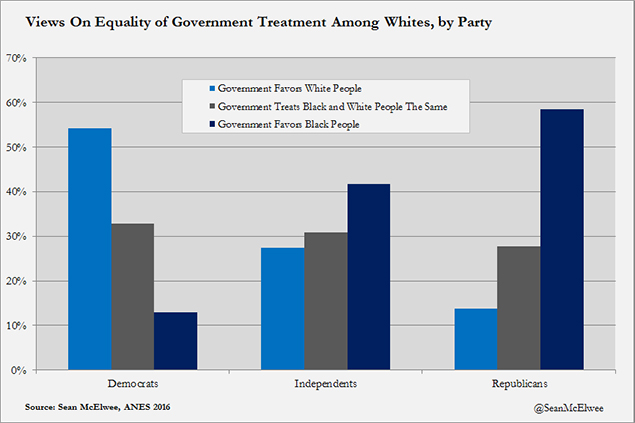
To paraphrase a popular idiom, when you’re accustomed to privilege, equality feels like discrimination. These data suggest that this feeling of loss and victimization, and the need for racial solidarity to protect what remains, is core to understanding Trump’s appeal. As I’ve noted before, beliefs in the importance of white racial solidarity are powerful predictors of Trump support. Whites who believe their race is “very important” to their identity had warmer feelings toward Trump. Trump’s rhetoric reflects this reality: He has described a world in which his white supporters are the victims of bad trade deals, elites and rampant crime. They feel they are living through rapid demographic change that will leave them as a minority of the population — and they know how minorities have been treated for so long in American populations.
As John Paul Brammer notes, Trump’s slogan, “‘Make America Great Again,’ speaks to that victimhood. We were great once. We aren’t anymore, because of those people.” In his book “The Reactionary Mind,” political theorist Corey Robin writes,
Far from being an invention of the politically correct, victimhood has been a talking point of the right ever since Burke decried the mob’s treatment of Marie Antoinette. The conservative, to be sure, speaks for a special type of victim: one who has lost something of value, as opposed to the wretched of the earth, whose chief complaint is that they never had anything to lose.
Trumpism is a movement built around the loss of privilege and perceived social status and a desire to re-create social hierarchy. It is one that requires its adherents to live in a state of constant fear and victimization. This mythology requires extensive ideological work and media filtering to remain true. Conservatives must create an ideological bubble in which crime is out of control (instead of hovering near historic lows), the rate of abortion is rising (instead of falling), refugees are committing terrorist attacks en masse (they aren’t at all) and immigrants are taking jobs (it’s the capitalists), all while the government is funneling money to undeserving black people (black people receive government support in accordance with their share of the population, despite making up a disproportionately large share of the poor). Conservatives, and many in the general public, believe that Muslims and immigrants (both legal and unauthorized) make up a dramatically larger share of the population than they actually do.
At the same time, the right has created a caricature of their opponents on the left. In this imagined caricature, the left is sensitive to being “triggered” at every corner, but also capable of unspeakable political violence. The activist left are “snowflakes” on one hand, and brutal killers on the other. In reality, political violence has long been a tactic of the right, from the labor violence that left thousands of workers dead to lynchings to brutality against peaceful protesters inflicted by corporate security and police to the harassment of women seeking abortion, the destruction of abortion clinics and the assassination of doctors who provide abortions. The rhetoric of victimization has costs — white supremacists are committing unspeakable violence to combat the perceived threat of immigrants, Muslims and people of color. For the next four years, we are likely to have a government driven by perceptions of white Christian victimhood.
znModeratorMel Kiper Jr., Todd McShay and Chris Sprow discuss what makes the strategy the Rams could employ in the upcoming NFL Draft with their first pick. Kiper suggests the Rams go with OT Garrett Boles. McShay thinks the Rams could take a CB such as Alabama’s Marlon Humphrey.
znModeratorYeah, i love old grizzled vets. I was hoping that is what McV would do.
plus this Sullivan guy wants to play for McVay…. that’s a good sign….
My favorite signing of the offseason thus far.
I view it this way.
For years, the Rams would sign and draft linemen who would then get injured. For example Havenstein’s ankle was so bad last year some said he was in effect playing on one leg. That’s just a recent example from a long long list going back years of Rams linemen, both draftees and free agents, who get hurt with the Rams.
What the Sullivan signing tells me is this.
The Rams are now pursuing already injured linemen. That way, you know, just get it over with.
.
znModeratorznModeratorAssuming Sullivan starts. (This of course does not keep them from drafting someone too).
Counting years of experience as the year a guy is IN. So someone drafted in 2016 is in his 2nd year in 2017. Etc.
YEARS OF EXPERIENCE, RAMS 2017 OL:
Whitworth: 12
Saffold: 8
Sullivan: 10
Havenstein: 3
Robinson: 4
AVG: 7.4YEARS OF EXPERIENCE, RAMS 2016 OL (counting the week 1 opening OL):
Robinson: 3
Saffold: 7
Barnes: 6
Brown: 2
Havenstein: 2
AVG: 4YEARS OF EXPERIENCE, RAMS 2015 OL (counting the week 1 opening OL):
Robinson: 2
Saffold: 6
Barnes: 5
Brown: 1
Havenstein: 1
AVG: 3znModeratorhttps://www.profootballfocus.com/pro-5-roster-cuts-that-can-make-an-impact-elsewhere/
PFF from Five players that could still make an impact in 2016 and should be picked up sooner rather than later(note: this is from 2016)
1. John Sullivan, C
Cut by the Minnesota Vikings
In 2013, John Sullivan was as good as any center in the game, and at that point, had three straight seasons graded among the top three centers in the league. Coming off knee problems, his 2014 season was less impressive, and he missed the entire 2015 season with back issues, but at only 31 years old, chances are that Sullivan can still be a very effective player. His issue in Minnesota was that Joe Berger—the player that replaced him at center in 2015—played at an All-Pro level in his stead, surrendering just one sack all season and ending the year with a PFF grade of 88.0, trailing only Cowboys C Travis Frederick. Sullivan was going to have his work cut out for him winning back his job anyway, but Minnesota bringing on board Tony Sparano to the coaching staff—who has history with Berger as a player in Miami—seemed to seal his fate. Sullivan hasn’t enjoyed the best preseason of his career, earning poor grades in the 44 snaps he has played so far, so his best football may still be some time away, but for any team in need of a center, the chance of acquiring a potential All-Pro heading into September should prove a very attractive proposition. Sullivan may not be ready to hit the ground running at that level, but he should be able to upgrade several situations around the league.(note: this is from 2016)
znModeratorRams to hold extra minicamp during off-season workout program
http://www.latimes.com/sports/rams/la-sp-rams-offseason-workouts-nfl-20170403-story.html
Gary Klein
The Rams, coming off a 4-12 season, will have the benefit of an extra minicamp when off-season workouts begin April 10, according to the schedule announced Monday by the team.
Because they have a new coach in Sean McVay, the NFL’s collective bargaining agreement allows the Rams to hold an additional voluntary minicamp for veterans before the NFL draft. That minicamp will take place April 25-27.
In the first two weeks of the nine-week off-season program, players are limited to strength and conditioning and rehabilitation.
During the next three weeks, individual drills and team practices can be held on the field but live contact or drills involving the offense against the defense are forbidden.
April 4, 2017 at 9:47 pm in reply to: McVay on many things (articles & vids & audio & a LONG transcript) #66974znModeratorFrom the 2017 NFL Owners meetings, Adam Schefter sits down with Rams HC Sean McVay to talk about what he has in Jared Goff & the importance of a good coaching staff.
znModeratorhttp://www.nfl.com/draft/2017/profiles/pat-elflein?id=2557879
Elflein, Pat C 6’3″ 303 Ohio St.
SOURCES TELL US “You are getting a guy who will be great for your locker room and will get the rest of the offensive line on board. I think he could have the same fast impact on a team’s running game that Zach Martin had in Dallas. Safe draft pick to me.” — NFC West scout
NFL COMPARISON Travis Frederick
BOTTOM LINE Elflein is a smart, tireless worker with a winning background and experience at all three interior offensive line spots. While his feet are just average, his core strength and wrestling background could make him a favorite of teams looking for more strength at the center position. Elflein will have occasional issues in pass protection, but his strength as a run blocker and ability to play with excellent hands and plus body control should make him one of the first interior linemen to come off the draft board.
-Lance ZierleinznModeratorA Todd Gurley bounce-back year is ‘going to take everybody’
Alden Gonzalez
LOS ANGELES — Todd Gurley fell off as a second-year running back in a way few ever have, from 1,097 yards in 12 starts to 885 yards in 16 of them.
His new coach sees it more as a system-wide failure.
“The run game,” Los Angeles Rams rookie head coach Sean McVay said from the owners meetings last week, “takes all 11 — whether it’s getting it targeted up front the right way with your linemen, having receivers that are willing to come down and block safeties when they bring an eighth guy down in the box, if you’ve got some run-pass options with the quarterback where you want to run it versus a two-safety look and throw it versus single-high. I think it takes all 11. And the back has to do a great job pressing it or reading out his keys, because everybody is tied together.”
Gurley went from being named Offensive Rookie of the Year in 2015 to amassing the fewest rushing yards ever for someone with at least 275 attempts in 2016. He averaged 3.18 yards per carry and 1.59 yards before first contact, both of which trailed only Doug Martin for the worst among qualified rushers.
Throughout the year, most of the blame was pinned to the circumstance, because the Rams’ inability to scare teams with their passing attack allowed defenses to stack the box and cheat against the run. But at the end of the season, young guard Jamon Brown called for the running backs and offensive linemen to get on the same page. The Rams’ running backs coach, Skip Peete, talked about how Gurley “pressed” when the initial results didn’t come and often times went away from the play.
But at its core, it usually comes down to blocking — and the Rams should be better equipped for that.
They signed one of the game’s premier pass blockers, Andrew Whitworth, as their new left tackle. They added Robert Woods, widely regarded one of the game’s best blocking receivers. And they brought in a new offensive line coach, Aaron Kromer, who spent the last two years with a Bills team that led the NFL in rushing yards per carry.
As the Redskins’ playcaller and offensive coordinator these last two years, McVay relied heavily on quarterback play and was never able to attain the ideal run-pass balance he always seeks.
But he believes he can obtain that with Gurley.
“A lot of times you have a tendency to just look at the stats instead of the actual tape,” McVay said, referencing Gurley. “I think you still see a natural runner who’s got a great body lean; he has a natural feel for how to work edges on people. And I think that showed up in spurts last year. Clearly, what he did in his rookie year, I think it sets the expectations where this guy is going to be a great back year-in and year-out. And that’s what we feel, too. I think Todd’s motivated, challenged in the right way to respond, and can have a bounce-back year. But it’s going to take everybody, and Todd is going to be a big part of it.”
znModeratorRams Announce 2017 Offseason Program Dates
Head coach Sean McVay and the Los Angeles Rams will get a head start on their offseason programs this year. Per NFL rule, new head coaches are entitled to conduct an additional voluntary veteran minicamp. This year, five clubs will hold voluntary veteran minicamps.
The Rams Offseason Workout Program calendar:
First Day: April 10
OTA Offseason Workouts: May 23-25, May 30-31, June 1, June 5-8
Voluntary Minicamp: April 25-27
Mandatory Minicamp: June 13-15Voluntary offseason workout programs are intended to provide training, teaching and physical conditioning for players.
As per Article 21 of the Collective Bargaining Agreement, each club’s official, voluntary nine-week offseason program is conducted in three phases:
Rams Phase One:
First Day:
April 10Phase One consists of the first two weeks of the program with activities limited to strength and conditioning and physical rehabilitation only.
Rams Phase Two:
First Day:
May 1Phase Two consists of the next three weeks of the program. On-field workouts may include individual player instruction and drills as well as team practice conducted on a “separates” basis. No live contact or team offense vs. team defense drills are permitted.
Rams Phase Three:
OTA Offseason Workouts:
May 23-25, May 30-31, June 1, June 5-8Phase Three consists of the next four weeks of the program. Teams may conduct a total of 10 days of organized team practice activity, or “OTAs”. No live contact is permitted, but 7-on-7, 9-on-7, and 11-on-11 drills are permitted.
Article 22 of the Collective Bargaining Agreement stipulates that clubs may hold one mandatory minicamp for veteran players. This minicamp, noted below, must occur during Phase Three of the offseason program.
Each club may hold a rookie football development program for a period of seven weeks, which in 2017 may begin on May 15. During this period, no activities may be held on weekends, with the exception of one post-NFL Draft rookie minicamp, which may be conducted on either the first or second weekend following the draft.
znModeratorhttp://mmqb.si.com/mmqb/2017/04/03/cleveland-browns-paul-depodesta-nfl-draft-peter-king
Peter King
On the Raiders’ move
To put it mildly, the reaction to the Raiders’ move from Oakland to Las Vegas at the meetings was muted. The Las Vegas backers were fired up, of course. But even though the owners voted 31-1 in favor of the move, it wasn’t an enthusiastic vote of confidence that they love Las Vegas; it was more resignation that the Raiders would never get a good stadium built in Oakland unless owner Mark Davis agreed to take on a partner. Which, unfortunately for Oakland, he refused to do.
I’ve written this several times, but Davis probably could have found a 50-percent partner who would have been a keystone to building a stadium in northern California, the same way the Mara family merged with the Tisches in 1991 when the cost of doing NFL business became too high for one family without significant income elsewhere. Easy for me to say that Davis should have sold half his team; I understand it’s his call. His father, the late Al Davis, steadfastly refused to cede any control of the franchise to partners. Ditto Mark Davis.
Look at a map of the Bay Area. Look at San Jose, on the southern end. Right next to San Jose is Santa Clara, where the 49ers play. Up in Oakland, 42 miles north of San Jose, is where the Raiders will be leaving. To get from San Francisco, Oakland and Berkeley to see the 49ers is a solid hour in the car.
And I can tell you that what concerns the league now is the fact that the northern part of the Bay Area, the sixth-largest market in the country, is now going to be without an NFL team. With so much money, and so much fan interest, having one team and having it at the southern end of the region, with nothing at the northern end, is disconcerting.
The fans in this region already are turned off by the 49ers, and it will take a rally orchestrated by GM John Lynch and coach Kyle Shanahan to get them excited again. The Raiders were being built into a power, the kind of team fans from all over the Bay Area could have learned to love. Now, the Raiders may not even be loved in the next two years inside the Oakland Coliseum.
Maybe a fabulously wealthy Silicon Valley entrepreneur will spearhead a drive to pick off a struggling NFL team and move it west in the next three or four years, and lead the building of a new stadium. If not, the NFL will miss the greatness of this region at a time when it’s continuing to explode (in a good way) economically.
Somehow the NFL has to figure a way to stop the bleeding in great football regions like San Diego and San Francisco/Oakland. It’s not going to be easy. But there are too many great fans of pro football in California getting slapped in the face with the moves of these two franchises.
That’s one of the reasons no NFL owner or executive was celebrating the move of Oakland to Las Vegas … and the Chargers in Los Angeles as a second team makes absolutely zero sense either. The Chargers in L.A. and the Raiders in Vegas are good for the NFL’s business. But there’s nothing else good about either move.
znModeratorhttp://mmqb.si.com/mmqb/2017/04/03/cleveland-browns-paul-depodesta-nfl-draft-peter-king
Peter King
I think the signing of free-agent defensive end Chris Long in Philadelphia—for a long-term deal that seems destined for him to play at least two years with the Eagles—had a couple of interesting messages. One: Long saw his role and playing time slashed late in his Super Bowl season in New England; he played 62 of 188 snaps in New England’s three postseason games. Playing a third of the snaps in the biggest games of the year must have stung.
Clearly the Eagles have more planned for Long, using a scheme that he believes will fit him well. Two: Long, by his own words in Philly on Friday, wanted to emphasize how strongly he felt about his future at 32. He said last year in New England, “I didn’t miss a practice, I didn’t miss a game, and that was something that I was very proud of.” He seemed like a guy happy to have a chance to finally get a Super Bowl ring after never making the playoffs in eight seasons with the Rams. But he also seemed like a guy saying, I can do more than I did in the postseason in New England, and I’ll show you now.
znModeratorhttp://mmqb.si.com/mmqb/2017/04/03/cleveland-browns-paul-depodesta-nfl-draft-peter-king
Peter King
On the changing face of the NFL
This might just be me, but I don’t think so. One afternoon at the pool at the Arizona Biltmore, the newest, and youngest, head coaches in the league were hanging around like pups with guys we hadn’t thought of as old vets.
By the pool on a roasting afternoon, Rams coach Sean McVay (age 31) and San Francisco’s Kyle Shanahan (37) were asking counsel of Steelers coach Mike Tomlin (45) and the Saints’ Sean Payton (53). McVay got introduced to Tomlin a couple of years ago by a Tomlin protégé, Atlanta assistant Raheem Morris, and they’ve spent time at the combine getting to know each other.
It’s more McVay picking Tomlin’s brain, but Tomlin gets something out of it too—keeping up with some of the new coaches and some of the new trends in football.
“One of the things I’ve learned to appreciate about Mike Tomlin is you always feel his presence in a room,” McVay said. “He seems like he never has a bad day, and that’s something we want to mimic and emulate. Mike’s been great with how to deal with the team, how to handle adversity, and staying true to your core beliefs. I can’t tell you how much respect I have for him, and I’ll continue to try to bother him for advice.”
Mike Tomlin as elder statesman … that’s different. And Payton has become an advice-dispenser too.
znModeratorLos Angeles Rams add quality, quantity in 2017 NFL free agency
By The Sports Xchange
AGOURA HILLS, Calif. — The Los Angeles Rams quickly and decisively got to work trying to rebuild their team in the image of new head coach Sean McVay, an energetic, offensive-minded leader who puts as much emphasis on chemistry, leadership and locker room presence as he does finding the right talent and scheme fit.
By the end of the first phase of free agency, McVay and the Rams found a high-end answer to their left tackle position and veteran leaders whose impact will be felt in multiple ways.
They also added a dependable weapon for young quarterback Jared Goff, a versatile, veteran playmaker for new defensive coordinator Wade Phillips’ 3-4 scheme and perhaps a new starting cornerback.
And in landing Pro Bowl left tackle Andrew Whitworth, dependable wide receiver Robert Woods, high-motor outside linebacker Connor Barwin and cornerback Kayvon Webster, the Rams added as much character as they did talent to help improve their 4-12 team from a season ago.
Most importantly, the added chemistry seems to fit the kind of team McVay hopes to build.
“I think they are taking on our image, kind of what we’ve all agreed that we’re looking for,” McVay said. “When you really look at some of the players that we’ve acquired; when you look at an Andrew Whitworth, you look at a (RB) Lance Dunbar, Robert Woods — especially just on offense — get Kayvon Webster and Connor Barwin — these are good people that kind of represent what we want to be in terms of that football character: accountability, coachability, you can depend on these guys. Then, they also have a certain way about themselves when you talk about them.”
Whitworth, in particular, should benefit the Rams in a number of ways, as his talent will allow the team to be flexible in moving some of its younger linemen to better position fits while also lifting the veteran presence in the locker room.
McVay was immediately drawn to Whitworth upon meeting him.
“Just how impressive he is when you talk football, you feel like you’re talking to a coach,” McVay said, “Talking to those other coaches that have been with him: Jay (Gruden), (Bengals defensive coordinator) Paul Guenther, (Bengals offensive coordinator) Ken Zampese, even (Bengals head coach) Marvin (Lewis) — talking about the leader that he is. Whether it was offensive or defensive players, he had a way of bringing people together.
“You get around him and he’s got a presence and a way about himself that’s very impressive. He’s a guy that we feel very fortunate to have. He brings his family in and you can see he’s all about the right stuff. That’s why, I think, he’ll be great for us.”
Woods won’t be called upon to blow the top off a defense, but he is a precise route runner with dependable hands and is a willing, active run blocker.
Webster has a history with Phillips after playing under him in Denver and is expected to compete for a starting job opposite Trumaine Johnson — unless Johnson is traded — and Barwin is an ideal fit at outside linebacker in Philips’ 3-4 defense, having played under him in Houston.
The Rams also addressed their backup running back position with the signing of former Cowboys backup Dunbar, re-signed kicker Greg Zuerlein, added a third quarterback in Aaron Murray and addressed their defensive line depth with veteran DL Tyrunn Walker.
Among the losses were veteran defensive linemen Eugene Sims (released), William Hayes (traded to Miami), veteran running back Benny Cunningham (signed with the Bears) and starting center Tim Barnes, who was released.
In addition, veteran safety T.J. McDonald signed a free-agent contract with the Miami Dolphins and wide receivers Kenny Britt and Brian Quick signed with Cleveland and Washington, respectively.
–Wide receiver Robert Woods is coming home, literally. The former USC wide receiver, who grew up in the Los Angeles area, is returning to his hometown after signing with the Rams as a free agent. The veteran spent his first four seasons with the Buffalo Bills, where he caught 203 passes for 2,451 yards and 12 touchdowns.
“I’ve always wanted to come home and play for the hometown team,” Woods said. “The Rams made the trip home and so did I.”
Woods will provide a much-needed dependable target for young QB Jared Goff.
“Big day, very exciting,” Woods said. “I just can’t wait to get going and look forward to working with (QB) Jared Goff. Big thank yous to (owner/chairman) Mr. (Stan) Kroenke and (general manager) Les Snead for bringing me on board. Big day, big opportunity, can’t wait to be a part of it — (offensive coordinator) Matt LaFleur, (head coach) Sean McVay — big things going on, on the offensive side. Very excited to be a part of it.”
–Left tackle Andrew Whitworth was the Rams’ top target to improve their play at left tackle, but also serve as a mentor to quarterback Jared Goff and help solidify an offensive line ranked among the worst in the NFL last season.
The 35-year-old Whitworth has graded out as one of the time three left tackles over the last three years and keeps himself in top physical shape.
“As I’ve always said it’s a simple thing and cliche of just doing your job. But the reality is that if every single football player goes out there and does their job we’re going to play real well,” Whitworth said.
“The first thing I have to do is do my job well and hopefully that can impact and influence throughout my group. I know some of those guys and I think a lot of some of them. I think that from the guys that I do know, I look forward to getting the chance to know the rest of them and know them better – kind of know who they are as a player and how I can help.”
–Outside linebacker Connor Barwin was a second-wave free agency addition to the Rams, but brings with him a level of production that should fit perfectly with new defensive coordinator Wade Phillips.
Barwin has been a productive player at outside linebacker in a 3-4 scheme, but slumped last year when moved to defensive end in a 4-3. That, coupled with the Eagles’ need to free up money to help add weapons and protection to young quarterback Carson Wentz, led to Barwin being cut loose.
Barwin had 26.5 sacks from 2013-15 with the Eagles in the 3-5 but only five playing in the 4-3 last season. He is especially looking forward to reuniting with Phillips, who coached him two seasons in Houston.
“Wade did a lot for me in the two years I was with Houston,” Barwin said. “He taught me so much about being a pro, enjoying being around the game every single day and he really elevated my game as a pass rusher.”
znModeratori could see engram catch 90-100 passes in this offense
znModeratorfrom An updated look at the edge defender class in the 2017 NFL Draft
By John Owning
link: https://www.fanragsports.com/nfl/updated-look-edge-defender-class-2017-nfl-draft/
The edge defender class in the 2017 NFL Draft has a chance to be great, or even historic. Take a look at any mock draft, and you will see a handful of talented pass-rushers permeating the first round.
Everyone can agree on who the first one of the board will be (Myles Garrett), but there is a multitude of varying opinions on which player should be next. It usually comes down to what type of pass rusher that analyst prefers.
If they are looking for a disruptive penetrator with position flexibility, Stanford’s Solomon Thomas would likely be the choice. If a long and lean pass-rusher is more their speed, then Michigan’s Taco Charlton would be a choice praised by many.
Personal preferences aside, most will agree that this is a deep edge defender class that is crawling with intriguing talent. With that in mind, let’s try to rank this edge defender group.
zn note: follow the link to the original for the complete article and the vids it contains
-
AuthorPosts