Forum Replies Created
-
AuthorPosts
-
 znModeratorMichael Silver@MikeSilverI mostly like the Chase Young trade… but there’s a reason he was available for so little…znModeratorMitchell Schwartz@MitchSchwartz71McDaniels is hated by the (best) players, the team and particularly his O isn’t performing, and there’s no light at the end of the tunnel. Surprised Davis actually did it but good move.znModeratorznModerator
Chase Young? Bigger, better athlete than Miller, but injuries have suppressed his career.
Rams can’t rely on superior coaching — which I think they have. They just can’t compete athletically via so many late rounders and UDFAs.
On Young. Is he a rental? He’s a FA in 24. Can they sign him? 9ers have no cap space in 2025. As it stands right now their 2025 combined cap hit for Williams, Armstead, Kittle, Warner, and Samuel is appx. 135 M.
In terms of the Rams competing with a lot of good low draft picks…as we know, the plan in 23 was to instigate then endure this year’s big dead money hit, and then use cap space and picks to add to a more seasoned team in 24.
The way you put it, it sounds like you think their plan is to do 23 forever. But this year was always a set-up year, they decided that early last off-season.
So starting next year they add high draft picks and FA money to their (by then) more seasoned roster of very good low-round draft picks (Fuller, Jones, Nacua, Kupp, the TEs, a nice stable of solid RBs…with Young and Turner developing).
I think they’re competive in 23 as long as Stafford is healthy, and are set up to take a leap forward in 24.
znModeratorReport: Rams to sign QB Dresser Winn. https://t.co/3JSR8ldKPZ
— ProFootballTalk (@ProFootballTalk) October 31, 2023
znModeratorJourdan Rodrigue@JourdanRodrigueReported Thursday I wasn’t getting a sense from league and team sources that Rams would move either way at deadline, w/ eyes on 24-25. They already weren’t moving Stafford, Kupp or Donald (latter also has a no-trade clause). They did get some calls on a couple others.znModeratorLos Angeles Rams PR@TheLARamsPRAccording to @PFF, OLB Byron Young has the 13th-best defensive grade (68.2) and the eighth-best pressure grade (70.4) for all rookie defensive players. He is also tied for ninth in the NFL in quarterback hits (13). @byron_97 #RamsHouseznModeratorThe season is over. We will not be making the playoffs.
I have to disagree with you there, Jack. Since this is a deliberate re-tooling year, the season is not over. The purpose of 23 is to develop a team with experience they can add players to in 24. When that’s your goal and purpose the season is not over.
Going back to before the season started I don’t think anyone here expected the playoffs. They all knew it was a re-tooling year and what that meant. But technically yes a wild card is still possible.
znModeratorDianna Russini@DMRussiniWhile the Rams were expecting to sign QB John Wolford off the Bucs practice squad, they were informed tonight that Wolford prefers to stay in Tampa Bay with the Bucs, per sources.znModeratorMcVay: Matthew Stafford day-to-day with UCL sprain in right thumb, plus updates on Rob Havenstein, Cobie Durant, Austin Trammell, Puka Nacua and Ethan Evans
Stu Jackson
THOUSAND OAKS, Calif. – Rams head coach Sean McVay on Monday said quarterback Matthew Stafford sustained a UCL sprain in his right thumb against the Cowboys and is day-to-day.
Given the Rams had concerns Stafford’s injury could have been worse, McVay said a sprain was encouraging news.
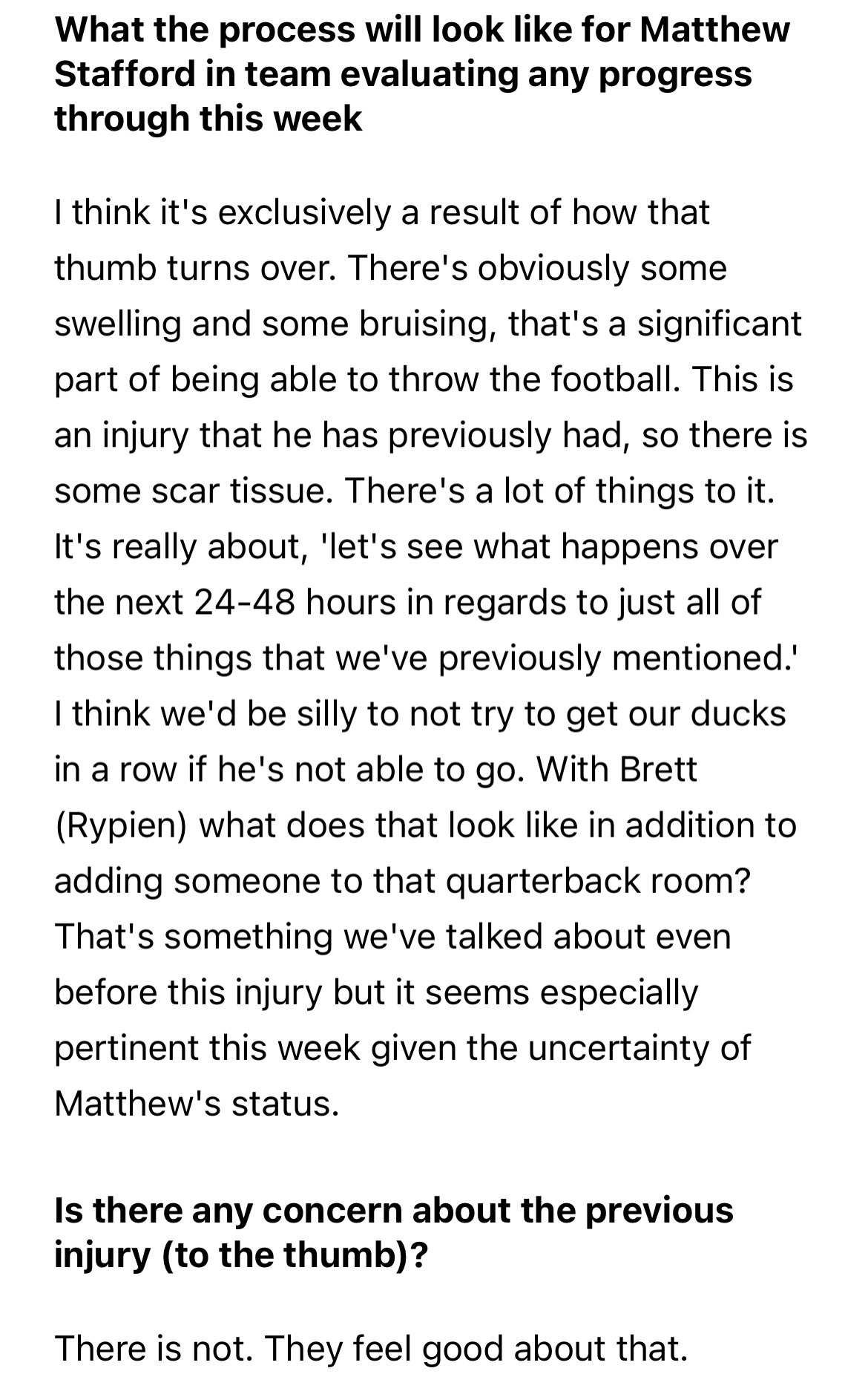
“I think we’re taking it a day at a time,” McVay said during a video conference with reporters Monday. “We definitely have to get some contingency plans in order. We’ve obviously got (backup quarterback) Brett (Rypien) on the roster, and there’s some other possibilities that we’ll explore and that we’re in the midst of working through once I get off with you guys today.”
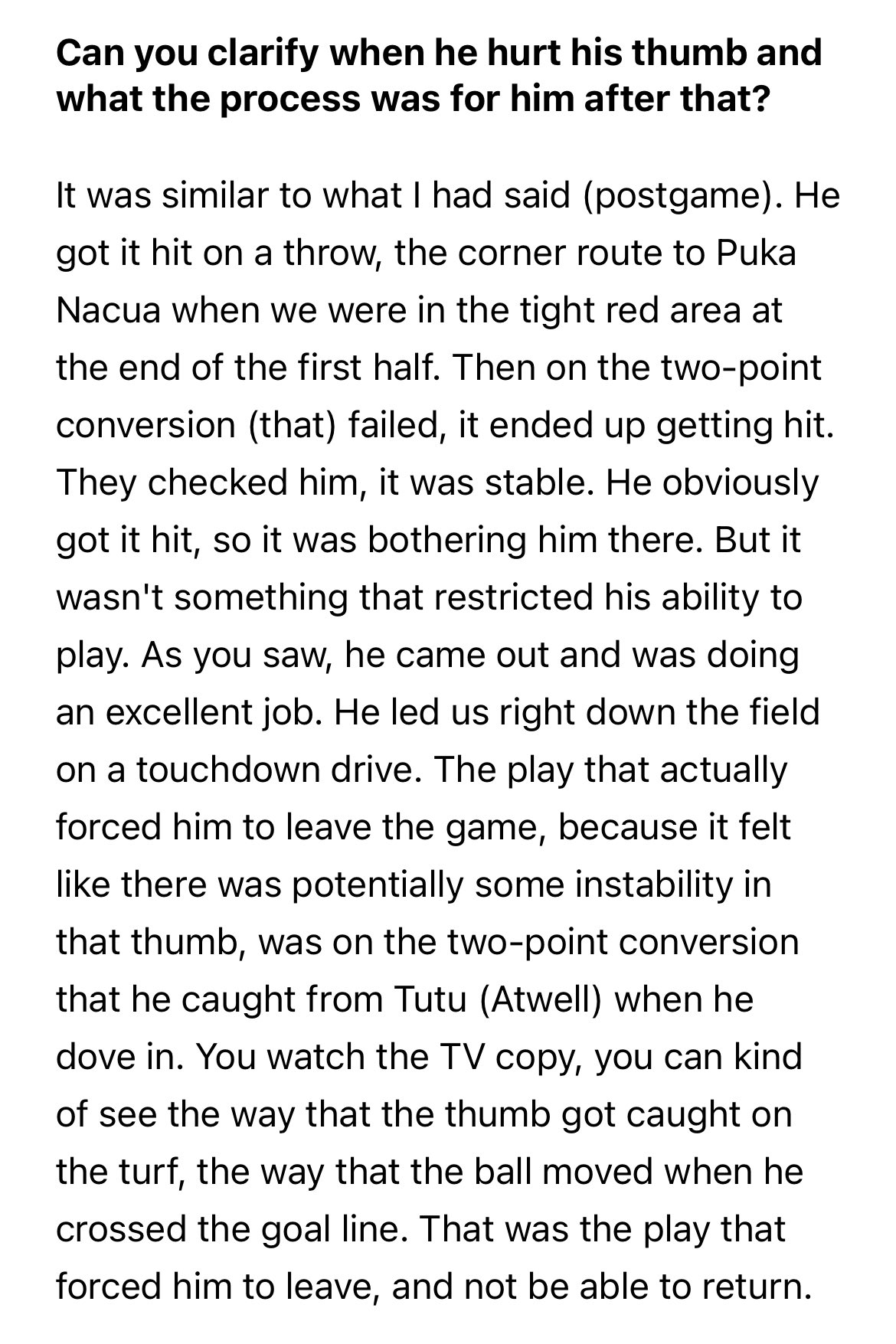
McVay said Stafford initially got his right thumb hit on the throw to the corner route to wide receiver Puka Nacua in the redzone on the Rams’ drive toward the end of the first half. After the Rams’ failed 2-point conversion at the end of that drive, TV replays showed Stafford’s thumb hitting the helmet of a Cowboys defensive lineman. McVay said doctors checked Stafford’s thumb after that failed 2-point conversion, and that Stafford’s thumb was stable. McVay said it wasn’t something that restricted Stafford’s ability to play.
However, on the Rams’ successful 2-point conversion, Stafford’s thumb got caught on the turf as he dove to make that catch. McVay said it was that play that caused Stafford to leave Sunday’s game in Dallas and not return.
McVay said there’s no concern about Stafford’s previous thumb injury. However, McVay said there is some swelling, some bruising and some scar tissue, so the sprain “absolutely” affects how Stafford grips the football.
Stafford was replaced by Rypien, who completed 5 of 10 pass attempts for 42 yards. While McVay said it was “hard to say” what stood about about the way Rypien came into Sunday’s game and took over, it’s party because it was a “really tough situation” in regards to running the offense. Still, McVay praised Rypien for his work over the past several weeks leading the scout team offense during practice.
“He’s done a great job,” McVay said. “I think he improved. He approaches every single week with an intentionality to really be able to say, ‘Alright, if these are the reps that I’m getting, how can I get better? How can I play within the timing and rhythm?’ I think he’s done a great job of mimicking and emulating the opposing team’s quarterback, the cadence, all those different things. But I just think the consistency at which he’s approached his craft and the intentionality has allowed him to improve, and he’s done a really nice job with that role.”
McVay confirmed the Rams are exploring signing another quarterback. The Rams have carried two quarterbacks for the majority of the season, which McVay said was due to the unforeseen circumstance of rookie Stetson Bennett’s situation.
Bennett is still on the Reserve/NFI list, and McVay said that there is no update in regards to Bennett being back with the team.
“I’m not ready to say that he won’t be back with us at all this year,” McVay said, “but it’s probably less like than it is likely he would be.”
Just like any injured veteran player, McVay said Stafford’s feedback is “key and critical” in determining whether he plays.
“I think in a lot of instances, so much of that is about the dialogue and the discussion in regards to how is he feeling?” McVay said. “What does he feel like he’s able to do? We would love to be able to have him available for us, but not at the expense of pushing it and making sure that you’re not leaving him susceptible to anything unnecessary. And you want to make sure that you’re setting them up for success.”
Updates on Havenstein, Durant, Trammell, Nacua and Ethan Evans
In terms of other injury updates, McVay said they are continuing to monitor offensive lineman Rob Havenstein (calf) and that Havenstein is day-to-day.
Defensive back Cobie Durant’s shoulder injury in the first half of Sunday’s game turned out to be a stinger in his neck. McVay said Durant will likely be a limited participant in Wednesday’s practice, “but he should be okay.”
Wide receiver and punt returner Austin Trammell sustained a hip injury on one of his punt returners, but McVay said Trammell “should be okay.”
Wide receiver Puka Nacua “had some knee swelling,” and the Rams will “be smart” with him on Wednesday.
Additionally, punter Ethan Evans suffered an ankle sprain on one of the Cowboys’ punt returns.
“We’ll see how he’s doing,” McVay said of Evans.
znModeratorJourdan Rodrigue@JourdanRodrigue
More from Sean McVay on Matthew Stafford’s injury, including how/when it occurred. Rams will look into adding to room quickly, McVay also indicated. No concern about previously repaired thumb injury but there is scar tissue and enough swelling to be concerned about gripping ball.znModeratorfrom https://theramswire.usatoday.com/2023/10/30/rams-matthew-stafford-injury-tendon-update-week-8/
Adam Schefter said on ESPN’s “NFL Live” this afternoon that Stafford has a tendon issue in his right thumb and the Rams will need a few days to determine his exact availability and status moving forward.
“Matthew Stafford is dealing with a tendon issue in his right thumb that the Rams believe will take a couple of days to figure out whether or not he can come back,” Schefter said.
Schefter didn’t rule out the possibility of Stafford playing on Sunday against the Packers, saying “we’ll see” if he can go in that game.
With the Rams having a bye in Week 10, it’s possible they’ll give Stafford this week off to heal and hope he can return in Week 11 when the Rams host the Seahawks.
znModeratorJourdan Rodrigue@JourdanRodrigue
Matthew Stafford has a UCL sprain and is day to day, per Sean McVay.
UCL 👇🏼👍🏼 pic.twitter.com/1kM2DyRav6
— RAMZILLA (@elitster) October 30, 2023
znModeratorGreg Beacham@gregbeachamStetson Bennett is “doing well,” but Sean McVay says it’s more likely than not that Bennett will not be back with the Rams this season.znModeratorJourdan Rodrigue@JourdanRodrigueMatthew Stafford has a UCL sprain and is day to day, per Sean McVay..HoldenCantor@HoldenCantorX-Rays on Staffords thumb were negative, no breakOctober 30, 2023 at 5:36 pm in reply to: Dallas game: analysts, twitter, some plays, + the big articles #146538znModeratorRodrigue: Multiple disasters sink Rams at Dallas and foreshadow ominous future
Jourdan Rodrigue
ARLINGTON, Texas — Sunday’s Los Angeles Rams were a portrait of pure disaster, the kind of disaster that lingers in the air long after the moment passes like a too-heavy breaking of wind.
They were embarrassed by the Dallas Cowboys 43-20. Their quarterback, Matthew Stafford, hurt his thumb in the third quarter — the exact time stamp depends on whom you ask, although coach Sean McVay said the injury occurred on a diving two-point conversion catch off a trick play (the first drive of the third quarter) — and Stafford’s status for the weeks ahead is unknown. The Rams head to Green Bay next week and then have a bye.
“I don’t have any more information on Matthew,” said McVay, who in his postgame comments indicated Stafford had received an initial evaluation from team medical personnel but declined to share what they said and indicated Stafford will undergo further testing. “I don’t want to speculate until I have full clarification from the doctors.”
McVay acknowledged Stafford had banged his thumb on a throw earlier in the game, but reiterated, “It looked like he did (hit it) when he was finishing a throw, that wasn’t the injury that limited him. … Unfortunately, it looked like that injury occurred, that kept him out for the rest of the game, it did occur when he ended up catching the two-point attempt.”
Backup quarterback Brett Rypien said he was alerted he was going into the game after the first drive of the second half, and that Stafford had “reaggravated the thumb.”
Things weren’t going well even when Stafford was in the game, though. In a truly mad three-minute sequence, between 45 seconds remaining in the first quarter and 12:50 remaining in the second quarter, events unfolded as such:
• Stafford threw a pick six. Receiver Cooper Kupp — who has “options” on his routes depending on how the defender plays him — broke outward on the play, and Stafford threw inside and right to cornerback DaRon Bland.
“On the interception, we ended up recognizing that they were in a pressure situation,” McVay said, “we had a miscommunication between Matthew and Cooper there, in regards to a route concept that has been one we’ve activated and had a lot of success with (in the past).”
Score, 17-3.
• Rookie Ethan Evans’ punt protection broke down and his leg swing was slow. His punt got blocked, and the ball dribbled through the back of the end zone for a safety.
“I take full responsibility for that as well,” Evans said. “Just wasn’t my best day playing. I gotta do better for my teammates. That’s about all I have to say about it.”
Score, 19-3.
• The Rams allowed a 63-yard kickoff return, to their 13-yard line. Dallas quarterback Dak Prescott threw a touchdown pass to receiver CeeDee Lamb two plays later.
Score, 26-3.
Lamb, by the way, chopped up the Rams. In the first half alone, he had nine catches for 122 yards and two touchdowns. On the second of the two scored, Lamb was so wide open in the end zone that I was looking around for penalties, someone tripping, a flag or something on the play. Astoundingly, inexcusably open. The Rams tried switching cornerbacks, for Cobie Durant to replace Derion Kendrick on the outside. Durant hurt his shoulder and left the game, and he did not return.
“Personally, I didn’t play good,” Kendrick said candidly after the game. “For myself, I gave up a touchdown. I gave up another big play at the end. I lost the ball in the lights. I didn’t play well on my end, but I’m going to come back next week, for sure.”
And yes, the Rams were again on the wrong end of a weird call. An illegal contact penalty against defensive back Quentin Lake gave Dallas a fresh set of downs on what otherwise would have been a third-down sack, and the second sack in three plays. Instead of a three-and-out, Dallas marched down the field for a game-opening touchdown.
That call is far from the reason the Rams lost — and frankly, is futile to argue. There is no fairness — players and coaches are not allowed to publicly complain about officiating, or else they are fined by the league even if the officiating is as poor as it was near the end of last Sunday’s loss to the Steelers. The organization is allowed to communicate with the league privately on this matter, though. That can be true. It’s also true the Rams are not playing good football, and that is why they are losing games.
For example, the Rams had not allowed that many points in a single half (33) since Nov. 4, 2018, against the New Orleans Saints. Sunday’s loss was the second worst of the McVay era, according to ESPN Stats and Info.
“It was a good, humbling day for us,” McVay said. “These adverse moments provide opportunities for us to be the men that we want to be and the people that we want to be.”
The person Rypien might be next is starting quarterback. Rypien finished Sunday’s game for the Rams and said if he is called upon to start in Green Bay, he will be ready.
The Rams, it should be noted, selected quarterback Stetson Bennett in the fourth round of this year’s draft intending to make him their long-term backup, but Bennett has been on the non-football illness list and away from the facility since the start of the regular season. McVay has declined to expand on Bennett’s status, because of the sensitive nature of the situation. If Stafford is out, and Bennett is not back in the team facilities this week, the Rams will have to make a move because they’ll only have one active quarterback.
Rypien had a little momentum building behind him early in the transition when he converted on a fourth-and-2 to rookie receiver Puka Nacua. Rypien had another fourth down a couple of plays later, but his pass to Kupp was incomplete.
But he and Kupp don’t get many reps together. The concept, in which Kupp has a lot of autonomy to run his route based on how the defender is playing him, failed when Rypien thought Kupp was doing one thing, and Kupp did another based on what he saw from the defender.
That prompts some thought about another problem that shouldn’t get lost in Sunday’s more pressing news: Kupp and Stafford haven’t seemed to have their typical connection even before Stafford’s injury. For the last two weeks, there have been drops and timing issues between the two, including Sunday’s interception. Kupp has been targeted 17 times over the last two games, for just six catches and 50 yards.
“What’s going through my mind after the last two games? I don’t know. Losing sucks,” Kupp said morosely after the game. “You put a lot of time working and don’t get the result you want, it’s not fun. There’s no easy answer. If there was an easy answer, obviously we would be doing it. So, just keep working … have solutions to things, make plays when you’re supposed to make them and do what you’re asked to do.”
I asked Kupp about the timing/option plays. Anybody who has been around this team for the last couple of years understands how odd it is when he and Stafford aren’t connecting, no matter what a defense is doing.
“I think there’s a lot of layers to it and everyone’s got a hand in it,” he said. “I certainly do. I can only control what I can control. I just need to look at the film and see how I can be better and in the right spots for those guys. There’s lots of layers to it. Obviously, it’s something we’ve been doing for a long time. It’s a lot of trust involved in it. We just weren’t on it today.”
Yes, the Rams have an injury problem with Stafford. They also have an offense that ranks No. 16 in scoring in weeks 2-8 (omitting their stellar season opener against the Seattle Seahawks) and is tied at No. 19 in second-half scoring with the 1-6 Carolina Panthers.
This, from a front office and coaching staff that openly — publicly! — committed to gutting its defense and special teams units in part to keep intact and even add to an offense that was supposed to lift the other phases, not get mired down along with them.
Worse, the Rams have been competitive in chances against the NFL’s elite teams this season — despite most on the outside believing they’d look, um, pretty much like this for all 17 games in 2023.
Sunday, as disaster after disaster struck, they only reeled.
znModeratorInteresting how many Rams that have been rightfully getting praise before this game suddenly tanked against Dallas…almost as if they were reading and believing their own press.
That includes
Witherspoon
Young
Dotson
Higbee
znModeratorRams Week 8 OL PFF Grades:
Alaric Jackson: 75.2 PBLK | 60.8 RBLK
Steve Avila: 34.2 | 57.6
Coleman Shelton: 43.7 | 74.8
Kevin Dotson: 62.3 | 66.3
Joe Noteboom: 44.1 | 38.115 pressures allowed.
— Blaine Grisak 💭 (@bgrisakTST) October 30, 2023
October 30, 2023 at 1:56 pm in reply to: Dallas game: analysts, twitter, some plays, + the big articles #146532znModeratorA true battle of the greats!
Aaron Donald beats future Hall Of Fame Guard, Zack Martin for his 2nd sack of the day. pic.twitter.com/aWaKaEdmsl
— RAMS ON FILM (@RamsOnFilm) October 30, 2023
znModeratorsuch as the time you referred to Kurt Warner as a poor man’s Matt Hasselbeck.
Don’t distort my words. I said “he wasn’t even a poor man’s Matt Hasselbeck.”
And also don’t question my loyalties. I know more about the Rams than anyone you can name. From legends like Deacon “The Refrigerator” Olsen to present greats like Kopper Coop, I know the Rams and Rams history inside and out.
znModeratorJourdan Rodrigue@JourdanRodrigueThe Rams are evaluating a range of potential scenarios with QB Matthew Stafford and his thumb injury, per source, and he’ll have further testing plus assessment on how he’s gripping the ball through the week. Chillier conditions in GB combined with a bye after are some details in.consideration for the short term, but Rams also are not ruling out injured reserve at this point as they are still gathering information that helps discern a larger timeline for Stafford.October 30, 2023 at 9:47 am in reply to: Dallas game: analysts, twitter, some plays, + the big articles #146522znModeratorPuka running hard even when the play isn’t blocked up well pic.twitter.com/YUpoWzTUXs
— RAMZILLA (@elitster) October 30, 2023
znModeratorThe wheels have come off. Starting to look like another lost season especially if Stafford misses multiple games. On the bright side, the 49’ers have lost three straight. That’s something anyway.
With this difference. 2023 was never a goal in itself and wins this year were always going to be gravy. Next year they will have a more experienced secondary, LB corps, edge rushers, DL, OL, and offense generally. They will be able to self-scout weak points and areas which will have developed. They can add to that in a very informed way via both free agency and the draft, including a 1st round pick that will more than likely be higher than 20th.
Not long ago, some thought the Rams were deliberately tanking. Then, turns out they’re better than that. But then on the 2nd “turns out,” turns out not so much better that they can afford a young team’s mistakes against top teams.
Yet they can still win some. This year will not be a slaughter-fest like 2022.
Here’s the Rams new slogan–we’ll see in 23, and then get more in 24.
October 29, 2023 at 4:38 pm in reply to: Dallas game: analysts, twitter, some plays, + the big articles #146507znModeratorRams Brothers@RamsBrothersPuka Nacua leads the NFL in drops. But he is the second highest targeted player as a damn rookie. His hands have time to get better, and they will..roberto clemente@rclemente2121you know it was a tough day at the office when your leading receiver was hendo: hendo – 3 catches, 54 yards higbee – 5 catches, 45 yards nacua – 3 catches, 43 yards kupp – 4 catches, 21 yards atwell – 2 catches, 21 yards skowronek – 1 catch, 20 yards.Blaine Grisak@bgrisakTSTnot how the Rams would have liked this one to go. Big questions about Stafford’s health going forward. Rams sit at 3-5. Same record through 8 games as last season. Today an example of this team not being good enough to overcome a series of mistakes. I still think they can win 9 games if Stafford is healthy. Can they get a win at GB before the byeOctober 29, 2023 at 4:24 pm in reply to: Dallas game: analysts, twitter, some plays, + the big articles #146502znModeratorJ.B. Long@JB_Long“It doesn’t seem like it’s good, but we’ll wait for full clarification…” -Rams HC Sean McVay on with us@ESPNLosAngeles regarding the status of Matthew Stafford’s injured hand.Stu Jackson@StuJRamsSean McVay said he doesn’t have any more information on Matthew Stafford’s thumb injury. Doesn’t want to speculate until he has more clarity. McVay said injury occurred on the 2-point conversion catch.-
This reply was modified 2 years, 12 months ago by
 zn.
zn.
October 29, 2023 at 4:21 pm in reply to: Dallas game: analysts, twitter, some plays, + the big articles #146501znModeratorroberto clemente@rclemente2121dating back to 1940, the rams are 1-19 when trailing by 24 or more at the half – @Jim_Everettis the only rams qb to overcome a 24+ halftime deficit. in 1992, down 3-27 at the half, the rams outscored the bucs 28-0 in the second half for the winOctober 29, 2023 at 12:05 pm in reply to: injuries going into Dallas game… + inactives list (10/29) #146496znModeratorJourdan Rodrigue@JourdanRodrigueRams starting RT Rob Havenstein is inactive today in Dallas..JAKE ELLENBOGEN@JKBOGEN#Rams RB Myles Gaskin will be ACTIVE today. Zach Evans INACTIVE. Gaskin expected to make his Ram debut could see some opportunities in the offense behind Darrell Henderson and Royce Freeman..Both teams #Rams and #Cowboys will be without their top tackles Rob Havenstein and Tyron Smith ruled out respectively.October 29, 2023 at 11:57 am in reply to: injuries going into Dallas game… + inactives list (10/29) #146495znModeratorFrom https://www.therams.com/news/rams-cowboys-inactives-week-8-rob-havenstein-tyron-msith
Below are the inactives for both teams.
LOS ANGELES RAMS
RB Zach Evans
OLB Nick Hampton
OL Zach Thomas
OL Rob Havenstein
DE Earnest Brown IV
DALLAS COWBOYS
QB Trey Lance
CB Noah Igbinoghene
CB Eric Scott
RB Deuce Vaughn
OT Tyron Smith
WR Jalen Brooks
DL Villiami Fehoko
znModerator -
This reply was modified 2 years, 12 months ago by
-
AuthorPosts