
Forum Replies Created
-
AuthorPosts
-
February 24, 2017 at 5:54 pm in reply to: Republicans vote for police powers to arrest people planning peaceful protests #65588
 znModerator
Right to protest?: GOP state lawmakers push back against public dissent
https://www.rt.com/usa/376268-republicans-seek-outlaw-protest/
Republican lawmakers are pushing back “by any means necessary” against the wave of protests sweeping across the US with new bills in at least half a dozen states seeking to rigorously curb public dissent.
The legislative tools, many of which have been introduced in recent months, would regulate public dissent as demonstrators take to the streets.In Indiana, Senate lawmakers introduced a bill in January that would require public officials to immediately dispatch “all available law enforcement” to clear a traffic blockade involving at least 10 people “by any means necessary.” Opponents, such as the Indiana Religious Coalition for Reproductive Justice, have dubbed it the “block traffic and you die” bill.
Senator Jim Tomes, who introduced bill SB285, said the bill’s purpose was very simple, to restrict permit-less protest, especially those that block roads and highways.
“We need to keep our streets and interstates open to commerce, traffic, motorists and emergency personnel,” Tomes told WRTV. “Anyone who wants to stage or participate in a protest or demonstration is free to do so. But they will need to do what other organizations do for an event or demonstration: apply for a permit with the local government. With this information, first responders will know what roads are going to be blocked and what roads they can take when responding to an emergency.”
Groups opposing the legislation say it is a naked attempt to curb free speech rights. The bill “doesn’t make sense,” Sue Ellen Braunlin, co-president of the Indiana Religious Coalition for Reproductive Justice, told the Guardian. “We have stopped traffic for a short time during protests, with police cooperation. Often they will let us stop traffic and we have not had a problem. We’ve had a women’s rights march and a Black Lives Matter march and it was all very peaceful and coordinated with the police,” Braunlin said.
In North Dakota, site of the Standing Rock protests over the Dakota Access Pipeline, bills were introduced by Republican lawmakers in January that would criminalize road protests, restrict what protesters can wear, and even allow the federal government to sue to cover enforcement costs.
Among the more controversial proposals, one measure would exempt drivers from liability if they unintentionally injure or kill a pedestrian obstructing traffic on a public road or highway.
State Republicans said they were motivated by residents’ frustration with the ongoing protests in the southern part of the state which at times saw a thousand-strong encampment opposing the construction of the $3.8 billion four-state pipeline.
“When people are having their lives disrupted, you’re going to see things move up here,” Senator Kelly Armstrong, an oil company executive and the state Republican chair, told AP. “It’s very difficult to write ‘protest laws.’ We need to make sure there is reasonable application of the law in all circumstances, whether protest-related or not.”
In Minnesota, new legislation seeks to increase penalties for blocking traffic, likely a response to a mass protest on a St. Paul interstate in July following the police killing of Philando Castille. Washington state legislators will consider draft legislation to classify as “economic terrorism” any permit-less protest that causes harm to the flow of commerce.
While in Michigan’s legislature, an anti-picketing bill would boost penalties against those, particularly unions, who attempt to harm a business’s profits.
Landmark civil rights “legislation didn’t pass because we had polite protesters,” said state Represenative Leslie Love, a Democrat from Detroit, in opposition to the Michigan bill. “We did it on buses and bridges and lunch counters. And those protesters were attacked by dogs, water hosed down.”
“I’m deeply appalled by these bills because I grew up in a union household and my mother took me to pickets and it was always a safe environment,” she added.
Many of the bills were drafted before President Donald Trump was elected president, and were in response to pipeline protests in North Dakota and the effective nationwide protests organized by the Black Lives Matter movement.
Trump joined the chorus of criticism of protests after students at New York University and University of California Berkeley protested the appearance of two right-wing commentators at talks invited by College Republicans.
Next week, North Carolina Senator Dan Bishop plans to introduce a bill that will call for imprisoning people who intimidate ex-officials, after former Governor Pat McCrory was pursed down a Washington, DC alley by a group chanting “Shame!”
McCrory cost the state millions of dollars and hundreds of jobs due to boycotts over the anti-LGBTQ law he signed while in office. Under the law, non-discrimination ordinances were nullified across the state, forced transgender people to use the bathrooms and locker rooms matching the gender on their certificate in government-owned buildings, capped the minimum wage at $7.25 an hour, and took away the right to sue in state court for discrimination.
The right to sue was later reinstated by executive order but the rest of law remained in effect. The video, tagged as being at the Capitol Hilton, accompanied by conservative pundit Lou Dobbs, showed the former governor doing his best to avoid a group of people shouting, “Shame!” and calling him an anti-gay bigot.
In Missouri a bill would prohibit demonstrators committing illegal acts from wearing masks or robes, In Iowa, lawmakers introduced a penalty of five years in prison for traffic disruptions.
All the bills are awaiting committee hearings or other legislative hurdles.
Civil rights advocates have argued that all the bills infringe on the constitutional right to protest under the First Amendment.
“I’ve been monitoring free speech legislation for about a dozen years now, and I’ve never seen anti-protest legislation in the states anywhere near as large as we’re seeing this year,” Lee Rowland, a senior staff attorney for the American Civil Liberties Union told Bloomberg News.
It’s no coincidence that the bills are being introduced as record numbers of people protest, she said.
znModeratorJohnson is an interesting guy to have when the team is transitioning from a WMs system to a Phillips system. Cause, he has previously worked with both guys.
Johnson coached for WMs in N.O. from 2009-2011.
He coached for Phillips in Atlanta from 2002-2003.
znModeratorso then what would be an answer moving forward?
cuz i haven’t heard a solution that makes any kind of success.
i just hear a big shit storm coming our way.
Get rid of any and all kinds of neo-liberal policies would be a good start.
znModeratorForrest was playing well till he got hurt , a rookie no less.
Littleton showed some stuff too but he looks more like a Phillips inside backer.
I also see some buzz about Grigsby. Though he’s also an inside type, if measurables mean anything.
So, so far, there’s a decently positive vibe about the 3 LBs they added last year (Forrest, Littleton, Grigsby).
The inside LBs in Denver for Phillips
2015
Trevathan: 6.0, 237
Marshall: 6.1, 2472016
Davis: 6.1, 230
Ray: 6.1, 242
Nelson, 6.1, 231The Rams 2016 LB additions
Littleton: 6.3, 227
Forrest: 6.1, 245
Grigsby: 6.1, 220This is all just fun speculation. We don’t know what they will think of these players. Anyway Denver didn’t have huge ILBs–they weren’t big trench fighters. Their ILBs were gap attackers so that fit their thing. They had what looks like a guy around 240 next to a guy around 230. If that means anything, then, the Rams have their 240 pounder in Ogletree.
This is all setting Barron aside, though as I said Barron could fight the ARZ style Bucannon role.
.
February 24, 2017 at 12:06 am in reply to: Goff getting outside coaching help + other things Goff #65571znModeratorBuilding Jared Goff
Albert Breer:
http://mmqb.si.com/mmqb/2017/02/23/aj-bouye-nfl-free-agents-houston-texans
Notice I didn’t say “rebuilding,” because that’s not what the Sean McVay-led Rams believe that their rising sophomore quarterback needs. No, Goff just needs to be built, period, as an NFL quarterback. He came into the league last year as a raw prospect, and that’s still where he is.
The positives? The initial look that the staff has taken at his tape has shown that Goff stood in there behind a deficient offensive line, and displayed some toughness, which was apparent during a similarly rough year he endured as a freshman at Cal in 2013. Also, he has a clean, natural stroke as a passer, something that’s challenging to create if a quarterback doesn’t have it coming into the NFL. And he’s accurate and can make the throws now required in the offense that McVay and offensive coordinator Matt LaFleur are installing. That said, he has a long way to go to become the kind of quarterback that Kirk Cousins was for McVay or Matt Ryan was for LaFleur last year.
The process for Goff will start in the next few weeks when he begins work with renowned quarterback coaches Adam Dedeaux and Tom House. It will start with what, from a technical standpoint, is called “sequencing.” The idea is to align Goff’s shoulder turn and his torque so it’s one clean motion, and tie his feet together with his hips and his shoulders. And the overriding theme here is to create consistency and balance in how Goff throws the ball, which should help him both in a clean pocket and when things break down around him. Another improvement that the Rams and the QB coaches are looking for is better core strength. That’s one area where Ryan made huge leaps with Dedeaux and House last offseason, and LaFleur saw the benefits of it in the quarterback making throws he couldn’t previously.
The other side of Goff being raw is within the mental part of the game—he came from a pure spread in Berkeley—and the Rams will have to wait until April to see how well he can take the new offense from the classroom to the grass. But as the new coaches see it, there’s plenty to like, and the feeling is Goff will have a better environment to learn, after last year playing in an offense devoid of an identity and without bedrocks for the then-rookie quarterback to fall back on.
February 23, 2017 at 9:03 pm in reply to: Trump campaign aides had repeated contacts with Russians prior to the election #65568znModeratorContradicting Trump on Russia: Russian Officials
WASHINGTON — For months, President Trump and his aides have insisted that they had no contact with Russian officials during the presidential campaign, a denial Mr. Trump repeated last week.
“I have nothing to do with Russia,” he told reporters on Thursday. “To the best of my knowledge, no person that I deal with does.”
The denial stands at odds with statements by Russian officials, who have at least twice acknowledged contacts with aides to Mr. Trump before the election.
It is not uncommon for a presidential campaign to speak to foreign officials, which makes the dispute particularly unusual. At the same time, any contacts would have taken place during a period when American intelligence agencies believe the Russian government was trying to disrupt the election with a campaign of computer hacking.
The dispute began two days after the Nov. 8 election, when Sergei A. Ryabkov, the Russian deputy foreign minister, said his government had maintained contacts with members of Mr. Trump’s “immediate entourage” during the campaign.
“I cannot say that all, but a number of them maintained contacts with Russian representatives,” Mr. Ryabkov said during an interview with the Interfax news agency.
Get the Morning Briefing by Email
What you need to know to start your day, delivered to your inbox Monday through Friday.Enter your email address
Sign UpReceive occasional updates and special offers for The New York Times’s products and services.
SEE SAMPLE PRIVACY POLICY
Mr. Ryabkov’s comments were met with a swift denial from Hope Hicks, a spokeswoman for Mr. Trump and now a member of the White House press team.More recently, Russia’s ambassador to Washington, Sergey I. Kislyak, told The Washington Post that he had communicated frequently during the campaign with Michael T. Flynn, a close campaign adviser to Mr. Trump who became the president’s national security adviser before resigning from the position last week.
“It’s something all diplomats do,” The Post quoted Mr. Kislyak as saying, though he refused to say what subjects they discussed.
Mr. Trump and his aides denied any contacts occurred during the campaign.
“This is a nonstory because to the best of our knowledge, no contacts took place, so it’s hard to make a comment on something that never happened,” Sarah Huckabee Sanders, a White House spokeswoman, said on Monday.
The Russian government did not respond to a message over the weekend seeking comment.
Separately, The New York Times and other news outlets reported last week that Trump campaign advisers and other associates of Mr. Trump’s had repeated contacts last year with Russian intelligence officials. Those reports, citing anonymous current and former American government officials, were vigorously denied by the White House.
On Thursday, Mr. Trump made clear his annoyance when questioned about contacts with Russia.
“How many times do I have to answer this question? Russia is a ruse. I have nothing to do with Russia,” he said during a White House news conference.
The president also lashed out at “illegal” leaks for bringing down Mr. Flynn, who the White House has acknowledged had multiple conversations after the election — in late December — with Mr. Kislyak about sanctions that were being imposed by the Obama administration.
U.S. & POLITICS By THE NEW YORK TIMES 3:35
Trump Calls Links to Russia ‘Fake News’
Video
Trump Calls Links to Russia ‘Fake News’
President Trump responded to questions about his administration’s dealings with Russia in a news conference on Thursday. By THE NEW YORK TIMES on Publish Date February 16, 2017. Photo by Stephen Crowley/The New York Times. Watch in Times Video »
Embed
ShareTweet
Under ordinary circumstances, few in Washington would blink at the statements by Mr. Ryabkov or Mr. Kislyak. It is common for foreign governments to reach out to American presidential candidates, and many foreign diplomats believe it is part of their job to get to know people who may soon be crucial to maintaining alliances or repairing broken relationships.“They want to better understand policy views of a particular candidate so they can perhaps make their case for certain policies,” said Derek Chollet, who was part of the Obama transition in 2008 and then served in senior roles at the State Department, the White House and the Pentagon.
Mostly, though, “it’s about relationship building — they want to get to know the people who are possibly going to be in important jobs,” he added.
The closest contacts between campaigns and foreign officials tend to be with allies. The Australian Embassy said it was in contact with the Trump and Clinton campaigns, and British officials said they had extensive contacts with the president’s top aides in the months before the election.
Contacts with potential adversaries, such as Russia, are also not unusual, but they are more complicated. Michael McFaul, who advised the Obama campaign in 2008 and later served as United States ambassador to Russia, said that he traveled to Moscow during the presidential race that year and that “everyone in Moscow knew that I was advising the campaign.”
The American Embassy even hosted a lunch for him with Russian officials. But “I was not there to discuss Obama policy but to better inform my views on Russian attitudes about U.S.-Russia relations,” Mr. McFaul said.
He said that during the transition, Russian officials wanted to talk about policy issues, but the Obama administration officials refused — in keeping with the tradition that there should be only “one president at a time.”
February 23, 2017 at 7:44 pm in reply to: Star discovered with 7 earth-sized planets including 3 in habitable zone #65565znModeratorSeven Planets, Including Three Habitable Ones, Found Around Ultra-Cool Dwarf Star
Forty light-years away, a faint, dim, tiny star known as TRAPPIST-1 caught the fancy of a team of exoplanet hunters led by Michaël Gillon. By observing the starlight over long periods of time, they could tell when an orbiting planet passed in front of it, blocking a small fraction of its light in a periodic fashion. Only a small fraction of stars have their planets aligned in such a way that we can see them, and even fewer have rocky, Earth-like worlds at the right distance to potentially have liquid water — and life as we know it — on them. But this particular star, as scientist Brian Koberlein reports, was discovered to have seven planets orbiting it. Not only that, but three of them might be perfect for life.

The relative orbital sizes of the seven discovered planets. The two innermost ones are likely roasted, and the third is probably too hot for liquid water on its surface as well. But the next three, in the right spot in the habitable zone, might be more Earth-like than any worlds we’ve discovered before. Image credit: ESO/M. Gillon et al.In order to be habitable, at least habitable like Earth is, a world needs to be:
at the right distance from its star,
of the right mass,
with the right atmosphere,
and with the right amount of liquid water on its surface.While Earth is 150 million kilometers (93 million miles) away from the Sun, TRAPPIST-1 is only 8% the mass of the Sun, and gives off only 0.05% of the Sun’s energy. It would take more than 1900 stars like TRAPPIST-1 to equal the Sun.

This diagram compares the sizes of the newly-discovered planets around the faint red star TRAPPIST-1 with the Galilean moons of Jupiter and the inner Solar System. All the planets found around TRAPPIST-1 are of similar size to the Earth. Image credit: ESO/O. Furtak.
Yet at the same time, the seven worlds discovered to orbit TRAPPIST-1 are incredibly close in. They’re more comparable to the moons of Jupiter than they are to the planets in our Solar System as far as distances go. Yet that’s exactly what this system would need if it were to have any hope of liquid water on one of its worlds. As coauthor Amaury Triaud explains:
The energy output from dwarf stars like TRAPPIST-1 is much weaker than that of our Sun. Planets would need to be in far closer orbits than we see in the Solar System if there is to be surface water. Fortunately, it seems that this kind of compact configuration is just what we see around TRAPPIST-1!

The orbits of the Galilean moons around Jupiter, the seven planets discovered around TRAPPIST-1, and the inner Solar System worlds, shown together for comparison of scale. Image credit: ESO/O. Furtak.
The way we reconstruct how large each planet is comes from noticing how much light is blocked when it transits in front of the star. Seven unique, periodic signals were identified, with each one corresponding to a bona fide planet.

The data obtained for the transit depths of each of the seven planets around TRAPPIST-1. Data taken with the Spitzer Space Telescope. Image credit: ESO/M. Gillon et al.
Remarkably, each one of them is approximately the size of a world like ours, with many of them right around the size of Earth or Venus. They’re almost perfect: massive enough to hold onto a reasonably thick atmosphere, yet small enough to still be rocky, without a gaseous envelope.
Unlike the worlds in our Solar System, each one should be tidally locked to the parent star, meaning that the same side always sees “day” while the opposite side resides in eternal night. Yet life on Earth began in the oceans, and of these seven worlds, the fourth, fifth and sixth might all have conditions to support liquid oceans or lakes — if the atmosphere is favorable — bathed in eternal sunlight.
These worlds are also interesting because they’re substantially different from the worlds in our Solar System in some ways: they’re only about two-thirds as dense. While other solar systems we’ve found, mostly around more massive stars than TRAPPIST-1, have most of their worlds substantially smaller or larger than Earth, this system has seven worlds that are all approximately our size. As Michaël Gillon notes:
This is an amazing planetary system — not only because we have found so many planets, but because they are all surprisingly similar in size to the Earth!
These worlds are also interesting because they’re substantially different from the worlds in our Solar System in some ways: they’re only about two-thirds as dense. While other solar systems we’ve found, mostly around more massive stars than TRAPPIST-1, have most of their worlds substantially smaller or larger than Earth, this system has seven worlds that are all approximately our size. As Michaël Gillon notes:
This is an amazing planetary system — not only because we have found so many planets, but because they are all surprisingly similar in size to the Earth!
While the discovery of these seven planets is remarkable, the most interesting part of this story is yet to be written. As our telescopes become larger and more sophisticated, we’ll finally gain the ability to measure the spectra of these worlds’ atmospheres, search for signs of water and life, and perhaps even discover an answer to whether we’re not alone in the Universe as far as life goes. With three strong candidates, we might finally need to face the possibility that most of the life that arises in the Universe might occur around stars that aren’t like the Sun!
February 23, 2017 at 11:11 am in reply to: Jackson & Garcon will get a lot of FA attention around the league #65554znModeratorBucs QB Jameis Winston: ‘I would love to have DeSean’: http://www.theredzone.org/BlogDescription/tabid/61/EntryId/61891/Bucs-QB-Jameis-Winston—I-would-love-to-have-DeSean-/Default.aspx
Cards could be interested in WR Pierre Garcon: http://www.theredzone.org/BlogDescription/tabid/61/EntryId/61888/Cards-could-be-interested-in-WR-Pierre-Garcon/Default.aspx
Pierre Garcon to NFL teams: Y’all hiring?: http://www.washingtontimes.com/news/2017/feb/22/pierre-garcons-message-to-nfl-teams-yall-hiring/
Rams Expressing Interest in Wide Receiver Pierre Garcon: http://washington.cbslocal.com/2017/02/16/rams-expressing-interest-in-wide-receiver-pierre-garcon/
The list of possible destinations for DeSean Jackson continues to get longer by the day: http://was.247sports.com/Bolt/Report-A-new-front-runner-for-DeSean-Jackson-51409367
DeSean Jackson says returning to the Eagles would be a ‘great story’: http://www.foxsports.com/nfl/story/washington-redskins-philadelphia-eagles-desean-jackson-free-agency-great-story-022117
February 23, 2017 at 10:51 am in reply to: Phillips' scheme won't be a big adjustment (lots of very good articles here) #65549znModeratorRams DC Wade Phillips sees more flexibility, deception in 3-4 defense
By Alden Gonzalez
THOUSAND OAKS, Calif. — Wade Phillips played in a 4-3 defensive scheme in college, as a linebacker at Houston in the 1960s. But he went on to become a defensive coordinator who would specialize in implementing the 3-4 scheme, one he will transition the Los Angeles Rams to in 2017.
He just thinks it’s a better defense.
“When you have a 4-3, you have four linemen, those are the four guys that are rushing,” Phillips said. “When you have a 3-4, you have three linemen and somebody else is coming from somewhere because it’s going to be a four-man rush most of the time. It gives an advantage of them not knowing, protection-wise. I think it helps you, pass defense-wise. If you look at our pass defenses over the years, you look at our sacks over the years, they’ve all been top of the league. And I think that’s the key to beating people is stopping the passing game in this league. That’s why I’ve stuck with the 3-4.”
Phillips has presided over 20 top-10 defenses since joining the NFL in 1976. The Broncos unit he oversaw was the game’s best each of the last two years, benefiting from a lockdown secondary and a devastating pass rush that didn’t require blitz packages to get to the quarterback. Phillips, 69, has incorporated concepts of the 4-3 and the 46 defense over the years, but all within the structure of a 3-4 set.
His defense isn’t expected to change much for the Rams’ players, even though they used four down linemen and mostly five defensive backs under former coordinator Gregg Williams, a master at disguising pass rushes.
Aaron Donald will remain a three-technique, and though veteran defensive end Robert Quinn may no longer operate out of a three-point stance, he’s still expected to spend most of his time getting around the edge to pressure the quarterback. New defensive line coach Bill Johnson, most recently with the Saints, was with the Falcons when Phillips converted their defense from a 4-3 to a 3-4 in 2002. He remembers there being a lot of angst about the transition, but the Falcons went from 26th to 12th in defensive DVOA in Phillips’ first season.
The 3-4 defense will only provide “more multiplicity,” Johnson believes.
“Really and truly, to me, it’s techniques,” Johnson said. “They [the four down linemen from the 4-3 scheme] are going to be playing the very same techniques. And I sort of had the same thing in Atlanta — this is a four-man front, how are we going to fit these players?
“I learned that you can be more multiple and you can attack protections better. I learned a lot of football with Wade that first time. And I think the advantage is we’ll be able to take our players and match them up in different positions that give us even better matchups.”
February 23, 2017 at 10:51 am in reply to: Phillips' scheme won't be a big adjustment (lots of very good articles here) #65548znModeratorWHY RAMS’ SCHEME CHANGE WON’T AFFECT AARON DONALD
With Wade Phillips in as the Rams’ new defensive coordinator, Sam Monson explores the impact of a defensive scheme change.https://www.profootballfocus.com/pro-why-rams-scheme-change-wont-affect-aaron-donald/
Nothing causes hysteria and concern among a fanbase like a new coaching hire that brings with it the prospect of a change in defensive scheme up front.
This offseason, Wade Phillips was let go as defensive coordinator in Denver following the head-coaching change there, and was quickly snatched up by the Los Angeles Rams, replacing the departing Greg Williams in the same role. That means a switch in scheme for Los Angeles between 4-3 and 3-4 defensive fronts, which immediately raises questions about whether the Rams have the personnel for that change, and what it means for star defensive tackle, Aaron Donald, a player that has ranked first and second in PFF’s Top 101 player list over the past two years, respectively.
The answer to that last question: almost nothing.
In reality, there isn’t much distinction between 3-4 and 4-3 schemes today the way there once was.
When the 3-4 was first in vogue back in the 1990s, it was a two-gap system, where giant behemoths on the D-line played head-up over their blockers, defending the gap to either side of them and occupying space for the linebackers behind them to make plays uncontested. 4-3 defenses were typically one-gap schemes with smaller bodies up front that attacked gaps and won with penetration, while the 3-4 was a system where the linebackers, not the defensive linemen, were the stars, and the big bodies up front controlled multiple gaps without overcommitting to either one.

Today’s 3-4 defenses are very different animals, and predominantly one-gap systems, just like the 4-3. The NFL is generally a one-gap league these days, and there is very little two-gapping deployed as the league has trended towards smaller, quicker players across the board. Gargantuan nose tackles of the past like Ted Washington, Gilbert Brown and Grady Jackson have been eased out in favor of more athletic players that can move down the line, rush the passer, and not just occupy space. Sub 300-pound defensive tackles are not uncommon, and you will even find 3-4 nose tackles that barely tip the scales at over 300 pounds.
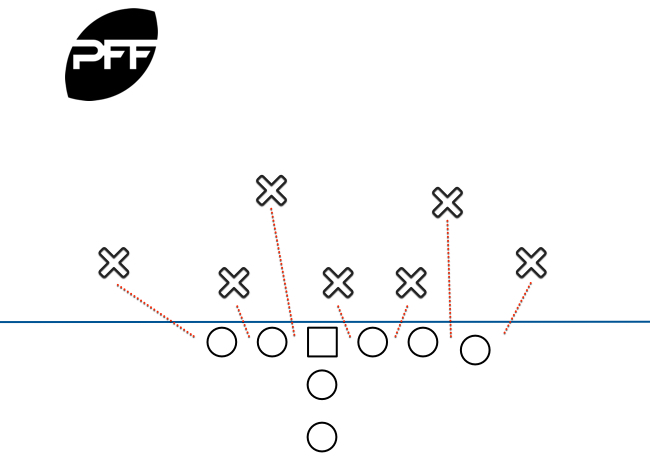
The real driving force behind the adjustments in scheme is the passing game. The NFL is a passing league and now lives in nickel defense, not base. Most teams run with three wide receivers on offense instead of a fullback or second tight end, so defenses have countered with an extra defensive back. Last season, base 4-3 and 3-4 defenses combined (with just four defensive backs on the field) accounted for only 27 percent of defensive snaps, while nickel defense (five defensive backs) was at 55 percent, and dime (six defensive backs) another 10.
What used to be your every-down defense is now being used on average only a quarter of the time. Even if two teams have dramatically different base defensive alignments, they are in sub packages far more often, and those sub packages are much more uniform in structure. Base defenses can see significant differences in alignment, but while the 55 percent of snaps the league spends in nickel defense breaks down into a few different personnel groupings, most of them are essentially different ways of achieving the same alignment.
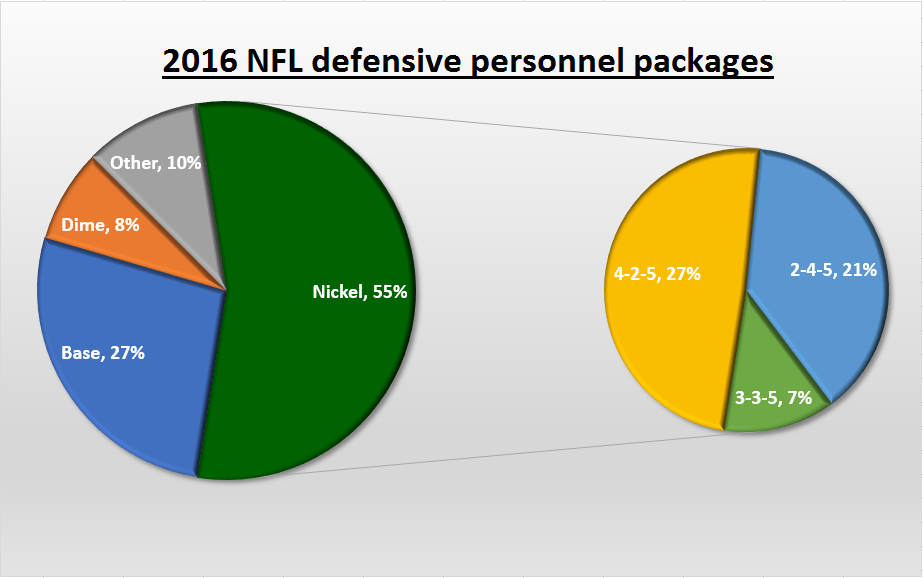
Whether you are a 3-4 or 4-3 base defense, moving to a nickel personnel grouping takes somebody out of the front-seven and adds a player to the secondary. When that happens, most teams deploy the remaining six players up front in more or less the same way because it is the most efficient way of accounting for every gap along the line.
The first guy to get sacrificed is the big nose tackle for 3-4 teams. Linemen that weigh 320-plus pounds may still be great run defenders, but they tend to offer little as pass-rushing threats. 4-3 teams typically lose one of their three linebackers, leaving both schemes with two edge defenders, two interior defenders and two off-the-ball linebackers to go along with their five defensive backs. The only difference is exactly how those edge defenders stand when they line up. Whether you’re a 3-4 or 4-3 base team, the alignment of the front four in nickel and dime defense tends to wind up the same, but is still differentiated by anachronistic position designations that no longer make sense as descriptive tools.
This image shows Denver’s defense under Wade Phillips and the Rams’ defense under Greg Williams from last year, superimposed into one image.
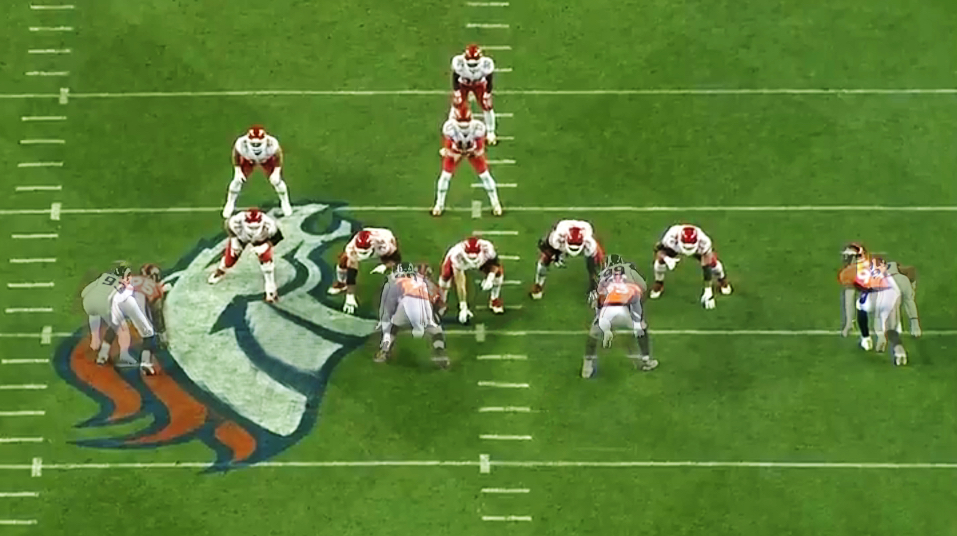
The teams were both facing near enough the same offensive formation, and they deployed their front four in identical gap alignments. The only difference between the two was that the player furthest to the right side playing on the edge was an outside linebacker for the Broncos (DeMarcus Ware) who rushed from a two-point stance, but for the Rams, that player was a defensive end that had his hand in the dirt (Eugene Sims).
Those players are listed at different positions on the roster, but have identical roles from the exact same alignment on the play in this situation. The distinction between linebacker and defensive end is far less meaningful in the world of nickel defense than that between edge defender, interior defender and off-the-ball linebacker, which is why the Pro-Bowl ballot will remain broken until it adopts that shift in player designation.
The difference in the stance of the edge defender between two-point and hand in the dirt may not even be a team-prescribed technique. There are teams in the league (the Patriots, being one) that allow their edge defenders to choose which they feel more comfortable with on any given play, effectively leaving the designation of that defensive front to one player’s whim each snap (if all you care about is how many players have their hand in the ground). As long as he is lined up in the right spot, those teams don’t care if he is in a two- or three-point stance, so the label of linebacker or defensive end is entirely meaningless and arbitrary for that player on that play.
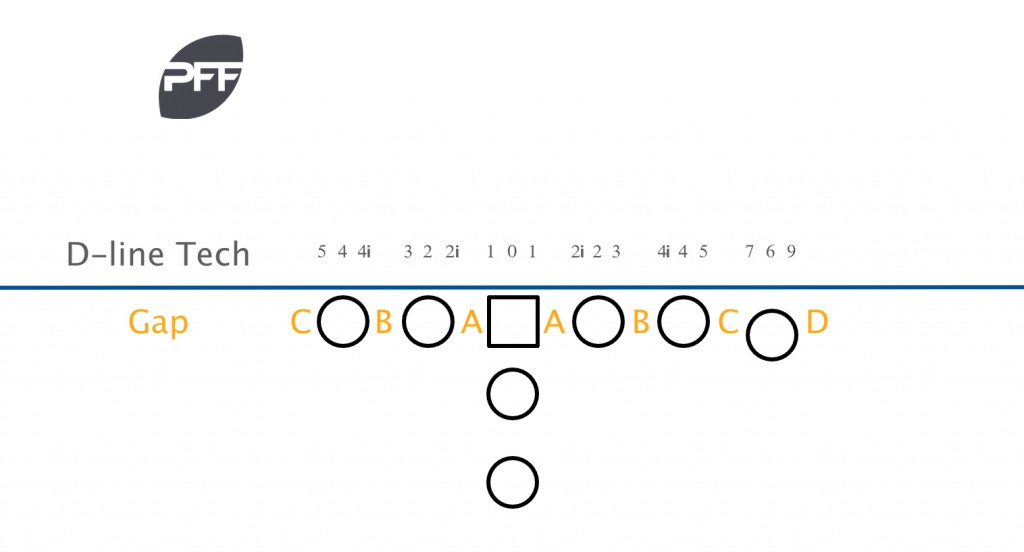
The same thing is true for interior defenders, too. Aaron Donald is known as a 3-technique defensive tackle, or “under-tackle” in a 4-man defensive-line scheme. 3-technique is simply the name of the defensive-line technique that sees a player lined up over the outside shoulder of the guard, ready to attack the gap to his outside. Most pass-rushing defensive tackles primarily play in that specific technique, but so do most pass-rushing 3-4 defensive ends. Calais Campbell, in Arizona’s 3-4 scheme, plays more 3-technique than any other technique—and more than many defensive tackles—but is listed as a defensive end on the roster. Donald’s alignment distribution in 2016 almost exactly matches that of Denver’s defensive ends, Derek Wolfe and Jared Crick.
The defense that Wade Phillips runs does have some eccentricities compared to other systems in the league—they tend to stay in base defense longer than most teams and then leap straight to six defensive backs, bypassing the nickel packages of five DBs altogether. Even in base defense, though, it is very much like a 4-3 scheme from an alignment standpoint.
When looking at the alignment distribution of Wolfe against Donald last year, the only difference between the two is a small spike for Wolfe in the 4-technique spot, the technique that plays head up over the tackle (the original 3-4 two-gap style alignment we mentioned earlier). There will be plays where we see Donald lined up in this spot, but Wolfe played there less than half as often as he played in the 3-technique spot that Donald usually occupied, and even in that alignment, he is going to be tasked with shooting a gap and defeating that tackle with quickness and hand speed rather than trying to eat up space and two-gap either side of him. In Phillips’ scheme, it is more of a disguise measure than it is a statement of two-gapping intent.
We are going to see Aaron Donald and the rest of the Rams’ defense lining up in a new defensive front under Wade Phillips in 2017, but if you can look beyond how many players have their hand in the ground, operating from a three-point stance, you’ll see that the alignment of those players has changed little despite the shift from 4-3 to 3-4. That once was a seismic shift that required a complete retooling of your defensive personnel to make it work, but in today’s NFL, it’s just a different way to shuffle the same cards. Aaron Donald may now be labelled as a 3-4 defensive end, but he will be the same destructive force as an interior defender as he has been over the past couple of seasons.
znModeratorPeete Stays in L.A. to Coach RBs
Myles Simmons
After a 2016 season full of transition, running backs coach Skip Peete is glad to have the stability that will come in 2017. Peete is one of three coaches to be retained from Los Angeles’ 2016 staff, including special teams coordinator John Fassel and assistant offensive line coach Andy Dickerson.
Of course, there was plenty of uncertainty through the coaching change process — one that resolved in a positive way for Peete and his family.
“You’re in limbo. You don’t know,” Peete said Feb. 10. “When you do it a long time, you kind of go through those types of deals. And like I told my wife, I said, ‘Well, we’ll see what happens.’
“I think it’s a little bit more uncertain for my family than it was for me. ‘Are we going to have to move?’ ‘Daddy, do we have to go to another school?’ Those types of things,” Peete continued. “But I think the transition’s been good now.”
Peete has not previously worked with head coach Sean McVay. But with friends on the 2016 Washington staff, Peete kept up with the team and was familiar with the scheme McVay implemented.
“Some of the things they were doing in the play-action game and the run game were things that excited me,” Peete said. “And so, we had that kind of conversation.”
Much was made about the reported phone call McVay received from running back Todd Gurley endorsing Peete staying on to lead his room. While Peete did not address the address that directly in an interview with therams.com, he did say he’s developed a pretty good relationship with the 2015 AP Offensive Rookie of the Year.
“The one thing that was interesting is when I first arrived, obviously there was a lot of change and things going on. So he was kind of a stand-off guy, kind of had a guard up,” Peete said. “But I think as time went on, we kind of built a bond where we kind of felt comfortable with one another. He felt he could say whatever he needed to say and get if off his chest.”
Clearly, Gurley’s numbers in 2016 were down substantially from his rookie season. Peete said there are many factors that led to Gurley’s sophomore campaign, and the coach sees ways for Gurley to get back to the gash runs that dazzled the league a season ago.
“Sometimes you look at the big picture and what produces that — I don’t know if there’s a true back in the entire league where you can just hand him the ball and they’re going to run 80 yards,” Peete said. “It’s a combination of everyone working together, wether it’s you and the runner being disciplined in your footwork, your course, your press, setting the defense to help the linemen, the tight ends, receivers all get in position to get their job done. And then that’s where you have naturally large and big gains.”
But there’s one particular aspect of Gurley’s game Peete would like to see improved to make the Georgia product a premier NFL running back.
“The biggest thing he and I talked about had nothing to do with the run game, though. It was more about the importance of a running back, in my opinion, in this league [to have] the ability to be a very dominant pass protector,” Peete said. “I think you as the runner as you step up to protect the quarterback — it’s very important that you physically do that in a manner where there’s no pressure in the framework of the pocket to where the quarterback can finish his throwing motion. And he and I had a lot of conversations about that.”
znModeratorRams want Todd Gurley to improve his pass blocking
Michael David Smith
Rams want Todd Gurley to improve his pass blocking
Rams running back Todd Gurley was one of the most disappointing players in the NFL last season, falling from 4.8 yards a carry as a rookie in 2015 to just 3.2 yards a carry in 2016. But running the ball isn’t what the Rams think Gurley needs to improve.
Asked what Gurley needs to work on, Rams running backs coach Skip Peete said pass protection.
“It has nothing to do with the running game,” Peete told ESPN. “I think the most important thing in this league, as far as a running back is concerned, is his ability to pass protect, whether it’s first or second down. Because they think it’s easy. They’ve all come into the league comfortable as a runner. But that aspect of it is a little bit different than you’re accustomed to coming out of college. He and I talk about that all the time — your ability to completely understand the blocking scheme, whether it’s run or pass.”
The Rams like the running back they drafted in 2015, but the player they really need to develop is the quarterback they drafted in 2016, Jared Goff. The NFL is such a pass-oriented league that even when you’re a franchise running back, your biggest job is protecting the franchise quarterback.
znModeratorBarron inside? He’ll get mauled. Sorry, but I’m dubious. He’s undersized. Quinn? He can be a Aldon Smith with the right guy inside of him on the line.
Shit. How do the Patriots do it? System Plug N Play…
Bucannon works inside for Arizona. He’s basically the same guy as Barron. According to Football Outsiders, the Arizona D is ranked 3rd in yards per carry allowed running from guard to guard, and 11th in yards per carry allowed running to the right tackle. If Bucannon were a problem, that’;s where it would show up.
This is a 1-gap attack D, not a grab blockers and read and react D. So Barron could work.
Quinn you figure will be a stand-up LB on the right side, with Ogletree inside him and Donald on the line.
znModeratorBroncos may be interested in Tony Romo, if he’s a free agent
Mike Florio
Broncos may be interested in Tony Romo, if he’s a free agent
It’s believed Tony Romo will ask the Cowboys to release him in lieu of trying to trade him. Romo has another reason to push for the termination of his contract.
The Denver Broncos, previously believed to be not interested in Romo, reportedly could be interested if Romo can be obtained free and clear on the open market. Mike Klis of 9news.com reports that “a source in the Broncos’ football department did not dismiss the possibility” of signing Romo, if a trade isn’t needed.
Although the Cowboys may prefer to get value for Romo, cutting him would actually have a benefit, since the salary cap hit could be divided over two years. The team nevertheless has been very coy about its plans for the franchise quarterback who has been supplanted by Dak Prescott, prompting speculation that the Cowboys prefer to finagle a trade.
Romo’s interest in the Broncos would depend on the role the team envisions for him. Would he be installed as the starter? Would he have to compete with Paxton Lynch and Trevor Siemian?
The financial package the Broncos offer to Romo would say plenty about how they plan to use him. Even then, it’s possible that some other team would offer Romo much more than Denver would.
None of it matters unless and until the Cowboys release Romo’s rights. The question of whether they will soon will become one of the biggest issues in the NFL.
===
What will the Cowboys do with Tony Romo? Our experts predict his fate
By SportsDayDFW.com
What does the future hold for quarterback Tony Romo? It’s the story of the Cowboys’ offseason. Will the franchise’s all-time passing leader suit up for another team? Will he be released by the Cowboys or traded? What about a backup role in Dallas or retirement? SportsDay’s columnists and Cowboys beat writers offer their predictions:
Tim Cowlishaw
Romo’s future: Release, June 1 designation
It’s fun to consider all the trade possibilities for Romo. To Denver for DeMarcus Ware? To Houston for Brock Osweiler and a No. 1 pick? Yes, it’s fun, but none of it makes sense.
There are teams that will want Romo, but it’s unlikely that he will leave Dallas in a trade. The cap ramifications make it easier for the Cowboys to designate him a June 1 cut and spread the salary-cap hit over the 2017 and 2018 seasons. It’s unrealistic to think this ends any other way.
Then again, these are the Cowboys, and with Jerry Jones, it’s wise to consider the “unrealistic” from time to time. Jones wants to keep Romo. He wants to convince Romo that he has a future here in the organization and that he should stay, presumably as the most expensive insurance policy in the league. Not having to worry about what happens when the backup quarterback enters the game would be a decided plus.
But that would be the only plus. This scenario would be bad for Dak Prescott, terrible for Romo and unfair to the coaching staff. The circus would never leave town if Romo stayed around.
Releasing him will allow Romo to pursue his final year or years with the team of his choice. It’s fair to him and best for the Cowboys.
Brandon George
Romo’s future: Release, June 1 designation
As much as Cowboys owner Jerry Jones would like to keep Romo around, it just doesn’t make fiscal sense. Romo will count almost $25 million against the salary cap in 2017. Last season, he played six snaps and counted $20.8 million against the cap.
NFL teams can’t afford to keep a backup quarterback — and that’s what Romo is now, behind Dak Prescott — on their roster for a big price tag if they’re serious about contending.
Working a trade for Romo will be difficult. He’s going to have to sign off on the team that wants to trade for him, the sides would have to agree on compensation and Romo would likely have to rework his contract at a much lower price. Having all that come together is unlikely, so an outright release makes the most sense here.
Look for Romo to land on a team that can immediately contend for a championship, has a strong offensive line and isn’t afraid to take a chance on a soon-to-be 37-year-old with a history of back injuries.
Denver makes as much sense as any team. The Broncos have a team in place that can immediately make a run at a championship. In John Elway, they also have a general manager who certainly knows a quarterback can win titles late in his career. Romo turns 37 in April. Elway won his first Super Bowl at 37 and won another at 38.
Rick Gosselin
Romo’s future: Release, June 1 designation
When you trade for a player, you trade for his contract. And with Romo on the books for almost $25 million next season, the Cowboys would have problems dealing him. It’s more likely the Cowboys will release him this offseason and let him cut his own deal with the team of his choice.
Whether the Cowboys trade or release him, they will take a sizable salary-cap hit. If the Cowboys designate him as a June 1 cap casualty, they can split that hit over two seasons. And that’s what I think the Cowboys will do — designate him as a June 1 release.
Romo has maybe a two-year window left … if he can stay healthy. So don’t look for him to sign with teams that are in rebuilding mode. That knocks the Bears, Bills, Jaguars and Jets out of the running. He needs to sign on with a team that is Super Bowl-ready, as Peyton Manning did. He picked his spot and wound up taking the Broncos to the Super Bowl. Joe Montana also picked his spot when he left the 49ers and wound up taking the Kansas City Chiefs to an AFC title game.
So only two teams seem logical fits for Romo, the Broncos and Texans. Both are Super Bowl contenders in need of upgrades at the quarterback position. My guess is Romo has Houston atop his shopping list. The Texans have the best defense in the NFL, and that defense will become even better in 2017 with the return of J.J. Watt. They have a 1,000-yard rusher in the backfield (Lamar Miller) and two talented young wide receivers (DeAndre Hopkins and Will Fuller). So Houston it is.
Jon Machota
Tony Romo’s future: Trade
The Cowboys will play this close to the vest until a deal is done. Jerry Jones has compared Romo to Aaron Rodgers, Ben Roethlisberger and Eli Manning within the last few months. The owner and general manager won’t just give away his former franchise quarterback. He realizes how few teams have a quality starter, so he’d like to drive up the price.
In the statement Romo read in November he didn’t sound like a player looking to retire or settle for a backup job. He’ll eventually be traded to an AFC team that believes it’s a good QB away from making a Super Bowl run. In return, the Cowboys will receive a third- or fourth-round draft pick.
David Moore
Romo’s future: Release, June 1 designation
The club’s preference is to swing a trade that meets with the quarterback’s approval. But compensation would be tricky, and finding mutual ground for the Cowboys, Romo and a third party would be complex.
Owner Jerry Jones and Romo have a relationship that transcends owner and quarterback. That’s clear. It’s one that will continue once Romo’s career is done.
Neither side will risk harming that bond. In the end, an outright release is cleaner and less complicated, making it the most likely option.
It will cost the franchise $19.6 million to sever ties with Romo whether he is traded or cut.
Romo has a salary-cap hit of $24.7 million for the 2017 season. If he’s released before June 1, the Cowboys actually free up $5.1 million in room they wouldn’t have otherwise.
If the club designates Romo as a June 1 cut, it can split the $19.6 million over two seasons. He would consume $10.7 million of the ’17 salary cap and $8.9 million of the team’s payroll the next season.
Do the Cowboys want to free up $14 million or $5.1 million this season with a release of Romo? As tempting as it will be to take the entire hit now and be out from under the contract in 2018, splitting the hit over the next two seasons is more of the team’s style.
Look for Romo to be designated a June 1 cut. And look for Houston to be a major contender for his services, with Denver right behind.
Kate Hairopoulos
Romo’s future: Release
This split isn’t easy on anyone. As is often the case in arduous situations, it’s best to just get it over with all at once. By releasing Romo, the Cowboys will actually save $5.1 million that they will have available for free agency, money that won’t be available to them if they designate Romo a June 1 cut. Yes, they’ll have to take the $19.6 million hit to the salary cap this season, but financial gymnastics will make it work.
Best of all, they can move into 2018 free and clear of Romo’s contract. Romo will also get to choose where he goes for his last hurrah. Contenders such as Denver and Houston seem to be the most obvious situations where the potential rewards of Romo outweigh the clear concerns about his durability.
There. Done. Everyone’s happy-ish.
Kevin Sherrington
Romo’s future: Release, June 1 designation
Tony Romo signs with the Broncos and leads them to the AFC Championship Game, where they lose to the Ravens. Romo subsequently retires and goes into TV. First order of business in new job: Lose the smirk.
February 22, 2017 at 5:45 pm in reply to: Star discovered with 7 earth-sized planets including 3 in habitable zone #65525znModeratorFor me cause of format this one was just easier to read here. Though I was wondering, is that Ceti Alpha 5 and 6 there?
..
At about 40 light-years (235 trillion miles) from Earth, the system of planets is relatively close to us, in the constellation Aquarius. Because they are located outside of our solar system, these planets are scientifically known as exoplanets.
This exoplanet system is called TRAPPIST-1, named for The Transiting Planets and Planetesimals Small Telescope (TRAPPIST) in Chile. In May 2016, researchers using TRAPPIST announced they had discovered three planets in the system. Assisted by several ground-based telescopes, including the European Southern Observatory’s Very Large Telescope, Spitzer confirmed the existence of two of these planets and discovered five additional ones, increasing the number of known planets in the system to seven.
The new results were published Wednesday in the journal Nature, and announced at a news briefing at NASA Headquarters in Washington.
Using Spitzer data, the team precisely measured the sizes of the seven planets and developed first estimates of the masses of six of them, allowing their density to be estimated.
Based on their densities, all of the TRAPPIST-1 planets are likely to be rocky. Further observations will not only help determine whether they are rich in water, but also possibly reveal whether any could have liquid water on their surfaces. The mass of the seventh and farthest exoplanet has not yet been estimated – scientists believe it could be an icy, “snowball-like” world, but further observations are needed.
“The seven wonders of TRAPPIST-1 are the first Earth-size planets that have been found orbiting this kind of star,” said Michael Gillon, lead author of the paper and the principal investigator of the TRAPPIST exoplanet survey at the University of Liege, Belgium. “It is also the best target yet for studying the atmospheres of potentially habitable, Earth-size worlds.”

In contrast to our sun, the TRAPPIST-1 star – classified as an ultra-cool dwarf – is so cool that liquid water could survive on planets orbiting very close to it, closer than is possible on planets in our solar system. All seven of the TRAPPIST-1 planetary orbits are closer to their host star than Mercury is to our sun. The planets also are very close to each other. If a person was standing on one of the planet’s surface, they could gaze up and potentially see geological features or clouds of neighboring worlds, which would sometimes appear larger than the moon in Earth’s sky.
The planets may also be tidally locked to their star, which means the same side of the planet is always facing the star, therefore each side is either perpetual day or night. This could mean they have weather patterns totally unlike those on Earth, such as strong winds blowing from the day side to the night side, and extreme temperature changes.
Spitzer, an infrared telescope that trails Earth as it orbits the sun, was well-suited for studying TRAPPIST-1 because the star glows brightest in infrared light, whose wavelengths are longer than the eye can see. In the fall of 2016, Spitzer observed TRAPPIST-1 nearly continuously for 500 hours. Spitzer is uniquely positioned in its orbit to observe enough crossing – transits – of the planets in front of the host star to reveal the complex architecture of the system. Engineers optimized Spitzer’s ability to observe transiting planets during Spitzer’s “warm mission,” which began after the spacecraft’s coolant ran out as planned after the first five years of operations.
“This is the most exciting result I have seen in the 14 years of Spitzer operations,” said Sean Carey, manager of NASA’s Spitzer Science Center at Caltech/IPAC in Pasadena, California. “Spitzer will follow up in the fall to further refine our understanding of these planets so that the James Webb Space Telescope can follow up. More observations of the system are sure to reveal more secrets.”
Following up on the Spitzer discovery, NASA’s Hubble Space Telescope has initiated the screening of four of the planets, including the three inside the habitable zone. These observations aim at assessing the presence of puffy, hydrogen-dominated atmospheres, typical for gaseous worlds like Neptune, around these planets.
This 360-degree panorama depicts the surface of a newly detected planet, TRAPPIST 1-d, part of a seven planet system some 40 light years away. Explore this artist’s rendering of an alien world by moving the view using your mouse or your mobile device.
In May 2016, the Hubble team observed the two innermost planets, and found no evidence for such puffy atmospheres. This strengthened the case that the planets closest to the star are rocky in nature.
“The TRAPPIST-1 system provides one of the best opportunities in the next decade to study the atmospheres around Earth-size planets,” said Nikole Lewis, co-leader of the Hubble study and astronomer at the Space Telescope Science Institute in Baltimore, Maryland. NASA’s planet-hunting Kepler space telescope also is studying the TRAPPIST-1 system, making measurements of the star’s minuscule changes in brightness due to transiting planets. Operating as the K2 mission, the spacecraft’s observations will allow astronomers to refine the properties of the known planets, as well as search for additional planets in the system. The K2 observations conclude in early March and will be made available on the public archive.
Spitzer, Hubble, and Kepler will help astronomers plan for follow-up studies using NASA’s upcoming James Webb Space Telescope, launching in 2018. With much greater sensitivity, Webb will be able to detect the chemical fingerprints of water, methane, oxygen, ozone, and other components of a planet’s atmosphere. Webb also will analyze planets’ temperatures and surface pressures – key factors in assessing their habitability.
NASA’s Jet Propulsion Laboratory (JPL) in Pasadena, California, manages the Spitzer Space Telescope mission for NASA’s Science Mission Directorate. Science operations are conducted at the Spitzer Science Center, at Caltech, in Pasadena, California. Spacecraft operations are based at Lockheed Martin Space Systems Company, Littleton, Colorado. Data are archived at the Infrared Science Archive housed at Caltech/IPAC. Caltech manages JPL for NASA.
..
znModeratorThey may add an LB but they have a lot of candidates already. They have a dozen on the roster, if you count possible DE to LB conversions.
There’s of course Quinn who you’d think would be going outside.
Then maybe between and among Sims, Longacre, and Fox they have a 3/4 LB or 2.
There’s last years LBs, Barron and Tree of course.
And who knows about the recently added LBs: Forrest, Grigsby, Hager, Littleton. Maybe there’s a player in there too. I know Littleton has gotten some buzz.
They also have 2 practice squad LBs: Cassanova McKinzy (6-3 253) & Reggie Northrup (6-1 237)
So that’s
Barron Ogletree Quinn Forrest Sims Longacre Fox Littleton Hager Grigsby Northrup McKinzy
A good guess right now would be that it could look something like this (at this point):
3-tech: Donald, Easley (they’ve already said Donald will be a 3-tech and not a standard 3/4 DE)
NT: Brockers
LDE: Hayes, WestbrooksROLB: Quinn
RILB: Ogletree
LILB: Barron (in the Rams version of the Deone Bucannon role in the Arizona D…DB plays at 216)
LOLB: ? … up to 9 candidates on the roster, some of whom played 3/4 LB in collegeznModeratorIt gets boring here. Rarely see posts.
Fwiw every board on the net is slow-ish these days.
znModeratorAs well he should.
znModeratormost of the posters here don’t really understand what “right” is. Or, rather, the mindset.
And that’s possible too!
Bernie was\is clueless. I think even to leftists like you. His sole argument was “free stuff,” essentially.
And no, we disagree on Sanders. I don’t particularly want to get into it myself right now (someone else might) but just saying how I see it, I think he’s far from clueless and that was not his argument.
.
znModeratorIt was the Democrats’ embrace of neoliberalism that won it for Trump
Naomi Klein
https://www.theguardian.com/commentisfree/2016/nov/09/rise-of-the-davos-class-sealed-americas-fate
Here is what we need to understand: a hell of a lot of people are in pain. Under neoliberal policies of deregulation, privatisation, austerity and corporate trade, their living standards have declined precipitously. They have lost jobs. They have lost pensions. They have lost much of the safety net that used to make these losses less frightening. They see a future for their kids even worse than their precarious present.
At the same time, they have witnessed the rise of the Davos class, a hyper-connected network of banking and tech billionaires, elected leaders who are awfully cosy with those interests, and Hollywood celebrities who make the whole thing seem unbearably glamorous. Success is a party to which they were not invited, and they know in their hearts that this rising wealth and power is somehow directly connected to their growing debts and powerlessness.
For the people who saw security and status as their birthright – and that means white men most of all – these losses are unbearable.
Donald Trump speaks directly to that pain. The Brexit campaign spoke to that pain. So do all of the rising far-right parties in Europe. They answer it with nostalgic nationalism and anger at remote economic bureaucracies – whether Washington, the North American free trade agreement the World Trade Organisation or the EU. And of course, they answer it by bashing immigrants and people of colour, vilifying Muslims, and degrading women. Elite neoliberalism has nothing to offer that pain, because neoliberalism unleashed the Davos class. People such as Hillary and Bill Clinton are the toast of the Davos party. In truth, they threw the party.
Trump’s message was: “All is hell.” Clinton answered: “All is well.” But it’s not well – far from it.
Neo-fascist responses to rampant insecurity and inequality are not going to go away. But what we know from the 1930s is that what it takes to do battle with fascism is a real left. A good chunk of Trump’s support could be peeled away if there were a genuine redistributive agenda on the table. An agenda to take on the billionaire class with more than rhetoric, and use the money for a green new deal. Such a plan could create a tidal wave of well-paying unionised jobs, bring badly needed resources and opportunities to communities of colour, and insist that polluters should pay for workers to be retrained and fully included in this future.
It could fashion policies that fight institutionalised racism, economic inequality and climate change at the same time. It could take on bad trade deals and police violence, and honour indigenous people as the original protectors of the land, water and air.
People have a right to be angry, and a powerful, intersectional left agenda can direct that anger where it belongs, while fighting for holistic solutions that will bring a frayed society together.
Such a coalition is possible. In Canada, we have begun to cobble it together under the banner of a people’s agenda called The Leap Manifesto, endorsed by more than 220 organisations from Greenpeace Canada to Black Lives Matter Toronto, and some of our largest trade unions.
Bernie Sanders’ amazing campaign went a long way towards building this sort of coalition, and demonstrated that the appetite for democratic socialism is out there. But early on, there was a failure in the campaign to connect with older black and Latino voters who are the demographic most abused by our current economic model. That failure prevented the campaign from reaching its full potential. Those mistakes can be corrected and a bold, transformative coalition is there to be built on.
That is the task ahead. The Democratic party needs to be either decisively wrested from pro-corporate neoliberals, or it needs to be abandoned. From Elizabeth Warren to Nina Turner, to the Occupy alumni who took the Bernie campaign supernova, there is a stronger field of coalition-inspiring progressive leaders out there than at any point in my lifetime. We are “leaderful”, as many in the Movement for Black Lives say.
So let’s get out of shock as fast as we can and build the kind of radical movement that has a genuine answer to the hate and fear represented by the Trumps of this world. Let’s set aside whatever is keeping us apart and start right now.
znModeratorI think the Dems have gone far left
It’s amazing how people see things differently.
There is not a single leftist here who would agree with that statement.
Remember, there’s an active core here of posters who consider themselves leftists. Not liberals. Not dems. Leftists. Actual leftists.
And I can confidently say that to all of us, as actual leftists on the actual left, what we see is the EXACT opposite of what you claim.
On economic and foreign policy issues, the dems have longs since been basically moderate centrists. At best.
There is absolutely no reality to me in which they can be construed as moving left, let alone tot the “far” left. In fact I can think of a single elected official in the entire USA who would qualify as FAR left, let alone LEFT.
The dems remain more or less ordinary liberals (not leftists) on cultural issues like sexuality. But that’s it.
This has been going on since Clinton and was just as bad under Obama.
znModeratorRams’ new O-line coach sees a young group he can work with
By Alden Gonzalez
THOUSAND OAKS, Calif. — Aaron Kromer, the Los Angeles Rams’ new offensive line coach, said he is “excited” about the group he will now oversee, which, on the surface, sounds odd. Kromer is inheriting a collection of offensive linemen who were nothing short of dreadful throughout the 2016 season. They couldn’t open holes for their star running back, Todd Gurley, and they couldn’t keep their franchise quarterback, Jared Goff, upright.
Not much to be excited about, unless you ask Kromer.
“The reason is the youth,” Kromer said. “When you look at it, there’s not many offensive lines in the league that have second- and third-year players across the board, other than the center with five. It’s got to be one of the youngest groups in the league, and the backups are just as young.”
Kromer mistakenly omitted Rodger Saffold, a seven-year veteran who might have been the Rams’ best offensive lineman this past season. But besides that, he’s right. Outside of Saffold and center Tim Barnes, an undrafted free agent from 2011, the Rams’ offensive line is awfully young, a product of the seven draft picks used on the position from 2014 to ’15.
That includes left tackle Greg Robinson (the second overall pick in 2014), right tackle Rob Havenstein (second round in 2015) and the three linemen who started at right guard this past season: Jamon Brown (third round in 2015), Cody Wichmann (sixth round in 2015) and Andrew Donnal (fourth round in 2015). Besides David Arkin, a fourth-round pick in 2011, all of the incumbent backups have completed no more than three NFL seasons, including Demetrius Rhaney (seventh round in 2014), Darrell Williams (undrafted in 2015) and Pace Murphy (undrafted in 2016).
Kromer believes he can still mold them.
“We’ve got work to do; we get that,” Kromer said. “But I feel good watching the tape of individually their skills that they have and trying to put five guys together that can work together to have success. … It’s going to be a lot of hard work for them; it’s going to be a lot of hard work for us. But I think the best quality a coach can have is to be able to teach and be a good communicator. We have to teach these guys exactly what we want and become repetitive with what we’re looking for.”
Kromer, who replaces longtime coach Paul Boudreau, has spent the last 16 years in the NFL, serving as a senior assistant, a running backs coach, an offensive coordinator, an interim head coach and, mostly, an offensive-line coach. Kromer coached offensive lines for the Raiders (2002 to ’04), Buccaneers (2006 to ’07), Saints (2009 to ’12) and Bills (2015 to ’16). During his four-year stint with the Saints, Kromer coached five offensive linemen who went to a combined 10 Pro Bowls. And over his last two years in Buffalo, the Bills led the NFL with 5.06 rushing yards per carry.
Behind the Rams’ offensive line in 2016, Gurley averaged 3.18 rushing yards per carry, the second-worst rate in the NFL, and Goff was sacked an NFL-leading 25 times over his last six games.
The first step in turning the offensive line around is deciding what to do with Robinson, but Kromer isn’t taking this job with any preconceived notions. He generally doesn’t want outside opinions. He’d rather make determinations on his own, and he sees this as “a new start” for every Rams offensive lineman, free to make of it what they want.
“We all know that the whole line has to improve,” Kromer said. “We all see that, and you see that on tape. But individually, I see skills, we see skills, in these guys, that if we can pull them together, and get them working together, which we see is possible, that we can get the group much better. It’s just going to be a process. I don’t know how long that process is going to take. Is it going to take a month, is it going to take a year, is it going to take two years? I don’t know that, and I don’t know if we need to add somebody yet. I can’t answer that yet. But I do see individual skills in each one of these guys that should allow them to have success.”
znModeratorThanks guys.
Cake!
 znModerator
Video surfaces of Milo Yiannopoulos defending pedophilia, ACU board reportedly not consulted on CPAC invite
The American Conservative Union, which hosts the annual gathering of conservatives called “CPAC,” announced over the weekend that alt-Right provocateur Milo Yiannopoulos would be this year’s keynote speaker.
Many criticized the move because Yiannopoulos is not seen as a traditional conservative — if a conservative at all. Instead, Yiannopoulos is seen as the figurehead of the alt-Right movement, a movement that prides itself in nationalism, which many accuse of racism and anti-Semitism.
Jonah Goldberg, a senior editor for the conservative magazine National Review who is seen as one of the conservative leaders in post-modern politics, said the move to include Yiannopoulos as the keynote speaker is “sad and disappointing.”
Still, ACU chairman Matt Schlapp defended the decision in comments to the Hollywood Reporter, which broke the story about Yiannopoulos.
“An epidemic of speech suppression has taken over college campuses,” Schlapp told the news outlet. “Milo has exposed their liberal thuggery and we think free speech includes hearing Milo’s important perspective.”
Then on Sunday morning, less than one day after the controversial announcement about the CPAC speaker lineup, video surfaced of Yiannopoulos allegedly defending pedophilia in the past.
“We get hung up on this sort of child abuse stuff,” Yiannopoulos is heard saying in a video, acknowledging that he has a controversial point of view, “to the point where we are heavily policing consensual adults.”
“In the homosexual world, particularly, some of those relationships between younger boys and older men — the sort of ‘coming of age’ relationship — those relationships in which those older men help those young boys discover who they are and give them security and safety and provide them with love and a reliable, sort of rock, where they can’t speak to their parents,” he added.
“It sounds like molestation to me,” an unnamed person tells Yiannopoulos in reply, likely an interviewer. “It sounds like Catholic priest molestation to me.”
“But you know what? I’m grateful for Father Michael. I wouldn’t give nearly such good head if it wasn’t for him,” Yiannopoulos replied, using a euphemism for male oral sex.
It doesn’t end there.
In an interview with comedian Joe Rogan in 2015, Yiannopoulos discussed his sexual relationship with “Father Michael,” which he allegedly had as a teenager at age 14.
During the interview, he even tried to normalize pedophilia.
“So you’re saying you’ve never seen a 15-year-old girl, at any point in your life, that you thought was hot?” Yiannopoulos asked.
“Yeah, when I was 15!” Rogan replied. “I’m not retarded dude.”
“No, when you were 25 or 30, you’ve never seen girls you thought were hot?” Yiannopoulos asked again.
“No, I thought they were little kids!” Rogan said.
Later, Rogan called “Father Michael” a “terrible person” for allegedly having a sexual relationship with Yiannopoulos when he was a young teenager, but Yiannopoulos tried to downplay it.
“It wasn’t molestation,” he alleged
“That’s absolutely molestation,” Rogan shot back.
Later in the interview, Yiannopoulos talked about a Hollywood party he went to years ago that had “very young boys” in attendance for sex.
Yiannopoulos has since responded to the allegations on Facebook Sunday afternoon denying them completely.
Yiannopoulos wrote:
There’s a video going around that purports to show me saying anti-semitic things (nope) and advocating for pedophilia (big nope). The shocking thing? It’s Republicans doing it. Sad to see establishment types collapse into the same tactics as social justice warriors: name calling, deceptively edited videos, confected moral outrage and public shaming. This is why they deserve to burn — and why they are burning. Here’s how I actually feel about pedophilia, which you’d know if you’d actually watched or read anything I’ve ever done. Or, you know, if you had two brain cells to rub together. There’s only one appropriate response to this sort of behavior, and it’s a gigantic F**K YOU!
In addition, it appears that the ACU board was not consulted about Yiannopoulos being named a speaker at this years CPAC, let alone the keynote.
“The ACU board was not consulted on this, nor was there a board vote,” Ned Ryun wrote on Twitter Saturday, who sits on the ACU board.
Last year’s keynote speaker was conservative radio host Glenn Beck, who many criticized in 2016 for being an outspoken critic of then-candidate Donald Trump. Beck didn’t support Trump because he didn’t think Trump was conservative enough.
znModeratorBill Maher’s ‘Real Time’ interview with Milo Yiannopoulos fuels new criticism
http://www.latimes.com/entertainment/tv/la-et-st-bill-maher-milo-interview-20170218-story.html
In the end, it was a non-event. Which to some people made it a really big event.
Bill Maher’s decision to host controversial blogger Milo Yiannopoulos on “Real Time with Bill Maher” on HBO Friday led to very few on-air fireworks. Maher talked to his guest mostly about free speech, agreeing with him nearly as much as disagreeing with him and generally affecting a convivial tone.
Yiannopoulos is a senior editor at Breitbart News and provocateur on many subjects, including Islam and feminism; he has gained particular notoriety in the past year with the ascent of President Trump.
Earlier in the week, Maher’s announcement that he had invited the blogger and author for a top-of-show interview caused the withdrawal of another guest, Jeremy Scahill, a left-wing journalist who founded The Intercept and produced the documentary “Dirty Wars.” Scahill said in a statement that he pulled out because he said the appearance would “provide Yiannopoulos with a large, important platform to openly advocate his racist, anti-immigrant campaign.”
Maher had defended the choice as necessary to bring the blogger’s positions under scrutiny. “If Mr. Yiannopoulos is indeed the monster Scahill claims — and he might be — nothing could serve the liberal cause better than having him exposed on Friday night.”
On Friday, Maher created an at times challenging but mostly friendly atmosphere for his guest. “There are so many things I can start an argument with you about,” Maher said at the beginning of the chat and also noted at one point that “some people would say you incited” violence with posts on social media. But, mostly, Maher stuck to issues on which they agreed, including free speech and comedy. The pair also found common ground on the controversy surrounding their respective speaking engagements at UC Berkeley and the subject of political correctness. At one point Maher noted “that part of liberalism that has gone off the deep end.”
Maher is known for supporting a number of progressive causes but also, as he put it to The Times last year, is inclined to point out when “liberals … have spinach on their teeth” on certain issues, including radical Islam.
While Maher said on-air Friday that he was against Yiannopoulos’ policy of going after people individually, he offered no rebuttal to Yiannopoulos’ repetition of slurs against “Saturday Night Live” and “Ghostbusters” star Leslie Jones, an earlier round of which got the blogger banned from Twitter last year.
Maher’s welcoming spirit was cited by critics as evidence for their argument earlier in the week that hosting Yiannopoulos amounted to a kind of normalization of him.
In the Daily Beast, for instance, Marlow Stern accused Maher of “backslapping” Yiannopoulos and alleged that Maher had “no follow-up … no challenging of statements.”
“When all was said and done, one thing was clear: the only one who took ‘the bait’ tonight was Maher,” Stern wrote.
There was, it should be said, a direct rebuttal on Yiannopolous’s attacks on Jones, but it came from fellow guest Larry Wilmore. When Yiannopoulos joined the panel mid-show, the former Comedy Central host directed a four-letter message to the blogger, then repeated it a moment later.
Off the show, perhaps one of the most pithy responses from the left came from the MSNBC anchor Chris Hayes, who after the interview posted online, tweeted “Watching the Real Time clip confirms: @jeremyscahill made the right call.”
znModeratorThe Staff: Eric Yarber
Get to know new Rams wide receivers coach Eric Yarber as he sits down for an exclusive one on one interview with Rams reporter Dani Klupenger.
http://www.therams.com/videos/videos/The-Staff-Eric-Yarber/777a680b-c215-4279-9dff-3a48618e7083
znModeratorI wonder how wv is doing.
Message from WV:
Computer problems. Hope to be online in a few days… m
February 20, 2017 at 10:31 am in reply to: Goff getting outside coaching help + other things Goff #65445znModeratorIt’s Jared Goff’s time, for better or worse
Alden Gonzalez
http://www.espn.com/blog/los-angeles-rams/post/_/id/33010/its-jared-goffs-time-for-better-or-worse
Key returnees: Jared Goff, Sean Mannion
Notable free agents: Case Keenum
Top free agents available (for now): Kirk Cousins, Ryan Fitzpatrick, Josh McCown, Shaun Hill, Matt Schaub, Matt McGloin, Mike Glennon, E.J. Manuel, Matt Cassel, Blaine Gabbert
Key stat: Among rookies with at least 200 pass attempts, Goff’s 63.6 passer rating was the 12th-lowest since 2000. The 11 who were worse: Andrew Walter (55.8 in 2006), Jimmy Clausen (58.4 in 2010), Kyle Orton (59.7 in 2005), Josh Freeman (59.8 in 2009), Joey Harrington (59.9 in 2002), Matthew Stafford (61.0 in 2009), Chris Weinke (62.0 in 2001), Kyle Boller (62.4 in 2003), Ken Dorsey (62.4 in 2004), David Carr (62.8 in 2002) and Mark Sanchez (63.0 in 2009). Those 11 have combined for one Pro Bowl invite, for Stafford.
As you might have noticed, the quarterback market drops off considerably after Cousins. That’s why trading for Jay Cutler sounds like such an appealing proposition. And it’s why so many teams are expected to line up for Tony Romo if the Dallas Cowboys release him. The Rams have been mentioned as a potential landing spot for Romo, but their biggest question at quarterback is whether Mannion, a third-round pick in 2015, is ready to be a full-time backup. If not, the Rams could bring in a fringe veteran.
But it’s Goff’s turn to start, for better or worse.
By the end of 2017, we’ll all have a much better understanding of how good, or bad, Goff actually is. The No. 1 overall pick in 2016, Goff never challenged Keenum for the starting job in training camp last summer and didn’t get the nod until Week 11. He started each of the Rams’ last seven games, all losses, and finished with the NFL’s fewest yards per attempt (5.31), second-worst Total QBR (22.2), fourth-worst completion percentage (54.6) and fourth-lowest touchdown-to-interception ratio (0.71).
But Goff also didn’t have any help, at receiver, along the offensive line or within the scheme. Now he’ll get a chance to play under Sean McVay, who helped Cousins ascend while serving as the play-caller for a quarterback-friendly Washington Redskins offense these last two years. And he’ll work alongside Greg Olson, who has spent 15 years in the NFL as either an offensive coordinator or a quarterbacks coach or both. Olson, who watched Goff closely at Cal, sees “tremendous arm talent” and said the key to Goff’s development rests on “being comfortable within a system.”
“This is a guy that we believe in,” McVay said of Goff at his introductory news conference. “We’re encouraged and excited about developing him.”
znModeratorCal, here’s what you did. I introduces spaces so you can see the code. Normally this would all be on one line.
<a href=”
https://www.youtube.com/watch?v=2JzinSRTwPk.
“>That won’t work with vids. You just paste the url into the post box and the software does the rest. Anyway I fixed it in your post.
znModerator“Arrival”. A linguistics expert is recruited to attempt to communicate with aliens. While I’m always wary of movies about aliens this was one heck of a movie. Highly recommend it -especially if one is interested in the mathematics behind language. I think Chomsky would be highly interested in the film.
Thanks for posting that, it’s interesting. However, it does lead me to think about something–which is that, arguably, the kind of linguistic theory in the film is the exact opposite of what Chomsky does. It’s true there’s a lot of linguistics in the movie, and they manage to make it cinematic. Still, you just got me to thinking about the difference between what Chomsky does and what some other language theorists do.
The film is a radicalization of what in linguistics is known as the Whorf hypothesis, which holds that culturally derived language conventions shape how people view reality. In the film, then, because the visitors cognitively live in open-ended time lines and can be in the future as much as the present, their language reflects this. Therefore, when the earth linguist learns their language, her actual reality alters and she too is capable of being in the future and present at the same time.
Chomskian linguistics is the opposite in many respects. Chomsky argues that not just the capacity to learn a language but the deep structures of grammatical form and syntax are innate—we are literally born with them built in already, just as we are born able (usually) to coordinate hand/eye function and understand the basic physics of space and movement. We have an innate linguistic capacity. It’s hard-wired into us. So the core rules of language and grammar are genetically determined. The difference between a noun and a verb, for example, is derived from a genetically pre-coded “rule” built right into a human brain.
The Whorf theory makes language primarily cultural. We internalize it and its logic as we learn it. Chomsky makes primary linguistic capacity entirely hard-wired psychological, not cultural.
-
AuthorPosts