Forum Replies Created
-
AuthorPosts
-
March 12, 2021 at 5:56 pm in reply to: Rams own FAs & roster decisions & trade rumors (w/ a good post by db) #128324
 znModerator
Relevant for Darious Williams unless they come to a long term agreement 👇🏼 https://t.co/5AcOVkazgq
— Los Angeles Rams UK (@LARams_UK) March 12, 2021
znModeratorSeattle would be significantly better off if Russell Wilson held out for 6 games than if they’d traded him for the Bears next three first round picks. https://t.co/0Uu4f5HAjJ
— Football Perspective (@fbgchase) March 12, 2021
znModerator[Whitworth on Stafford:] “For all NFL guys that have been around Matt’s career and what he’s been able to do, you look at a guy that you think of as just toughness and a chip on his shoulder a little bit to how he plays and competes,” Whitworth said…. “Has not had the best run with teams there in Detroit and talent around him, I would say, but there’s nobody in this league that doesn’t have a lot of respect for that dude, the way he competes, some of the throws he makes and really his style of play at the quarterback position.”
znModeratorSosa K@QBsMVP
Sebastian Joseph-Day (@SJD_51) ranked 3rd among all DL in the NFL in run stops in 2020 with 30 (
@PFF).He played in significantly fewer run snaps (207) than both of the DL ahead of him in Sam Hubbard (265) and Daron Payne (340).
Bash has developed into a big-time performer.
Fun fact: Bash had the most run stops per run defense snaps (0.144) among all DL in the entire NFL (min. 150 snaps).
Wildly efficient and effective player that had a major, major impact on the Rams’ run-stuffing efforts with light boxes this past season.
Sosa K@QBsMVP
PFF’s highest-graded CB’s when aligned in nickel since 2019 (min. 30 targets) among the free-agent class:1. Troy Hill – 89.8
14. Nickell Robey-Coleman – 68.4
znModeratorThe Deep QB Draft
With five (six?) college quarterbacks set to be solid first-round candidates on April 29, I asked five people who’ve studied the tape on the class how they’d rank the best passers. Lots of similarities—except, as I mentioned, from Chris Simms.
Chris Simms, NBC, Former NFL QB
1. Zach Wilson, Brigham Young. Best pure thrower in the draft, most explosive arm in the draft. Has Mahomes/Rodgers magician type of traits. I think he’s more pro-ready than Trevor Lawrence.2. Trevor Lawrence, Clemson. Big, strong-armed, and played in a lot of big-time games. Still untapped potential. Throwing is not as consistent as Wilson or Mac Jones, but has great tools.
3. Mac Jones, Alabama. A machine. Best processor of information I’ve seen this year—the way Joe Burrow was. Throws a perfect spiral that hits the bullseye almost every throw. The way Alabama called plays, you could tell they trusted him more than Tua.
4. Kellen Mond, Texas A&M. Way under the radar. Don’t know why. Third-purest thrower, behind Wilson and Jones. When pocket’s collapsing, can still throw a perfect 20-yard out. I think he’s a first-round talent. After my rankings came out, I had people in NFL text me, “Damn you. Wish you hadn’t brought his name up in the conversation.” Some teams love him.
5. Justin Fields, Ohio State. An Adonis. Built like Cam Newton. Great runner. Some inconsistencies in his throwing—mechanics and accuracy. Too many times when the mechanics lead to throws that aren’t effective.
6. Trey Lance, North Dakota State. I like his throwing and mechanics more than Fields. Wideout-type speed, really strong arm. But there’s a lack of experience, and often looks at one guy and makes a throw. Probably needs to sit for a year. Wouldn’t be surprised to see him last till the second round.
Dan Orlovsky, ESPN, Former NFL QB
1. Lawrence. Elite fundamentals, elite talent. Untapped potential because of subpar scheme in college. Most consistent high level of play—we take it for granted.2. Wilson. Omar Vizquel hands at QB. Very natural thrower of the football with the most “holy cow” throws in this draft. Play every snap with a belief there’s a big play out there somewhere on the field.
3. Fields. Physical talent is off the charts. Throws very well on the run. Will have to develop throwing to covered guys. Covered in college is often times open in NFL. Needs to be less “deliberate.”
4. Jones. Most impressive tape of any guy. Makes me say “so well done” the most. Perfect case of traits versus tape. Isn’t fast, but plays incredibly fast. I will know draft night if he’s going to be good (most dependent on where he goes).
5. Lance. Reminds me some of Dak Prescott. As good a deep ball thrower as anyone in the draft. Confidence in decisions. He’s an oxymoron—has a calm restlessness style of play.
Mike Renner, Pro Football Focus
1. Lawrence. He doesn’t have weaknesses. Not a Josh Allen arm, not Joe Burrow-accurate. But he’s NFL-ready. Very reminiscent of Andrew Luck. Can be a top-12 NFL quarterback in the NFL as a rookie.2. Wilson. How much do you love big, highlight-reel impressive throws on every tape? Throws on the move, downfield, from different arm angles. Was not under pressure much. Didn’t play top competition.
3. Fields. Very accurate. For his career, the most accurate quarterback we’ve ever charted. His average depth of target is two yards farther than [ex-Buckeye] Dwayne Haskins. Plus, a legit weapon as a runner.
4. Lance. Probably the most impressive physical skill set of any QB in the draft. Probably the strongest arm, and he’s an excellent runner. Accuracy isn’t what the others have, but you fall in love with what he could be.
5. Jones. Doesn’t have the arm strength or mobility of the others. Might not make the special throws. But he’s accurate, with a very quick release, operated a good offense at a high level of a good offense. Outplayed Tua.
Greg Cosell, Analyst, “NFL Matchup” show
1. Lawrence. What consistently stood out was how precisely accurate he was on intermediate and deep throws. Bring the designed QB run game to an offense. Has an aggressive, turn-it-loose throwing mentality. Will be a day one NFL starter.2. Wilson. His 2020 tape shows a QB whose game was built on pocket efficiency and off-schedule movement. My sense is he’s a combination of structured system efficiency with precise ball location and second-reaction improvisation.
Cosell has not ranked the order of Fields, Lance and Jones. Fields has a compact delivery and plus arm strength, Cosell said, but “did not show a natural feel for timing and anticipation—needed to see it before turning it loose.” Lance is “the most intriguing QB prospect” this year with great traits and a live arm; “it would not surprise me if Lance was a very good NFL QB three years down the road once he gains more experience and coaching.” Jones, Cosell said, is experienced with NFL route concepts and RPO, but he was concerned about Jones’ ability “to play outside of structure and make off-schedule plays.”
One more note from Cosell: “Jones is the most fascinating prospect. Almost every coach you talk to says second-reaction movement is almost essential for NFL quarterbacks now. Yet Jones has none and is not a good athlete. It will be interesting.”
Daniel Jeremiah, NFL Network Draft Analyst
1. Lawrence. Such a unique package. When you have that size and athletic ability, and he’s shown the ability to make plays outside the system too. Played against a high level for a long period.2. Wilson. You’re getting pushback from a lot of folks who maybe didn’t watch as much of him. But there’s a lot of support for Zach around the league. He played the best this season, but there’s a difference between playing the best and being the best quarterback. If he hadn’t had that shoulder surgery [labrum surgery in 2019], I might be having some of Chris [Simms’] courage, putting Zach number one.
3. Lance. Lance and Fields are very close. Both physical, strong, aggressive, tough demeanor. It comes down to decision-making. Lance protects the football, has poise and doesn’t put the ball in harm’s way. Trusts what he sees. Is he ready right now? It’s more of a long-term play. I believe in the kid.
4. Fields. A little more accurate and consistent, but at times he got a little reckless with the ball. That bothered me. At times, he holds the ball too long. You can speed up your clock, which he needs to do.
5. Jones. Because his athletic tools are limited, it puts pressure on the organization to build up the rest of the roster. You’ve got to have a good offensive line in front of him.
znModeratorFMIA: In This 2021 NFL Draft Primer, Uncertainty Is No. 1 Overall Prospect
Peter King
This is the kind of pre-draft season it’s been: There’s a first-round pass-rush prospect from the University of Miami named Gregory Rousseau. High school wideout/safety. College history, checkered. Year one: Played a few snaps as a freshman, got hurt, redshirted. Year two: ACC Defensive Rookie of the Year with 15.5 sacks. Year three: Opted out because of COVID concerns. Basically, four months of college game experience. No NFL Scouting Combine to probe him physically and mentally. No in-person visits with teams; Zoom meetings only. Rousseau is 20 years old.
Information sources? Shut off, pretty much, for so many of the prospects. In the fall, NFL Network draft analyst Daniel Jeremiah wanted to know how much Rousseau weighed; he played his one season at 248, but it was a year later, and Rousseau, after opting out, was totally off the grid. “I DM’d him on Twitter, just trying to get info any way I could,” Jeremiah said. “And he wrote back: 262.”
“More than any year I’ve been doing this,” Jeremiah told me Saturday evening, “this draft’s a mystery. Say you’re watching a kid who played a season against great competition in the SEC this year, and you’re comparing him to a kid who opted out, maybe played nine or 10 games in 2019, and you haven’t seen him play football in over 400 days. It’s crazy.
“It kind of feels like the MLB draft, with the uncertainty. All kinds of kids in it. The college kids are safer, because you’ve seen them against good competition. They’ve got maybe a lower ceiling but a higher floor. The high school kids, the upside’s enormous but there’s a major risk. It’s usually not that way in the NFL Draft, but it feels like it this year.”
I looked at five mock drafts over the weekend, and Gregory Rousseau ranged from 11 to 21 on each one. Let’s just say he’s the 16th pick. Some team is going to guarantee him $15 million in a rookie contract, perhaps not even meet him in person till late July (no one knows the COVID rules for off-season work), and pray this man who hasn’t played a football game in 520 days will be ready to rush the passer in an NFL game after seven weeks of professional training.
Yikes.
The Lead: Draft Primer
Plenty of time to shuffle up team’s draft boards, but with increasingly important Pro Days beginning in earnest this week (vital this year because of no combine and no in-person meetings with prospects), and the draft 52 days away, I wanted to do a draft primer this week. With help from Jeremiah—you can watch him dissect a complicated year for quarterbacks in the video atop this column—I’ll try to give you the elementary look at what matters this year.
One other point about the importance of the 2021 draft: A look at the cap space on Over The Cap for the current season shows that exactly half the teams, 16 of 32, are either over the projected salary cap or have less than $10 million to spend. An average team will spend $8 million to $10 million to sign its rookies—so that shows you exactly how important the rookies are this year. Several teams will be forced to all but steer clear of significant free agents to build their rosters in 2021. Talk about combustible: There’s more of a need for rookies to contribute this year, and the knowledge base of those rookies will likely be lower than any year in memory.
I had one GM tell me Sunday his team is having trouble in three major draft areas:
• More players than ever—in this GM’s memory—have one season of successful college football only (such as Rousseau). The error rate on those players, because they’ve had less experience than normal prospects, is higher.
• With no on-campus scouting this year other than the Pro Day, the exposure to information sources is reduced. The GM said draft meetings so far have shown less information than ever in things like, How does he take coaching? What kind of teammate is he? What’s his work ethic?
• Limited medical information. Combine physical exams are notoriously thorough, sometimes discovering previously undiagnosed ailments. This GM told me his team won’t have trust in the exams till their own doctors can examine them—after the draft.
With all that, the show will go on. Final draft boards will be constructed over the next seven weeks, and Roger Goodell will step to a podium—in his New York-area basement or in Cleveland, site of the draft—and call out the picks. What you need to know about the landscape of the 2020 draft:
The quarterbacks are plentiful, as is the uncertainty. Five are likely to go in the first round, with Clemson’s Trevor Lawrence the likely number one pick to Jacksonville and BYU’s late-rising Zach Wilson likely number two to the Jets or some team trading up for him. After that, it’s a jumble. Ohio State’s Justin Fields is likely to go in the top 10, and the other two could go that high as well. North Dakota State’s Trey Lance was a terrific size-speed prospect against FCS competition in 2019, but played just one game in 2020, so some teams don’t know what make of him. And Mac Jones, great last fall in leading Alabama to the national title, could go as high as eight to Carolina. But he’s not an athlete and doesn’t fit the mold of a new-wave NFL passer.
“Jones is the most challenging evaluation for me,” Jeremiah said. “Ten years ago, lots of prospects were like him—accurate, great decision-making, poise in the pocket. He’s outstanding in those three. But the league is going in a different direction. You need guys who can create plays. If you can’t create and buy some time, or take off and run for a first down on third-and-five, it’s hard. You have a narrow path to winning consistently.”
Not a great defensive draft, at all. Jeremiah has 24 players with first-round grades, only 10 on defense. (For the record, four quarterbacks, four wideouts, three offensive linemen, two running backs, one tight end, three edge players, three linebackers, three corners, and one safety. No defensive tackles.) Jeremiah has Rousseau, Jaelan Phillips of Miami and Kwity Paye of Michigan atop his Edge rankings, but it doesn’t seem like any of them are locks.
What’s weird about this draft: It’s conceivable that the first eight players could be offensive players, and one of the unheralded corners—opt-out Virginia Tech athlete Caleb Farley or Alabama’s Patrick Surtain II—could be the first defender taken. “If you want a corner,” Jeremiah said, “you better get one in the first couple of rounds. It falls off after that.” Another son of an ex-NFLer, South Carolina cornerback Jaycee Horn (son of former wideout Joe Horn), should go by the end of round one.
Best position in the draft: Wide receiver (again). In the last two drafts, teams have picked a total of 30 wideouts in the first three rounds. This year, Jeremiah has 19 receivers with grades in the top three rounds. When you see the recent draft depth of the position—third-round wideouts from the last three years: Terry McLaurin, Michael Gallup, Tre’Quan Smith, Diontae Johnson—I begin to think NFL teams should start treating the receiver position like running backs. Don’t waste a high pick on one; you can get a good one in the seventies, eighties, nineties overall.
“It’s almost the same every year now, Jeremiah said. “Last year, I had a record number of guys with top-three-round grades [27]. Not as much this year, but so many good options in the second, third, fourth rounds.” Most draft boards will have LSU’s Ja’Marr Chase and Alabama’s DeVonta Smith and Jaylen Waddle among the top 12 picks. Kadarius Toney of Florida is Jeremiah’s fourth first-round wideout, but his favorite wideout at a bargain price (mid-round two) is Mississippi’s Elijah Moore: “There were games that nobody could cover him.”
Surest position at the top? Might be offensive line. It’s not deep, but either Rashawn Slater of Northwestern or Penei Sewell of Oregon (both were 2020 opt-outs) could be opening-day left tackles in September. They should both go in the top six or eight. Slater played well against Ohio State and ace edge-rusher Chase Young in their 2019 meeting. Alijah Vera-Tucker (USC) could play guard or tackle comfortably, and Christian Darrisaw (Virginia Tech) and Jalen Mayfield (Michigan) could crack the end of the first round.
The Unicorn. Florida tight end Kyle Pitts is the first player at his position in 43 years of Mel Kiper’s draft-grading to crack the top five overall prospects. Whether he goes that high is a matter of taste, but a smart team could use him as an in-line tight end, running routes out of the slot, split wide, and as an athletic motion man. (Remember Rob Gronkowski’s Jet Motion Super Bowl TD, when he was untouched by any defenders?) So Pitts may be drafted as a tight end but could end up playing all over the map. “If he had ‘WR’ next to his name,” Jeremiah said, “he’d be a top 15 pick.”
Run-and-chase linebackers are in style. Jeremiah loves Jeremiah Owusu-Koramoah of Notre Dame, and sees Micah Parsons (Penn State) and Zaven Collins (Tulsa) as first-round ‘backers. “He’s such an exciting player,” Jeremiah said of Owusu-Koramoah. “He’s one of the guys in this draft I can’t wait to see—both how he’ll be used and how many plays he makes all over the field.”
Running backs high in the draft are out of style, but not to Jeremiah. He loves Clemson’s Travis Etienne and Alabama’s Najee Harris, and the prospect who might be his favorite player in the draft (encompassing value as well as talent) is a likely second-rounder, North Carolina’s Javonte Williams. Jeremiah thinks Williams could end up being the best back in the draft. “Not often a running back is the leader of your football team,” Jeremiah said, “but Javonte Williams was at North Carolina.”
“I know one thing,” Jeremiah said near the end of our conversation. “If you’re a team or if you’re a fan, you’d better exercise patience after the draft this year. There’s just too much we’re not going to know about too many players.”
With the draft dominating news cycles increasingly from November to April, that’s not something draft-crazy fans are going to want to hear. But it sure sounds like the truth in 2021.
znModeratorXavier Jones, Tremayne Anchrum among unproven players Rams are high on https://t.co/gN2Z4x09hM
— Rams Wire (@TheRamsWire) March 11, 2021
March 10, 2021 at 8:47 pm in reply to: Les Snead Press Conference Ahead of Free Agency (w/ transcript) #128300znModeratorJourdan Rodrigue@JourdanRodrigue
It’s one thing to have a Les Snead presser, and another thing to interpret it.
Here’s what you really need to know about the Rams’ approach to free agency after speaking with Snead – from restructures to roster formulas to up-and-coming talent and more==
Interpreting the Rams’ approach to 2021 free agency, via GM Les Snead
Jourdan Rodrigue
About a week before the 2021 free-agency period officially opens, and just hours after NFL front offices were finally informed by the league that the salary cap will shrink to $182.5 million this offseason, Rams general manager Les Snead spoke to reporters virtually, in place of the usual annual NFL combine press conferences.
On March 17, when the new league year begins, the Rams can officially introduce Matthew Stafford as their new quarterback. He’ll join the team via a trade agreement struck in late January that will send 2016 No. 1 overall draft pick and former Rams franchise quarterback Jared Goff, a 2021 third-round pick and two future first-round picks to Detroit in exchange for Stafford.
As per league conditions, Snead couldn’t discuss the trade or Stafford — who is technically still on the Lions’ roster — until the new league year. He could, by those rules, discuss Goff (who is still technically on the Rams’ roster), as head coach Sean McVay did a few weeks ago. But Snead adamantly declined to do so, opting instead to focus on the many moves, nips, tucks and maneuvering required of the front office to get from about $32 million over the projected cap to under it by 4 p.m. on March 17.
Here’s what we learned:
Restructuring first, cuts as a last resort
The priority for the Rams, in terms of getting under the cap — not just to be “under” but also to then have some flexibility to add or extend internally as needed — is to restructure, Snead said. The Rams are in the process of doing so now and have been for the past couple of weeks.
“That would be priority No. 1” over moves such as cutting cap-heavy players or trying to execute trades, he added. “The vision right now is to get to the finish line without having to release players.”
This means veteran contracts, obviously. Rookie deals are often too small to really be helpful in the restructure system, and any extra money is already added via signing bonus — some of the point of a veteran restructure, anyway.
The deals the Rams can look at here are that of defensive tackle Aaron Donald, cornerback Jalen Ramsey, receivers Robert Woods and Cooper Kupp, left tackle Andrew Whitworth, defensive tackle Michael Brockers and possibly right tackle Rob Havenstein.
Here are some of the cap savings available via restructures for those players, according to Over the Cap. (Bear in mind, these are estimates and not officially where players’ numbers will land. They are also indicative of savings against the cap, and not the player’s new cap number. Finally, the Rams don’t need to do all of these — but will likely hone in on a few of the more recent deals.)
• Donald: $14.1 million
• Ramsey: 13.2 million
• Woods: $9.1 million
• Kupp: $8 million
• Whitworth: $4.2 million
• Brockers: $3.4 million
• Havenstein: $3.4 millionSums up to these amounts can be converted into cash bonuses or stipend out in other ways.
They can’t touch Stafford’s deal until he is officially on their roster, so additional maneuvers will come after the new league year, and those could help set up the Rams for a second and third wave of free agency — where more of the under-the-radar, possibly higher-upside candidates they like to bring in will be available.
Another option is to put an extra year on the relatively shorter contracts of Kupp and/or Woods and backload some of the 2021 money that way. It kind of depends on the deal itself and the viability of the player. Restructuring options are written into original extensions, too. Stafford, for example, has a clause in his contract that allows it to be restructured without the Rams needing “permission” from the player — but, as a point of emphasis, having that dialogue with core players before making those moves is important.
Are cuts or trades still possible? Sure. It’s not far-fetched to imagine the Rams parting ways with a veteran or two, especially if they have depth at his position — and especially if they can’t work out a restructure with that player’s agent, should they not have a clause similar to Stafford’s in their deal. But it’s important to note that Snead flat-out said that the Rams’ first, and hopefully only, option is to lean on restructures as they work to get under the cap.
Compensatory picks, and the Rams’ formula
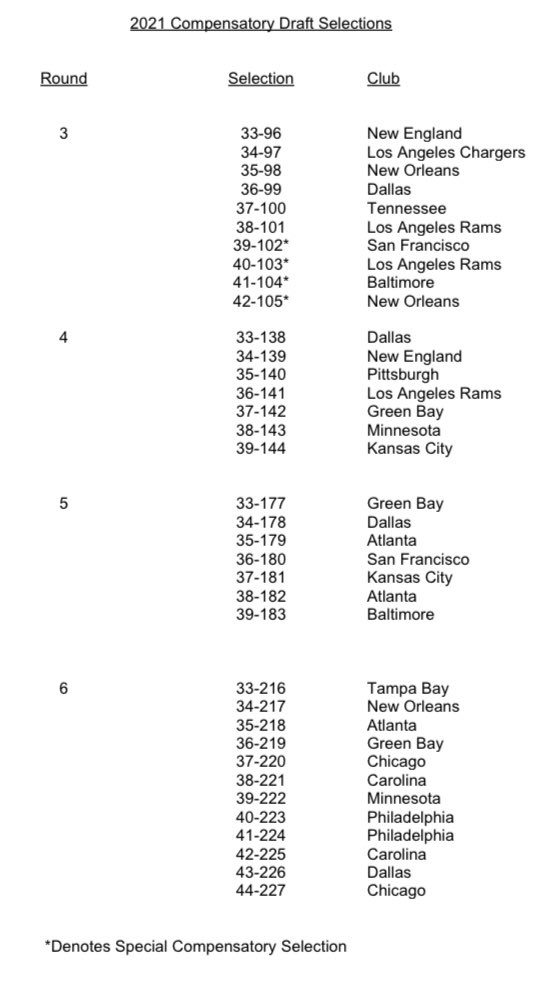
The Rams were awarded three compensatory picks on Wednesday — two third-rounders and a fourth — which keeps in alignment with their strategy since McVay took over as head coach in 2017. Stay with me here on this journey — which Snead also illustrated through about an eight-minute response to a question about the salary cap.
Why is McVay’s arrival important? The Rams’ roster-building formula hinges on winning sustainably, and the belief from the front office is that they will, between McVay running things on the offensive side and the core contracts of outlier players such as Donald and Ramsey on the defensive side.
So that means that Snead, chief operating officer Kevin Demoff and cap specialist Tony Pastoors will bet on their inherited first-round picks being low enough each year (because they believe they will be winning at a rate that would put them in the lower third of the first round), and because there is less draft value in those picks, they’ll package them as trade capital on what Snead calls “proven entities” (players like Ramsey and Stafford, who operate at a high-performance rate at a high-value position).
In complement, the Rams depend on mid- to late-round draft picks. One way to stack those up, especially if you are limited in other resources such as cap space or trade pieces, is to secure compensatory third-, fourth- and fifth-round picks. The Rams do this by managing the formula of free agents they develop/sign cheaply into starting roles, then allow to walk in future free agency, and recently through the hiring of Brad Holmes into the general manager role in Detroit (a 2021 and a future third-round pick).
For example, the Rams parted with starters Dante Fowler and Cory Littleton instead of paying them heavy contracts, and got one of the third-rounders and the fourth-rounder in return. Even an undrafted free agent can work into a compensatory pick if he starts and produces (like Littleton), so the Rams also depend on their assistants to develop those players into key roles, knowing that if they can’t retain them via extension, they’ll at least get back a comp pick. They also depend on their projection models and their scouts/draft personnel to identify players who could grow into key contributors around those core contracts, and then their assistant coaches to develop those players. Candidates for this in the near future are Leonard Floyd (depending on whom the Rams sign for the pass rush) and safety John Johnson. Candidates in the distant future include defensive tackles Sebastian Joseph-Day, Morgan Fox (if he returns on an extension) and even safety Taylor Rapp.
It’s quite the high-wire ecosystem. How long is it sustainable and what disruptors to the ecosystem must the Rams avoid, aside from losing games? That’s the story of the next several years.
Meanwhile, is Snead comfortable operating in a financial deficit, considering the money tied up in those core contracts?
“Yes,” he said.
The Rams’ offensive line
One of the key decision-making phases for the Rams this offseason pertains to their offensive line. There is still little clarity on Whitworth’s situation, although he and Snead previously expressed their desire that he return in 2021 (he also has two years left on his contract, with a potential out clause after 2021). With or without Whitworth, a long-term future at the position needs to be addressed at some point in the next couple of offseasons.
Could reserve left tackle Joe Noteboom — who is entering the final year of his rookie contract — be that replacement?
“Joe played some really good snaps for us this year in meaningful games,” said Snead of Noteboom, who started nine games last season in place of Whitworth as the latter recovered from MCL and PCL tears, and ultimately returned for the Rams’ playoff run. Snead also compared Noteboom’s situation to that of backup quarterback John Wolford, whose Week 17 performance proved to the Rams that he would be solidified as their long-term backup, perhaps hinting at future viability.
But Noteboom’s situation is tricky contractually, because of its timing. He could play out the last year of his rookie deal (either behind Whitworth or as the starter), and the Rams would have to figure out whether to extend him — at notoriously loaded left tackle money — or to once again find a replacement. Because he was not a first-round pick, he does not get a fifth-year option.
Meanwhile, the Rams have a big decision to make at center, a priority spot for them this offseason. They could try to extend starter Austin Blythe, but if they can’t, they will have to evaluate the market while likely also double-dipping on the interior line in the draft. It’s a difficult position to evaluate, too.
“The center, because it’s such a nuanced position of almost being the second quarterback on the field, it’s hard to project that a rookie can do it,” said Snead. “It’s even hard to project a player that may be with another NFL team, just because they will still have to learn our system and at that point have to quickly process football within our system … little bit harder to project than other positions.”
The Rams have Brian Allen on the roster, who spent last season recovering from what Snead called a “serious” leg injury. Allen has starting experience, but Snead cited the factor of the “unknown” in terms of how Allen will ultimately return from that injury and rehab process.
Under-the-radar players to watch
Because the Rams do depend on mid- to late-round draft picks and even undrafted free agents to develop into starters or key role players, I asked Snead to share the names of non-starters who he believes took a step forward in 2020. Those names can also give us more insight about which positions Snead feels are OK and which positions we might see the Rams attend to in the draft.
Snead listed Wolford, receiver Van Jefferson, running back Xavier Jones — who he said they were “ready to run down the stretch in important games” if lead back Cam Akers had not recovered so well from a high ankle sprain. He also mentioned running back Raymond Calais, who is really liked as a return specialist by new special-teams coordinator Joe DeCamillis, Snead said.
“We like big (offensive lineman) Tremayne Anchrum,” Snead added, “going back to some of those camp practices, you definitely saw some things there.”
Importantly, Snead cited the return of tackle Chandler Brewer, who was a COVID-19 opt-out in 2020. He also spoke highly of the “four practice-squad defensive linemen” — Eric Banks, Marquise Copeland, Jonah Williams and Michael Hoecht, and added, “the linebackers speak for themselves — and, I think, the safeties, because a lot of those guys got to play.” That includes players such as practice squad linebacker Christian Rozeboom, safeties Nick Scott and J.R. Reed and even players who started at times last year, such as linebacker Kenny Young.
March 10, 2021 at 7:46 pm in reply to: Les Snead Press Conference Ahead of Free Agency (w/ transcript) #128299znModeratorGeneral Manager Les Snead – March 10, 2021
(Opening statement)
“I know we all want to ask about the trades. Obviously, we know the rules on that, so I won’t be able to really elaborate. We’ll talk about free agents and free agency; I know you will want to do that. Again, I will not share a lot of details, but we’ll try to definitely share some context of this probably unprecedented year, but there’s also some similarities. I’m sure we’ll get into the draft and probably the adjustments we’re having to make in that process and things like that. So, that’s how we’ll open. I think we’ll go with questions from there.”(On how the skillsets of the quarterback affects the type of players and skillsets he looks for in free agency and the draft)
“I like to keep it simple, especially when you talk about offense and the five eligibles. The reason I always use a basketball analogy is just because it’s actually five and you’re trying to build the best basketball team. Again, system comes into play. Philosophy comes into play. Who you actually have in your lineup, on your roster, and presence comes into play. Do we need a shooting guard? Do we need a rebounder? Do you need a center, things like that. So, I think there’s different flavors and genres that you look at and try to assess. And the quarterback, we can talk ad nauseum about it and try to figure out all the characteristics that make a great QB, but that definitely probably matters. I’ll keep it as simple as when you have someone really big, maybe (Former Titans QB) Steve McNair in his day, and there’s a chance for a guy who’s 250 pounds to not get sacked, break tackles, go east and west, keep plays alive, and has a really strong arm, so maybe it’s good to have a subset of receivers that are larger and bigger, so that he can throw it up, things like that. So, there’s definitely some nuances in the flavor of QB that you would have to build around to maximize the strength of the 11 people playing on offense for him, probably more. You get to 12 because there’s slots, you get to 13 because there’s a second tight end, you get to 14, maybe a third tight end or fullback, you get to 15 because you may go four wide receivers sometimes. So yeah, this game’s gotten sophisticated.”(On when was the decision made to move on from former QB Jared Goff)
“As we said earlier, I think there will be a better time when we can actually discuss it.”(On does he agree with Head Coach Sean McVay that the assessment of Goff didn’t change)
“I’m a relatively open person. There are some things, obviously, we’re not going to ever discuss in public, you’re going to keep within the walls, but it’s hard to address this while tippy-toeing around it and things like that. I mean, I think that’s a better question and I certainly don’t mind sitting down at that point in time and discussing it because what we’re talking about is a big move and definitely deserves to be talked about at the right time. I can say I agree. I do think it would be nice to be able to talk about it just because the move was agreed upon, it seems like forever ago, and we still can’t talk about it. But I’m going to respect those rules and hopefully by respecting them, we might have a chance of evolving or being a part of the evolution of some of these rules, if this is the way cycle of roster movement is going to go.”(On the challenges and opportunities of this years’ salary cap)
“I think the unprecedented part being, for the first time in modern era, the cap decreases instead of increases. But again, I think many people on this planet, not just us in NFL football, have had to make sacrifices, some probably harder than others over the past year. I think in history, generations before us have had to make sacrifices for unprecedented circumstances and those sacrifices paid off to help make a strong place. So that’s the unprecedented part with the cap definitely going down. That’s definitely basically spurned us to have to make difficult decisions and actually have some difficult discussions with current players and figure out if we can – goal number one is for us to get under the cap so that we can begin to resign some of the players we want, but take the unprecedented pandemic and situation circumstances out of it, I do think this is where we are as an organization, as a football team right now. Moving forward is, every year even when the cap does go up, there’s going to be players – a lot of the guys we will talk about, or you might want to talk about specifically, we’re talking about them because (Head Coach) Sean (McVay) and his coaching staff penciled them into probably a very significant role in previous seasons, and we maybe basically forced to allow them to move on or choose other players and not some, things like that, and that’s all what we’re working through now.(On what are the impacts of Pro Day constraints)
“It’s interesting with pro days, just because a lot of times, different than this year, there’s been a combine. So, do you need to attend a pro day or do you not? I think for every Pro Day attended, there should be a specific reason. Maybe the case or the file on that player is not necessarily complete yet. Is there anything that we can get from a pro day to complete that file, to help us be more certain that we could onboard that player and he becomes a contributor for us. So the interesting thing this year, with no combine, all pro days we will share data but that occurs every year in a system that’s referred to as the APT system where every club doesn’t have to attend a pro day, but let’s call it a player, subset school, didn’t go to the combine, we can get the standard 40-yard dash standard short shuttles, and that data is shared. So, I think this year, unlike combine, some of those numbers, some of those measurables would just get to us later in the process. And then as a club, there is times where maybe you don’t want to attend the pro day just because you don’t want to show your cards or what have you, and things like that. So, there’s always some of that game theory going on. Nothing different than in years past, because in most situations, we probably haven’t sent three to a pro day anyway. But I do think because there’s no private workouts this year, there’s definitely a cap, but maybe allow three, because a lot of times with position coaches, coordinators, even head coaches, if they wanted to get out to a pro day, they could but a lot of times nowadays that is done somewhat privately to try to keep – what we try to do is keep people from going, ‘oh the Rams had defense coordinator, offensive coordinator at this position’ and now teams will try to take note of that and try to use it against you maybe.”(On what are some of the priority positions for free agency and the draft)
“I don’t want to get in – I can’t totally do that without maybe giving some teams a leg up in the draft if they wanted to move up and jump us per se at a position, but there’s definitely some players that we feel like we have a shot, once we get under the cap, to resign during whatever we call that period when we can negotiate. I hate calling it the legal tampering period because that just seems like that’s a debacle of the English language, ‘legal tampering’ and tampering is illegal. But we’ll have to adjust based on that because there’s no guarantee that you can resign. I think we would love to get to, from a big picture standpoint, and we’re very close to in the draft, where for the most part there is a lot of returning starters returning so that when you do go to the draft, there’s multiple positions alive each time you pick. It’s not going to always be the case, but when you do take positions out of the mix, there is a chance that you could pass on a really good player at another position who might not necessarily help you day one, but could really begin to contribute somewhere during the season and even become a valuable starter down the line. A free agent that we have this year (S) John Johnson III is a great example of that right. When we drafted him back in 17’, we had starting safeties, but it was one of those we really liked this player, we think – I always say there’s not a good reason to not take a really good football player. That player usually finds a way to contribute and somewhere along the way, I think it was – I still remember post Dallas game, maybe it was the Dallas game where we inserted John into the starting lineup over a previous star and it worked out.”(On is restructuring contracts a priority over cutting players to get under the salary cap)
“That would be priority number one. So that’s the process that’s occurring now. Our vision is to get there without having to do that, but again – and if we have to do that, player agents definitely know that there is a deadline and we have to be under the cap. So, if you can’t work something out before then, that’s a possibility. We definitely didn’t want to surprise anyone. This has been an ongoing process probably for the last, really getting, getting into the weeds, two or three weeks trying to work with everyone to come up with win-win solutions for player and club at this point in time.”(On what sort of traits is needed to best maximize a quarterback)
“I think the first part of that question is, Sean and his coaching staff right now and this is probably one of the benefits of not doing a combine and there’s a lot of benefits that you try to find the roses of maybe the thorns that we’re going through, but by let’s call an entire organization, moving to Indy (Indianapolis) for over a week and then taking about a week to recover from Indy, it has allowed the coaching staff to get to watching the upcoming players in the draft play football, get to that, get to the film quicker and probably a more quality and focused environment but it’s also allowed them to again, looking at the just the overall scheme and what maybe Sean and his staff want to do differently. That’s even probably taking the QB out. I do think depending on what you think that your QBs, and every player is different, right? We say it a lot, right? What’s the player’s superpower? Or one to two to three or however many there are, and all of us have an element of kryptonite to us and you try to definitely put those players in positions and use those superpowers. And then again, how can the five eligibles that are going to be on the field at the time enhance that process? If our offense is a sword, you want those five eligibles and they don’t have to be the same five eligibles at the same time, but you want those players to make that sword sharper.”(On his reaction when the salary cap was set)
“My stepson, Tate, asked me this morning when he said, ‘Hey, does that $2.5 million help you?’ I’m like, I don’t think the $2.5 is really going to help us. If you kind of look at where we are and look at how much we’re over. So, $2.5 is probably a little bit of a drop in the bucket. I do think along the way, we’d always said, ‘Look, let’s build models, design models, engineer models, where we got to get to that original minimum,’ and then when the news did break that the minimum now was going to be $180 (million), that did allow us to get a little more breathing room without having to make sacrifices or tougher sacrifices within, but we’ve always worked off of the minimum model. So, I do think that’s helped along the way. That was about probably a week ago or within the last few weeks, but then today’s news is the extra $2.5 million doesn’t necessarily going to really move the needle with us but it is very, very helpful now to know that, ‘Okay, it’s not going to be 188 per se,’ and that would have been a little more breathing room. So, that is to know now, we know what the finish line is. So, we’ve been running a marathon right now, and didn’t know whether we were going to run 25 miles, 24, 26 or 28. So, at least now we know it’s 26.2 and let’s roll.”(On if he has had any discussions or informed any veteran plays that they will not be returning)
“Yeah, we’ve definitely had discussions. It’s interesting. They haven’t been with players on rookie contracts because deleting those contracts do not help the team in terms of cap for the most part. So, what makes this unprecedent, we’ve had to knock on the door of a lot of our key figures, key pillars and ask them to, in some cases, make sacrifices and in some cases, adjust their contract to help us get under the cap and the vision right now is to get to the finish line without having to release players. And with that being said, and we are well aware that we’ve had to have some calls with a subset of our unrestricted free agents and restricted free agents and let them know our intent, whether we were going to be attempting to resign them, or assuming they’re going to have a better market than what we would be able to pay and allowing them to know their path and how they need to move forward. So, that’s where we’re at, but it’s evolving. It’s changing. It’s unprecedented. But I do think the positive thing is, I think everybody in the environment, ecosystem, realizes this is different. This is tougher. So, I think all of us have been willing to somewhat make sacrifices, somewhat think out of the box, that wouldn’t necessarily normally occur in a normal year.”(On what were the positives and negatives of not using the franchise tag)
“I think the first of all, you’ve got to have cap room to use the franchise tag. So, that’s number one. And I think I had mentioned to someone earlier that strategically, probably philosophically, you’d love to be able to not utilize the franchise tag and work to get something done long-term, just because usually when there’s a franchise tag used, the history of it says, it’s very hard to get something done longer term off of that tag and one of the reasons because of that is, whatever the tag is, a lot of times a player, player rep knows, ‘Okay, that’s the P5 for one year,’ and to get something long-term maybe, ‘Hey, we want more than that P5 over the long term,’ where a lot of times a longer-term deal, they may be less P5 but more guaranteed things like that. So, I think that would be the reason not to, and try to come up with a win-win to I will say not have to go through it again. If you tag someone, they stay on the tag, then you’re going to go through the process again in a year. So, I think when you’re constructing the team for not necessarily just a microscopic 2021 season, but with the telescope in mind, we’d love to know with a few of these players that there’s an element of certainty. That they’re going to be around longer, that affects how you might draft, might not draft in this draft. So, that would be the reason, but you’ve definitely got to have cap room to use the tag and even when you do have cap room and you use the tag, I mean, that’s definitely a lot of cap that goes to a single player.”(On finding a receiver in free agency or the draft to be a deep threat)
“Yeah, we definitely have discussed that, based on looking at, and I think, I know Sean had used (Texans WR) Brandin Cooks and going back to ’18 and ’19, Brandin, he didn’t play every game based on some of the injuries, so it was really starting in ’19, even ’20 and going back to even when (Chiefs WR) Sammy Watkins was here. I would say this, deep threat can be many things, right? It’s not just speed and throwing the ball deep. There’s an element. If there’s a vertical presence, whether the guy might not be as fast, but he’s tall and big and he can go get a rebound and you can throw the ball up. When there’s an element of a vertical presence and they come in all shapes and sizes, it definitely loosens the defense. There has to be the defense coordinator, the defensive staff will want to protect. You want to protect explosions. The analytics say, the more explosions, explosive plays you have, the better chance you have to win along with turnovers. So, what that actually does, even though a Sammy Watkins back in ’17, Brandin in ’18, let’s just say Brandin had a lot more yards than Sammy did and I know in ’17 and ’18, but it’s not necessarily just the yards that those players are actually catching, it’s what they’re doing to the enemy and then that does loosen up some things underneath. But again, that can come up. The New England Patriots maybe made that happen with a freak tight end. So, when you say that, it doesn’t have to just be a speed receiver, but I think we’re all saying the same thing. There’s an element of presence vertically that the defense now has to ensure against and that usually means less compact, more space and more allies to throw to the shorter, intermediate stuff.”(On what veteran players contracts are in discussions)
“I’m definitely not going to mention any names here, but a rookie contract doesn’t help you with the cap. So, it’s definitely veterans who are on their second, maybe even third contracts and those are the ones that can help you gain cap space in the immediate.”(On his reflection on being over the cap and if it reflects a plan that’s working or situational)
“I think it’s probably a combination of both with some of our higher paid players. Aaron Donald, that’s probably one that’s gone right. Jalen Ramsey, one that’s gone right. So the plan that there is who are some of your pillars? Who are some of the core players that you’re going to somewhat build schemes around, maybe strike fear, maybe change the math of the enemy? And that’s part of it and you definitely realize when you do that, I think number one is to do this plan per se, we definitely needed to breakthrough. We definitely needed it and with breakthrough I mean, who of you can win and not just win one year, but prove you can be, I call it a contender for division, more than once. And then at that point, it is probably sound to begin going, ‘Okay, we’re in this window,’ and again, when I say contend, I’m contending for divisions, but let’s keep this subset together. With that comes, yes, there’s going to be some mistakes along the way and that’s where some of the dead money comes into. And it sometimes, there could be a subset where some of those players really helped but then post-contract visit didn’t help as much for unforeseen circumstances or things like that. But that’s where the dead money comes into but I do think, whether there’s a lot of dead money or not, and we see it with teams that are maybe in this window is, they’re going to have players that played for them, they’re going to not be able to resign them. So, at that point in time, you definitely know that there’s going to be change over every year. So, what we’ve tried to do too, is know that, so if we lose good veteran players in free agency, and I think you’ve heard us say, try to play the comp form in it. So with that being said, instead of maybe replacing a player we lose in unrestricted free agency with another unrestricted free agent. So, whether you now replace that player with a free agent, who’s not an unrestricted that doesn’t affect the comp formula or a rookie, or maybe Sebastian Joseph-Day, who wasn’t necessarily a rookie, but he was a sophomore. He was coming into his sophomore season, little lesser known because if you kind of spend that rookie season as a redshirt, that sophomore-type player is not as sexy, not as known. Nothing against that. So, that’s kind of the model, but by being able to be disciplined with the comp formula, I do think and I know (ESPN writer) Lindsey (Thiry), I did read your article, did a nice job of kind of, if you want to call it, the method to the madness is, even though we’ve utilized or we may not have used our number one picks on necessarily draft picks. We definitely used them on going to get an All-Pro corner, the trade we just made. So, instead of using them on, let’s go to a rookie, we’ve gone after more known commodities, but how can you still be fruitful in the draft and by utilizing being disciplined with the comp formula, since 2017, we’ve had the eighth most draft picks in the league. Not number one, but the eighth most. Now on day one, Thursday, we’re 32nd. We’ve had zero, but day two, which is really your second, third round, we’ve had the third most, and there’s an element there of the comp formula coming into play. We traded for (Falcons DE) Dante Fowler, hit (Saints QB) Drew Brees in overtime, John Johnson makes an interception, we get a chance to go to the Super Bowl, plays well for us, moves on and we more than likely get a third rounder this year. So, with those day two picks, and then we’re sixth in day three picks in total number. The interesting thing, we’re sixth in receiving comp formula picks and I do think after this year, when they’re announced, we’ll probably move into the top three or two. And what’s interesting too on that, is we’re fourth in the league in acquiring extra draft picks via trade, whether it’s having the 31st pick post Super Bowl and trading, not necessarily using them on a draft pick and trading back, but also could be taking some of our veteran players like a BrandIn Cooks and receiving a second rounder. So, that’s kind of the, I call it the model, the method to the madness and what that does take, is discipline and I can’t stress this enough. It takes a special coaching staff and they matter, not only in partnering with the front office, partnering with our scouting staff to help identify players, and every player we identify, at each subset of the draft, doesn’t necessarily have to come in and become a starter, but there definitely needs to be a plan. Like we’ve mentioned, what traits do they have that can help us fill a role? It definitely takes right development, not only from the coaches, but everybody in this building, from the athletic performance staff, from the player engagement, helping these young players that were playing college football. Some of them were playing high school three years ago and to be able to handle the pressure of coming to a team that wants to win now, and one of the things that’s underrated is the coaching staffs courage to play those players. A good example this year, linebacker. We were going into this year with an inexperienced group of linebackers in the first place and (LB) Travin Howard, somebody we really liked, was having a really good camp and everybody was just jacked, stoked about how he was improved and how he was involved in the plays we were making and then he had the unfortunate injury, but for our coaching staff, for us to sit down and go, ‘Okay, you know what, let’s have the courage to continue to model, not necessarily go out and get a veteran with experience, but to play the young players,’ What that does for you now, is just about everybody in that linebacker room has played and started games for us that we’ve won and big games. So, it allows you to have this healthy depth. It allows you to figure out the sophomores maybe on your team, that can help you. The (CB) Darious Williamses in time, the (CB) Troy Hills. So, that’s the model, that’s the method. You have these core players that are pillars. Definitely use cap space and cash and salary on those players, but it will take discipline on the backend to utilize the draft and make the most of that, even when you are using your number one picks for known commodities and that type of thing. So that’s the model. Good question. I probably went longer than you wanted, but yes, along the way, you’re going to make some mistakes or even have more dead money than you want. I’ve said this, even about (Falcons RB) Todd Gurley’s dead money. There’s not a moment that you regret the seasons he had for us and what he made even the year we made a run for the Super Bowl.”(On if he is comfortable being in the current cap situation)
“Yes, definitely. Because again, this is an unprecedented year. But, I do think we’ve seen over the years with teams that have won consistently, Baltimore Ravens, Pittsburgh (Steelers), see right there, New England Patriots, they had players that would unfortunately have to move on. And when they moved on, they gained some comp (compensatory) picks. They use those comp picks wisely and they developed from within and they were still able to keep some core players. So, I don’t think it’s anything that we’re doing really differently here, other than the fact that we had determined that it might be beneficial to use some of our late first-round picks, and even bet that we’re going to have some later first round picks on the future, to get known commodities instead of rookies. And I say that, if we are winning and you are using cap, the reason I say you’re comfortable with is that, usually means you’re paying right quality players that have at least been definitely a key contributor to you sometime along the way. For instance, I’ll say this, I would rather pay (DL) Aaron Donald a lot of money than not have Aaron Donald, but have this cap space. If that answers your question very simple.”(On if there is value in free-agency visits)
“Yeah, I actually think that the age of the visits are a dinosaur. They were still be a few, but I do think that’s in the past. I even think, probably I would bet you, that we probably changed what I said was a debacle of English language, or the ‘illegal tampering period,’ from let’s call it starting on a Friday or Saturday and ending on a Monday, I bet you, that was made with collaboration with networks going, ‘Hey, you know, there’s no visits and all the fun news occurs on a Saturday when you all are hiking and not necessarily working per se.’ And then by the time you ring the bell on Monday, it’s like, ‘Well, you’re all ready to Phase C of free agency. So, I think that’s why we started on Monday night. I can’t confirm that. They may not admit it, but I do think the age of the visit is less important. The part about the visit that is important though, I think players will research organizations, especially coaches, with other players with people they trust. Maybe things like that. We’re in a society now where, you can live somewhere else and go to work somewhere else. I think the one thing that still has to occur is, and, and we saw it last year, maybe with (DL) Mike Brockers is, at some point there has to be a visit. And at some point there has to be a physical and there has to be a passed physical to execute the contract. And that would be the negative of this area is when those visits don’t happen right now and they’re delayed. If there is a hiccup in the physical, that can be negative dividends for both the club and the player. With the club being, ‘Wait a minute, you might not want to go to that club or sign early because of, wow, they failed some people with physicals in the past’ and we didn’t all of a sudden have a seat at the table. And obviously, a player could be hurt where he made a turn down other things, and now he doesn’t necessarily have a seat at the table.”(On whether OL Joe Noteboom is ready to succeed OL Andrew Whitworth)
“(OL) Joe (Noteboom) played some really good snaps for us this year in meaningful games and proved (himself), to keep it simple, you could watch a Rams game and usually when you’re discussing Joe Noteboom or Andrew Whitworth, it’s usually when something went wrong. It’s not as fun to talk about looking at that guy making blocks down there. It’s usually, ‘Holy Cow, there’s a lot of pressure or what have you coming from somewhere.’ So, I think that’s definitely a thumbs up for Joe. You’re always projecting with Joe’s traits, even though he came from a spread offense, where we’re never going to execute that technique that he came from TCU. We’re now going to have to re-teach him how we do things. But, you’re betting on the traits. The one time when you really know, the one QB let’s say we could talk about – we now know (QB) John Wolford can be a backup QB. Why? He went in the game and played and won it. Not necessarily, ‘Ok, you had a really good scrimmage.’ You can start, ‘Ok, we might make that bet, which we did last year, but you now somewhat confirm it when they actually get in the game and play and think he has done that.”(On if OL Brian Allen could step in if OL Austin Blythe doesn’t re-sign with the Rams this season)
“Yeah, I think that if we’re not able to re-sign (OL) Austin (Blythe), he moves on, I do think that’s one position, where the good thing with (OL) Brian Allen. Similar to Joe (Noteboom), he’s actually started for us and played. The key that what we don’t necessarily know with Brian is, how will he play, how will he play post-injury? That was pretty serious injury that has gone through, and he’s done a heck of a job rehabbing it. That’s always going to be something he’s got to do. But I do think in the center, because it’s such a nuanced position of almost being the second QB on the field, it’s hard just to project a rookie can do it. It’s even hard just to project a player that may be with another NFL team can do it just because they will still have to learn our system and still at that point have to quickly process football within our system. So, a little bit harder to project them than other positions.”(On which non-starters he believes took a step forward this past season)
“I think I mentioned John Wolford, that’s an obvious one, right? I can mention (WR) Van Jefferson, but that doesn’t seem like an unknown one. Again, I think a good one that would be (RB) Xavier Jones. Heck, we were ready to run him down the stretch there in important games, but (RB) Cam (Akers) was able to get through it (injury) and be the warrior. But, as players like him, where I call those the sophomores, they may have played on special teams. I can mention a lot of them because even the runner we signed or claimed, I forget what it was, (RB Raymond) Calais from Tampa and Southwest Louisiana, and it’s really not that they would get mad at me at Louisiana. How this world works, right, to (Special Teams Coordinator) Joe DeCamillis who comes here – he was a big fan of Calais as a returner in Jacksonville. But, now he’s a Los Angeles Ram. I think we like big (OL) Tremayne Anchrum (Jr.). Again, didn’t necessarily play in games. He did dress for a couple of games, but going back to some of those camp practices and you definitely saw some things there. A very interesting one is getting a (OL) Chandler Brewer back from an opt-out who actually played well in our San Francisco game way back in ’19 when we went up there and geez-louise, the game still bothers me the way we lost that game, even though it might not have mattered at all. But, it was a heavyweight fight, he played well. So, it’s those moment. Hey, all of those defensive linemen, we kept on practice squad. I probably couldn’t even name them all, but there were four of them and we kept them for a reason and liked them and those guys. The linebackers speak for themselves and I think the safeties because a lot of those guys got to play. Even someone like (DB J.R.) Reed that we signed from Jacksonville someone we really liked really liked in the draft didn’t get him, he went to Jacksonville and then we ended up signing him. So, it’s players like that again, not household names, not sexy, but sometimes you have to take the knowledge and doubt, you have to make a bet on them to help play a role. And again the posterchilds of that working out, (DL) Sebastian Joseph-Day, (CB) Troy Hill, (CB) Darious Williams, even to an extent, the (LB) Kenny Youngs and (LB) Troy Reeders and people like that. So, those are kind of the posterchild. It doesn’t always work out, but that’s the vision and I tried to mention a lot of names because if I just mentioned one or two, if somebody is really listening to this press conference, will their feelings hurt?”znModeratorRamBill
Rams, 6 Total Picks
Round 1
No pick (Jalen Ramsey trade)Round 2 No. 57
Round 3
No. 89 traded in Matthew Stafford deal
No. 101: Compensatory pick (via Dante Fowler Jr. loss)
No. 104: Compensatory pick (via Brad Holmes hiring)Round 4
Original pick traded in Jalen Ramsey deal
No. 142: Compensatory pick (via Cory Littleton loss)Round 5
No pick (Austin Corbett trade)Round 6
Pick slot TBDRound 7
Pick slot TBDznModeratorGov. Ron DeSantis faces deepening controversy over vaccines for ultra-rich Florida community https://t.co/UuqOrvPHZW
— Jon Cooper 🇺🇸 (@joncoopertweets) March 10, 2021
znModeratorWe've been awarded three comp picks in the 2021 NFL Draft.
— Los Angeles Rams (@RamsNFL) March 10, 2021
znModeratorSosa K@QBsMVP
Sebastian Joseph-Day (@SJD_51) ranked 3rd among all DL in the NFL in run stops in 2020 with 30 (
@PFF).He played in significantly fewer run snaps (207) than both of the DL ahead of him in Sam Hubbard (265) and Daron Payne (340).
Bash has developed into a big-time performer.
Cameron DaSilva@camdasilva
Les Snead mentioned a handful of young, unproven players who the Rams like entering 2021. Xavier Jones and Tremayne Anchrum were among them, as were “all those defensive linemen we kept on practice squad”Geoff Schwartz@geoffschwartz
OL in free agency and the draft is deep. Great year to help your favorite team with the big ugliesznModeratorWe've been awarded three comp picks in the 2021 NFL Draft.
— Los Angeles Rams (@RamsNFL) March 10, 2021
znModeratorTom Pelissero@TomPelissero
Here’s the
2021 compensatory draft picks that just went to clubs.
March 10, 2021 at 5:09 pm in reply to: Les Snead Press Conference Ahead of Free Agency (w/ transcript) #128292znModeratorJourdan Rodrigue@JourdanRodrigue
Written a lot about this but for team-building enthusiasts, Rams GM Les Snead broke down the Rams’ entire roster-building/cap strategy over the course of eight-minute response, ending w/ definitive “yes” re. whether Rams are comfortable being in cap situation y/y. Worth a watch.Hinges, of course, on betting they’ll win consistently.
– Rams believe they can bc of coach, and guys like AD, Ramsey, etc.
– Because they believe they get more value from proven players than what they feel will consistently be late-round picks, no issues trading them.– In complement, they rely on comp picks, personnel and data people who can correctly project long-term potential of mid-round picks, coaches to help develop, and players themselves to stay on development course to start around core contracts.
How long can such an ecosystemkeep its balance in that way? As long as they keep winning 9-plus per/playoffs? Do other variables disrupt that balance? That’s the story of the next few years for the Rams, in my mind.
March 10, 2021 at 12:47 pm in reply to: Les Snead Press Conference Ahead of Free Agency (w/ transcript) #128289znModeratorNote: these tweets overlap a bit but they also each have a detail or 2 the others don’t.
…
Jourdan Rodrigue@JourdanRodrigue
Snead says the Rams are in the process of restructuring multiple contracts and have been in that process for a couple weeks. He adds their preference is to do that fully to get under the cap without cuts or trades. Several top contracts can be maneuvered.“Difficult decisions” ahead, says Snead, as the Rams move to get under the cap. Adds it means that some guys who otherwise may have stayed may have to move on.
Stu Jackson@StuJRams
Rams GM Les Snead on restructuring deals to navigate their current salary cap situation: “That would be priority number one.” Says team is working on that right now, and preference is to get under the cap without making cuts or trades.Lindsey Thiry@LindseyThiry
Rams GM Les Snead says there have been conversations with players/agents about restructuring contracts and that the “Vision is to get to the finish line without releasing players.”Stu Jackson@StuJRams
Rams GM Les Snead on NFL teams being limited to 3 representatives at pro days this year: Nothing different than previous years, because the team hasn’t usually sent that many reps to a pro day in the past.March 10, 2021 at 12:43 pm in reply to: Les Snead Press Conference Ahead of Free Agency (w/ transcript) #128288znModerator.@JourdanRodrigue is insanely good at her job. Asked every single question on topics we wanted more information on.
Here’s Snead discussing the restructuring process, and how it holds priority over some other immediate obligations: pic.twitter.com/3HsafWAwY9
— Rams Brothers (@RamsBrothers) March 10, 2021
March 10, 2021 at 12:41 pm in reply to: Les Snead Press Conference Ahead of Free Agency (w/ transcript) #128287znModeratorLes Snead on the new guy we can’t technically talk about yet. pic.twitter.com/D0HDLfb4I0
— Rams Brothers (@RamsBrothers) March 10, 2021
znModeratorLindsey Thiry@LindseyThiry
With the 2021 salary cap set at $182.5 million, the Rams’ adjusted salary cap will be $187,099,141, according to Roster Management System used by ESPN. With a week until free agency begins, the Rams are over the cap by $31.3 million, per RMS, and that accounts for the pending trade that send Jared Goff to the Lions in exchange for Matthew Stafford. The Rams also have $34 million in dead money, per RMS.znModeratorOnly one NFL team has less cap space than the Rams right now https://t.co/3abuBkYNRP
— Rams Wire (@TheRamsWire) March 7, 2021
znModeratorMoving things from another thread to here.
==
In advance of the new NFL League Year, decided to do what so many have asked for: Salary Cap 101. A primer on the Cap, busting myths about it along the way. Settle in:https://t.co/kLHLxIYjC9
— Andrew Brandt (@AndrewBrandt) March 2, 2021
==
here is the article: good read:
URL = https://www.si.com/nfl/2021/03/02/business-of-football-understanding-the-salary-cap-dead-money
Business of Football: Understanding the Salary Cap, Dead Money and Impact of 2021 Decrease
With NFL teams about to open their wallets, here’s a refresher course on the salary cap and an explanation of why we’ve seen bigger dead-money cap hits lately.ANDREW BRANDT MAR 2, 2021
Of all the areas of coverage around the NFL, there is not one more frequently misinformed, misunderstood and misrepresented than that of the salary cap. It is one of these subjects that qualify for the adage: A little knowledge is a dangerous thing. Yes, I realize most fans and media know all they want to know about the cap, which for many fans, is simply how far their team is under it. That, however, is a momentary snapshot into a complicated and ever-changing figure. Managing the NFL salary cap, as I did for 10 years with the Packers, is like stuffing an octopus in a box; there is always something trying to hang out. Every action has a reaction; every move with one player is watched by every other player (and agent); precedent is paramount.
Cap management is one of the three parts of an NFL team’s football operation, along with coaching and player evaluation. The better-managed teams have all three areas working in concert, communicating and buying into one another’s plan. And this year, more than any other year in memory, cap management may be the most important of the triad of football operations.
With that in mind, and with my background, I thought I would answer some common cap questions, debunk some cap myths and try to give you a better understanding of that amorphous thing we call the NFL salary cap. With the NFL offseason upon us, settle in for this master class.
What is the salary cap and how is it calculated?
The cap is an artificial limit on collective player spending set by the Collective Bargaining Agreement (CBA), the governing document between the NFL and the NFL Players Association. Everything about the NFL is rooted in competitive balance. The cap, in theory at least, levels the playing field on the financial side.
The CBA sets the percentages for sharing of NFL revenue, dividing it between the owners and the players according to what has been negotiated. Prior to the two most recent CBAs, the players’ share was roughly 50% of NFL revenues. Recently the pendulum has swung toward ownership, with owners getting 53% and the players receiving 47%, rising by a point to 48% once the NFL starts playing 17 games per regular season but getting no higher for the players over the next decade.
Thus, to calculate the cap in simplest terms: 47% of NFL revenues is divided by 32—the number of NFL teams—to set the team cap number for the year. For 2020 that number was $198 million. For 2021 due to economic losses suffered from a year of playing largely without fans—that number will go down considerably. As that number has not been set yet, for our purposes we will estimate the 2021 cap to be $185 million.
Myth: The reduced cap for 2021 has NFL teams scrambling
No. NFL teams are not waking up in March of 2021 and saying, “Oh my God, what are we going to do with a dramatically reduced cap?” This diminution of the 2021 cap was known by every team—as well as every player, fan and media member since July, when the NFL and NFLPA negotiated that it would be no lower than $175 million. This idea out there that teams are now scrambling is laughable; they have known about this for nine months. Teams spend eight months preparing for the draft; the good ones have been preparing eight months for the reduced cap.
Myth: The $185 million number is the cap minimum number for 2021
No. The $185 million is not the minimum, or floor; it is the maximum, or ceiling, for the 2021 team cap. A salary cap has a minimum as well as a maximum; many do not know that, as NFL teams have—and should have—a minimum that they have to spend on players.
I have been critical of the CBA minimum team spending requirements, as there is neither annual accounting nor biannual accounting, but rather it is only viewed over three- or four-year tranches. As an example, the Steelers spent $138 million in 2020, a stunning $60 million below the cap. No matter how much they spend in the year before or after, that should not happen, but that is for another discussion. Suffice it to say the minimum spending for 2021 could be well below $185 million, especially with such a long inspection period.
Myth: Every NFL team’s cap number is going to be $185 million
No. Actually, no team’s cap number is going to be $185 million (or whatever the final cap number is).
The 2011 CBA, for the first time, allowed teams to carry over unused cap room from one year to the next. In managing the cap for the Packers, we did not have that option; it was use it or lose it. I had to negotiate dummy incentives—such as a clause giving our third-string quarterback $20 million if he threw seven touchdowns in our last game—to carry over cap room. (When he didn’t earn the incentive, we would get it as a credit toward the next year.) Now teams don’t have to play those games.
As per NFLPA numbers, every team in the league has carried over 2020 cap room, from a low of roughly $500,000 for the Ravens to a high of more than $30 million for the Colts. Teams carrying over $20-plus million of cap include the Jets, Browns, Eagles, Cowboys and Jaguars. Thus, although the team cap is $185 million, the Colts’ adjusted cap will be around $215 million, and so on.
And again, these teams have been preparing, or should have been preparing, for this reduced cap for months.
Myth: Unlike the NBA, the NFL has a “hard cap”
No. The NFL does not have a hard cap; it has a soft cap (a yarmulke, if you will). To clarify, no team can go “over the cap” in terms of cap accounting. However, teams can and do go over the cap in terms of cash spending due to the feature of the NFL cap that differentiates it from all other sports leagues: proration.
Here is an example: Let’s say a player signs a four-year contract with a $20 million signing bonus. Signing bonuses, for cap purposes, are prorated. Thus, that player’s bonus is treated as $5 million in cap each year. The “cash over cap” for that one player, on one bonus of one contract, is $15 million: He received $20 million cash with only $5 million against the cap. This illustrates how teams are able to spend over the cap in terms of cash spending without being over the cap in terms of cap accounting.
But alas, the future cap charges do not go away. The problem with proration is when things go south with the player, leading to the scourge of the cap: dead money.
Dead money is cap accounting for players no longer on a team’s roster, “dead weight” that hamstrings teams from signing “live” players. We have now seen—within the last month—the two largest dead-money charges in NFL history in Jared Goff and Carson Wentz. These contracts were structured as if there was no way on God’s green earth the teams would exit them early—with tens of millions of future proratable monies (large signing bonuses, guaranteed option and roster bonuses, etc.) pushed out into future years as unamortized proration. Therein lies the rub. When a player separates—through release or trade—all unamortized proration accelerates on the team’s cap.
Goff will count $22 million on the 2021 Rams’ cap while playing for the Lions. Wentz will count $34 million on the Eagles’ cap, the fourth-highest cap charge in the NFL this year, while playing for the Colts. That is why I said for months that he would not be traded, and why I truly underestimated the breach of trust between Wentz and the Eagles.
For you fantasy football players playing in cap leagues, imagine that while the other players have $185 to play with, you start the draft with $151. You are the Eagles.
Myth: NFL teams don’t care as much as they used to about dead money
No. Believe me, they care: I have talked to members of several, including the Eagles, who desperately wanted to avoid this scenario.
Beyond Goff and Wentz, the only other two dead-money charges in history over $20 million are for receivers, Antonio Brown and Brandin Cooks. As to this being the evidence of teams’ willingness to incur dead-money charges? Please.
Brown would have been kept on the Steelers for many more years if he hadn’t forced his way out of town. As for Cooks, well, when it comes to dead money (and first-round draft picks), they do not care. They are true outliers.
Myth: Cap gurus magically create cap room by moving it into future years
No. You could do that and, sorry, no, you wouldn’t be a cap guru. You could take a big salary or a big bonus (not currently prorated), turn it into signing bonus (prorated) and, in the stroke of the player’s pen, cap room would magically appear and the problem would be deferred, although not solved.
The Rams did this with Goff. The Eagles did this with Wentz. The Saints have done this repeatedly with Drew Brees. The Steelers have done this repeatedly with Ben Roethlisberger. Pain is now being felt by the first two teams and will soon be felt by the latter two. Some NFL teams are doing this now to alleviate some existing cap problems, continuing the vicious cycle of stacking additional proration upon already existing proration and creating more problems down the road.
No one doing this is a cap guru. A true cap guru sets a team up so it never needs to do much of this, if any at all.
So Andrew, what is the best way to manage an NFL cap?
It is simple: Pay as you go. The goal for every team’s cap management, in my opinion, is to match, as much as possible, cash spending and cap accounting. It is to resist the temptation for short-term gain—which always leads to long-term pain—and pay as you go.
One of the things I am most proud of from my time in Green Bay is resisting temptation to play the “prorate/push out” cap game with Brett Favre. I learned from what I had seen at that time around the league, noting huge dead-money charges when franchise quarterbacks separated, including John Elway, Troy Aikman, Steve Young, Dan Marino, Steve McNair and more. I knew at some point we would not have Brett; I did not want to burden the future front office and the future quarterback (who turned out to be Aaron Rodgers) with a $20-plus million cap charge for someone not there. Brett was ultimately traded with a final dead-money charge to the team of $600,000. Sorry for the not-at-all-humble brag, but you get my point.
For a current example, the 49ers, in negotiating the Jimmy Garoppolo contract, took on a first-year cap number of $37 million, very close to the first-year cash number of $40 million. Now, if the 49ers decide to move on from Garoppolo, it will cost them less than $3 million in dead money, a drop in the bucket compared to the $34 million for Wentz and $22 million for Goff. How a team proves itself as cap-savvy is by putting itself in a position to have ultimate flexibility on its roster, never to have to prorate, to put the team in position for sustained success.
Many teams do this well besides the 49ers, including the Buccaneers, Jaguars, Colts, Patriots and Browns, among others. They are ahead of the curve with the competitive advantage of being able to front-load, not back-load, cap. Thus, if things go south with a player, they can move on without the albatross of dead cap.
The reduced 2021 cap represents a huge opportunity for well-managed cap teams to, as the cool kids say, flex. More than any year before, prudent and solid cap management is really going to matter, and shrewd front offices are going to truly separate themselves. The business of sports always wins.
March 10, 2021 at 12:47 am in reply to: Rams own FAs & roster decisions & trade rumors (w/ a good post by db) #128275znModeratorJourdan Rodrigue@JourdanRodrigue
Not expecting any last-minute Rams tags today, as we previously reported. S John Johnson, OLB Leonard Floyd are on track for free agency.Not getting tagged doesn’t put a nail in either player’s journey with the Rams. Am expecting both to have great external opportunities – but in a year this strange, not tagging also opens VERY slim possibility that at the end of the cycle, you can re-sign short &under tag value.
 znModerator
Before his Cinderella season in 1999, @kurt13warner had to prove himself in NFL Europe in the Spring of 1998. pic.twitter.com/0LkdvWaebY
— NFL Throwback (@nflthrowback) March 9, 2021
March 9, 2021 at 8:13 pm in reply to: Rams own FAs & roster decisions & trade rumors (w/ a good post by db) #128268znModeratorWhy John Johnson, Leonard Floyd weren’t tagged: Rams free agency tracker, grades, news
Jourdan Rodrigue
The Rams already opened the offseason with a blockbuster trade agreement of their franchise quarterback, but as free agency draws closer, they opted out of using the franchise tag on a couple of key defensive starters.
As Tuesday’s franchise tag deadline passed, the Rams chose not to apply it to either John Johnson III, their starting safety in 2020, or outside linebacker Leonard Floyd, who ranked second in sacks (10.5) last season. Only nine players received the tag this year; three safeties (Jets’ Marcus Maye, Saints’ Marcus Williams and Denver’s Justin Simmons), and no edge-rushers.
We knew, through our own previous reporting, that the tag was unlikely for any Rams player this spring — even less likely than the already-improbable scenario of a long-term extension for either. Tuesday, that became official.
The tag number for a safety is estimated to be around $10.5 million (as of the deadline, the actual salary cap had yet to be confirmed by the league, and tags are based in part on that valuation). Sure, the Rams felt that Johnson, especially last season, was a valuable member of their defense (he even called the signals for the top-ranked unit) — but as a part of their long-term financial plan, they simply do not invest in safeties outside of drafting and developing, or signing cheap veterans. Instead, higher-priority positions on defense are within the pass-rush, and at cornerback.
This is dictated, in part, by the way the league continues to move toward the passing game. Elite cornerbacks and pass-rushers become invaluable to counter that, and the Rams were particularly effective here in 2020, ranking first against the pass and in limiting explosive passing plays (and in total yards), while finishing second in sacks (53). The Rams have the bulk of their salary cap’s defensive allocations tied up in All-Pros Aaron Donald (DT) and Jalen Ramsey (CB), and will tender restricted free agent cornerback Darious Williams. Around Ramsey and Williams, the Rams’ strategy in the secondary has developed into the drafting of starting-caliber safeties in mid-to-late rounds (current depth includes Terrell Burgess, Jordan Fuller, Taylor Rapp and Nick Scott) and/or bringing in cheap veterans. They plug in extra cornerbacks in similar ways.
Because they have Donald, the three-time Defensive Player of the Year whose team-leading sack production and pressure rates often come from the interior, the Rams also get flexibility with how they can build their outside pass-rush. They have the ability to bring in outside linebackers on year-long, team-friendly and incentive-heavy deals that also are easy on their annual cap limitations. They seek out slightly under-the-radar players with good build, durability and upside as fits in their system — first, because they can get them on cheaper deals, and second, because of the Donald factor.
Donald draws so much attention from opposing blockers — who double-team him at a league-high 70 percent rate — that outside linebackers and other pass-rushers get an automatic single-block advantage on the majority of snaps.
Of course, Floyd breezed through his incentive clauses on a career season, and also proved to be an excellent addition against the run. For the Rams, Floyd may have extra leverage in understanding the lack of depth currently on the roster at outside linebacker. The three viable pass-rushers left, should Floyd depart in free agency, are Obo Okoronkwo (who has real potential but has also battled through a few injuries), third-year hybrid outside linebacker Justin Hollins (who was in a rotational role in 2020) and second-year rusher Terrell Lewis, who was sidelined by recurring knee issues during an otherwise very productive rookie season. And, Floyd has proof of production — plus is a fit for the style of pass-rusher new defensive coordinator Raheem Morris likes.
The Rams’ own leverage may come from real-world examples of players who left on longer deals elsewhere after a standout season. Outside linebacker Dante Fowler was replaced by Floyd when the former signed a three-year deal in Atlanta, but recorded just three sacks in 2020 and may even become a cap casualty. If they can’t re-sign Floyd, they’ll be in the mix for several of the many intriguing outside linebackers who are preparing to hit free agency — such as Romeo Okwara, Trey Hendrickson, Justin Houston and maybe even Haason Reddick, depending on how competitive that position gets.
Floyd is No. 18 in The Athletic’s free agent rankings this offseason, while Johnson is No. 23.
All through free agency, I’ll be providing analysis and grades for the moves the Rams do — or don’t — make via this tracker:
Not using the tag
There’s a difference here between “not retaining valuable players” (which always stinks) and “not using the tag”, the latter of which is a smart move by the Rams — not least because they simply cannot be investing a hard $10 million or more on their non-core positions. Tag money can’t be restructured on any sort of back end to ease the pressure in 2021, and the Rams (who are $20 million to $30 million over the cap) will be in the restructure/relief business as the new league year begins.
Would a tag-and-trade have worked? Perhaps, but some league insiders believe that teams may be holding on tighter to inherited, non-financial capital (like draft picks) in a year in which just about everybody is in debt. The Rams need draft picks — and didn’t have much leverage in a trade for a player like Johnson. Why would a team offer high draft picks if they didn’t have to, knowing that the Rams couldn’t, and wouldn’t, want to keep Johnson’s tag number on their books?
Both players will undoubtedly draw interest in free agency from teams who are now coached or run by former Rams personnel. Brad Holmes, who helped draft Johnson in the third round in 2017, is now the general manager in Detroit (and he’s got former Rams director of pro personnel Ray Agnew in the front office with him, too). Aubrey Pleasant, who formerly coached the Rams’ cornerbacks, is now the Lions’ secondary coach. Former Rams defensive coordinator Brandon Staley is now the head coach of the Chargers. Staley placed Johnson in his leadership role on the Rams’ defense, and raved about his communication abilities. A new head coach always tries to bring in one or two of “his guys” in his first few years, to communicate his system and his culture to the rest of the locker room. The Chargers will likely at least have a conversation with Floyd, too — the outside linebacker followed Staley from the Bears to the Rams in hopes of reviving his career (it worked!).
After the season he had, Floyd may be looking for as much as $12 million-$13 million per year. Over the Cap has him valued at $11.5 million per year, and the projected tag number for his position would even be well over that, at $17.8 million.
The safety market is notoriously and annually fickle, but one league source postulated that Johnson’s market could even get as high as $14 million per year — a sum the Rams certainly would not pay — and of course, much higher than the projected tag.
Yet for both players, my sense is that if the free agency market becomes too clogged for such deals as it floods with cuts and tough-decision free agents from cap-strained teams across the league, and then bottoms out, the Rams would be able to re-sign one or both on a short-term deal … well under the tag value.
znModeratorWhile teams are juggling pieces to create cap room, the #Patriots enter this offseason with $66M in cap space. That’s 3rd most in the NFL. They’re just starting. pic.twitter.com/8SCnGe2t5m
— NFL Update (@MySportsUpdate) March 9, 2021
March 9, 2021 at 3:06 pm in reply to: Rams own FAs & roster decisions & trade rumors (w/ a good post by db) #128264znModeratordb
Had some down time and was able to catch up with my friend who is a long time Rams scout. He’s mainly focused on college player evals of course (which he can’t talk about and I don’t bother asking), but we did talk about existing Rams sleepers and here is what he passed on. Will all these guys make the leap, who knows, but they are ones to watch:
Eric Banks – when this UDFA made the 53 out of training camp, everyone said “who?” (including me). He’s a very powerful kid. He ended up back and forth from the practice squad, but they view him as a piece to the DL depth equation, particularly if they make a cap cut or trade (i.e. Brockers or Robinson) or don’t resign Fox. He’s better against the run right now than the pass, which is not unexpected.
Chandler Brewer – the year before last, he graded out as one of their top OL’s in the preseason. He can play guard or tackle. His game and build are similar to Edwards, not as powerful but with quicker feet. If they end up trading Havenstein, in large part its because they have Evans, but you don’t make that move if you don’t also have swing depth, and that is Brewer.
Triston Jackson – when an UDFA makes the 53 and stays there for the entire season without playing but never gets released to the PS, its obviously a dead giveaway that they really like this kid and other teams do too. He caught a lot of deep balls at Syracuse. He’s not a straight burner per se, but has good game speed and route talent, and they are not resigning Reynolds.
From a FA perspective, this is not earth shattering news, but he said there will be a few restructures and cuts, potentially more cuts than anticipated, because there will be lots of FA’s out there in the middle/end of the free agency period looking for a deals of any kind, so they think they’ll be able to fill holes with team friendly contracts. Also, don’t completely rule out a tag on JJ if they can restructure enough existing contracts, although he’ll be pissed.
From a draft perspective, again not earth shattering and he can’t go into specifics, but they are anticipating much greater variability than normal since its harder to grade prospects with the lack of film, interviews, combine. etc., and they think the other teams’ grades and draft boards will be all over the place. Their strategy will be BPA but centered in the early rounds around certain positions, he mentioned edge in particular – with Floyd likely gone, Ebukam likely gone, Lewis a question mark with injuries, its their number 1 hole by a long shot. If they had to play tomorrow, they have or could get a center quickly/cheaply, and they have enough at ILB (Howard is back and he also mentioned Rozeboom as a sleeper), but who is going to start at either OLB?
Anyway, not saying I agree with all of the above, just passing on the info.
March 9, 2021 at 12:40 pm in reply to: Rams own FAs & roster decisions & trade rumors (w/ a good post by db) #128263znModeratorMichael Brockers is reportedly on the trade block. If the Rams deal him, what could they get in return?
Unfortunately, probably not much. Interior D-linemen haven’t fetched a lot of value in recent years https://t.co/D8mfnhmx3L
— Cameron DaSilva (@camdasilva) March 9, 2021
znModeratorGolladay is what all Rams fans hoped Josh Reynolds would have been. https://t.co/SnPto4yi9D
— SeattleRams (@seattlerams_nfl) March 9, 2021
March 9, 2021 at 10:22 am in reply to: (pre-draft): off-season rankings and progress reports #128260znModeratorfrom https://www.footballoutsiders.com/four-downs/2021/four-downs-nfc-west
Los Angeles Rams
Biggest Need: Secondary
Really, the biggest need here should read “cap space” (the Rams are more than $34 million over the cap, per Over The Cap) or “draft picks” (after trades for Jalen Ramsey and Matthew Stafford, the Rams don’t have another first-round pick until 2024), but on the field, general manager Les Snead is charged with rebuilding a secondary for new defensive coordinator Raheem Morris. Three of the four L.A. defensive backs who played at least 800 defensive snaps last year will soon be free agents.
The good news is the one that is staying is Jalen Ramsey, the two-time All-Pro cornerback. But the three who could be leaving include:
– Safety John Johnson, who led the team in defensive snaps (1,024) and tackles (105) and got our vote for the All-Pro team;
– Cornerback Troy Hill, a 16-game starter in 2020 who led the NFL in both yardage (119) and touchdowns (two) on interception returns and gave up only 24.3 yards per game in coverage, sixth-lowest among corners with more than 10 starts;
– and Darious Williams, who started 10 games at corner and finished third at the position in success rate (63.9%) despite seeing an average target depth of 16.8 yards, deepest in the NFL.Williams at least will be a restricted free agent, which makes him the most likely to stay in town, but that’s just going to add to the Rams’ salary cap burden.
Major Free Agents: John Johnson, S; Troy Hill, CB; Darious Williams, CB; Leonard Floyd, ER; Samson Ebukam, ER; Josh Reynolds, WR; Austin Blythe, C; Gerald Everett, TE
As if losing most of their coverage men wasn’t bad enough, The Rams could also lose their top two edge rushers in Leonard Floyd and Samson Ebukam. Floyd is the real prize here, with 10.5 sacks in his first year in L.A. after 18.5 in four years with the Bears. Ebukam started 14 games, but played less than.half of the team’s defensive snaps in 12 of them.
The Rams also have three major contributors on offense hitting the market, but each plays in a position of depth. They have Van Jefferson, a second-round rookie last year, ready to step in for Josh Reynolds and his 52-618-2 statline. The departure of Gerald Everett should just mean more targets for Tyler Higbee, ninth in DYAR last season and top-20 in that category for three years in a row. Austin Blythe would be the biggest loss—he has started 47 of 48 games the last three years at both left guard and center—but the Rams also have Brian Allen, who started nine games at center for them in 2019.
-
AuthorPosts