
Forum Replies Created
-
AuthorPosts
-
 znModerator
Thought I explained why.
I should have put that differently. That is, I don’t buy your reasons for it and I honestly don’t get why you do.
I should also say that’s not an effort on my part to offer a reasonable argument, it’s more just a little quip meant to underscore how completely differently we 2 see these things.
znModeratorRamsNewsNow@RamsNewsNow
Aqib Talib not ‘fully back’ from hamstring tweak but will be ready for Week 1==
Defensive Player of the Year
1. Aaron Donald (12 votes: Bergman, Bhanpuri, Brandt, Chadiha, Davis, Grant, Jones-Drew, O’Hara, Rank, Schein, Thomas, Trotter)
T-2. Myles Garrett (5 votes: Cersosimo, Dameshek, Filice, Gbajabiamila, Sessler)
T-2. Khalil Mack (5 votes: Blair, Casserly, Hall, Jones, Mariucci)
4. Bradley Chubb (3 votes: Baldinger, Battista, Parr)
T-5. Stephon Gilmore (1 vote: Rosenthal)
T-5. Darius Leonard (1 vote: Carr)
T-5. Von Miller (1 vote: Patra)
T-5. Bobby Wagner (1 vote: Reece)Why Jim Trotter chose Aaron Donald: History is not on Donald’s side, as no player has ever won the award three straight seasons (Lawrence Taylor and J.J. Watt are the only others to take it in back-to-back years). But Donald is a transcendent talent, and transcendent talents have been known to do transcendent things.
August 27, 2019 at 6:04 pm in reply to: Faulk on Eisen (2 vids, ie 2 parter) & another (long) Faulk interview vid #104377znModeratorznModeratorfrom The 10 greatest uniforms in NFL history
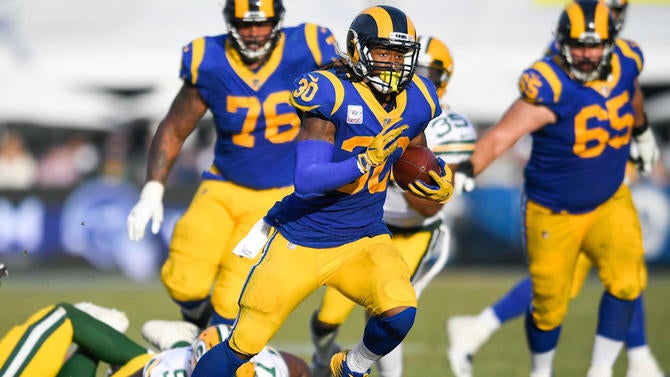
3. Los Angeles Rams – The royal and yellow
The Rams’ return to blue and yellow is the best thing that has happened to the NFL’s uniform landscape in a long time. The navy and gold that they wore in St. Louis didn’t quite bring the same pop as the old school color scheme, and the revival of these unis seemed to help inject some life into the franchise as they moved back to Los Angeles.
For as eye-popping and electric as the Chargers’ Color Rush jerseys are, the Rams’ old school blue and yellow is better — thanks in large part to the horn design in the helmet and on the jerseys. It’s just a very cool and unique look that works so well, even if it’s slightly bothersome that the helmet blue doesn’t match the jersey blue.
In fact, the home uniform is so enjoyable overall that we’ve all been willing to put up with the rest of their uniform set being a complete inconsistent mess since the move. The team will look to rectify that mess with a new set in 2020, but let’s hope the home look stays similar because it’s hard to imagine them doing much better.
znModeratorSkip Bayless@RealSkipBayless
I don’t get the Aaron Donald phenomenon.Cameron DaSilva@camdasilva
This is something said by people who don’t watch footballznModeratorI don’t know why you think Trump beats Sanders.
August 27, 2019 at 10:37 am in reply to: Gluten does not induce gastrointestinal symptoms in healthy people #104361znModeratorI prefer non-GMO gluten products.
(Subtle joke.)
August 27, 2019 at 10:31 am in reply to: the one-shot tweets thread (diff'rent stuff, funny angry interesting) #104360znModeratorTypical Twitter argument pic.twitter.com/nPS23rvdqP
— Carl Gustav (@CaptYonah) August 26, 2019
znModeratorAdam Lefkoe@AdamLefkoe
Q: Which coach’s defense is the toughest to read and attack?McVay: Vic Fangio
Shanahan: Vic Fangio
LaFleur: Vic FangioznModeratorRams Head Coach Sean McVay – August 26, 2019
(On if everyone other than the players requiring surgery will practice on Monday)
“As far as I know, everybody’s good to go. We just had a good walk-thru right there and other than the guys that we talked about that were injured as a result of playing in the game the other night, we’re pretty healthy. I think (T) Bobby Evans we’ll be smart with, with the bone bruise that we talked about. He would be the only guy outside of the players that are going to require surgery that will be out today.”(On CB Aqib Talib’s status)
“We’re building him (CB Aqib Talib) back in. He’s done some stuff. To say that he’s fully back in it – we’re not at that point yet, but he worked out before the game. He’s feeling good and we anticipate him resuming truly full participation at some point this week. He’s been a participant and just hasn’t been a full participant yet.”(On if there is progress on contract extensions for QB Jared Goff and CB Marcus Peters)
“I think right now we’ve been so busy just kind of handling training camp, things like that. Those are two very important players to us as we move forward this season. That’s kind of where we’re at right now with that.”(On if he is preparing for the Carolina Panthers as the team ends the preseason)
“It’s a little bit of that, and then it’s also focusing on continuing to establish our identity, some of the things we want to do offensively, defensively and on special teams. We’ll start to tailor and trim our focus towards the Panthers as we get closer and closer. We’re kind of still in the mode of, ‘Alright, let’s really get good with the finer details,’ and then we have some different things on both sides of the football that I think we would anticipate utilizing against Carolina, but to say that we’ve truly put ourselves in the game plan mode for them, that wouldn’t be accurate yet. There is a little bit of eyes looking towards them coming to a theatre near you.”(On LB Dakota Allen being in the middle of everything during the preseason games)
“He’s done a great job. He certainly has made his presence felt and I think you feel what a physical football player he is, the instincts. Made a lot of good plays in the run game and then he showed up the other night in some other opportunities that he had coverage-wise. Been really pleased with him, it’s been good to just have him out there healthy and get a chance to compete. You see some of the things that we like so much. He’s definitely making a case for himself.”(On DL John Franklin-Myers getting a chance to play)
“I thought it was his best. I thought he did a really nice job. He had a sack in our four-man, rush where we’re playing three-deep behind that. It thought he was able to push the pocket consistently, played physical against he run. I thought both (DL) John Franklin(-Myers) and I thought (DE) Morgan Fox was outstanding. I think from the interior defensive line, those two guys and then (DT) Tanzel Smart continued to show up consistently. Really, it was good to see John out there, feeling healthy, feeling ready to go. I thought also that was Morgan Fox’s best performance of the preseason as well.”(On the short week and his philosophy of not playing starters in the preseason)
“You never like to see guys get injured. Like I said, there is a lot of merit to playing in these games, where you’re actually playing real football. You have the ability to play tackle football. For quarterbacks to get rushed, for running backs to get tackled to the ground, but that was the decision that we felt like was best. You never want to see guys get injured, whether it be our team or anybody else, that’s always the worst parts about it. But where we’re at, we feel good. We’re healthy, unfortunately we had some injuries that were sustained that other night in that action, but that’s part of the game. You always want to try to keep players as healthy as possible, especially going into Week 1. For the most part, I think we’re in a pretty good place.”(On how much roster evaluation goes into games versus practice)
“It’s really all of it. We use all of the ways we are trying to evaluate guys in those competitive situations to really try to project who are the best 53 (players). Certainly, there are some positions that I think you have a better chance to evaluate in the live action. But, we try to do as good of a job as we can creating those competitive scenarios, situations, but it is all part of the evaluation process. Even how they handle themselves in meetings, how they retain information, how they handle the above-the-neck walk-thrus, that’s a big part of what we do. So, everything that these guys are asked to do, they are being evaluated in that phase and really trying to carve out a role for themselves. Whether it be establishing themselves as a starter on offense or defense or starter in some of our special teams phases, it’s all part of the process. I think it’s a little bit easier depending upon the certain positions, to say, ‘all right, you can put a little bit more weight on one or the other’, but it is all a collaboration of all those.”(On if LB Travin Howard can play safety in addition to linebacker)
“He’s a guy that has the athleticism you would think just based on the way he moves around. He’s been exclusively a linebacker playing at that inside spot. Some of the things that we ask those guys to do, when we get into our dime-personnel defense, he’s doing lot of the things that we ask of some of our underneath defenders that are playing from the secondary position. I thought he did a great job. We mention Dakota Allen, but you also recognize (LB Travin Howard) ‘T-Howard’ a lot the other night. Pass to the flat, you can just feel him uncoil on that, playing the quarters as a zone-match two player, he did a really nice job the other night. That was one of the things (General Manager) Les (Snead) and his group and our coaches like so much about him – was the athleticism, the speed and the ability to go sideline to sideline. I think he’s showing that. But haven’t done that with him, but I wouldn’t ever, say never, I guess.”znModerator“It’s good. There’s pros and cons.”
– RB Todd Gurley II
The Rams chose to rest Gurley and many other starters for the second consecutive preseason, and he is happy with the decision. One of the benefits to the approach, according to Gurley, is how well it works with the new NFL roster deadlines. Since clubs no longer have to trim their rosters from 90 to 75 to 53 – now it’s just 90 to 53 – it gives several players opportunities to make an impression whenever starters sit.
“We’re slowly building him back in.”
– HC Sean McVayCB Aqib Talib will be cleared for full participation in practice at some point this week after dealing with a “little twinge” in his hamstring since joint practices with the Raiders, according to McVay.
znModerator🗣 NEVER LET THE BALL HIT THE GROUND! @brandincooks | #LARams pic.twitter.com/QcVBE6Jg5N
— Los Angeles Rams (@RamsNFL) August 26, 2019
znModeratorRyan Shazier was told he had a 20% chance of walking again.
Sunday, he was catching balls on the field during Steelers warm ups 🙌 (via @TDavenport_NFL) pic.twitter.com/ezCgXiUNd9
— ESPN (@espn) August 27, 2019
znModeratorWould you like to see Travin Howard (@TravinTheGreat) murder a man? pic.twitter.com/vokxK7v6OP
— Sosa K (@QBsMVP) August 26, 2019
znModeratorJ.B. Long@JB_Long
First, everyone’s OL depth is dicey.Second, context is important. CLE is planning to start former Rams Greg Robinson & Eric Kush.
Third, significant trades at this point can be tough because you could just wait for waivers.
znModeratorHow it looks now (still too early).
Right now this defense looks:
1. DEEP. As deep as I have ever seen a Rams defense. In fact it’s a little freaky to see. For example, Allen, Patrick, Obo, Howard, and even Durham have all shown something. That’s 3 rookies and 2 2nd year guys. When was the last time the Rams had 5 (!) new bright spots at LB showing things early like this. I don’t think I have ever seen it.

2. Smart at the top. Weddle, Talib, Matthews, Donald, all dedicated leaders and versatile and smart. It looks like there;s a lot of teaching going on.
3. Well coached. Wade is cooking up all sorts of mad scientist ways to use subpackages and to take advantage of the all the gold he has among the DBs.
This really promises to be something.
znModeratorBonifayRam…
UDFA OC Vitas Hrynkiewicz for the first two preseason gms saw late 4th quarter action @ OC but Kromer did something different last Saturday in gm #3. When Neary went down he sent VH out to play RG with 11 minutes remaining in the gm. I am happy to report that VH made zero mistakes made all his blocks & was able to reach some second level blocks. His passing & run blocking was excellent. But he was going up against the Broncos reserve front seven. But at least you can factually state Vitas performance @ RG was better than Kolone, Demby & Evans. I would imagine that Kromer will play VH a ton in this last preseason game!(y):)
Jamil Demby was crowned the 6th OL’er by the Rams. He was to be the replacement for Austin Blythe. JD has stunk up the playing field @ most positions. His best playing OL post is @ LG. But its not saying much since rookies David Edwards & Chandler Brewer have outplayed JD in this post. This has been our biggest offensive disappointment this preseason.
Snead’s top 2019 draft selection Bobby Evans is behind 3 or 4 of our current reserves & not yet ready for any starting role. It’s my opinion that the Rams thought he would be starting RG material. I am sure the Rams are disappointed at this time in his performance @ RG he has played better @ RT. But again both Edwards & Brewer have outplayed Evans @ RT.
Aaron Neary has a broken left ankle injury & SUP that will keep him out from practicing with the team until October the 5th & longer. Neary can play RG in an emergency, but he is best suited for the reserve center or LG positions
Its very apparent that David Edwards has won the all important 2018 Joe Noteboom swing OT position on the roster. This is very good news & shows us Snead is not losing his touch. Edwards has also played LG very well too. Edwards has secured himself a roster position.
Jeremiah Kolone has been working mainly as the swing OG in TC & pre season. His performance has been fair @ those two OG posts but Kromer has two OL’ers who have outplayed Kolone. JK got lucky with the injury suffered by Neary…… has forced Kromer to insert JK into the important reserve center position. Thus securing him a roster position & a game day reserve. I would preferred to have seen Vitas Hrynkiewicz win this position.
Chandler Brewer has outplayed Kolone, Evans, Demby, Kaskey & Neary @ both OG post in preseason. CB has outplayed Bobby Evans, Jamil Demby & Matt Kaskey @ both OT posts. Who do you think is in the drivers seat to play & START @ the RG post if there is a need?
znModeratorAtlantic Ram
I am loving this preseason.
I have zero interest in the starters playing and love seeing the position battles and players trying to make the team or get good film out there. And I like all of the Rams QBs for the first time I can remember.
I think 4 preseason games are perfect and I hope they don’t change anything. I don’t get the “games are boring” sentiment. Just the opposite for me.
znModeratorRams Wire@TheRamsWire
Ravens offered Clay Matthews more money than Rams didVincent Bonsignore@VinnyBonsignore
“Unit” is a loose term in this situation as guys are literally rotating among two and sometimes three positions during games. Cohesiveness is hard to come by as a result, if not impossible. The manner in which the staff evaluates reflects that.As a result, there is more emphasis on individual play rather than the collective effort. That said, there appeared to be better collective efficiency on Saturday as opposed to the first two weeks as guys seemed a little more settled in the unsettled way they are being utilized
The ultimate goal being, which three guys can be counted on most as reserves on the 53-man roster and which two guys can be counted on most on the 46-man game-day roster?
==
Clay Matthews' exit from Green Bay was abrupt, but he's loving LA now…https://t.co/ddpCOtguiW
— Michael Silver (@MikeSilver) August 26, 2019
August 26, 2019 at 6:59 pm in reply to: the one-shot tweets thread (diff'rent stuff, funny angry interesting) #104341znModeratorCNN in the same hour:
Warren's 1st in the new Monmouth poll & had a huge crowd of 15k
Bernie's in the top 3, but the poll could be an outlier & crowd sizes don't matter
REMINDER: Bernie won the poll, has the most volunteers, donors, $, & diverse support & easily beats Trump.
— Pat the Berner🌹 (@PatTheBerner) August 26, 2019
znModeratorEd Werder@WerderEdESPN
Jacoby Brissett was among the few Andrew Luck told of his retirement in advance. “I was shocked, which I’m sure everybody was,’’ he said. “Then we had long conversations and emotions were going back and forth. He was smiling at the end and that’s what helped me gain clarity.’’August 26, 2019 at 6:49 pm in reply to: the one-shot tweets thread (diff'rent stuff, funny angry interesting) #104339znModeratorMondays, amirite?💪🤷♂️😳😱🤭 pic.twitter.com/pX3CTlIiqs
— Rex Chapman🏇🏼 (@RexChapman) August 26, 2019
znModeratormerlin
Last year to this year… Boom was better than anyone we have this year, in terms of his ability to handle change and step in to different spots quickly. But after him? In comparison I think this year’s depth is better because you have Edwards looking like a steal and Evans improving every game, plus some others like Kolone and Brewer playing earlier snaps vs better competition and holding their own.
Where we have probs is center. Neary got trucked last game, and we don’t have a young guy like Allen sitting back there learning.
August 26, 2019 at 2:39 pm in reply to: the one-shot tweets thread (diff'rent stuff, funny angry interesting) #104331znModeratorYou: Pardon me
Me: What
You: You’re standing on my foot
Me: I don’t think so
You: You are
Me: I don’t have a standing on feet bone in my body
You: If you just look—
Me: So now I can’t even stand
You: No it’s just that—
Me: You have to be SO CAREFUL these days where you stand—GOD— A.R. Moxon (Julius Goat) (@JuliusGoat) August 26, 2019
znModeratorD’Marco Farr@DMarcoFarr1
I liked the 2nd half Brandon Allen better than 1st half Brandon Allen. And in an some alternate universe of the shared multiverse John Kelly and Darrell “fresh legs” Henderson are a really good 1-2 punch in a running back by committee backfield that finishes top 10 in rushing.Michael Silver@MikeSilver
Belichick, on Germany’s World War 2 surrender: ‘Tough war. I didn’t really follow it, but lots of dead people. We all have to make our decisions. We’re on to Cincinnati.’Pete Prisco@PriscoCBS
This is the worst NFL week of the year in a lot of ways. Games are terrible and tons of guys lose their jobs.znModeratorAs great of a coach as he is, I honestly wonder if we’re wasting Nick Saban on football. Guy absolutely kills it when he talks about larger societal issues. pic.twitter.com/qsdxwera2n
— Clay Travis (@ClayTravis) August 26, 2019
znModeratorfrom PFF ReFocused, NFL Preseason Week 3: Los Angeles Rams 10, Denver Broncos 6
https://www.pff.com/news/pro-pff-refocused-nfl-preseason-week-3-los-angeles-rams-10-denver-broncos-6
Los Angeles Rams 10, Denver Broncos 6
LOS ANGELES RAMS
John Franklin-Meyers was very impressive rushing the passer, making some nice moves en route to a few pressures, including the lone sack of the night for his team.
Mike Thomas had an impressive night in a game that didn’t have much offense. On the Rams’ second play of the game, he scorched the Denver secondary on a hitch-and-go for a 51-yard gain. Thomas also made an acrobatic catch near the sideline, ending the night with 76 yards through the air.
Rookie Takeaways
Dakota Allen might have been the most impressive player on the Rams’ defense tonight. He made plays in the run game, rushing the passer and in coverage. He finished with five tackles and included a pass breakup to boot.
znModeratorMichael Silver@MikeSilver
1) Clay Matthews insists he isn’t bitter, that he has no ill feelings toward the Packers. He says playing for the Rams “feels like this is where I’m supposed to be”…2) But Matthews says the Packers essentially told him to get lost just before free agency, and it caught him off guard. “I was kind of taken aback, because I thought I’d always be back there, whether it was at a cheaper price (or not)…”
3) “People say, ‘You chose to go to L.A.’ I didn’t choose. They told me there was no room for me”…
4) Even when he was on the verge of agreeing to a relatively affordable deal with the Rams, Matthews had his agent go back to the Packers one last time. They said no thanks: “I don’t think they were interested at that time. I think they were ready to move on”…
5) Now Matthews is gone from Titletown, and hoping to help bring a title to his hometown: “Everybody says, ‘Oh, I want to go play for a team that has a chance,'” Matthews said. “But we’re one of the few that really does.”…
znModeratorMartellus Bennett@MartysaurusRex
Football doesn’t care about players. Players are starting to realize that more and more. The game gets what it needs from you then moves on. Now that players are getting what they need from the game and moving on it’s fucking up the ecosystemAlbert Breer@AlbertBreer
I’ve seen people make comparisons. To me, the Andrew Luck retirement most closely mirrors the way my dad used to talk about Gayle Sayers — basically that he should’ve been the best, it was all there, then it was just over while he had so much left to give.𝒥𝒾𝓂 𝐸𝓋𝑒𝓇𝑒𝓉𝓉@Jim_Everett
Thought: Whats not being discussed with the Andrew Luck story is the possibility that contract insurance (held by either by himself or the club) would honor the remainder or a portion of his contract if he was forced to retire injured. #PayUpFull Dissident@hbryant42
Let’s also remember the reason why these early retirements are so “shocking” is because fans have no professional respect for athletes. They don’t respect pain. They use money as the response to every question, and cannot fathom any decision that rebukes the sports biz in any wayZak Keefer@zkeefer
Probably no surprise, but fans calling Colts HQ today, demanding refunds for their season tickets.Will Brinson@WillBrinson
Colts fans have had two decades — literally — of nearly uninterrupted franchise quarterbacks fall in their lap and the second adversity strikes they want a refund. Grow up.AngryNFLScoutVet@angryscout2
Luck is not some pansy who just didn’t want to rehab. My guess is rehab wasn’t helping and he couldn’t get fully right. Those attacking Luck should probably talk to him. He certainly isn’t complaining about a helmet like some. I’m sure playing was gonna be more dangerous 4 him.Russell Lande@RUSSLANDE
I would also add that until people see what NFL training rooms look like on day after game and while players are rehabbing injury they have no idea the amount of physical toll the game takes on players and how hard it can be to come out relatively healthy on the other end.==
Andrew Luck’s retirement and the mental exhaustion of rehab. I know the feeling all too well. My thoughts @SBNation https://t.co/eB8UQf3ZNZ
— Geoff Schwartz (@geoffschwartz) August 26, 2019
It’s all over for Andrew Luck. @AlbertBreer on what we know right now about the QB’s stunning decision to retire from the NFL at age 29 https://t.co/r4L5WRurbE
— The MMQB (@theMMQB) August 26, 2019
What does Andrew Luck's retirement mean for the #Colts and the NFL as a whole?:https://t.co/alEkEwhgnz
— Pro Football Rumors (@pfrumors) August 26, 2019
znModeratorstlramz
Understand the context, this guy is a dude that Goff liked and followed in College, so there is a level of comfort.
Some of the cussing is gratuitous, but the football stuff is gold.
For example, talking about New Orleans game (NFC Championship), with the crowd noise, the helmet malfunction then his first pick he said he was amazed because he came to the sideline and “Could NOT care less” about the pick”. He was amazed at himself that he wasn’t even worried about it. He said it didn’t “even trigger” as a problem.
He talks about learning this concept of “PACE” in high school: Performance After Critical Error (PACE) and how critical that is for the QB. Talks about situations where this has applied.
This is a really good interview and so different from the others because Goff is comfortable with this guy and knows he has time to give details.
He talks about the Rams trading up for him and asking him to show up at the same time he was to throw out the 1st Pitch at the Giants game and wondering if he could move the interview. He runs through all the behind the scenes draft process which is fascinating, using Luminosity games and strange questions asked at the combine.
He talks about the SB Loss and owns up to his own shortfalls and how he deals with it.
-
AuthorPosts