
Forum Replies Created
-
AuthorPosts
-
 znModerator
For a bit there last week there was a rumor that Everett might be traded. It looks like they’re keeping him. The trade talk might not have been anything real.
Everett is a bit of mystery, not because he hasn’t come through, but because he keeps getting banged up…and that’s on top of being a developmental guy when they picked him. TEs are notoriously slow to develop, and getting banged up on top of it doesn’t help.
So who and what is he? Well the team has a far better idea than we do…we are mostly still just guessing at this point. He shows flashes but can’t stay on the field. For example at one point midseason last year he was becoming a primary target. Starting with the Tampa game and going through to the Pittsburgh game, he had 49 targets in 6 starts. That’s a bit inconsistent–in 2 of those games he had 20+ snaps, when in the other 4 he had 50+ snaps a game–but still, that shows the intention to use him. That was for 26 catches and 322 yards. 8 targets a game for 16 games would have been 128 targets, which would have ranked 3rd among TEs in 2019.
But then he banged his knee up.
Before the injury though, I don’t think they put him in that position if they don’t believe in him. (In fact in a recent interview McVay said he thinks GE is a “rising star.”)
Plus they need 3 viable TEs, though all three top TEs are very different animals (obviously, Higbee, Mundt, Everett). There are different offensive games built around which pair you put out there–HIgbee and Everett is one thing, Higbee and Mundt is another. That’s something a good offensive mind can play around with.
(Hopkins is a very developmental rookie and as was said, rookie TEs rarely do much.)
Everett is more of a move TE and not an inline blocker, though he can block in his role.
He needs to stay healthy and it’s true that so far he has not managed to do that.
I doubt they extend him. Hopkins could replace him in 2021. I doubt they extend him because they can only afford so many extensions. So I would say he looks to be good enough to use effectively in 2020 (if there’s a season), but he’s not a transcendent, must-keep kinda player. (Not many are.)
Higbee is clearly the #1 TE but they can do things with Higbee + Everett packages, or just with Everett out there as the only TE in what amounts to a 4 WR set (with GE being the 4th WR). A 6’3 240 TE in that situation gives you obvious mismatch advantages.
He’s also great after the catch. That’s always been true though other parts of his game had to develop. I think he has enough to be a factor in 2020.
Or…they could trade him. 😎
znModeratorDan Graziano@DanGrazianoESPN
NFL/NFLPA negotiations continue this afternoon and likely this evening. Reality is, something has to get done tonite. If HOU/KC rookies show up Monday and NFLPA hasn’t signed off on protocols, union could file a grievance claiming unsafe work environment. Neither side wants that.znModerator“The good and just society is neither the thesis of capitalism nor the antithesis of communism, but a socially conscious democracy which reconciles the truths of individualism and collectivism.” — Martin Luther King jr
Kind of the slogan of the principled moderate social democrat.
znModeratorAdam Schefter@AdamSchefter
NFL and owners now will be conducting a league meeting at noon ET today as they try to finalize health and safety measures, financial arrangements, and reducing or eliminating preseason games, per league sources.Judy Battista@judybattista
There are still a lot of outstanding issues — including preseason, testing frequency, structure of camp — but a person involved in the talks told me Friday things were moving in right direction. We’ll see what emerges today==
A fall without football a real possibility because of COVID-19 as NFL players, others raise questions https://t.co/myRERRO2X6
— Joe Curley (@vcsjoecurley) July 20, 2020
znModerator.@Jim_Everett ➡️ @Flipper_83 for the win!
Team Yearbook | A look 🔙 at the 1989 Los Angeles Rams » https://t.co/T5ucETkD0n pic.twitter.com/agnlpTQ9Oy
— Los Angeles Rams (@RamsNFL) July 20, 2020
znModerator— PoliteViking 💥🌻🔥🎽☭🏴 (@leigh_fall) July 19, 2020
znModeratorI’m the medic who took him to meet an ambulance, this guy is so badass, honestly I think he was calmer than I was. Looks like a broken hand, won’t say more for his privacy. 🖤#PortlandProtest https://t.co/4871dKn8SR
— 👁 TAV 👁 (@peyhubbard) July 19, 2020
znModeratorme note: this is actually an article about the top 2020 draft prospects at qb, but it mentions Goff several times, so here it is.
==
from https://medium.com/@thetim_dix/nfl-draft-how-strong-is-joe-burrows-arm-b69abd897399
THE RESULTS
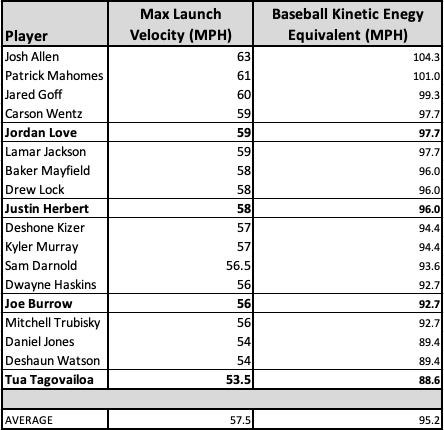
The maximum launch velocity, release time, and trigger time (I’ll explain this one) for each quarterback is below, sorted by launch velocity. For context, I’ve also included data from some QB prospects I’d previously analyzed.
Arm Strength
Throw velocity isn’t a common stat in football, but even casual sports fans know that a pitcher who can throw a baseball at 100 miles per hour is, like, pretty freakin’ impressive. So, to make this QB metric a bit more relatable, I’ve converted these football throw velocities into baseball pitch speeds. This is based on kinetic energy and it should give you a better idea of how hard each QB can actually sling it.
Release Time
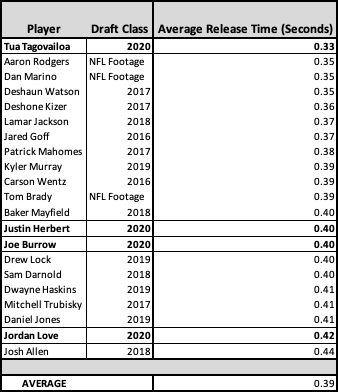
Again, this refers to the amount of time it takes a quarterback to complete their throwing motion. I start my “timer” on the frame where the quarterback begins to drop the ball on their windup and I end it when the ball first leaves their hand. And while a quick release doesn’t completely make up for a weak arm, it can mitigate some of the problems lower-tier arm strength can create.
 znModerator
Translating the #WeWantToPlay posts you're seeing now: Joint medical committee recommended a 21-day acclimation period. NFL asked players to show up 2 weeks early to accomodate it; NFLPA said no. NFL shortened acclimation period to accommodate 2 preseason games. Union wants 0.
— Tom Pelissero (@TomPelissero) July 19, 2020
Sense a trend…. pic.twitter.com/KJQqo7nKSI
— Adam Schefter (@AdamSchefter) July 19, 2020
A coordinated posting blitz from some of the NFL’s top players calls on the NFL to provide answers and address health concerns. All have the hashtag #WeWantToPlay pic.twitter.com/BwQtxcnLOq
— Ian Rapoport (@RapSheet) July 19, 2020
Same here, my family deserves to know that the @NFL is doing everything in their power to keep us safe. #WeWantToPlay but we need the league to follow recommendations from their own experts. https://t.co/ajEwi12lYh
— Johnny Hekker (@JHekker) July 19, 2020
It’s a shame that the @nfl doesn’t care about doing their part to keep players healthy and safe. They need to make sure football can come back the right way. We have to look out for ourselves as well as our families. #WeWantToPlay
— AD_99 (@AaronDonald97) July 19, 2020
znModeratorThe Oregonian@Oregonian
national media reports, particularly those published by right-wing outlets, suggest a vastly different version of how safe it is for children and families to stroll through downtown Portland.One America News Network describes “violence gripping the city.” A Fox News headline blares “Portland protesters flood police precinct, chant about burning it down.” The New York Post reported Saturday that Portland “descended into violence.”
Many people who live in Portland…heard over the past few days from worried relatives in other states who feared that their loved ones in Portland might have been affected by fires or caught in police crossfire as they went about their day.
The images that populate national media feeds, however, come almost exclusively from tiny points in the city: a 12-block area surrounding the Justice Center and federal courthouse.
And they occur exclusively during late-night hours in which only a couple hundred or fewer protesters and scores of police officers are out in the city’s coronavirus-hollowed downtown.
Those events are hardly representative of daily life, including peaceful anti-racism demonstrations that have drawn tens of thousands of protesters, in a city of 650,000 people that encompasses 145 square miles.
The vast majority of Portland residents spend quiet home-bound lives on hushed tree-lined streets with coronavirus and its resulting economic catastrophe as the greatest threat to their well-being.
Portlanders swiftly rebutted Acting U.S. Secretary of Homeland Security Chad Wolf’s portrayal of the city as under siege from violent protests, posting mundane scenes from their neighborhoods.
As the national spotlight continues to shine on Portland, the Trump Administration dispatched federal marshals and U.S. CBP agents to protect federal property from vandalism after Wheeler ordered PPB to scale back their confrontations with demonstrators.
@Oregonian spoke to nearly two dozen Portlanders and visitors downtown Friday as Wolf and other federal officials continued to characterize the city as lawless and under threat of constant riots. (13/14)
Read the full story: https://t.co/rRUapwLnOA (14/14)
— The Oregonian (@Oregonian) July 18, 2020
znModeratorfrom https://abcnews.go.com/US/wireStory/fires-set-fences-moved-police-call-portland-protest-71864787
Before the aggressive language and action from federal officials, the unrest had frustrated Mayor Ted Wheeler and other local authorities, who had said a small cadre of violent activists were drowning out the message of peaceful protesters in the city. But Wheeler said the federal presence in the city is now exacerbating a tense situation and he has told them to depart.
“Keep your troops in your own buildings, or have them leave our city,” Wheeler said Friday.
Oregon Attorney General Ellen Rosenblum late Friday sued Homeland Security and the Marshals Service in federal court. The complaint said unidentified federal agents have grabbed people off Portland’s streets “without warning or explanation, without a warrant, and without providing any way to determine who is directing this action.”
Rosenblum said she was seeking a temporary restraining order to “immediately stop federal authorities from unlawfully detaining Oregonians.”
The administration has enlisted federal agents, including the U.S. Marshals Special Operations Group and an elite U.S. Customs and Border Protection team based on the U.S.-Mexico border, to protect federal property.
But Oregon Public Broadcasting reported this week that some agents had been driving around in unmarked vans and snatching protesters from streets not near federal property, without identifying themselves.
Tensions also escalated after an officer with the Marshals Service fired a less-lethal round at a protester’s head on July 11, critically injuring him.
House Speaker Nancy Pelosi and U.S. Rep. Earl Blumenauer, D-Oregon, issued a joint statement Saturday denouncing the Trump administration’s actions.
“We live in a democracy, not a banana republic. We will not tolerate the use of Oregonians, Washingtonians — or any other Americans — as props in President Trump’s political games. The House is committed to moving swiftly to curb these egregious abuses of power immediately,” they said.
Hundreds of people had gathered Friday night for a vigil outside the downtown Justice Center, which is sandwiched between two federal buildings, including a courthouse, The Oregonian/OregonLive reported. Across the street, dozens of other protesters entered two recently closed city parks after dismantling chain-link fencing that blocked access.
Federal agents emerged from an office building next door and used impact munitions, stun grenades and tear gas to clear the area, the news organization reported. It said its journalists did not observe any incident that might have prompted the use of the weapons.
Federal officers deployed tear gas again just before midnight after a few protesters placed dismantled fencing in front of plywood doors covering the entrance of the federal courthouse.
Early Saturday, Portland police declared the gathering unlawful, saying protesters had piled fencing in front of the exits to the federal courthouse and the Multnomah County Justice Center and then shot off fireworks at the Justice Center.
Federal officers and local police then advanced simultaneously on the demonstrators to clear the streets, making arrests as protesters threw bottles and pieces of metal fence at police, the Portland Police Bureau said. Portland Police Chief Chuck Lovell told reporters Friday that his officers are in contact with the federal agents, but that neither controls the others’ actions.
The overnight action by Portland’s police was condemned by Jo Ann Hardesty, a prominent member of the City Council. Hardesty said Saturday that local police “joined in the aggressive clampdown of peaceful protest.”
Hardesty also slammed Wheeler, telling the mayor he needed to better control local law enforcement. Hardesty, who oversees the city’s fire department and other first-responder agencies, said in an open letter to Wheeler if “you can’t control the police, give me the Portland Police Bureau.”
znModeratorfrom CDC director: We can control virus in 4 to 8 weeks if everyone in the US wears a mask
In an editorial in the journal JAMA and a corresponding interview with the journal’s editor, CDC Director Robert Redfield called for “universal masking” to control the virus in as little as four weeks.
He and his CDC colleagues pointed to several studies and case reports showing how mask wearing could reduce the spread of the virus.
They also emphasized the benefit of a mask to the wearer. Not wearing one is as “absurd” as to choosing to undergo surgery by an unmasked medical team, they said.
While more people have come around on mask wearing, there’s still a resistance that needs to be cut through to truly tackle the virus.znModeratorRe: Canada's decision to not allow the Blue Jays (and other MLB teams) to play in Toronto.
Canada, a country of 38 million, has not had a day of 1,000 new cases since May 25, and about 300 a day over the last month.
The U.S. has had 70,000+ documented cases in the last day.— Buster Olney (@Buster_ESPN) July 19, 2020
znModeratorCameron DaSilva@camdasilva
Based on how McVay/Snead have talked this offseason, I think we’ll see a lot more of the running game and more 2-TE sets. Less reliance on 11 personnel. Kinda like the end of last seasonznModeratorThat was very interesting.
July 18, 2020 at 10:31 pm in reply to: big story coming on the Washington no-name-yet team… scandals brewing #118131znModeratorWashington N.F.L. Harassment Report Shocked Many, but Not Women
Diversity and inclusion advocates said until the league fully addresses its toxic relationship with women, “those stories will keep coming.”After news broke Thursday that there were accusations of rampant sexual harassment within the Washington N.F.L. franchise, several colleagues at women’s organizations hopped on their group chat.
None of them were surprised that The Washington Post reported that 15 women brought harassment claims against male co-workers. Some members of the group chat had previously counseled the N.F.L. on workplace culture issues and all were familiar with how difficult it could be to nudge the male-dominated pro football industry forward.
“If the leadership was OK with a disrespectful, racist and objectifying team name, it wasn’t really a stretch to think that it was going to be translated into the workplace culture there,” said Linda Seabrook, general counsel and director of workplace safety and equity for Futures Without Violence, referring to the team’s long battle against changing its name, which Native Americans (and many dictionaries) consider to be a slur. Washington’s owner, Daniel Snyder, recently folded under pressure from sponsors to change the team’s identity and imagery.
“There are stories after stories of women who have been harassed, marginalized and tokenized within the N.F.L.,” Seabrook said. “And until leadership makes it a priority to change workplace culture, those stories will keep coming.”
Six years ago, after the Ray Rice domestic violence case, the N.F.L. ignited a national debate about how the league and its players treat women, prompting Commissioner Roger Goodell to highlight the N.F.L.’s reform efforts. At a nationally televised news conference, he promised changes to the league’s personal conduct policy, saying, “We will make it happen.” He added: “We will get our house in order first.”
Yet continued reports of domestic violence and sexual assault within the league are reminders that the N.F.L.’s work is far from done. And women’s groups that have pushed the league to make substantial efforts to prevent sexual harassment and domestic violence are painfully aware of how far the league still has to go.
“Change takes time, but you need to have a will and a will is more than words,” said Rene Redwood, a consultant for inclusion and equality who has advised the league on issues of race and abuse. “They’re good at the marketing aspect, saying what they think people will think is important rather than doing the systemic work, whether race or gender.”
Redwood questioned whether the N.F.L. has provided enough resources or the motivation for its teams to keep female employees safe and to give those women equitable chances to succeed. In her view, there are few mechanisms for the league to enforce its guidelines or hold teams accountable for failing to abide by them.
Redwood and other women who advised the N.F.L. said that the league reacted fastest when it perceived that it had an image problem or was under financial pressure, and since few sponsors walked away from the league after the Rice case, organizational reform has been slow.
“As long as they generate revenue, why bother to change?” Redwood said.
The team in Washington has hired the law firm Wilkinson Walsh to review the claims of the women who told The Washington Post that they were sexually harassed while employed by the team. Snyder, the team’s owner, said on Friday in a statement that the behavior described in the article published Thursday “has no place in our franchise or society.”
“This story has strengthened my commitment to setting a new culture and standard for our team, a process that began with the hiring of Coach Rivera earlier this year,” he said in the statement, referring to Ron Rivera, who was hired in December 2019.
The league, in a statement, said the allegations “are serious, disturbing and contrary to the N.F.L.’s values.”
Sunu P. Chandy, the legal director for the National Women’s Law Center, said league and team leaders should immediately re-evaluate and change how they run their male-dominated workplaces, including by installing multiple mechanisms to report harassment and abuse so that every employee can be comfortable at work every day.
“If I was in charge of the N.F.L., I would be asking myself, ‘What kind of culture are we creating here with any team affiliated with us?’” she said, adding that leaders can, and should, decide to be a force for good and not just remain complacent.
One of the hurdles to changing behavior in the N.F.L. is the structure of the league itself. Like most sports leagues, the N.F.L. is essentially a trade organization with 32 franchises across the United States. It has control over some functions, like negotiating broadcast contracts and labor agreements, and it handles marketing and the scheduling of games, but each team is run as its own business entity.
The league establishes guidelines for the workplace that teams must follow, and in some cases, the commissioner can assess financial and other penalties to clubs that violate those rules. But the league office cannot tell a team who to hire.
“There’s no question it’s a juggling act for the N.F.L. to maintain their profits while trying to do the right thing, and there is often a connection between those two things,” said Kim Gandy, the former chief executive of the National Network to End Domestic Violence who advised the N.F.L. after Rice assaulted his then-fiancée.
In recent years, the N.F.L. began anti-harassment training at the league office and clubs undertook their own training efforts. In February, the league’s workplace diversity committee told teams that by next spring, they have to submit plans for unconscious bias training and anti-racism training. The league separately conducts inclusive leadership for employees at its headquarters.
In 2019, 36.8 percent of the people hired at the N.F.L.’s headquarters were women, up nine percentage points from 2010, according to data collected by the Institute for Diversity and Ethics in Sport at the University of Central Florida. Since 2014, the league has hired several women to fill key positions, including chief operating officer, vice president for social responsibility and a former prosecutor to run investigations into player misconduct.
But the N.F.L. head office has a lower percentage of women in its ranks than those of other major sports leagues, such as the N.B.A., W.N.B.A. and Major League Soccer. Overall, the institute gave the N.F.L. a “C+” grade for its gender diversity in 2019. In 2016, the league expanded the N.F.L.’s so-called Rooney Rule, decreeing that at least one woman would have to be interviewed for any executive position openings in the league office.
At the club level, the number of women in senior and professional administrative jobs has risen just five percentage points during the past decade. The league does not provide a breakdown of hiring by team, so it is unclear how diverse the front office is at the Washington club.
Still, employing more women at the league office and within its teams, said Seabrook, of Futures Without Violence, won’t solve the recurring mistreatment of women unless there is more fundamental change.
“You can promote all the women you want and put them into all the top positions you want, but if you’re not creating accountability and buy-in in fostering an inclusive and supportive workplace, it doesn’t mean much,” she said.
znModeratorAfter today’s memo, multiple NFL teams already have sent notice to rookies and begun booking flights for them to report to camp Tuesday, per sources. Still a lot unknown, including structure of camp, but teams proceeding as if players will begin returning to facilities this week.
— Tom Pelissero (@TomPelissero) July 18, 2020
znModerator"…my family and I believe that it will be people helping people that will raise us to a better place and pull us through this time."@CooperKupp provided 84,000 meals for food banks serving residents in Los Angeles, Ventura County + his hometown region 💙
— Los Angeles Rams (@RamsNFL) July 17, 2020
znModeratorWill the #Rams rebound from a disappointing 2019 season and make the playoffs in 2020? @PFF_George on @NFLTotalAccess pic.twitter.com/appeW6xQqd
— PFF (@PFF) July 17, 2020
znModeratorfrom https://www.nfl.com/news/aaron-donald-jalen-ramsey-aim-to-overcome-losses-under-new-dc
In the eyes of some, Phillips’ departure was a bit surprising. Aside from the aforementioned streak of finishing outside of the top 10 of scoring defenses, the Rams were second in the league in takeaways (82) and Pro Football Focus bestowed them with the sixth overall team grade for defense last year. And, of course, that was a season removed from going to the Super Bowl.
znModeratorThe NFL and NFLPA would like to have the all-important economics figured out before camp. But it’s not a necessity, so they can keep talking about the revenue shortfall while camp goes. They’ll resolve other money issues (risk stipends etc) sooner. https://t.co/yojAaf7JC8
— Ian Rapoport (@RapSheet) July 18, 2020
znModeratorThis is not accurate. 2,800 NFL players have not been tested yet. There are 72 players who are known to test positive, but they were tested independently from the NFL https://t.co/n4P6ncmQCD
— Ben Volin (@BenVolin) July 18, 2020
July 18, 2020 at 10:57 am in reply to: Goff talk … June to Sept. (a lot of great stuff here) #118113znModeratorfrom https://www.nfl.com/news/will-new-faces-help-mcvay-get-goff-rams-offense-back-to-form
Goff – via NFL Research – is the first Rams quarterback to connect for back-to-back seasons with 4,000-plus yards passing, but the young gunslinger’s league-high 626 passing attempts last year continued a trend of a more passing for L.A. and less success. The Rams passed on 62% of their plays in 2019, up from 56.7 during their Super Bowl season and increased form 54.6% the year prior in 2017, per NFL Research.
July 18, 2020 at 10:46 am in reply to: big story coming on the Washington no-name-yet team… scandals brewing #118111znModeratorSNYDER’S STANDING AS REDSKINS OWNER DEPENDS ON NEXT STEPS
Daniel Snyder’s future in the NFL hinges on his next actions in light of a damaging workplace report.link https://www.sportico.com/2020/law/analysis/snyders-standing-redskins-owner-next-steps-1234609409/
The much-anticipated report by The Washington Post on a workplace scandal involving the Washington Redskins has been published. The story details a hostile workplace environment. It also raises questions about how the NFL might respond.
A key question: Will the NFL try to oust Daniel Snyder from the league?
Most of the report details troubling instances of male Redskins executives allegedly engaged in harassment of women who worked for, or reported on, the team.
For instance, the report references multiple allegations against ex-pro personnel director Alex Santos. He allegedly “made inappropriate remarks about their bodies and asking them if they were romantically interested in him.” According to The Post, Rhiannon Walker, a reporter for The Athletic, informed the team that Santos had “pinched her” and opined that she had “an ass like a wagon.” This allegation would be disturbing in any time but is even more outrageous given that it occurred in 2019—during the #metoo era.
While Snyder oversaw what is depicted as a workplace out-of-control, The Post makes clear that he is not accused of engaging in mistreatment of women.
That’s not to say he is praised.
The report cites suspicions that Snyder knew about the mistreatment and declined to pursue any corrective measures of consequence. He also is accused of ridiculing a male employee, ex-business operations president Dennis Greene, for having been a male cheerleader in college.
Further, The Post cites an account by a former who asserted that Snyder “had ordered [Greene] to do cartwheels for their entertainment.” An owner ordering an employee to perform cartwheels, presumably against the employee’s wishes, could be regarded as a type of abusive conduct. However, it is of a different nature than the type of misconduct detailed elsewhere in the report.
Snyder issued a statement on Friday. “The behavior described in yesterday’s Washington Post article has no place in our franchise or society,” the statement said. “This story has strengthened my commitment to setting a new culture and standard for our team.”
Although he was not accused of engaging in any abusive conduct, Dallas Mavericks owner Mark Cuban could be seen as analogous pro sports owner implicated in wrongdoing. In 2018, an investigation found that Cuban had failed to adequately supervise former CEO Terdema Ussery, who was accused of sexual harassment. Cuban did not face a formal penalty but agreed to make a $10 million donation to domestic violence and women’s empowerment organizations.
The Redskins have retained Washington lawyer Beth Wilkinson to conduct a review of the team and its culture in light of the Post’s investigation and story. Maintaining credibility will be essential for Snyder to present his case to the league and the public.
“It is a critical first step to retain a third-party investigator when there are allegations of sexual harassment against top executives – which the Redskins have done here,” Sue Ann Van Dermyden, an attorney whom the Sacramento Kings hired to investigate coach Luke Walton for alleged sexual misconduct, said. “It is imperative that the investigators are truly independent and not influenced by anyone at the team with an interest in the outcome.”
The NFL has the power to investigate on its own, though it will likely refrain from immediate action. The league’s personal conduct policy governs owners and requires them to refrain from “conduct detrimental to the integrity of, or public confidence in, the game of professional football.” That said, the NFL is a private entity. It doesn’t have subpoena power, nor can it compel disclosure of records or witness statements (though can punish Redskins officials who fail to cooperate in a league investigation).
The league in a statement called the alleged conduct “serious, disturbing and contrary to the NFL’s values.” Further, the NFL said it would meet with Wilkinson’s team after their investigation and “take any action based on the findings.”
Snyder will have at least a first shot at redemption before facing any league action.
“You have to give the owner the opportunity to do what Mark Cuban did. He has to clean that house. He has to do all the things to show he’s managing a club worthy of his membership in the league,” said Donna Lopiano, former CEO of the Women’s Sports Foundation and current now president of Sports Management Resources, which helps sports organizations solve integrity, growth and development challenges.
Also, The Post report depicts Snyder in a less damaging light than the Sports Illustrated report uncovering misconduct by former Carolina Panthers owner Jerry Richardson. Richardson himself allegedly partook in physical and sexual misconduct against women who worked for the team. He also allegedly made racially insensitive comments. The NFL fined Richardson $2.75 million. Though the league has denied doing so, it is thought to have pressured Richardson into selling the team, too.
Amy Trask, the former Raiders chief executive officer and the first woman team executive in the NFL, said that whether or not Snyder is forced out will depend on a handful of powerful owners, without specifying which ones.
“The league is comprised of thirty two teams, and the individuals who control each of those teams wield varying levels of influence in setting policy,” Trask said. “Whether or not there is an effort to compel Dan to sell the team in which he owns the controlling interest will depend almost entirely on the wishes of the handful (or less) of team owners who wield the most influence.”This is not the first workplace controversy for Snyder or the Redskins. There was a recent scandal involving Redskins cheerleaders. While on a trip to Costa Rica in 2013, they were allegedly required to accompany sponsors and pose topless. The allegation, which was detailed in a New York Times story from 2018, did not lead to known sanction against Snyder.
But 2020 is a different time in America than 2018. Social protests, sparked by the killing of George Floyd, have led to less tolerance for misbehavior and controversial attitudes. The fact that 15 different women allege misconduct also makes it harder for the NFL to believe that Snyder either didn’t know or shouldn’t have known.
Also, The Post stresses that several women who worked for the Redskins will only speak anonymously due to fear of breaching nondisclosure agreements and being sued. It’s worth noting that the NFL could mollify those concerns by indemnifying employees for any litigation brought by the Redskins.
In addition, if those nondisclosure contracts are governed by Virginia law (the team is headquartered in Virginia), they might not be enforceable. An NDA cannot be more restrictive than necessary. Meanwhile, a new Virginia statute, § 40.1-28.01, limits their usage in situations where they would conceal sexual assault (the allegations detailed by The Post generally appear more along the lines of harassment than assault).
Ultimately, however, the responsibility for the workplace’s culture lies with its owner.
“Is it proper to place the blame on the desk of the owner? The answer is absolutely yes. Will the other owners act in concert to do it? Let’s be realistic. These owners have been tribal. Look at Colin Kaepernick,” Lopiano said.
znModeratorznModeratorMelissa Whiteorth completely dismantling trolls is probably the only good thing about 2020. https://t.co/crqDIsSJ68
— SeattleRams (@seattlerams_nfl) July 18, 2020
znModeratorChargers allow season ticket holders to opt out of 2020 https://t.co/0RhxpvGYkr
— ProFootballTalk (@ProFootballTalk) July 15, 2020
znModeratorSome speculate this is about a trade.
Word is, he removed “LA Rams” from his bio.
waiting on a decision that’s already been made… ⏰ 💤
— Gerald Everett (@lightningstrk12) July 17, 2020
July 17, 2020 at 7:58 pm in reply to: NFL on having a season w/ pandemic (thread 1, to 7/17)) #118095znModeratorDan Graziano@DanGrazianoESPN
THREAD: What I’ve learned today from sources on NFL/NFLPA reopening negotiations:-They’re ongoing, expected to continue thru the weekend.
-Both sides believe, if the health/safety piece of the talks gets resolved, they can start camps and continue to discuss financial piece.
Players still want daily testing, league doesn’t believe it’s necessary. (Actually worries it can create false sense of security.) Possible compromise involves daily testing at start of camp, phase into less frequent as people get more comfortable with the facility protocols.
Players still want all preseason games eliminated, league continues to resist. Possible compromise involves going down to just one preseason game per team, but NFLPA doesn’t want any. Thinks it raises infection risk unnecessarily (i.e, the games don’t count)
Both sides are dug in. especially on preseason games. Imo, nothing gets resolved and the nflpa files an expedited grievance against the league. I’m sorry, but that’s the way I see it play out unfortunately.
==
In the interest of having everyone on the same page in terms of what we know and don’t know at this time, here are a few things I’ve learned being on four NFLPA calls in the last two weeks with hundreds of other players.
Keep in mind our rookies are scheduled to report in 48 hrs pic.twitter.com/wAH1XyQenf
— JJ Watt (@JJWatt) July 16, 2020
znModeratorRams Brothers@RamsBrothers
The Rams are +130 to make the playoffs, currently behind: 49ers, Saints, Cowboys, Buccaneers, Eagles, Packers, Vikings & Seahawks.Odds/percentages will change drastically once we see them in action. We’re trying not to be fixated on either in mid-July.
-
AuthorPosts