
Forum Replies Created
-
AuthorPosts
-
 znModerator
off the net from Florida_Ram
Projecting GOFF’s Preseason & 2016 Regular Season Stats

As we follow Jared Goff’s rookie preseason and his first NFL regular season, I listed the statistics (minus rushing) for all of the QB’s drafted from 2012 through 2015.
I only listed the QB’s (9 total) that played in the Regular Season their rookie year and are still the Projected Starters for the 2016 season.[/b][/color]
I thought this would be a good barometer for comparing and tracking Goff’s progress and maybe give a glimpse of possibly what to expect from him in the regular season. All eyes are about to be on him as he gets ready to perform in his first NFL preseason game Saturday vs the Cowboys at the LA Coliseum.
Obviously for all rookie QB’s in their first NFL season, the talent/supporting cast of the team that drafted them, along with the Offensive Scheme and pedigree of their coaching, surely played a Large Part in their rookie development and overall statistics.
As you look over each QB’s Preseason stats by individual games, you can see that some of the rookie QB’s for various reasons, were given more snaps and had more pass attempts. Regardless of their preseason stats, it was their Regular season statistics that Jared Goff will be compared to at the end of his 2016 campaign.
Recent Rookie QB’s NFL PRESEASON & REGULAR SEASON HISTORY (2012-2015)
Andrew LUCK (2012 #1 overall pick)
QB Rookie Preseason Games Stats
WK1.. 10/16.. 188 Yds.. 2 TD.. 0 INT
WK2.. 16/25.. 175 Yds.. 0 TD.. 2 INT
WK3.. 14/23.. 151 Yds.. 1 TD.. 0 INT
WK4… 1/2……… 8 Yds.. 0 TD.. 0 INT2012 SEASON: ATT 339/627.. % 54.1.. 4,374 Yards.. YPA.. 7.0.. 23 TD.. 18 INT.. RATING 76.5
________________________________________________________________________________Robert GRIFFIN III (2012 #2 overall pick)
QB Rookie Preseason Game Stats
WK1.. 4/6…. 70 Yds.. 1 TD.. 0 INT
WK2.. 5/8…. 49 Yds.. 0 TD.. 0 INT
WK3. 11/17. 54 Yds.. 1 TD.. 0 INT
WK4.. 0/0 (did not play)2012 SEASON: ATT 258/393.. % 65.6.. 3,200 Yards.. YPA.. 8.1.. 20 TD.. 5 INT… RATING 102.4
________________________________________________________________________________Ryan TANNEHIL (2012 #8 overall pick)
QB Rookie Preseason Game Stats
WK1.. 14/21.. 167 Yds.. 1 TD.. 0 INT
WK2.. 11/23.. 100 Yds.. 0 TD.. 0 INT
WK3.. 11/27.. 112 Yds.. 0 TD.. 1 INT
WK4… 5/7……. 34 Yds.. 0 TD.. 0 INT2012 SEASON: ATT 282/484.. % 58.3.. 3,294 Yards.. YPA.. 6.8.. 12 TD.. 13 INT.. RATING 76.1
____________________________________________________________________________Russell WILSON (2012 #75 overall pick)
QB Rookie Preseason Game Stats
WK1.. 12/16.. 124 Yds.. 1 TD.. 1 INT
WK2.. 10/17.. 155 Yds.. 2 TD.. 0 INT
WK3.. 13/19.. 185 Yds.. 2 TD.. 0 INT
WK4… 5/11….. 72 Yds.. 0 TD.. 0 INT2012 SEASON: ATT 252/393.. % 64.1.. 3,118 Yards.. YPA.. 7.9.. 26 TD.. 10 INT.. RATING 100.0
________________________________________________________________________________Blake BORTLES (2014 #3 overall pick)
QB Rookie Preseason Game Stats
WK1… 7/11… 117 YDS.. 0 TD.. 0 INT
WK2.. 11/17.. 160 YDS.. 0 TD.. 0 INT
WK3.. 10/17.. 158 YDS.. 1 TD.. 0 INT
WK4… 4/6……. 86 YDS.. 1 TD.. 0 INT2014 SEASON: ATT 280/475.. % 58.9.. 2,908 Yards.. YPA.. 6.1.. 11 TD.. 17 INT.. RATING 69.5
________________________________________________________________________________Teddy BRIDGEWATER (2014 #32 overall pick)
QB Rookie Preseason Game Stats
WK1… 6/13….. 49 Yds.. 0 TD.. 0 INT
WK2.. 16/20.. 177 Yds.. 2 TD.. 0 INT
WK3… 4/7……. 40 Yds.. 2 TD.. 0 INT
WK4… 4/9……. 17 Yds.. 1 TD.. 0 INT2014 SEASON: ATT 259/402.. % 64.4.. 2,919 Yards.. YPA.. 7.3.. 14 TD.. 12 INT.. RATING 85.2
________________________________________________________________________________Derek CARR (2014 #36 overall pick)
QB Rookie Preseason Game Stats
WK1.. 10/16… 74 Yds.. 0 TD.. 1 INT
WK2… 9/16.. 109 Yds.. 1 TD.. 0 INT
WK3…. (did not play)
WK4.. 11/13.. 143 Yds.. 3 TD.. 0 INT2014 SEASON: ATT 348/599.. % 58.1.. 3,270 Yards.. YPA.. 5.5.. 21 TD.. 12 INT.. RATING 76.6
________________________________________________________________________________Jameis WINSTON (2015 #1 overall pick)
QB Rookie Preseason Game Stats
WK1.. 9/19.. 131 Yds.. 0 TD.. 1 INT
WK2.. 8/13…. 90 Yds.. 0 TD.. 0 INT
WK3.. 6/15…. 90 Yds.. 0 TD.. 0 INT
WK4.. (did not play)
_
2015 SEASON: ATT 312/535.. % 58.3.. 4,042 Yards.. YPA.. 7.4.. 22 TD.. 15 INT.. RATING 84.2
_______________________________________________________________________________Marcus MARIOTA (2015 #2 overall pick)
QB Rookie Preseason Game Stats
WK1…. 7/8.. 94 Yds.. 0 TD.. 1 INT
WK2…. 5/8.. 59 Yds.. 0 TD.. 0 INT
WK3.. 7/11.. 99 Yds.. 0 TD.. 0 INT
WK4…. 2/3.. 74 Yds.. 1 TD.. 0 INT2015 SEASON: ATT 230/370.. % 62.2.. 2,818 Yards.. YPA.. 7.6.. 19 TD.. 10 INT.. RATING 91.5
________________________________________________________________________________Summary: When you look at each rookie QB’s individual preseason games, for various reasons (total snaps, injury prevention etc) some of the QB’s were allowed to throw the ball 15-20 times, while others had only 12 or less passing attempts.
If Goff gets 2 quarters of playing time vs the Cowboys he might get 15 or more passing attempts in his debut depending on the circumstances of the game. As you all know, various factors will determine how many snaps and pass attempts Fisher allows before the rookies evening is done.
PRESEASON STATS FOR THE ROOKIE QB’s of (2012-2015)
1) T.BRIDGEWATER 30/49.. 283 Yards.. 5 TD.. 0 INT
2) R.WILSON……….. 40/63.. 536 Yards.. 5 TD.. 1 INT
3) D.CARR…………… 30/45.. 326 Yards.. 4 TD.. 1 INT4) B.BORTLES…….. 32/51.. 521 Yards.. 2 TD.. 0 INT
5) R.GRIFFIN………. 20/31.. 173 Yards.. 2 TD.. 0 INT
6) A.LUCK…………… 41/65.. 522 Yards.. 3 TD.. 2 INT7) M.MARIOTA……. 21/30.. 326 Yards.. 1 TD.. 1 INT
8) J.WINSTON…….. 23/47.. 311 Yards.. 0 TD.. 1 INT
9) R.TANNEHILL…. 41/78.. 413 Yards.. 1 TD.. 1 INTREGULAR SEASON FINAL STATS For the Rookies of (2012-2015)
1) R.GRIFFIN III……… ATT 258/393.. % 65.6.. 3,200 Yards.. YPA.. 8.1.. 20 TD… 5 INT.. RATING 102.4
2) R.WILSON…………. ATT 252/393.. % 64.1.. 3,118 Yards.. YPA.. 7.9.. 26 TD.. 10 INT.. RATING 100.03) M.MARIOTA……….. ATT 230/370.. % 62.2.. 2,818 Yards.. YPA.. 7.6.. 19 TD.. 10 INT.. RATING 91.5
4) J.WINSTON……….. ATT 312/535.. % 58.3.. 4,042 Yards.. YPA.. 7.4.. 22 TD.. 15 INT.. RATING 84.25) T.BRIDGEWATER.. ATT 259/402.. % 64.4.. 2,919 Yards.. YPA.. 7.3.. 14 TD.. 12 INT.. RATING 85.2
6) D.CARR…………….. ATT 348/599.. % 58.1.. 3,270 Yards.. YPA.. 5.5.. 21 TD.. 12 INT.. RATING 76.67) A.LUCK…………….. ATT 339/627.. % 54.1.. 4,374 Yards.. YPA.. 7.0.. 23 TD.. 18 INT.. RATING 76.5
8) R.TANNEHILL……. ATT 282/484.. % 58.3.. 3,294 Yards.. YPA.. 6.8.. 12 TD.. 13 INT.. RATING 76.1
9) B.BORTLES………. ATT 280/475.. % 58.9.. 2,908 Yards.. YPA.. 6.1.. 11 TD.. 17 INT.. RATING 69.5
___________________________________________________________________________________________Summary: As you look at the each of the above rookie QB’s Regular Season Stats, even with different team talent, offensive schemes, all of them had almost 400 passing attempts. Marus Mariota was the low of 370 attempts due to missing a games from injuries. Luck, Carr and Winston all had over 500 passing attempts.
In the Regular Season 6 of 9 QB’s had (19) or more TD’s with 3 of them Bortles (11), Tannehill (12) and Bridgewater (12) with the lowest total. 8 of the 9 QB’s had at a minimum of 10 Interceptions. All of these rookies QB’s had close to 3,000 passing yards with Luck and Winston topping the 4,000 mark.
________________________________________________________________________________If & When They Play in a 2016 REGULAR SEASON GAME… Welcome to the NFL
Jared GOFF_____________Carson WENTZ_________Paxton Lynch
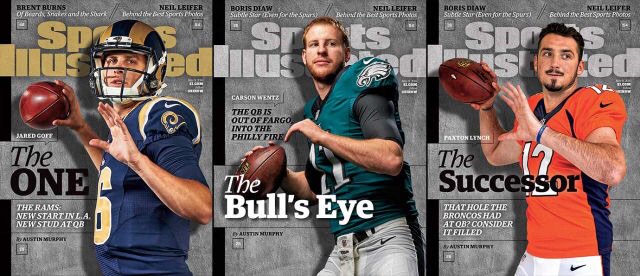
With the first pick in the 2016 NFL Draft, “The Los Angeles Rams select”
http://www.ooyuz.com/images/2016/5/9/1465516353811.jpg
For entertainment purposes, I thought this would be a be a good archive and reference guide to use as we scrutinize Jared Goff’s rookie season.
I’m curious to know if anyone of you faithful Rams fans have an estimated guess of which of the above listed QB’s Goff’s Regular season stats stats might be similar with, assuming he starts all or most of the 2016 season?
Anyone have any educated opinions/estimations
Thanks for observing, Florida
________________________________________________________________________________(On May 5, 2016 this was the over under odds at Bovada) not sure what they are today?
JARED GOFF – TOTAL PASSING YARDS IN 2016 REGULAR SEASON
OVER… 3400 -120
UNDER 3400 -120JARED GOFF – TOTAL TOUCHDOWNS PASSES IN 2016 REGULAR SEASON
OVER… 16.5 -120
UNDER 16.5 -120http://www.oddsshark.com/nfl/jared-goff-rookie-season-betting-props
znModeratorRams want to get ball in Tavon Austin’s hands more: He’s an ‘explosive player’
Austin had the most productive season of his career in 2015 and Jeff Fisher is expecting even morePrior to last season, Rams coach Jeff Fisher announced that he was making it a priority to get Tavon Austin more involved in the offense. “There’s no doubt in my mind that his production level should increase,” he said at the time, also noting, “This potentially could be a breakout year for him. Because he’s got the potential to win outside and inside.”
Austin did wind up having the most productive season of his NFL career last season. He caught 52 passes for 473 yards and five touchdowns, adding 52 carries for 434 yards and another four scores. In all, his 104 touches went for 907 yards and nine touchdowns.
On a per-touch basis, he actually was not as efficient as he’d been through his first two NFL seasons. Austin averaged 8.72 yards per touch in 2015, down from 8.92 in 2013 and 2014 combined. Still, getting the ball in his hands more often resulted in his greatest impact to date.
Now, Fisher wants to get Austin even more involved. He said in June that he expects Austin to crack 100 catches in 2016. Considering Austin has 123 total catches across his first three seasons, that’d be quite a leap in production. It’s also worth noting that Austin would need 163 targets to get to the 100-catch mark, based on his current 61.5 percent catch rate in his career. His career high is 87, set last year.
Still, Fisher doubled down this week on his insistence that Austin will have a huge year. Why? Well, mostly because he’s fast.
“He’s got two speeds,” Fisher said, per ESPN.com, which noted that the team is trying to open up its offense in order to utilize Austin’s skill set more fully. “One’s fast and the other is sleep.”
I’m not sure what that means, but Fisher definitely sounds excited about Austin yet again. “A really smart player,” Fisher called him. “Very exciting, explosive player. Loves to play and compete.”
Austin, meanwhile, is excited to take on a bigger role. “I appreciate it, just for what I’ve been through,” he said. “It’s only going to get better for me. I’m about the wins and any time I get to touch the ball, hopefully I can make something good happen with it.”
The Rams have been fairly mediocre thus far during Austin’s career, but maybe making a concerted effort to get the ball into his hands will help them take a step forward. They’re going to need somebody other than Todd Gurley to make things happen offensively, after all
znModeratorWhat to expect from the Rams in preseason opener against the Cowboys
Gary Klein
http://www.latimes.com/sports/rams/la-sp-rams-watch-20160812-snap-story.html
What to watch for in the Rams’ preseason opener against the Dallas Cowboys:
QUARTERBACK ROTATION: Case Keenum will start and is expected to play two or three series before No. 1 draft pick Jared Goff makes his pro debut. The Rams were 3-2 in regular-season games Keenum started last season. He has been efficient in training camp and, perhaps even more impressive, has handled with candor and humor all of the questions about Goff. Goff played in the Coliseum against USC in 2014. Don’t expect offensive coordinator Rob Boras to give either quarterback too much of what you’ll see in the regular season. Second-year pro Sean Mannion will play late in the game. Dylan Thompson also is on the roster.
OFFENSE: Running back Todd Gurley was the NFL’s offensive rookie of the year last season after not participating in exhibition games while recovering from knee surgery. So it would not be a surprise if the Rams severely limit his snaps or hold him out completely. Tavon Austin and Kenny Britt are the starters for a receiving corps that features the best competition for roster spots. Look for rookie Pharoh Cooper and rookie tight end Tyler Higbee to get multiple opportunities. Left tackle Greg Robinson’s development will be a topic of interest throughout the exhibition schedule.
DEFENSE: Alec Ogletree makes his debut at middle linebacker and gets his first opportunity to show the Rams did not err by releasing veteran James Laurinaitis. Tackle Aaron Donald leads a line regarded as the unit’s strength. Quinton Coples and Dominique Easley were free-agent acquisitions signed to add depth. Cornerbacks Lamarcus Joyner, E.J. Gaines and Coty Sensabaugh are competing to start opposite Trumaine Johnson. Maurice Alexander is making a run to start at safety.
ODDS AND ENDS: Kicker Greg Zuerlein struggled last season and now he’s kicking outside the controlled conditions of a domed stadium. He converted a 64-yard field-goal attempt last week during a practice at the Coliseum. Punter Johnny Hekker is a two-time Pro Bowl selection. Linebacker Josh Forrest, the only defensive player among the Rams’ 2016 draft picks, is among those trying to find a spot on special teams. This is the first game with the Rams for assistants Mike Groh (receivers and passing game coordinator), Skip Peete (running backs) and John Lilly (tight ends)
znModeratorHistory will be made, then football will be played when Rams face Cowboys in Coliseum
VINCENT BONSIGNORE
http://www.ocregister.com/articles/rams-725611-game-jones.htmlIt’s not often the executive of an NFL team starts thinking about a preseason game three months before kickoff – let alone talks it up in historical terms.
But when Dallas Cowboys CEO Stephen Jones pondered the Cowboys’ preseason opener against the Rams on Saturday at the Coliseum, he did so with a bit of awe.
“I’m not sure you’d be far off calling it the biggest preseason game in the history of the NFL,” Jones said, standing in the lobby of the Ballantyne Hotel in Charlotte last May. “I can’t think of a bigger preseason game, ever.”
Jones has a point.
A crowd of 80,000 to 90,000 is expected to cram into the Coliseum to watch the Rams’ first home game at the 93-year-old stadium since 1979, and their first home game back in Southern California in 21 years.
It will be raucous. It will be electric. And it will be emotional.
And based on some of my Twitter DM’s the last few days, you might even see grown men crying when the Rams emerge from the iconic Coliseum tunnel and take the field at a stadium they called home from 1946-79.
It only seems appropriate the Cowboys will share the Coliseum turf on the day of the Rams’ poignant homecoming.
Long-time Angelenos remember epic battles back in the day in which quintessential NFL names such as Roger Staubach and Bob Lilly and Tony Dorsett locked horns with Roman Gabriel and Merlin Olsen and Jack Youngblood – and so any others – on Sunday afternoons in downtown L.A.
A newer generation remembers the critical role Jones and his father Jerry – the colorful owner of the Cowboys – played in paving the freeway the Rams eventually rode home from St. Louis.
Jerry Jones, as much as anyone else, helped convince fellow NFL owners that the NFL needed to return to Los Angeles, and that sending the Rams home to play in the $2.6 billion stadium owner Stan Kroenke is building in Inglewood was the right call over the Raiders and Chargers joint stadium bid in Carson.
“There isn’t but one place like Los Angeles and Inglewood,” Jerry Jones said recently. “And so, the idea that the venue, that we can have the opportunity for that venue to match the iconic feeling that our league should feel in Los Angeles, that carried the day.
“And of course the guy that could do it, the guy that did do it and lead the way, was Stan Kroenke.”
Only fitting, then, that history and influence will converge the way it will Saturday at the Coliseum when the Rams and Cowboys officially put the NFL back on the L.A. map.
But soon nostalgia will give way to competitiveness.
Jones and Kroenke were allies during the contentious process of sorting out the NFL’s return to Los Angeles.
Come kickoff on Saturday, they’ll retreat to their private boxes and it’ll be all football.
“Let me tell you, the next time we play, he knows and I know we want to win,” Jerry Jones promised. “That’s what we’re here for.”
The Rams fully expect to get caught up in the moment, if only for a moment of two.
It will be back to work soon after, as they continue the process of setting their roster, settling some position battles and fine tuning before their regular-season opener against the 49ers on Sept. 12.
The game plan – such as it is – will be acutely vanilla and basic. But the expectations are high relative to precision.
“We’re looking for execution and obviously keep the penalties down,” Rams coach Jeff Fisher said. “I just want to see them execute, you’d like to see execution throughout the game. Your starters, in a perfect world, your defense goes out and goes three-and-out, they come off the field and the offense goes down and gets points. It doesn’t always happen, but you have to keep in mind and be objective about the fact that we’re not doing an awful lot.”
There are position battles to assess – the Rams have starter openings at safety and cornerback after the free agent departures of Rodney McLeod and Janoris Jenkins, and the offensive line puzzle is still being sorted out.
Meanwhile, newcomer Tyler Higbee hopes to state his case for a significant role at tight end and Michael Thomas, Pharoh Cooper and Nelson Spruce are angling for playing time at wide receiver.
But all of that takes a secondary role to the quarterback battle, where current starter Case Keenum is trying to fight off rookie Jared Goff for the job.
Goff, the top pick in last April’s draft, will eventually get the nod. But Keenum won’t just hand him the position.
If normal preseason protocol unfolds Saturday, Keenum will play a series or two before giving way to Goff. How long Goff plays remains to be seen, but the Rams need to get a handle at quarterback as soon as possible, so you imagine they’ll give Goff an ample look under game conditions.
Goff is ready to make the step from the practice field to an actual game.
“I feel good, I feel ready,” Goff said. “Obviously, my first NFL game. I’m going to try and go out there and treat it like every other game I’ve ever played in my life, and have fun, execute, enjoy my time, and do the best I can.”
The back drop will be emotional and electric. It’s a historic occasion to be sure.
But eventually it will be back to business.
znModeratorRams’ preseason games mean everything to undrafted free agents like running back Aaron Green
RICH HAMMOND
http://www.ocregister.com/articles/green-725608-rams-players.html
IRVINE – In the early-evening hours Saturday, when Rams starters relax on the sideline during the second half and even diehard fans reach for the remote control, Aaron Green will be running for his football life.
The Rams’ preseason opener against Dallas doesn’t mean the same to everyone. For the (possible sellout) crowd at the Coliseum, it’s the symbolic return of NFL football for the first time in 22 years. For veteran players, it’s a low-key tune-up game. For those on the fringes of the roster, it’s a night of survival.
The Rams have 89 players in training camp, and 53 will make the season-opening roster. That’s brutal math, and the four preseason games present the best opportunities for players to stand out to coaches.
After the starters play a handful of series against the Cowboys, most of the game will be contested by little-known rookies such as Green, who seemingly is in a perilous position. Last year, the Rams kept five running backs coming out of training camp. Green might be running back No. 5 or No. 6 at this point.
“There’s not anxiety at all,” Green said this week. “I really feel like I have ice water in my veins. That’s why I’m able to come out here and make plays. There’s no reason to be nervous when you’re prepared and ready. I’ve waited my whole life for this opportunity, and I’m here and enjoying the ride.”
First roster cuts, which will take the Rams down to 75 players, don’t have to be completed until Aug. 30, but players – particularly rookies – can be released at any point, so there’s no margin for error.
A big run, a key kickoff-return hit or, on the other hand, a missed tackle in a nationally televised preseason game could swing the momentum for a young player, and that’s why Green is one to watch.
NFL teams made 253 picks at this year’s draft, and Green’s phone didn’t ring. In the view of scouts, Green, listed at 5-foot-11, 201 pounds, wasn’t strong enough to be a between-the-tackles runner and went down too easily upon first contact.
Still, Green’s 1,272-yard senior season at TCU made him an intriguing back, and shortly after the draft, the Rams signed Green as a free agent.
That’s a contract with very few strings attached, with no promises. Green earned the right to show up at rookie mini-camp in May, at OTA practices in June and training-camp practices in July and August. That’s it. Anything else would have to be earned.
“You definitely remember all the people drafted ahead of you and all the running backs, especially,” Green said. “But now, none of that matters. When the smoke clears, I’ve just got to make sure I’m here.”
Typically, the odds are long. Last year, the Rams signed 15 undrafted players and only two – linebacker Cameron Lynch and receiver Bradley Marquez – made the opening-week 53-man roster. Five other players were signed to the practice squad and eight were released during training camp.
Lynch ended up playing all 16 games last season, mostly in a special-teams role, and this week he instantly recalled his first preseason snap of 2015. The Rams sent him out on a fourth down and asked him to chase down then-Raiders returner Trent Richardson. Lynch had a bit of anxiety.
“My legs were so heavy,” Lynch said. “After a while you settle down and get into a flow and you have so much excitement and so much pent-up energy. It’s a good feeling. I’m excited for the young guys.”
Who will stand out? There’s a fierce competition ongoing among rookie receivers, given that the Rams already return Tavon Austin, Kenny Britt, Brian Quick and Bradley Marquez.
Pharoh Cooper, this year’s fourth-round pick, seemingly is guaranteed a spot, so that leaves four significant undrafted free agents – Paul McRoberts, Nelson Spruce, Mike Thomas and Duke Williams – fighting perhaps to unseat Quick or Marquez or to land a spot on the Rams’ 10-player practice squad.
For a player such as Spruce, who has displayed great hands in camp, it’s a time for excitement, eagerness and anxiety.
“All of it,” Spruce said. “It’s our first NFL game. Camp and OTAs and practice is a big part of it, but ultimately it’s what you do in the games that is going to distinguish you from the rest. For me, it’s a huge day and I’m really looking forward to it.”
So is Green, and it will be fascinating to see how Coach Jeff Fisher divides carries against Dallas.
Todd Gurley isn’t expected to get much work, and with last year’s primary backup, Tre Mason, involved in a bizarre legal situation (and not in camp), Benny Cunningham has slid into the No. 2 spot.
After that, there’s opportunity. Green, Malcolm Brown, Terrence Magee and Chase Reynolds all can contribute on special teams, but it’s likely that only two or three of them will make the Rams’ final cut.
A fumble would be disastrous. A touchdown would be huge. A big special-teams block could turn some heads. Throughout the first two weeks of camp, these young players have been attempting to make an impression, but now things change.
“The players understand that there’s an intensity level on the practice field,” Fisher said, “and it ratchets up a notch before preseason games, especially on special teams, because everybody that’s covering a kick or returning a kick is trying to make the football team. It’s a different deal.”
znModeratoroff the net from alyoshamucc
I have a few spotlights to cast out before the game starts.
1) Roberson … Roberson was after Haden and Jenkins, before Hargreaves … and was there during the brutal coaching change fiasco with Muschamp. He has the physical talent to be a starting caliber and even shutdown CB, so who is he this year and how hard has he worked? His biggest question mark is long speed … but he’s long and can play.
2) FS, Randolph and Bryant … I don’t believe Mo is a FS … can they come in and track the defense? I liked both kids coming out and honestly I’d give the edge to Bryant from a leadership and intelligence standpoint even though Randolph is crazy strong.
3) Wichmann … I want him on the O line, he’s a beast. And if he, Brown and Hav are solid? We have our O line in place mostly for the next few years.
4) Coples/Easley … can they play?
5) UDFA WR … Can someone please push Quick off the team?
Spruce .. is he a bigger Welker?
Duke … is he going to play like a top 25 pick?
McRoberts … is he going to distinguish himself?
M North … is he going to play up to his potential?
Austin HIll … anything left in the tank of the former beast Belitnikoff runner up?Anyway, that’s my focus … and I probably missed something
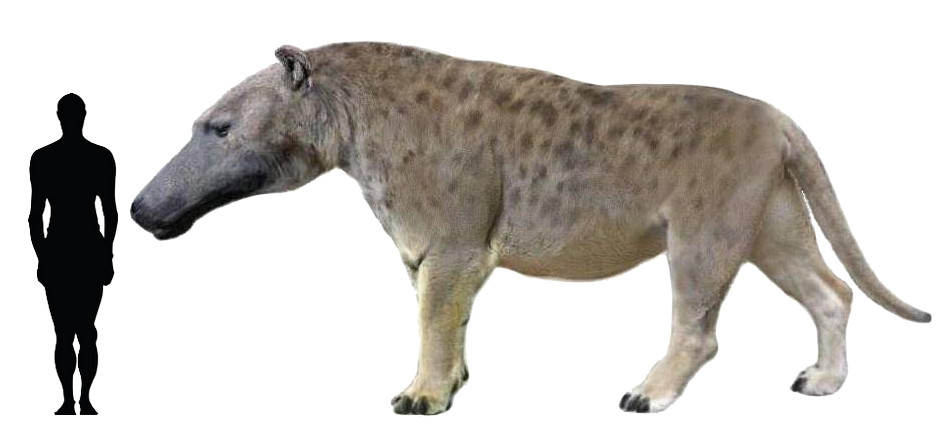
znModeratorhttp://io9.gizmodo.com/top-10-prehistoric-mammals-that-were-way-cooler-than-di-1703978216
4. Andrewsarchus mongoliensis…eleven-foot-long, 3700 pound wolf-like creature.
 August 12, 2016 at 9:10 am in reply to: Rams announce they are going with home whites all season #50673znModerator
Yes but NEVER a Super Bowl!
They won a pre-superbowl championship in 1945.
Then again in 1951. Championship. Before the superbowl.
And then they lost one in 1979 (though it was a great game).
Then they won one in 99.
Then they lost one in 2001.
See, to me? Same team, same history. A championship in 3 different cities (Cleveland, LA, St. Louis).
There’s different perspectives. One way to approach that is to announce your perspective several times a day in case no one gets it yet. Another way to approach that is to assume there’s different groups with different perspectives and we all belong to the same community here.
August 12, 2016 at 8:27 am in reply to: Rams announce they are going with home whites all season #50667znModeratorhttp://www.ocregister.com/articles/goff-725488-fisher-game.html
ALL WHITE NOW
The Rams will wear all-white uniforms in their two preseason games at the Coliseum and in five of their seven regular-season games at the Coliseum, the team announced Thursday.
In the other two games – dates yet to be announced – the Rams will wear the blue and gold uniforms they sported before their 1995 move to St. Louis.
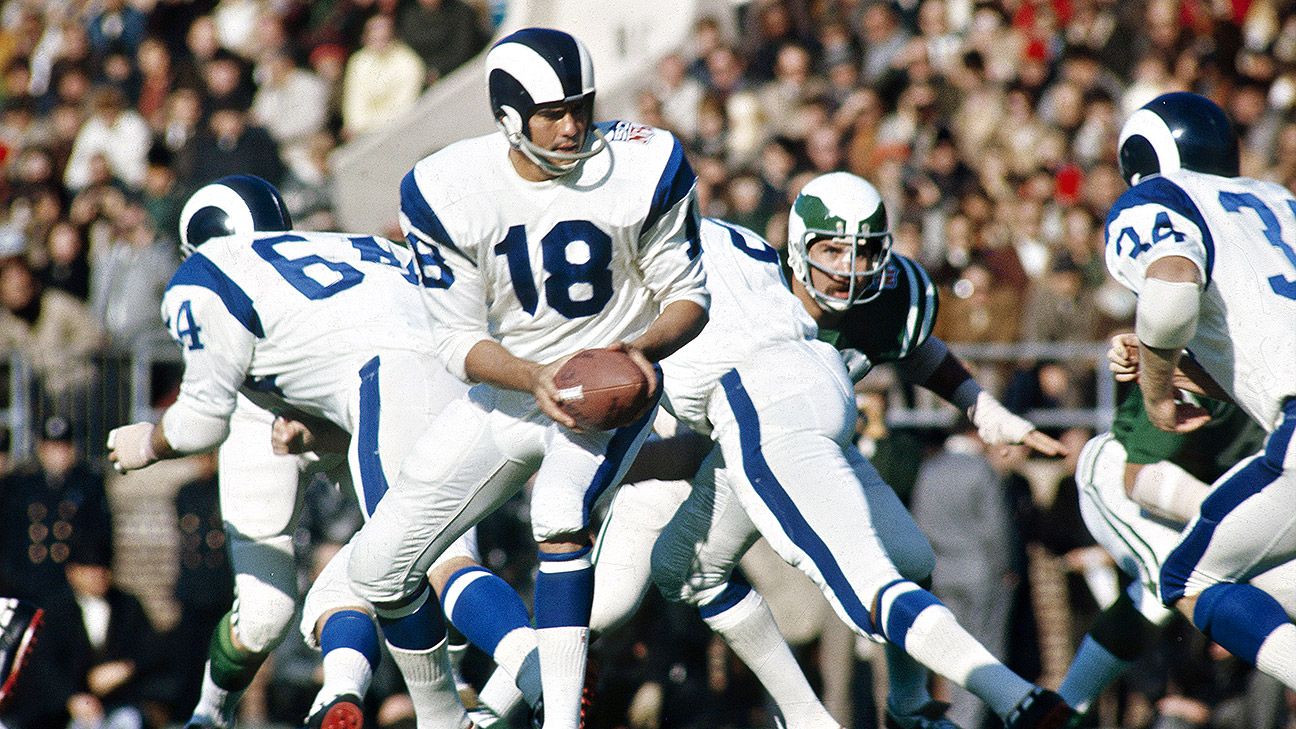
Many fans have clamored for a return to those familiar jerseys, but NFL rules prohibited the Rams from switching back to them full-time this season. Fans won’t see the darker St. Louis jerseys, as the team will go with the all-white theme, similar to what the team used at the Coliseum in the 1960s and 1970s.
znModeratorRams QB Jared Goff will start exhibition on bench
RICH HAMMOND
http://www.ocregister.com/articles/goff-725488-fisher-game.html
IRVINE – Jared Goff gazed toward the east – the direction from which the sun “rises” – and pondered the question. When was the last time he didn’t start a game?
“In football?” Goff finally said, and that essentially answered the question.
It’s been a while, but this is a time for Goff and his Rams teammates to adjust to new turf. They’ll play their preseason opener against Dallas on Saturday evening, before a crowd that could number 90,000. It’s the latest “Welcome to L.A.” moment for the Rams, who have had a couple this week.
Goff won’t start at quarterback against the Cowboys – Case Keenum will – but is expected to play a significant portion of the game. No matter how much it is, it will be closely scrutinized.
That’s life for Goff these days. His appearance on this week’s premier of the HBO documentary series “Hard Knocks” inspired ribbing after Goff was captured not knowing the sun rose in the east.
“I thought it was funny,” Goff said. “I caught a lot of grief from my friends, but it was fine. I didn’t mind.”
Coach Jeff Fisher didn’t indicate exactly when Goff would enter the game, but said his plan typically calls for starters to play two or three series. Presumably, then, Goff would be playing with the second-string offense, which he did Thursday and has done for most of this training camp.
Fisher said some players wouldn’t get into the game – not surprising, given that there are more than 80 healthy players on the roster – and that he wouldn’t get too deep into game-planning against Dallas.
“We’re keeping things pretty basic, as I would expect the Cowboys to as well,” Fisher said. “Most teams keep things pretty basic in their first preseason game. Our players are excited about lining up against someone else. Our interior (offensive) linemen have just about had enough of Aaron Donald.”
The Rams won’t practice Friday, but Fisher will put the team through a simulated pregame session, with warmups and the national anthem, and then the team will bus to downtown Los Angeles and stay in a hotel.
The routine will be different for Goff, who said he couldn’t remember the last time he didn’t start a football game (Goff also was a star baseball player). Goff was a three-year starter at Cal.
Goff said he wouldn’t change his routine because of his backup status and said that while he is excited to play in his first (unofficial) NFL game, he would attempt to keep his emotions in check.
“I can’t make it more than it is,” Goff said. “I can’t blow it up in my head. I just have to treat it like any other game. I’ve always been pretty good at doing that, throughout my whole life.”
August 12, 2016 at 8:10 am in reply to: Rams announce they are going with home whites all season #50661znModeratorSt. Louis football Cardinals used to do that and they never won squat too.

Actually they’re emulating the old whites and blues, back when they won a lot.
 znModerator
Rams Head Coach Jeff Fisher – August 11, 2016
(Opening Remarks)
“A lot has happened here the last couple of days. As you know, this kind of concludes the week as we’re preparing for the Cowboys Saturday. We’ll have a session tomorrow, but we’ll tone things down and kind of go through all those little detailed things that you have to go through, including the anthem and pregame warm ups and stuff. It’ll be fun for the players, starting tonight and tomorrow. We’re going to be talking to them over the next day or so about playing time, most of them have a pretty good idea, know what to expect as far as Saturday is concerned. There may be a couple guys that don’t get on the field – we may wait until next week – we want to inform them first before I can tell you. Typically speaking, what we’ve done in the first preseason game is you play your starters two-to-three series and then you start making your changes. The challenge is in special teams, where you’ve got guys up and down and moving around and the real burden falls on the younger players that are starting offense and also playing four core special teams – those guys are going to get a lot of exercise. But that’s typically how the first preseason game is. We’re looking forward to it; our guys had a great experience at the Coliseum (on Family Day on Saturday) and they’re looking forward to going back under real-life situations and circumstances. Beyond that, we’re ready to go, let’s see how we are.”
(On if he has accomplished everything he wanted to in the week leading up to the first preseason game)
“We’re keeping things pretty basic, as I would expect the Cowboys to do as well. Most people keep things pretty basic in the first preseason game. We just want to see them block and tackle and run and do those things. The players are excited about lining up against somebody else. Our interior center and two guards have just about had enough of (DT) Aaron Donald. They’re looking forward to lining up against someone else.”
(On if the preseason games take on a little more meaning in his evaluation on tackling with how the practices are structured now with a limit on how often teams are allowed to be in pads)
“I think defensively, yes tackling. But we tackled today. You don’t have to tackle with pads on and go to the ground – we had tackling drills today, so we’ll see how these drills carry over. But there’s an emphasis placed on it. When you got through preseason games, you don’t want to go out and win 48-0 and have no penalties, you have to learn from things. It’s a great learning experience for the team. Once we grade the tape, we come back, address the penalties and address the mistakes that you have to correct.”
(On how much time he spends preparing for what he may see from Dallas in the preseason game)
“We’ll familiarize them tomorrow in a walk-thru session environment. Their fronts are a little different for our guys on offense and some of the formations, or run concepts, are a little different. We want the young guys to have some familiarity. They’ll get a chance to look at some tape from last year.”
(On his impression of the first episode of Hard Knocks)
“I thought it was great. I was especially impressed with the talent – the video and the shots and everything – it’s a very, very talented crew. There are some extraordinary shots in there. The content was good – obviously, it didn’t come as a surprise to me, I had a pretty good idea of where they were going, for obvious reasons. I got one of these yesterday: ‘Jeffrey,’ (laughs) this is from mom, so I said ‘sorry, mom, this is our world. I’ll try to do better.’ So she watched. When I hear ‘Jeffrey,’ it’s like ‘uh-oh, something went wrong.’”
(On what his message was on Hard Knocks when he said he wasn’t going 7-9 or 10-6)
“Part of the whole process is inviting them in to the meeting rooms. There are spontaneous things that come up that, as coaches, you have to go and address them. So, I addressed something that took place in the morning and I wanted to get the point across. People can read into whatever they want, but that was me talking to the team as if the cameras weren’t there. They were there and I was okay with what was said. I stopped at that point, I could have gone on – you don’t know that I didn’t go on because there’s an edit guy there. There’s a lot of stuff that took place that was edited. To answer your question, I thought the guys did a great job and I thought it was an outstanding show.”
(On if he went on after the cameras cut off)
“I may have. You never know.”
(On what he wants fans to learn about the Hard Knocks series and what the team goes through every day)
“They’re portraying our life at camp as it is. The players, on occasion, are going to have a little fun – which they should and they normally do. None of it, from my perspective, is done for cameras; it’s done just because that’s the way they are. Aaron Donald would have taken his shirt off and played ping-pong had (the cameras) been in there or had they not been in there. You get an opportunity to kind of see how life in an NFL training camp is. I think, as we move forward, things are going to get more specific. There’s going to be some stories – is a guy going to make the 75-(man roster)? Is he going to make the 53-(man roster)? That will probably be the direction that we’re heading. I thought from an introduction standpoint, I thought it was outstanding.”
(On if he will be looking at any specific position battles over the next few games that he feels are particularly close)
“Not only are there battles for the competition for the backup spot – we have to move some people around on the offensive line. As you’ve seen, (G) Roger’s (Saffold) playing right tackle, we’re waiting on (T) Rob (Havenstein) to come back. Defensively, the corner spot is competitive. They’re all playing well right now. Someone’s going to have to go inside on the slot and somebody is going to have to line up outside and start for us. I think that would be one position that you keep an eye on. I’m not going to say when I’ll make the decision – particularly because everybody’s going to get a chance to play.”
(On what he expects from the crowd on Saturday)
“Only what I’ve been told, which is there’s going to be a lot of people there and there are going to be a lot of Cowboy fans there as well. And that’s the NFL; I’ve been told the number is going to be quite high. I think it’s great, it’s a great experience. It’s going to be a great experience for the fans to come out there and see us for the first time and hopefully we make some plays that they can be impressed about.”
(On if he sees a different intensity from younger guys before preseason games)
“The players understand that there’s an intensity level on the practice field and it ratchets up a notch before preseason games – especially on special teams, because everybody that’s covering a kick or returning a kick is trying to make the football team. It’s a different deal. Our suggestion to them is that we go out and set the tempo, let’s set the standard for play – start in the preseason and gain on throughout the season.”
(On what he most wants to see translate from the practice fields to the game)
“We’re looking for execution and obviously keep the penalties down. Granted, this is (the referees’) first game back, too. The crew is getting back and there’s some points of emphasis and things like that, so you have to work through that. I just want to see them execute, you’d like to see execution throughout the game. Your starters, in a perfect world, your defense goes out and goes three-and-out, they come off the field and the offense goes down and gets points. It doesn’t always happen, but you have to keep in mind and be objective about the fact that we’re not doing an awful lot. We’re not game-planning the Cowboys, we do very little game-planning in the offseason. There are a lot of things, but intention, we hold back and that you don’t show. And clearly there are things that we haven’t shown here for obvious reasons that once we get into the closed practices, we’ll do some things.”
(On what he wants the fans to take away from the game on Saturday)
“I want them to go home having lost their voices. You have to get ready for that, that’s what’s important. We want to hear them; we need that ‘12th man.’ If they go home and they’ve lost their voices, they did their job.”
—
Rams QB Jared Goff – August 11, 2016
(On his thoughts regarding the offense and how it has progressed since the start of training camp)
“It’s been great. It’s been really good to see. I think early on the defense was playing really well. We’re trying to settle in. Up to this point, we’ve had a lot of days where the offense is thriving and doing well, it’s a credit to everyone’s hard work, and just continuing to grind and trying get through training camp.
(On what specifically he’s seen in terms of the overall improvement of the offense)
“I think everything has been going well. I think the offense is just been improving on all aspects, as far as communication, execution, and the speed, it’s just all been really good and on the rise.
(On whether he’s ready for Saturday’s preseason game against the Cowboys)
“Yeah, I think so. I feel good, I feel ready. Obviously, my first NFL game. I’m going to try and go out there and treat it like every other game I’ve ever played in my life, and have fun, execute, enjoy my time, and do the best I can.”
(On whether he gives himself time to relish the fact that this is his first NFL game)
“Maybe a little bit at first when I run out of the tunnel, but after that, it’s just football. It’s the same game I’ve played my whole life. I’ve played hundreds of games up to this point, this will just be another one.”
(On his thought regarding the first episode of Hard Knocks Training Camp)
“It was funny, I thought it was funny. I caught a lot of grief from my friends and stuff. But it was funny, I didn’t mind it.”
(On if he’s heard from Taylor Swift yet)
“No, I haven’t.”
(On when is the last time he didn’t start a game)
“In football, I don’t know. I’ve had various times where I’ve watched, of course. It’ll be fine. It will be like any other game. Go in there, execute, and do my best.”
(On if he’s changed the way he’s prepared this week in anticipation of Saturday’s preseason game)
“No, not at all.”
(On whether he will ask for more series and reps during Saturday’s game, depending on the flow of the game)
“I’m going to do whatever they tell me. I’ll go in whenever they tell me to go in, and come out whenever they tell me to come out. I don’t think that’s up to me.”
(On if there’s any way to prepare for the speed of an NFL game)
“I don’t know if there’s any way to prepare other than practice. Our tempo in practice is pretty good. Our defense is really fast, and flies around. So, I think that’s been a really good bar, as far as when I go into the game to base myself off of. I’m going to treat it like every other game, like I said, go in there and have fun.”
(On his thoughts regarding his timing on the field with the wide receivers)
“Great, great, great, always improving, but I feel really good right now. Feel like I’ve come a long way so far.”
(On his thoughts of Hard Knocks Training Camp on terms of how he was portrayed, the outcome, and if it’s what he expected it to be)
“I don’t really care what they do. I know it’s a TV show, and their trying to make a story line, and whatever that may be, it really doesn’t bother me. I think it’s funny, I think it’s cool. Something I can probably watch for years to come.”
(On whether or not there’s a different kind of anticipation or butterflies for Saturday’s preseason matchup)
“Yeah, yeah, there’s a little bit. But at the same time, I know once I step on the field, again, it’s just the same thing. I can’t make it more than it is. I can’t blow it up in my head. I’ve just got to treat it like any other game. I’ve always been pretty good doing that my whole life. So, I don’t feel like I have any issue with the magnitude of it.”
(On whether or not the coaches outlined with him regarding playing time and when he will see the field this Saturday)
“No, not sure. No”
(On if he’s seen anything in camp that makes him question whether he can handle being in the position he’s in)
“Sure yeah, there’s tons of things. I think the fact that the coaches won’t be there to like, kind of coach you up right after. You just kind of have to move on from the play, good or bad, and move on to the next play, and execute the next play that will be a little bit different. But other than that, it’s going to be a regular game. I’ll do my best, and have as much fun as I can.”
(On if he’s ready to handle the criticism that will come his way if things don’t go well)
“I don’t. I prepare myself not to handle any of that stuff. Whatever you guys say, take it with a grain of salt. It does not mean much to me. I don’t read anything, I don’t look at anything. I just try to do my best everyday out here, and get better, and continue to do the best I can.”
(On if he’s prepared to be the quarterback and have stuff said about him)
“Absolutely, they’ll probably say stuff about me, good or bad, for the rest of my career. Ain’t nothing I can do about it. So, you just continue to move on. Hopefully it’s more good than bad. But either way, it doesn’t really matter.
znModeratorTyler Higbee creates believers he can be exceptional
RYAN KARTJE
http://www.ocregister.com/articles/tight-725479-higbee-rams.html
IRVINE – Take one look at Tyler Higbee as he settles into the slot, his hulking, 6-foot-6, 250-pound frame towering over 5-foot-8 nickel corner LaMarcus Joyner, and you’ll have at least some notion as to why a fourth-round rookie tight end from Western Kentucky has already become the most buzzed-about non-quarterback at Rams training camp, with a path already paved to a potential breakout rookie campaign.
Because with Higbee, it all starts with that first, infallible observation: He is gargantuan – to a point even his on-paper measurables don’t seem to grasp. Catcher’s-mitt-sized hands yank passes authoritatively out of midair. Tatted arms extend out from supernaturally broad shoulders, as if he were designed to create mismatches by scientists in a lab. “Little Baby Gronk,” Todd Gurley recently dubbed him.
Even Rams coach Jeff Fisher admitted to gawking when he first saw Higbee walk off the bus at OTAs. And as you watch him leap over unsuspecting safeties in the red zone or collide headlong into linebackers at the second level, it’s hard not be swept away in that hyperbole, envisioning a Gronkian nightmare dominating the seam for the foreseeable future.
“Tyler has the potential to play very, very early for us and be a big-time part of our offense,” Fisher said at practice last week.
But before riding this tide of hopeful preseason promise any further, let’s tether our expectations to what we know about rookie tight ends. Turns out, given recent history, those expectations are likely too high.
Over the last 20 seasons, 116 tight ends have tallied at least 100 receiving yards in their debut year, according to Pro Football Reference. But just one managed to surpass 700 yards – Jeremy Shockey, who reeled in 74 catches and 894 yards for the Giants in 2002. Only two others – Cam Cleeland of the Saints, and John Carlson of the Seahawks – even cracked the 600-yard mark.
In the red zone, rookie tight ends have been slightly more successful, but not by much. Of the 89 who scored as rookies, 11 finished the season with at least five touchdowns – a total that would have tied for the Rams’ team lead last season. But only two, Patriots All-Pro Rob Gronkowski and former Lions tight end Joe Fauria (a UCLA product who did it on 13 catches), have scored more than six.
The success rate is even lower for tight ends drafted as late as Higbee. Former Patriots tight end Aaron Hernandez and undrafted free agents Tim Wright (Buccaneers) and Will Tye (Giants) are the only players in NFL history selected in the fourth round or later that caught 40 or more passes as rookies. Last season, 23 tight ends had that many receptions.
“It’s such a hard position to learn,” explains Lance Kendricks, the tight end ahead of Higbee on the depth chart. “You have to know the run game, the pass game, and you have to know about protections, and then, on top of that, you have to get stronger to block bigger guys, while staying fast enough to run routes. There’s a lot going on.”
A former two-star receiver recruit, Higbee was converted to tight end after his redshirt freshman season at Western Kentucky. In all, he played just 20 games at the position, as he battled injuries during his three seasons. But over those 20 games, Higbee evolved into a force, catching 66 passes for 962 yards and 13 touchdowns – good for a jaw-dropping 20 percent touchdown rate – before a knee injury derailed what was shaping up to be a standout final season.
“For us, he was the guy that, in between the hashes, he owned,” Western Kentucky coach Jeff Brohm said. “He had no fear.”
That’s certainly been evident through two weeks of Rams camp, as he’s quickly made his presence felt with both the first- and second-team offense. But for Rams coaches, the biggest concern with Higbee – and any rookie tight end, for that matter – remains the same.
“The hardest adjustment, from their standpoint, is blocking,” Fisher said. “Most of them are going to line up against the defensive end. And I’m not talking about pass protection, I’m talking about run game – and that’s not an easy thing to do. You don’t just come to the National Football League and dominate the line of scrimmage, so it takes time.”
Watch Higbee closely, as offensive coordinator Rob Boras purposefully positions him across from behemoth starting defensive end William Hayes, and you can understand what Fisher is getting at. Higbee is a willing and enthusiastic blocker, but by no means is he polished in his protection. That’s why the Rams have put him in uncomfortable situations early on, even asking him, at times, to shift to the backfield and block as a fullback.
Ask Higbee himself, and he’ll shrug off these concerns. Though, even he acknowledged last week, just as his camp stock began its sharp rise, that “some of the things, technique-wise, are a little new to me.”
From Brohm’s point of view, Higbee’s blocking is a secondary issue – “He’s definitely adequate,” he says. The more pressing concern, Brohm says, is Higbee’s health.
“He goes extremely hard, and for a couple years, he probably didn’t take care of his body the way he should have,” Brohm said. “If he does that, he’s going to have a great career.”
As for his rookie season? History tells us that Higbee will almost certainly struggle, especially early – though, few tight ends in the past 20 years stepped into a situation with such a dearth of offensive playmakers. If he stays healthy, the Rams seem determined to let him operate as the second tight end in their base two-tight end set. When it comes to developing a rapport with his quarterback, Higbee also happens to have an advantage: He and No. 1 pick Jared Goff are already roommates.
And then, of course, there’s that tantalizingly monstrous frame, bursting into the seam past backpedaling linebackers and hypnotizing the doubters into wondering if maybe, just maybe, he be the exception to an unforgiving rule about rookie tight ends – one that even tripped up future Hall of Famers like Tony Gonzalez and Antonio Gates.
Along the sidelines of Rams training camp, you’ll find plenty of believers.
“Once he polishes himself up,” Kendricks said, “he’s going to be a very good tight end. He’s really what we’ve been looking for.”
CATCHING ON SLOWLY
Here are the rookie receiving stats for selected NFL tight ends:
 znModerator
Rams’ Goff believes he’s prepared for first NFL action
The Associated Press
http://www.dailyrepublic.com/sports/rams-goff-believes-hes-prepared-for-first-nfl-action/
IRVINE — No matter when Jared Goff relieves starting quarterback Case Keenum or how much the rookie plays, he will be the focal point of the Los Angeles Rams’ preseason opener Saturday.
The No. 1 overall pick in the 2016 draft got a preview of what kind of attention he can expect going forward from the season premiere of “Hard Knocks,” the HBO documentary series that follows life in an NFL training camp. Goff was shown taking a ride on the Goodyear Blimp, buying electric fans so offensive players could stay cool in their dorm rooms at UC Irvine, adjusting to a pro-style scheme, and not remembering where exactly the sun rises.
Goff said Thursday he hasn’t heard back from Taylor Swift after his interest in the pop star became television fodder, but is hearing about his sunrise gaffe.
“Got a lot of grief from my friends and stuff, but I thought it was funny,” Goff said. “I know it is a TV show and they are trying to make a story line whatever that may be. That doesn’t bother me. I think it’s funny and I think it’s cool, something I can probably watch for years to come.”
Everything Goff has done during training camp has drawn plenty of interest.
Goff’s media availability attracted more than a dozen reporters Thursday, while Keenum spoke to less than half that number on Monday. While he has been taking snaps with the first team offense in closed walk-throughs, Goff’s first public work with the starters in a two-minute drill on Tuesday resulted in a barrage of questions for coach Jeff Fisher and offensive coordinator Rob Boras.
That interest will only intensify, but Goff said he isn’t paying heed to the overwhelming attention from fans and media.
“Whatever you guys say, take it with a grain of salt. It doesn’t mean much to me,” Goff said. “I don’t read anything. I don’t look at anything. I just try to do my best every day out here and get better and do the best I can.”
Goff said he believes the tempo of practice and quality of the Rams’ defense has him prepared for his first NFL action. He expects to treat it like every other game he has played in, though there will be one notable difference as he will be coming off the bench. Goff, a three-year starter at California, didn’t remember the last time he did not take the first snap in a game.
“In football, I don’t know,” Goff said.
Goff didn’t know how much he would play against the Dallas Cowboys either.
“I’ll go in whenever they tell me to go in and go out wherever they tell me to go out,” Goff said, “I don’t think that is up to me.”
NOTES: Fisher hasn’t divvied up playing time just yet, but indicated starters would likely play two or three series before exiting. A handful of players might not make their preseason debut until Week 2, he added. … Fisher is certain that no one is more excited to see the Cowboys than Rams center Tim Barnes, left guard Cody Wichmann and right guard Jamon Brown, not even the expected crowd of nearly 90,000. “Our interior have had just about enough of (All-Pro defensive tackle) Aaron Donald, so they are looking forward to lining up against someone else,” Fisher said.
August 12, 2016 at 12:09 am in reply to: Adam Gase (Groh's mentor): The NFL is a dink-and-dunk league #50649znModeratorThe game is getting boring.
You know actually the Fisher Rams have always been in the top third of the league in throwing long passes…meaning, percentage of attempts that go 31 yards or more.
True but only completing the passes is exciting.
Which they do at a good rate. I did those numbers too.
August 11, 2016 at 11:24 pm in reply to: Adam Gase (Groh's mentor): The NFL is a dink-and-dunk league #50646znModeratorThe game is getting boring.
You know actually the Fisher Rams have always been in the top third of the league in throwing long passes…meaning, percentage of attempts that go 31 yards or more.
znModeratorbarely a rams contingent at orlando’s hof induction? that’s kind of sad.
I know. I thought that was embarrassing.
znModeratorPractice Report 8/11: Ready for the Cowboys
Myles Simmons
The second week of training camp is complete, and now the Rams are ready to take on the Cowboys for the first preseason matchup.
“We’re looking forward to it,” head coach Jeff Fisher said. “Guys really had a great experience at the Coliseum and they’re looking forward to going back under real-life situational circumstances.
“The players are excited about lining up against somebody else,” Fisher added. “Our interior center and two guards have just about had enough of Aaron Donald, so they’re looking forward to lining up against someone else.”
While football will be back in a sense, there are a few significant differences between the exhibition matchups and the regular season. The first is the level of game planning that goes on — which, especially for the first contest, is very little. The Rams did practice a few plays against the Cowboys’ schemes during Thursday’s session and will do a bit more on Friday. But it certainly doesn’t come close to the level of preparation during the regular season.
“We’re keeping things pretty basic, as I would expect the Cowboys to as well,” Fisher said. “Most people keep things basic in the first preseason game.”
“We’ll have a session tomorrow, but we’ll tone things down and kind of go through all those little detail things that you have to go through, including the anthem and pregame warmups,” the head coach added.
The larger point of the first couple of preseason games is to see how much players have learned in camp against live competition.
“We’re looking for execution. Obviously, keep the penalties down,” Fisher said. “In a perfect world, you defense goes out, they go three-and-out, they come off the field, you go down and get points. That doesn’t always happen. But you have to keep in mind and be objective about the fact that we’re not doing an awful lot.”
While the head coach said he had not yet discussed with the players the specifics of Saturday’s playing time, there are some general conventions that come with early exhibition matchups.
“Typically speaking, what we’ve done in the first preseason game is you play your starters in that two-to-three series [range], and then you start making your changes,” Fisher said. “Most of them know what to expect as far as Saturday’s concerned. Maybe a couple guys don’t get on the field. We may wait until next week.”
“The challenge is in special teams where you’ve got guys up and down and moving around, and the real burden falls on the younger players who are starting offense and are also playing on the four core special teams,” Fisher added. “So guys are going to get a lot of exercise. But that’s typically how the first preseason game is.”
Of course, No. 1 overall pick Jared Goff will be among those players subbing in early. He said Thursday he’s feeling ready for his first live professional action.
“I feel good,” Goff said. “Obviously it will be my first NFL game, and I’m going to try to go out there and treat it like every other game I’ve ever played in my life. Have fun, execute, and do the best I can.”
The rookie has played in the L.A. Coliseum before, but as a visitor while in college at Cal. Goff admitted he might take in the moment for a minute or two, but then he’ll get right back into the mental space where he feels he needs to be.
“Maybe a little bit at first when I run out of the tunnel,” he said. “But after that it’s just football — the same game I’ve played my whole life. I’ve played hundreds of games up to this point, and this will just be another one.”
Aside from Goff, there are a few position battles that should be worth monitoring not just for this first game, but also throughout the preseason. Fisher pointed out the offensive line, with Rodger Saffold currently playing at right tackle for Rob Havenstein, as a group where positions aren’t quite set in stone. Plus, there’s the ongoing battles in the secondary, particularly at cornerback with Coty Sensabaugh, Lamarcus Joyner, and Marcus Roberson all currently in the mix.
“We’re going to move some people around a little bit on the offensive line,” Fisher said. “Defensively, the corner spot is competitive. They’re all playing well right now. Someone’s going to have to go inside on the slot, someone’s going to line up outside and start for us. So I would think that would be one position you keep an eye on.”
But, again, it’s important to remember Saturday represents the first time players have faced live competition in at least seven months. Because of that, mistakes will be made. And that’s OK.
“You don’t want to go out and win 48-0 and have no penalties — you have to learn from things,” Fisher said. “It’s a great learning experience from the team once we grade the tape and come back, and address the penalties and address the mistakes, because you have to correct them.”
REACTIONS TO HARD KNOCKS
One of the most talked about scenes from this week’s debut episode of Hard Knocks was Jared Goff vs. where the sun happens to rise and set. The quarterback took a few questions about that from the media today, and handled everything in stride with a laugh.
“It was funny,” Goff said. “Caught a lot of grief from my friends and stuff, but it was funny. I didn’t mind it.”
But apparently there was someone who wasn’t quite happy with some of the language used during the uncensored show.
“I got one of these yesterday: ‘Jeffrey!’ This is from mom,” Fisher said with a laugh. “I said, ‘Sorry, mom. That’s our world. I’ll try to do better.”
“When I hear, ‘Jeffrey,’ it’s like, uh-oh — something went wrong,” Fisher continued.
But overall, reviews have been positive for the show and the experience of being on it.
“I thought it was great,” Fisher said. “It’s a very, very talented crew. And I thought they [had] some extraordinary shots in there. And the content was good.”
The next episode of Hard Knocks will air Tuesday at 10 p.m. on HBO.
VISIT FROM THE CREW
While the first preseason game won’t be televised on a Monday, ESPN’s Monday Night Football crew is working the game. That means new play-by-play man Sean McDonough, sideline reporter Lisa Salters, and color commentator Jon Gruden were at practice on Thursday to observe and get a feel for what the team might look like for Saturday’s game.
After practice, our Dani Klupenger sat down with Gruden to get his take on Los Angeles’ quarterbacks and what he’s looking forward to seeing from the team against Dallas.
“When I watch the Rams, I look at the defense first because that’s where the Pro Bowlers are,” Gruden told Klupenger. “I’m interested in [Alec] Ogletree at middle linebacker, who the free safety is going to be — I see [Maurice] Alexander. And the communication was very good, the energy level’s great. I’m excited about Ogletree in the middle, personally.
“And then I want to see Goff,” Gruden continued. “I want to see the young offensive players — all of them. Gurley, Goff, I want to see the young offensive linemen. Which receiver is going to step up and be the third, guy, the fourth guy, the fifth guy. So there’s a lot of competition, a lot of unknown. That’s why this preseason is critical.”
Gruden and Klupenger talked about plenty more, which you can check out in the full one-on-one video right here on the site.
znModeratorWealth is different from income. Wealth may not even appear as money in the bank. It includes what your house is worth for one thing.
It’s not what YOU can do, it;s what you had before you started.
So for example, if a child grows up in a bought and paid for house in a neighborhood that has good schools, that’s something substantial that the previous generation did for the individual child. It’s incalculable. And it;s not something that the individual child DID, he or she just simply benefits from that. And then the government handback on taxes for homeowners helped guarantee things like ordinary decent medical and dental care while growing up.
So the article is not about what WE do as individuals to build OUR worth. It’s about what WE got as a headstart before we even started doing that.
And of course behind the parents owning the house is a long series of policy decisions that made the house affordable to them. Before the 1940s, people typically had to come up with a 50% down payment, and before 1930 the mortgage would be 3 to 5 years to pay off.
The 30 year mortgage with an affordable down payment was a deliberate, direct, orchestrated shift in policies at the government level. (This all has to do with the history of the FHA.)
It’s not simply that our parents bought us cars and paid the college tuition. (I am talking in generalities here…I don’t know your history. My own parents did not pay college tuition. I don’t know anyone’s personal history. It’s just the sociological types I am talking about here.) Those who had all that were already ahead of kids who did not grow up in an owned house in a neighborhood where the schools were at least recognizably decent. None of those kids did that on their own. They grew up WITH that.
So even the kid who goes to a public university without a scholarship and pays his way through by working is starting off with enormous advantages just if their parents owned a house in a decent safe neighborhood with a decent school and who could afford to pay for basic medical and dental expenses while they were growing up. (Add to that the fact that until recently public universities were affordable in the first place because they were mostly tax funded…tuition is not the major financial force keeping those institutions going.)
This goes on and on and on. What did WE get to help us before we even started to make our own income as individuals.
That;s what the Conley article is about.
znModeratorWhat that research points out is that poor in terms of income isn’t really the issue…it’s net worth or assets.
And THAT has a history, because it turns out you don’t just get that on your own. You need laws helping you:
The American government provided low-interest loans to returning veterans and other white Americans after World War II. This created a boom in home ownership and helped suburbanize America, but blacks were excluded from participating….When the government instituted rental housing in inner cities, in the form of public housing projects, for poor minorities, and then developed home ownership in low-cost, suburban communities for low-income whites, where you could put almost nothing down, they created this incredible wealth gap.
znModeratorAn interesting thing.
According to good sociology, one of the prime indicators of a child’s potential success in school and employment is the parents’s total assets. Homeownership is part of this, and many other things too. That is, the stability and resources that come from parents having those kinds of accumulated assets make a huge difference. (And it’s not necessarily money…you can, as many know, be house-poor and living on ramen but still own the house.)
In fact…
If you compare kids from the SAME general categories when it comes to this kind of asset wealth, they do equally well (or badly), regardless of race.
Kids whose parents (or parent actually) have asset wealth all do equally well, regardless of race.
Kids whose parents lack this do equally poorly, regardless of race.
————-
————From Interview With Dalton Conley
PBS: http://www.pbs.org/race/000_About/002_04-background-03-03.htm
Dalton Conley is director of the Center for Advanced Social Science Research (CASSR) and an associate professor in the Department of Sociology at New York University. He is the author of Being Black, Living in the Red: Race, Wealth, and Social Policy in America.
What does the wealth gap have to do with race?
The one statistic that best captures the state of racial inequality in America today is wealth, or net worth. If you want to know your net worth, just add up everything you own, subtract all your debts and that’s your net worth.
Today, the average Black family has only one-eighth the net worth or assets of the average white family. That difference has seemingly grown since the 1960s, since the Civil Rights triumphs, and is not explained by other factors like education, earnings rates or savings rates. It is really the legacy of racial inequality from generations past. No other measure captures the legacy – the cumulative disadvantage of race for minorities or cumulative advantage of race for whites – than net worth or wealth.
The wealth gaps between blacks and whites aren’t explained by income. In fact, if you compare people at the bottom of the income distribution – say, a family that makes around $15,000 a year, you’ll find that the average black family that earns $15,000 year in income has $0 net worth, or is in debt actually. Compare that with the average white family that earns $15,000 a year, and they have a good $10,000 to $15,000 in equity. That means being poor, being at the bottom of the income distribution, really means two different things depending on whether you are black or white.
That white family has a little bit of a cushion. If unemployment strikes, as it does so often to people at the bottom of the economic distribution, they’ve got some means to ride out the storm. They might have a car that will increase the radius of their job search. They might have this money that they can spend in case of a medical emergency, even if they don’t have health insurance. But compare that to the situation for a poor black family with $0 or negative net worth. There is no cushion. There is nothing in between the paycheck and homelessness, so to speak.
The same kind of disparity emerges at the upper end of the income distribution. If you compare, say, a white family that earns $50,000 with an African American family that earns $50,000, you’ll find that the white family has about double the net worth – about $80,000 to $100,000 of net worth compared to about $40,000 to $50,000 of net worth for the African American family at that income level. So when you are talking about the difference between financing their kid’s college education, starting a new business, moving if they need to move for a better job opportunity – having $100,000 versus $50,000 in net worth might make the difference between upward mobility and stagnation.
How does wealth affect life outcomes?
The single largest item in most people’s nest egg is the family home. That has enormous consequences for the next generation. It means, for example, that if you own your home and have significant equity, you’re in a high-property tax district, and you’re going to a good, well-funded public school.
It means that when it’s time to go to college, if you don’t have money in the bank, you can always take a second mortgage and draw off the equity in your home to finance your kids’ college education. It means that you’re in a neighborhood, most likely in the suburbs, where jobs are on the increase, and not in the inner city where jobs are on the decrease.
It means that you’re in a neighborhood where your neighbors control information and access to jobs. So you’re getting the cultural aspects by virtue of living in a high property value area and you can get your kids better job connections. It means that if you want to finance your kids’ job search after school, you’ll have equity to support them for a while.
These are just a few of the ways that having wealth, or owning a home, has enormous consequences for the next generation, not to mention one’s own old age.
How does home ownership help you accumulate wealth?
There is this tendency for white Americans to see the structure of their aid in the form of tax credits and not as aid, or government assistance, or welfare. But they see other forms of assistance, like reduced rents or welfare benefits, as a direct handout from Big Brother.
Owning your home, first of all, gets you a big mortgage deduction. That means you pay less income tax than you would be paying if you were renting and making similar monthly payments. Second, it probably places you in a community that has higher property values than one where you were just renting. Owner-occupied communities tend to be valued more, and that means that the property tax base is higher. That means that local services, everything from garbage services on up to the public school system, most importantly, are going to be better off in that community. So, without even having to spend your equity in your home, you are getting benefits from it.
Third, there is the ability to borrow off that equity. You can finance starting up a business by taking a second mortgage. You can pay for your kids to go to college through a second mortgage. You can finance your retirement by selling your home. Since homes have increased so much in value over the course of the latter half of the 20th century, people can finance their retirements through the sale of their home and the capital gains they get from it. The home has been a central part of savings for most American families in the latter half of the 20th century. White Americans that is.
What role did the government play in shaping housing and wealth?
The American government provided low-interest loans to returning veterans and other white Americans after World War II. This created a boom in home ownership and helped suburbanize America, but blacks were excluded from participating. At this same time, the government was building high-rise public housing for minorities in inner cities. The segregation in America between a largely dark inner city and a largely white suburban community is not something that just magically happened from market forces. It is part and parcel government policy.
When the government instituted rental housing in inner cities, in the form of public housing projects, for poor minorities, and then developed home ownership in low-cost, suburban communities for low-income whites, where you could put almost nothing down, they created this incredible wealth gap.
What does housing have to do with wealth?
Where one’s family lives in America is not just a matter of taste and preference. It has important consequences for the perpetuation of advantage or disadvantage across generations for a lot of reasons. First, you have the issue of housing and wealth. The majority of Americans hold most of their wealth in the form of home equity. So, that is their nest egg. It is their savings bank. They are living in their savings bank.
To make matters worse, the way that we finance education in America public schools is based on local property taxes. This means even if you never cash in the value of your home, just living in a high property value district or a rental and low property value district is going to affect what kind of school your kids go to.
Increasingly, there are lawsuits in various states against this way of financing, where school funding is based on local property taxes. But still, it’s the dominant form. We pay for our schools locally based on property taxes. So, in high value neighborhoods, which are predominantly white, you are getting well-funded schools. And in low-value neighborhoods, which tend to be predominantly minority, you are getting inadequately funded schools.
The constraints that minorities face in the housing market doesn’t just affect quality of life issues, you know, and the selection of homes and styles that people can live in. It really has enormous consequences for economic stability and upward mobility and the life chances of the next generation.
Because minorities have faced limited housing options in the past, now they are usually confined to areas that have worse environment conditions, have poor school funding, have increased risk of violent crime, have worse tax bases. Plus their homes have less equity value, so even if they want to move, they are less able to afford to. Therefore the whole economic structure of the next generation can be really readily viewed in the limited housing selections of the previous generation.
Didn’t the civil rights era fix everything?
The Civil Rights movement of the 1960s really marks both an opportunity and a new danger in terms of racial relations in America. On the one hand, the Civil Rights era officially ended inequality of opportunity. It officially ended de jure legal inequality, so it was no longer legal for employers, for landlords, or for any public institution or accommodations to discriminate based on race. At the same time, those civil rights triumphs did nothing to address the underlying economic and social inequalities that had already been in place because of hundreds of years of inequality.
The danger lies in the fact that many white Americans see the civil rights changes as having solved or addressed the racial problem, because it addresses the rules of the game. And many minorities recognize that because the starting line is so different for whites and blacks, it is almost irrelevant that the rules of the game were altered to be more fair. You really have this danger, where there is a complacency about issues of inequality, because we have addressed the official forms of segregation and discrimination.
How did the wealth gap come about?
There’s a lot of reasons why there are enormous wealth gaps between minorities and whites in America. The most simple answer is, it takes money to make money. Part of the reason that there’s this enormous gap is because whites have long had higher wages and wealth to pass on from generation to generation. And it’s like a snowball – it gets bigger and bigger as it gets passed on, and the interest gets compounded. That’s partly the reason why the wealth gap has actually increased since the 1960s, since the civil rights times.
But that’s not the whole story. There’s a long history of exclusion of minorities from wealth accumulation in America, going back to right after the Civil War.
First of all, during slavery, slaves were forbidden legally in most cases from owning anything, including their own bodies. After the Civil War, Jim Crow laws instituted policies such as the Black Codes, which required black entrepreneurs to pay, for example, a $100 licensing fee but required whites to pay nothing. Back in 1870, $100 was basically like a million dollars today. It would shut people out of business. So blacks in the 19th century through that mechanism, and through pure terror, threats of lynching, were precluded from becoming business owners, as one example.
By the 20th century, you had the institution of redlining as a policy in which banks rated neighborhoods for loans based on a four-tier system, red being the lowest ranking that a neighborhood could get. And African American neighborhoods were invariably given this red circle around them, and no loans from private banks would go into that system. That was a policy that was initiated by the federal government and adopted by private lenders.
Fast forward to the New Deal, when Roosevelt really cut a devil’s deal with white southern senators. He didn’t overtly exclude blacks from Social Security, but subtly did it by excluding agricultural workers and domestic workers, who were predominantly minorities, from receiving Social Security benefits. This was done explicitly to appease southern Senators, to exclude African Americans, who were disproportionately employed in those two sectors. It wasn’t until the Truman Administration that that got corrected. But there’s a whole generation of elderly African Americans that didn’t receive Social Security benefits, when in fact, it was the biggest giveaway of all, because no one had paid into the system yet.
So you had whites receiving this sort of windfall, and blacks not getting it. More poor black elderly not receiving Social Security means that working families in the African American community have to support them and pay for it. So it’s not only an issue of that generation. It trickles down through issues of inheritance and having to support the aged.
Fast forward again to after World War II when you have two separate American housing policies. You have this really pro home ownership policy where the government guaranteed low-interest loans for whites in suburban America and helped them obtain wealth. And for minorities you get rental, large-scale, inner-city public housing, which of course is a wealth destruction policy.
In the 1960s there were occasional efforts to foster minority asset accumulation, but they really focused on things like financial skills, and community benefit which was, by definition, nonprofit. These efforts really didn’t focus on rectifying the enormous wealth inequalities that had grown up to that point.
Until we correct the fundamental wealth inequalities, these little programs of financial education and other sorts of cultural issues aren’t going to make much of a difference, because the underlying economic structure is still unequal.
I also would like to mention, by the way, that savings rates are the same for blacks and whites. That’s a common stereotype, you know, of why these gaps exist – the idea that white people save more. And the data show that’s simply not true.
But aren’t there cultural factors that affect performance and have nothing to do with wealth?
Many social observers point to outcome differences between blacks and whites, say in education, where the college graduation rate for whites is double that of blacks. Or in occupational achievement, where whites are twice as likely to have a white collar or managerial job as blacks. Or in income, where white family income is on average about double that of the African-American unit. Or family structure, where whites are much more likely than African Americans to delay childbearing past their teenage years and until marriage. In almost any realm of life you can think of, there are racial disparities.
Often when policymakers or social scientists want to compare the outcomes between black and white kids, they’ll look at kids who come from families with the same income level. And when you make that comparison, you’ll find that there’s still a racial gap. People often point to this as something cultural or innate.
But often when we’re talking about these racial disparities, we’re comparing apples and oranges, because there’s still an enormous wealth gap between those families with the same income level.
And I find that when you make the right comparison – when you compare a black kid from a family with the same income and wealth level as the white kid from the similar economic situation – rates of college graduation are the same; rates of employment and work hours are the same; rates of welfare usage are the same.
So when we’re talking about race in terms of a cultural accounting of these differences or a genetic accounting of these differences, we’re really missing the picture, because we’re making the wrong comparison. We’re not comparing blacks and whites on an equal footing if we don’t take into consideration these wealth differences in addition to the income differences.
So a lot of times when we’re talking about race it’s really indirectly race. It’s that race is associated with these vast income and wealth differences. And that’s what’s driving these seemingly cultural or behavioral differences in the next generation. The real issue is inequality.
Why don’t we just replace race with class then?
In the post Civil Rights era it’s very difficult to talk about race and class as two separate entities, because they overlap so much in our society. Many things that we associate with race on the surface, like differences in savings rates or differences in education and performance, are really class differences when you get the data and compare individuals coming from similar economic circumstances.
But the complicating factor is that those very economic circumstances are determined by race, through historical inequalities; through contemporary dynamics where whites get jobs disproportionately more than blacks do and other minority groups. So race matters, but it often matters indirectly through the class position, the economic situation of a family.
How does past wealth help the future generation?
As individuals, we like to think that our property is a result of our talent, hard work or even luck – that it’s our individual fruits of labor. But economists have shown that about 50-80% of our lifetime wealth accumulation is really attributable, in one way or another, to past generations.
Inheritance actually plays a small role in that. What’s more common is something like your parents financing your college education, supporting you while you’re in school or taking care of you, letting you live with them, while you’re looking for a job. It’s also little gifts along the way, co-signing the loan for a mortgage, that sort of thing.
All those kind of things lead to lifetime wealth accumulation. And it’s this enormous debt we have to our ancestors’ wealth that largely explains the perpetuation – in addition to discrimination and government policies – of racial equality in wealth over generations.
So a lot of our wealth comes from our ancestors. Since whites have wealth in their family histories to a disproportionate amount, they’re able to confer wealth upon their descendants, and this reproduces racial inequality.
Blacks, on the other hand, tend to have not had wealth accumulation in the past generations for a variety of reasons. But whatever those reasons, even if the current generation makes a lot of money – because there’s not also the past wealth to pass on, this racial inequity in wealth gets reproduced generation after generation, and maybe in fact gets worse.
How does the housing market continue to perpetuate disparity?
The housing market is a place where culture meets economics – where values about what people want and where they want to live actually influence prices. Whites control the market by virtue of pure numbers, being the largest group. So when whites want to live somewhere, prices go up, and when whites don’t want to live somewhere, prices go down.
If you compare housing in black and white neighborhoods that’s otherwise exactly equal – the quality of the housing is the same, the income level of the residents is the same, education system is the same, almost everything is the same – you’ll find that the white housing will be worth more precisely because it’s white. Because whites are the biggest group in the marketplace, their preferences count the most in terms of supply and demand. So wherever whites want to live, housing values will be high.
The flip side is that if whites don’t want to live somewhere, the value of houses in that neighborhood will be less. Think about it: if you have a group that makes up 12-14% of the population like African Americans do – or even 25% of the population if you take the entire non-white population of the United States – they can’t compare with the demand created by the other 75-80% of the population, so houses in neighborhoods where whites don’t want to live will be depressed by virtue of supply and demand.
The evidence shows that even if a house is in exactly the same condition – it’s been kept up at the same rate, the neighborhood is almost exactly the same, but it’s black racially – it’s going to be worth less money than a similar situated white neighborhood.
At one time we had explicit legal racial covenants and/or redlining policies on the part of banks. Today we don’t need those anymore, because once we’ve segregated the market, it becomes in whites’ interest to perpetuate the divisions. Whites get a boost in their property values by maintaining a segregation of the marketplace, maintaining their position as the dominant group in the housing market. So once you sort of have the initial push of racial covenants or redlining or any other policy that segregated the housing market, it becomes a self-fulfilling prophecy after that.
And in fact, there’s a vicious cycle here. Because when a neighborhood, a previously white neighborhood starts to integrate, even if individual whites don’t have personal or psychological animosity or racial hatred, they still have an economic incentive to leave. Because they recognize that others might make the same calculation and leave first.
And therefore, if there’s a rash of selling by whites, which are the biggest group in the marketplace, prices will go down, by virtue of the laws of supply and demand. So you get a vicious circle where whites calculate that other whites are going to sell when the neighborhood integrates. Therefore, they want to sell first to avoid losses, and they actually make it happen – they make white flight happen and drive down property values when the neighborhood becomes more integrated.
It’s obviously disadvantageous to African Americans who want to accumulate equity in integrated or in predominantly black neighborhoods. But people don’t talk about how it’s advantageous to whites.
What’s in it for whites?
The strongest argument you can make to white people is that the current system is not in their own interest, in the long run. The fact is that homeowners and people who have a stake in the American dream are better citizens. So when you systematically shut out a group from wealth ownership, from their slice of the American pie, you’re creating an unstable and dangerous situation. You’re inviting civil unrest. You’re inviting crime. You’re inviting a situation where there’s incredible tension.
When you have an inclusive society, a republic of property owners where everyone has the opportunity and reality of owning, then you create a stable society where people care about their communities and have a stake in their future. And it’s in everybody’s interest for everybody in America to have a stake in the future in terms of asset accumulation and economic self-sufficiency.
What about affirmative action?
A lot of people say that affirmative action is problematic because it’s giving preference to a single group, but we’re doing that already all the time in our “colorblind” society. Take the example of college admissions. Sure, there are racial preferences, but those are only meant to countervail some of the more subtle preferences that tend to benefit whites. For example, look at legacies. Kids who have a parent who went to that college have an increased chance of getting into the college. It’s an explicit policy among admissions officers. Since whites, in the past, were more likely to have gone to college, especially elite colleges, that’s conferring racial advantage, without ever being an explicit racial policy. Affirmative action is one way to counteract that.
Another criticism of affirmative action is that it stigmatizes the group that’s receiving the aid. So if a white sees a minority kid in the hallways of Yale or Harvard, they always think, well, did he get in because of affirmative action or does he really “deserve” to be here? No one says the same thing about legacies, who get in at a much higher rate. Now, that’s because race is something that we can clearly mark or identify, in a way that you can’t see whether someone’s parent went to Yale or Harvard on their lapel when they’re walking down the hallway, as well.
So, it is true that affirmative action as it’s currently designed has some stigmatizing aspects, but it can be mended. I think it shouldn’t be eliminated, because the absence of it would mean that we’re doing nothing at all to level the playing field, when we recognize there’s enormous disparities.
znModeratoroff the net from TomSlick
Hard Knocks
Okay, finally watched it last night. Damned entertaining. My wife liked it as well.
A few observations…
Fisher the dude is likeable. A fisherman with a cabin nicer than my house. What’s not to like? I also dug the no more 7-9 BS, no 8-8 and 10-6 won’t be acceptable. Sounds great to me. Now if we go 7-9 this season, I want Fisher locked in a room for a month with that clip of him saying 10-6 is not acceptable played 24 hours a day and played at full volume. After that one month is up…fire him…and give me his cabin.Deon Long seemed unfazed by getting the boot. I’m guessing they didn’t roll tape until after he knew he was being canned. Let’s hope Goff doesn’t bring any honeys into his room.
During the 1-on-1 and 2-on-1 drills there seems to be a lot of holding going on. Is this why we draw the yellow hankies like a magnet?
Finally, a RAM QB who can throw a fade pass. Haven’t seen that done successfully since Bulger and Warner.
Is Goff a goof? I don’t think so, but that is the angle the show seems to be going for. I must say that if a camera was in my face, and I knew the whole nation would watch it, I’d be very self-conscious about everything I did and would act differently from the the usual calm stud that I am…cough. Add the fact that Goff was number 1 and learning the hardest position on the field…the young man seems to be doing quite well.
I guess we can expect some fumbled snaps in the pre-season. I forgot he was a shotgun QB at Cal.
The whole Goff supplied fans thing was much ado about nothing. Interestingly, when I read that sequence in one of the posted articles here, it seemed like a big deal, but after watching it, with Fisher’s snicker, it really was nothing.
So rappers get preferential treatment for practices while the riff-raff have to stay behind the ropes…I dunno…call me old school…everyone stays behind the ropes as that is treating everyone the same. Yeah, I know…what planet am I from?
I think one issue the players will be dealing with is the Hollywood glitz and fans drooling all over them because they have come back to LA. Keep your head in the game, chaps.
znModeratorYeah some people don’t even get that it wasn’t the GERMANS who bombed Gettysburgh Harbor. It was the British few gawdsake.
znModeratorbubbaramfan
For the past five years I’ve watched Rams games on my laptop. atdhe.com. You have to wade through the ads, but when you get through that games come in just fine.
===
Picked4td
those are the 3 sites i have bookmarked to use
http://www.feed2allnow.eu/type/football.html
znModeratorsome thoughts from a regular camp reporter: Hacksaw_64
This past years draft wasn’t great at the top end for receivers, but it was uncharacteristically deep at that position. There was very little drop off in talent potential beteewn Mike Thomas WR OSU 2nd round and Mike Thomas SWMS 6th round.. In fact several credible scouts had these guys flipped on there boards. Duke Williams if not for being a dumbass and getting kicked out of school was being projected to go in the first round at one time. He was the #1 5-star JUCO recruit in the country.
I wouldn’t blank these guys out based on their round. Mike Thomas, Williams, Spruce and even McRoberts all can match or better our starters in raw receiving talent. Just go back and watch the college tape on Thomas, Spruce and McRoberts you may be suprised. Higbee is already an instant upgrade over Cook.
One thing these guys can all do better is catch the football.
If Britt, and Quick didn’t have the veteren experience over these guys I think they might lose their jobs. I’m not saying we have instant ProBowl talent here by a longshot, but across the board there is a big improvement in sklillset. And the good thing is of these young guys bring a unique skill to the table. First and foremost they manage to go up and come down with the reception.
August 11, 2016 at 12:37 pm in reply to: Bernie Sanders Buys Third House – A Mere $600k “Summer Vacation House”… #50562znModerator, and bnw has a problem with Sanders and his wife buying a vacation home at 74-years-old and 65, respectively?
“Hypocrisy.”
“If he critiques the status quo he is supposed to live like Gandhi.”
August 11, 2016 at 11:36 am in reply to: Bernie Sanders Buys Third House – A Mere $600k “Summer Vacation House”… #50557znModeratorYou’re making a mountain out of a molehill.
That would be the logical version.
He’s just engaged in the usual partisan personality defamation tactics that very partisan political types buy into. They even bot it off of bot sites, they don’t invent it. It’s not like we’re ever going to get an original, informed critique of a Sanders policy. Just monkeys throwing shit level stuff.
August 11, 2016 at 11:03 am in reply to: Bernie Sanders Buys Third House – A Mere $600k “Summer Vacation House”… #50553znModeratorSFW? lol
It’s like the “people on the left are racist too!” crap you hear from some righties. As in…why not just condemn racism instead of trying to deflect blame for it.
B, people here see through stuff like that beyond instantly.
 znModerator
Ramzee
Camp Report 8/9/16
Finally getting to a camp report. I’ll keep it short and sweet. I have another camp to get to early this morning and the drive is loooooooong.
The big story out of Rams camp on Tuesday was Jared Goff taking reps with the 1’s in the 2 minute drill. No starting QB in this league is giving up important reps like that unless there’s a chance he may not be the starting QB for much longer. Goff has been making strides in camp. On Friday vs the 2’s, Goff had 3 potential INT’s during the 2 minute drill portion before throwing a nice TD on a fade to end the drill. On Tuesday, no such errors. A nice improvement over the course of a few days. He’s starting to look more comfortable out there but he’s going to need as many reps as possible to get ready if he’s to play this season.
By the time I got to camp, I was already 30 mins late. I wanted to see the OL vs DL drills but it was too far off on the other field so I focused on the LBers vs TE’s and HB’s. The big thing I took from this drill though is that our new rookie TE can block! Higbee isn’t just a receiving threat. He plays with great leverage, gets nice and square, mirrors and shuffles his feet well. He doesn’t wait to catch defenders either and has a nice punch. Hemingway OTOH got blown up by Mark Barron on a solid bullrush. He just exploded right into him and jolted him heavily backwards, into a would-be QB.
znModeratorMike Singletary has seen some talented defensive players in his day. So when he says Aaron Donald stands out, that really means something.
“I don’t think I’ve ever seen a kid like 99. I’ve never seen a kid like that.”
Different version:
SunTzu_vs_Camus
I loved what new coach Singletary says about ADonald….in that 5 sec. clip..”I have not seen a DT… EVER….do what that kid that does!!! ”
wow. Now that is some praise.
-
AuthorPosts