
Forum Replies Created
-
AuthorPosts
-
 znModerator
An example of how the Rams use the preseason. 14 different DBs got time during the game, and that’s not even counting Gaines, who sat this one out. They are not going to keep 15 FBs, obviously. They would keep 10 at most, though 10 might be stretching it. More like 9? I forget how many they kept last year.
Troy Hill btw was one of the leaders in snap counts.
Lamarcus Joyner CB 30 52.63%
Troy Hill CB 28 49.12%
Coty Sensabaugh CB 27 47.37%
Michael Jordan DB 23 40.35%
Jabriel Washington DB 19 33.33%
Cody Davis FS 16 28.07%
Christian Bryant S 16 28.07%
Maurice Alexander SS 16 28.07%
Marcus Roberson CB 15 26.32%
T.J. McDonald SS 14 24.56%
Jordan Lomax DB 14 24.56%
Brian Randolph DB 13 22.81%
Jordan Kovacs DB 13 22.81%
Rohan Gaines DB 12 21.05%znModeratorThose words don’t mean anything to me either.
Left and Right, Forward and Backward — those are
the words wv-brain can process.w
vI just sense the sort of “living map” made by active gravitational waves.
Yes, technically, that’s a superpower, for all the good it does, since I never go anywhere anyway.
.
znModeratorRams Waive/Injured S Brian Randolph, Sign S Michael Caputo
link: http://nfltraderumors.co/rams-waiveinjured-s-brian-randolph-sign-s-michael-caputo/
The Los Angeles Rams waived S Brian Randolph with an injury designation on Monday and signed S Michael Caputo to a contract, per Myles Simmons.
Should Randolph clear waivers tomorrow, he would revert to the team’s injured reserve list.
Rams HC Jeff Fisher announced Sunday that Randolph suffered a torn ACL and would subsequently miss the entire 2016 season, so this shouldn’t come as a big surprise.
“It’s very unfortunate for him,” Fisher said of Randolph, via TheRams.com. “Fortunately for him, he’s gone through it before. So we’ll tuck him away, we’ll give him an opportunity to compete next year.”
Randolph, 23, went undrafted out of Tennessee before signing a three-year, $1.62 million contract with the Rams. He was set to make a base salary of $450,000 for the 2016 season.
During his college career at Tennessee recorded 306 tackles, four forced fumbles, a recovery, eight interceptions and 13 pass defenses.
Caputo wound up going undrafted out of Wisconsin back in May before signing on with the Saints a few days later. Unfortunately, Caputo lasted just a few weeks in New Orleans before he was waived.
During his four-year college career at Wisconsin, Caputo recorded 244 tackles, 1.5 sacks, four forced fumbles, five recoveries, three interceptions and 17 pass defenses.
znModerator[Higbee] has a great chance to start, too, with the dearth of quality in front of him. Lance Kendricks has never totally convinced since being selected with the 47th overall pick in 2011
You know these national types who cover 32 teams? It’s amazing what they don’t get that well-informed fans do. We know the Rams better than they do.
Higbee and Kendricks are not and never will be in competition.
In effect they play different positions. They are not competing head to head for the same position. It’s just an accident of conventional terminology that they are both called “tight ends.”
And Kendricks is very good at what they actually DO ask him to do.
Higbee can become all universe and a first-ballot hall of famer in his rookie year and it would still take nothing away from Kendricks and the role he plays.
In fact I would imagine they’re going to be on the field together a fair amount of the time.
znModeratoroff the net from Dick84
Boras and Groh seem to be working together well. Incorporating Goff’s college concepts shows that they are flexible and smart. Looking forward to seeing what they can do. Goff will be more comfortable in the offense sooner than you think.. because they’re incorporating a bunch of Cal stuff and, as he said, the concepts behind the Rams shotgun and what they did at Cal are similar. That deep route to Cooper is also something that takes advantage of a pass Goff threw *very well* in college. They didn’t look like they’re developing a one-dimensional offense.
Having Gurley out there and Goff and Higbee will make this a functional unit. Oline is looking a little better to me… I saw push on several running plays on the right side.
The issues the offense had were with execution (drops), not scheme. They actually got guys open. … the Rams have paid attention to what has and hasn’t worked for QBs coming from spreads. They’re integrating aspects of Goff’s college offense that work with what they are doing to *ease* his transition. Pretty obvious and it’s pretty obvious that’s one of the reasons he looked comfortable. Good work by the staff on that one.
Goff’s *performance* didn’t show me anything that makes me believe he’s overwhelmed in any way and his *talent* is obvious. Goff seemed to be completely in control of the offense.. no issues getting plays in, lining guys up and getting plays off. No penalties.. no confused looks to the sideline.. and when Cooper was lining up incorrectly, *instantly* and jumped on him, getting him in position *and* got the play off well in time. His reads on progressions were very solid.
So Goff looked prepared to me, and they integrated more shotgun. That throw isn’t in there for Keenum. Unlike Prescott, Goff had to go through progressions. Looked like Prescott was making single reads. Prescott had a delay of game penalty and had the ball snapped while two players were still in motion. He also started to look very average as they got deeper into it.
*
Westbrooks is way more likely to be the 4th DE than Coples. Westbrooks has more “get off the line” and more bend getting around a corner. It’s not a criticism of Coples, btw. Maybe he’s just miscast as a DE. Coples is still pretty athletic and very large.
*
Quick’s not going anywhere. Made the catch on the only ball on target to him.. .threw a solid, solid block to spring Benny.. stripped a defender after the int. He’s going to get a shot this season. We’ll see if he can take it.
znModeratorThe biggest difference I saw in the first half was the Cowboy receivers made catches and the Rams’s receivers dropped to many catchable balls. Cooper, Thomas, and Austin made drops on drive sustaining passes, while Dez Bryant made outstanding, highly contested catches. The Rams passing offense was actually pretty functional, and Boras is doing a nice job.
Good report. I think everything in the paragraph I quote is dead right. Basically I agree with both things you say there…drops a problem, nicely designed offensive attack.
Now just to run off with my own thoughts. I also think along with the backs being good, as games go by that we will start seeing the run game as being very well-designed and well thought out too.
znModeratoroff the net from jrry32
We went 0-4 in the preseason last year and then beat Seattle in the first game. Fisher always plays vanilla, crappy football in the preseason. It’s not something that I love, but it’s also not something worth getting worked up over. It’s also worth pointing out that we went 2-2 over the first 4 games last year. All four games were against playoff teams.
So it’s not like the strategy hurts us. In the end, the preseason doesn’t matter.
Truth is that our defense is what it is. The real use of the preseason will be getting Goff, the offense, and the WRs/TEs up to speed. Let’s get Goff ready to play Week 1. And let’s get those drops and incorrect routes out now.
Goff was a positive in my book. Greg Robinson was also a positive because he played well. Goff can really throw the football. That is still apparent. The Dallas blitzes pissed me off at first, but I’d rather see Goff get used to it than have him surprised come regular season. After that crap, I hoped GW would dial up the heat and beats the Cowboys QB to a pulp….but either way, Goff was a positive in my book. Greg Robinson was also a positive because he played well.
We went 7-9 with the worst QBs in the NFL. Goff + Gurley + our defense has the makings of a playoff team. Who cares what we do in the preseason? So, okay…let’s stay healthy and prepare Goff to go Week 1.
Let’s hope the WRs got the drops out of the way. I’ve seen some talented WRs drop a ton of passes early in their careers. When you have to focus on the depth and the footwork in your routes, you aren’t completely focused on catching the ball. But still I’d like to see the WRs put together a better effort.
Tyler Higbee looks like a player. He’s athletic. He catches the ball when it’s thrown to him. He doesn’t go down easy. He’ll be a weapon once he gets the NFL game down. Goff is such a great thrower. The mental game will get there. I want to see Spruce get more reps with the 1s and 2s, so we see him against better DBs. But I love what I saw today.
znModeratoroff the net from Rampage2K
Wow…that was amazing!!! To steal what Ty Burrell said on the pregame show (that I’m watching on dvr right now)
“As a life long Rams fan- this feels like an hallucination”
The last couple days kinda felt like I was living a dream…packing the car for the trip up to LA was one of those “I can’t believe I’m doing this right now” moments.
I thought I might shed a tear when I saw the team run out onto the field, but I have to admit, I didn’t even make it to my seats…as soon as I got through the gates and turned around to see my wife and kids coming in behind me , with a big smile on my face I told them I loved them and it hit me – I got choked up, it was quite emotional for me and I’m not afraid to admit it.The place was packed!!! Yes there were lots of Dallas fans as was expected, but the Rams fans outnumbered them 4-1…. I understand people wanted to cash in on the frenzy, but to me that game was more important historically then the season opener . The first game back in 22 years was something I wasn’t going to miss!!!
As for the game…..ughhhh, not the start we wanted to see, but what an ending!!! As I said last week in my camp report that Mannion was by far the most improved player on the team, it was nice to see him come out and prove it!!! :bravo
Yes it was a meaningless preseason game, but that game and win was far from meaningless…..That was awesome for them to come back like that and start the rebirth in LA with a great win!!!!
The good the bad and the ugly….
The good-
The RB’s are deep on this team, they all had flashes and looked great…someone is going to get cut that deserves a spot on a team.The QB’s looked good…Case played well and I was impressed by Mannion. …the dude was great yesterday rallying this team from a 24-7 deficit to winning 28-24 in a game that meant a lot more then just a meaningless preseason game… He was quick and decisive, confident ,no dumb delay penalties or false starts, calm under pressure and pretty damn accurate…. he looked pretty damn good to me…a far cry from what I saw out of him last year in Oxnard. That was a HUGE WIN yesterday IMO and he was a big part of it….
As far as Goff, I thought he looked pretty damn good…only to be failed by his young WR’s and their drops. I had a great view from my seat on that pass to Cooper and it was a great throw!!! Would have been great catch as he got popped, but he has to hold onto that ball…we score on the next play if he makes that catch.
The offense as a whole was impressive, except for the WR drops that plagued us through out the night…drive killers
Higbee lived up to the hype he has been getting around here, dude is a beast and you better scoop this guy up in your fantasy leagues as he looks to be a big part of this offense.
Spruuuuce….. Dude is a baller!!! No way this kid gets cut….
A couple young guys on defense helped themselves last night..Seau and Hill to name a couple.
The bad-
The defense looked pathetic, not gonna lie… They looked slow and uninterested in stopping anything…although, there were some suspicion officials helping them look bad.
Dez’s first catch was a drop, they showed it on the stadium replay and it was clearly a drop, but Dallas was smart and hurried up to get the next play off before Fish could challenge…he should have thrown the flag..bad call there by Fish!!! Dez’s TD catch was suspicious considering the new rules, but it stood as a catch.. On the Williams TD, the play before was 2nd and 10, the Dallas RB was down a yard behind the first down but rolled another couple yards and the moron ref spotted the ball there, instead of where it should have Been spotted bringing up a 3rd and 1, instead it was a first down and the Cowboys took a shot and hit the long TD to Williams….another opportunity missed by Fish to challenge a bad call/spot.The ugly-
On a day as beautiful as yesterday, it was hard to find anything ugly====
===off the net from laram
First it was an experience like none other to see Rams football back in Los Angeles.
I saw Rosey Grier and was able to talk to him for a minute. He use to live above me in Fox Hills many years ago.
I shed a tear talking to him about Lamar, Merlin and Deacon not being there to witness this event. Deacon was very grateful to ST Louis for the way they treated him, but he always wanted the Rams to come home.
On to the game.
Can anyone name one area where the Rams were dominant in this game? The Rams were once again flat and didn’t come out ready to play and focused on their assignments. Lane integrity was awful on the opening kickoff and the Rams paid for it.
STUDS
The RB’s – Brown, Reynolds, Green and the Swiss Army knife Benny Cunningham all ran hard and acquitted themselves quite well. Rams are in good shape in the backfield. I love Benny but the tackling on his TD run by the Cowboys was atrocious.
Tim Barnes – Watch his movement and the way he operates in space. He’s not a phone booth center, where he’s gonna sit there and maul you in a tight quarter, but there are very few centers that can move as he does. He’s perfect for the Rams misdirection, traps and zone blocking schemes. .
Tyler Higbee – The guy looks like a player. Big target with good athleticism and hands. I haven’t seen him blocking on an end or LB, but in the pass game he’s gonna be a force.
Nelson Spruce – I’m giving this kid STUD status because of his moxy and nice hands. He appears to have fly paper for hands, and bailed out Mannion nicely on a poorly thrown ball in the seam. But I need to see more of him going up against better corners, not guys that will be selling insurance in a couple of weeks. I need to see if he can create separation, for I didn’t notice anything in Spruce’s movements that jumped out at me.
Matt Longacre – It was Longacre that made the 4th down stop in the middle, not Easley. I wanted to give him credit for making a play. He was active
DUDS
~The first team defense was flat out slow, flat footed and soft.
~ Tru Johnson – Prescott came out the gate throwing right at Tru, and he never stood up. Soft coverage and he got beat a couple of times in a row on simple routes.
~ Coty Sensabaugh had tight coverage on Dez on a couple of passes and still got beat by a superior athlete. That’s an issue for a corner because you’re gonna go up against some very talented and athletic receivers in the NFL and you gotta be able to win. He was beat by others as well.
~ Lamarcus Joyner – Beat badly on a double move by who, T. Whizzle??
~ Aaron Donald – Got blown off the ball a couple of times and ran past another. Bad foul on the PAT. He was uninspiring in this game, in front of some greats from Rams past.
~ Quinton Coples – Fisher gave him plenty of playing time to see something. I’m sure Fisher is still looking.
~ D. Easley – Same for Easley. He didn’t make a play until late in the game going up against 3rd stringers. Really uninspiring play by him.
~ TJMcD – Loafing and out of position on the opening KO. First game back in the great Coliseum, show some pride!!
~ Tavon Austin – Maybe I was to hard on Groh for comparing TA to Welker and Edleman. He does look like Welker, with the drops. They both have very inconsistent hands, just ask Gisele. Didn’t Tavon lead the Rams in drops his rookie year? Ugh
~ Case Keenum – He didn’t throw a ball that traveled more than 5 yards in the air. We might have a new check down king here.
~ Sean Mannion – He was essentially playing pitch and catch in the backyard out there and only threw one pass with any degree of difficulty. The out pattern he threw to Spruce on the far side on 4th down was his only NFL throw IMO. I don’t like his mechanics, wasn’t thrilled with his accuracy, and he showed me nothing to think that he should make the team. Looks like the same guy to me.
~ Jeff Fisher – We get all of these camp reports about Goff running with the 1’s in 2 minute drill, and what happens in the game? Perfect opportunity for Goff and the Rams to run the drill and they botch it!! Fisher is just not a good game manager, PERIOD!
HONORABLE MENTION
~ Jared Goff – His performance was good and bad, but the bad has more to do with his inexperience than anything. I am encouraged by what I saw from him. He stood tall in the pocket and made some nice throws with zip on the ball. However I do need to point out a few mistake HE made that are being attributed to the o-line.
* On the INT, the Cowboys showed that blitz look two plays in a row. The first one the faked the blitz, the second one they came on. That’s the type of games defenses run especially on rookie qb’s. That was on Jared, he should have been aware of it, and he held the ball to long. It was a delayed blitz, and the rusher came from well off the line.
* On the second sack that Goff took, it was indecision on his part that contributed to the sack. Sure he got immediate pressure, but in his face and he had his release valve Reynolds right in his sight line that he hesitated to…oops to late. Things move faster in the NFL, so I hope that was a lesson learned for young Goff. Hopefully he is a quick study, because he has a lot to learn.
But overall I thought he was quite accurate and appeared to be pretty steady in the pocket. I didn’t see any of the frenetic movement that I saw from his college tape. He showed good promise, and I am hopeful for the kid.
~ Ian Seau – Some good pressure, a sack and a missed sack. The missed sack was obviously glaring. Thus far after one PS game, Seau looks just like another rookie from last season who didn’t make the team. Lots of pressure, sack, pushed back in the run game. Let’s see if Seau makes the team.
Final Thoughts
This game reminded me of the Dallas game at home in 2013 season where the Rams were paying tribute to Rams legends. The Rams come out with a totally uninspiring performance and get their asses handed to them in front of the Rams greats. Fast forward its a HUGE day for Rams fans as well as football fans in general, playing in front of a record crowd and the Rams starters come out and lay an egg. HTH does that continue to happen?
I know some will poo poo it and pass it off as the first preseason game. Its more than that, its a trend, its a disturbing pattern with Jeff Fisher teams. . This team is still not good enough to turn it on and off when ever they want to. This crap really bothers me.
Before the game Snead was interviewed right in front of me and said…”If Case Keenum had been our qb the last 4 seasons we would have made the playoffs two of those 4 seasons” I just about fell out of my seat. He needs to go when Fisher does, this dude is dillusional.
znModeratorWhat was learned from the Rams’ preseason opener
Vincent Bonsignore
http://www.dailynews.com/sports/20160814/bonsignore-what-was-learned-from-the-rams-preseason-openerGame one of the Rams’ return to Los Angeles is officially in the books. And it was a mixed bag at the Coliseum Saturday night, to be sure.
As Jeff Fisher so aptly put after the Rams backups chased down the Cowboys in 28-24 victory: “We’ve got our work cut out. We’re not close to being regular season-ready.”
The good news is, the Rams still have three weeks to sort themselves out before their season opener against the San Francisco 49ers.
On the other hand, some of the red flags we saw Saturday night might take months to rectify rather than weeks.
That said, let’s take a look at the good and bad of a historical night in downtown L.A.:
IT TAKES A VILLAGE TO RAISE A ROOKIE QB >> Jared Goff looked every bit the rookie quarterback he is before an injury to his non-throwing shoulder landed him on the bench after just two series. His offensive line didn’t help matters by exposing him to a pair of vicious hits — one on the interception he threw in the second quarter — and in doing so raised a valid concern.
Goff isn’t a runner — nor is he stout despite his 6-foot-5 length — and while his outstanding footwork enabled him to dance out of trouble in college, the NFL ain’t the Pac-12.
If the Rams can’t provide even average protection for Goff at this stage — and their offensive line has been a major concern for years now — he’s liable to take a pounding. And that could sabotage his rookie year.
As Goff progresses at the NFL level and makes the kind of quick decisions and throws he was known for at Cal, he can help mitigate offensive line issues. But the split-second indecision he shows at this point will play poorly if his blockers can’t buy him that extra second of time.
SPRUCE MAKING A PUSH >> Nelson Spruce is the all-time leading pass catcher in Pac-12 history. Let that dance around your head a bit before remembering he went undrafted last April.
Done laughing?
Or cringing?
Me too.
Whatever NFL scouts penalized Spruce for in measurables, he makes up for in intangibles. Like impeccable footwork off the line of scrimmage, which buys him back the split-second he lacks in prototypical wide receiver speed. Spruce’s footwork enables him to get past faster defenders off the line of scrimmage, which means he’s a step ahead of them from the get go. That’s critical at this stage. Throw in his precision route running and sure hands, and all of a sudden it doesn’t matter that he doesn’t run a world-class 40-yard dash. The point is to get open and catch the ball, and Spruce has been doing that all during camp and continued to do so on Saturday.
STARTING WIDE RECEIVERS WERE NO-SHOWS >> The Rams have had issues for years at wide receiver, and aside from Tavon Austin, who is a screen, slant, running weapon that, when utilized correctly, can be an asset, none of their starting wideouts have stood out in camp or against the Cowboys.
Kenny Britt and Brian Quick have had ample time to prove they are worthy of starting jobs and spots on the roster, but by now it’s painfully obvious they are keeping their positions by default. Neither was a big factor on Saturday, and while playing time had a bit to do with that, it’s hard to believe either will turn a new leaf at this point.
SECONDARY HAD ISSUES >> Preseason perspective is understanding that defensive game-planning is nonexistent and schemes and coverages are locked tightly in playbooks for obvious reasons.
That said, Rams cornerbacks Coty Sensabaugh and Lamarcus Joyner were badly outplayed in one-on-one, go-get-the-ball battles with Cowboys receivers Dez Bryant and Terrance Williams.
It was a case of physics.
The Cowboys 6-foot-2 wide outs had an obvious advantage over the 5-11 Sensabaugh and the 5-8 Joyner.
That could be an issue moving forward.
Sensabaugh and Joyner have been getting the bulk of the first-team reps as replacements for Janoris Jenkins, who left for the Giants via free agency. E.J. Gaines is also in the mix, but has been banged up and limited in camp so far.
Joyner seems better suited in the slot, where his 5-8 stature won’t be as apparent, as that position is more about matching up against quickness than big wideouts. Sensabaugh is an experienced veteran, but the Rams didn’t necessarily sign him to take over a starting cornerback spot.
They need Gaines to get back as soon as possible.
The Rams gambled a bit by letting Jenkins walk. It’s only one preseason game — and a slew of vanilla coverages — but his absence was felt.
HIGBEE IS A KEEPER >> Tyler Higbee has been one of the stars of training camp, and he absolutely transferred his practice field success to an actual game.
At 6-foot-6, 250 pounds and blessed with adequate speed and athletic ability, the fourth-round rookie tight end from Western Kentucky has been a nightmare to defend for Rams linebackers and defensive backs.
It was no different against the Cowboys.
Higbee is strong enough to get off the line of scrimmage, fast enough to beat linebackers in coverage and big enough to block out linebackers and defensive backs on jump balls.
If he stays healthy, he’s got a chance to be a big-time rookie contributor.
znModeratorI forget if this has been posted, but Matt Taibbi is damn funny.
This avalanche of verbose disgust on the part of conservative intellectuals toward the Trump voter, who until very recently was the Republican voter, tells us everything we need to know about what actually happened in 2016.
There never was any real connection between the George Wills, Andrew Sullivans and David Brookses and the gun-toting, Jesus-loving ex-middle-class voters they claimed to embrace. All those intellectuals ever did for Middle America was cook up a sales pitch designed to get them to vote for politicians who would instantly betray them to business interests eager to ship their jobs off to China and India. The most successful trick was linking the corporate mantra of profit without responsibility to the concept of individual liberty.
Into the heartland were sent wave after wave of politicians, each more strident and freedom-y than the last. They arrived draped in the flag, spewed patriotic bromides about God, guns and small-town values, and pledged to give the liberals hell and bring the pride back.
Then they went off to Washington and year after year did absolutely squat for their constituents. They were excellent at securing corporate tax holidays and tax cuts for the rich, but they almost never returned to voter country with jobs in hand. Instead, they brought an ever-increasing list of villains responsible for the lack of work: communists, bra-burning feminists, black “race hustlers,” climate-change activists, Muslims, Hollywood, horned owls…
By the Tea Party era, their candidates were forced to point fingers at their own political establishment for votes, since after so many years of bitter economic decline, that was the only story they could still believably sell.znModeratorJared Goff has uneven performance in Rams debut
Chris Wesseling
The Dallas Cowboys welcomed Jared Goff to the NFL on Saturday.
Whereas rookie counterpart Dak Prescott dazzled while operating behind pro football’s dominant offensive line and throwing to a pair of veteran wideouts, Goff struggled with a subpar supporting cast as the Los Angeles Rams’ second-string quarterback.
Entering in the second quarter, Goff was blitzed, hit as he threw and intercepted on his second pass attempt of the game. He settled down from there, but fell victim to a couple of drops. After the game, Rams coach Jeff Fisher explained Goff was feeling sore after taking a hit on his non-throwing shoulder.
“(He) got a little stiff at halftime, decided to hold him out,” Fisher said. “He’ll be fine.”
Goff finished 4 of 9 for 38 yards and the one turnover. His box score would have looked much tidier if fellow rookie Pharoh Cooper had held onto a perfect pass that was jarred loose by safety J.J. Wilcox on the doorstep of the end zone. Goff took a sack on the next play, knocking the Rams out of field-goal range just before halftime.
The draft’s top pick might not be ready to unseat Case Keenum for the Week 1 starting job, but he showed enough in his Los Angeles debut to allay offseasons concerns about his transition to the pro game.
znModeratorWhat we learned from Rams’ exhibition opener against the Dallas Cowboys
Gary Klein
http://www.latimes.com/sports/rams/la-sp-rams-what-we-learned-20160814-snap-story.html
What we learned from the Rams’ 28-24 exhibition victory over the Dallas Cowboys at the Coliseum:
Jared Goff is a work in progress
We already knew that – he’s a rookie after all – but much was revealed during Goff’s brief two-series appearance.
Goff played almost exclusively in the shotgun formation at California and that’s how he started when he first came into game in the second quarter. But he also took snaps under center and did not appear uncomfortable.
Goff, 21, is listed at 6-4 and 215 pounds. His thin frame leaves him vulnerable to especially violent hits. Cowboys linebacker Derek Akunne delivered one that caused an interception and left Goff with soreness Coach Jeff Fisher decided was too much to play through in an exhibition.
Goff got into a rhythm during his second series and delivered a strike down the middle of the field to Pharoh Cooper. The rookie receiver dropped the ball and Goff was sacked on the next play.
The secondary remains a primary concern
Let’s start by acknowledging that covering Cowboys receivers Dez Bryant and Terrance Williams is not easy.
Coty Sensabaugh and Lamarcus Joyner were reminded of that Saturday night.
Bryant beat Sensabaugh for several catches, including a 10-yard touchdown. Sensabaugh waved his arms to indicate no catch on that play and another, but officials disagreed.
Sam Farmer, Gary Klein and Lindsey Thiry break down the Rams’ 28-24 victory over the Dallas Cowboys in a preseason opener at the Coliseum.
Williams got behind Joyner for a 32-yard touchdown catch.Replacing Janoris Jenkins is not going to be easy.
Tyler Higbee will contribute immediately
The rookie tight end from Western Kentucky caught five passes for 49 yards, continuing the outstanding play he has demonstrated during training camp practices.
Three of his receptions came courtesy of passes from Goff, his training camp roommate.
Higbee, Lance Kendricks and Cory Harkey, who serves mainly as a blocker, could give Rams quarterbacks a viable trio of tight ends.
Todd Gurley should probably never play in exhibitions
Gurley was held out against the Cowboys for precautionary reasons, keeping his career participation in exhibitions at an impressive zero games.
Rams beat Cowboys, 28-24, in preseason opener
Rams beat Cowboys, 28-24, in preseason opener
The 10th pick in the 2015 draft watched four exhibitions last season while recovering from knee surgery. He went on to become the NFL’s offensive rookie of the year.So Fisher apparently is not messing with a proven system for success.
The Rams’ decision to keep Gurley out of harm’s way on Saturday enabled backup Benny Cunningham to run for a touchdown.
Malcolm Brown rushed for a team best 66 yards in eight carries, and Chase Reynolds and Aaron Green caught touchdown passes from Sean Mannion.
Alec Ogletree took a step
Ogletree started at middle linebacker for the first time.
Rams vs. Dallas Cowboys
The Rams made their return to the Coliseum on Saturday, playing the Dallas Cowboys in front of an expected 91,000 fans.
He did not intercept a pass, force a fumble or record a sack, but he played for the first time since suffering a season-ending ankle injury in Week 4 last season.Ogletree was credited with two solo tackles.
Nelson Spruce will push for a roster spot
The Pac-12 Conference’s all-time receptions leader was an undrafted free agent.
Against the Cowboys, he caught six passes for 51 yards, including a touchdown.
On another team, Spruce might be a longshot to make the 53-man roster. But the Rams last season were plagued by dropped passes. Spruce has made a career of catching nearly everything thrown his way.
znModeratorBut last year would have offered many opportunities to take a better look at him. They didn’t. He looks very good–yes–against back-ups. Still…
Just going to respond to this one bit. Teams don’t take better looks at players during the season, that’s a fan thing. They had 2 vets in Foles and CK. Foles melted down and they went with CK to win. Meanwhile the Mannion we saw yesterday was a guy who has been through 2 off-seasons now and presumably has developed. So maybe one reason coaches don’t put players in just to see what they have is cause they already know what they have, and so they knew at that point, he was not going to play better than a veteran. Just my 2 cents.
Loved the rookie running back…#36. Can’t recall his name right now.
Green. Yeah he looked good.
znModeratorSo, should they trade Goff, and sign Mannion
to a mega-deal?I just thought I’d be the first. Ya know.
w
vJust think how many good draft picks they could get if they traded Goff, AND Mannion, AND Keenum.
They would be set. All they would need at that point would be a quarterback.
August 14, 2016 at 11:08 am in reply to: Tre Mason: reports on erratic behavior keep mounting up #50815znModeratorRams RB Tre Mason led police on wild ATV chase, reports say
The list of bizarre, disturbing occurrences involving Rams running back Tre Mason has grown even larger.
Mason, according to a report from TMZ Sports, led police in Palm Beach, Fla., on a high-speed chase … through a park … on an ATV.
The alleged incident occurred on July 27 at roughly 3 p.m. Sources told TMZ that police found Mason operating the vehicle at a local park, tearing up grass and not wearing any helmet or eye protection.
Once an officer tried to approach Mason, he drove past, prompting the police to give chase. They followed him to his home, where he locked himself in until they could persuade a family member to ask him to come outside. He was cited for operating an ATV on public roads and for fleeing the police.
The vehicle was allegedly towed from the house, since it was not registered to anyone.
That incident would have been the sixth time the Rams running back’s erratic behavior has led to a visit from police. Things only got worse from there: Mason turned into a no-show at camp two days later. He was later found at his mother’s Lake Worth home.
Mason is due in court later in August, TMZ reports.
znModeratorOther than injuries preseason games mean next to nothing in gaging what will happen in week 1.
Well good thing, then, no one said they were worth anything in gauging what will happen in week 1. So far what I see is people gauging what did happen in pre-season game 1.
 znModerator
PFF: HOW NO. 1 OVERALL PICK JARED GOFF PLAYED IN FIRST PRESEASON GAME
No. 1 overall pick Jared Goff took the field for the first time on Saturday
JORDAN PLOCHER
Jared Goff’s first NFL game action came on a sunny Southern California day in front of a huge Coliseum crowd. However, the first overall pick had to wait his turn before seeing the field; Goff isn’t being handed the starting quarterback job in Los Angeles, and he began the preseason opener against the Cowboys as the backup to Case Keenum. Goff came into the game with just under 10 minutes remaining in the second quarter.
Rough start resulting in pass defense, interception
Goff’s first play was a run-pass option that looked similar to some of the plays he ran at Cal, and he handed the ball off. Things then got off to a rocky start, as his first pass attempt was a crossing route to Pharaoh Cooper (South Carolina), but the throw was knocked down by the defensive back. On his second pass attempt, Goff showed the same willingness to stand in the pocket and take a hit that he did in college, ultimately knocked sideways while throwing the ball, which caused the pass to float and be intercepted by the Cowboys. A pass defensed and an interception in his first two NFL preseason passes is not exactly the start that Goff—or the Rams—wanted.Connection with fellow rookie Tyler Higbee evident
Goff’s second drive began with a hitch route on target, but went through the hands of rookie wide receiver Michael Thomas (Southern Miss). On 2nd-and-10, Goff completed a hitch to fellow rookie tight end Tyler Higbee (Western Kentucky) for 7 yards. On third-and-three in shotgun, Goff spotted a blitz and changed the protection, throwing a hitch route for a first down to Higbee, who was split wide and facing man coverage against Cowboys safety J.J. Wilcox.In the next series, on second-and-one, Goff threw a check-down to the running back to pick up the first down, but then something strange happened. With the clock running—a fantastic opportunity to see Goff operate a hurry-up two-minute drill—the Rams became incredibly conservative in their offensive pace, huddled up, and ran the ball on 1st-and-10. On second-and-seven, Goff threw a hitch to Higbee, who was once again split wide—and once again beat Wilcox and forced a missed tackle to pick up a first down.
The Rams then went back to the pass on 1st-and-10, as Goff threw a go-route to Brian Quick deep down the right sideline, but put too much air under it and it landed out of bounds. On 2nd-and-10 Goff, tried to fit a post route to Pharaoh Cooper between two deep safeties, but Wilcox broke on the pass and hit Cooper, dislodging the ball. On 3rd-and-10, the Rams had difficulty picking up a stunt, and Goff was sacked to end the drive.
Will LA move Goff into starting role soon?
Goff was supposed to keep playing into the third quarter, but it appeared the Rams’ coaching staff had a change of heart, leaving the first-rounder with only two drives on the day. It was a rough start for Goff overall, as he was outperformed by the other rookie quarterback in the game, Dallas’ Dak Prescott (Mississippi State). Goff could have used a bit more support from his offensive line, as they surrendered a QB hit in his first series and a sack in his second, both of which led to drive-ending plays. The bright spots in his performance where his velocity, ball placement, and willingness to attack downfield.Goff will continue to grow, but will also need the reps to do it. The big question, then, is when will the Rams move him up the depth chart and into the starting role? There are two sides to this debate; on one, it might be better in the short-term for a rookie quarterback to sit for awhile and learn. On the other side, it’s arguably best to learn while doing in the preseason, and Goff started at Cal as a skinny true freshman who got knocked around a lot on a poor team, so he has already shown that he can take his lumps while learning on the job. Furthermore, the longer Goff remains on the second-team during camp, the longer he will be throwing to—and building a rapport with—second-team wide receivers, and not the starters.
One thing that was obvious during Saturday night’s game is that Goff and Higbee are forming a connection, and that Higbee is also adding an element to the Rams’ offense as a tight end who can split out wide and make drive-extending catches. Hopefully we get to see a bit more of Goff next wee
znModeratorSome stats.
Rams were 5/12 on 3rd down conversions. That’s 41.6%. Last year that would have been ranked 11th in the league. As it stands, last year the Rams were actually ranked 32nd in the league.
Combined the 3 qbs were 28 of 41, 68.3%.
They were 4-4 in the redzone.
They averaged 5.6 yards a carry on 25 carries. Last year that would have been ranked first (by far).
They had 2 penalties the entire game.
znModeratorVID: Every Jared Goff Throw from Week 1 / 2016 NFL Preseason Highlights
znModeratorRams return to L.A. and win, but time will tell how long they remain a marquee item
Jason La Canfora
LOS ANGELES — Kickoff was still more than three hours away, but traffic around the Los Angeles Memorial Coliseum was clogged and congested for block upon block. Figueroa Street, Exposition and Martin Luther King Jr. boulevards were overflowing with cars, with police trying to coordinate a smooth entrance to the stadium. Thousands were still already tailgating inside, guys were holding signs offering parking across Vermont Avenue for the bargain price of $80 — a telltale signals that the NFL was back.
This preseason football game between the Los Angeles (again) Rams and the Dallas Cowboys had registered as a bonafide event, even by L.A. standards, as the Rams were back in town — ostensibly to stay this time — and this grand old stadium hosted its first NFL game since Dec. 24, 1994.
It was the place to be and be seen — even with Adele performing another of her eight-straight sold-out concerts at Staples Center mere miles away and with the Dodgers in the heart of a pennant race. Eventually, the 89,140 fans poured in here (some late arriving, sure) which the Rams were pointing out as an NFL record for a preseason game in the States hours before it actually began.
The Rams rallied for a 28-24 win on this gorgeous beach evening (85 degrees with a nice breeze), with their deep reserves overcoming a 17-point deficit in the second half.
“It was great, it was great” said Rams coach Jeff Fisher, a SoCal guy who played in this stadium for USC. “Anytime you get close to the Coliseum it’s hard to get in, because there are so many people. But it was fun. It was great. … We’re glad to be back.”
The fight for relevance and resonance and success — in the standings and at the box office — is on … again, with the Rams seeking a connection with both the bevy of entertainment stars in the area, and especially with the hoi polloi, thousands of whom were amassed all around this cavernous stadium from the morning hours on.Of course, the rub is, the novelty always wears off and this is an incredibly fickle NFL market and this team may have to win and win soon if it wants to capitalize on this initial shot of adrenaline. For all of the many shots on the scoreboard before kickoff of various models on the sidelines dancing and preening for the camera and for the celebrity cache on hand, it’s going to take the Rams capturing a fan base and mollifying their corporate sponsors and suite holders to really make a go of it here. (Lest we forget the Chargers or Raiders could still be joining them here.)
Learn how to select the best mobile platform for your company as well as evaluating different offerings.
And, well, allowing Cowboys receiver Lucky Whitehead to return the opening kickoff 101 yards for a score (the first of many Rams special teams failures) — with a cacophony of Dallas fans wailing all the while — probably wasn’t the most auspicious way to begin this latest phase of pro football in Los Angeles after a 22-year absence.
Of course, it was no coincidence that Jerry Jones’ team served as the opponent for this momentous event, as he has long looked for a share of the market by holding his training camps in Oxnard, California, he was the primary power broker in getting the other owners to approve Stan Kroenke’s plan to move here from St. Louis and eventually build a football palace in Inglewood, and you couldn’t miss the Cowboys’ massive trailer truck parked outside the Coliseum, serving as a mobile team store.
One thing Jerrah always does is follow the money, and make no mistake, that’s what this latest dalliance with L.A. is all about.
So, let us commence with some of the “firsts” and get them out of the way.
They played I Love L.A. by Randy Newman for the first time on the Coliseum loudspeakers about 75 minutes before kickoff (they played a snippet of the chorus of the theme of Welcome Back, Kotter about 500 times, inter-splicing it between other songs for three hours or so before game-time).
Whitehead, as you already know, scored the first touchdown back here and explosive back/return man Benny Cunningham scored first for the Rams, a 14-yard scamper that punctuated a drive he sustained. And in the end, Fisher was addressing his locker room following a wild comeback win trying to keep them from getting too high.“I had to remind them it was a preseason game,” Fisher said of his partying locker room. “It was as if we had just clinched the playoffs as far as they were concerned. And that’s always fun.”
This being a preseason game — even one with all of this pomp and circumstance and, I suppose, history — the primary context of the affair was still more about who did not play than it was about who did. Yes, the Rams are trying to raise their national profile (Hard Knocks and all) and are desperate to get their young core some exposure and profile in this over-saturated L.A. media/marketing and entertainment landscape.Todd Gurley, the best candidate for Breakout Star From a New Hollywood Production on this roster, for instance, has joked that he only gets noticed, when he does get noticed, as the guy from a local hamburger ad. But it can’t be at the expense of over-exposure to injury, and he was among those who did not play.
The Cowboys, predictably, sat star quarterback Tony Romo after an injury-marred 2015, as well as veteran tight end Jason Witten and stud left tackle Tyron Smith, to name just a few.
And the Rams still had to be smart about how much they played their starters, too. Journeyman Case Keenum started the game under center, though one can’t imagine he’ll play much football once these games actually start to count in the standings. And the individual most in the limelight Saturday night — even more than Gurley — was first-round pick Jared Goff, whom this franchise mortgaged a good bit of its future to move up and select despite a somewhat middling college career.
The early years of this franchise — particularly these three seasons before Kroenke completes construction on his state-of-the-art football Taj Mahal in Inglewood — will be defined by the success of that trade, or lack thereof, and Goff’s development. For a franchise that has lacked anything close to stable and competent quarterback play for a decade (since the emergence of Marc Bulger), and which hasn’t finished above .500 since 2003, much is riding on Goff’s arm. His importance cannot be overstated, and while he played in this monstrous stadium in college at Cal, the stakes are markedly higher for him and his bosses, now.Had Goff been able to come close to the poise and ability of Cowboys rookie Dak Prescott (a fourth-round pick), then there would have been considerably more postgame buzz about this contest. Prescott (10 of 12 for 139 yards, two touchdowns and a near-perfect rating of 154.5) displayed veteran savvy and splayed the ball around the field. He made two pretty back-shoulder throws to Dez Bryant early on — one for a big gain and another for a highlight-reel touchdown; it was the kind of throw Goff failed repeatedly to make to receiver Kenny Britt with no defenders around from the opening episode of Hard Knocks and indicative of the many strides he must make.
Prescott was pristine, displaying perfect form and placement on a beautiful 32-yard lob that led Terrance Williams right into the end zone (Prescott was the leading man of this exhibition).
“He did a really good job of commanding the guys,” said Cowboys center Travis Frederick, one of many veterans raving about the rookie. “He was very comfortable.”
Goff, on the other hand, was picked off on his second attempt in ugly fashion, taking a blow to his non-throwing shoulder that would end his night early. He was beat by the blitz on third-and-9, hit as he threw and the ball caromed right to a defender for an easy pick.Goff has been struggling in practice from what I have heard, looking quite raw and rudimentary in some special situations, and it was impossible not to want to compare him to Prescott, who had the air of a veteran from the onset, leading an 80-yard drive and later making astute plays from a first-and-25 situation to eventually scramble alertly on third down to get Dallas in field-goal range, making it 24-7 on the drive following Goff’s interception.
“He played with poise and composure, in every aspect of it,” Cowboys coach Jason Garrett said. “You saw it in his eyes in warmups. In no way did the game seem too big for him. I thought he handled himself really well. … He handled the success of the game well and handled the adversity and he got our team back in favorable situations on a couple of different occasions when we were behind in the chains. He read the defenses well, he threw the ball well. He made a lot of little plays and a few big plays. I thought he did a really good job.”
Goff was let down by a drop deep in his own territory to start his second drive, but rallied to convert on third-and-long. He threw a few nice balls later in that possession that fell to the ground and, using a lot of clock on what would normally be a two-minute drill, he took a drive-ending sack as well to close out the first half (how shrewd it was to let Goff play behind a backup line is worthy of debate). He finished 4 of 9 for 38 yards with a sack and a pick and a rating of 17.1.
“After the first hit he took he was a little sore,” Fisher said, adding that “he’ll be fine” and back to practice this week. Fisher also said that moving forward Goff will get ample opportunity to work with the starters.
“It’s fine,” Goff said. “I’ve played through much worse.”
Goff said he felt more comfortable on his second drive and “once I was able to settle in I felt great.”
After more than two decades of no pro football (OK, there is a USC joke in there somewhere), however, even a sloppy, uneven product largely placated this big crowd. The Rams were 4-12 in their last season in California, playing in Anaheim, on a team that produced 29 offensive touchdowns as a team (somehow Jerome Bettis carried 319 times with just three scores).
The last NFL game here featured Joe Montana and the Chiefs beating the L.A. Raiders (the last score at the Coliseum was Vince Evans to Alexander Wright for 65 yards). Nowhere to go but up, I suppose.The last time an NFL team played here Gurley was 4 months old and Goff was about 10 weeks old. Rams president Kevin Demoff, one of the people most integral in the move, was midway through his senior year of high school here in Los Angeles (only a few years removed from a crushing defeat on Nickelodeon’s Double Dare).
The top movie in the country was Dumb And Dumber and the forgettable Ini Kamoze had the top song on the Billboard charts (Here Comes the Hotstepper). If you were super cool (and rich) in SoCal back then maybe you sprung for what’s now considered the first “smart phone” — the IBM Simon Personal Computer Communicator retailed for $1,100. Yeah, it has been a while.
Time will tell how long the Rams remain a marquee item in this latest incarnation, and if Kroenke’s sparkling new stadium will be enough to hold L.A.’s attention for good. I like their odds of besting the late-model IBM phone and Ini Kamoze in terms of staying power. Dumb and Dumber, well, we’ll have to see about.
More notes from the Cowboys-Rams game
You can’t overstate how good Prescott looked: Many scoffed at Jerry Jones when he didn’t rush to outbid the Chiefs for Rams castoff Nick Foles as a his backup following the injury to Kellen Moore. Prescott played the entire first half and with the Cowboys being very careful with Romo, there will be a lot of snaps out there for the rookie QB. Prescott’s DUI scared teams off more than anything he displayed on field. I’ll be watching his development closely. He had three absolutely perfect throws, and you could tell before the ball even reached its apex that the 32-yard arc to lead Terrance Williams into the end zone was going to be a thing of beauty. I ran into Cowboys Hall of Famer Michael Irvin after the game — he called Prescott the best QB in this draft and said he begged Jerry Jones not to sign a veteran when Moore was hurt. “I told Jerry — don’t you dare take any reps away from this rookie,” Irvin said. “Don’t you dare mess this up for him.” Looks pretty sage so far. Don’t expect to hear anything about the Cowboys signing a veteran if Prescott keeps this up. “He made a really favorable impression on a lot of people,” Cowboys coach Jason Garrett said.Dallas could end up with a bevy of backs: They have more runners than they need barring injury. None would land all that much in trade — whether it’s Alfred Morris or Darren McFadden — but I wouldn’t rule it out.
Expect plenty of expletives out of Jeff Fisher on the next Hard Knocks: The Rams continue to take a lot of silly flags. Especially on special teams. They handed plays and drives back to the Cowboys and generally got burned for it, and the starting defense was not sharp, especially against the run. “We’re not close to being regular season ready right now.”
Love Rams running back Benny Cunningham: Great as a change-of-pace guy and in the return game and he was excellent carrying the Rams offense in the first half with Todd Gurley not dressed. Fisher loves him too and at some point he’ll land a new contract with this team. The Patriots explored him as a restricted free agent this offseason.
Rams third-string QB Sean Mannion made the most of it: He led scoring drives adroitly and converted a late fourth down to keep the final drive going — he found receiver Nelson Spruce (who’ll get more Hard Knocks action) several times and finished it off with the game-winning touchdown pass. Spruce — becoming a cult favorite around here — went for X-rays on his knee but Fisher thinks he’ll be fine. Mannion finished 18 of 25 for 147 yards and three touchdown throws. “Sean handled things like we expected him to,” Fisher said.znModeratorSentimentality flows at blue and yellow reunion
RYAN KARTJE
http://www.ocregister.com/articles/rams-725718-angeles-father.html
LOS ANGELES – In the shadow of the Coliseum, a reunion, 22 years in the making, is underway on the blacktop of Lot 2.
Old friends pose for photos in matching blue and yellow jerseys, marveling at the path they took to get to this parking lot, toasting the occasion with cans of Bud Lite. So few here expected this reunion to ever happen, and yet here they are, dusting off their old yellow and blues, sharing stories of Dickerson and Deacon and Ferragamo with their sons and daughters, smiling wide at memories that, for two decades, dripped with gloomy nostalgia.
Today, though, the pain of the past has melted away. Under the canopies that make up this first, triumphant tailgate, there is only pure, unbridled joy. Tupac’s “California Love” rings out throughout Lot 2, and a spontaneous dance party erupts.
“We’re home, baby!” one fan yells, “The Rams are home!”
This is the day the NFL officially returns to Los Angeles after a two-decades-long drought, and while some may have questioned the fervor for pro football in the nation’s second-largest city, those doubts hardly seem to matter here. This is a celebration. An emotional release. A surreal welcome home.
For Mike Pugrad, it’s all of those things. The 58-year-old from Whittier hasn’t been in the Coliseum since opening day of the 1979 NFL season. As a young boy, his father – a Filipino immigrant who adopted the team when it moved to Los Angeles in 1946 – brought him to the stadium often, regaling mythic tales of Bob Waterfield and Elroy “Crazy Legs” Hirsch. And so, on the occasion of that 1979 game, Pugrad brought his father along to repay him.
Now, a few hours before the Rams’ return, he looks down at a beat-up gold wedding ring on his left hand. “He gave this to me six years before he passed,” Pugrad says.
He pulls the ring off of his finger and looks up at the stadium in the distance. The Rams still remind him of his father. The team was their means for understanding each other. In his voice, you can sense that connection still. Pugrad remembers, in vivid detail, the first moment he watched the Rams run out of the Coliseum tunnel, in 1968, how his father nudged him and whispered in his ear. “Son,” he said, “that’s the greatest team in the NFL.”
He looks back down at the ring, his father’s words in his ear. “I wanted to bring something of his today,” Pugrad says.
Under a nearby tent, Max Stanley is wearing a far different homage to his father, Dave, who years ago instilled in him a love for the Rams, even while they played in St. Louis. Upon hearing about the Rams’ return to L.A., Stanley even named his new puppy “Kroenke” after the Rams’ owner. But Saturday, with his dad at his side, Stanley received the headwear he’d long been waiting for: a watermelon, with the name “Max-A-Melon” written on it.
Dave Stanley was a founding member of the Melonheads, a group of Rams diehards who began donning carved-out watermelons in 1985, as a sign of their fandom, and for years, he has wondered what it might be like to sit in the “Melon Patch” with his son.
“Now, I get a chance to be with him almost every week,” Dave Stanley says. “I can’t help but get sentimental about it.”
“You’ve got a little melon seed in your eye there, dad,” Max jokes.
The Melonheads were in the stands for that final, depressing end to the Rams’ first stretch in Los Angeles, on Christmas Eve 1994. A few of them still won’t utter former owner Georgia Frontiere’s name. Most say they never expected the Rams to come back.
Steve Goldstein, however, suggests he’s the exception. As they trudged through the parking lot that day, Goldstein insisted he buy a long-sleeved Los Angeles Rams T-shirt. He handed over $10 and told his friends that he’d wear it when the Rams returned.
On Saturday, Goldstein, now 56, came to the Coliseum wearing that same shirt, 22 years later. It was riddled with holes and frayed along the collar.
“I have to retire it after today,” Goldstein says. “It’s been through enough.”
Perhaps, after 22 years of waiting, everyone here in Lot 2 could say the same. But judging by the joy amid these yellow-and-blue masses, the wait has only made this moment sweeter.
“This is all I ever wanted,” says Tom Bateman, director of “Bring Back The Rams.” “They made it right. They finally made it right.”
What the future holds for the Rams in Los Angeles remains to be seen. Will the rest of the city welcome the Rams with open arms? Will they ever retain the status they once held in the Southland? For the moment, in Lot 2, none of this matters. There is too much to celebrate – fathers and sons, old wedding rings and frayed T-shirts, and a new era ahead.
In a few hours, as this reunion trickles inside the Coliseum’s creaky walls, past racks of “Welcome Home!” memorabilia and commemorative preseason T-shirts, the moment finally sinks in. A voice bellows over the stadium PA: “IT’S TIME TO WELCOME HOME YOUR LOS ANGELES RAMS,” and grown men wipe their eyes, thankful for the second chance they never dreamed they’d receive.[/quote]
znModeratorBonsignore: Introduction was awkward, but Rams’ welcome-home party turned out OK
VINCENT BONSIGNORE
http://www.ocregister.com/articles/rams-725713-first-half.html
Timid is the foot that steps back into the old neighborhood.
Hoping to make a good impression on their first night back in town, the Rams nearly stuck their foots in their mouths.
Maybe they were trying too hard.
It happens some times.
You want to say the perfect thing so bad you end up babbling on and on until you’ve insulted everyone in sight.
You knock down a drink or two to loosen up, only to end up wicked plastered and making a fool of yourself.
The Rams were that guy for most of Saturday.
And get this: It was on a night the old neighborhood threw a party in their honor.
More than 89,000 tickets were distributed to Saturday’s game, and the vast majority showed up at the Coliseum to welcome the Rams home from the 21-year sentence they served in St. Louis after being banished there by former owner Georgia Frontiere.
Everything was set up for the Rams to succeed: A full house. A national television audience. An entire city eager to slap them on their backs and welcome them back home.
All they had to do was show up, fist-bump some of their former pals, kiss a couple of babies on the forehead and wink at a pretty girl or two and they would have had the whole joint eating out of their hands.
They were home-free.
Instead, most of them wake up this morning with a rip-roaring headache wondering what exactly went down on a night that began as a celebration but deteriorated into a blurry haze of first-half mistakes and misplays that buried them in a 17-point hole against the Dallas Cowboys.
“We have our work cut out for us,” Rams coach Jeff Fisher said. “We aren’t close to being regular-season ready.”
Nelson Spruce and Sean Mannion and the rest of the Rams B-teamers cleaned up the mess, roaring back in the second half with a spirited comeback to win 28-24.
It sent everyone home happy and saved the Rams starters from making an embarrassing first impression.
Spruce has a chance to make the team as an undrafted free-agent wide receiver, by the way, and if L.A. has any say in the matter he’ll have a spot on the final roster. The shouts of “Spruuuccceeee” coming from the packed house seemed to echo all the way to L.A. Live.
You figure Fisher was listening.
“He played really well. And it’s no different from what we’ve seen in practice,” said Rams starting quarterback Case Keenum. “Just a really good football player.”
As for the fans, by the end of the night it didn’t seem to matter that it was a bunch of backups and long shots they were cheering on.
The Rams won. There was a cool little fireworks show afterward.
And everyone left beaming.
“It was as if we just clinched the playoffs,” Fisher said.
That didn’t excuse what happened the first 30 minutes, though.
The Cowboys punished the Rams starters over the first two quarters, and in the whole scheme of things that’s more important than what happened in the second half.
The Cowboys returned the opening kickoff 101 yards for a touchdown and then got two touchdown passes from rookie quarterback Dak Prescott to take a 24-7 lead at halftime.
Outside of Bennie Cunningham’s touchdown run to cap a crisply led drive by Keenum, the first half was a big bummer.
“I just feel like we shot ourselves in the foot with penalties and mental errors,” Cunningham said.
Jared Goff, the top pick in last April’s draft and the quarterback the Rams have hitched their future to, completed 4 of 9 passes for 38 yards with an interception and a sack. His quarterback rating was 17.1. Worse, he took a vicious hit and suffered a shoulder injury that kept him on the bench in the second half.
Meanwhile, the defense got ambushed by a Cowboys offense quarterbacked by a fourth-round draft pick who sliced and diced his way to 139 yards and two touchdowns on 10-of-12 passing and a 154.5 passer rating.
“We made a couple of mistakes, but that’s part of the bump we’re doing to take, definitely,” Rams defensive tackle Aaron Donald said.
That’s the bad news.
On the other hand, most of the 89,000 fans who crammed into the Coliseum stuck it out till the end and were rewarded with a positive finish.
They weren’t in any rush to kick the Rams to the curb, no matter how many times they cringed or turned away in the first half. And they cheered wildly as Spruce and Mannion ignited the second-half comeback.
After spending the last 21 years without the NFL, it seems they’re so happy to have it back they’ll set aside their critical eye and let the Rams ease their way back into their hearts.
No boos. No demands to fire the coach or bench the quarterback or pound dirt.
It was a night to celebrate. And L.A. wasn’t about to let a guest of honor who initially forgot his manners to louse up their party.
The Rams appreciated the support.
“It was great,” Donald said. “Definitely great to see a packed house, and it’s loud, so it’s pretty good.”
Besides, L.A. may have gone 21 years without pro football, but that doesn’t mean we aren’t savvy enough to put the first preseason game in perspective.
The Rams starters have three weeks left to get themselves cleaned up before the season opener. If they’re tripping all over themselves opening night against the San Francisco 49ers, we might have issues.
But for now, it’s just one sloppy first-half performance in an exhibition game no one is likely to remember or care about.
znModeratorWhicker: Rams get boosts from Tyler Higbee and Nelson Spruce, hope for better things from their receivers
MARK WHICKER
http://www.ocregister.com/articles/rams-725715-saturday-half.html
LOS ANGELES – The Rams fans who have quietly endured these 22 years are a forgiving sort. They’re also a forgetting sort. Somehow they blocked out the final, fruitless years that led up to the Rams’ move to St. Louis.
They pretty much filled the Coliseum on Saturday, but before a lot of them parked and made it inside, the Cowboys’ Lucky Whitehead was returning their opening kickoff for a touchdown. Yes, it’s like they never left.
Things settled down afterward, and the sight of actual Rams wearing actual horned helmets seemed more important than the bottom line. And the bottom line turned out fine, with quarterback Sean Mannion handling the second half and bringing the Rams back for a 28-24 victory. Conclusions don’t come easy from games like this, and it’s true that neither the Rams nor the Cowboys used everything in the playbook. But you can see individuals or individual position groups, and use your imagination.
As best they could, the Rams tried to improve their pitchers and catchers. They did draft tight end Tyler Higbee from Western Kentucky, which looked wise from the beginning and especially Saturday, when Higbee smoothly caught four passes in the first half.
They also had three drops by wide receivers in the first half Saturday, including one by Tavon Austin on third down.
Rookie Pharoh Cooper popped open down the middle at the end of the second quarter and Jared Goff zipped it in there nicely, but Cooper was separated from the catch by the Cowboys’ J.J. Wilcox.
“I have to come up with that ball,” Cooper said later. “It was cover-2 and I got in between. I could have taken a better angle. Maybe (Goff) was a little late with the throw. What you do afterwards is get together and say, ‘OK, we both saw the same thing.’ Now we’ll know what to do if that happens again. That’s why you need games like this.”
No Rams receiver has enjoyed a 1,000-yard season since 2007, which is bizarre considering the pass-giddy era in which we live. Last year Austin led them in catches with 51. That ranked 61st in the league, and he was the only St. Louis pass-catcher in the league’s top 100.
The Rams averaged 10.7 yards per catch. That was third-worst in the NFL. They had 35 pass plays of 20 or more yards, which is little more than two per game, and that was dead last among the NFL’s 32. So was their total of 11 touchdown catches.
The same wideouts are back: Austin, Kenny Britt and Brian Quick, along with Bradley Marquez, a second-year man known for his good works on special teams. So there is some room for upward mobility, with rookies Cooper, Nelson Spruce, Duke Williams, Michael Thomas and Paul McRoberts.
But most of their passing game Saturday, at least early, was quick stuff to Higbee and Lance Kendricks. The encouraging thing for the Rams is that they had a strong running game with Benny Cunningham and Malcolm Brown, and that’s with right tackle Rob Havenstein still out, and without Todd Gurley, of course.
In the second half Mannion made a connection with Spruce, who went to Colorado and set Pac-12 receiving records on poor teams. He snagged six passes for 51 yards, including a touchdown.
“Pretty much of a dream thing, getting to do this in my home city,” Spruce said.
“That’s why we drafted him,” Coach Jeff Fisher said. “He’ll have an opportunity to help us down the line. What he and Tyler (Higbee) did was a continuation of what we’ve been doing in camp.”
But in a vacuum, every impression is real. The Cowboys started Dak Prescott, the Mississippi State rookie. He looked like he’d been playing 10 years. He had a QB rating of 154.5 in the first half and threw two touchdown passes, and had the offense purring nicely without the services of rookie Ezekiel Elliott. And that was against the Rams’ first defensive unit, which has big names and big dreams if nothing else.
However, that unit lost Janoris Jenkins and Rodney McLeod to free agency and showed it on Saturday.
“Like every preseason game you see things you like,” Fisher said. “And there’s a long list of things we’ll have to do better.”
There’s a longer list of fans, judging by the cars on the 110, the 10 and every road in between Saturday night, who will be there to watch that list get narrowed.
znModeratorPreseason Five Takeaways: Cowboys vs. Rams
Myles Simmons
The Rams welcomed professional football back to Los Angeles with a rousing preseason matchup against the Cowboys. With an announced crowd of 89,140, the final whistle blew with L.A. on top after a nice 28-24 comeback victory.
Of course, in preseason, the final score is never the whole story. For a better understanding, here are five takeaways from the Rams’ first exhibition matchup.
1) Goff has an up-and-down debut
Aside from the hoopla surrounding the overall return of the NFL to the L.A. Coliseum, much of the intrigue on this game had to do with No. 1 overall pick Jared Goff’s debut. The quarterback entered the game with 9:45 left in the second quarter, playing the rest of the period for his first NFL action.
The first possession ended after only three plays, as the rookie was hit hard from a blitz on third down and threw an interception.
But Goff looked much more comfortable in his next series, especially on his passes to rookie tight end Tyler Higbee. The Cal product went to his fellow rookie three times on the drive, and two of those passes went for first downs. Goff also threw a strike down the middle that would have gotten the Rams in the red zone, but the pass was dropped.
All this despite Goff aggravating his non-throwing shoulder on the hit that induced the interception.
Head coach Jeff Fisher had initially planned on playing Goff playing a couple series into the third quarter, but scrapped that as a precaution at halftime.
“We talked to him and he was getting a little stiff, so I said, ‘I’m not going to mess with it,’” Fisher said.
Sean Mannion played the rest of the game, but both Fisher and Goff said the rookie will be fine going forward.
“I’ve played through much worse,” Goff said.
2) Running backs steal the show
Running backs Benny Cunningham and Malcolm Brown did a fine job of gaining yards and breaking through tackles on Saturday. With Todd Gurley a healthy scratch, Cunningham got the lion’s share of carries in the first two quarters, amassing 23 yards on four carries. He broke through at least three tackles en route to his 14-yard touchdown run. And he also had a 20-yard reception on a screen during the same scoring drive.
“I just feel like the offensive line did a good job the entire game,” Cunningham said. “Those guys have been grinding during camp. I feel like they’re going to be the staple of this offense. And they were just opening up holes. I know every series I was in, it was cake the way those guys were grinding for me.”
Brown did plenty of damage himself as the club’s leading rusher. He had eight carries for 66 yards — including a 39-yard rush in the third quarter that put the Rams in position for their second touchdown.
Running back depth is always important, and if Saturday night is any indication, Los Angeles should be just fine behind Gurley.
3) Higbee, Cooper make early contributions
Dubbed “Little Baby Gronk” by Gurley at Family Day last week, Higbee showed why head coach Jeff Fisher said he could contribute early and often to the Rams’ offense this year. Through three quarters, Higbee led the home team with five receptions for 49 yards. L.A. can use him all over its offensive formations, and he’s shown prowess in both blocking and receiving.
But when he makes a catch and breaks tackles, like he did on a reception from Goff in the second quarter, that’s where he gets the nickname “Little Baby Gronk.”
As for Cooper, the Rams already have two strong return men in Cunningham for kicks and wide receiver Tavon Austin for punts. But Cooper may be making creating a good problem for Los Angeles to have.
Cooper brought back a kickoff return 48 yards in the first quarter to the Los Angeles 41. Then he used his shiftiness to reverse field and bring a punt back 25 yards to the Dallas 33-yard line.
Again, it’s only one preseason game, but those return skills show just one reason why the club was happy to grab Cooper in the fourth round.
4) Spruuuuuuuuuuce
There’s a reason Nelson Spruce became the Pac 12’s all-time leader in receptions.
Spruce has been making catch after catch in training camp. And that certainly translated to the field on Saturday, as Spruce caught led the team with six receptions for 51 yards and a touchdown.
The former Westlake High School star shone bright again in Southern California, as he was one of the main catalysts for the Rams’ second-half comeback. At one point in Los Angeles’ go-ahead scoring drive, Mannion completed three passes in a row to Spruce. The wideout also made a number of tough catches, including a leaping grab that gave the Rams a first down in the red zone.
All that induced some pretty loud “Spruuuuuuuce” chants from the Coliseum crowd.
“I’ve seen that from him throughout OTAs, to tell you the truth,” wide receiver Kenny Britt said. “He’s becoming a young player who’s coming into himself.”
“Nelson’s a guy I trained with, and for us to be on the same team now and to see him do that was really exciting,” Goff said. “I’m really happy for him.”
Fisher said Spruce needed X-rays on his knee, postgame, but the issue shouldn’t be anything that should keep him out for a significant amount of time.
“He’s a little sore,” Fisher said. “I think he’s going to be fine.”
Especially considering his performance tonight, Spruce is making an early case for a spot on the 53-man roster.
“We brought him here because we think he’s got a chance to help us win games,” Fisher said. “He’s talented. You look at what he did in college — setting the Pac 12 record is pretty impressive. So we’ve thought that since well before the draft.”
5) One for the Fans
The fans deserve a nice ovation for supporting the Rams in the club’s return to Los Angeles, as the announced attendance was 89,140. Clearly many, many people wanted to help welcome the Rams back to Southern California, which helped create what was undoubtedly a special event.
“You could feel after we came in from warmups and then once some of the guys who were no longer playing — the response was, ‘Hey, this is very cool,’” Fisher said. “Some of them had not had that in their professional career. So it was really cool.”
“They stayed until the fourth quarter of a preseason game and were on their feet for the whole fourth quarter, so you can tell right there what it means to them and how exciting it is to have a team back here,” Goff said of the fans. “You could tell the atmosphere was just awesome. I expect it to be like that most games in the regular season as well.”
znModeratorI
To me the “they ran the team down” deliberately rountine is, and always has been, just a fan-driven conspiracy theory.
————
I tend to agree, but I dunno. There’s definitely not as much hard evidence for the Georgia-ran-the-team-down,
as, say, the case of the faked-moon-landing.w
vI don’t buy into conspiracy theories much. And spreading conspiracy theories is not wise. That’s why the NSA reads this board. To monitor conspiracy theories.
August 13, 2016 at 2:31 pm in reply to: What would a Trump Presidency Would Be Like? Look to Maine #50768znModeratorSometimes I don’t read articles till I post them. To me, this article is superficial and barely scratches the surface.
People said to me, don’t worry about LePage, his ideas are so crazy he won’t be able to implement them.
Well guess again.
He has done incredible harm.
znModeratorI never believed for a second the “intentionally running the team down” argument.
What ran the team down was good old-fashioned incompetence and bad decisions…cause, that’s what happens when your team is run by a lawyer and not a football pro.
And that incompetence continued in St. Louis too until Vermeil came aboard. So the idea that it was intentional just has no legs to stand on.
Besides, they didn’t need “to run the team down.” Anaheim attendance was always going to lag on its own. They could always find a way to engineer the move.
To me the “they ran the team down” deliberately rountine is, and always has been, just a fan-driven conspiracy theory.
znModeratorfrom off the net Merlin
The Rams offense needs another weapon to step it up. No matter how good or explosive Tavon is it won’t matter if teams have the ability to disregard everything else.
Gurley’s emergence was huge last year for that reason, and he is going to be an enormous mismatch in the passing game which is something they did not do enough of last year. But they need another to truly make things difficult on defenses.
That other weapon could be Higbee, or Cooper, or who knows any of the other young wideouts. It could be Quick; not ruling anything out right now. But they need at least one more guy to step up and if/when that happens defenses will not be able to focus on Tavon like they have and he will explode.
znModeratorI’ve never tried those other 3 sites. Which ones seem to log in quicker and give more consistent video feeds (the atdhe site seems to take a long time to load and the video hesitation can drive me crazy)?
Good question but I don’t honestly know the answer. I was more setting up discussion based on info from others than making recommendations. I haven’t actually investigated.
znModeratoroff the net from Florida_Ram
Projecting GOFF’s Preseason & 2016 Regular Season Stats

As we follow Jared Goff’s rookie preseason and his first NFL regular season, I listed the statistics (minus rushing) for all of the QB’s drafted from 2012 through 2015.
I only listed the QB’s (9 total) that played in the Regular Season their rookie year and are still the Projected Starters for the 2016 season.[/b][/color]
I thought this would be a good barometer for comparing and tracking Goff’s progress and maybe give a glimpse of possibly what to expect from him in the regular season. All eyes are about to be on him as he gets ready to perform in his first NFL preseason game Saturday vs the Cowboys at the LA Coliseum.
Obviously for all rookie QB’s in their first NFL season, the talent/supporting cast of the team that drafted them, along with the Offensive Scheme and pedigree of their coaching, surely played a Large Part in their rookie development and overall statistics.
As you look over each QB’s Preseason stats by individual games, you can see that some of the rookie QB’s for various reasons, were given more snaps and had more pass attempts. Regardless of their preseason stats, it was their Regular season statistics that Jared Goff will be compared to at the end of his 2016 campaign.
Recent Rookie QB’s NFL PRESEASON & REGULAR SEASON HISTORY (2012-2015)
Andrew LUCK (2012 #1 overall pick)
QB Rookie Preseason Games Stats
WK1.. 10/16.. 188 Yds.. 2 TD.. 0 INT
WK2.. 16/25.. 175 Yds.. 0 TD.. 2 INT
WK3.. 14/23.. 151 Yds.. 1 TD.. 0 INT
WK4… 1/2……… 8 Yds.. 0 TD.. 0 INT2012 SEASON: ATT 339/627.. % 54.1.. 4,374 Yards.. YPA.. 7.0.. 23 TD.. 18 INT.. RATING 76.5
________________________________________________________________________________Robert GRIFFIN III (2012 #2 overall pick)
QB Rookie Preseason Game Stats
WK1.. 4/6…. 70 Yds.. 1 TD.. 0 INT
WK2.. 5/8…. 49 Yds.. 0 TD.. 0 INT
WK3. 11/17. 54 Yds.. 1 TD.. 0 INT
WK4.. 0/0 (did not play)2012 SEASON: ATT 258/393.. % 65.6.. 3,200 Yards.. YPA.. 8.1.. 20 TD.. 5 INT… RATING 102.4
________________________________________________________________________________Ryan TANNEHIL (2012 #8 overall pick)
QB Rookie Preseason Game Stats
WK1.. 14/21.. 167 Yds.. 1 TD.. 0 INT
WK2.. 11/23.. 100 Yds.. 0 TD.. 0 INT
WK3.. 11/27.. 112 Yds.. 0 TD.. 1 INT
WK4… 5/7……. 34 Yds.. 0 TD.. 0 INT2012 SEASON: ATT 282/484.. % 58.3.. 3,294 Yards.. YPA.. 6.8.. 12 TD.. 13 INT.. RATING 76.1
____________________________________________________________________________Russell WILSON (2012 #75 overall pick)
QB Rookie Preseason Game Stats
WK1.. 12/16.. 124 Yds.. 1 TD.. 1 INT
WK2.. 10/17.. 155 Yds.. 2 TD.. 0 INT
WK3.. 13/19.. 185 Yds.. 2 TD.. 0 INT
WK4… 5/11….. 72 Yds.. 0 TD.. 0 INT2012 SEASON: ATT 252/393.. % 64.1.. 3,118 Yards.. YPA.. 7.9.. 26 TD.. 10 INT.. RATING 100.0
________________________________________________________________________________Blake BORTLES (2014 #3 overall pick)
QB Rookie Preseason Game Stats
WK1… 7/11… 117 YDS.. 0 TD.. 0 INT
WK2.. 11/17.. 160 YDS.. 0 TD.. 0 INT
WK3.. 10/17.. 158 YDS.. 1 TD.. 0 INT
WK4… 4/6……. 86 YDS.. 1 TD.. 0 INT2014 SEASON: ATT 280/475.. % 58.9.. 2,908 Yards.. YPA.. 6.1.. 11 TD.. 17 INT.. RATING 69.5
________________________________________________________________________________Teddy BRIDGEWATER (2014 #32 overall pick)
QB Rookie Preseason Game Stats
WK1… 6/13….. 49 Yds.. 0 TD.. 0 INT
WK2.. 16/20.. 177 Yds.. 2 TD.. 0 INT
WK3… 4/7……. 40 Yds.. 2 TD.. 0 INT
WK4… 4/9……. 17 Yds.. 1 TD.. 0 INT2014 SEASON: ATT 259/402.. % 64.4.. 2,919 Yards.. YPA.. 7.3.. 14 TD.. 12 INT.. RATING 85.2
________________________________________________________________________________Derek CARR (2014 #36 overall pick)
QB Rookie Preseason Game Stats
WK1.. 10/16… 74 Yds.. 0 TD.. 1 INT
WK2… 9/16.. 109 Yds.. 1 TD.. 0 INT
WK3…. (did not play)
WK4.. 11/13.. 143 Yds.. 3 TD.. 0 INT2014 SEASON: ATT 348/599.. % 58.1.. 3,270 Yards.. YPA.. 5.5.. 21 TD.. 12 INT.. RATING 76.6
________________________________________________________________________________Jameis WINSTON (2015 #1 overall pick)
QB Rookie Preseason Game Stats
WK1.. 9/19.. 131 Yds.. 0 TD.. 1 INT
WK2.. 8/13…. 90 Yds.. 0 TD.. 0 INT
WK3.. 6/15…. 90 Yds.. 0 TD.. 0 INT
WK4.. (did not play)
_
2015 SEASON: ATT 312/535.. % 58.3.. 4,042 Yards.. YPA.. 7.4.. 22 TD.. 15 INT.. RATING 84.2
_______________________________________________________________________________Marcus MARIOTA (2015 #2 overall pick)
QB Rookie Preseason Game Stats
WK1…. 7/8.. 94 Yds.. 0 TD.. 1 INT
WK2…. 5/8.. 59 Yds.. 0 TD.. 0 INT
WK3.. 7/11.. 99 Yds.. 0 TD.. 0 INT
WK4…. 2/3.. 74 Yds.. 1 TD.. 0 INT2015 SEASON: ATT 230/370.. % 62.2.. 2,818 Yards.. YPA.. 7.6.. 19 TD.. 10 INT.. RATING 91.5
________________________________________________________________________________Summary: When you look at each rookie QB’s individual preseason games, for various reasons (total snaps, injury prevention etc) some of the QB’s were allowed to throw the ball 15-20 times, while others had only 12 or less passing attempts.
If Goff gets 2 quarters of playing time vs the Cowboys he might get 15 or more passing attempts in his debut depending on the circumstances of the game. As you all know, various factors will determine how many snaps and pass attempts Fisher allows before the rookies evening is done.
PRESEASON STATS FOR THE ROOKIE QB’s of (2012-2015)
1) T.BRIDGEWATER 30/49.. 283 Yards.. 5 TD.. 0 INT
2) R.WILSON……….. 40/63.. 536 Yards.. 5 TD.. 1 INT
3) D.CARR…………… 30/45.. 326 Yards.. 4 TD.. 1 INT4) B.BORTLES…….. 32/51.. 521 Yards.. 2 TD.. 0 INT
5) R.GRIFFIN………. 20/31.. 173 Yards.. 2 TD.. 0 INT
6) A.LUCK…………… 41/65.. 522 Yards.. 3 TD.. 2 INT7) M.MARIOTA……. 21/30.. 326 Yards.. 1 TD.. 1 INT
8) J.WINSTON…….. 23/47.. 311 Yards.. 0 TD.. 1 INT
9) R.TANNEHILL…. 41/78.. 413 Yards.. 1 TD.. 1 INTREGULAR SEASON FINAL STATS For the Rookies of (2012-2015)
1) R.GRIFFIN III……… ATT 258/393.. % 65.6.. 3,200 Yards.. YPA.. 8.1.. 20 TD… 5 INT.. RATING 102.4
2) R.WILSON…………. ATT 252/393.. % 64.1.. 3,118 Yards.. YPA.. 7.9.. 26 TD.. 10 INT.. RATING 100.03) M.MARIOTA……….. ATT 230/370.. % 62.2.. 2,818 Yards.. YPA.. 7.6.. 19 TD.. 10 INT.. RATING 91.5
4) J.WINSTON……….. ATT 312/535.. % 58.3.. 4,042 Yards.. YPA.. 7.4.. 22 TD.. 15 INT.. RATING 84.25) T.BRIDGEWATER.. ATT 259/402.. % 64.4.. 2,919 Yards.. YPA.. 7.3.. 14 TD.. 12 INT.. RATING 85.2
6) D.CARR…………….. ATT 348/599.. % 58.1.. 3,270 Yards.. YPA.. 5.5.. 21 TD.. 12 INT.. RATING 76.67) A.LUCK…………….. ATT 339/627.. % 54.1.. 4,374 Yards.. YPA.. 7.0.. 23 TD.. 18 INT.. RATING 76.5
8) R.TANNEHILL……. ATT 282/484.. % 58.3.. 3,294 Yards.. YPA.. 6.8.. 12 TD.. 13 INT.. RATING 76.1
9) B.BORTLES………. ATT 280/475.. % 58.9.. 2,908 Yards.. YPA.. 6.1.. 11 TD.. 17 INT.. RATING 69.5
___________________________________________________________________________________________Summary: As you look at the each of the above rookie QB’s Regular Season Stats, even with different team talent, offensive schemes, all of them had almost 400 passing attempts. Marus Mariota was the low of 370 attempts due to missing a games from injuries. Luck, Carr and Winston all had over 500 passing attempts.
In the Regular Season 6 of 9 QB’s had (19) or more TD’s with 3 of them Bortles (11), Tannehill (12) and Bridgewater (12) with the lowest total. 8 of the 9 QB’s had at a minimum of 10 Interceptions. All of these rookies QB’s had close to 3,000 passing yards with Luck and Winston topping the 4,000 mark.
________________________________________________________________________________If & When They Play in a 2016 REGULAR SEASON GAME… Welcome to the NFL
Jared GOFF_____________Carson WENTZ_________Paxton Lynch
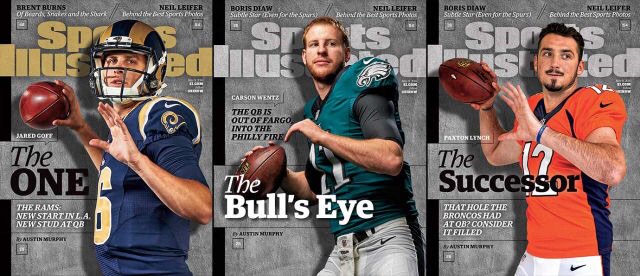
With the first pick in the 2016 NFL Draft, “The Los Angeles Rams select”
http://www.ooyuz.com/images/2016/5/9/1465516353811.jpg
For entertainment purposes, I thought this would be a be a good archive and reference guide to use as we scrutinize Jared Goff’s rookie season.
I’m curious to know if anyone of you faithful Rams fans have an estimated guess of which of the above listed QB’s Goff’s Regular season stats stats might be similar with, assuming he starts all or most of the 2016 season?
Anyone have any educated opinions/estimations
Thanks for observing, Florida
________________________________________________________________________________(On May 5, 2016 this was the over under odds at Bovada) not sure what they are today?
JARED GOFF – TOTAL PASSING YARDS IN 2016 REGULAR SEASON
OVER… 3400 -120
UNDER 3400 -120JARED GOFF – TOTAL TOUCHDOWNS PASSES IN 2016 REGULAR SEASON
OVER… 16.5 -120
UNDER 16.5 -120http://www.oddsshark.com/nfl/jared-goff-rookie-season-betting-props
-
AuthorPosts