
Forum Replies Created
-
AuthorPosts
-
 znModerator
from off the net
===
jrry32
Iupati is exactly the type of player that we sign that blows up in our faces again and again. He’s an overrated and overpriced player that’s about to turn 28 years old that has been getting more and more nicked up the past few years. He’s a great run blocker but has major flaws in pass pro. He’s a good OG that could be nearing the downside of his career with injury issues that’s about to be paid top OG money. IMO, he’s the type of guy that will be cut by the end of the third year of his new contract.
And Bulaga is a solid all around player that has had some major durability issues. Again, the type of player that always blows up in our face. And he’s about to be paid like a top OT.
Moves like this don’t fix it once and for all. They lull us into a false sense of security…like Jake Long, Scott Wells, Jason Brown, Jacob Bell, etc. all did.
Nope. Go get some solid starting OLs with reasonable price tags and draft some highly talented rookies. Because if we throw $15 to $16 million a year combined at Bulaga and Iupati, they’re not going to spend high picks on the OL. I’d rather that money go to OUR young players that need extensions and them spend $6 to $7 million a year combined on a couple guys like Justin Blalock/Rob Sims at OG and Jermey Parnell/Ryan Harris/Derek Newton. You come away with an OG and a RT from that list…you have a solid starter for a next year and the Rams still have a reason to go draft a RT and LG of the future. Win-win. We have a bridge player for the rookie, we have depth on our OL, and we have young talent for the future.
And we can take that $8 to $10 million we saved and use it to keep important current Rams on the team.
Frankly, if protecting Sam Bradford is our motivation, I’m not sure why anyone would be calling for Bulaga and Iupati. Sims and Blalock both are superior pass protectors to Iupati (Iupati is the superior run blocker). And Sims/Blalock will be available for shorter contracts, far less guaranteed money, and likely cost $6 million less per year. As far as Bulaga goes, he’s a very good pass protector but he’s only played 36 of his last 48 games. Hard for him to protect for Sam while he’s injured for a quarter of the season.
I think the best method is to go after a couple mid tier guys who will likely cost the same per year COMBINED that a guy like Iupati will cost by himself. Maybe even less than Iupati. Because we’ll have motivation to put talented draft picks behind them giving us veteran starting talent, talented depth in case of injuries, and young OLs for the future. That’s a winning formula for me.
znModeratorI don’t agree that the game has passed Williams by. Also, the Saints defenses that were low-ranked had personnel issues…and still do. So the fact that he got anything out of them at all speaks well of him.
If you like Fisher’s involvement with the defense, he’s still involved.
Wms has produced several top 5 Ds over the years. I see no reason why he can’t do it again.
Most of the really big issues I saw last year were from mental errors. They weren’t overmanned, and I did not see the scheme as a problem in its own right.
The one thing that might hold them back is that maybe these particular players (in the secondary mostly) are just prone to mental errors and there’s no fixing it.
And yes having a young secondary makes a massive difference. That’s never just an “excuse,” it’s real.
CAN the defense improve in 2015? Sure. Will they? Probably (IMO).
znModeratorBernie: Bradford could help Rams by taking pay cut
By Bernie Miklasz
I’ve always liked Rams quarterback Sam Bradford. I’ve gotten on him at times, but I’ve been termed a Bradford apologist more often than I can remember. That’s fair.
I’ll always wonder what it would have been like for Bradford had he been drafted by a smarter football organization that knew how to put good talent around him.
While I suppose it is still possible for Bradford to become a consistently good NFL quarterback, he’s missed the last 25 regular-season games because of two knee operations. And because of injuries he’s been able to start only 49 of a possible 80 games during his five seasons with the Rams. His final year of college ball at Oklahoma was wrecked by a shoulder injury. Given Bradford’s extensive bad luck with football health, the odds are probably against him.
The Rams want Bradford to take a pay cut. This will be the final year of his six-year, $76 million contract, and he’s scheduled to make just under $13 million this season. But Bradford will count $16.6 million against the Rams’ tight salary cap. That’s a lot of money for someone who hasn’t been able to stay on the field or perform at a high level.
Of course, Bradford is under no obligation to take a cut. The Rams could release Bradford and redirect that money into addressing a few glaring roster needs, but they don’t have an appealing, viable option at quarterback. And that’s their fault.
Despite Bradford’s average play and his disturbing injury record, Rams GM Les Snead and coach Jeff Fisher have failed to add or develop a quarterback who can lead the franchise into the future. They could try to remedy that in the 2015 draft, but for now there is no backup plan. And after three consecutive losing seasons here, does Fisher really want to throw a rookie QB into the pit in 2015?
Snead and Fisher continue to praise Bradford and declare that he’s their man. They seem committed to taking one last shot with Bradford. Knowing that the Rams have no one lined to replace Bradford, why would Sam or his agent Tom Condon agree to slash his salary?
Given the shortage of NFL quarterbacks, Bradford could probably walk out of Rams Park and find teams eager to sign him to a surprisingly lucrative deal.
As a pure debate, I think Condon and Bradford win the argument. The Rams botched this and should pay up. And with the coach and GM insisting that Bradford is the starter, why would he play for less?
Despite that, I still believe Bradford should accept a pay cut. Here’s why:
1. Bradford already has collected about $63 million from the Rams, and he’s started only 61.25 percent of their regular-season games, and the team has won only 18 games that he’s started. It isn’t unreasonable to ask him to help out here — even though the Rams foolishly put themselves in this vulnerable position of depending on him again.
2. If Bradford accepts less money in 2015, the Rams will have more money to spend on free agents. I’m not saying they’d spend it wisely. But at least the Rams would have more money in hand to add players. The Rams’ biggest area of need is the offensive line. Bradford is standing on a twice-repaired left knee. By taking a pay cut, Bradford could indirectly invest in his own protection.
3. If Bradford plays at a reduced rate and does well this season, can you imagine the insane level of bidding for him on next year’s free-agent market? We just watched numerous GMs wildly engage in a bidding frenzy over Josh McCown.
4. If the Rams are willing to put attainable incentives in a reworked Bradford contract for 2015, he’d probably end up making close to the original $13 million, anyway.
5. If five-time league MVP and future Hall of Famer Peyton Manning can take a $4 million pay cut in Denver this season, then why can’t Bradford do something similar?
Bonus reason: Bradford isn’t exactly a popular figure among Rams fans. This would be one way to engender some goodwill. But it’s Bradford’s life and career, and he should do what he thinks is best.
znModeratorBarksdale to hit open market next week
By Jim Thomas
Joe Barksdale, the Rams’ starting right tackle for the past two seasons, has one foot out the door. Barksdale has decided to test the market Tuesday, the first day of the free agency period, according to sources familiar with the negotiations.
The sides are simply too far apart in terms of what the Rams are offering and what the expectations are in the Barksdale camp. Of course, the Rams have more than three days to come up with something that might change Barksdale’s mind, but that appears unlikely.
In addition, outside teams can contact and negotiate with Barksdale starting Saturday as the three-day “legal tampering” window opens. Barksdale had a couple of tough games last season, but losing him would be a blow for the Rams, who already have needs at guard and possibly center on the offensive line.
Barksdale is coming free at a time when there’s a very thin crop at offensive tackle. Green Bay’s Bryan Bulaga is generally considered the best tackle in this year’s free-agent class. Denver’s Orlando Franklin would be No. 2, although he switched to left guard in 2014 after being the Broncos’ starting right tackle for three seasons.
When it comes to possibly replacing Barksdale, the options are limited on the current Rams roster. Jake Long, recovering from a second knee injury in the span of 10 months, could move to right tackle. But it’s not even certain he’ll be on the roster much longer because of a contract clause that guarantees $4 million in base salary if he’s on the roster the fifth day of the league year (March 14).
The current roster also includes offensive tackle Steven Baker, who was on the Rams’ practice squad for the last nine games of the 2014 season. Rodger Saffold has played right tackle in the past, but the coaching staff feels his best position is guard, followed by left tackle.
In other developments, the Rams have sent out one-year tender offers to three of their four restricted free agents.
Quarterback Austin Davis and fullback and tight end Cory Harkey were tendered at the minimum level of $1.5 million. Safety Rodney McLeod was tendered at a second-round level of $2.4 million.
Restricted free agents are players with three years experience and with expiring contracts. Because Davis and Harkey were undrafted players, the Rams would get matching rights if either player got outside offers, but no draft pick compensation if they chose not to match any offer.
They would get a second-round draft pick as compensation on McLeod if they chose not to match an outside offer on him.
The Rams did not make a qualifying offer to restricted free agent Tim Barnes, a center and guard from the University of Missouri. The Rams may try to re-sign him for a lower rate once the free agency period begins.
Also, special teams core player Chase Reynolds and offensive lineman Brandon Washington received one-year tenders offers as exclusive rights free agents (players with less than three years experience).
znModeratorFrom Rotoworld:
http://www.rotoworld.com/playernews/nfl/football-player-news
Tim Barnes – C – Free Agent
The Rams did not tender restricted free agent C Tim Barnes.
Barnes was overmatched in four 2013 starts, and didn’t start a game last season as Scott Wells stayed healthy. Even with Wells on the chopping block, the Rams were unwilling to pay Barnes the $1.54 million lowest-possible tender.Austin Davis – QB – Rams
Rams extended tenders to restricted free agents QB Austin Davis and FB/TE Cory Harkey.
Both players were given the original pick tender. Davis made eight starts last year before getting benched for Shaun Hill in Week 11. Harkey should return as the Rams’ No. 2 tight end behind Jared Cook.
Rodney McLeod – DB – RamsRams extended a second-round tender to FS Rodney McLeod.
McLeod started all 16 games last season, registering 72 tackles and two interceptions. He graded out as PFF’s No. 45 safety out of 87 qualifiers. The second-round tender is a one-year deal worth $2.356 million.znModeratorhe wouldn’t
take a pay-raiseIt’s not YOUR money WV. If Jackson doesn’t want more money is it really any of your concern?
znModeratorTough, tough player. Became
as classy a leader as Rams have had.You know, uniformed fan types bug me.
If Jackson were so great, why did the Rams just release him this week?
Hunh? Answer me that.
znModeratorznModeratorWhy Goldman Sachs Wants the Chargers in Los Angeles
Beau Lynott
Investment bank Goldman Sachs wants the Chargers to move to Los Angeles. They also want the Rams to stay in St. Louis, and out of Los Angeles.
The firm is working diligently on both fronts.
Those are not Goldman’s publicly stated positions, of course, but it doesn’t take much analysis to arrive at this conclusion.
SportsBusiness Journal’s Daniel Kaplan, citing unnamed sources, reported Monday that Goldman Sachs will finance the Chargers’ costs of moving to L.A. by covering “any operating losses suffered by the team in the first few years in that city as well as costs for any renovations needed in a temporary venue.” If they relocate, the Chargers are expected to play in the Los Angeles Memorial Coliseum or the Rose Bowl while a new L.A.-area stadium is under construction.
Chargers special counsel Mark Fabiani confirmed to ESPN that the Chargers have a long-standing working relationship with Goldman and that the firm will work with them on financing a new stadium in the Los Angeles market.
“We are in a hyper-competitive environment regarding Los Angeles at this moment, and so we won’t be releasing specifics on our work with Goldman Sachs,” Fabiani told ESPN. “The bottom line is that we, along with Goldman Sachs, are completely confident that the Raiders/Chargers L.A. stadium proposal can feasibly be financed.”
Fabiani has been less than fully transparent about the Chargers’ dealings with Goldman Sachs as recently as January, when he refuted a report out of St. Louis that the team and firm had reached an agreement to build a stadium in L.A.
Goldman’s relationship with the Chargers is not new. (Nor are Fabiani and Goldman strangers.) Covering the team’s losses and renovation costs related to relocation, if true, is definitely a new wrinkle.
Meanwhile, Goldman Sachs managing director Greg Carey is advising Missouri Gov. Jay Nixon’s task force on building a publicly funded stadium to keep the Rams from moving to Los Angeles. The St. Louis Regional Convention and Sports Complex Authority hired Goldman two years ago to find ways to keep the Rams, or at least NFL football, in St. Louis.
Bloomberg:
the [Missouri task force] has a potent player in Greg Carey, a 54-year-old Goldman Sachs Group Inc. banker who is known in professional sports circles as the guru of stadium financing. Under Carey, Goldman Sachs has worked on more than two dozen stadium deals, the company says, amounting to more than $11 billion in financing.
Carey’s specialty is crafting deals that are lucrative for team owners, often at the expense of taxpayers. What sets him apart, say his clients and critics, is his ability to steer projects through conflicting interests of teams and local government officials. He often does so by using obscure tools available in public finance to help owners get low-interest loans, avoid taxes or tap subsidies.
Carey also steered financing of the San Francisco 49ers $1.27 billion stadium in Santa Clara, cited by Fabiani as a template for the proposed Raiders/Chargers stadium in Carson.
49ers management and Goldman executives touted their work on the Santa Clara stadium in a promotional video.
“It was one of the most exciting transactions that I’ve been able to work on in my career,” Carey says in the video. “We actually committed $850 million of our own capital as a construction loan to ensure that the stadium could be built.” (It’s slightly more complicated than that.)
Carey was understandably excited about financing an $850 million loan. San Diegans might be less than excited about the implications of Goldman’s involvement with the Chargers and their prospects of remaining in San Diego.
Goldman Sachs could not expect to earn nearly as much in commissions, fees and interest from a San Diego stadium as they would from the proposed Raiders/Chargers stadium in Carson. The Carson proposal is for a privately financed $1.7 billion stadium, modeled after the financing used for the 49ers stadium in Santa Clara.
The Chargers described their view of the different market situations in a statement announcing their partnership with the Raiders:
A stadium can be financed in Los Angeles because the LA-Orange County-Inland Empire marketplace is able to support the sale of hundreds of millions of dollars of Personal Seat Licenses (PSLs) or Stadium Builder Licenses (SBLs). These licenses provide a significant amount of funding for the stadium project, as the City of Santa Clara and the 49ers recently demonstrated with the public-private partnership and the record-breaking SBL sales that helped make possible the financing of Levi’s Stadium.
In addition, the LA-Orange County-Inland Empire area is the second-largest media market in the country, and as a result, revenues from the sale of naming rights, advertising, and sponsorships will be significantly larger than they would be in San Diego. Taken together, simple economic realities make a financing reliant solely on stadium-generated revenues possible in a large market such as Los Angeles.
It’s all about PSLs/SBLs and their ability to raise hundreds of millions of private dollars for building a stadium. The Chargers and Goldman Sachs don’t think the San Diego market can generate enough PSLs to build a stadium privately.
National University System Institute for Policy Research President Eric Bruvold is preparing a study that concludes San Diego County would have to cover up to 65 percent of the cost of a new stadium. Bruvold said San Diego might buy $50 million to $100 million in PSLs, but not a large proportion of the overall package. That would mean much less private financing for lenders to the project.
That’s where the shadow of a potential conflict arises.
Goldman Sachs would substantially benefit from a privately built stadium in Carson. Their paid advocacy for the St. Louis Stadium Authority also compels them to strive for a solution that keeps the Rams in Missouri, which would bring an ancillary benefit of keeping the L.A. market open for the Carson stadium.
If the Chargers end up with a San Diego stadium solution, Goldman Sachs will have done their duty to their client, in that they would have helped them reach a satisfactory outcome. But will Goldman act as an honest broker if they are involved in negotiations to build a stadium in San Diego? It would go against their own financial interests in Los Angeles and St. Louis. They stand to gain much less if a stadium is built here.
I asked representatives of the Chargers, the mayor and the mayor’s task force to comment on Goldman’s possible involvement in the stadium process in San Diego.
Citizens Stadium Advisory Group spokesman Anthony Manolatos said the group hasn’t had any contact with Goldman Sachs. He didn’t dismiss the idea of the group meeting with Goldman at some point, though.
“Possibly, but probably not. The focus of the advisory group is on determining what site is best, then developing a financing plan for public consideration. It’s not all that interested in what’s going on Carson,” Manolatos said.
“It would appear to me that Goldman Sachs would be conflicted. I expect if it got that far, negotiations would have to be with another investment bank,” Manolatos said. “It appears there would be a conflict.”
Craig Gustafson, the mayor’s spokesman, said he needed to look into the issue and get back to me. I’ll update this post if I hear back.
I emailed several questions to Chargers special counsel Mark Fabiani. At first, he offered just a boilerplate response: “Goldman Sachs has been the team’s longtime investment banker, something that we have been very public about over the years. A Goldman representative even spoke at the Carson2gether press conference on February 20. So our relationship with the firm is hardly news.”
When I pressed him on the questions I’d asked, he wrote: “With regard to the City of San Diego, we of course have not yet seen any specific ideas from the Mayor or the task force, but we will certainly be prepared to have the appropriate experts from our side evaluate whatever might be proposed in the future.” He added: “To date Goldman has not met with the Mayor or any task force members.”
So, would “appropriate experts from our side” mean Goldman could advise the Chargers on a future San Diego stadium proposal?
“I can’t answer that hypothetical question since we have no idea what specific issues will be raised by the task force or the mayor. We would always try to bring the best expertise to bear on a particular issue, after evaluating what’s needed, checking for client conflicts, and so on,” Fabiani said.
Oh, and the NFL’s “point man on the L.A. market“? That’d be NFL Senior Vice President Eric Grubman — a former Goldman banker.
Goldman Sachs representatives declined to comment for this story.
It isn’t ethically or legally wrong for Goldman Sachs to be the Chargers’ financial partner and stadium adviser. If, however, San Diego officials end up in stadium negotiations with Dean Spanos and his investment banker, they may wonder whether the Carson stadium is too lucrative for Goldman to let fail.
znModeratorIt always seemed to me like his scheme was a “steal from Peter to pay Paul” type scheme.
I could be wrong though.. I just don’t know.
Yet Fisher seemed to cut it back during the season. One immediate result was that Ogletree was less of a deficit and more of a strength.
It’s an old complaint that the Wms defense has a lot of built in risks, but then, there are things about that defense that often don’t come up in conversation, like the way he uses his safeties. This defensive system has been great before, and it contributed to the New Orleans superbowl win.
znModeratorGordon: Relocation talk reduces Rams draft intrigue
By Jeff Gordon
While most pro football fans were gearing up for their team’s big games in recent years, Rams fans have fired up for the annual NFL draft.
Each spring they channeled their inner Mel Kiper Jr.-Todd McShay personnel debate. They watched college all-star games, tuned into the scouting combine, pored over draft projections and wondered which collegiate stars would bring hope to Rams Park and break the cycle of despair.
Recent drafts have been way more entertaining than the actual games. The remarkable Robert Griffin III heist made the Rams a major draft story three years running.
While the Rams have remained predictable with their game strategy — especially on offense — they have pulled some clever surprises at the draft. Last year’s class was one of the best St. Louis has ever seen.
But that fun is done. As preparations for the 2015 draft intensify, many Rams fans merely shrug.
This team seems unlikely to captivate us with its draft maneuvers. Les Snead spent No. 4 and No. 6 picks to add run-stuffing safety Mark Barron to his stack of run-stuffing safeties last season, so the team lacks the volume of picks needed to get highly creative.
Then there is the larger issue of the Rams’ future here, or lack thereof. Owner Stan Kroenke is trying to move to team to Los Angeles. Many fans view the 2015 season as a farewell tour, given the momentum Kroenke’s Inglewood project is gaining.
Yes, there’s a chance St. Louis could emerge from this chaos with a new stadium and a place in the league. But local fans become more alienated by the day, so they spend less time wondering which 2015 additions could make a difference by 2018.
Right now Rams fans in Southern California are more interested in that topic.
The Rams’ offseason activity has added to the local indifference. Their free agent priority appears to be the interior offensive line. One of their top draft priorities is offensive tackle.
Injury-battered Jake Long was another in the long line of expensive free agent busts for the Rams, and the offensive line is crying for fresh legs.
Iowa offensive tackle Brandon Scherff is a person of interest to the Rams, assuming he gets down to the No. 10 slot. Stanford’s Andrus Peat could fit that bill, too, and he appears likely to be there for the Rams.
Yes, the Rams could buck up and overpay free agent Joe Barksdale to remain at right tackle. Yes, coach Jeff Fisher and Snead could sift through the slim pickings and (gulp) add another tackle from the open market.
But circumstances suggest drafting a tackle is the right play, instead of going for a wide receiver like Kevin White, Amari Cooper or DeVante Parker. The Rams could re-up Kenny Britt to continue his mentoring of Brian Quick and count on Mountaineer pals Tavon Austin and Stedman Bailey to finally break out.
Should that plan fail, the Rams can target wide receivers in future drafts after firming up the offensive line foundation.
Adding fresh blockers wouldn’t do much for marketing … but at this point, marketing is a moot point for the franchise. There isn’t much the sales department can do to move tickets to fans in this region for this season.
The Rams can only hope their opponents don’t travel well in 2015.
Fisher is prepared to take a similarly patient approach at quarterback by giving Sam Bradford one more season, assuming the money makes sense.
Why not? The free agent alternatives are pedestrian and the 10th overall pick seems unlikely to yield their quarterback of the future.
The Rams can trot out Bradford one more time, find a solid back-up and draft somebody with long-term potential in the second or third round.
So what if Bradford breaks down again? The Rams could just leave him on the curb with the used player lounge furniture if the team packs up and moves to SoCal.
The team could get its fresh start with a new quarterback better than, say, Brian Hoyer. Next year’s free agent quarterback class can’t possibly be as bad as this one.
Fisher kept things in house by promoting quarterbacks coach Frank Cignetti to the offensive coordinator post vacated by the oft-maligned Brian Schottenheimer.
This was a sensible move. Cignetti helped coax reasonable production from Shaun Hill and Austin Davis last season after Bradford went down. Fisher isn’t looking to reinvent his offense in the fourth year of his regime, so the status quo rules.
Cignetti accepted the challenge of taking Fisher’s familiar run-oriented philosophy and getting better results. And maybe, just maybe, the Rams will actually complete a few passes to Austin down the field for a change.
New quarterbacks coach Chris Weinke was also a solid hire under the circumstances. He refined his teaching skills at the IMG Academy, working with aspiring NFL quarterbacks like Russell Wilson and Cam Newton.
This is an entry level position coaching job, so the uncertain Rams future shouldn’t concern him. Weinke is getting his big break at the highest level of coaching.
He will get to mold whichever young quarterback the Rams draft. He is bringing lots of energy to this challenge.
At least somebody around here is excited about what the organization’s long-range future may hold.[/quote]
znModeratorA look at the NFL’s top 30 free agents
By Jim Thomas
1. NDAMUKONG SUH • DT, DETROIT, 28 — Will be the most talented defensive player to reach the market in years.
2. DeMARCO MURRAY • RB DALLAS, 27 — Best running back in the league based on last season (1,845 yards, 13 TDs).
3. RANDALL COBB • WR, GREEN BAY, 24 — Just entering prime, coming off monster year (91 catches, 1,287 yards, 12 TDs).
4. DEVIN McCOURTY • FS, NEW ENGLAND, 27 — Rangy free safeties are hard to find, and he’s one of the best in the business.
5. JERRY HUGHES • DE, BUFFALO, 26 — After slow start to career, has posted back-to-back 10-sack seasons for Bills.
6. JEREMY MACLIN • WR, PHILADELPHIA, 26 — Mizzou, Kirkwood HS product showed he could be a No. 1 in breakout 2014 season.
7. TERRANCE KNIGHTON • DT, DENVER, 28 — It’s hard to find a better run stuffer, with a better nickname than “Pot Roast.”
8. MIKE IUPATI • OG, SAN FRANCISCO, 27 — Had some injury issues lately, but one of the game’s best interior run blockers.
9. BYRON MAXWELL • CB, NEW ENGLAND, 27 — Everywhere he goes these days, he ends up with the Lombardi Trophy.
10. JULIUS THOMAS • TE, DENVER, 26 — Catches, yards down in ’14, but hard to ignore 24 TDs over past two seasons.
11. JASON WORILDS • OLB, PITTSBURGH, 27 — Had 15 ½ sacks over past two seasons playing in Steelers 3-4 scheme.
12. NICK FAIRLEY • DT, DETROIT, 27 — Powerful inside force hasn’t lived up to his potential so far in the NFL.
13. GREG HARDY • DE, CAROLINA, 26 — Buyer beware: one of the league’s best pass-rushers still on exempt list.
14. BRYAN BULAGA • OT, GREEN BAY, 25 — Talented, but injury issues. Has played all 16 games once in four seasons.
15. TORREY SMITH • WR, BALTIMORE, 26 — Underrated deep threat has career average of 16.9 yards per catch.
16. BRIAN ORAKPO • OLB/DE, WASHINGTON, 28 — Skilled pass-rusher but has missed 24 of past 48 games with injuries.
17. TRENT COLE • OLB/DE, PHILADELPHIA, 32 — Skilled pass-rusher would be great short-term addition for contender.
18. BRANDON FLOWERS • CB, SAN DIEGO, 29 — Revived career with Chargers following his Kansas City release last June.
19. STEFEN WISNIEWSKI • C, OAKLAND, 25 — Four-year starter at center for Raiders is not expected to return.
20. C.J. SPILLER • RB, BUFFALO, 27 — Good combination rusher/receiver also has value as return man.
21. PERNELL McPHEE • OLB/DE, BALTIMORE, 26 — Coming off a career year that included 7 ½ sacks for Ravens.
22. RODNEY HUDSON • C, KANSAS CITY, 25 — On the small side (6-2, 299), but some like him better than Wisniewski.
23. VINCE WILFORK • DT, NEW ENGLAND, 33 — One of the era’s premier DTs can squeeze out another couple seasons.
24. MICHAEL CRABTREE • WR SAN FRANCISCO, 27 — Injury issues last two seasons, but still has potential to be elite receiver.
25. ORLANDO FRANKLIN • OG, DENVER, 27 — Was very good at guard in 2014 and can also play right tackle if needed.
26. DAVID HARRIS • LB, NY JETS, 31 — Has been one of the league’s most underrated LBs for several years.
27. BUSTER SKRINE • CB, CLEVELAND, 25 — Aggressive player who had 4 INTs and 18 breakups last season.
28. JUSTIN FORSETT • RB, BALTIMORE, 29 — Career backup had career year in ’14: 1,266 yards, 5.4 yards per carry.
29. DERRICK MORGAN • DE/OLB, TENNESEE, 26 — Decent pass rusher is good for six, seven sacks per season.
30. JOE BARKSDALE • OT, ST. LOUIS, 27 — Some glitches in ’14, but could make most of thin group at position.
znModeratorHard to keep up with all this.
We should try though.
====================
What Black & White thinking misses about ISIS/Daesh & why it Matters to us AllBy Neslihan Çevik
http://www.juancole.com/2015/01/thinking-misses-matters.html
To combat radicalism, EU countries should avoid considering an increased interest in the origins and nature of Islam as a sign of potential radicalization, while Muslim states should encourage the youth to analytically inquire about their religion and systematically reject radical Islamism based on that inquiry
Debates on whether the Islamic State of Iraq and al-Sham (ISIS) represents Islam or is a malevolent distortion of the religion continue to divide not only Western skeptics and Muslims outraged by ISIS, but also domestic political frontlines in the U.S. and EU. This debate gained new momentum as renowned German journalist, Jürgen Todenhöfer, 74, managed to gain exclusive access to ISIS-controlled territories, reporting that the group is much stronger than we realize, concluding that to defeat the militant group we must have a deeper understanding of what it is and what it stands for.
If we were to follow a linear logic, we would conclude, as have the skeptics of Islam, that ISIS represents and stands for Islam. After all, ISIS is composed exclusively of Muslims, it claims to speak in the name of Islam, it has declared itself to be the caliphate, and it overwhelmingly quotes Quranic verses and concepts while slaughtering Muslims and clerics, beheading Westerners, tearing down places of worship and historical sites and forcing women and girls into the sex trade and slavery. Moreover, the violent doctrine and militancy of the 21st century’s self-claimed caliphate are not without historical precedence – they, in fact, rekindle parts of the Islamic past.
There is, however, one simple fact that linear logic misses – something belonging to the past does not make that thing authentic or true. That is, the past that ISIS revives and continues is not the “true Islam,” untouched by modern reform, but a part of the Islamic past that fell far outside the belief system and practices of normative Islam by the standards of the same Early Islam itself.
ISIS bears the closest resemblance to, in fact it looks like a carbon copy, of the Kharijites of the seventh century, especially its radical branch, the Azraqites, followers of Nafi al-Azraq. Azraqites were the first in Islamic history to terrorize the populace with horrendous, violent acts and were the first to make a distinction between true Muslims versus nominal Muslims. That they were the first “terrorists” of Islam and the first to make such a distinction is not at all a coincidence as the latter induced the former.
Needless to say, Azraqites considered themselves the only true believers within the entire Muslim world of the time, and their camp was the adobe of Islam. Whoever remained outside their camp and did not submit to their view was only nominally Muslim, and those Muslims, living within the Muslim community, threatened the purity of Islam. Kharijites drove this distinction from the Quranic dichotomy of “mumin” versus “kafir,” or believer versus unbeliever, but they corrupted the inner structure of these concepts and flawed their etymological meanings.
With the Kharijite distinction of real versus nominal Muslims, kafir no longer simply meant unbeliever as defined by the Quran, it now meant heretic. Azraqites took it a step further declaring non-Kharijite Muslims to be “mushrik” – one who commits the unpardonable sin of idolatry. There was more corruption to come. Azraqites ruled that a single sin would excommunicate a Muslim, although this very clearly went against the Quranic doctrine on sin. They also considered it to be lawful to kill whomever they defined as a disbeliever, spoil their possessions and slaughter and enslave their women and children. With this flawed interpretation, Azraqites denounced prophets of the past as heretics and their contemporaneous Prophet Ali, the cousin of Prophet Muhammad, as a sinner, subsequently assassinating him. Furthermore, a number of them engaged in the practice of “istirad” – asking people to expose their beliefs – the choice was simply between death and submission to the Azraqite view of Islam.
It was based upon this corruption of Quranic concepts that Azraqites formulated their version of Islam, laying the foundations for radical Islamism from 18th century Wahhabism to today’s radical Islamist terrorism. We should briefly take note that the Azraqites were not theologians, not in the sense of the dialectic study of belief. Rather, their belief system was developed under shadow politics mainly focused on defeating their opponents on the question of the rightful ruler of the “umma” – the community of Muslims.
It is difficult not to see the stark similarities between the actions and religious doctrine of ISIS and that of the Azraqites. By declaring itself the caliphate, ISIS gave more than a political message. It has declared its camp as the adobe of Islam, composed of only true believers. Whoever remains outside the caliphate is a “kafir,” in the sense of the word used not by the Quran, but by the Azraqites. Just like the seventh century fanatics, ISIS too, based on the distorted formula of disbeliever versus believer, considers it lawful to kill anyone who it sees as an unbeliever be they Muslim, non-Muslim, Sunni clerics, women, children, and enslave them, spoil their possessions and burn their places of worship.
Early Islamic theologians from Ibn Hazm to Taftazani to al-Ghazali, who disagreed upon many aspects of Islamic theology, tightly agreed that “kafir” only meant unbeliever and one who professes to believe is considered a believer. Moreover, major schools of Islamic thought agree that belief is inner belief and the locus of it is the heart. God is the only one that can know one’s heart, not even the prophets have that ability, or indeed the duty, to separate true-Muslims from nominal Muslims. The hadith makes this clear. In response to a man who accused others for pronouncing what is not in their hearts, the Prophet Muhammad said: “I assure you I have not been sent [to you as a messenger of God] in order to split open the hearts of men.”This demonstrates that no authority other than God can judge sincerity of the confessor nor can one confer another’s spiritual destiny. In regard to unbelievers, Islamic doctrine is unambiguous – it absolutely forbids killing unless there is a need for self-defense. Furthermore, as I wrote extensively here, belief requires the freedom of choice – one must believe out of volition and through deliberating, inferring and evaluating what she believes.
ISIS violates all of these elements that are core to Islam’s belief system, elements that assign God absolute authority and as such, endow the individual with moral autonomy and freedom of choice while rebuking controlling tendencies of the state or community, particularly when these institutions would try to assert authority over the believer in ultimate spiritual matters.
Recognizing that what ISIS stands for is not Islam itself but its perversion is not just an intellectual exercise to defend Islam it has quite practical consequences. It affects the ways in which we think about and produce policies for de-radicalization.
In the early 2000s, EU countries’ counter-radicalization programs focused on the prison system and protection of the public from terrorist attacks. As radicalization of young Muslim immigrants has become a mounting challenge in Europe, more recently policies have started to concentrate on de-radicalization, seeking to prevent Muslim youth from being recruited to terrorism in the first place. This is the right direction to go, yet there is an overarching problem. EU countries tend to associate radicalism with the putatively innate radical nature of Islam. In other words, any young man or woman who is a practicing Muslim or is devout becomes a potential terrorist. Such an erroneous start leads to the erroneous result that de-radicalization must require de-Islamization of Muslim youth.
France for instance, the country with the highest Muslim population in Europe. A few months back, the Academie de Poitiers prepared a document enlisting individual indicators of Muslim radicalization. Some of the signs that schools and teachers were to monitor included weight loss due to fasting during Ramadan, rejecting tattoos, having a long beard and adopting Muslim attire – religious practices themselves were depicted as signs of radicalization. There are various problems here. This approach fails to recognize the difference between expressions of piety and radicalization, and undermines individual rights, moral freedoms and religious plurality, and it violates secular principles by assigning the state the authority to oversee how much religion one can have.
The same French document also considers an increased interest in Islamic history, origins and the nature of Islam as a sign of potential radicalization. This is a graver problem. A growing individual interest in understanding Islam’s message is not a cause of radicalization. On the contrary, it has been the decline of individual thinking and reflection on religion in Muslim societies that have enabled radicalism in the first place. This trend that started back in the ninth century along with the rise of anti-philosophic Islamic currents was reinforced by post-colonial authoritarian states, be they secularist or Islamist, which oppressed individual moral agency, prevented development of religious identity and co-opted religion to make it serve state power and ideologies.
To combat radicalism we need to revive the individual thinking about Islam that is no longer satisfied with inherited knowledge, imposed from above whether it is the state or an authoritarian community. Only after that is one able to discern with certainty between what is flawed and what is not. Paradoxically, the rise of ISIS has had a very constructive consequence in that sense as it has finally awakened a consciousness among Muslims, individually and collectively, to analytically inquire about their religion and systematically reject radical Islamism based on that inquiry. It is essential to keep this interest awake and channel it in the right direction to instill Muslim youth with a proper knowledge of Islam. This rising interest gives a great opportunity to the world to dry the roots of radicalism, and to Europe to tackle the issue of de-radicalization without violating its own democratic principles, unless of course, it is cut out by policies informed by Islamophobia.
Neslihan Çevik, Ph.D., is Associate fellow at the Institute for Advanced Studies in Culture, University of Virginia & Board member, Post-Colonial Studies Research Center, Üsküdar University
znModeratorWell its a great topic. Most of us
have no idea what the ‘standard’ should
be for calling a draft “average”
or “good” or whatever.As that guy emphasizes its a really
tricky subject.If a team makes an All-pro-pick like Robert Quinn
does that balance out the draft if they pick a bunch
of busts after that? Does an Andrew Luck type pick
make the whole draft?I couldn’t agree more—there has to be some kind of standard in the discussion, though it’s not all there is to the discussion. Still it’s important.
I approach it this way. It’s 2 things.
First you need a simple numerical baseline. This keeps people from just assuming you’re supposed to hit on 50% of your picks at least. It adds a component of objectivity.
How many players do good drafting teams get on avg. per draft? I looked once at the Giants, Packers, and Steelers and what they did between 2005-2010. 2010 is far enough back so you can actually judge.
BTW, by going back in time you also eliminate the “draft discount.” That is, most teams keep all 7 guys they draft (or close to it) for at least a year or 2. And, some guys start at first if picked high, but they don’t hold up (like Carriker with the Rams.) So you can’t count them. Going back in time clears all that up. If you were grading Rams drafts before the 2009 draft, and you just counted starters because they’re starters, Carriker counts. He started. But as time ticks by, that kind of thing gets weeded out.
What I found was that on avg. a good drafting team gets around 2.6-3 players per draft, counting starters and important role players (like 3rd receivers or situational pass rushers, etc.) That’s around 40%.
Just AVERAGE drafts get around 2 players per draft. Edging toward 30%.
Anything past the low 40s in terms of percentages is exceptional (see Seattle from 2010 on).
Okay so that’s just a baseline. That’s the objective part.
You then need to add some prose. What kind of players are they–top? just good? Did they pick high or low? Any all pros, and do they balance any of the busts? That’s a value judgement.
So I like to combine a numerical baseline with evaluative commentary. 40% is good, 30% is average, below 20% is poor. But then you have to look at who it is (any pro bowlers? mostly JAGs?) and makes some qualitative judgements.
Right now, it’s too soon to judge the Rams drafts under Fisher. I mean yeah so far the numbers favor them looking good–so far, having Robinson, Donald, Mason, Gaines, possibly Joyner, Austin, Ogletree, McDonald, Stacy, Brockers, Quick, Jenkins, Zuerlein …that looks like 48%, though it’s not all certain and the quality isn’t clear yet (plus maybe there’s Givens, Johnson, Jones, Bryant and Rhaney).
But you can’t write a decent or reliable qualitative assessment yet, and maybe some of those picks don’t hold up when viewed from the long term.
znModeratorThe 2015 Free Agents Ranked, 1-100
Suh to the Raiders? Hardy to the Falcons? Crabtree to the Seahawks? (!) A
look at the top players available when the market opens, and where they best fitBy Greg A. Bedard
http://mmqb.si.com/2015/03/04/nfl-top-free-agents-1-50/
Note: This list represents unrestricted free agents whose contracts expired after the 2014 season. It doesn’t include “street” free agents, whose contracts were terminated before they were set to expire (their ranks will grow in the coming days) and who are free to sign before unrestricted free agency begins on March 10. Age listed is for the start of the 2015 regular season. Status updates appear to the right of the player’s name. Click here for Nos. 51-100.
1. Ndamukong Suh
1-ndamukong-suh-cmsDT, Detroit (Age 28)Could be the best defensive free agent to hit market since Reggie White in 1993. A disruptive force rushing the passer and stuffing the run. Must be accounted for on every snap. Has started every game in his career (suspended for two). Best fit: Raiders. If GM Reggie McKenzie wants to keep his job beyond this season, he has to land Suh, who should set the record for biggest defensive contract ever.
2. Dez Bryant // FRANCHISE TAG
2-dez-bryant-cmsWR, Dallas (Age 26)The Cowboys didn’t let Bryant hit the market. He’s averaged 91 catches for 1,312 yards and 13.6 TDs the past three seasons. A complete receiver who can take over a game. Best fit: Cowboys. DeMarco Murray is also a free agent, but only one is a no-brainer to retain.
3. Justin Houston // FRANCHISE TAG
3-justin-houston-jjOLB, Kansas City (Age 26)Ultra-productive pass rusher who has 33 sacks in past 27 games. Also plays the run well; plays within scheme and without need to be heroic. Has played left OLB, meaning he’s gone against (mostly) right tackles. Best fit: Chiefs. Tamba Hali will be 32 this season and isn’t long for the roster. Now franchised, Houston will be the next guy.
4. Demaryius Thomas // FRANCHISE TAG
4-demaryius-thomas-jwmWR, Denver (Age 27)Has caught at least 92 passes for 1,430 yards and 10 TDs in each of past three seasons with Peyton Manning as his QB. Terrific athlete, but drops some easy passes and isn’t as strong against physical play as Dez Bryant. Best fit: Broncos. With TE Julius Thomas to hit market, Denver needed to keep at least one Thomas to pair with Emmanuel Sanders.
5. Devin McCourty
5-devin-mccourty-jwmFS, New England (Age 28)Settled the Patriots’ troubled secondary when he switched from cornerback to free safety in middle of 2012 season. Fast, smart, unselfish and durable, McCourty is rock-solid in middle of field. Can also cover top TEs when needed. Best fit: Patriots. They know his true value, and he enjoys being in Patriots’ program. Would be difficult to project a divorce.
6. Jason Pierre-Paul // FRANCHISE TAG
6-jason-piere-paul-atDE, New York Giants (Age 26)Hasn’t become the dominating presence his vast athletic skills seemed to promise when career began, but still capable of having an impact on the game rushing passer and defending the run. Had back surgery in 2013, so that would cause other teams pause. Best fit: Giants. Aren’t a feared pass-rushing team without him, so can’t afford to lose him.
7. Randall Cobb
7-randall-cobb-rbWR, Green Bay (Age 25)Dynamic offensive talent who can make plays lined up at any spot, and on special teams. Durability is knock (he missed 10 games with a broken leg in 2010), but he’s played at least 15 games in three of his four seasons. Best fit: Raiders. They have cap space, and GM Reggie McKenzie was with Green Bay when Cobb was drafted. Chiefs would be great fit, but probably can’t afford Cobb.
8. Julius Thomas
8-julius-thomas-jjTE, Denver (Age 27)When he’s on the field and healthy, Thomas is among the toughest matchups at the position, especially in the red zone (24 TDs in 27 games over the past two seasons). But he hasn’t yet proven to be durable, and that’s a concern. Best fit: Jaguars. They need to start getting some weapons around Blake Bortles, and tight end is a good place to start.
9. Byron Maxwell
9-byron-maxwell-rbCB, Seattle (Age 27)Has been to two Super Bowls starting opposite Richard Sherman, so Maxwell sees a lot of action and produced 24 passes defensed and six interceptions over the past two seasons. A long and physical player at 6-1, 207 pounds, he’ll fit some schemes but not all. Best fit: Eagles. He fits their physical profile and scheme perfectly, but the price tag will be high. May not play up to that contract.
10. Jerry Hughes
10-jerry-hughes-tsgiDE, Buffalo (Age 27)Busted out of Indianapolis after producing just five sacks in three seasons as a first-round pick, but revived career with 10 sacks in two seasons with Bills (one year as a full-time starter). Some will point to his great surrounding cast and doubt his potential. Best fit: Jets. They are sorely lacking a pass-rushing threat to go with their stout linemen.
11. Jason Worilds
11-jason-worilds-prmOLB, Pittsburgh (Age 27)Produced 15.5 sacks the past two seasons, but his athletic talent shows he is capable of more. Frustrating that he hasn’t been more dominating, but some teams out there will think they can unlock his potential greatness. Best fit: Titans. With ex-Steelers defensive boss Dick LeBeau now in Tennessee, there’s a scheme fit. Perhaps LeBeau has already seen enough of Worilds.
12. Pernell McPhee
12-pernell-mcphee-atOLB, Baltimore (Age 26)Had to sit behind Terrell Suggs and Elvis Dumervil for two years in Baltimore but has shown flashes of productivity and positional versatility. Low mileage and still young. Best fit: Colts. They need to throw a lot of resources at finding more pass rushers. Head coach Chuck Pagano was Ravens’ defensive coordinator when McPhee was drafted.
13. Jeremy Maclin
13-jeremy-maclin-atWR, Philadelphia (Age 27)Came back from knee surgery to put up career highs for catches (85), yards (1,318) and touchdowns (10). Some teams will point to Eagles’ system and wonder if Maclin deserves to be paid as a No. 1 receiver. Best fit: Browns. With Josh Gordon suspended for 2015 and his career in doubt, Cleveland needs to find receivers quickly.
14. Mike Iupati
14-mike-iupati-rbG, San Francisco (Age 28)Mammoth (6-5, 331 pounds) and powerful left guard who has gone to three straight Pro Bowls. Can dominate in the running game, but his occasional woes in pass protection have kept him from being the annual All-Pro most envisioned. Has dealt with variety of injuries. Best fit: Colts. Quarterback Andrew Luck needs a lot better protection, and they need someone to open up some running holes.
15. Bryan Bulaga
15-byran-bulaga-dekRT, Green Bay (Age 26)Can be a dominating tackle in both run and pass game. Some teams thought he had left tackle potential in the 2010 draft. Finished two seasons on injured reserve, and dealt with knee injury and a concussion last season. Best fit: Colts. They have plenty of cap space. Add a pass rusher, guard and right tackle, and they’ll be cooking with gas.
16. Nick Fairley
16-nick-fairley-cmsDT, Detroit (Age 27)Powerful and talented interior force who can rush passer and stop the run when he wants to—or is on the field (has missed 16 games in his four seasons). No question about potential. Can someone unlock it? Best fit: Seahawks. Complete pipe dream as they still have to pay QB Russell Wilson, but Fairley would look nice in the middle of that line.
17. Brandon Flowers
17-brandon-flowers-jwmCB, San Diego (Age 29)Teams always look for top-tier cornerbacks, and Flowers showed he can be that after a strong season with Chargers on one-year deal. Some might be scared off because he was released by Chiefs, and he’s small at 5-10, but Flowers can play. Best fit: Jets. Lack of cornerbacks really hurt them last season, and it’s hard to see the secondary being that thin again.
18. Derrick Morgan
18-derrick-morgan-wesley-hitt-giOLB, Tennessee (Age 26)Deftly made switch to 3-4 OLB and showed versatility, so he’ll appeal to 3-4 and 4-3 teams. Consistent, with at least six sacks in each of past three seasons. Best fit: Chargers. They have to develop more of a pass rush or else they won’t topple Denver in the AFC West.
19. DeMarco Murray
19-demarco-murray-jwmRB, Dallas (Age 27)Reigning rushing champion with 1,845 yards and 13 touchdowns, to go with the 1,121 and nine he put up in 2013. Hard runner with good vision, and very good receiver out of the backfield. Injury woes dominated first two seasons, and he can put the ball on the ground. Best fit: Cowboys. Could linger on the market, which will bring price tag more in line for Dallas. Smart move is taking less money to stay behind that line.
20. Greg Hardy
20-greg-hardy-atDE, Carolina (Age 27)Ferocious pass rusher who had 26 sacks over ’12 and ’13 seasons. Plays the run just as well. After high-profile domestic violence case, teams will tread carefully and likely won’t guarantee much of his contract. Best fit: Falcons. Clock is ticking on GM Thomas Dimitroff, who is desperate for a pass rusher. This may be a gamble he’s willing to take.
21. Brian Orakpo
21-brian-orakpo-sbOLB, Washington (Age 29)Hasn’t finished two of the past three seasons, but is among most consistent and productive pass rushers in league when healthy. Best fit: Bills. Jerry Hughes will likely find a bigger pay day, so Rex Ryan will need an outside rusher to pair with Mario Williams.
22. Rodney Hudson
22-rodney-hudson-atC, Kansas City (Age 26)Not yet elite, but on his way. Rock-solid run- and pass-blocking. Not a well-known name, but Chiefs’ rivals know his value and may come knocking, along with many others. Best fit: Falcons. Was a second-round pick of current Atlanta assistant GM Scott Pioli when Pioli was Chiefs GM. They have a ready-made spot for him.
23. Brandon Graham
23-brandon-graham-atOLB, Philadelphia (Age 27)Among leaders in pass-rushing productivity the past three seasons, according to Pro Football Focus. Few players make more of their snaps than Graham. Has 4-3 and 3-4 appeal, which should open up his market. Best fit: Titans. All the teams listed above with the other pass rushers will be playing musical chairs. It’s going to depend on fit and timing with who gets whom.
24. Jared Odrick
24-jared-odrick-cmsDT, Miami (Age 27)Constantly a disruptive force as both a 3-4 DE and 4-3 DT at 6-5 and 304 pounds. Can get after the passer and stand up blockers against the run. Much more impactful than his sack numbers (just one in ’14) would indicate. Best fit: Patriots. They have a habit of going after players who have success against them. Watch Odrick vs. Logan Mankins in ’13.
25. Buster Skrine
25-buster-skrine-fvCB, Cleveland (Age 26)An aggressive cornerback who can be boom or bust, Skrine isn’t afraid of competition (he held off first-round pick Justin Gilbert last season). Performed well in a defense that puts pressure on its cornerbacks. Better player than people think. Best fit: 49ers. They could get hit hard in free agency, and Skrine is their type of physical player.
26. Torrey Smith
26-torrey-smith-sbWR, Baltimore (Age 26)One of better deep threats in league, but has some limits as a short and intermediate receiver, and can drop some easy passes. Will appeal to vertical teams. Best fit: Jaguars. They’ll be looking for a lot of weapons to help Blake Bortles. A deep threat is needed.
27. Kareem Jackson
27-kareem-jackson-sbCB, Houston (Age 27)A first-round pick in 2010, Jackson got off to a very slow start, but he’s rebounded to become a good outside cornerback with a nose for the ball. A little small, so won’t fit all schemes. Best fit: Lions. With veteran Rashean Mathis likely to find more money elsewhere, Detroit needs another cornerback, and Jackson would fit scheme nicely.
28. Davon House
28-davon-house-jfCB, Green Bay (Age 26)A very talented player with good size (6-1, 195 pounds), House has produced when healthy, but he’s missed 10 games over past three seasons with unlucky injuries. Somebody is going to see the potential and take the leap. Best fit: Eagles. If they don’t want to pay Maxwell’s contract, House could be the cheaper and eventually better option.
29. Charles Clay
29-charles-clay-bfTE, Miami (Age 26)A multi-dimensional athlete who can line up anywhere from fullback to receiver and cause problems for a defense. Averaged 63.5 catches the past two seasons. An emerging talent. Best fit: Dolphins. Hard to see them parting with an ascending player.
30. Dan Williams
30-dan-williams-ckDT, Arizona (Age 28)An excellent run-stopping nosetackle who is consistent and always in the right spot. Can give you a little bit rushing the passer, but his real value is on the first two downs. Best fit: Browns. They need a true 3-4 nose to really make Mike Pettine’s scheme work.
31. Sean Weatherspoon
31-sean-weatherspoon-rbLB, Atlanta (Age 27)Named a defensive captain in 2012, Weatherspoon is a terrific athlete with top-notch instincts. However, he missed most of the past two seasons with injuries, so his future is in doubt. Can play any linebacker spot. Best fit: Falcons. They know him and health history so might be willing to give a little bit more money.
32. Rolando McClain
32-rolando-mcclain-jwmLB, Dallas (Age 26)Was one of best stories in NFL last season. Had gone from eighth overall pick in 2010 (by Raiders) to out of football in 2013 to glue of resurgent Cowboys defense. A very good athlete with great instincts. Really hurt his market when he reportedly violated the league’s substance abuse policy and is facing a four-game ban. Best fit: Cowboys. Great fit all around, and can’t see many teams committing to a suspended player with a troubled past.
33. Michael Crabtree
33-michael-crabtree-bmWR, San Francisco (Age 27)Became one of the game’s top receivers in 2012, but an Achilles tear set him back in ’13 and appeared to take away some of his explosiveness in ’14. Teams could on a return to form this season. Tough, smart, competitive. Best fit: Seahawks. OK, this might just entertain me, but the thought of Crabtree crossing rivalry lines and teaming with nemesis Richard Sherman is good fun.
34. Rahim Moore
34-rahim-moore-jjFS, Denver (Age 25)Will entice many teams with his age and athletic ability. Has improved in coverage (five interceptions last season) but still struggles at times. Missed tackles are a problem. Should have a lot of suitors. Best fit: Bears. They have to land one of the top free safeties, and they’ll have competition with Colts, Jaguars, Titans and Eagles.
35. Chris Culliver
35-chris-culliver-jjCB, San Francisco (Age 27)Knee injury that wiped out his 2013 season seemed to linger into ’14, but he eventually settled into being a good corner who can run with speedy wideouts. His size—6-0 and 199 pounds—will appeal to many teams. Best fit: Eagles. Has the type of size they covet and would be an instant upgrade on what they had last year.
36. Antonio Cromartie
36-antonio-cromartie-jbCB, Arizona (Age 31)Getting up there in age but still one of the better cover corners in the league. Will never be a big tackler, and his concentration can wane, but he can match up with No. 1 WRs if needed. Best fit: Jets. New coach Todd Bowles had Cromartie in Arizona, so he knows his positives and weaknesses well and can make them work.
37. Jabaal Sheard
37-jabaal-sheard-bfDE, Cleveland (Age 26)Had 15.5 sacks his first two seasons but struggled once team moved to 3-4. Would benefit from returning to playing in 4-3. Has shown ability to be a dominating player, but consistency is a problem. Best fit: Buccaneers. With Adrian Clayborn released, Tampa needs some edge pressure to go along with Gerald McCoy on the inside.
38. Antrel Rolle
38-antrel-rolle-jjSS, New York (Age 32)Still a very good safety who is dependable (missed one game since 2006) and a playmaker (nine interceptions, 21 passes defensed past two seasons). Teammates love him and know for being an unselfish leader. Best fit: Eagles. They’re among the many teams looking for safety help, and as a division rival, they’ll know his scouting report well.
39. Terrance Knighton
39-terrance-knighton-dekDT, Denver (Age 29)Came into his own as a run stuffer and pass rusher when he left Jacksonville for Denver. Probably won’t get the payday he envisions, so a return isn’t out of the question. Weight is a constant issue, as it was with Jaguars. Best fit: Broncos. They need him in the middle of that defense, and both sides should find common ground once Knighton sees the market.
40. Tramon Williams
40-tramon-williams-ghmCB, Green Bay (Age 32)This veteran can still play. Has 27 interceptions over past seven seasons. Missed one game over past five years, and he played through a lot of injuries that affected his performance. Best fit: Vikings. For some reason, they always end up with Packers at the end of their careers, and Minnesota could use the help.
41. Clint Boling
41-clint-boling-dekOG, Cincinnati (Age 26)Developed into a good run-blocking guard but has struggled in pass blocking. Smart and tough, he became a valuable part of a very good Bengals offensive line. Best fit: Washington. Jay Gruden is the former Bengals offensive coordinator, so he knows the calming influence Boling can have.
42. Orlando Franklin
42-orlando-franklin-sbOG, Denver (Age 28)Struggled in pass protection at RT but settled in nicely at guard for the Broncos last year. Has always been able to run block very well. Durable player. Best fit: Rams. Could use some instant help at right guard, and Franklin would certainly be an upgrade.
43. Stephen Paea
43-stephen-paea-atDT, Chicago (Age 27)Picked a good time to have a career year with six sacks last season. Fits the bill if a team is looking for a pass rusher. Has never been a standout against the run. Best fit: Broncos. If Knighton doesn’t return to Denver, then Paea would be a possibly cheaper alternative.
44. David Harris
44-david-harris-jets-cmsILB, New York Jets (Age 31)Harris is still one of the smartest players in the league and can help a defense get to the next level. Sometimes not everything is about athletic ability. Best fit: Bills. Wanted to fit him to Buffalo initially but it already had Kiko Alonso. With the reported trade to Philadelphia for LeSean McCoy, that’s no longer an issue. Rex gets his defensive QB.
45. Stefen Wisniewski
45-stefen-wisniewski-cmsC, Oakland (Age 26)Looked to be one of the league’s top young centers, but pass protection waned. Still hard-nosed and durable; his best years are to come. Best fit: Jaguars. If you have a young QB and want him to have success, you better have a reliable guy in front of him.
46. Rey Maualuga
46-rey-maualuga-sbILB, Cincinnati (Age 28)Increasingly has a tough time staying healthy (missed seven games over past two seasons) but is a good player without a glaring weakness. Best fit: Vikings. They could be looking for a starting middle linebacker, and Mike Zimmer knows Maualuga can run his scheme.
47. Mark Ingram
47-mark-ingram-fvRB, New Orleans (Age 25)Thanks to the Saints’ running back rotation, he has low miles. Has steadily improved during career to become a good runner and decent receiving option. Market could be hurt by his failure to stay healthy. Best fit: Cardinals. They have a home-run threat in Andre Ellington but really need a big back to carry the load.
48. Mason Foster
48-mason-foster-gbLB, Tampa (Age 27)Wasn’t a good fit for Lovie Smith’s defense but is capable of being a productive middle linebacker in a different system. Struggled with injuries last season. Best fit: Falcons. Defensive assistant Raheem Morris was Foster’s coach in Tampa and probably thinks he can be better in Atlanta’s scheme.
49. Jordan Cameron
49-jordan-cameron-sbTE, Cleveland (Age 27)Broke out with 80 catches, 917 yards and seven touchdowns in 2013. But last season was wiped out with various injuries, including a concussion for the third straight season. That will scare off a lot of teams. Best fit: Patriots. Made an impression with nine catches for 121 yards and a touchdown at New England in ’13. Patriots have a need for a move tight end, and they aren’t afraid of injury problems on short money.
50. Shane Vereen
50-shane-vereen-wijRB, New England (Age 26)Dynamic receiving running back (99 receptions over past two seasons) who is a matchup nightmare against linebackers and can line up at receiver. Has improved inside, but he’s not an every-down back. Best fit: Giants. With Rashad Jennings and Andre Williams, Giants have two solid every-down backs, but they lack a receiving threat to make Ben McAdoo’s system really go.
51. Ryan Mathews
51-ryan-matthews-165-jbRB, San Diego (Age 27)Has played 16 games only once in his career, including just six in last season. When healthy, a very good runner (career 4.4 average) and receiver, and has overcome fumbling problems that plagued him early in his career. Best fit: Falcons. With the release of Steven Jackson, Atlanta needs an every-down back.
52. Mark Sanchez
52-mark-sanchez-165-atQB, Philadelphia (Age 28)Inconsistent passer who turns the ball over far too much for his skill set (career: 82 TDs, 80 interceptions). He’s a better fit for the Eagles than stats showed—line injuries and Philly’s sluggish run game contributed to his problems. Best fit: Eagles, depending on what they do in the draft and with Nick Foles. Sanchez showed comfort in Chip Kelly’s scheme.
53. Stephen Gostkowski // Franchise tag
53-stephen-gostkowski-165-jwK, New England (Age 31)Coming off a career year when he made 94.6 percent of his field goals, and he’s also one of the top kickoff men in the league. Best fit: Patriots. With a team this good, I have a hard time seeing Bill Belichick relying on a rookie kicker.
54. Nate Washington
54-nate-washington-165-atWR, Tennessee (Age 32)Has always been a solid performer for the Titans, even with their mediocre (at best) quarterback play. Getting up there in age, but possesses skills to help a team. Best fit: Dolphins. With the release of Brian Hartline, Washington would be a good veteran addition.
55. Jermaine Gresham
55-jermaine-gresham-165-sbTE, Cincinnati (Age 27)Has never lived up to first-round status—despite dazzling physical skills he’s been purely average. Best fit: Broncos. They could lose two TEs, Julius Thomas and Virgil Green, and perhaps think Peyton Manning can make Gresham look better than Andy Dalton did.
56. Justin Forsett
56-justin-forsett-sbRB, Baltimore (Age 29)Underrated journeyman who broke out with 1,266 yards and 52 catches behind a good offensive line in Baltimore. A durable performer who showed he can be an every-down back when given the opportunity. Best fit: Colts. Trent Richardson obviously isn’t the answer, and Forsett has the varied skills to make Andrew Luck better.
57. Ryan Mallett
57-ryan-mallett-fvQB, Houston (Age 27)After serving as Tom Brady’s backup, Mallett finally got a chance to start in Houston and lasted two games (one efficient performance against Cleveland) before a torn pectoral muscle ended his season. Best fit: Texans. He knows Bill O’Brien’s system as well as anybody, and Houston doesn’t have a franchise quarterback yet.
58. Frank Gore
58-frank-gore-jjRB, San Francisco (Age 32)Is up there in age but has had four straight 1,000-yard seasons and eight in his last nine. Incredibly tough and powerful runner who’ll help somebody. Best fit: Washington. New GM Scot McCloughan knows Gore, who’ll be the type of leader to help revive the franchise.
59. Brian De La Puente
59-brian-de-la-puente-dekC, Chicago (Age 30)Steady if unspectacular veteran who is efficient at both center and guard. Ended last season on injured reserve but should have decent market once Rodney Hudson of Kansas City signs with a team. Best fit: Raiders. They could be looking for a replacement for Stefan Wisniewski, and Hudson will be too expensive.
60. Doug Free
60-doug-free-atOT, Dallas (Age 31)Undisputed veteran leader of standout offensive line in Dallas. Has increasingly battled injuries (he missed five games last season) after being durable for four straight years. Best fit: Cowboys. They know what they have in the room, and Free has been amenable to taking less money to stay in previous years.
61. James Carpenter
61-james-carpenter-atG, Seattle (Age 26)Didn’t come close to living up to being the 25th overall player drafted in 2011 and really struggles to sustain in the run game. But the physical skills are there. Best fit: Washington. It needs help on the offensive line, and GM Scot McCloughan was in Seattle when the Seahawks drafted Carpenter.
62. Cecil Shorts
62-cecil-shorts-jwmWR, Jacksonville (Age 27)Despite his small-school background (Mount Union) and the Jaguars’ quarterback woes, Shorts has shown he can be a productive NFL receiver. Not the most durable player. Best fit: Browns. He’s from the area, and Cleveland needs a big influx of viable receiving targets.
63. Niles Paul
63-niles-paul-cmsTE, Washington (Age 26)Got a chance to show he was more than a special teams standout and produced (39 rec., 507 yards, 1 TD). He’s versatile and on the rise, and a team will be enticed by what he could do as a full-timer. Best fit: Bills. They need a more athletic player to pair with Scott Chandler.
64. Ahtyba Rubin
64-ahtyba-rubin-sbDT, Cleveland (Age 29)Looked to be miscast as a 3-4 nosetackle last season because he couldn’t hold the point of attack well enough. However, that may have been because of injury. Could be better in a 4-3. Best fit: Lions. They like to bring in veteran types and could have holes to plug.
65. Jimmy Wilson
65-jimmy-wilson-cmsCB, Miami (Age 29)Versatile player who saw time at nickel and safety in his fourth season. Has been mostly a role player for Miami, but another team could do more with him. Best fit: Saints. They need help in the secondary, and Wilson has the type of versatility that DC Rob Ryan could utlize.
66. Bruce Carter
66-bruce-carter-atOLB, Dallas (Age 27)Played all three LB spots but Sam seemed his best spot. Finished 2014 strong but has struggled with consistency, injuries. Led team with five INTs. Best fit: Dolphins. They have an opening at SLB, and Carter could be plug-and-play if the Dolphins think his future is bright.
67. Malcolm Smith
67-malcolm-smith-dbLB, Seattle (Age 26)Former Super Bowl MVP got caught behind the talent in the Seahawks’ linebacking corps. Good athlete who has developed his instincts. Can play any linebacker spot. Best fit: Raiders. Former Seattle and USC positions coach Ken Norton Jr. is the new coordinator in Oakland, which needs a middle linebacker.
68. Tyson Alualu
68-tyson-alualu-gbDT, Jacksonville (Age 28)Though overdrafted as 10th pick in 2010, Alualu is a durable, athletic and strong interior line player. Such players at 6-3 and 300 pounds have value in this league. Best fit: Seahawks. They need help on the interior line and also could project Alualu as a strong-side end.
69. Derek Newton
69-derek-newton-gnOT, Houston (Age 27)Showed vast improvement in ’14 after being terribly inconsistent (sometimes just terrible) in his first three years, but that’s what you get with a seventh-round pick. Best fit: Texans. With so much time invested in developing Newton, it’s difficult to see the team parting with him. But former coach Gary Kubiak could use a RT in Denver.
70. Jake Locker
70-jake-locker-jwmQB, Tennessee (Age 27)Another one who didn’t live up to his draft position (eighth overall in 2011), Locker constantly battled injuries. But he has shown glimpses of being a decent starter when healthy. Best fit: Eagles. Like Mark Sanchez, Locker could be another mobile veteran reclamation project.
71. Walter Thurmond
71-walter-thurmond-jrgiCB, New York Giants (Age 28)Never got off the ground with the Giants after suffering a torn pectoral muscle in Week 2, but he’s still the player who had good inside/outside ability with Seattle. Best fit: Giants. Both sides should finish what they started, and New York is always looking for secondary help.
72. Patrick Robinson
72-patrick-robinson-bfCB, Saints (Age 27)A great athlete who has yet to put it all together after being a first-round pick in 2010. He was benched early last season but rebounded to play solid down the stretch. Best fit: Jets. They may need three cornerbacks to get that thin unit up to speed.
73. Louis Delmas
73-louis-delmas-bfSS, Miami (Age 27)After injuries and inconsistency in Detroit, Delmas found a home in Miami before tearing his ACL in Week 14. Likely won’t receive much interest until training camp. Best fit: Dolphins. Off an injury, he won’t cost much, and he’s shown he can perform in Miami’s D.
74. Eddie Royal
74-eddie-royal-jwmWR, San Diego (Age 29)Has never lived up to his rookie season in Denver, when he had 91 catches and 980 yards, but still has his quickness and can get open at any spot. Best fit: Panthers. Could be a low-cost option to give Cam Newton the speedy slot receiver he doesn’t have.
75. Lance Kendricks
75-lance-kendricks-dekTE, St. Louis (Age 27)Not much of a blocker, but at 6-3 and 250 pounds with some speed, Kendricks is a good athlete for the position. Best fit: Browns. Doesn’t look like Cleveland will bring Jordan Cameron back. Kendricks would be a low-cost player to give the team options.
76. Da’Norris Searcy
76-danorris-searcy-cmsS, Buffalo (Age 26)An underrated player with the Bills who showed a knack for big plays. Also very valuable on special teams. Could get a lot of interest from smart teams. Best fit: Colts. They have money to spend and two openings at safety.
77. B.J. Raji
77-bj-rajiDT, Green Bay (Age 29)Found a tepid market as an FA last year and took a one-year prove-it deal with Packers, but missed 2014 with a torn triceps. Still a good nosetackle when healthy. Best fit: Packers. Injury will scare teams off, so he could be back on another prove-it deal.
78. Brooks Reed
78-brooks-reed-dekOLB, Houston (Age 27)Has 14.5 sacks in four seasons, six in his rookie campaign when he was tasked with replacing Mario Williams. Solid two-way player in a 3-4 scheme. Best fit: Colts. They lack outside linebackers, so expect them to entertain all options in draft and free agency.
79. Letroy Guion
79-letroy-guion-rbDT, Green Bay (Age 28)Proved invaluable once B.J. Raji went down with an injury. Was basically the Packers’ only decent run defender on the line. Best fit: Packers. They still need a lot of help there, and he showed enough to be given a contract. Will he take it?
80. Corey Peters
80-corey-peters-dsDT, Atlanta (Age 26)Took time to return to form following Achilles surgery late in ’13 but by end of ’14 was a good two-way player. Could vault up this list if others saw same. Best fit: Lions. With Ndamukong Suh, Nick Fairley and C.J. Mosley potentially gone, they’ll need reinforcements.
81. Dan Connolly
81-dan-connolly-atG, New England (Age 33)Solid, workmanlike G who can also play C. Great leader and teammate. Injury problems will give other teams pause. Best fit: Patriots. As 2014 showed, they lack options at guard. Could see him not having much of a market and returning at least for camp.
82. Ray Rice
82-ray-rice-rmgiRB, No team (Age 28)Viewed as a toxic after his domestic violence suspension. His putrid season in 2013 wrongly blamed on him and not Baltimore’s poor line play. Best fit: Cowboys. Good fallback should DeMarco Murray leave, and Dallas is used to spotlight Rice would bring.
83. Brandon Spikes
83-brandon-spikes-jwgiILB, Buffalo Bills (Age 28)Still one of the top first- and second-down run defenders in the league, but few teams will view him as a three-down option, which will limit market. Best fit: Giants. They have needed a big thumper in the middle for some time. Will bring toughness.
84. Perrish Cox
84-perrish-cox-jjCB, San Francisco (Age 28)Has bounced around in his first five years in the league but played well at times last season, including five interceptions. Best fit: 49ers. Fellow free agent Chis Culliver had better season and will likely sign elsewhere. Cox a decent fallback.
85. Rob Sims
85-rob-sims-jwmG, Detroit (Age 31)Tough competitor with decent feet who’s viewed as a standout leader. Struggles against the better DTs but still has games left. Best fit: Lions. With center Dominic Raiola as good as gone, Detroit could really use a leader on its interior.
86. Bradley Fletcher
86-bradley-fletcher-atCB, Philadelphia (Age 29)Up-and-down player last season who was inactive for the final game. Miscast as a No. 1 CB. Has good size, athletic ability and experience. Best fit: Lions. Veteran Rashean Mathis is a free agent, and Fletcher could be a younger option.
87. Nate Allen
87-nate-allen-jjS, Philadelphia (Age 27)Struggled to the point that it would be a surprise if he returned to Eagles at anything other than a backup. But thin safety talent around league and in draft means someone will take a chance. Best fit: Bears. Will bring in a bunch of guys to try to figure out DB spots.
88. Joe Barksdale
88-joe-barksdale-mtgiOT, St. Louis (Age 26)Decent run blocker who struggles at times in pass protection, Barksdale is a good stop-gap measure for a team looking to give a young player more time. Best fit: Panthers. They can use all the help they can get on the offensive line.
89. Adrian Clayborn
89-adrian-clayborn-amgiDE, Tampa Bay (Age 27)Former first-round pick never consistently showed the type of athletic and pass rush ability he did in college. Biceps injury ended 2014 season after one game. Best fit: Falcons. Dan Quinn needs a lot of pieces to make his defense work in Atlanta.
90. C.J. Mosley
90-cj-mosley-atDT, Detroit Lions (Age 32)Tough inside player who probably benefited from the talent around him. Getting up in age but would be good fit for contender looking for inside help. Best fit: Broncos. Terrance Knighton and Mitch Urein are FAs and might not return. Mosley would be good, low-cost option.
91. Denarius Moore
91-denarius-moore-jjWR, Oakland (Age 26)Highlight-reel speedster fell out of favor and was benched last season. Still, talent is there. Best fit: Panthers. If Carolina can’t get a top-tier free agent like Torrey Smith, Moore would be good, alternative with speed.
92. Jermey Parnell
92-jermey-parnell-atOT, Dallas (Age 28)Former basketball player and defensive end wasn’t made a full-time OT until 2010 with Dallas. Brought along slowly, was decent fill-in for injured Doug Free. Best fit: Washington. Big needs on the line, and new OL coach Bill Callahan knows Parnell from Dallas.
93. Brian Hoyer
93-brian-hoyer-fvQB, Cleveland (Age 29)After being the toast of his hometown, Hoyer struggled down the stretch and was benched as line woes and lack of targets finally caught up with Cleveland. Best fit: Texans. With Ryan Mallett a free agent, Texans coach Bill O’Brien would like to have the confidence knowing that at least one in-house quarterback is steeped in his teachings as New England’s offensive coordinator.
94. Kenrick Ellis
94-kenrick-ellis-rsgiDT, New York Jets (Age 27)Never got much playing time (15 percent of snaps last season) behind the vaunted trio of Muhammad Wilkerson, Sheldon Richardson and Damon Harrison, but Ellis is quietly a solid player. Best fit: Browns. Mike Pettine, former Jets DC, could bring in his former player to strengthen Cleveland’s interior line.
95. Owen Daniels
95-owen-daniels-sbTE, Baltimore (Age 32)Proved to be a reliable, if limited, target for Joe Flacco one year after a broken leg. Perfect veteran player to have around. Best fit: Ravens. With Dennis Pitta’s future in doubt, Daniels would give Ravens cover while developing a younger player.
96. Nate Irving
96-nate-irving-dekILB, Denver (Age 26)Coming off knee surgery but showed some promise before that. Plays strong and has athletic ability. Can play Mike or Sam spot. Best fit: Bears. Figure Broncos coach John Fox to come calling for some of his former players.
97. Marcus Gilchrist
97-marcus-gilchrest-rbSS, San Diego (Age 26)Solid player who developed into an assignment-sure strong safety after a move from slot cornerback. Still has that versatility. Struggles in space. Best fit: Chargers. John Pagano likes using multiple safeties, and Gilchrist has a growing rapport with FS Eric Weddle.
98. Kenny Britt
98-kenny-britt-dekWR, St. Louis (Age 26)After being a disaster on and off the field his final three seasons in Tennessee, Britt seemed to get things going with Rams with a 48-catch, 748-yard season without a quarterback. Best fit: Rams. Britt should sign short term to continue the positive vibes where he is.
99. Lance Briggs
99-lance-briggs-jwmOLB, Chicago (Age 34)He’s far from the dominating presence he once was but still a good player. Injury last season will really hurt his value. Best fit: Saints. Could be the type of veteran leader New Orleans needs on that side of the ball.
100. Virgil Green
100-virgil-green-jwmTE, Denver (Age 26)A good blocking tight end with upside as a pass-catcher. Didn’t see many targets with Broncos’ weapons, but another team could be enticed. Best fit: Browns. They need a lot of help at the skill positions
znModeratorI think Jackson was that. I think a personality like Jackson’s would go a long way on a team like the Rams. I’ve said many times that someone like Ray Lewis could make a real difference. Like him or hate him, he nurtured teammates and demanded focus and effort from them. These are areas that I think the Rams are very inconsistent in. It’s not something that is easy to find. Examples of this are few. I would tend to think that it will be a few seasons before we see anything like that in a Rams’ uniform. If then.
I agree with all that.
I think it’s a real issue…it’s not clear the Rams have a top leader type.
One hope is, Bradford stays healthy, and becomes that.
znModeratorEven if Gaines started, they still need a physical cover corner opposite him.
That could be. We’ll see on JJ though.
znModeratorBrian De La Puente would be a nice bargain basement sign. He has always graded well when he started and I was impressed with him in New Orleans.
I noticed Brian De La Puente too.
The over 30 guys don’t bother me. This is the kind of year where they can sign a 30+ guy and then draft someone at the same position.
znModeratorWhy on earth would the rams want to bring back hill? I thought they wanted to upgrade the position when Bradford gets hurt again. If hill comes back, it would almost certainly be as the backup. Then same scenario as the last 2 seasons. This coaching staff has me up in arms.
But…as opposed to what? Who is the great leap forward from Hill? Not a lot of options. And even if they did that (and I am not saying they will) they will draft someone too…so it’s not really the same scenario.
znModeratorIt has some interesting points. Worth a listen. It is really a podcast, but posted on youtube.
Thanks
znModeratorAg, I don’t have time tonight, have you seen the Cosell vid you just posted? Is it pretty good? Worth coming back to later?
znModerator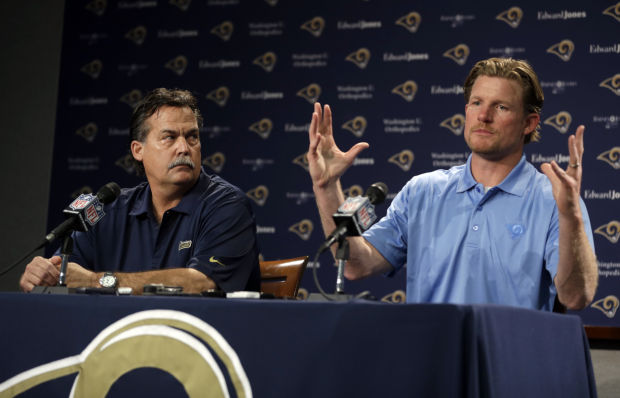
RAMS COACH FISHER THINKS HIS GM LES SNEAD SHOULD GET ON WITH THE PRESS CONFERENCE & NOT OBSESS OVER CATCHING ONE STUPID LITTLE FLY.
March 4, 2015 at 11:33 pm in reply to: Bills sign Matt Cassel and other musings on the qb market this year #19463znModeratorWorst Quarterback Market … EVER? (Maybe Not, But It’s Pretty Terrible)
http://grantland.com/the-triangle/worst-quarterback-market-ever-maybe-not-but-its-pretty-terrible/
That the Josh McCown sweepstakes was a real thing tells you all you need to know about this year’s veteran quarterback market: It’s barren as hell. The available talent — if you can call it that — can only be described as Bortlesesque.
The “winners” of McCown’s services — the oranger-than-ever Cleveland Browns — are probably no more set at quarterback today than they were before McCown’s signing. While part of that has to do with the fact that Johnny Manziel is in rehab, it’s mostly a reflection of the historically uninspiring options at hand. Sometimes life gives you lemons, and other times it gives you a 35-year-old career journeyman who went 1-10 in his most recent stint as a starter. This is an article about those other times. Join me as we meet the free-agent quarterback class of 2015, where accuracy, arm strength, and durability go to die.
Mark Sanchez’s season in Philly was a pretty apt microcosm of his career: A hot, victorious start quickly gave way to a dismal conclusion, reminding everyone why he inked only a one-year deal in the first place. Chip Kelly seems content to ride it out with Nick Foles or sell the farm for Marcus Mariota, leaving Sanchez in the dust like a college facing possible NCAA sanctions. This has turned out to be a rather fortuitous development, though, because the door is now open for Sanchez to reunite with Rex Ryan in Buffalo, and I think I speak for all of America when I say that we really need those two on Hard Knocks again. I mean, Rex has already updated the tattoo of his wife in a Sanchize jersey to Bills colors, and it’s not like he’s got anyone better to play quarterback.
Something that is definitely not meant to be: Christian Ponder as an NFL starter. You knew it was over when he was benched for Matt Cassel in 2013, and the Vikings officially gave up on the dream when they drafted Teddy Bridgewater last year. Of course, Ponder can still be a serviceable backup, and someone — perhaps the Bucs, what with the Leslie Frazier connection — will bring him in on a short-term contract to fill out a roster spot and “mentor” a rookie.1
Meanwhile, I steadfastly maintain that fellow 2011 first-rounder Jake Locker would be a semiproductive starter if there were no such thing as injuries, but alas, his future employer might as well sign him straight to IR. As for Michael Vick and Jason Campbell, well, I’d encourage them to sign up for America Works. Speaking of which, here’s an exclusive look at Frank Underwood’s assessment of this quarterback market:
Former Brady Backups
The transcendent quality ascribed to Tom Brady’s backups is one of the more inexplicable phenomena in recent sports history, but that doesn’t mean anyone will actually back up the Brinks truck for Brian Hoyer or Ryan Mallett next week. With the Browns adding McCown, Hoyer’s future in Cleveland appears to be over, and if this Adam Schefter report from November is to be believed, the Titans and Texans will be among his primary suitors, which isn’t surprising given that he has played for Ken Whisenhunt and Bill O’Brien. Lurking, of course, is Buffalo. Buffalo is always lurking.
Nevertheless, I can’t see the Texans bailing on Mallett’s relatively high upside for a known commodity like Hoyer, who wouldn’t provide much improvement over the immortal Ryan Fitzpatrick. Needless to say, Houston is fortunate to play in the AFC South, at least until our man Bortles comes from out of nowhere. (You know it’s coming.)
Need a starter? Then this is decidedly NOT the section for you, unless you harbor abnormally positive feelings about the career prospects of Matt Moore, Colt McCoy, and/or Shaun Hill, among other low-rent backup options. Let’s start with Moore: Yes, he has prototypical size. No, he doesn’t offer anything else of note, including experience — he’s attempted only 29 passes in the past three seasons. And while McCoy beat the Cowboys on Monday Night Football last year and promptly unseated RG3, he also floundered down the stretch and finished the season on IR. Hill is basically an off-brand version of McCown and somehow made Austin Davis look like a god for a brief period of time, which is the greatest possible indictment of a quarterback’s ability.
This is the point when names like Tarvaris Jackson, Matt Flynn, and Jimmy Clausen come into play, and that’s a rabbit hole I am simply not willing to explore. If your team is in the market for a quarterback and starts shopping in this aisle of the Econo-Save, the best option might just be to pray.
znModeratorinteresting. sounds like the carson site was never really an option.
from off the net
===
laram
I’ve been sitting on this post for weeks. Out of respect to my St Louis brothern (who already know this) I never talk about the Rams situation publicly, but I feel compelled to speak on this subject and clear up a few things.
The NFL already knows who they want to be in Los Angeles, they’ve done their due-diligence to ensure that they get it right.. That is the reason they took control of the Los Angeles market, so they could ostensibly control this golden goose. They don’t have to do or say anything until the chairs stop.
As you know, the NFL initially sent out a notice for participants to be a part of a Focus Group to gauge the potential return of the NFL to the Los Angeles area. The response was so overwhelming that they had to scale it down by setting certain criteria. They conducted phone interviews with top business owners, individuals that hold psl’s, suites, season tickets, etc., with other sports teams, and individuals with a certain net worth.
There are 32 of the Top Fortune 500 companies located in LA County, each one was represented.
I attended the Focus Group in downtown LA at Mondo Research conducted by Conventions, Sports & Leisure International out of Addison Texas. There was a very small select group of approximately 15 people in my group. However, when they found out my affiliations, I could only participate as a spectator.
The questions they asked centered around potential seating concepts, pricing and amenity packages and most importantly teams! I sent pictures and pricing to a few of my board friends months ago.
Long story made short, it was unanimous among all of the groups that they would not support the Oakland Raiders, even if the suites/PSL’s/tickets were offered at a discounted price. The premise was that there would be two teams between the Rams, Chargers and Raiders, and every scenario that included the Raiders was the least desired.
Overwhelmingly the combination of the Rams/Chargers was the preference. The money had spoken.
The Chargers and Raiders will not play in Carson, CA partially for the reasons I stated above, as well as these.
1. Carson is dealing with an abhorrent gang problem right now. The last thing they will allow is for the Raiders to play in that community.
2. Neither Spanos nor Davis can afford to fight the NFL. They don’t have the finances to build a stadium, pay relocation fees and fight a lawsuit
3. The Chargers and Raiders aren’t even at the starting gate. Even if everything went smoothly, they’re at least 4 years away.
4. Despite what is being reported, the Chargers/Raiders do not even own the land. This land was/is an oil mine area that is already encumbered by several law suits.
5. They will not be able to raise the desired funds through PSL sales in Carson.Won’t happen.
After the vetting process, below is the invite that I received.
Conventions, Sports & Leisure International (CSL), a sports and entertainment advisory company, will be hosting a limited number of focus group sessions on Wednesday, October 29th and Thursday, October 30th in the Los Angeles area in order to obtain opinions and feedback related to the potential return of the National Football League (NFL) to the Los Angeles area.
Thank you for your willingness to assist Conventions, Sports & Leisure International in asessing the potential return of the NFL to the Los Angeles area. Your attendance is confirmed for the focus group to be held on Wednesday, October 29th, from 7:30am to 9:00am at Mondo Research.
The facility is located in downtown Los Angeles at the following address:
Los Angeles NFL Focus Group – RSVP ID: 26942
You have confirmed 1 person(s) will be attending this event.When:
Wednesday, October 29, 2014
07:30 AM – 09:00 AMWhere:
Mondo Research
1130 S. Flower St., Suite 203
Los Angeles, CA. 90015znModeratorFerguson Police Routinely Violate Rights of Blacks, Justice Dept. Finds
Ferguson Police Department May Fold Due To DOJ Probe
from Ferguson Report: Rampant Racism and Other Scathing Findings From Probe
http://news.yahoo.com/ferguson-report-rampant-racism-other-scathing-findings-probe-230500693.html
The Department of Justice today released its investigation of the Ferguson police, which found a pattern and practice of discriminatory policing.
“As detailed in our searing report … this investigation found a community that was deeply polarized; a community where deep distrust and hostility often characterized interactions between police and area residents,” said US Attorney General Eric Holder. “A community where local authorities consistently approached law enforcement not as a means for protecting public safety, but as a way to generate revenue. A community where both policing and municipal court practices were found to disproportionately harm African American residents. A community where this harm frequently appears to stem, at least in part, from racial bias – both implicit and explicit. And a community where all of these conditions, unlawful practices, and constitutional violations have not only severely undermined the public trust, eroded police legitimacy, and made local residents less safe –- but created an intensely charged atmosphere where people feel under assault and under siege by those charged to serve and protect them.”
The conclusions come nearly seven months after a confrontation with officer Darren Wilson left 18-year-old Michael Brown dead.
In the wake of the controversial slaying of unarmed teenager Trayvon Martin, Brown’s death reignited a national debate over race in America and sparked protests across the country. Separately today, the DOJ announced that Wilson will not be charged in Brown’s death.
Here is a sampling of some of the 100-page report’s most scathing findings:
POLICING PRACTICES
The investigation has found that the Ferguson police department “routinely” stopped African American drivers without reasonable suspicion, arrested them without probable cause, and used unreasonable force against them. The police actions, the investigation found, were “unconstitutional,” and amounted to a “pattern and practice” of unlawful conduct.
“Conducting stops without reasonable suspicion and arrests without probable cause” — both violations of the Fourth Amendment, according to the DOJ.
RACIAL BIAS
The report found that racial bias and a desire to generate revenue drove much of the law enforcement efforts in Ferguson. African Americans accounted for 85 percent of the vehicle stops, 90 percent of the citations, and 93 percent of the arrests, despite making up only 67 percent of the population. “African Americans are more than twice as likely as white drivers to be searched during vehicle stops,” the report found, “but are found in possession of contraband 26 percent less often than white drivers.”
Harmful municipal court and police practices are due, at least in part, to intentional discrimination as “demonstrated by direct evidence of racial bias and stereotyping about African Americans by certain Ferguson police and municipal court officials,” according to the DOJ.
USE OF FORCE
When it comes to use of force by the police, the report found that nearly 90 percent of the documented force cases involved African Americans. Senior DOJ officials said that they found 161 excessive force cases filed against the police from 2010 to 2014, but only one had been “founded.” No officers were disciplined for excessive force in that time period. And, in every canine bite incident for which racial information is available, the investigation found, the person bitten was an African- American.
26 REMEDIES
In summary, investigators say that even before the shooting of Micheal Brown, years of biased and unlawful policing practices has eroded community trust.
The Department of Justice has recommended 26 steps the city should take to start correcting these longstanding issues. Among them:
Implement measures to reduce police bias and its impact on police behavior
Implement a robust system of community policing
Stop search, ticking and arrest practices, and focus on community protection
Change use of force practices and encourage de-escalation and use of minimal force
Change response to students to avoid criminalizing youth
Improve and increase training generally
Increase civilian involvement in police decision making
Improve officer supervision
Develop mechanisms to more effectively respond to allegations of officer misconduct
Change Court procedures to simplify processes
Reform trial procedures to ensure full compliance with due process
Stop using warrants as a means of collecting owed fines and feesAt a briefing about the results of the investigation, top DOJ officials – who asked not be named – said that some of the recommendations are already being implemented, and they believed Ferguson officials had to ability to change. If the city does not make the recommended changes, these officials said that the Justice Department would not hesitate to file suit against the city.
znModeratorProFootballTalkVerified account @ProFootballTalk
Per league source, Texans have informed Chris Myers he will be released.
===
Texans cut longtime C Chris Myers, save $6M
http://www.rotoworld.com/headlines/nfl/0/football-headlines/
Myers has been the Texans’ center the past seven seasons and never missed a start. Due $6 million in the final year of his contract and scheduled to count $8 million against the cap, it was a logical move to move on from the 33-year-old. Myers was a top-three run-blocking center at Pro Football Focus this past season, but finished 33rd out of 41 as a pass blocker. Myers may resurface in Denver with old pal Gary Kubiak. At 286 pounds, he’s built for a zone-blocking scheme.
Source: Profootballtalk on NBC SportsznModeratorSource: Probe Of Ferguson Police Uncovers Racist Comment About Obama
Ferguson Police Routinely Violate Rights of Blacks, Justice Dept. Finds
Ferguson Police Department May Fold Due To DOJ Probe
FERGUSON, Mo. — U.S. Justice Department investigations of police departments in the past have led to reforms or lengthy litigation. But the DOJ probe of the Ferguson, Missouri, police department, to be announced on Wednesday, may lead to a possible outcome that would set the St. Louis suburb apart: eliminating the police department.
The investigation, begun after a Ferguson officer shot to death unarmed teenager Michael Brown in August, alleges that town authorities routinely violated the constitutional rights of residents with unreasonable searches and force, and that the city budget was largely funded by tickets and fines.
Once Ferguson tallies the costs of either fighting the DOJ allegations or adopting reforms the department will require, it may decide the best choice would be to get rid of the police department and hire another agency to police the town.
“My guess is it’s going to be so expensive to the city of Ferguson, they’re going to have to make a survival decision,” Tim Fitch, the former head of the St. Louis County Police Department, said in a recent interview with The Huffington Post. “Financially, I don’t believe they’re going to be able to do one of two things: Either they’re going to fight it, and not be able to afford that, or to implement all of the changes that DOJ is going to require is going to be so expensive, they’re not going to be able to do it.”
Fitch and some other county law enforcement officials have criticized some small police departments in the county for aggressive ticket-writing and law enforcement. Jon Belmar, the current St. Louis County police chief, called the ticketing practices of some departments “immoral.” St. Louis County Prosecuting Attorney Bob McCulloch has said there are police departments in the area that shouldn’t exist. St. Louis County may stand to benefit by taking over Ferguson policing if such a decision is reached.
Ferguson officials have given no indication they are considering handing the town’s law enforcement to another agency. They said they won’t comment on the DOJ investigation until it is formally released.
“I can tell you that the citizens I hear from by and large –- and this is even from citizens who’ve been involved in protests -– want nothing to do with St. Louis County Police,” Mayor James Knowles III recently told St. Louis Public Radio. “Many people, for whatever they feel is wrong with a local municipal police department, feel that they have the most influence over a local municipal police department.”
But the costs of reform, including paying for a court-ordered monitor, along with a likely decrease in revenue generated by Ferguson’s municipal court, may force consideration. Only a few cities as small as Ferguson have worked with the DOJ on police reforms. The process may cost millions over several years.
The DOJ’s so-called pattern or practice investigation of Ferguson police was announced in September, weeks after 18-year-old Michael Brown was killed by Ferguson Officer Darren Wilson. Police Chief Tom Jackson said at the time that his department would “fully cooperate,” with what he saw as an opportunity to “get better.”
Merrick Bobb, executive director of the nonprofit Police Assessment Resource Center who has worked with the Justice Department as a court monitor, said he doesn’t believe eliminating Ferguson’s police department will solve the problems.
“I happen to believe that a consent decree and a monitor are going to be required in the Ferguson situation, and I find it hard to believe that if the department just folded up and flew away, that would end the problem,” Bobb said in a recent interview.
As news of the DOJ investigation leaked out Tuesday, some Ferguson-area activists and politicians renewed their calls for the city police department to be shut down.
Tony Rice, a protest organizer and Ferguson resident, said he hopes the Ferguson department dissolves, but he is unsure about the idea of St. Louis County Police Department taking over.
“At this point, yes they should fold,” Rice said in an interview, adding that he thinks Ferguson Chief Jackson could be part of the solution.
“St. Louis County approved of the militarization of the officers,” Rice said. “I am not fond of them.”
——————
Here are 7 racist jokes Ferguson police and court officials made over emailhttp://www.vox.com/2015/3/4/8149699/ferguson-police-racist-jokes
The US Department of Justice found many, many things wrong in its investigation into the Ferguson Police Department, including a pattern of racial bias. But perhaps the most disturbing findings were the racist email exchanges between police and court officials, which show outright hostility and prejudice toward the St. Louis suburb’s black residents.
Here are the seven emails the Justice Department uncovered, all of which come from current employees and were apparently sent during work hours:
A November 2008 email said President Barack Obama won’t be president for long because “what black man holds a steady job for four years.”
A March 2010 email mocked African Americans with horrible stereotypes about their families and how they speak. One line of the email read, “I be so glad that dis be my last child support payment! Month after month, year after year, all dose payments!”
An April 2011 email depicted President Obama as a chimpanzee.
A May 2011 email said, “An African-American woman in New Orleans was admitted into the hospital for a pregnancy termination. Two weeks later she received a check for $5,000. She phoned the hospital to ask who it was from. The hospital said, ‘Crimestoppers.'”
A June 2011 email said a man wanted to obtain “welfare” for his dogs because they are “mixed in color, unemployed, lazy, can’t speak English and have no frigging clue who their Daddies are.”
An October 2011 email had a photo of a bare-chested group of dancing women, apparently in Africa, with the caption, “Michelle Obama’s High School Reunion.”
A December 2011 email made jokes based off offensive stereotypes about Muslims.
The Justice Department found no evidence that any of the police and court officials who engaged in these emails were ever disciplined. The investigation also found no indication that any official asked the sender to stop sending such emails, or any proof that the emails were reported. “Instead, the emails were usually forwarded along to others,” the report stated.
The emails back an important point made by the Justice Department: the report argued the disparities in law enforcement can only be explained, at least in part, by unlawful bias and stereotypes against African-Americans. The exchanges show that outright racism very clearly.
The report noted that, although black people make up about 67 percent of Ferguson’s population, 88 percent of documented uses of force by Ferguson police from 2010 to August 2014 were against African Americans. In the 14 police canine bite cases for which racial data was available, the people bitten were black.
There were similar racial disparities in traffic stops. From 2012 to 2014, 85 percent of people stopped, 90 percent of people who received a citation, and 93 percent of people arrested were black. Black drivers were more than twice as likely as their white counterparts to be searched during vehicle stops, but 26 percent less likely to have contraband.
znModeratorNext year scares me. Even if we are competitive this year… What’s going to happen next year when we have to let playets go due to cap problems. I don’t see how we can pay them all.
Basically, as of right now, it’s Bradford, Hayes, Brockers, Quick, Jenkins, and Zuerelein.
We don’t know yet if they will want to keep all 6.
But…the way the Rams frontload contracts, they use the 2nd year of a signing, not just the first. So let’s say someone signs in 2015. Their 2015 cap could be less, while the heavy frontload hit is put in 2016.
So the key to the Rams cap is that they are okay IF they have a lot of space in UPCOMING years. Not just the free agency year.
As it stands right now, with a projected 150 M cap in 2016 and presumably at least the same in 2017, the Rams are fine.
They have 60 M free in 2016, and 100 M free in 2017.
That’s before they sign 2 draft classes or add anyone else.
But that’s also before they cut or modify the numbers for guys like Jake Long or Laurinaitis (who will be an 8 M dollar 9 year vet in 2017).
znModeratorRams show interest in Darnell Dockett
By Nick Wagoner
http://espn.go.com/blog/st-louis-rams/post/_/id/16731/rams-show-interest-in-darnell-dockett
EARTH CITY, Mo. — There’s a battle brewing for the services of defensive lineman Darnell Dockett in the NFC West division.
According to ESPN NFL Insider Adam Schefter, all four teams, including the St. Louis Rams have showed interest in the recently released Arizona Cardinal.
Adam Schefter @AdamSchefter
Former Cardinals DT Darnell Dockett expected to decide today between 49ers and Cardinals, though Rams and Seahawks also interested.Schefter’s report makes clear that Dockett is going to decide soon and all signs point to that decision coming down to a return to Arizona or a move to San Francisco to play for the 49ers. The Seattle Seahawks and the Rams have apparently “shown interest” in Dockett but that interest hasn’t manifested into any sort of visits.
Dockett paid a visit to San Francisco on Monday night with the Niners’ interest coming in part because of the uncertain future of defensive lineman Justin Smith. Arizona released Dockett in order to save $6.8 million in salary-cap space but did so with hopes of bringing him back at a reduced cost.
In 158 games with the Cardinals, the 6-foot-4, 293-pound Dockett had 459 tackles, 40.5 sacks and four interceptions. The 33-year old Dockett missed all of last season with an ACL injury but had been extremely durable before that, missing only two games in the previous 10 years.
Even though it sounds unlikely that the Rams will be major players in the Dockett sweepstakes, that they have some interest in Dockett should be telling for what they are looking for on their defensive line.
The Rams released defensive tackle Kendall Langford last week in a cost-cutting move and though they left the door open for Langford’s return, he has begun taking free-agent visits in search of a starting job. Langford wrapped up a visit to Detroit and is scheduled to head to New York to meet with the Jets before a stop in New Orleans.
Sans Langford, the Rams are down to just two defensive tackles — Aaron Donald and Michael Brockers — under contract for 2015. Much like last year, it means the Rams will again be scouring the free-agent market for depth. In 2014, that resulted in the addition of Alex Carrington, who didn’t offer much in his one season with the team.
An older veteran like Dockett would make sense for what the Rams need because whoever they bring in will probably only be needed for 25 or so snaps a game. Although it appears the Rams aren’t going to be Dockett’s destination, the Rams’ potential interest should be instructive in the types of defensive tackles the team will be vetting as free agency begins.
znModeratorWe’ve been told that the Rams have very limited funds for and interest in FAs.
Actually, it’s not really the case that they have limited resources for FAs. They aren’t set up for massive FA spending, but they can do a fair amount. They do have the ability to create cap space, in fact easily. The Rams cap is deceptive, since they are slow to cut people and they frontload aggressively. But they can instantly produce space any time they want to sign someone.
Dockett is a cut. That means he can be signed immediately. If they are interested, it would be a kind of “opportunity hire.” Showing interest in him looks to me like it has to do with seeing an unexpected possibility and being pragmatic enough to follow it.
Free agency hasn’t even started yet. If a cut like Dockett interests you, you have to jump on it.
But none of that is related to what they can do come time for free agency. As I said, these guys can create space at will. They’re set up to do that. Their cap policies allow for it–in fact their policies deliberately set things up that way.
So to me jumping at a chance for Dockett is just not going to impair their ability to sign a FA when it is time to sign FAs, if in fact they’re interested in FAs.
-
AuthorPosts