
Forum Replies Created
-
AuthorPosts
-
 znModerator
This is a very good article and McVay comes up in it.
.
znModeratorPro Football Focus @PFF
Jared Goff had little chance on many third downs last year
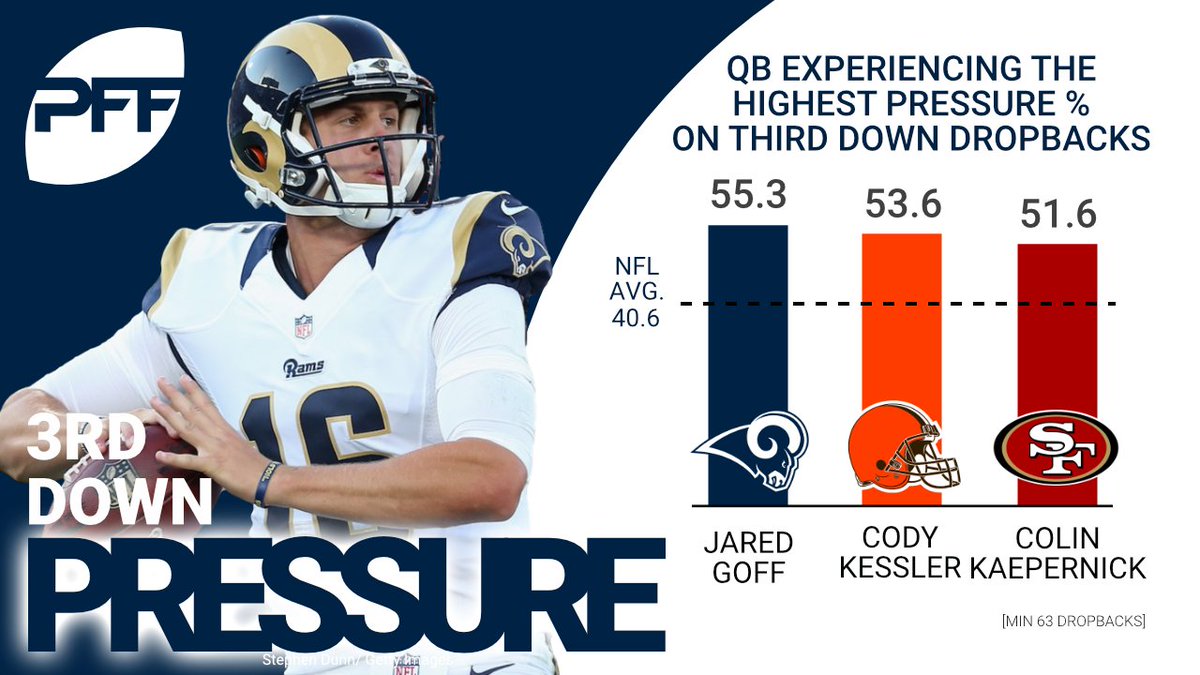 znModerator
In second year in L.A., Rams hope latest transition brings more wins
Joe Curley
It took more than 30 tractor trailers and three stops to return the Rams to Southern California a year ago.
And yet, for all the changes the franchise endured off the field, the on-field results in Los Angeles bore a striking resemblance to what fans had suffered through in St. Louis.
The first season in Southern California since 1994, the first in Los Angeles since 1979, was launched with “Hard Knocks” and the Red Hot Chili Peppers.
Then it crashed to earth with empty seats and bitter defeats. Eleven losses in the final 12 games made for a long limp to the 12th straight year without a playoff berth and a 13th consecutive season without a winning record.
What once was The Greatest Show on Turf had devolved into an unwatchable mess, no matter the playing surface. A second straight season as the worst offense in football cost head coach Jeff Fisher his job with three games to play.
“Anytime you let a head coach go, we all have to take a look in the mirror,” Rams chief operating officer Kevin Demoff said on Dec. 12. “We have to improve across the board.”
That introspection led Demoff and owner Stan Kroenke to make Sean McVay, the then-30-year-old Washington offensive coordinator, the youngest head coach in modern NFL history on Jan. 13.
“Age is not a factor here,” Demoff said. “This is really about Sean’s talents, his ability to lead and communicate, and what we think that will do for the Los Angeles Rams.”
And so, one year after uprooting the entire franchise and moving 2,000 miles west, the Rams entered yet another transformative offseason, albeit a more typical NFL transition.
“Those are some pretty big transitions,” linebacker Alec Ogletree said. “Going from one city to another and then, after that, the whole coaching staff leaves.”
A young roster, the vast majority of which had never played for another NFL head coach, was left to start over from scratch with new leadership.
“He definitely seems like a guy that’s been around a while,” Ogeltree said of McVay. “You can gravitate toward a guy like that because he’s young, energetic and you can definitely tell he has a lot of wisdom about him.”
When he stepped foot on the Coliseum grass for the first time in June, McVay recalled watching the Rams’ first game back in Los Angeles, the come-from-behind win over Dallas before the largest crowd in preseason history.
“I remember I was in Richmond coaching (at Washington’s training camp) and thinking, ‘What an unbelievable atmosphere,’ ” McVay said. “So you can see that this city is hungry for a great football product.
“It’s our job to be able to give the fans something that they can be proud of and give them a product that they want to root for consistently week in and week out.”
The Rams felt short of that aim a year ago. They scored the fewest points in the NFL, just 14 points per game, and mustered the franchise’s lowest mark in total offense (262.6 yards per game) since 1963.
It was, according to Football Outsiders’ metrics, the NFL’s worst offense since 2005.
The wall of sound that met the Cowboys in preseason game fell away as the losses piled up, as star running back Todd Gurley struggled through what general manager Les Snead would label a “sophomore slump,” as No. 1 overall pick Jared Goff went 0-7 as a rookie quarterback, as the heartbreaking losses of October and November turned into embarrassing blowouts in December.
“We all left with a nasty taste in our mouth,” defensive tackle Aaron Donald said.
Meanwhile, Washington was third in total offense, as McVay helped Kirk Cousins emerge as one of the most productive passers in football.
“We want to be an offense (gives) the quarterback answers,” McVay said. “You want to be able to distribute the ball. … When you feel like you’ve got a handful of playmakers, the idea is to kind of have that quarterback be a point guard and be a great distributor to all your guys.”
McVay has been hired to follow up his success with Cousins by putting Goff’s young career on track. It is the biggest priority of his first season as head coach.
Several players have already come forward to declare themselves as believers in their new coach, including the quarterback.
“I think right off the bat you can tell that his knowledge is extremely high, far higher than a lot of guys,” said Goff.
McVay retained three members of the former staff, special teams coordinator John Fassell, who was elevated to interim head coach for the final three games of the season, running backs coach Skip Peete and assistant offensive line coach Andy Dickerson.
Besides that, the entire staff, highlighted by offensive coordinator Matt Lafleur and defensive coordinator Wade Phillips, is new.
“For us, the guys who have been here, I guess it’s a fresh start,” Ogletree said during the team’s offseason program in Thousand Oaks. “We’re just trying to get to know them as well as they’re trying to get to know us.”
There was also significant turnover on the roster. Almost a third of the players who ended the 2016 season with the team aren’t in Irvine for the start of training camp, including 13 starters who combined to make 145 starts a year ago.
That figure includes receivers Kenny Britt and Brian Quick and tight end Lance Kendricks, who combined for 62 percent of the team’s receiving production; offensive line starters Tim Barnes and Greg Robinson; defensive leaders William Hayes, T.J. McDonald and Eugene Sims; special teams stalwarts Benny Cunningham and Chase Reynolds; and quarterback Case Keenum, who started the first nine games before yielding to Goff.
The Rams didn’t just move on from Fisher, they moved on from many of his veteran leaders.
“I know there’s a lot of respect in this building, and me personally, for Coach Fisher,” McVay said. “It certainly isn’t anything like that.”
A bigger motivation for the culling may have been salary-cap related. The moves allowed the Rams to add several veterans in free agency.
The duo of 35-year-old left tackle Andrew Whitworth and 31-year-old center John Sullivan, the only two players on the roster older than McVay, were signed to solidify the offensive line.
Whitworth, an All-Pro in Cincinnati, allowed the fewest pass pressures among NFL tackles in 2016, according to Pro Football Focus.
“He’s played at an extremely productive level and he’s a grown man,” McVay said.
Sullivan, whose health will be a key factor in the season, worked in Washington with McVay, who sees center as one of the most important positions on the field.
The hope is Lance Dunbar, signed from Dallas, can be the versatile type of running back that Chris Thompson was for McVay in Washington.
Robert Woods, the former USC star, was signed from Buffalo to bring some experience to the receiver room, which now includes four players drafted over the past two years.
“He does all of the little things the right way,” McVay said. “He’s competing in the run game. He can play inside, outside.”
Outside linebacker Connor Barwin and cornerback Kayvon Webster, who played for Phillips in Houston and Denver, respectively, were brought in to help stabilize the defense’s move to his 3-4 system.
“Having his opinion on those guys and that intricate, inside knowledge … it’s why you’re glad to have a guy like Wade Phillips that we can all lean on,” McVay said.
Perhaps part of the reason why the Rams always seemed to be building under Fisher, and never really arrived, was because of their perpetual youth.
They had the youngest roster to open the season in each of the past five years, according to an annual study by Jimmy Kempski of the Philly Voice.
In each of those years, the Rams’ roster was an average of about 25 years old. An early estimation of the 53-man roster shows the Rams trending toward a similarly youthful figure this fall.
While Fisher was fired, Snead was retained, which was seen as a clue to who had final say on personnel matters over the past five years.
But this hasn’t been a fun offseason for Snead, either.
The Rams have spun their wheels in contract negotiations with franchise cornerback Trumaine Johnson. They elected to spend $17 million to franchise tag the 27-year-old, who had one interception last season, for the second straight year, making him the highest-paid cornerback in the NFL.
Johnson looks set to hit the open market next year, which would be two years after the Rams lost two members of their starting secondary, safety Rodney McLeod and cornerback Janoris Jenkins, to free agency.
“I think Trumaine is going to be a fit in any system,” McVay said. “This is a talented corner.”
Perhaps worse, Donald, one of the top defensive players in the league, sat out organized team activities as the team and his representatives worked on a contract extension that has yet to materialize. He reportedly didn’t show up for the first day veterans were to report to training camp Friday.
The Rams may be hamstrung by their cap situation. Even after saving money by dealing Robinson to Detroit, they have the least amount of cap space in the NFL, less than $4 million, according to overthecap.com.
The Rams also suffered a setback off the field during the offseason, announcing in May that the opening of their $2.6 billion stadium in Inglewood would be delayed a season until 2020.
The delay was blamed on record rainfall during the excavation phase of the project. In the aftermath, the NFL also pushed back the Super Bowl’s return to Los Angeles by a year, until 2022.
The Rams, in the meantime, will remain in the Coliseum, as the historic venue receives its own $220 million facelift.
After enduring radical changes off and on the field over the past two seasons, the Rams may remain a team in transition, as the seismic shifts of football in Los Angeles continue to settle.
znModeratorRams General Manager Les Snead, Head Coach Sean McVay – July 28, 2017
(Opening Remarks)
Snead: “Look, I think I will open with this, today is no different than yesterday, not any different than this summer, not any different than this spring – (DT) Aaron (Donald) is a priority. The goal is still the same, make Aaron a Ram for a long, long time, so that didn’t change at all. I definitely respect Aaron as a human, respect the process. I will let (Head Coach) Sean (McVay) get into this – I do know that Indy is still going to come to town, they are going to keep score, they will post standings the next day and we have got – just as Aaron is a priority, there are 89 other guys here that are a priority as well. Sean and those guys are going to work to get those guys ready for Indy.”
McVay “Yeah, a lot of the same. He is a great player. We knew that this was a potential possibility for us and we are constantly going through, trying to get a solution to this. But in the meantime, training camp starts tomorrow. We have 90 guys or 89 guys that will be ready to go and we are not going to allow this to set us back as our preparation moving towards the Dallas preseason game and leading into the regular season. Just like anything else, I love him, he is a great player, I think his resume speaks for itself. But in the NFL, whatever it is, adversity is inevitable and we have to be ready to handle that as a team and we will move forward accordingly.”
(On if this was a surprise)
Snead: “Like I told you yesterday, I don’t want to get into whether we were optimistic or pessimistic. I do realize that these are always complicated, so I am not going to say that it wasn’t. It wasn’t shocking or a surprise – you knew that there was a chance that it could occur. You also knew that and were hopeful that we work things out soon, but we didn’t.”
(On if they have spoken to Donald’s representatives today and have they given the Rams any indication how long he may not be at camp)
Snead: “Spoken to him today and I think that right now the focus again is getting a contract done, so that Aaron is a Ram for a long time. I am not necessarily talking about the timeline of when he shows up or not.”
(On how concerned they are about the effect that this could have on preparation and the overall vibe amongst the players)
McVay “Unfortunately he wasn’t there for a large part of the offseason program, so this is something that – kind of missing the OTAs and things like, we have been accustomed to this. He took part in the minicamp in just the walk-thru setting. Really, our plans moving forward like Les said, we are proactively pursuing to try and come to a solution because of how important Aaron is to us. But there are plenty of guys that we feel give us a chance to compete and win football games on our D-line and fortunately that is a position that we do feel like we have got some depth at. (DT) Dominque Easley had a great spring. He is a guy that will get an opportunity to play a lot more with Aaron not being there, (DL) Ethan Westbrooks, so some guys that have done some different things that I know will get a chance to get more reps in practice than they would if Aaron were here.”
(On if the talks are resting or ongoing)
Snead: “Just like you said, respect Aaron, respect his agents working through this. We have said all along, let’s try not to get into specific details. But stick to the mantra, it is a goal to make Aaron a Ram for a long time.”
(On how Donald’s absence prompts more motivation than before to come to a contract agreement)
Snead: “Like I said, today is no different than yesterday or the spring. As Sean said, Aaron’s plays speaks for itself that’s the reason we want to make him a Ram a long time. So, today doesn’t change that urgency at all.”
(On whether he thinks Donald sitting out is hard on him)
Snead: “I do know Aaron Donald relativity well. I bet yes, when the calendar or the clock strikes training camp time, he’d love to be on the grass. But again like I said earlier. Respect him, respect the process that we’re going through.”
(On why they called the press conference today rather than waiting until the first day of training camp practice tomorrow)
McVay “Well, we wanted to be proactive about addressing this situation because we knew these would be questions. I think with respect to Aaron and this situation tomorrow is about training camp and us getting the things started off the right way. ‘Would we love him to be here?’ Absolutely. But like we said, we’ve got 89 guys. I think when there’s a player of his caliber that’s not present it is something that needs to be addressed and talked about. But we don’t want it to affect our ability to move forward as a team, because this is a great team sport and I think that’s really the reason we just want to be pro-active about it.”
(On how he thinks the players are handling the situation)
McVay “Well, I would say this. I know his teammates have a whole lot of respect for him with the way that he competes, what he’s about. You know, like you mentioned he loves the game of football. He’s what represents what’s right about this game in terms of those top tier players like he is. I know that they would him to be around, but there are business elements to these things that take place that have some nuisances to them. I think his teammates respect and understand that the organization and the player, it’s about us coming to a solution. But I don’t think it’s going to affect their ability to perform and do things tomorrow. While they want him to be out there, they’ve got a job to do and I think that’s their mindset.”
(On whether he’s going to specifically address the team on this situation tomorrow)
McVay “Yeah, we’ve already done that. That was one of the first things. You know, I think anytime you’ve got a player like him, a captain, an important part of what we’re trying to do you want to be able to address it right away and that’s what we did. It wasn’t like the players didn’t know what was going on. So you want to at least address it and then be able to move forward accordingly.”
(On if he has some sense of how behind Donald is as a result of the time missed and inconsideration of the new defense being installed this year)
McVay “I think with the offseason program, you know him and missing some of those OTAs, but then coming back in minicamp one of the things you do appreciate about Aaron is he loves football. There’s ways that he can stay up with it based on some of the technology that we have. So, he understands kind of his roles and responsibilities within the framework of the defense. But there’s no substitution for getting those physical reps in. That’s why this time of year is important to us. But, he is a type of guy that you know he’s going to stay up from a mental standpoint. He’s one of the few guys that you feel like will be able to make a smooth transition to whatever system just because of the caliber player he is.”
(On the pressure to get Aaron Donald to training camp)
Snead: “I mentioned it earlier, today is no different than yesterday or last week. We want Aaron to be a Ram for a long time, for all the reasons you just mentioned. I think we also said too, there’s 52 other guys, 89 other guys who are going to help us win ball games too, so I don’t think you treat any guy any different because you respect what each one of those men go through to play this game. That one’s not going to change, no matter what level you are or where you are on the depth chart, because each one of those guys are special.”
(On the possibility of striking a deal in the last 24 hours to get DT Aaron Donald to training camp)
Snead: “I told the guys earlier, never get into optimism or pessimism, but he’s been a priority and obviously in these situations both sides are working and you’re working hard to try to get something done.”
(On talking today with Donald’s representation)
Snead: “I’ll keep the details in-house, but the obvious answer is yes. Any time you’re dealing with this, you don’t go a few days without discussing the matter.”
(On how much ground needs to be made up to make a deal)
Snead: “Again, I’m going to keep the details. We respect Aaron a lot. What you said are variables, but I think we’ve seen it the last few years, especially with the new rookie bargaining agreement (Collective Bargaining Agreement). Teams like us and other teams are having to deal with these situations and we’re trying to deal with them and we want to deal with them because, like we said, we feel like Aaron has earned the right to be a Ram a long time and be paid a little more.”
(On if everybody else made it in)
McVay “Yeah.”
(On players listed on the Physically Unable to Perform list)
McVay “Those are just some things with regards to little nuances with the physicals. It’s not going to hold them up. There are certain things that we ask our players to be ready to do when they come in and report and those were the reasons. There’s no injury or anything like that and our anticipation is they will be ready to practice tomorrow.”
znModeratorRich Hammond @Rich_Hammond
I’m told, from Rams’ side, discussions with Aaron Donald and his reps have been amicable. Dialogue is open. No bitterness, just business.As today’s comments indicated, Rams have tried to show their respect to Donald. They value him as a player and a person.
That doesn’t mean a deal will get done, say, tomorrow, but it’s better than the alternative of a nasty stalemate.
znModeratorHe was claimed off waivers at the start of the 2015 season by the Pittsburgh Steelers before being released by the team a month later.
Lyons signed a futures contract with the Tennessee Titans earlier this year before being waived.
That description is a bit misleading. It leaves a gap. He actually spent 2 years on the Steelers’s practice squad.
From the wiki–
Tampa Bay Buccaneers
Lyons was signed by the Buccaneers as an undrafted free agent on May 5, 2015. He was waived on September 5, 2015.Pittsburgh Steelers
Lyons was claimed off waivers by the Pittsburgh Steelers on September 6, 2015. He was released on September 30 and then re-signed to the practice squad on October 2. On January 19, Lyons signed a futures contract with the Pittsburgh Steelers.On September 3, 2016, Lyons was released by the Steelers as part of final roster cuts. The next day he was signed to the Steelers’ practice squad.
Tennessee Titans
On January 24, 2017, Lyons signed a futures contract with the Titans. He was waived on June 13, 2017.znModeratorOH MY GOD I’M FREAKING OUT!
Vincent Bonsignore @DailyNewsVinny
1. My (educated take) #Rams and Aaron Donald will forge their path to a long-term contract that satisfies everyone’s objectives.2. There are nuances involved in a situation where the player and the team want a long-term relationship that is cognizant…
3. …Of the reality of the NFL salary cap – which is unlike that of the NBA or MLB4. The trick for both sides is a contract that rewards a talent like Donald but also leaves flexibility to fairly pay others…
5. As well as go out and add talent. There’s nuance involved in creating that kind of deal for a mega talent like Donald. Takes time===
Joe Marciano @JoeMarciano
Yet the Rams cant sign their best player. Incompetent FO.Benjamin Allbright @AllbrightNFL
They will. Trust meznModeratorJoe Marciano @JoeMarciano
Yet the Rams cant sign their best player. Incompetent FO.Benjamin Allbright @AllbrightNFL
They will. Trust meznModeratorWhat’s Camp with Wade Phillips like? Barwin says ‘Fun and Intense’
Myles Simmons
Heading into his ninth professional season, outside linebacker Connor Barwin has been through his share of training camps. And while it’s his first year with the Rams, it won’t be his first time playing under defensive coordinator Wade Phillips.
Barwin had one of his most successful NFL seasons under Phillips back in 2011, when the outside linebacker recorded 11.5 sacks with the Texans. Now reunited after four years apart, Barwin has a good idea of what to expect from Phillips during training camp.
“I would say that it’s fun and it’s intense,” Barwin told reporters Friday morning. “Wade is really going to really make sure people are improving. Wade — as I’m sure you guys are starting to learn — Wade wants to make sure
that everyone knows exactly what they are doing. Wade doesn’t allow people to make mistakes and he will become very frustrated with you if you do not learn that through training camp, which I learned and everyone is going to learn.
“People saw that during OTAs and minicamp, but when you are here now this is the big show and if you are continuing to make the same mistakes here, that is the kind of player that you are going to be this season,” Barwin continued. “So you need to show that you can continue to learn and improve. Wade has been around for a long time, obviously. He knows what camp is like and part of that is having fun and getting to know the guys better as well.”
Head coach Sean McVay has continually stated throughout the offseason that his focus is on ensuring the Rams improve daily. Barwin echoed that sentiment when asked about the defensive unit’s ultimate potential in 2017.
“I think we had a good offseason, good OTAs, good minicamp,” Barwin said, “but now we’ve got to kind of put in the work you need to put in during training camp and make sure that we take the next month and improve and be a lot better a month from now than we are today.”
znModeratorWell no-one does the “the US does it too” schtick either.
But on a message-board its hard to work in subtleties and nuances and layers in every post. Makes’em too long. We just shoot from the hip and it leads to misunderstandings. Or actual differences. I dunno.
w
So, according to you, I said that the US is a message board that is too hip to shoot.
I said no such thing.
I hate it when posters misread like that.
…
znModeratorMcVay Prepares To Take On First Training Camp As Head Coach
By Kristen Lago
A new head coach only gets one shot at his first NFL training camp.
Rams head coach Sean McVay will get his chance tomorrow with the opening practice of 2017 training camp. Though McVay has been with the team throughout the offseason program, Saturday marks his first chance to truly set the foundation for a strong season.
Speaking to the media on Thursday, McVay expressed his enthusiasm to get started and his eagerness to take the field with his team.“I know myself and all the coaches are all excited to get going and I feel like the players share that same feeling,” he said. “It’s about that daily improvement. If we do that, we feel like we’ll make those incremental improvements every single day that will lead to good things when those games come around on Sundays.”
But those good things won’t come easily. McVay inherited a Rams team that has not seen a winning season since 2003 and has yet to make the playoffs in the last decade. And last season’s 4-12 record was not exactly the dynamic return to Los Angeles that Rams fans were hoping for.
As most Angelenos know, sports fans here in L.A. can be some of the toughest critics out there. However, McVay expressed confidence that training camp would allow them the space needed to create a good product for fans on the field, a product that will carry over into the regular season.
“I think the thing with training camp is like we’ve talked about — it’s really coming together as a team and figuring out a way for everybody to reach their highest potential,” he said. “Because ultimately as coaches, it’s our goal to try to help these players reach their highest potential and come together as a unit. It’s about us trying to be the best football team we can be.”
The next three weeks will be a significant indication as to what the team will look like. McVay, along with the rest of his staff, has had to face a number of challenges in the time leading up to Saturday’s camp, including various contract negotiations and roster changes.
Fortunately for Rams fans, football comes naturally to the young coach, and even in his time off, McVay’s mind was always on the game.
“I did try to get away a little bit. I went on vacation with my family and with my girlfriend,” he said. “It was good to get away, but sometimes you get that playbook out, or you get some of the things out that you want to [get] going into the offseason program. But, it’s exciting to be back and be around these players. This is what you love to do.”
Both his players and staff members alike have experienced that love firsthand. General Manager Les Snead has spent the last seven months getting to watch McVay adjust to life as a head coach and is quick to comment on McVay’s passion for the game..
“I could go on for days,” Snead said. “[McVay] has a passion for football — eats, sleeps, breathes football. He is all about football. We have joked that we have got no life skills, but we can do football and I think every decision he makes is all about ‘how do you help the Rams?’”
McVay will set out to achieve that goal during training camp over the next three weeks by continuing to instill and establish a new identity for his Rams team — promoting an attitude within the Rams organization that is focused on the “we” and not the “me.”
“We’re always trying to embody a culture where it’s established through our character and communication,” he said. “There’s something special about being a part of something bigger than yourself. When you have great teams, that’s when it ends up becoming a championship opportunity.”
“When you look around the sports environment you see a bunch of great individuals, but for some reason they haven’t achieved it,” he added. “They always want to be a part of a team. And when you go through some of the adversity we’re inevitably going to face, and some of the good times, it’s all about that journey.”
And for McVay, that journey begins tomorrow as he takes the field for his first training camp as an NFL head coach.
znModeratorSnead Has High Expectations for Goff Heading into Year Two
Kristen Lago
What are realistic expectations for Jared Goff in Year 2? Will Jared Goff improve? Is Jared Goff the answer at QB for the Rams?
If you have visited any sports media website in the last few months, chances are that you have read a variation of one of these headlines. Throughout the offseason, much of the attention has surrounded the development of the Rams’ young quarterback who returned to training camp this week, kicking off his second year in the NFL.
General Manager Les Snead was met with those same questions on Thursday, ahead of Saturday’s first official training camp practice.
“Right now, there are 32 quarterbacks penciled in at starter,” Snead said. “He is the only one that is 22 years old. So I do think the experience he got last year coming in with a new offense, you get better with experience, so you expect progress.”
Goff completed just 112 passes for 1,089 yards and five touchdowns in his rookie season in Los Angeles.
But the Rams made important changes throughout the offseason to surround Goff with a strong offensive line, signing veteran left tackle Andrew Whitworth to protect his blindside. The staff also made a point to bring in new skill players and offensive weapons for Goff, including wide receivers Robert Woods and Cooper Kupp.
“We did make some moves,” Snead said, “some where you let players go, some where you bring them in. I do love the veteran presence of an Andrew Whitworth, even a Robert Woods, [who] is a younger guy. We still have a young team, but bringing in some guys that have been there and done that in the locker room helps.”
Snead went on to discuss Goff’s steady improvement over the offseason, translating his hard work in the classroom, studying the playbook, into better action on the field.
“He definitely didn’t spend time trying to get better at golf if you look at the [American Century Celebrity Golf Championship] Tahoe scores,” Snead said with a laugh. “He has spent a lot of time trying to improve his trade in football. I thought throughout the course of the offseason program he was kind of just getting comfortable with some of the core things that we want to embody as an offense,” he continued, “and some of the things that will shape and establish our identity.”
While the next three weeks here at UC Irvine will give Goff a chance to answer many of the questions surrounding his development himself, Snead made a strong point of looking at the quarterback’s improvement not as an immediate goal, but as a continuous journey.
“Hey, he could have stayed another year in college and he didn’t,” Snead said. “He is still young, so when we made the decision with Jared, we knew it wasn’t necessarily a short-term fix — it was going to be a long-term decision for the franchise. I think he’s showing really encouraging things, it’s just about doing it consistently down-in and down-out.”
July 28, 2017 at 6:47 pm in reply to: CTE Study Finds Evidence of Brain Disease in 110 Out of 111 Former NFL Players #71391znModeratorNFL to End Partnership with National Institutes of Health on Concussion Study
Alec Nathan
The National Institutes of Health will reportedly let its partnership with the NFL expire in August after the NFL previously pledged $30 million to help research the connection between brain disease and football.
According to ESPN’s Mark Fainaru-Wada and Steve Fainaru, the NIH decided not to renew its agreement with the NFL “following a bitter dispute in 2015 in which the NFL backed out of a major study that had been awarded to a researcher who had been critical of the league.”
“The NFL’s agreement with [the funding arm of the NIH] ends August 31, 2017, and there are no current research plans for the funds remaining from the original $30 million NFL commitment,” the NIH said in a statement, per ESPN.
Confirmation of the severed relationship between the NFL and NIH comes two days after the Washington Post’s Mark Maske reported Democratic members of the House Committee on Energy and Commerce submitted a letter to the NFL asking if it planned to fulfill the terms of its donation.
According to Maske, the NFL has still not contributed $18 million of the initial amount pledged in 2012.
“We are currently engaged in constructive discussions with the FINH regarding potential new research projects and the remaining funds of our $30 million commitment,” the NFL said Wednesday in a statement provided to Bleacher Report by CNN’s Jill Martin. “In September 2016, the NFL pledged $100 million in support for independent medical research and engineering advancements in neuroscience-related topics. This is in addition to the $100 million that the NFL and its partners are already spending on medical and neuroscience research.”
The relationship between the NFL and NIH has reportedly been contentious for years.
According to a May 2016 investigation by the New York Times’ John Branch, the House Committee on Energy and Commerce conducted a study that detailed the NFL’s attempt to influence where its donation was funneled.
“Our investigation has shown that while the NFL had been publicly proclaiming its role as funder and accelerator of important research, it was privately attempting to influence that research,” the committee wrote. “The NFL attempted to use its ‘unrestricted gift’ as leverage to steer funding away from one of its critics.”
On Tuesday, the medical journal JAMA (via CNN’s Daniella Emanuel) published the results of a study that showed chronic traumatic encephalopathy (CTE) had been found in the brains of 110 of 111 deceased former NFL players.
znModeratorts part of the totality of the circumstances. If we just leave that out and focus on Russia,
No one does that though. Right?
Meaning actual lefties (not dems) who also (among the many things they do) critique Russia and the Trump/Russia connection, and/or don’t dismiss the Russia thing in general.
Those are informed lefties, and not real likely to ignore American systematic problems and abuses.
..
znModeratorAaron Donald doesn’t show up for training camp
Mike Florio
https://www.profootballfocus.com/news/pro-rams-lb-alec-ogletree-working-on-an-extension
Rams G.M. Les Snead said recently that the team is working to find a resolution to defensive tackle Aaron Donald’s contract. Apparently, they’re not working hard enough for Donald’s liking.
Donald didn’t report for the start of camp, according to multiple reports.
Since he has fewer than four years of service, he’d lose a year of credit toward free agency if he doesn’t report within 30 days before the NFL’s regular-season opener. But since the 2014 first-round pick has two years left under contract but is only one year of service away from being eligible for free agency, the year of service toward free agency doesn’t matter.
Seven years ago, cornerback Darrelle Revis held out beyond the 30-day deadline despite having only three years of service. Eventually, he got his contract.
Given that the Rams actively have been negotiating with Donald, the holdout could be the spark to get the job done.
Donald was taken one spot after Giants receiver Odell Beckham Jr., who showed up for training camp despite not yet having a new deal.
znModeratorLOl, I hadn’t thought of that.
Anyway naw it was just a courtesy style public notice, in case he went looking for his post and didn’t know what happened.
So it wasn’t
Jack….sleeps with the fishes.
znModeratorTo me, it’s not a good argument to basically say, “We do it too!” Or, “We’re even worse!” One would think “the left” would oppose both our current system AND theirs, vigorously, defiantly, with passion, etc.
An interesting read (below) if you never saw it before.
There is also a lot of great stuff on Russia posted by PA Ram in this thread: http://theramshuddle.com/topic/oliver-stones-complete-putin-interviews/
—
FIRST A SYNOPSIS FROM 2 DIFFERENT, ARTICLES THAT ARE HERE: http://theramshuddle.com/topic/putin-on-syria/#post-69731
SYNOPSIS:
Russia fears the total collapse of the Syrian state, which would end a decades-old alliance and threaten its strategic position in the Middle East. And it views Islamic insurgents as not only a threat to Assad, but also a potential threat at home.
The Kremlin’s involvement in Ukraine and Syria seems to be motivated partly by its aversion to democratic regimes, in particular the so-called color revolutions that have sprung up in the Middle East and in Georgia and Ukraine. The Arab Spring came only half-heartedly to Syria, with the democratic uprising soon overtaken by armed conflict. But this does not rule out, from the Kremlin’s point of view, the possibility of insurgent groups unfriendly to Russia eventually taking over the country. The breakup of Syria, or the replacement of the Assad regime by a government more aligned with the Sunni Arab world, would leave Russia without a client state in the Middle East.
We don’t have to choose between critiquing our own foreign policy and opposing unjust foreign governments. Sure, the west’s attitude towards Putin is hypocritical. When Putin prosecuted his savage war in Chechnya, there was none of the western outrage later meted out when the Russians annexed the Crimea. Bill Clinton once lavished Putin for having “enormous potential”; Tony Blair, meanwhile, continues to call for the west to work with Putin against Islamic fundamentalism and last year attended a Putin “vanity summit”.
But for the left, opposition to Putin should go without saying
We should express our solidarity with Russia’s embattled democrats and leftists. We don’t have to choose between critiquing our own foreign policy and opposing unjust foreign governments. In a sense, critics of western foreign policy have more of a responsibility to speak out. While supporters of, for example, the Iraq calamity can be more easily batted away by Putin apologists, nobody can accuse people like me of hypocritically failing to critique western foreign policy. Russia is ruled by a human rights abusing, expansionist, oligarchic regime. The Russian people – and their neighbours – deserve better. And the western left is surely duty-bound to speak out.
each state’s propaganda machine, with patriots believing their own country’s talking points and dissidents believing the other’s, obscuring what out to be the glaringly obvious fact that neither nation-state is motivated by any principle in domestic or global affairs more honorable than “what’s good for our oligarchs,” who even live in the same parts of Manhattan.
Of course one of the reasons for even the start of this conflict was that Russia was concerned about the expansion of NATO, which happened during the last decade. Also it was the question, you could say, of the “domestic” area of Russian imperialism, which is the post-Soviet space – the idea that the post-Soviet space, maybe including the Baltic states, should be space where nothing can be decided politically without the participation of Russia. So you can’t change the government without agreement from Russian society. That is something that led to the conflict with Georgia in 2008 and that is something that led to the conflict with Ukraine, because it’s just simply a question of the master or owner of this space, who is the main person who should be asked about everything.
Russia in its English-language media, such as Russia Today, portrays Russia’s actions as basically just a response to U.S. imperialism, as if Russia itself is not imperialist but rather an anti-imperialist power
Russian foreign policy is not a policy based on any kind of view of how the world should look. There’s no kind of our own “Pax Americana” or something like this. In this sense, Russia is not the Soviet Union because the Soviet Union had a kind of project for the world; a clear alternative to the values and ideas [of the West]. There is nothing like this in Russian foreign policy. … Russia as a realist, cynical world force, wants to discuss its place in the world: the size of their piece of the cake. That’s the explanation you always hear from Putin . . . that everyone has their interests in this world, everyone wants to benefit from everything, so we want to understand the rules of the game.
I mean, if the left are ready to support this kind of logic, even if this kind of logic in some ways confronts American imperialism, I probably don’t agree with this left in a very fundamental way. I think that one of the main mistakes of a very big part of the left for years was the idea that imperialism can only be American; that if you talk about imperialism, we mean the United States, because there are not any other imperialist powers. But if we look back at the Marxist definition of imperialism we will find that imperialism, it’s always a conflict. It’s a conflict between states, between capitalist interests, and it always leads to a kind of military confrontation with the blocs of interests, like it was in the first world war. . . . So you should simply recognize that yes, even if we have no justification for American imperialism, we should recognize that there are other imperialisms. And you can’t find among these imperialisms something that is more progressive or objectively progressive than the other.
For the American left, of course for them only American imperialism exists, yes? I can’t understand it. . . . In Russia, there are a lot of leftists who also believe that Russia is the main evil in the world, it’s a reactionary empire, and it should be destroyed. Or, at the same time, you have a lot of leftists who believe somehow Russia is resisting American imperialism [and] who support these “republics” in the East of Ukraine.
But you have a huge provincialization of the left as a whole because they can’t even understand each other and every leftist community, they believe in their own national reality. And that’s why they can be so easily manipulated. By whom? By Russia Today? I think it’s a very pitiable situation because the Russian propaganda machine, which is not the most clever, not so smart . . . it can so easily manipulate such a big sector of the Western left. It points to the problem of the Western left itself, but not the strength of Russia Today.
—
THEN ONE OF THE 2 ARTICLES I REFER TO IN THE SYNOPSIS
“We should recognize that there are other imperialisms”: A Marxist dissident explains what the left gets wrong about Russia
CHARLES DAVIS
Charles Davis is a writer and producer in Los Angeles whose work has been published by outlets including Al Jazeera
Russia today is not as depicted on Russia Today, the English-language news network established by the Russian government in 2005 that paints a capitalist state led by a right-wing nationalist in pseudo-left colors: the anti-America, almost, where the poor are always fed – not just shot dead by racist police – and foreign policy is motivated not by cynical self-interest, but a dogged, one might even say principled determination to stand athwart U.S. imperialism and yell “stop!” The critiques the network airs of poverty in the United States and Washington’s bloody wars abroad are an amusing, completely fair rejoinder to the State Department’s habit of pointing out the human rights hypocrisy of everyone else, but the implication that things are any better in Moscow is no less amusing to leftists in Russia who are aware an Occupy Red Square, like Occupy Wall Street, would be crushed with all the skull-cracking efficiency a state can muster.
Russia is also not the Russia we read about in the West’s corporate tabloids, its long-time leader, Vladimir Putin, cast as an irrational psychopath bent on eliminating all who oppose him, at home and in Eastern Europe and maybe even the United States too if he wakes up cranky. The truth, as is so rarely the case, lies somewhere in the middle: The truth is Russia is a nation-state and an imperial power that may not be any better than the United States, but also isn’t really any worse. When it comes to being terrible, the competition is actually pretty close: The only country that sells more arms to repressive regimes than Russia is the United States of America, though the former has actually been stealing some market share by capitalizing on the instability caused by the latter (they also frequently arm the same people). When it comes to imprisoning the highest percentage of its own population, the USA is still number one, but Russia is again number two.
The United States plays up its devotion to “liberty,” appealing to Russian liberals whose Skype conversations with Western NGOs are recorded by the NSA, while Russia appeals to Western leftists (and Eastern Ukrainians) by capitalizing on nostalgia for the Soviet Union and the idea, more propagandistic than realistic, that state capitalism is markedly superior to the liberal variety. Too often, however, this is what defines the debate: each state’s propaganda machine, with patriots believing their own country’s talking points and dissidents believing the other’s, obscuring what out to be the glaringly obvious fact that neither nation-state is motivated by any principle in domestic or global affairs more honorable than “what’s good for our oligarchs,” who even live in the same parts of Manhattan.
If there is to be a new Cold War, the left should reject the temptation of reducing evil in the world to the actions of one’s own government and recognize that imperialism, like capitalism, is a global phenomenon for which one can blame more than one villain. Are there differences between the powers? Sure, just as there are differences between Republicans and Democrats – and they are significantly less profound than the partisans of either faction would have us believe, having more to do with who has power than what one does with it. Russia sending billions of dollars worth of weapons to the Assad regime in Syria, for instance, is no less evil, nor fundamentally different, than the United States arming the brutal regimes of Bahrain and Saudi Arabia. We on the left can explain why imperialists do what they do and how it’s not irrational but makes total sense according to the logic of capitalist nation-sates, but we shouldn’t confuse an explanation with justification or accept that logic as our own. We should focus on the crimes of the empire we know best, perhaps, but we shouldn’t just dismiss the crimes of others or else we’ll find we lost our moral credibility and swapped mindless patriotism for useful idiocy. The left is at its best when it doesn’t allow skepticism and solidarity to stop at a national border – and just applying a cookie-cutter analysis to events abroad, it actually communicates with its comrades in other countries.
Ilya Budraitskis is an activist, writer and student at the Russian Academy of Science in Moscow who edits the socialist website, OpenLeft.ru, and serves as a spokesperson for the Russian Socialist Movement, which he described to me as a “Marxist, anti-establishment organization.” Founded in 2011, when Russia saw massive street protests over allegations of vote-rigging by the government – the largest demonstrations since the collapse of the Soviet Union – the group is deeply critical of both Putin and his liberal opposition, demanding the nationalization of major industry and worker control over the workplace while warning that anyone expecting serious change to come from establishment politicians through a corrupt electoral process is going to be sorely disappointed. “Now the streets must become the arena of political struggle,” the group said in a 2011 appeal, arguing that if the left wants to change Russia it must not sit back in the name of unity or pragmatism and cede the political arena to “the rich bastards who have commissioned the hideous farce known as Russian politics!”
I spoke with Ilya about the opposition to Putin – who’s leading it, as well as who’s going to these demonstrations and why – the effect the conflict in Ukraine has had on Russia’s political culture, who killed Boris Nemstov, and whether Russian imperialism is a necessary evil in a world that could use a check on the ambitions of the American empire.
Obviously the biggest story in Russia and here in the United State is the recent assassination of Boris Nemstov. Here in the West, Russia right now is portrayed as sort of a police state – people are afraid to express dissent. Is there any truth to that? Can you describe what the climate is like in the wake of this assassination? Is there fear among the opposition or is that overstated in the corporate media?
I will say that the fear in the opposition came much earlier. It came after we faced repression after the rise of the protest movement in 2011-2012. Maybe you hear about this 6th of May affair – it was a huge police provocation at the anti-Putin demonstration in 2012, just the day before his inauguration as president. So you can say this atmosphere of fear and the atmosphere of repression towards the opposition they were growing during these years. Of course, last year was very difficult and very crucial in this sense because it was the year when the war with Ukraine was started and the confrontation that had existed before in this society became much more harder.
You can say that from the beginning of last year the main fear in the internal politics for power, for the government, became the shadow of Maidan [Square, the Kiev center where protesters helped topple the Russian-backed Ukrainian government]; that something that happened in Ukraine could also be possible in Russia. So even if there is no real reasons exactly for the moment to have something… in Russia this shadow of Maidan became a paranoid idea for the government and also it became a very good instrument for criminalization of any kind of protest. So even now if you have some local protest or some strike or some kind of action which is not exactly political – it can be immediately identified as a kind of Maidan attempt.
So there is an atmosphere of paranoia which is very much distributed and of course which is very much in the interest of not only the president, but every local power on any level. So during all this era, from the beginning of the Ukrainian conflict, [we have been subjected to] extreme media propaganda. This propaganda was very much focused on the idea of the internal enemy: that we have this “fifth column.” And even the term, fifth column, came from a Vladimir Putin speech a year ago, a very famous speech, when he announced the annexation of Crimea, and he also [claimed] that we have a group of national traitors inside the country and we have a fifth column. So if you look at Boris Nemstov, he was one of the figures who were presented as this fifth column during the last year mostly. So you can see the logic that stands behind this murder.
I do not totally agree with people who blame Putin for this murder. I’m not sure he has an interest in it. I will say that he probably has no interest in this kind of murder. When it happened it was clear that the media or government, they were very much confused.
So you don’t think Putin would have ordered this himself because, obviously, this politician wasn’t really a threat to his power. But would you agree with the argument that this atmosphere, this talk of “fifth columns” and “traitors,” contributed to this murder? Or is this too much speculation at this point?
It was not in the clear interest of Putin because the picture of Russian life and Russian politics that he wants to create and his media wants to create is a picture of national unity and stability. And his fight against a possible Russian Maidan is a fight in the name of stability. When you have this kind of murder very openly, just a few hundred meters from the Kremlin, it totally contradicts the idea of stability. It’s a break with stability. And this break comes not from the opposition, but it seems like from their opposite – from people who call themselves ‘specialists.’ It’s quite clear that those who tried to destabilize the internal situation, they’re not part of the opposition, but they’re like enemies of the opposition. And that completely destroys this propaganda [that it’s the opposition destabilizing the country].
Second thing, of course it’s an open challenge to the Russian police and security service, because it clearly shows that they don’t control the situation; they even don’t control the most central, important part of the city and they’re also probably not interested in this kind of events for even the bureaucratic reaction [i.e., taking the blame for letting it happen].
The third thing is that all these . . . these organizers of the anti-Maidan movement [in Russia], all these ‘patriotic groups’ around the government, who are probably feted by the government, they are now very much discredited because what kind of reaction [their rhetoric] now should produce.
All the levels of this official Putin political machine, you have problems with this murder. To say that he wants to frighten opposition, well it’s real effect was the opposite: Because the demonstration which [followed], my impression was that it was one of the most massive demonstrations that you have in the last year and it was clear that this murder touched a lot of people who before were not politically active. You had a lot of very new people at this demonstration.
What kind of people are showing up to these demonstrations? And how would you describe the opposition in Russia? Is it mostly neoliberals like Nemstov or is it more diverse than that?
I can’t say that it’s just middle class because you have a lot of middle class who are totally loyal and you have a lot of people who do not belong to belong to the middle class who are on the side of the opposition. But it’s mostly cultural, educational markers – you can say that it’s some people who connect with the Soviet intelligentsia tradition. Maybe some of them are teachers or professors, some of them are small businessmen, but they have the same background, the same more or less level of education, and the same tradition of disagreement. And disagreement, more ethical than political disagreement. So these people, of course they’re very politicized, but at the same time their level of political consciousness is [rather] primitive.
I mean that, for example, with the poor, they don’t analyze their exact social interest or they don’t connect their social interest with their political expression. So that’s why for them, people like Nemstov, who as you said was openly neoliberal, as are a lot of people in the top of this opposition, who – despite the very just critiques of Vladimir Putin’s politics in Ukraine or lack of freedom of speech – openly say that hospitals should be privatized, that we should be more aggressive in austerity in Russia, and should privatize the state property and things like this. Their position is somehow not so much discussed among their supporters, because for them it’s something secondary, something not in their core of their nature of support, because the most important thing with them is ethical support – they see these people as the good people, the educated people, the people who talk to them using their language, but not people who have some exact social and economic program which confronts their own interest.
Right, so they’re motivated more by issues like freedom of speech than free markets – that’s the position of the elites, but not what gets these people out to demonstrations.
Yes, you can say that.
What do they not like about the Putin government? Is it a sense that there’s a crackdown on civil liberties? The state of the Russian economy, which makes people unhappy with the leader?
Right now the main issue for people is they feel [there are] so much lies from the government. They are so angry about the propaganda over what has happened in Ukraine. Because what you have now in Russian media, it’s unbelievable. It’s never ever happened, even in Soviet times, I mean this level of aggression and in a very crazy kind of style. If you even look at the Russian TV you understand that the third world war has already started and you are a soldier in this war. And what has happened in Ukraine is already a third world war war against, I don’t know, Barack Obama . . . on one side acting against Russia. And so I think that it’s mostly a reaction to these lies, but not a reaction to some real, economic or social problems that we now face in Russia. But those problems, they are really serious and they touch a much broader part of the population than this strata that are politically active and visit these kind of demonstrations.
The main question for this opposition is if they are satisfied with this ethical position and in fact isolation from the majority of the population . . . or if they want somehow to break with these constructions, and if they want to break they should also change their social agenda, radically change it, because right now you have an ongoing economic crisis in Russia, you have huge inflation, and you have the very clear answer of the government and this answer is extremely anti-social, it is extremely neoliberal. Putin’s answer is the increase of the pension age, a lack of indexation [increasing pension payments to match price increases] in a situation where inflation is going on – in reality, 15 percent or even more – and you have no opportunities for people who are losing their workplaces
They’re [the opposition] not able to attract a real big number of people from that part of society which is not already involved in the opposition. So I mean the situation is kind of a dead end. You have 50,000 or even more people in Moscow in commemoration of Boris Nemstov, this is the kind of force that is able to mobilize – this number of people again and again, but there is no chance to build a kind of more broad movement based on the interests of the majority.
Why do you think given Russia’s history there isn’t more of a class consciousness among the working class in Russia today?
Now you don’t have the same working class as you did in the Soviet Union because of the total destruction of Soviet industry . . . and Boris Nemstov was a part of that process. And what was the real price of it? It was the lumpenization of a big part of the working class on one side, and on the other side it was the feeling of hopelessness on [the part of] working class people that any kind of collective struggle can work effectively. And you have very, very tiny independent unions in Russia and these independent unions, they became even weaker from the start of the economic crisis. And also, of course . . . their [the working class] main fear is still instability . . . and that’s why they’re still ready to basically support the current government who [they believe can] somehow prevent the situation which happened in the 90s.
Alexander Dugin has written that the annexation of Crimea marks “Russia’s return to history.” Do you think that “return to history” and this idea of restoring Russia’s greatness on the world scene – that that’s what’s appealing to a lot of Russians? And that this current war climate is basically co-opting people who would otherwise be critics of Putin’s economic policies?
Yes, of course. These kind of ideas always work, everywhere. If you make a promise to people to bring them back to history, whatever it means, it always works as rhetoric. But I think, for most people, for them it’s unclear what is the real picture of the situation in Ukraine. The majority still believe there is a just struggle between . . . our brothers and a fascist Ukrainian army.
You say a lot of people buy into the Russian government’s propaganda on Ukraine. Here in the United States some parts of the left seem to have bought into this too. They think Maidan was basically a Nazi coup backed by Europe and the United States and they kind of ridicule the idea that Russia has inflamed the conflict by supporting the separatists in the East. Can you comment on that?
Of course, both the pictures of what is happening there are very simplified. So firstly, it’s not true that it was a fascist coup in Ukraine because a “coup” is an action of a small, organized, armed group of people. [In Ukraine] the “coup” . . . had the clear support of hundreds of thousands of people. Even if you don’t like it you should recognize that it was a real huge movement with the big support of the population of Ukraine. I have no sympathy with the Ukrainian government that you have now, but for me it’s quite clear it can’t be reduced just to a Western plot. There were some deep social contradictions in Ukrainian society that led to this moment.
Of course, in any situation like this you have the interests: American interests, European interests, Russian interests, and so on. But these interests can work effectively only if you already have some problems within the country. And that is true also for Crimea and the East of Ukraine; you also can’t say that it’s just the result of Russian military intervention. I knew very well even a few years ago what kind of feelings most people in Crimea had toward Russia. So for me it was clear that a total majority of them want to be part of Russia. It was clear for everyone 10 years ago, even 15 years ago, that you have some serious cultural split in Ukraine between the West and East.
And of course what happened after Maidan with this language law from the new government, it was a kind of provocation. But at the same time you can’t imagine that this kind of terrible military confrontation that you have in Eastern Ukraine was possible without Russian participation. For those on the American Left who believe that there is some “anti-fascist” partisans operating in the East of Ukraine, I really recommend reading some books about other guerrilla movements, like Che Guevara or whatever they like. It’s the first [anti-fascist] partisan movement in the history, in Eastern Ukraine, which has more arms and more modern arms than the army who they confront.
Is it a common belief in Russia that these arms are coming from the Russian state?
There is a lot of evidence . . . . that there are thousands of soldiers or weapons and so on sent to the East Ukraine. I think that the reason why it’s still not recognized officially by the West, it’s not because the West has no evidence, but because the West is trying to find a compromise. If they recognize it, if they say openly that Russia is in fact in a state of war in Ukraine, it means it will be much more difficult to somehow find a diplomatic solution. So I think that’s the only explanation.
What do you think motivates the separatists in Ukraine? Is it just the language issue and identifying as Russian or is there something else? “Luhansk People’s Republic” – “people’s republic” sounds to my ears as if there’s some socialist motivation. Is economics and socialism at all a part of this or is it all identity?
These slogans are not just socialist, but mostly Soviet slogans, which refer to a kind of Soviet nostalgia – and they mix openly with Russian chauvinism. A lot of people are fighting not for the Soviet Union, but for Russian empire, and deny even the existence of Ukraine as a nation. And these people are at the top of the movement. They act like the ideologists of this movement, like Igor Strelkov, who was one of the first leaders of this kind of uprising in the East of Ukraine who was a Russian from Moscow who came there with clear identification, historical reference to the White Army during the Civil War, the White Army who fought against he Red Army and who fought against the Ukrainian nationalists for the Great Russia. So I mean if you look at many, many [news] sources of the separatists, you find a lot of Russian chauvinist propaganda, the ideas of Russian empire and so on, which is very much mixed with Stalinism – but Stalinism mostly understood as the idea of the great state, but not as a kind of socialist order of things.
They’re not motivated necessarily by a workers’ state, but the idea of a strong, powerful state that the rest of the world respects.
And which can confront the West. And also another very important idea is anti-Semitism. For this movement in the East Ukraine, the idea that Maidan was a Jewish plot and all this kind of thing, they are very distributed. You can find it in thousands of publications. I don’t want to say all people who participate in this movement are a bunch of anti-Semites, fascists and Stalinists, because on the side of Ukraine you also have open Nazis and anti-Semites as well as . . . just normal people who just want to save the independence of the country. And I also can understand their way of thinking, their feelings, and their fears – it’s understandable. In Ukraine, you really have a lot of people for whom the question of the existence of Ukraine is very important. And they really feel that there is a fear for the independence of the country itself; it’s not just the question of East Ukraine, but the right of the state to exist.
What do you think motivates the Russian government? Is Putin also interested in restoring this Russian empire? Because we also hear that Russia is afraid of NATO expansion and that NATO expansion is what is motivating it to take on a greater role in Ukraine. Is that just an excuse?
Of course one of the reasons for even the start of this conflict was that Russia was concerned about the expansion of NATO, which happened during the last decade. Also it was the question, you could say, of the “domestic” area of Russian imperialism, which is the post-Soviet space – the idea that the post-Soviet space, maybe including the Baltic states, should be space where nothing can be decided politically without the participation of Russia. So you can’t change the government without agreement from Russian society. That is something that led to the conflict with Georgia in 2008 and that is something that led to the conflict with Ukraine, because it’s just simply a question of the master or owner of this space, who is the main person who should be asked about everything. Of course after what happened in Ukraine, for Putin it was another clear evidence that Russia somehow was out of the decision-making process. And I think there was also a third reason . . . the internal situation. What kind of political example could Maidan give to Russian society?
As in Putin was fearful of the same thing happening in Russia?
Yes. What has happened in Ukraine, there was a foreign policy element in it, but it was also a big challenge for the internal policy.
Russia in its English-language media, such as Russia Today, portrays Russia’s actions as basically just a response to U.S. imperialism, as if Russia itself is not imperialist but rather an anti-imperialist power; supporting the Assad government in Syria, for instance. And that’s portrayed as a check on U.S. hegemony. Do you share that view? Do you think, whatever your view of Putin domestically, that overall Russia does serve as a necessary check on the U.S.’s agenda or does it serve as a negative influence in the world?
Russian foreign policy is not a policy based on any kind of view of how the world should look. There’s no kind of our own “Pax Americana” or something like this. In this sense, Russia is not the Soviet Union because the Soviet Union had a kind of project for the world; a clear alternative to the values and ideas [of the West]. There is nothing like this in Russian foreign policy. Russian foreign policy is a realistic policy. As Obama has pointed out a couple times, there are no ideological problems with Russia. . . . Russia as a realist, cynical world force, wants to discuss its place in the world: the size of their piece of the cake. That’s the explanation you always hear from Putin . . . that everyone has their interests in this world, everyone wants to benefit from everything, so we want to understand the rules of the game.
I mean, if the left are ready to support this kind of logic, even if this kind of logic in some ways confronts American imperialism, I probably don’t agree with this left in a very fundamental way. I think that one of the main mistakes of a very big part of the left for years was the idea that imperialism can only be American; that if you talk about imperialism, we mean the United States, because there are not any other imperialist powers. But if we look back at the Marxist definition of imperialism we will find that imperialism, it’s always a conflict. It’s a conflict between states, between capitalist interests, and it always leads to a kind of military confrontation with the blocs of interests, like it was in the first world war. . . . So you should simply recognize that yes, even if we have no justification for American imperialism, we should recognize that there are other imperialisms. And you can’t find among these imperialisms something that is more progressive or objectively progressive than the other. That should be a kind of rule, like in the conflicts you have in Ukraine: You have no good side; no progressive side. Of course, you have fascists on both sides. Of course, you have imperialist interests on both sides. And any kind of support of one or another side from the left simply strengthens one of the sides, but weakens the left.
I read your piece, “Intellectuals and ‘The New Cold War,’” and you talk of the appeal of this kind of black-and-white worldview – of the “imposed choice between two ‘camps,’ the West and Russia” – has to many intellectuals, not just in Russia but here in the United States. What do you think is the problem with that view and also what do you think is so attractive about it?
It’s attractive because it touches some structures of consciousness which were developed during the decades in the time of the Cold War, so it acts like a kind of reflex for many on the left to find some good, “progressive” side. And also of course it represents a lack of general picture of the world from the left. Even a hundred years ago one of the most important and strong points of the left was that they have the explanation of not just some basic laws of capitalism, but also the understanding of what is going on now in the world. They had a kind of complex picture of it. And now the left today they have no picture. They are very fragmented. They are very localized in their own countries, in their own situations. And it’s kind of a paradox because the world became more global and the left became more provincial.
For the American left, of course for them only American imperialism exists, yes? I can’t understand it. . . . In Russia, there are a lot of leftists who also believe that Russia is the main evil in the world, it’s a reactionary empire, and it should be destroyed. Or, at the same time, you have a lot of leftists who believe somehow Russia is resisting American imperialism [and] who support these “republics” in the East of Ukraine.
But you have a huge provincialization of the left as a whole because they can’t even understand each other and every leftist community, they believe in their own national reality. And that’s why they can be so easily manipulated. By whom? By Russia Today? I think it’s a very pitiable situation because the Russian propaganda machine, which is not the most clever, not so smart . . . it can so easily manipulate such a big sector of the Western left. It points to the problem of the Western left itself, but not the strength of Russia Today.
znModeratorThe consequences? Everything is being destroyed, while everyone’s looking the other way.
I don’t agree that everyone is looking the other way, Joe! I think we’re all capable of seeing all kindsa things at the same time.
In terms of the Dems falling short, well, that’s who and what they are. If they weren’t falling short for one reason, it would just be a different reason.
znModeratorYes, the Dems have used Russia as a distraction….But that doesn’t mean it’s not a serious issue.
Yeah that’s my view too.
I mean in a lot of ways Putin’s Russia is an example of what would have to the USA if it went even further rightward into overt, dominant, 100% oligarchic authoritarianism.
As long as we can write things like my last sentence without getting into serious trouble, we’re not there yet.
We won’t get progress if we slide further right.
There is nothing good about a right-wing authoritarian oligarchy trying to intervene in our world.
As far as the Russia resisting empire argument I hear sometimes, it’s laughable. Russia IS empire. Marx, we should always remember, pointed out that one of the dominant features of imperialism is that it involves competition among different empires. In modern imperialism, there is never just one empire.
.
znModeratorThat’s quite something. Have a good time with that.
Me, I am just going to wait for next year’s eclipse.
znModeratorJoe Curley
FILLING OUT THE ROSTER
The Rams announced the signing of four players Thursday, bringing them within one player of a full 90-man training camp roster.
Two of the players, running back De’Mard Llorens and linebacker Folarin Orimolade, were with the team during its rookie camp in May.
Outside linebacker Andy Mulumba and offensive lineman Parker Collins are new faces. Mulumba played 22 games across three seasons for Green Bay. Collins is a 6-foot-2, 305-pound rookie from Appalachian State.
The Rams also worked out a few free-agent quarterbacks Thursday, but decided to start camp with three players at the position: Jared Goff, Sean Mannion and Dan Orlovsky, who was signed earlier this week.
“Dan will be our third and we will only go into camp with three,” Snead said.
Additionally, tight end Johnny Mundt was placed on the Active/Physically Unable to Perform list and defensive tackle Omarius Bryant, defensive back Dominique Hatfield, offensive lineman Alex Kozan and cornerback Aarion Penton were placed on the Active/Non-Football Injury list.
“We are working through some of those,” Snead said. “There is always a few that do and some, let’s call it for legitimate injury reasons, some for not doing as well on the conditioning test.”
znModeratorData dislike Goff and, thus, the Rams’ 2017 prospects
Expectations for Jared Goff and the Rams’ offense really can’t get any lower.Seth Walder
ESPN AnalyticsOne year after the former Cal quarterback was selected with the first overall pick by the Rams, Los Angeles’ offense is widely anticipated to be one of the worst — if not the worst — in the NFL. ESPN’s FPI thinks even that is generous.
Under the hood in FPI are two offensive strength predictions for each team: one assuming the starting quarterback is playing and the other assuming the backup is playing. Both measurements incorporate expected points added per play and are derived from a combination of the team’s offensive performance the year before, a version of the quarterback’s Total QBR history and a team’s Vegas win total.
With 32 teams and two quarterbacks apiece, that means 64 theoretical offenses are ranked. The Rams with Jared Goff under center? They’re behind the Colts with Scott Tolzien, the Jaguars with Chad Henne and the Jets with Bryce Petty. That’s right: The Rams with Goff are predicted to have the 64th-best offense among the group — dead last. That’s the kind of forecast that probably leaves Rams fans yearning for the days of guaranteed mediocrity under Jeff Fisher.
But being 64th means something else, too. It shows that FPI thinks the Rams, at this moment, would have a better chance of winning with backup Sean Mannion — he of 13 career pass attempts — instead of Goff. While FPI doesn’t project the Rams’ offense with recently signed veteran Dan Orlovsky because he is the third-string quarterback, it’s safe to assume that FPI would also predict Los Angeles to have a better chance with the 33-year-old manning the offense, based on the Lions’ predicted EPA/P with him as their backup last year and how little the metric thinks of Goff.
This, of course, comes on the heels of a disastrous rookie season in which Goff couldn’t even beat Case Keenum for the top spot on the depth chart until the 10th game of the season and then posted a QBR of 22.2 in his seven starts.
Optimists will point out that the situation Goff walked into wasn’t ideal. It’s true — his teammates did not ease his transition to the pros.
Goff was constantly under duress during his seven weeks as a starter. He was sacked a league-high 26 times in that span and dealt with pressure on 35.6 percent of his dropbacks, third-most in the NFL. Opponents blitzed him like crazy — more than anyone else in the league during those weeks. Interestingly, despite his offensive line allowing pressure on 53.8 percent of dropbacks when blitzed (the second-highest rate in the NFL during that span), Goff was actually better when opponents brought five or more pass-rushers. When he wasn’t blitzed, Goff’s protection was better, though, as the Rams allowed him to be pressured at only the 10th-highest rate in the league.
Once/if Goff got rid of the ball, his teammates still didn’t help him much. Rams receivers dropped the rookie’s passes 5.4 percent of the time during those weeks — the seventh-highest rate in the NFL in that span and what would have been the fifth-highest rate among qualified quarterbacks over the course of the season. Unfortunately for L.A. fans, QBR is not blind to the shortcomings of the other players on last year’s Rams offense. It recognizes when receivers drop the ball and when a quarterback is under duress and tries to debit or credit accordingly. Because QBR is an input into FPI’s rating of the Rams’ offense with him at the helm, it helps limit unfair punishment of Goff for his teammates’ limitations.
But all is not lost for Los Angeles and its young quarterback. The Rams can pin their hopes on three factors that could positively affect their offense and Goff, the latter two of which are not considered in FPI’s prediction:
While the level of Goff’s play in 2016 was damning, it did come in a small sample. That means there is a wider range of outcomes for him going forward than, say, a 10-year starter. As such, if Goff and the Rams’ offense started to click, their predicted EPA/P would probably adjust rather quickly.
Goff played in an “Air Raid” system in college and therefore was always going to face a schematic transition. Perhaps he simply needs more time to adjust. Unfortunately for him, there isn’t exactly a great track record of former Air Raid-style quarterbacks making said transition successfully.
Sean McVay. The Rams’ new head coach is charged with developing Goff after Kirk Cousins blossomed into a franchise quarterback in Washington with McVay as his offensive coordinator. If you look closely, there are parallels here. No, Cousins wasn’t drafted with the No. 1 overall pick, but at the start of 2015, he had had limited experience on the field and hadn’t been particularly successful to that point. In fact, heading into that season, FPI saw the Redskins’ offense with Cousins as the starter as the 41st-best theoretical offense in the league. Not quite Goff levels of bad but not a ringing endorsement of Cousins as a starter, either. And, in fact, it did not start out all that pretty. In his first eight games in 2015, Cousins posted a Total QBR of 58.6. From Week 10 on, he was second-best in the NFL with a QBR of 82.5. He followed that by finishing sixth in QBR in 2016.
Was McVay critical to Cousins’ development? Rams fans are hoping so.
But like Goff, McVay enters 2017 with what is effectively a small sample size. Even given the benefit of the doubt that Robert Griffin III was a lost cause by the time McVay took over the offense in Washington in 2014, the new Rams head coach is essentially 1-for-1 in developing quarterbacks.
Ultimately, Goff’s ability as a quarterback looks awfully bleak at the moment but maintains plenty of uncertainty going forward. No one knows if Goff still can become the quarterback the Rams envisioned — by virtue of McVay, a better offensive line or otherwise — but at least at this early stage it is still conceivable, even with FPI’s dour forecast. Although uncertainty might not sound like much, at least the Rams have that.
znModeratorHow Cooper Kupp went from no college offers to several college records
Alden Gonzalez
IRVINE, Calif. — Cooper Kupp, the Los Angeles Rams’ rookie slot receiver, made friends with the janitors at Eastern Washington University.
They were his lifeblood.
Kupp needed them to open the facilities in February so he could catch tennis balls from a machine two months before anyone was even thinking about football. He needed them on Saturdays, hours after the games that concluded long weeks, so he could pore over film deep into the night. Beau Baldwin, the former Eastern Washington head coach who is now the offensive coordinator at Cal, would often return to the office to pick something up and see Kupp sitting there, alone. Sometimes he would be watching practice film of an offensive lineman, repeatedly rewinding it because he wanted to know what everyone was doing on every play.
Baldwin coached college football players in the state of Washington for 22 years and never met a player with Kupp’s work ethic.
“He didn’t waste a minute, ever,” Baldwin said. “I know a lot of people say it, but he truly wasn’t going to let anyone outwork him.”
Kupp left Eastern Washington with 6,464 receiving yards, more than any college receiver at any level. He set Football Championship Subdivision records for receptions (428) and receiving touchdowns (73), and he caught at least two passes in each of the 52 games he played. The Rams made him a third-round pick in this year’s draft and are expected to use him as their No. 3 receiver, behind Tavon Austin and Robert Woods. By the end of the season, Kupp could lead the team in receptions.
On Wednesday, the day rookies reported for training camp at UC Irvine, he recalled where he was in his life nearly six years ago — walking off the field after his final high school game without a single college offer in hand.
Kupp wanted to go to Yale, an Ivy League school he had the grades for. He thought he had impressed the Bulldogs.
“The coach that was recruiting me, his dad was actually at [a] game,” Kupp said. “So I felt like, ‘OK, this is going to be a thing for me. I have a good shot of going here.’ That week, after that first game, the coach called me and said that they were going a different direction with it. So, right in the middle of the season, I lost the only interest that I had.”
Rams receiver Cooper Kupp set Football Championship Subdivision records for receptions (428) and receiving touchdowns (73) at Eastern Washington. Kirby Lee/USA TODAY Sports
Kupp was a late bloomer who never possessed eye-popping straight-line speed. He comes from two generations of NFL players — his father, Craig, played one season at quarterback and his grandfather Jake enjoyed 12 years as an offensive lineman — but Kupp wasn’t even deemed good enough to play in college. He sent tapes to a laundry list of coaches, publicized himself through a recruiting service and even had his grandfather work his connections at Washington, his alma mater. Nobody replied.It wasn’t until three weeks after his senior season that Eastern Washington finally came through with a scholarship offer, beating out Idaho State.
“It was tough,” Kupp said. “There’s no feeling like that. I believed that I could play at the next level, but there is that voice in the back of your head saying, ‘Well, right now no one else thinks that you can.’ You know? But it didn’t change my idea.”
Kupp, who redshirted in 2012, was the FCS Offensive Player of the Year each of his last two seasons at Eastern Washington and had at least 90 catches, 1,400 yards and 16 receiving touchdowns in all four years. He finished his senior year with a Big Sky Conference-record 117 catches for 1,700 yards and 17 touchdowns, not to mention four other scores — two passing, one rushing and one on a punt return. In four career games against Pac-12 opponents, Kupp averaged — averaged — 10 catches, 179 yards and 2.75 touchdowns.
“Growing up, all his life, people wanted to maybe label him, and he always did more than what people expected,” said Baldwin, who has known Kupp since his sophomore year of high school. “He really wasn’t any sort of one-trick pony. He could do anything within the receiver game and other things. He can get behind defenses, he can run underneath, he can catch screens, run after the catch, it didn’t matter.”
The Rams quickly fell in love with Kupp. They sat down with him for a formal, 15-minute interview at the scouting combine in Indianapolis and new head coach Sean McVay said, “You felt like you were almost talking to a receiver coach.” When Kupp left the room, McVay turned to his actual receivers coach, Eric Yarber, and told him, “You’re lucky we just hired you.”
“You watch him play, you see he’s got those pre-snap plans that, a lot of times, you don’t see,” McVay said of Kupp. “He is one of the more polished college receivers that I’ve evaluated coming out in a while.”
Kupp ran an underwhelming 4.62 40-yard dash, but his times in the 20-yard shuttle (4.08 seconds) and the three-cone drill (6.75) were elite. He comes out of his breaks quickly, runs routes precisely, knows how to get open and has great hands. It was evident throughout the offseason program, and now the Rams are counting on Kupp to be a reliable security blanket for franchise quarterback Jared Goff, who badly needs one.
Through college, Kupp studied three wide receivers: Larry Fitzgerald, Antonio Brown and A.J. Green, all of whom do it differently.
After graduating, he studied the three main NFL offenses: Air Coryell, West Coast and Erhardt-Perkins.
He’ll be ready for whatever the Rams throw at him.
“I don’t have a single doubt in my mind that he will have an amazing impact in an NFL offense,” Baldwin said. “I’ve never seen him get defended by anyone. I’ve never seen him struggle. I mean, it’s been consistent, no matter who we played, no matter who it’s against. And he’s got a drive and a mindset that he’s not going to allow himself to not have success.”
znModeratorMiller: Sean McVay, Rams ready to pop perception right in the kisser
By JEFF MILLER
IRVINE – He was vacationing with his girlfriend in Europe.
Barcelona, specifically, and then Paris.
Along the way, according to Sean McVay, he pulled out his Rams playbook.
RELATED ARTICLES
Rams still uncertain whether Aaron Donald will report for start of training camp
Miller: Rams are back and so is football, like it hasn’t been in years
Rookie receiver Cooper Kupp could become a starter for Rams
Bonsignore: Five things the Rams must accomplish in training camp
What’s new at the Rams training camp in 2017? A tunnel, a beer garden and more
After hitting reset button, a changed Rams team is ready to open a new training camp
Remember, he was with his girlfriend. On vacation. In Paris. A place where X’s and O’s are supposed to mean hugs and kisses, for starters.
The City of Lights probably flickered at the very sight. McVay’s girlfriend must have blinked. Then she asked him to please put away the NFL long enough for a little TLC.“We’ve joked that, you know, we’ve got no life skills,” Rams general manager Les Snead said Thursday when asked about his rookie head coach. “But we can do football.”
Let’s hope so, because this franchise, which most recently made the playoffs in 2004, has spit out 13 consecutive non-winning seasons, spit them out like anything that tastes especially sour.
Now Snead has handed over the tattered reins to the youngest head coach in modern NFL history, entrusting with his own tenuous future a man who never before has been a head coach at any level, a man still at an age – 31 – where it doesn’t sound strange to have a girlfriend.
Aren’t NFL head coaches supposed to be advanced far enough in life to be married? Or divorced? Or divorced and then married again?
Aren’t they supposed to be closer to Wade Phillips, the Rams’ new 70-year-old defensive coordinator who began working in this league a decade before McVay was born?
“Coach Wade” they call him around here because “Coach Phillips” sounds too formal. Yeah, “Coach Wade,” which comes off the tongue quite comfortably, not unlike “Grandpa Wade.”
But here the Rams are, their veterans scheduled to report to training camp at UC Irvine on Friday, ready to start down the path to making everyone forget about 4-12 and Jeff Fisher and “Hard Knocks,” being led from the tunnel by a kid coach.
“We’re optimistic,” McVay said, “that we’ll put a product out there that the fans can be proud of.”
It won’t be easy or anything that looks remotely easy, pride – at least outside the organization – just one of the many things the Rams misplaced en route to their miserable finish last season.
They also have this sobering reality: Their youth at head coach is matched by their youth at quarterback, meaning they lack experience only at the sport’s two most significant positions.
The Rams moved up 14 spots in the spring of 2016 to draft Jared Goff. This season, his progress, more than any other factor, will determine if the Rams move up again.
They have a rebuilt offensive line and a reshuffled group of receivers and, as McVay was speaking with great anticipation and excitement about both, ESPN released a list that projected the Rams as having the NFL’s 29th worst “offensive weapons.”
“A weird stack of skill-position talent” is not a description normally attached to teams expected to contend for anything other than the distinction of division doormat.
Sobering, as well, is the prospect that the veterans reporting Friday won’t include the Rams’ best player, defensive tackle Aaron Donald, who wants his contract reworked.
So, the new coach with all the enthusiasm, energy and drive already faces a draining second-and-long before the first official groin tweak of training camp, the business of football in this league never far from the football itself.
“We have to be ready to handle different situations,” McVay explained, “and not flinch.”
Early Friday night, the 2017 Rams will gather as one for the first time, McVay prepared to address the group to “set the foundation” and “talk about what we want to embody.”
The players will look down – literally, in nearly every case – on their sparkling, fresh leader, who stands barely 5-foot-8 and won’t turn 32 until after the season.
What they don’t see in stature, however, they’ll hear in desire, McVay the sort of coach who could probably speak with frenzied emotion about a blocking sled.
“Passion for football,” Snead said when listing his coach’s finest qualities. “Eats, sleeps, breathes football. It’s all about football. … I think every decision he makes is all about how do you help the Rams.”
This week, the team announced a business partnership with the Laugh Factory comedy club, a venture that opened up the possibility of a million jokes.
For example, two Rams walk into a bar … and each is tackled for a 1-yard loss. And, what do you get when you cross one Ram with another Ram? I’m not sure, but, if it doesn’t work out, I do know Jeff Fisher would have an excuse for it.
McVay is now charged with stopping the punchlines, a daunting job but one he’ll no doubt attack with the devotion and intensity of the warmest of embraces.
Or, to be more accurate in this case, the most sizzling of French kisses.
znModeratorTraining Camp Positional Preview: Defense
Kristen Lago
We’re just 48 hours away from training camp, which means it’s time for another look at the Rams roster heading into Saturday’s practice. Yesterday, we gave you a breakdown of which players to watch out for on this season’s offense, but now it’s time to look towards the other side of the ball, with a position-by-position look at the defense.
DEFENSIVE LINEMEN –
Likely Starters:The Rams’ defense forced 109 negative plays in their first season back in Los Angeles last year. The team will once again be led by a strong defensive core headed by defensive end Aaron Donald and nose tackle Michael Brockers. Defensive end Dominique Easley joins these two as a projected starter this season, rounding out the front three. With a strong line, you can expect more of the same numbers on defense, especially under new defensive coordinator Wade Phillips.
The Bottom Line:
The Rams defensive line has a proven success rate of forcing opponents back and working together as a unit. But with Phillips installing a new 3-4 scheme this season, it will be interesting to see how the projected starters adjust to the new defensive system during training camp.
LINEBACKERS –
Likely Starters:No surprises at this position either — outside linebackers Robert Quinn and Connor Barwin along with inside linebackers Alec Ogletree and Mark Barronshould take the field as starters this season. Though Quinn will need to adjust to the linebacker position as a former defensive end, these four vets should put the Rams in a good position overall, fitting well into Phillips’ style of play.
Key Additions:
After being signed to a one-year contract in March, Barwin reunited with Phillips, who coached him as the Texans defensive coordinator from 2011-2012. Though he played throughout last season as a defensive end in Philadelphia, he will transition back to the outside linebacker position in Phillips’ 3-4 scheme.
The Bottom Line:
Phillips has a habit of improving the overall defensive unit of whichever team he inherits and the Rams should be no different. Though he is converting the defense from a 4-3 to a 3-4, the new scheme should free up the linebacker position group — making them more mobile and better able to cover both the run and passing game.
DEFENSIVE BACKS –
Likely Starters:Veteran Trumaine Johnson could be joined by Kayvon Webster, who the Rams signed earlier this year, as the two starters at cornerback. Johnson returns to training camp for his sixth season with the Rams, where he has proven himself as a standout member of the secondary. Webster, joins the team from Denver where he spent the last four seasons, and will be reuniting with Phillips, who served as the Broncos’ defensive coordinator in 2015.
At safety, the projected starters include Maurice Alexander and Lamarcus Joyner. Alexander was named by Pro Football Focus as one of the Most Improved Defensive Players of 2016 where he had a career high 50 tackles and two interceptions. And though Joyner played as a slot corner last season, he will make the move to free safety in 2017.
Key Additions:
The Rams made significant moves to add depth to the defensive back position group over the offseason drafting safety, John Johnson out of Boston College while signing both Webster and Nickell Robey-Coleman at the cornerback position.
The Bottom Line:
The secondary is one of the Rams greatest areas for improvement this upcoming season. But with Phillips at the helm and young talent coming in, the secondary looks primed for success in the future.
SPECIAL TEAMS –
Likely Starters:Punter Johnny Hekker and kicker Greg Zuerlein will once again lead the way for the special teams unit. According to Pro Football Focus, Hekker was the league’s second highest-graded punter of 2016 leading the NFL in net yards per punt. Zuerlein also enjoyed success last season, recording the second-highest field-goal percentage of his career at 84.6 percent. In addition, special teams coordinator John Fassel will have the chance to look at different punt and kickoff returners like Shakeir Ryan and Pharoh Cooper, in addition to Austin.
The Bottom Line:
Pro Football Focus ranked the Rams special teams unit as one of the best in the NFL last year and this season should prove no different. In 2016, the Rams limited punt returners to just 4.3 yards per chance and with Fassel leading the way, this crew is set for more of the same success.
znModeratorJoe Curley @vcsjoecurley
Rams add OL Parker Collins====
Parker Collins
Center
SCHOOL: APPALACHIAN STATE | CONFERENCE: SUN BELT
HEIGHT/WEIGHT: 6-2 / 292 | 40: 5.10 | DRAFT YR:2017
RankingsBio:
Three-year starter who earned First Team All-Sun Belt honors as a center in 2016. Started 13 games at left guard as a junior. Made seven starts at left guard in 2014 and was named Honorable Mention All-Sun Belt.
Pos:
Smallish but hard-working lineman who gets the most from his ability. Displays outstanding vision, blocks with a nasty attitude and works through the whistle. Fires off the snap into blocks, stays square and shows explosiveness at the point. Effective with the shotgun snap, seals opponents from the action and plays smart football.
Neg:
Lacks bulk and strength at the point and gets minimal movement run blocking. Average skill blocking in motion for a smaller lineman.
Analysis:
Collins was a hard-working blocker on the college level who did a good job at both center and guard. He leads by example and shows terrific football intelligence, which could make him a serviceable backup.===
App State alum Parker Collins signs with NFL’s Los Angeles RamsWinston-Salem Journal
BOONE – Former Appalachian State offensive lineman Parker Collins arrived in California this week to take part in a Los Angeles Rams tryout Wednesday. On Thursday, he signed a contract that will enable him to participate in the team’s training camp.
Collins and three other players signed with the Rams, who will hold their first practice of camp Saturday in Irvine, Calif. Their roster is currently at 89 players, one short of the camp maximum.
A rookie offensive guard and center, Collins signed with the Jacksonville Jaguars as an undrafted free agent but was released last month to make room for offensive lineman Demetrius Rhaney, who was claimed off waivers from the Rams.
Collins was App State’s starting left guard for two seasons before filling a void at center as a senior.
====
This:
Collins signed with the Jacksonville Jaguars as an undrafted free agent but was released last month to make room for offensive lineman Demetrius Rhaney, who was claimed off waivers from the Rams
Funny twist of fate.
.
znModeratorAlso TE Johnny Mundt was placed on Active/PUP and DT
Omarius Bryant, DB Dominique Hatfield, OL Alex Kozan, CB Aarion Penton on Active/NFIN.Active/PUP and Active/NFI
Active/PUP relates to players who are unable to start training camp due to a football-related injury. Active/NFI is related to an injury that’s non-football related, though it’s really just any injury sustained in either offseason workouts or a previous college injury, such as John Ross needing shoulder surgery as a result of an injury sustained in college. There are no rules governing the Active/PUP and Active/NFI players to sit out of practice for any designated amount of time. Once they are medically cleared to practice, they’re allowed to practice at that moment.
At this point, any mention of PUP you’re seeing around the NFL refers to the Active/PUP. This list enables players to eventually become eligible for the other PUP list, but it also allows players to come off PUP at any moment in training camp or the preseason. The same goes for Active/NFI designation.
znModeratorWhat I got out of all that:
SNEAD
1.
I think you have to respect Aaron and his side in that business move. It is really at that point all about respect. And yes, we would love for him to be here, we hope he is here, it would help if he is here, but if he decides not to then it is a thing that you have to respect from their group.”
This does just not sound like one of those “greedy player holds out for more money” type of tense situations. This sounds like a mutually invested process.
2.
we did make an intentional choice to go, ‘Let’s go bring in some veterans who we still think can play and help us on the field, but can also provide some wisdom to the younger bunch in the locker room’.
It is an interesting crowd there, but at some point and we are getting close to it where, hey, these guys guess what? Take the – not just take the lead from the coaching staff, but take the lead themselves and say, ‘Hey, this is us. This is where we are going to go.’”
Interesting, it was a policy thing to leaven a young team with key leadership.
And it looks like one of the things they decided about last year’s team is that it lacked internal leadership. Where you don’t need a motivating coach but the team is taking ITSELF where it has to go.
3.
Todd Gurley who is only going into year three, but hungry and wants to take that step to be a leader.
Snead is stressing, IMO, that Gurley is different from last year and being out front as a leader. Snead must know or have heard the whispers about how TG wasn’t as dedicated last year. If so he is putting that to bed.
—
MCVAY
1.
I think he’s showing really encouraging things, when you just go back to college and evaluate some of his best throws that he’s made. Really it’s about doing it consistently down-in and down-out.”
IMO McVay is going to stress this “one thing at a time, improve every day” thing with Goff. We will not hear a whole lot of Goff praise. It will be all keep your head down, keep grinding. If I see any negative hints at all in Goff on McVay (and this is a pure hunch), it’s that Goff doesn’t process on paper playbook info as quickly yet as McVay would like. I am not setting that up as a big flaw, just a rough early part of mixing the recipe.
2.
[Thomas] won’t be available for those first four games, but we have confidence that Mike (Thomas) will work. I thought he did a great job this offseason demonstrating his ability he’s a guy that can go down the field and then also contribute in the intermediate game and underneath. When the ball is in his hands, good things happened this offseason. I thought his confidence grew, and this is something that we’ll navigate through together, but when he’s back we’ll be excited to have him….We’re going to support Mike, we’ll put our arm around him and we’ll embrace him when he comes back.”
“When he comes back.” Bold words. Unless he really screws up this summer, Thomas is a Ram in 2017.
3.
(On RB Todd Gurley’s limited live play action during training camp last year and philosophy this year)
…it’s just like any other player, Todd’s going to be in there. He’s one of our most important players …. I think having him out there, getting that work – especially with some of the things we envision the way that we want to utilize him moving forward. He’s going to practice and he’s going to be a big part of what we’re doing.
You know if the rumors are true about TG not being in optimal shape last summer, then maybe one reason he was used less in training camp is that he wasn’t prepared for it. Either way to me the emphasis on working TG is important. It means they count on him, they are going to use him in a lot of different ways, he has to know it all at the instinctive level, and he has to be in peak football game shape going forward into the season.
4.
Being able to stay manageable where you’ve got your run pass options open and you can present any personnel group – is going to be key for us to try to avoid some of those bad second-and-longs and third-and-longs where really the defense can kind of tee off on you. With regards to the personnel groupings that something that’s to be determined every single week. We have a plan going into it, how we want to use guys and then the way the games unfolds you have to be ready to react accordingly.”
“the way the games unfolds you have to be ready to react accordingly.” Interesting. The offense not only has to be flexible in terms of its overall design (different TE and WR sets for example), but they intend on remaining flexible on game day. That is if they see something that wasn’t in the film they adjust by switching their offensive attack, then and there. The point then is to always be in a position to set up mismatches, and if they defense turns out to be doing one thing, they want to be able to shift personnel groupings then and there to exploit it.
znModeratorRICH HAMMOND
PLUGGED IN
McVay, already known for his long hours at Rams headquarters, said that after the Rams’ OTA practices in June, he took two vacations: with his family to Mexico and with his girlfriend to Barcelona and Paris.
Football, though, was never far from his mind.
“Fortunately, it’s something that I love. I did try to get away a little bit,” McVay said. “It was good to get away, but sometimes you get that playbook out. … My girlfriend or my family has to say, ‘Put that away and relax a little bit.’”
znModeratorRICH HAMMOND
FILLING UP
The Rams brought their roster to 89 players, one short of the training-camp maximum, when they signed four free agents: running back De’Mard Llorens, offensive lineman Parker Collins and linebackers Andy Mulumba and Folarin Orimolade.
The Rams also worked out free-agent quarterbacks Thursday but didn’t sign them, and will go into camp with only three quarterbacks: Goff, Sean Mannion and Dan Orlovsky.
-
AuthorPosts