
Forum Replies Created
-
AuthorPosts
-
 wvParticipant
“Stalin had higher positives and lower negatives than Yeltsin….”
====================
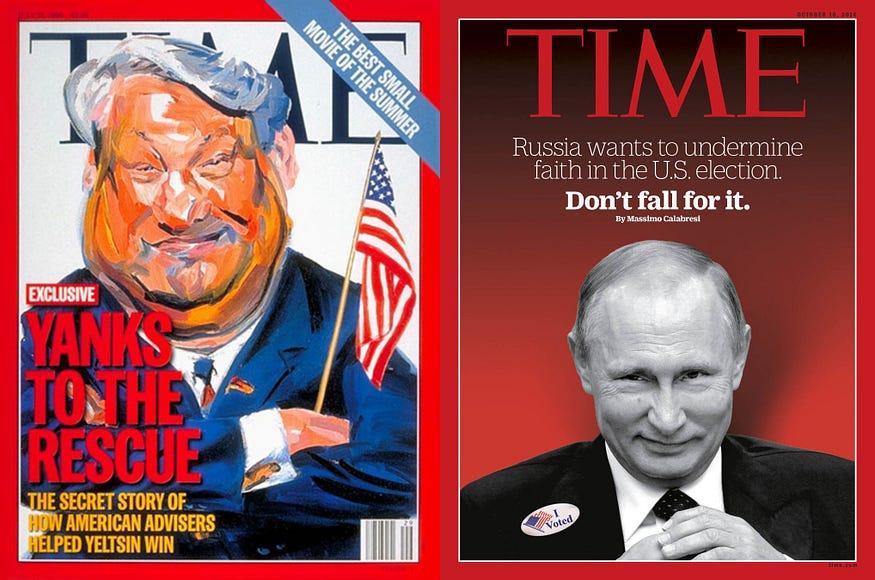
“….Secondly, in terms of finances, they might as well have had unlimited refills. Forget fundraising dinners and appealing to donors, never mind Russia’s electoral law that supposedly capped campaign spending at $3 million for each presidential candidate (as an interesting aside, the communists did, in fact, abide by this rule, although that likely had more to do with their empty coffers as opposed to, say, actually feeling morally obligated to adhere to said provision than anything else), for as was the case with a great deal of the members within the fourth estate, the fear of a communist victory was such that the Oligarchs, as to who, at the bare minimum, likely stood to face both jail time and the loss of their considerable wealth in the wake of a triumph by Zyuganov #DroppingRhymes, did everything in their power so as to ensure a Yeltsin victory, putting up somewhere between $700 million and $2 billion, according to estimates, to finance the campaign. Yeah…
Finally, Gorton, Dresner, Shumate, and, obviously, Yeltsin, by extension, greatly benefited from the contributions that were made by many of the latter’s minions, as to who pulled out all the stops — legal or otherwise — in order to deliver a w for the president. Among the favorite tactics employed by these goons included “[the] cancellation of hotel reservations made by the Zyuganov campaign, issuing false invitations to Zyuganov press conferences with the wrong times, and the publication and distribution of fake extremist Communist programs.” Even better, “The Communist candidate’s speeches and position papers were blacked out in the major media, and voters could learn about Zyuganov’s program only if they happened upon a rally or leaflet.” Noice.
At the same time, however, all of the dirrty money and political black ops in the world could do nothing to remove Yeltsin from his precarious political predicament, for as the team soon discovered upon conducting their own analysis primarily by, you know, asking questions of actual substance, it wasn’t just that the majority of the Russian people didn’t like the guy #DoubleNegative — it was that they justifiably saw him as “a friend who had betrayed them, a populist who had become imperial[,]” to further borrow from Kramer’s article, and there was more bad news. According to Dresner, “Stalin had higher positives and lower negatives than Yeltsin. We actually tested the two in polls and focus groups. More than 60% of the electorate believed Yeltsin was corrupt; more than 65% believed he had wrecked the economy. We were in a deep, deep hole.”
Still, it didn’t exactly take an experienced pollster to recognize that the issue that had the entire country — mobsters and oligarchs, etc., notwithstanding, of course — understandably seething was of the economic variety (even those same Russian newspapers with the empty statistical findings were on top of the matter). More specifically, Russkies were all up in arms over the dire financial straits #MoneyForNothing that had beset government workers as to who hadn’t seen a paycheck in MONTHS despite Yeltsin promising to remedy the situation in a development that might as well have induced a Dresner facepalm but nevertheless provided the team with a teachable, if not also as to what one would think should have made for a classic “Captain Obvious”, moment. As Dresner explained to Dyachenko, “You can’t just promise these things. You have to do them. And then you have to make sure the people know what you’ve done.”
In order to accomplish this relative to the criminal economic deprivation that was facing the aforementioned members of the proletariat (sorry, it’s just too easy), the triad advised Yeltsin to, in the political equivalent of flogging someone in a public square/Village Green, chastise those officials as to who had failed to apportion the money that had been earmarked for said salary arrears as per his instructions — a proposal that both Yeltsin and the press were all too happy to implement and cover, respectively.
Yet even so, while such a feel-good PR exercise might have looked great for the cameras and bought the president some desperately needed political capital, without the money that was needed to actually alleviate said financial suffering the entire undertaking would have been seen as yet another empty gesture, and it was at this pivotal point wherein the Clinton connection paid crucial dividends (no pun intended), although you wouldn’t know it from reading Time’s featured report, which is rather curious given that the whole lipstick on a pig scenario was certainly not lost on other reputable news outlets such as The New York Times and The Washington Post, never mind esteemed Kremlinologist Lilia Shevtsova.
Strong-armed by the administration, and in a move that was aptly characterized by Michael Dobbs in The WaPo as “an expression of political support by Western governments for Russian leader Boris Yeltsin in advance of presidential elections in June[,]” the normally, or at least outwardly, politically neutral International Monetary Fund became, with a single transaction, Boris’ single largest donor by approving a loan for $10.2 billion (the second largest loan of its kind in IMF history to that point, by the way, that was only superseded by the one that was given to Mexico in 1995 for $17.8 billion), with a crucial installment of more than $4 billion being made available during that first year, thereby enabling Yeltsin to repay $2.8 billion in back wages as well as giving him the ability to follow through on his promise to increase spending on social programs. Sidebar — there were social programs in Russia during the ‘90s?
Even at the time, the sentiment that was expressed by many Russian political experts and as to which has subsequently been substantiated by history was that without the sudden infusion of Das Kapital #SorryNotSorry, Yeltsin almost assuredly would have lost — possibly in the first round — and the West went still further to influence the outcome of the election. While privately the U.S. Ambassador to Russia, Thomas Pickering, unsuccessfully attempted to persuade Grigory Yavlinsky, a democratic candidate as to who presented a considerable threat to Yeltsin, to back out of the first round so as to increase the odds of success for Boris Nikolayevich, the then-managing director of the IMF, Michel Camdessus, went out of his way to state that not only was the aforesaid loan hardly a blank check, but also, and more importantly, that should “a new Government” come to power that would fail to adhere to “the commitments of Russia established in these documents,” that their “support would be interrupted[,]” thereby essentially blackmailing the Russian populace into voting for Yeltsin, and the results spoke for themselves in the opinion polls that were conducted by ROMIR (Russian Opinion and Market Research) in which the amount of support for the president more than doubled from a paltry 8% on February 18 to 17% on March 17, and suddenly the campaign had traction.
From there, and in order to capitalize on their newfound momentum, the team knew that it needed to …see link
Link:https://medium.com/insurge-intelligence/from-russia-with-revenge-536b25921ca6wvParticipantlink:https://www.theatlantic.com/ideas/archive/2020/07/isnt-hillary-clintons-polling/613690/
Believe the Polls This TimeThese aren’t Hillary Clinton’s numbers. Biden has a wide lead because the landscape has changed.
July 2, 2020
Stanley Greenberg
Political strategist and polling adviser“…So one reason to trust my polls more now than in 2016 is this change: Four years ago, those without a four-year degree made up 48 percent of my survey respondents; today they account for 60 percent. Whites without a college degree were 33 percent of my surveys; today they are 43 percent. That is a huge change—an elixir against being deceived again. The pain of Trump’s victory and disastrous presidency has concentrated the minds of campaign staff and the polling profession in ways that give me confidence that Biden’s lead in the polls is real.
But much more important than all of that is the sustained, unwavering, and extremely well-documented opposition of the American people to every element of Donald Trump’s sexist, nativist, and racist vision. Indeed, the public’s deep aversion to Trumpism explains why Biden has such a poll lead…
…
…..
…..wvParticipant=================
Trump has a point about the pollsSome pollsters are still grappling with the same problems that plagued battleground state surveys four years ago.
link:https://www.politico.com/news/2020/06/17/trump-polls-biden-324210
“….
……..But some pollsters, especially the relatively few who conduct surveys in battleground states, are still grappling with the problems that plagued those polls four years ago. In fact, most pollsters believe that, on balance, state polls are overstating the scale of Biden’s advantage.That was precisely the problem in 2016: The national polls were largely accurate, to within the margin of error. But there were too few state polls, and many of those that were conducted failed to collect accurate data, especially from white voters without college degrees in key swing states.
And those issues haven’t been fixed.
“I would say that most, if not all, of the concerns that we expressed still hold — some to a lesser degree,” said Courtney Kennedy, director of research at the Pew Research Center and lead author of the polling industry’s post-2016 autopsy. “But I think some of the fundamental, structural challenges that came to a head in 2016 are still in place in 2020.”
Polling errors are not uncommon in presidential elections. But pollsters see a real risk this year that the mistakes of 2016 will be repeated. Their colleagues still are not accounting for the fact that voters with greater educational attainment are more likely to complete surveys — and more likely to vote for Democratic candidates.
“There’s still a number of state polls, in particular, that are not fixing this issue,” said Kennedy.
….
……
…….. — the problem that pollsters identified in 2016 remains. Not enough surveys are being conducted in the battleground states, and those that exist are failing to account for a key political dynamic of modern politics, especially in the Trump era: the rapid movement of lower-income white voters to Republicans and upscale whites to Democrats.Pollsters are looking for answers. One of the major takeaways of the American Association for Public Opinion Research’s post-2016 autopsy was that state polls that didn’t weight, or adjust, their samples to include more white voters who hadn’t graduated college missed a key element of Trump’s coalition. In previous elections, the differences in white voters’ preferences along educational lines were smaller, but they began to grow during the past decade and accelerated with Trump on the ballot in 2016.
“Before 2014, it wasn’t that big of a deal because the reality is non-college white voters and college-educated white voters — the distinction between the two wasn’t as dramatic,” said Democratic pollster Jefrey Pollock. “But starting with 2014, that began to cleave a lot and is now obviously humongous.”
GOP pollster Glen Bolger said he believes a combination of pollsters’ inability to get the right educational mix and to persuade potential Trump voters to respond and answer truthfully to phone polls is pointing their surveys in a slightly Democratic direction.
“I don’t know how big the effect is. I also don’t know what the ratio is between it being ‘shy Trump’ voters and interviewing too many college graduates and not enough non-college grads,” Bolger said. “But I do think those are factors in some of the polls that show a particularly wide lead for Biden at this point in time. And I do think that things will be closer in the states than the polls indicate right now.”
…
…..
……At last week’s annual convention of the American Association of Public Opinion Research — held online because of the coronavirus pandemic — Nate Cohn, the New York Times data journalist who has worked with Siena College on their multimillion-dollar polling partnership, observed that the state polls leaned way too far toward Democrats in 2014 and 2016. In 2018, he said, the polls were more accurate but still showed a Democratic slant, especially “in a number of white, working-class states,” like Indiana and Ohio.
And, Cohn noted in his presentation, it might be happening again this year.
“So far in 2020, it sure seems like Joe Biden is faring particularly well in the states where the polls were most biased toward Hillary Clinton four years ago,” Cohn told the virtual attendees.
As if on cue, a new poll was released in Michigan on Tuesday: It showed Biden ahead by a whopping 16 points.
wvParticipantJust some tidbits that interested me:
“….Their expertise and methodology no longer in question, and with the campaign’s theme now finally cemented, the troupe sought to further fine-tune their approach by tasking their focus-group coordinator, Alexei Levinson, with identifying the electorate’s underlying fear of the Communists; and while “Long lines, scarce food and [the] renationalization of property” were among the chief concerns that were cited by the citizenry, the subject that made for the most trepidation was the prospect of civil war, which proved to be the team’s, as well as Yeltsin’s, in. As Shumate explained, “That allowed us to move beyond simple Red bashing. That’s why Yeltsin and his surrogates and our advertising all highlighted the possibility of unrest if Yeltsin lost. Many people felt some nostalgia for what the communists had done for Russia and no one liked the President — but they liked the possibility of riots and class warfare even less.” Said Dresner, “ ‘Stick with Yeltsin and at least you’ll have calm’ — that was the line we wanted to convey. So the drumbeat about unrest kept pounding right till the end of the run-off round, when the final TV spots were all about the Soviets’ repressive rule.”…
….
……
……By “it became public”, of course, Morris was seemingly attempting to gloss over a rather embarrassing episode for the administration that not only threatened to put the kibosh on the entire operation but also had all the makings of a geopolitical disaster. In late March of 1996, a classified memo from the State Department which documented a private powwow between Bill and Boris that had occurred only about two weeks earlier at the anti-terrorism summit in Sharm el-Sheikh, Egypt, as to where the two heads of state had promised to assist each other in their respective re-election bids with Clinton saying during the meeting that “he wanted to make sure that everything the United States did would have a positive impact, and nothing should have a negative impact. The main thing is that the two sides not do anything that would harm the other,” was leaked to the Washington Times, prompting congressional outrage with the White House interestingly characterizing the security breach as a “violation of federal law”, while also conveniently failing to mention that the content of the document in question was in clear violation of international law, and calling on the Justice Department to conduct an official inquiry into the matter…..see link.link:https://medium.com/insurge-intelligence/from-russia-with-revenge-536b25921ca6
wvParticipant============
link:https://swarajyamag.com/insta/russian-interference-in-us-elections-maybe-but-the-us-did-help-boris-yeltsin-get-elected
—–
“….According to political analyst and former Hillary Clinton confidant Dick Morris, in 1996 the then US President Bill Clinton meddled in Russian affairs, helping Yeltsin get elected to a second term. Morris said:When I worked for Clinton, Clinton called me and said, ‘I want to get Yeltsin elected as president of Russia against Gennady Zyuganov, who was the communist who was running against him. Putin was Zyuganov’s major backer… It became public that Clinton would meet with me every week. We would review the polling that was being done for Yeltsin that was being done by a colleague of mine, who was sending it to me every week. We, Clinton and I, would go through it and Bill would pick up the hotline and talk to Yeltsin and tell him what commercials to run, where to campaign, what positions to take. He basically became Yeltsin’s political consultant….
Morris believes that Putin resented the intervention at the time by Bill Clinton and took his revenge out on Hillary Clinton. Although there is no indication of this belief from Putin himself, it seems like 2016 was karmic payback for 1996…
————wvParticipantwvParticipantJust a few bad apples out there. Nuthin wrong with the system.
Bad apples. Thats the problem.
w
vJuly 11, 2020 at 11:01 am in reply to: updated–Round Three? Robinson’s rebuttal to the rebuttal to the . . . #117857wvParticipantPopulist Right article.
—
“New Right” Leaders Are Co-opting Progressive Language to Mislead Voters
link:https://truthout.org/articles/new-right-leaders-are-co-opting-progressive-language-to-mislead-voters/?eType=EmailBlastContent&eId=8b631f41-8133-4021-bde4-54bef5e2436c“…..At least a handful of journalists and progressive commentators have taken this anti-elitist posturing quite seriously. However, in reality, it is grossly misleading. Far from pioneering a democratic political transformation — or, really, any political transformation — the leaders of the “new populist right” are refurbishing the very conservative and elite order they claim to oppose.
The elitism of this group — who I will, for brevity’s sake, simply call the new right — can be easy to miss. In addition to opposing the empowerment of financiers, they frequently imitate the rhetoric of well-known progressive leaders, including Bernie Sanders, Elizabeth Warren and Alexandria Ocasio-Cortez. Media figures like Tucker Carlson and Saagar Enjeti speak in sweeping and often vitriolic terms about “the exploitation of Americans” and “neoliberals in Washington.” Even the faction’s most mainstream members engage in this imitation. For example, in a speech touted by new right intellectuals, Sen. Marco Rubio spoke eloquently about American capitalism’s betrayal of the “common good” and business’s “obligations” toward workers.
Yet, if you push beyond the rhetoric and focus on what the new right actually proposes, the truth becomes clear: their agenda is, at its core, mostly a revamped version of the one that has dominated conservative politics for the last 40 years. The cultural or social side of this agenda is, of course, by their own admission, similar to what the mainstream right has long embraced. If anything, it is perhaps more extreme. Many of them, for instance, support further tightening already conservative and draconian immigration controls and eliminating almost all abortion rights.
More to the point, even the new right’s apparently unorthodox and progressive-leaning economic agenda is broadly similar to that of mainstream conservatives. For example, they typically oppose universal entitlements like Medicare for All and favor creating a welfare state centered on tax credits and work promotion — a standard conservative position. In addition, their support for the labor movement is tepid at best; and, in many cases, they have opposed it, campaigning for right-to-work legislation and contesting increases to the minimum wage. Their one major difference with mainstream conservatives is, of course, that they advocate redistributing wealth away from affluent financiers and toward domestic industrial expansion. They go to significant lengths to construe this stance as proof of their greater allegiance to workers. Yet, in the absence of support for universal entitlements and a strong labor movement, all it really indicates is their greater allegiance to American industrial, rather than financial, economic elites.
Lacking any truly groundbreaking positions, the new right’s revamped conservatism has no more capacity to transform and democratize U.S. politics than the “free market” conservatism they criticize. For starters, as others have already pointed out, their claim to respect the values of the “American middle” is laughable. By any reasonable measure, their cultural stances disregard most Americans’ core beliefs in favor of propping up a fringe minority. Record-high majorities support many of the ideals and policies they oppose, including abortion rights, the legalization of marijuana, legal immigration and affirmative action. In contrast, only a radical few back the positions advocated by leaders on the new right, such as banning abortion or reducing legal immigration.
Furthermore, contrary to their proclamations….see link…
wvParticipantWith Veto-Proof Majority, Seattle City Council Votes to Defund Police by 50%
link:https://www.democracynow.org/2020/7/10/headlines/with_veto_proof_majority_seattle_city_council_votes_to_defund_police_by_50wvParticipantMaybe I’m stuck in a left-bubble, but
it seems like the Trumpies are gettin nervous. Feelin the pressure.
===============
July 10, 2020 at 10:19 am in reply to: updated–Round Three? Robinson’s rebuttal to the rebuttal to the . . . #117823wvParticipantwvParticipantI had to check who the Grand Wizard was. Because the only way i learn history, is when a statue is removed.
———-More than forty years after Black Americans protested the unveiling of Nathan Bedford Forrest’s bust in the Tennessee State capitol, it will be removed.
Tennessee’s State Capitol Commission voted 9-2 to remove the bust of the Confederate general, slaveholder and grand wizard of the Ku Klux Klan along with two others.
The busts of Forrest, U.S. Admiral David Farragut, a leader in the Union Navy during the Civil War, and U.S. Admiral Albert Gleaves, who served during the Spanish-American War and World War I, will be relocated to the state museum as part of an exhibit “honoring Tennessee military heroes.”
link:https://thehill.com/changing-america/respect/equality/506672-bust-of-confederate-general-kkk-grand-wizard-to-be-removedwvParticipantbbc:https://www.bbc.com/future/article/20190411-the-violent-attack-that-turned-a-man-into-a-maths-genius
The violent attack that turned a man into a maths geniusFuton salesman Jason Padgett cared little about anything beyond partying and chasing girls, then one fateful night changed him forever…
…
…But while Padgett was experiencing all these negative consequences from his attack, something incredible was happening too. The way Jason was seeing things changed.“Everything that was curved looked like it was slightly pixelated,” he explains. “Water coming down the drain didn’t look like it was a smooth, flowing thing anymore, it looked like these little tangent lines.”
The same thing happened with clouds, sunlight streaming between trees and puddles. To Padgett, the world essentially looked like a retro video game. Seeing such a radically different view of his surroundings evoked conflicting emotions in Padgett. “I was surprised…confused. It was beautiful but it was also scary at the same time.”
Because of these visions, Padgett began to think about huge questions in relation to mathematics and physics. Given his hermit-like existence at that time, the internet became a valuable source of information to him as he read extensively about mathematics online…
…
….“I would always describe that math was shapes not numbers and that was the first time I’d heard anybody but me talk about what numbers looked like,” says Padgett.He scoured the internet for more information and came across Berit Brogaard, a cognitive neuroscientist now at the University of Miami. The pair spent hours talking on the phone and from these conversations, Brogaard hypothesised that Padgett had synaesthesia – essentially a cross-wiring of the brain in which the senses get mixed up…..see link…
July 9, 2020 at 12:31 pm in reply to: soul of an Octopus–“best of” old octopus posts + new octopus posts #117788wvParticipantBtw, that article is really a must-read. Its more than an Octopus article.
…“It’s remarkable how little is known about them . . . but I could see it turning out that we have to change the way we think of the nature of the mind itself to take into account minds with less of a centralized self.”
“I think consciousness comes in different flavors,” agrees Mather. “Some may have consciousness in a way we may not be able to imagine.”…
w
vwvParticipantWell, you do know, Zooey beat you to him. Zooey spotted him a long while back.
But then he jilted him and became obsessed with Krystal Ball. These things happen.
w
v
——
“One distinguishing difference between neoliberalism and plain old nineteenth-century free-market capitalism is this tendency to try to improve the ‘image’ without changing the substance. Wall Street votes Democratic now, holds diversity trainings, and deplores outright bigotry. But they still won’t hesitate to profit off the victims of a natural disaster or close a factory to make a buck.”
― Nathan J. Robinson, Why You Should Be a Socialist
———–
“Bakunin had a simple formula that captures the ethos of libertarian socialists: We are convinced that liberty without socialism is privilege, injustice; and that socialism without liberty is slavery and brutality. Liberty without socialism means rule by CEOs, socialism without liberty means rule by bureaucrats.”
― Nathan J. Robinson, Why You Should Be a Socialist
—
“But there is something even more insidious about liberal politics: it is the politics of wealthy people who want to appear virtuous without actually making personal sacrifices.”
― Nathan J. Robinson, Why You Should Be a Socialist
——
“Equality doesn’t mean ensuring everybody is the same, it means making sure some people don’t get godlike power to determine the fates of others.”
― Nathan J. Robinson, Why You Should Be a Socialist————
“Being an honest leftist requires one to have a nose for jargon and a determination to figure out what is actually going on. It means examining phrases like national security and globalization and ascertaining what they mean for real human beings. When we do so, we often find that the reality beneath the words is disturbing. The ‘freest’ country in the world is also the one that imprisons the most people; the most ‘democratic’ country in the world is one in which ordinary people’s policy preferences matter little; and ‘security’ can be invoked to justify almost any kind of brutality. You can rationalize nearly anything if you speak at the right level of abstraction. But my kind of humanistic socialism, unlike the authoritarian Soviet variety, begins with a resolute determination to find the truth, to care about human beings, and to not turn away from unpleasant facts or find ways to make them less comforting.”
― Nathan J. Robinson
———-“Dorothy Day (1897–1980). She is a legendary figure among social justice Catholics, organizing the Catholic Worker Movement and advocating pacifism, economic equality, and civil rights from a Christian anarchist perspective.26 Arrested numerous times for her civil disobedience, Day often took Biblical teaching more seriously than the Church did. She was the kind of Christian who defers to the Sermon on the Mount rather than the prejudices of local priests and bishops, and as such has been long admired for her moral courage. Predictably, there have been attempts to sanitize her legacy and minimize her radicalism. The Catholic Crisis magazine has suggested she was a conservative, because she “lamented the encroachment of the state and the perils of the welfare system.”27 She did so, however, because she was an anarchist, not a conservative. It’s true that her economics were not purely socialistic, but her words made clear how she felt about capitalism: I am sure that God did not intend that there be so many poor. The class structure is of our making and our consent, not His. It is the way we have arranged it, and it is up to us to change it. So we are urging revolutionary change … We need to change the system. We need to overthrow, not the government, as the authorities are always accusing the Communists “of conspiring to teach [us] to do,” but this rotten, decadent, putrid industrial capitalist system which breeds such suffering in the whited sepulcher of New York.28”
― Nathan J. Robinson, Why You Should Be a Socialist
———-
“4 Conservatism is “the felt experience of having power, seeing it threatened, and trying to win it back.”
― Nathan J. Robinson, Why You Should Be a Socialist
———-more quotes at goodreads
wvParticipantYeah, I’m glad they are keeping the burgandy and gold. I actually think thats important to the fans. And its one of my favorite color schemes. So there’s that.
Snyder is such a piece of shit.
w
vJuly 8, 2020 at 8:41 pm in reply to: soul of an Octopus–“best of” old octopus posts + new octopus posts #117736wvParticipant“…“It is as if each arm has a mind of its own,” says Peter Godfrey-Smith, a diver, professor of philosophy at the Graduate Center of the City University of New York, and an admirer of octopuses. For example, researchers who cut off an octopus’s arm (which the octopus can regrow) discovered that not only does the arm crawl away on its own, but if the arm meets a food item, it seizes it — and tries to pass it to where the mouth would be if the arm were still connected to its body…”
==============I would like to cut some parts off researchers. Just, ya know, for the sake of science.
w
vwvParticipantI think she’s right.
I don’t expect any effort from Biden to lead. He’s not a leader. And he isn’t going to lay out a vision for the future this country needs. But he will certainly be more responsive to mass pressure. He can be leveraged into doing some things that are helpful to some degree. Trump can’t. Trump can’t even…you know…tell people they should wear masks.
=============
Yes, she’s right. Noam’s right. Etc.
I’m probly gonna vote for the Corporate-Piece-of-SHIT.
I’ve managed to find a way to create a safe-space in my brain for such dastardly-despicable-acts-of-voting.So we vote for Mussolini instead of Hitler. O happy day.
But if we are gonna do things like this. Commit acts like this. I think we have to do the work of Naming the Bidens, Pelosis, Hillarys, Liebermans, Gores, Kerrys of America. This kind of ‘voting’ only makes sense if we spend the other 364 days of the year, totally trashing these lying criminals.
And perhaps there’s time for the young people to…learn. And then to…organize.
And then to vote these Dem-Rep lowlife bastards out of office. And to change this country into something decent. Perhaps there is time.But i doubt it.
Right now, the score is 99 to 1. I’ll keep noting that score, because i think it accurately reflects the situation.
99 to 1.
Thats where we are.
Thats the Left in America. Thats the great progressive movement in Amerika.
Thats whats been accomplished against this Capitalist-Imperialist-Terminator.
w
vwvParticipantIs it my imagination or have you been posting more on Politics lately, Invader?
Is there a reason for that? Or am i imagining that? Do you think of yourself as a ‘leftist’ or a ‘liberal’ or just a Seahawk fan like Zooey?it’s not your imagination. honestly? with the pandemic and the protests i’ve been leaning toward this side of the board more often lately.
i’m not particularly political. and for some of the reasons you stated. i often am conflicted between the way i would want to see things done vs being practical and trying to focus on things that are within the realm of possibility.
but also. how do you get 8 billion people to agree on a way forward? how do you even get half of them to agree on a way forward?
but then i also think does it even matter? is this planet supposed to go on forever? are humans meant to exist forever? the universe? sometimes i think i should just enjoy the world for what it is. faults and all. but then other days i think it does matter, and we should try and make this place better while we’re here. even if you can’t reach that ideal society.
i think what i would want is that we treat each other compassionately. universal healthcare. universal basic income. free education. free housing. i do think those are steps towards that. so if that makes me a leftist then i guess i’m leftist.
it wouldn’t solve everything. but then what would? again. trying to get 300 million people (not to mention 8 billion) to agree. well good luck with that. you can’t even get 30 million to agree.
i think you always have the end goal in mind. but you also enjoy the journey if that makes any sense. so even if you don’t ever reach the goal, you at least appreciate the steps it takes to get there?
so if we could get at least universal healthcare and universal basic income before i pass. and a mars landing. i’d be pretty cool with that.
————–
I hear ya. I can relate to a lot of that. You covered a lot of ground there.
Our human brains have a lot of shit goin on inside them, dont they. I wonder if dolphins think about all this shit. Leftist-Dolphins probly do. They probly swim around thinking ‘what the hell is wrong with this whole entire pod…’
w
v
 wvParticipant
I thought he had it…. he got fucked….. twice…..
Compassion…. what’s so bad about that?
==============
Well Biden has compassion for the CIA, Exxon, Monsanto, Goldman Sachs, and Wall Street.
w
v
 wvParticipantwvParticipant
I have more stuff to add later . . . but want to wait a bit in hopes of more posts from you and others, etc. . . .
A link to (IMO) an important New Yorker article:
==================
I dont really have anything to say about him, BT. I mean we all agree he’s a monster. I had hopes he would be the anti-NAFTA Trump he ran on. I thought that might outweigh the other obvious monstrous stuff. But he became the worst President ever, I suppose. Hard to calculate these things.
My brain has a very very hard time focusing on Trump though. Even though he’s a monster, even though he’s the Worst. My brain always puts him together WITH the Hillary’s
and the Senate,
and the House,
and Corporate Media,
and the murderous-CIA,
and the idiot-voters
and the whole biosphere-killing Corporotacracy,Trump is just an image in the Guernica/Dali mash-up postmodern painting.
He’s the flaming Giraffe maybe 🙂
w
vwvParticipanti don’t know. but i do know that we’re currently going in the wrong direction.
===================
Is it my imagination or have you been posting more on Politics lately, Invader?
Is there a reason for that? Or am i imagining that? Do you think of yourself as a ‘leftist’ or a ‘liberal’ or just a Seahawk fan like Zooey?One of the continuing-thots that bounce around in my head on the topic of ‘what is a leftist’ is what i might call the ‘utopian’ notions and the ‘practical’ notions. Sometimes those things do not play together, well.
On tuesdays and thursdays i might think ending all forms of capitalism and private property is a good longterm goal. Maybe. But then that kind of utopian notion is often utterly, completely counter-fucking-productive to building a big tent in order to get practical policies done — like Medicare For All. Etc.
So deep down I might be a pure Commie. At least on Tuesdays and Thursdays. Maybe.
But then what matters in the real world is not my commie-brain. What matters is Medicare For All. Something DO-able.There’s always this clash between utopian/aspirational broad ideas, And fucking real-world policies and building real, actual coalitions, with real actual people.
At least that clash exists IN MY Head. Its always there.Blah blah blah.
w
vwvParticipantWell Beau’s notion is not how i would put it. I’d probly say something like
Leftists reject the worst aspects of capitalism, among other things. I think thats a better ‘strategic’ position at any rate. Leftists oughta think about making the tent bigger, not smaller.w
vI assume we’re saying the same thing, and that Beau’s definition represents the smaller tent.
=============
Zooey is taking up too much room in the tent. Plus your avatar looks like a Bourgeoisie ram. I’m forming my own tent. My tent will be waay more revolutionary than yours.
w
vwvParticipantI like what Reed said just before the video started. I thought this was an interesting comment.
This [the most recent shift in the protests] is the bread and circus stuff that appeals to the other side and you can feel the long hand of the Ford Foundation and leadership development corporations shaping the institutional structure of a political economy of race relations administration in a certain direction so that it moves in a slightly different direction, farther away from anything that smells anything like class re-distribution.
Interesting stuff–I looked up the Ford Foundation and was intrigued to see BLM protest photos on the website of a multi-billion non-profit that has been operating since the 60’s.
Off topic–If you still need info WV about sharpening a (Japanese) knife a friend of mine sent me an insightful email as I need to put a sharper blade on my knife.
=================
Yeah, we used to talk about a Thomas Frank collection of essays back in the 90s, called ‘Commodify Your Dissent.’ Its kindof about that whole subject of the system taking authentic-dissent and turning it into something tame so it doesnt actually threaten capitalism. Think of CHE earrings and such.
This ‘process’ of domesticating and shaping dissent-movements
would not work if the citizens actually had higher political-IQs. But they’ve been dummed-down so far, that its not that hard for the system to nudge them, shape them, bewilder them, tame them, divert them…Ah well.
I dont wanna sound too dark though. 🙂 This latest uprising did indeed lead to some nice reforms in some places. Colorado.
w
v
—-
link:https://www.amazon.com/Commodify-Your-Dissent-Salvos-Baffler/dp/0393316734
Amazon.com Review
In this thought-provoking collection of essays, editor Thomas Frank and other contributors to the contrarian journal the Baffler examine the unprecedented ascendancy of business as the dominating force in American life. If the closest historical parallel is with the Gilded Age and its all-powerful robber barons, Frank and his ilk clearly see themselves as the muckrakers out to expose the absurdities and abuses of big business. Today, however, advertising has come to permeate every aspect of our society, and corporations are in the business of manufacturing culture–what Frank calls the “Culture Trust.” These essays analyze the ways in which this Culture Trust has co-opted the power of dissent by appropriating the language and symbolism of nonconformist youth culture, from hippie slang to grunge fashion; in other words, when the media markets rebellion, it becomes just another consumer choice. As evidence, the essayists explore the image of consumer as rebel pioneered by publications such as Details and Wired, as well as the preeminence of “revolutionary” business gurus such as Tom Peters. The result is a highly original book, a satirical and savage indictment of ’90s consumerist culture.
Review
You’d have to look back at the fights between New York intellectuals in the fifties to find the sort of verbal firepower unleashed here. — Nation[Frank is] … perhaps the most provocative young cultural critic of the moment, and certainly the most malcontent… Although he has been to graduate school … both his thinking and his prose hark back to a time when the radical left was something more in America than conferences and seminars attended by Foucault-steeped professors. Frank has thrown off the mandarin jargon; for him it’s about wealth and power, haves and have-nots, loud and simple–it’s as if he were channeling Herbert Marcuse and C. Wright Mills and Thorstein Veblen through a boom box. — The New York Times Book Review, Gerald Marzorati
From the Back Cover
The 1980s and 1990s have seen an enormous increase in the power of business over the American mind. Not since the Gilded Age have the robber barons of business accumulated more wealth or won more popular attention. But where the tycoons of yore built railroads or banks, today culture stands at the heart of American enterprise and mass entertainment has become its economic dynamo. For a decade The Baffler magazine has been an invigorating voice of dissent against these developments, in the tradition of the muckrakers and H. L. Mencken’s The American Mercury. Commodity Your Dissent gathers together the best of its excoriating criticism of the new American cultural order, exploring such peculiar developments as the birth of the rebel consumer as hero in the pages of Wired and Details; the dramatic rise of “alternative” culture in the post-Nirvana era; the appearance of new business gurus like Tom Peters and corporate fads like “reengineering”; the ever-accelerating race to market youth culture; and the encroachment of advertising and commercial enterprise into every last nook and cranny of American life.
About the Author
Thomas Frank is the author of One Market Under God and The Conquest of Cool.wvParticipantI havent kept up. This is great. The R word has been a pet-bugaboo of mine for a long time, and i never thought I’d see the day the asshole in Washington would change it.
It annoys me that it was not the players themselves that organized and put pressure on Snyder. But a win is a win.
Now watch Snyder screw up the new name.
I suggest Washington…Deep-State. And just have maybe, a pitch black helmet.
Or..Washington Capitalists. That would be perfect.w
vwvParticipant“you can define leftism as rejecting capitalism”
Is that true of social democracy? I don’t even think social democracy is anti small business. I think that social democracy–which is left/progressive, of course–supports a mixed economy where large wealthy interests don’t and can’t dominate public and economic life.
I have recently found myself in arguments many times with righties who assume social democracy is socialism and I then have to explain the difference.
It’s funny if some leftists don’t even make the same distinction.
================
Well Beau’s notion is not how i would put it. I’d probly say something like
Leftists reject the worst aspects of capitalism, among other things. I think thats a better ‘strategic’ position at any rate. Leftists oughta think about making the tent bigger, not smaller.w
vwvParticipantAdolph alludes to the corporate-lib notion that you cant be ‘working class’ and ‘black’
yeah. that’s the most annoying thing. well. one of the most annoying things that people don’t seem to get. or maybe just ignore.
——————
Preston Smith should be more well-known. In another country, he would be.w
vwvParticipantAdolph referred to Preston H. Smith’s book:
July 4, 2020 at 6:26 pm in reply to: updated–Round Three? Robinson’s rebuttal to the rebuttal to the . . . #117580wvParticipant -
AuthorPosts