
Forum Replies Created
-
AuthorPosts
-
October 18, 2015 at 12:19 am in reply to: A closer look at what could be next for Rams and Saffold #32516
 znModerator
You know I move some of these things because I think they would make cool threads. I hope you don’t mind.
For example I think this is a very interesting point:
I can’t remember a time when the Rams have had this much talent, draft capitol, and cap space all in combination.
October 18, 2015 at 12:15 am in reply to: A closer look at what could be next for Rams and Saffold #32513znModeratorIf they plan to spend the money on another vet guard, they might as well keep Saffold. imo
Maybe use some of Saffold’s cap space to resign Barnes? I like our young players on the Oline.
Could you explain what Wagoner was talking about in regards to Saffold’s injury guarantee of 4.5. I would appreciate it.
October 17, 2015 at 10:17 pm in reply to: A closer look at what could be next for Rams and Saffold #32505znModeratorWhat other free agent VET guards
would be available if they released Saffold.They are potentially on the hook for 4.5 M against the cap if they cut him. That’s an injury guarantee. That 4.5 M (if I am following this) is in addition to a hit on the signing bonus.
So probably better to keep him, whether or not he’s a starter.
My big issue is that he wasn’t playing well this year before the injury.
znModeratorAsk me again at the end of the year.

i might feel differently when the season ends and no progress has been made.
Me 3. I like where they;re going but I don’t have any particular loyalty to HIM per se. Though that’s a bigger, more complicated issue.
znModeratorYep, the players know Fisher’s system well.
Stuck at .500 play over the last 3 1/2 years.
My view is that that is not the coach. Fact is they had back-up qbs for 25 of those games, and multiply injured OLs for 28 of them. The times when they had a running threat, a relatively healthy OL, and a starting-caliber qb they did well. Actually though that’s only 11 of 48 games. In those 11 games they were 6-4-1 and that included 6 games against top 10 defenses.
As I said elsewhere, they built a line in 2012/13 and it got injured.
I always think it’s a mistake to not account for crucial things like (multiple, simultaneous) OL injuries.
An equivalent would be a young line. Do you think Foles and the Rams in general would have done better so far if they had a solid, veteran line to start with? Like they had in 2013. Well it’s the same thing from 2012-14, except it’s multiple injuries and not youth, and except for it’s mostly not Foles-level qbs, and also except it’s across 37 games.
.
znModeratorfrom off the net
==
thehammer
Foles ran a 4.68 short shuttle and 7.14 3 cone…basically the worst scores by a qb going back to 2002…as far back as nfldraftscout kept records. A heavy legged, bad athlete that struggles moving inside the pocket. Flacco ran a 4.27 and a 6.82 in comparison.
my problem with Foles. isn’t his slow feet .it’s the mental part. I went back rewatched all his int’s at Philly. They were almost all identical..slow in his reads getting the ball to his 2nd receiver…just consistently late which shows in his time in the pocket.
Foles has averaged 2.84 sec in time to throw throw the ball(2.63 in 2015)for his career…scary slow times for a pocket passer..Brady and P Manning, two more bad athletes, avg around 2.3 secs and are always among the quickest in time to throw in the nfl. .
.5 seconds is an eternity in the pocket. He ain’t doing the young oline any favors and even Mannion, another bad athlete, only needed 2.35 secs to throw in the preseason…
bad athlete who is slow in his reads which shows in his play action qb rating of 111.3 and bad non play action qb rating of 66.5..also Foles has thrown away 16 balls this season the most in the nfl and almost twice as the next qb… Slow dropping back into the pocket and slow finding his 2nd option so often has to just throw the ball out of bounds when pressured
Foles is a qb you can lose with but that might be a tad harsh. Best comparision might be Matt Schaub at Houston but Schaub had Andre Johnson to throw to who could easily beat man coverage…Rams don’t have wr on the team who wins 1 v. 1
Foles has a lot to like, hard worker, good size, great touch on his intermediate, long routes and is fearless… BUT also has serious negatives…struggles without play action, needs great pass protection and a good #1 wr capable of winning 1 v. 1 battles to be effective.
znModeratorwatch Tim Barnes, he is relentless.
He’ll hit his guy then quickly get to the second level and hit another guy.
I think Barnes is exceeding expectations. But then the next problem Barnes presents is that he is on a one-year.
In terms of GR, that’s a highlight vid. The people who watched him on all 22 and like him were concentrating on several successive plays, and even then people note that he is not “there” yet in terms of consistency. FWIW here again is the GB reporter who remarked on GR.
All quotes in blue:
===
from Rating the Packers vs. Rams
Bob McGinn | On the Packers
http://www.jsonline.com/sports/packers/rating-the-packers-vs-rams-b99594632z1-332282942.html
As the game wore on, left tackle Greg Robinson played like a man among boys. . . . With refinement, Robinson might have the dancing-bear feet and aggressive temperament to become the next dominant tackle.
===
And here is a GR enthusiast who watched the all-22:
===
Pass Pro is still a work in progress…but watch each and every pass play…and I bet you see some dominant plays, some good plays, some stalemates and a few plays where he just blows it…
The Rams run behind him and he is mashing people.
===
My thing about things like this is read lots of sources, trust your eyes, and see what the range is. In general, the range is that he’s improving. In terms of the specific claim that he is run blocking well or at least was in the GB game, that’s harder to pin down without viewing the 22, but I would say that to me it sounds likely.
Do the Rams run behind him?
That’s hard to tell with a zone blocking scheme since you don’t design those to open a specific hole. It’s a flow that opens up lanes, and the RB has to read the options.
BUt according to ESPN splits, (and I don’t know the answer to this until I look which I am doing right now for the first time), this is how his runs tend to go:
On 55 carries, TG has run
right sideline 8 … 1.5 a carry
right side 7 … 11.6 a carry
middle 18 … 4.5 carry
left side 11 … 7.9 a carry
left sideline 11… 4.8 a carryThat’s all fwiw
znModeratoragainst a journeyman qb and a lousy defense.
One they played before, too.
Week 12, November 24, Chicago Bears at Rams, Rams win 42-21.
Josh McCown: 36 of 47 for 352 yards, 2 TDs, 1 Int
znModeratorHere;s the way I see it. Fwiw.
So far they have played 4 teams PFF ranks in the top 10: Green Bay (1), Arizona (6), Seattle (7), Pittsburgh (9). They beat 2 of them.
The same 4 teams all have top 10 defenses: Green Bay (6), Arizona (7), Pittsburgh (9), and Seattle (10).
3 of those teams have top 10 offenses: Arizona (1), Green Bay (5), and Pittsburgh (10).
So as I said they won 2, and in the other 2, they were actually visibly in the games and in fact the games were there for the taking.
They did that with a new coordinator, a new qb, and a new young OL which, as any new young OL would be, is struggling. Their receivers are not in sync, and they only had Gurley for 2 of the games.
Young OLs do get more in sync, the qb will get more in sync, there’s Gurley, and the receivers can settle down.
If even some of that happens, a team with as much working against as the Rams had in the 1st 4 games will be….to use the simplest, most obvious word…better.
A team that played like that in the first games while stumbling over their own deficits and problems has a good future. All they have to do is get more in sync in a couple of areas, and so stop beating themselves.
It’s here, it’s arriving, you can see the postman at the mailbox.
znModeratorfrom PFF POWER RANKINGS FOR WEEK 6
https://www.profootballfocus.com/blog/2015/10/13/pff-power-rankings-for-week-6/
15. St. Louis Rams
4 of the 5 teams the Rams have played so far rank in the top 10, according to PFF power rankings:
Green Bay (1)
Arizona (6)
Seattle (7)
Pittsburgh (9)znModeratorfrom PFF POWER RANKINGS FOR WEEK 6
https://www.profootballfocus.com/blog/2015/10/13/pff-power-rankings-for-week-6/
15. St. Louis Rams
Wide receiver Tavon Austin has forced seven player to miss tackles on his receptions, tied for eighth-most in the league. He’s the only player in the top 10 with fewer than 20 receptions. Last year, he only forced five players to miss tackles on his 32 receptions.
October 17, 2015 at 1:42 am in reply to: The effects of all the sacks and pressure on Russell Wilson & other Seattle woes #32462znModeratorWHAT’S WRONG WITH MY TEAM? SEAHAWKS EDITION
What’s up with the 2-3 Seahawks this season? PFF dives into the data to explain.
VID LINK:
https://www.profootballfocus.com/blog/2015/10/14/whats-wrong-with-my-team-seahawks-edition/
znModeratorfrom off the net
==
fearsomefour
I see Foles create pressure sometimes by rolling to his right, always to his right, when he feels pressure that may not be there. In the Washington game there was a play where Robinson blocked his man down inside….there was no one to to Foles left, feeling pressure that wasn’t really there he rolled to his right….running past Saffold who had his back to Foles, Saffolds guy just peeled off and gave chase. He created pressure on that play.
It is a mix of things. The O line has certainly done their part to create pressure….not picking up simples twists or stunts (again), whiffing on blocks and not having a consistent running game. Foles does his part as well. Until the running game works well enough where play action has meaning some struggle with both will continue I think.
This is the knock of Foles. Slow through progressions and finding secondary guys. Leads to plenty of check downs too. In Philly throwing to RBs is a decent chunk of the offense. Here it is a lack of early down production. The running and play action is what Foles needs more than anything. If that doesn’t develop I think Foles will continue to be up and down. His last 13 games (after his “dream” season) he has 19 TDs and 15 INTs. Thats who he is without extra help from the O in my opinion.
znModeratori think what’s interesting is that they mix and match and disguise all the different plays making them look the same right up until the last second.
I like everything else you say too, but focusing on this bit, this is why Kendricks is so important to this offense. I wish he would get over his pass catching slump, and maybe part of it was the injury, but still—this is an offensive design made for him. My mantra on LK is that he can line up anywhere in the formation (in-line, out wide, in the backfield) and pass block, or run block, or catch a pass from any one of those spots. Plus of course he can motion from one spot to another. Taken all together that means he adds another layer of deception to the offense. He adds to the power, he adds to the movement, he adds to protection, and he can fake any of that and go catch a pass too.
This could be quite a formula.
znModeratorYou know what would have been better than fining him?
Penalizing him 15 yards.
Well I agree.
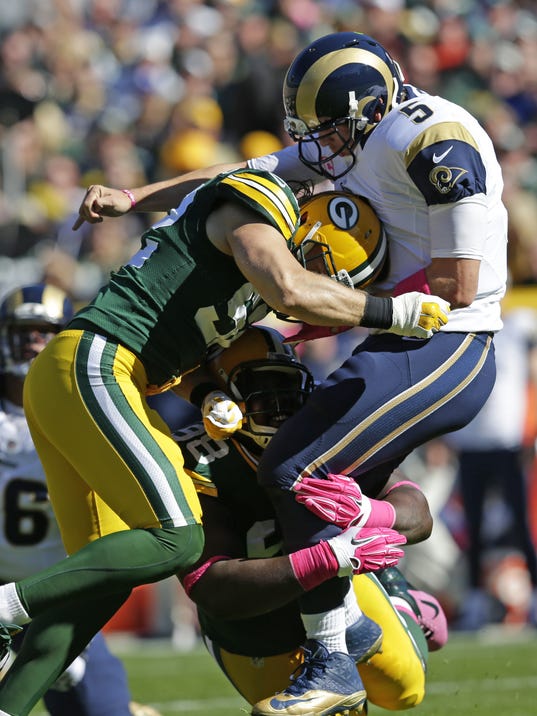 znModerator
Bean counters. I swear to God. Somehow, somewhere, that fine makes a lot of sense to somebody.
63 dollars covers the postage.
It’s really only that.
znModerator@SiriusXMNFL: BREAKING NEWS: #Browns Johnny Manziel was pulled over by Avon police on highway, arguing with girlfriend. Drinking involved
znModeratorThat’s a good vid but he gets a few things wrong. First, I don’t buy the idea that Cigs suddenly found ways to use Austin. It seems to me Austin upped his game and became more useable. Second, Cook did not cut off his route on that INT…he paused in a zone and Foles threw a bad pass under pressure.
Not to say Cook is having a great season, but, fair is fair.
But that’s just a couple of things. It’s good overall. I also like some of the more subtle things in that vid. First, he praises Kendricks as a blocker. IMO Kendricks is very good as a move TE/H-back hybrid type blocker and not as a straight-up in-line TE. Some of that gets highlighted. He also basically indicates that this OL can be both a zone blocking line and a power line, which (and he doesn’t say this) is why they have guys zone-blocking who don’t fit the mold of the smaller more athletic ZBS linemen. I also like the fact that this is a play-action offense and the analyst stresses that.
IMO this offense is just out of sync right now, and that includes being young but it’s not just that. When it is more in sync and confident, then, it’s not just that we will see less of the OL getting flat beat, we will see fewer drops, the qb pressing less, and fewer stupid false starts in the redzone. Those, from my point of view, are always the kinds of mistakes you get from a unit that doesn’t have core confidence yet. But it also looks like a team that will get out of that bad state sooner rather than later..
znModeratorif we lose a tackle, then Reynolds is likely now the guy kicking out to fill that position
Fisher has already said the back-up at tackle is Williams.
.
znModeratorGarrett Reynolds offers calming presence in replacing Rodger Saffold
Nick Wagoner, ESPN Staff Writer
EARTH CITY, Mo. — With Rodger Saffold lost for the season because of shoulder surgery, the St. Louis Rams will turn to the one backup on the roster with extensive NFL experience to replace him.
That would be seventh-year veteran Garrett Reynolds, a free-agent offseason addition from Detroit. After playing the first four games with the same five offensive linemen in place, Reynolds got his first extended action with the offense last week in Green Bay when he came in for Saffold.
According to coach Jeff Fisher, Reynolds fared well upon entering the game.
“When Garrett went in, it was kind of almost a settling factor in there,” Fisher said. “The guys almost seemed to settle down when Garrett went in there. That’s not a negative towards Rodger, but it just settled down for us, so we’ll see where it goes.”
Garrett Reynolds is the most experienced lineman on the Rams and has moved around the line. AP Photo/Jeff Roberson
Where it goes now that Saffold is on injured reserve is that Reynolds will step into the starting lineup at one of the guard positions. He filled in for Saffold at right guard against the Green Bay Packers but he played a lot of left guard in the preseason. Some in the organization believe he’s more suited to that side, though he’s played both guard spots and right tackle in his career.Either way, Reynolds instantly becomes the most experienced lineman on the roster with 57 games and 27 starts to his credit. In his time with Atlanta and Detroit, Reynolds has moved around on the line which makes him a logical fit in the sense that there’s very little he hasn’t seen.
“I haven’t played center or left tackle but wherever they need me, that’s the kind of mentality I’m going to try to keep on it and just go wherever I’m told to go, know what I’m supposed to do and play whatever role I’m needed to play,” Reynolds said.
At 6-foot-7. 305 pounds, Reynolds’ reputation upon arriving in St. Louis was as a power blocker in the run game with limited upside in pass protection. He worked with the starters at left guard during organized team activities as Saffold was recovering from the left shoulder surgery he had in the offseason. He says he had little trouble picking up the offense, though the terminology is different than what he’s used in the past.
“There’s a lot of carryover no matter where you go because football is football,” Reynolds said. “Of course some things are going to be different, terminology is going to be different, the lingo, the offensive line language might be a little bit different but by OTAs, usually you have that down.”
Although Reynolds is just now getting the opportunity to start, he immediately embraced a leadership role for the Rams’ young line, a job that will only grow in importance now that he’s in the lineup.
The Rams have rookies at right tackle and one guard spot, a second-year left tackle and a center only emerging as a starter this season — plus a quartet of backups made exclusively of players who have never played offense in regular season NFL games. So Reynolds had better be the type of calming presence Fisher insists he is.
To that end, Reynolds poked a little fun at himself when asked what he thought Fisher meant by calling him a “settling” factor.
“Probably just because they are all faster and more athletic than me so if I can get in the way then you guys can too,” Reynolds said.
Quarterback Nick Foles offered a better explanation.
“He’s a guy who’s been around, been in the league,” Foles said. “He’s a very knowledgeable, talented guy who’s played a lot of football. I think he’ll bring another veteran guy in there.
znModeratorLighter schedule after bye guarantees nothing for St. Louis Rams
Nick Wagoner
EARTH CITY, Mo. — Since entering the league in 2009, St. Louis Rams linebacker James Laurinaitis has been a part of multiple teams that were considered easy fodder for opponents.
You know, the types of teams that fans of average to good teams see on the schedule when it comes out in April and put a big “W” next to when they’re projecting their favorite team’s record for that season. Since Jeff Fisher arrived in 2012, that has changed as the Rams have at least risen to a level of mediocrity that’s removed them from the pushover category.
Having been on that side of the ledger, though, makes Laurinaitis aware that he and the Rams can’t overlook anyone when it comes to examining their schedule for the final 11 games.
“I’ve been the, on paper, light part of the schedule too many times in my career early here,” Laurinaitis said.” So I know any given Sunday you can get a teams best. And quite frankly, I don’t think any team comes in to playing the Rams anymore as ‘Oh, it’s just the Rams.’ They understand we have a lot of talent. So we have got to be able to put a full game together in all three phases together for all 60 minutes and be more consistent.”
James Laurinaitis knows there’s no such thing as an easy part of the schedule in today’s NFL.
At 2-3, the Rams have played one of the league’s toughest schedules through the first five weeks. Seattle, Washington, Pittsburgh, Arizona and Green Bay have a combined record of 16-9 entering Week 6. It was a slate that appeared tough before the season started and proved true after the games began. The hope for many Rams fans was that the Rams could get through it at 2-3 or better with an eye toward a lighter slate moving forward.On paper, at least, the schedule certainly appears poised to ease when the Rams return from this week’s bye. The team’s next five opponents — Cleveland, San Francisco, Minnesota, Chicago and Baltimore — have a combined record of 8-16. And if you want to look beyond that, the Rams only have two opponents, Arizona and Cincinnati, with records currently above .500 in the final 11 weeks.
So in theory that should bode well for the Rams’ chances to make a run for a playoff berth, right? Not so fast.
For starters, a five-game sample size isn’t exactly indicative of how the remaining opponents will play for the rest of the season. Chances are, some of these teams will surge to winning seasons, some will land in the middle of the pack and some will bring up the rear.
More than any of that, the Rams haven’t come anywhere close to earning the benefit of the doubt when it comes to winning games they are “supposed” to win. This is the team that, under Fisher, has made a habit of winning games that many think they’ll lose and losing games that many think they’ll win. There are plenty of examples from recent seasons but none more relevant than the first five games this year.
The Rams knocked off Seattle and Arizona but lost to the one team most thought they would beat, the Redskins, in Week 2. In other words, the Rams are in no position to believe that the schedule is going to serve as some sort of panacea to their season.
“There’s no question,” Laurinaitis said. “When I look at the schedule at the beginning of the year, I don’t view it as ‘Oh gosh, this is the tough part of our schedule if we can just survive.’ I take it week by week. That’s really for the media to look at ‘Well, these guys are good, these guys aren’t’ kind of thing. I just view it as it’s the next game and let’s go one by one.”
According to NumberFire’s latest projections, the Rams are still expected to finish with an 8-8 record, which would mean a 6-5 finish over the final 11 weeks and a 28 percent chance of making the playoffs. In Year 4 under Fisher, a .500 record and no playoff berth would undoubtedly be a disappointment for a team that Laurinaitis calls the most talented since he got to the league.
But before anyone can start thinking about the long-term, the Rams have to stick to one of sports’ biggest cliches and prove they can get the job done one week at a time.
“Put the Cleveland tape on and watch them play against Baltimore,” Fisher said. “None of that matters. It’s a week-to-week thing.”
znModeratorI would think that having good vision of what’s going on around you is important to being able to pick up stunts. Don’t bother double teaming the DT to your left if you lose sight of what is happening to your right.
They’re take is that everyone knows what to do the problem is, under fire, they don’t know what the other guy next to them is going to do. A young line with communication issues.
znModeratorRams Need to Use Bye Week to Iron Out Passing Game
Anthony Stalter
http://www.101sports.com/2015/10/14/rams-need-to-use-bye-week-to-iron-out-passing-game/
The 2015 Rams could take a page out of the 2008 Dolphins’ playbook.
In September of 2008, Miami Dolphins offensive coordinator Dan Henning faced a dilemma in regards to his offense.
Foles went 11 for 30, throwing four interceptions in the Rams- 24-10 loss at Green Bay.
The Dolphins were coming off an embarrassing 31-10 loss to the Cardinals in Arizona and had generated just 24 points in their first two games of the season. Quarterback Chad Pennington had struggled behind a shaky offensive line and suffered from limited options in the passing game.
Henning knew he needed a spark for his offense, so on the flight back from Arizona, he spoke with quarterbacks coach David Lee about an idea to utilize Ronnie Brown and Ricky Williams in the same backfield.
Lee had worked previously in Arkansas as the Razorbacks’ offensive coordinator. The year before Lee became the team’s play-caller, Gus Malzahn helped Darren McFadden become a Heisman candidate while using him extensively in the Wildcat formation. Thus, Lee was a good source for Henning to lean on when it came to bringing his idea to fruition.
The following week, the Dolphins caught Bill Belichick and the Patriots off guard while successfully utilizing the Wildcat in a 38-13 victory at Gillette Stadium. Miami went on to win 11 games that season before Baltimore negated the success of the Dolphins’ Wildcat in a 27-9 victory in the opening round of the NFL playoffs.
That 2008 Miami team in a few ways parallels the present-day Rams, who head into their bye week following a 24-10 loss to the Packers.
Let’s stop short of insinuating that the Rams should install the Wildcat during their bye week. Jeff Fisher loves the ground-and-pound approach, but running Gurley out of the single wing for the next 11 weeks would be excessive (even with how good Gurley has looked the last two weeks).
I bring up the 2008 Dolphins because Henning displayed a sense of urgency after just two games. He needed a spark offensively and instead of waiting for a punchless offense to right itself, he decided to throw his opponents a wrinkle. The Wildcat wasn’t new to football, but it caught opponents by surprise and allowed Henning to simplify his approach, all while playing to the strengths of his personnel.
Rams’ offensive coordinator Frank Cignetti now finds himself tasked with the same challenge as the team heads into the bye week.
The Green Bay game brought to light what might continue to happen if the Rams fall behind and all they have is Gurley for support. Down 11 midway through the fourth quarter, the Rams kept running the ball with Gurley because Cignetti was hamstrung by poor pass protection, a quarterback that kept turning the ball over, and a receiving corps that couldn’t catch or create separation in coverage.
Down by two scores and likely faced with only two more possessions in the game, the Rams couldn’t generate chunk yards in the passing game and suffered for it. They were one-dimensional.
Gurley has been fantastic. But if the passing game continues to struggle, perhaps opening games in the two-minute offense will allow Foles to get into a rhythm early.
The quick passing game is often an extension of the running game and allows teams to establish tempo. Allowing Foles to get the ball out of his hand quickly will also go a long way to masking the issues in pass protection.
Starting faster in general would help, as well.
Through five weeks, the Rams’ offense has generated just two first downs and one touchdown on their opening drives. The one score came in Arizona after rookie David Johnson fumbled the opening kickoff. There needs to be a greater sense of urgency at the start of games.
Even in the Rams’ three losses, Cignetti has done a solid job with what he’s had. He wasn’t the one tossing interceptions inside the red zone in Green Bay or losing the ball in the lights versus Pittsburgh. Players need to make plays and Cignetti is hardly at fault for some of the miscues on display.
Now is the time for the Rams to correct their issues on offense because they can’t continue to waste strong defensive efforts like the ones versus Pittsburgh and Green Bay.
This bye week comes at a great time for the Rams. It’ll allow Cignetti to find his own Wildcat – a way to tip the scales in the Rams’ favor even when there’s obvious limitations.
From here on out, he’ll be tasked with designing game plans that feature Gurley all while forcing defenses to know where Tavon Austin is. The Rams may only have two playmakers, but Cignetti will have to figure out a way to make it work.
Henning made it work in 2008. Opponents eventually adjusted, but he found a way to feature his best playmakers and overcome the shortcomings of his offense.
znModeratorThe Raiders are feeling pretty good about themselves about now.
Not really. People are turning the Raiders thing into urban legend. They said they thought the left shoulder needed surgery. In fact Saffold got that surgery. The Raiders said nothing about the right shoulder or RS’s injury history in general. They just said, no we don’t like his left shoulder. Assigning them this blanket insight isn’t accurate. If the left shoulder had already been surgically repaired they would have signed him. Then they would have been stuck with the later, different right shoulder injury.
znModeratori’m ok with reynolds. saffold wasn’t exactly lighting the world on fire this season anyway.
IMO Boudreau does well with players like Reynolds. If you look back, guys like Richardson and Turner were fine on tha OL in the 2nd half of 2012 that was getting Jackson 4.3 a carry and keeping the sack percentage down to 4% (which is phenomenal in Rams history…the last Rams qb to get that percentage was in the mid 80s.) It wasn’t a great line but it was an effective one. Yet neither Turner nor Richardson had done anything before and didn’t do anything after. So I just think PB knows how to use guys like that effectively. He may be one of the ones it doesn’t work with, but still, there are many it did work with in PB’s history.
At this juncture I think Reynolds is a good add-on, because if nothing else, as you say, Saffold was struggling this year. Reynolds may be better for the OL than RS at this point. If nothing else I notice that that article stresses his leadership…RS at his best was a very good guard (before this year anyway) but he never struck me as being the kind of leader Reynolds apparently is.
znModeratorWith Saffold out, it’s Reynolds’ turn
Jim Thomas
Last March in free agency, the Rams signed Garrett Reynolds for moments like this. Backup guard, backup tackle and he was ready to step in and start at a moment’s notice if somebody went down.
When right guard Rodger Saffold suffered a right shoulder injury last Sunday in Green Bay, Reynolds figured he might be starting for a week or two. On Thursday, “a week or two” became most likely the rest of the season when the Rams placed Saffold on the season-ending injured reserve list.
After being checked out by Rams doctors, Saffold received a second opinion from his own specialist. According to coach Jeff Fisher, both sets of doctors agreed that undergoing surgery right now was the best course of action to repair labrum damage in Saffold’s right shoulder.
“You know, he was willing to try to play, but inevitably it’s gonna come out again when we talk about the condition of his shoulder,” Fisher said. “So we just felt like career-wise and future-wise, it’s best to get it fixed.”
Fisher said the surgery will take place “in the next couple of days.”
Saffold fought through a similar injury last season to his left shoulder, wearing a brace and playing in pain when that shoulder popped out, putting off surgery until the end of the season. He decided against doing that this time around.
By having the surgery done now, it’s expected that Saffold should be healthy by late February or early March, meaning he’ll miss little or no offseason work.
With Saffold done for the year, Reynolds becomes the most experienced offensive lineman on the roster in terms of career starts – with 27. At age 28, Reynolds already was the oldest O-lineman on the team – 11 months older than Saffold.
Reynolds is from Knoxville, and speaks with a Tennessee drawl. But he played his college ball at North Carolina, and as a senior Reynolds was teammate to a talented Tar Heels freshman named Robert Quinn. The better part of a decade later, they are teammates again with the Rams.
“Kind of a flashback,” Reynolds said. “It’s kind of funny where life takes you.”
Indeed. Just five games into his first season in St. Louis, life has taken Reynolds into the Rams’ starting lineup at right guard.
He spent the first five seasons of his NFL career with the Atlanta Falcons, with Paul Boudreau his position coach there in 2009-2011.
“He grew up playing behind Harvey Dahl, so he learned the right way,” said Boudreau, who came in with Fisher as Rams O-line coach in 2012.
The now-retired Dahl, who played in St. Louis after a stint in Atlanta, was a tough-minded player who protected his quarterbacks and running backs, even it meant playing outside the lines from time to time.
(Think back to 2013 when Dahl went after Carolina safety Mike Mitchell after Mitchell celebrated a sideline hit that knocked quarterback Sam Bradford out of the game and out for the season with a knee injury.)
Well, Reynolds has some of that spirit in him. Go after his quarterback or running back too vehemently, and Reynolds will, uh, clean up the pile.
“It comes with the territory, I reckon,” Reynolds said.
Fisher said the line seemed to settle down when Reynolds entered the Green Bay game following Saffold’s injury. That that happened probably is not mere coincidence. Because of his experience and past association with Boudreau, Reynolds was positioned as a leader of the line almost from the moment he set foot in Rams Park.
“He knows me, and he knows when I’m (upset),” Boudreau said early in training camp. “He knows when we’re doing OK. So he’s kind of been my helper as far as getting ’em together off the field.
“He’ll say, ‘We’re all going out, we’re gonna have pizza and beer. And if you don’t show up, you’re gonna pay the bill.’ ”
After spending the 2014 season with Detroit, the chance to hook up again with Boudreau was a major reason why Reynolds signed with the Rams.
“It’s easier to come in and understand the scheme,” Reynolds said. “Even though it’s gonna be a little bit different, you can relate it back to, ‘hey, it’s something I did a couple years ago.’”
Reynolds has started at guard and tackle during his NFL career, but most of his experience has come at right guard. When he signed with the Rams, he figured his job description would be backup/fill-in starter.
“Nothing was ever said to me, but that’s kinda the person I’ve always been,” Reynolds said. “Wherever you need me, throw me in, and I’ll be ready to roll.”
Added to that in St. Louis, Reynolds said, “is to be the older guy and try to bring some these young guys along.”
As for having a settling influence on the younger players, Reynolds said: “I just get in there and remind guys to stay calm and let’s keep rolling. It’s a long game, and just stick together. That’s the most important thing: just stay together and keep pushing.”
In terms of his blocking, Reynolds more than held his own once he replaced Saffold at Lambeau Field.
“He played well,” Fisher said.
Fisher also likes what he sees from rookies Cody Wichmann and Andrew Donnal. Eventually one of them could take over the starting spot. Perhaps next season if the team decides to part ways with Saffold. But for the foreseeable future, it’s Reynolds’ time.
“You never want to see anybody, especially any of your buddies, go down,” Reynolds said. “But that’s part of the game. I’m looking forward to playing.”
znModeratorI have waited a long time to see someone consider the effect OL injuries have. It usually seems to be an invisible topic.
It’s impossible to watch a Steelers game and forget that Ben Roethlisberger is unavailable, but it’s easy to forget the impact of Maurkice Pouncey’s injury. The “Peyton Manning is old” story overlooks the fact that left tackle Ryan Clady got injured during OTAs. Branden Albert’s injury in Miami hastened Joe Philbin’s firing. The Saints played without starters Jahri Evans and Terron Armstead on Sunday; Drew Brees was sacked five times as a result. Teams like the Chargers and Texans have resorted to some desperate juggling on the offensive line.
[
znModeratorOffensive Lines in Crisis: Why the Seahawks, Saints and Others Are in Trouble
Mike TanierOffensive line play in the NFL is no worse than it has been in recent years. In some respects it may even be a little bit better.
At least, that’s what the statistics show.
This table shows the sack rates, both per game and per 100 pass attempts, for the NFL over the past five years. It also shows the rushing yards per carry and the adjusted sack rate, a Football Outsiders metric that accounts for down-and-distance situations and other variables.
Offensive Line Performance: 2011 thru 2015
Year…Sacks-game…Sacks-100 pass attempts…Yards-rush…Adjusted sack rate
2015…………..2.3………………………… 6.4…………………………4.1…………… 6.3%
2014………….2.4…………………………. 6.8……………………….. 4.2…………… 6.6%
2013………….2.5…………………………. 7.1…………………………4.2…………… 7.0%
2012…………2.3………………………….. 6.6……………………….. 4.3…………… 6.5%
2011…………2.3………………………….. 6.8……………………….. 4.3…………… 6.7%
Pro Football Reference and Football OutsidersThere’s nothing new or noteworthy statistically about the 2015 season. Sack rates are actually down a little bit from 2013. Rushing averages are in an imperceptible decline: Two-tenths of a yard over five years is not the kind of difference you notice when eating hot wings on a Sunday afternoon.
So the stats say “nothing to see here; everything is fine.” Tell that to Drew Brees, who got battered behind a makeshift line last week and is likely to be missing several starters up front Thursday night. Tell it to Alex Smith, who has been sacked 21 times through five games.
Tell it to the Seahawks, whose offense is one long Russell Wilson scramble; or the Colts, whose Super Bowl dream has become barely-beat-the-Jaguars reality thanks to an ever-changing cast of ineffective blockers; or the Lions, averaging a league-low 2.8 yards per rush; or the Broncos, who hoped their running game would make Peyton Manning’s golden years easier but have gotten mediocre performances from a makeshift cast of linemen.
If offensive lines are playing well this year, many are doing a great job of hiding it.
I contacted several experts—former players, executives and coaches—to find out if there really is something wrong with the offensive line play this season. The experts generally agreed with the statistics: There really hasn’t been a sudden drop-off in offensive line play, just a few high-profile examples of line failure.
But most have seen a gradual decline in blocking quality in recent years, and all offered explanations as to why several teams that entered the season with playoff or Super Bowl expectations are being sabotaged by their offensive lines.
Bad Planning
A few teams brought their offensive line woes upon themselves. “Some teams, it’s just a lack of prioritizing, which is ‘shame on the GM,’ ” one former general manager told me via email. “The GMs that didn’t focus on it deserve a lot of criticism. They have paralyzed their teams.”
This former exec wasn’t pointing any fingers, but it is not hard to speculate about which teams he was referring to. The Seahawks traded center Max Unger away from an already weak line, then sat out the first three rounds of a draft that was rich in quality interior line prospects. The Eagles ignored the offensive line completely in the draft for two straight years but released veteran guard Todd Herremans in February and cut guard Evan Mathis over a summer salary dispute.
Of course, not all of the teams with line woes neglected to restock the cupboards. The Chiefs offensive line is filled with recent draft picks and veteran trade acquisitions. The Lions drafted Laken Tomlinson and traded for Manny Ramirez in the offseason.
Neglecting an offensive line is always bad. Change for change’s sake, however, is not much better. “I don’t think teams value the continuity and chemistry as they should,” said Ross Tucker, former NFL lineman and host of the Ross Tucker Football Podcast. Teams that swap out linemen just because they “need a spark”—think the Colts—aren’t likely to enjoy immediate results, because the new linemen aren’t used to working together.
It doesn’t help that the players getting swapped in and out aren’t very good in the first place.
Bad 2013 Draft
Teams that have invested along the offensive line in recent years are not getting the return they would like on that investment. “Look at the draft class [in 2013],” one former offensive lineman told me. “All those top picks should be All-Pro right now, but none of them can stay in the lineup.”
Chiefs tackle Eric Fisher, the first pick in the 2013 draft, was terrible in 2014 and has been shifted back from left to right tackle. He may be starting to come around, but Donald Stephenson has been pressed into service as the Chiefs’ left tackle, and Pro Football Focus charges Stephenson with two sacks and 15 hurries allowed through five games.
Luke Joeckel, the second pick in that draft, has had two difficult years and missed three games for the Jaguars with a sprained ankle this year; replacement Sam Young outplayed him in his absence.
Fourth overall pick Lane Johnson played well for the Eagles in 2014 but has allowed three sacks already, according to Pro Football Focus. Seventh overall pick Jonathan Cooper has been plagued by minor injuries and finally cracked the Cardinals lineup this year.
There were also many fine selections that season—Kyle Long, Travis Frederick, David Bakhtiari, other capable starters—but imagine if quarterbacks who were selected 1-2-4-7 in the draft were struggling or fighting for their jobs three years later. It would be a major national storyline.
The proliferation of spread offenses in the NCAA—that favorite bugbear for NFL traditionalists—may be having a greater impact on young linemen than young quarterbacks. The former linemen I contacted spoke of top college prospects who never even had to identify the “Mike” (middle linebacker) pre-snap and were only expected to get a good initial set-and-strike on pass-rushers instead of sustaining blocks and coping with counter-moves.
“The techniques and nuances of the craft, particularly pass protection, have suffered in college,” Tucker said. “It’s all about tempo now.”
Bad Injuries
It’s impossible to watch a Steelers game and forget that Ben Roethlisberger is unavailable, but it’s easy to forget the impact of Maurkice Pouncey’s injury. The “Peyton Manning is old” story overlooks the fact that left tackle Ryan Clady got injured during OTAs. Branden Albert’s injury in Miami hastened Joe Philbin’s firing. The Saints played without starters Jahri Evans and Terron Armstead on Sunday; Drew Brees was sacked five times as a result. Teams like the Chargers and Texans have resorted to some desperate juggling on the offensive line.
When quarterbacks or star receivers get hurt, we lower expectations. When offensive linemen get hurt, we forget that they are playing short-handed or wonder why the replacements haven’t stepped up. It’s the nature of life in the trenches.
The replacements for injured stars lack timing and chemistry with their linemates. They may lack fundamental skills. They may also just not be very good at all.
Bad Athletes
Ben Muth, former All-Pac-10 lineman and offensive line analyst for Football Outsiders, has watched (and participated in) enough preseason football to know that things always get ugly when the second- or third-string lines enter the game. In the last few years, however, he noticed the situation got so bad that “offenses almost stop functioning” once the starters leave.
Injuries, coaching preferences and the failure by executives to prioritize the offensive line have forced many of those second- and third-stringers into action already. Cody Wallace, the 30-year-old back-of-the-roster journeyman subbing for Pouncey in Pittsburgh, can often be seen getting blown backward by quality defensive tackles.
Matt Paradis, the 2014 sixth-round pick charged with protecting Peyton Manning (we’re a long way from Jeff Saturday, folks), has surrendered seven hurries, according to Pro Football Focus. The NFL is full of interior linemen who just “look slow and unathletic,” in Muth’s estimation.
A lack of top athletes may explain why teams were so eager to draft Fisher and Joeckel two years ago. Fisher was a small-school standout who tore up the predraft process, Joeckel a physical prototype who didn’t do much conventional pass-blocking while protecting Johnny Manziel. When good athletes are rare, teams draft rare athletes, despite concerns about the system or level of competition.
So where have all the fast, athletic linemen gone? Muth theorizes that athletic two-way high school football linemen are more likely to focus on defense when they enter college. College defenses now rotate waves of eight or nine linemen, making the path to playing time for a freshman quicker on that side of the ball. The second-tier athletes end up on the interior offensive line.
The Seahawks are trying to use converted tight ends as tackles (Garry Gilliam) and converted college defenders as centers (Drew Nowak), clear signs that they aren’t finding the athletes they want in the draft.
Andy Reid has long preferred smart interior linemen to overpowering ones, so the Chiefs line is full of players like rookie center Mitch Morse (playing well early in the season) and guard Laurent Duvernay-Tardif (recently benched).
A Gary Kubiak searching for quick, technical blockers for his system may not be able to find enough of them. Teams that suffer an injury or two have no choice but to draw from an increasingly shallow pool of offensive line talent.
Of course, the offensive line is not the only position facing a talent shortage.
Bad Quarterbacks
Nothing makes an offensive line look bad like a bad quarterback. So far this season, NFL teams have started two rookies, four second-year players and at least five aging journeyman backups at quarterback, not to mention young veterans adjusting to new systems (Sam Bradford, Nick Foles), old backups who are now starters (Ryan Fitzpatrick, Josh McCown), inexperienced young starters (Ryan Mallett, Tyrod Taylor, Kirk Cousins) and the occasional top prospect who has completely lost his way (Colin Kaepernick).
Bad quarterbacks hold the ball too long, scramble themselves into trouble or allow safeties to creep up and crash running plays because they don’t fear deep passes.
Inexperienced and over-their-heads quarterbacks also do little things that hurt their offensive lines—or at least fail to do little things that would help their offensive lines. “Offenses may need to utilize the snap count [more effectively],” one veteran offensive lineman told me. “[Aaron] Rodgers does a great job of using the snap count to his advantage.”
A hard count can get defensive linemen to reveal their assignments. Watch Rodgers, Tom Brady or one of the other top-tier veterans at the line of scrimmage, and they often lure defenders into flinching toward a gap or dropping a foot toward coverage; much offensive pointing and adjustment ensue.
Young quarterbacks aren’t ready for such maneuvers. Journeymen who bounce from system to system don’t often have a good hard count in their quiver. And some systems don’t offer much leeway for the hard count. The Eagles, for example, prioritize snapping the ball quickly, not letting the quarterback identify potential blitzers.
Bad Tight Ends
One former coach recently lamented the sorry state of tight end blocking in the NFL. “The fast ones don’t want to block and the big ones are too slow to block s–t,” he told me.
Old coaches have been complaining about tight ends’ blocking since they were complaining about Kellen Winslow’s blocking. But this has been an awful year for tight ends’ setting the edge or providing extra pass protection. Pro Football Focus only gives 10 tight ends “green light” positive rankings as run-blockers through five weeks; 39 tight ends have “red light” rankings. Only Marcedes Lewis of the Jaguars, Garrett Celek of the 49ers and Heath Miller of the Steelers get positive grades as pass protectors.
It’s no surprise that many of the tight ends with low blocking ratings are excellent receivers: Jimmy Graham, Greg Olsen, Travis Kelce and Jason Witten (usually a fine blocker, but battling injuries this year) are too important to their teams in the passing game to quibble much about their blocking (unless it makes a juicy Monday Night Football talking point, as was the case with Graham).
Second-tier and backup tight ends, however, used to stay in the league because of their blocking. Many teams now keep two catch-first, block-maybe tight ends in their rotations. True blocking tight ends have become rare, and rarely see the field when they do make rosters.
It’s all fun and games until someone is expected to block Von Miller.
Good Defenses
Understaffed, undertalented offensive lines are increasingly facing more complex, dynamic defenses. “Defensive coaches are doing a better job of understanding how the offense is protecting the quarterbacks,” one former offensive lineman told me.
Defensive coaches have always had an advantage in the line-of-scrimmage chess game: They can vary fronts, slide defenders around before the snap and rotate fresh legs and situation specialists into the game while the same five offensive linemen line up the same way on snap after snap.
Recent seasons have seen even more sub-packages and defensive creativity. When the Giants attacked the Patriots with four defensive ends in Super Bowl XLII, it was a novel tactic. Now, “everybody employs their own version of the ‘NASCAR package,’ ” Tucker said. “They’ve all got four legit rushers on the field.”
These souped-up defenses are facing understaffed offensive lines that lack continuity, fundamentals and talent. It’s a wonder that sack totals have edged downward instead of flying through the roof. For all the issues plaguing offensive lines, the problem really isn’t quite as bad as it appears.
Bad Timing
The whole NFL appears to have an offensive line crisis right now because several high-profile teams are facing an offensive line crisis. It’s unusual for a two-time conference champion like the Seahawks to field so terrible an offensive line. The Eagles spent lots of money and energy signing big-name players who spend as much time moving the ball backward as forward this season.
Offensive line woes have caused the Colts’ supposedly explosive offense to fizzle and may be opening up fissures in the franchise’s power structure. Alex Smith is on a painful sack pace that can only get worse with Jamaal Charlesout of the lineup. The Broncos cannot run the ball, and every hit he absorbs could be Peyton Manning’s last. Saints line injuries led to a Brees injury that has contributed to a miserable start to a promising season.
[IMG]
Ed Zurga/Associated PressThese are traditional playoff teams, most of which play in prime time and generate lots of national attention. Meanwhile, offensive line play has been good-to-excellent for teams like the Falcons, Cardinals and Redskins: small-market teams, perennial doormats or both. If the Eagles and Redskins, Saints and Falcons or Seahawks and Cardinals swapped offensive line quality this season, we might not be talking about the state of blocking in the NFL. It would just be business as usual.
Several experts reminded me that defenses are often ahead of offenses developmentally early in the year, especially now that practice and preseason reps are limited, preventing offensive lines from perfecting their timing. In a few weeks, lines that look “out of sync” now may coalesce.
“It’s like having a conversation with your wife on the phone,” Tucker joked. “You never step on each other, because you know when the other person is done talking. … During the course of a season, provided they stay healthy, offensive lines should always get better, because of that familiarity.”
After talking with experts on a variety of NFL topics this week, I came away with a sense that offensive lines look terrible right now because everything looks terrible. Backup quarterbacks look terrible. Kickers look terrible. Injuries have taken some of the biggest stars off the field. Officiating isn’t exactly stellar. Unless you are watching the Patriots, Packers, Bengals, Falcons or Cardinals, it’s easy to point to something that looks lackluster and disappointing during an NFL game, often several somethings.
The stats say that offensive line play is not as bad as it seems. The experts see gradual forces at work, not an emergency. Maybe offensive line play will improve as newcomers develop and lines jell; maybe that’s precisely what happened to the Eagles last week. Saints, Seahawks, Colts and Chiefs fans are hoping that happens before it is too late.
znModeratorRodger Saffold needs shoulder surgery, out for season
Nick Wagoner
ESPN Staff Writerhttp://espn.go.com/nfl/story/_/id/13895516/rodger-saffold-st-louis-rams-rest-season-shoulder-injury
EARTH CITY, Mo. — St. Louis Rams guard Rodger Saffold will miss the remainder of the 2015 season because of a right shoulder injury, coach Jeff Fisher said Thursday afternoon.
“He’s going to require season-ending surgery, unfortunately,” Fisher said. “Our doctors agreed with the second opinion, and so it will take place in the next couple of days.”
The Rams placed Saffold on injured reserve, which means he will miss the rest of the season.
Saffold is scheduled for surgery with Dr. Frank Cordasco from the Hospital for Special Surgery in New York, according to ESPN NFL Insider Adam Caplan. Cordasco repaired Saffold’s left shoulder in January.
In addition, Fisher announced tight end Lance Kendricks had surgery Monday to repair a torn ligament in his finger. He had been playing with the injury since Week 1.
Kendricks isn’t expected to be out long, but Fisher indicated he could be questionable for the team’s next game against Cleveland on Oct. 25. Tight end Justice Cunningham was promoted from the practice squad to take Saffold’s spot on the roster.
Veteran Garrett Reynolds will step into one of the starting spots at guard in Saffold’s place. With Saffold out, Reynolds instantly becomes the team’s most experienced starting lineman. He’s played 57 games at right tackle and both guard spots since entering the league in 2009.
Saffold also had offseason surgery on his left shoulder after suffering a similar injury — and continuing to play with it — last season.
The Rams and Saffold, after getting a second opinion, decided it was best not to again play through the injury. With the projected recovery time, the Rams believe Saffold will be back to 100 percent around February or March.
“Once we got both opinions together, he was willing to try to play, but inevitably it’s going to come out again when you’re talking about the condition of the shoulder,” Fisher said. “So we just felt like for career-wise, future-wise, it’s best to get it fixed. He fought through it with the left shoulder last year, and we fixed it when the season was over. So we’re getting an earlier start.”
Saffold’s latest injury adds to a growing list of ailments since coming to the NFL in 2010. He’s only twice played a full season, and the Oakland Raiders called off a free-agent contract with him in the 2014 offseason after he failed a physical because of left shoulder concerns.
After the Oakland deal fell apart, the Rams wound up re-signing Saffold to a five-year, incentive-laden deal worth up to $42.5 million. His $4.5 million base salary for 2016 becomes guaranteed on March 11. Additionally, the Rams still have $3 million of Saffold’s original $5 million signing bonus scheduled to count against the cap in $1 million increments over the next three years.
Running back Trey Watts was signed to the practice squad in Cunningham’s place.
znModeratorRams’ Tre Mason focused on staying ready despite reduced workload
Nick Wagoner
EARTH CITY, Mo. — After St. Louis Rams running back Todd Gurley burst on the scene in Week 4 against the Arizona Cardinals, coach Jeff Fisher lamented the fact that backup running back Tre Mason didn’t get more work on a day when Gurley had 19 carries.
Fisher attributed Mason’s lack of snaps to an overall lack of snaps for his offense, which ranks last in the NFL in first downs and thus has struggled to sustain drives.
“I’d like to get Tre more playing time, but that’s an offensive issue,” Fisher said then. “That’s a production issue — a team issue. When you’re not converting third downs or you’re having difficulty on first down and our opponents are getting a lot more snaps than we are, it’s hard to get the reps. We need more offensive reps. Fortunately, we got it in the second half and it showed what we can do. I’d like to get Tre more snaps and we’ll continue with Todd. It’s the way we’ve been doing it.”
Last Sunday against Green Bay, the Rams did both of those things, but the Gurley part of the equation was far more substantial than the Mason portion. Mason played just two snaps against Arizona. He played five against the Packers, not exactly a major increase in workload. Gurley, meanwhile went from 19 carries on 35 snaps to 30 carries on 44 snaps.
On Monday, Fisher again said the Rams would like to get Mason more work moving forward.
“We wanted to get Tre in more; it just didn’t happen,” Fisher said. “He will play more. I think 30 carries a game down the stretch is probably a little much for [Gurley]. He’ll probably be one of those guys that get some rest this week.”
Indeed, nobody will get any carries this week with the Rams on their bye week. Gurley is getting a breather after so much work the past two weeks, but it’s hard to see Fisher pumping the brakes too much on Gurley, who is already the Rams’ best offensive weapon.
All told, Mason has played just 51 snaps in four games after missing the opener because of a hamstring injury. Gurley has claimed the starting job, playing 93 snaps in three weeks and Benny Cunningham (the only back to play in all five games) is the team’s trusted third-down option. He leads the team’s running backs with 112 offensive plays.
For the second year in a row, the Rams’ leading rusher from the previous season is watching his playing time dwindle dramatically. No one could blame Mason if he was frustrated by the situation, but if he is, he’s not expressing it publicly.
“You have got to stay positive,” Mason said. “It’s not my decision. I’m just thankful for every day I wake up. You have got to be thankful for every day you wake up. Of course you want to be on the field and you want to win. The main goal is to win.”
A third-round pick in 2014, Mason didn’t earn his way into the lineup until week 6 of his rookie season. But when he finally got his chance, he claimed the starting job from incumbent Zac Stacy and finished with 765 rushing yards and averaged 4.27 yards per carry.
As this year’s draft approached, the Rams decided that Gurley could be the type of game-changing running back who could become the focal point of the ground-oriented attack that Fisher has committed to. The Rams used the No. 10 overall pick on Gurley and traded Stacy to the New York Jets. Gurley’s ascension to the top of the running back depth chart was just a matter of getting his surgically-repaired ACL back up to speed.
Now that it’s happened, Mason is doing his best to stay ready for when his number is called.
“I’m doing everything I can, I feel like,” Mason said. “Just be ready, prepare myself as a starter and continue to be ready. When you truly are thankful for waking up in the morning, then you’ll have a nice mindset to be ready.”
Understandably, the Rams want to continue to get the ball in Gurley’s hands as much as possible. His 5.71 yards per carry easily exceeds Mason’s 2.45. But Mason still figures to have some value and has the type of outside speed that could not only be a good complement to Gurley, but also ease some of the burden on the burgeoning rookie.
“Those aren’t my decisions,” Mason said. “I’m a player. I just want to win. That’s my mindset.”
-
AuthorPosts