
Forum Replies Created
-
AuthorPosts
-
 znModerator
Happy #NationalPumpkinDay! 🎃
Tweet us your #LARams themed pumpkins! pic.twitter.com/mFx7JmXJ0T
— Los Angeles Rams (@RamsNFL) October 26, 2017
znModeratorThese Defenses give up the fewest yards per play in Nickel – the most played sub package in the NFL#Steelers #HereWeGo #Jaguars #Seahawks pic.twitter.com/6lRuAa83pW
— NFL Matchup on ESPN (@NFLMatchup) October 23, 2017
znModeratorThese are the top-rated QBs on 3rd Down this season!#FlyEaglesFly #GoPats #OnePride #ChiefsKingdom #Browns #KeepPounding #HereWeGo pic.twitter.com/r1V7uzr8Wh
— NFL Matchup on ESPN (@NFLMatchup) October 24, 2017
znModeratorThese RBs lead the league in 1st down rushing, plus some notable outside the top 10!#ChiefsKingdom #LARams #Jaguars #HereWeGo #GoBills pic.twitter.com/9q8AjrRMn9
— NFL Matchup on ESPN (@NFLMatchup) October 24, 2017
znModeratorThese teams Blitz the most & least on defense this season!#Browns #KeepPounding #LARams #BroncosCountry #RaiderNation #ChiefsKingdom pic.twitter.com/MQqXn6Mc9x
— NFL Matchup on ESPN (@NFLMatchup) October 24, 2017
znModeratorThese Offenses lead the league in Explosive Plays!#GoPats #LARams #BeRedSeeRed #FlyEaglesFly #RavensFlock #FinsUp #Steelers pic.twitter.com/8J2YQXIWcg
— NFL Matchup on ESPN (@NFLMatchup) October 25, 2017
znModeratorBest & Worst Defenses vs the Pass, according to opponent passer rating#Jaguars #Seahawks #RavensFlock #HereWeGo #RaiderNation #GoPats pic.twitter.com/87WjSTrn8n
— NFL Matchup on ESPN (@NFLMatchup) October 25, 2017
znModeratorThese QBs deal with the most DROPS this season!#GoNiners #RaiderNation #GiantsPride #Bears #TitanUp #Texans #LARams pic.twitter.com/uY3hN7Jiyr
— NFL Matchup on ESPN (@NFLMatchup) October 25, 2017
znModeratorThese Defenses get the most pressure on opposing QBs!#LARams #Bengals50 #Jaguars #DallasCowboys #Bucs #OnePride pic.twitter.com/fHOHtV7dF6
— NFL Matchup on ESPN (@NFLMatchup) October 24, 2017
znModeratorPhotographic evidence that Jared Goff is a much better QB
Alden Gonzalez
Jared Goff won zero games through seven starts in 2016, but he has won five games through seven starts in 2017.
He absorbed 26 sacks in the Los Angeles Rams’ final seven games last season, but only 10 in the first seven this season.
As a rookie, 2016’s No. 1 overall pick completed 54.6 percent of his passes, averaged 4.3 yards per attempt, threw five touchdowns to seven interceptions and posted a Total QBR of 18.3. As a second-year player, he has completed 59.9 percent of his passes, averaged 7.7 yards per attempt, thrown nine touchdowns to four interceptions and posted a Total QBR of 53.6.
So, yeah, things are looking up for Goff.
He isn’t an elite quarterback yet, but there’s restored hope in the belief that he someday might be. And there’s comfort in knowing that he is at least serviceable now, less than two weeks removed from his 23rd birthday. A lot of the credit for the improvement has been directed at Goff’s surroundings — he’s operating under a friendlier scheme, while taking snaps behind a better offensive line and throwing to a more dynamic group of receivers.
But Goff himself got better, too.
“He’s done a good job of improving throughout this first part of the season,” Rams first-year head coach Sean McVay said. “I think he’s gotten better and better. Any time that you’re able to learn from your experiences, both good and bad, you’re going to give yourself a chance for growth.”
Below are five screen grabs to help illustrate that growth. Three were taken from the best game of Goff’s professional life, when he went 22-of-28 for 292 yards and three touchdowns in a win over the San Francisco 49ers on Sept. 21. Two others were taken from Goff’s worst performance of the year, when he turned the ball over three times in an Oct. 8 loss to the Seattle Seahawks.
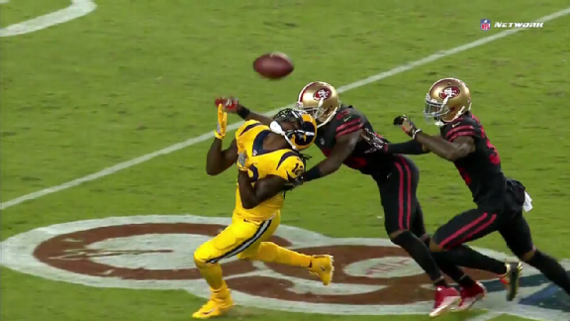
While Goff sat through the first half last year, former Rams quarterback Jim Everett identified him as someone who can “visualize the deep ball better than anyone on that roster.” After studying film from 2016, McVay saw past Goff’s struggles and continually referenced his “arm talent.”
It showed in the throw above, a 47-yard completion to Sammy Watkins.
Watkins made a nice over-the-shoulder catch. But Goff stepped up into the pocket off play-action and dropped that throw in the only place he could, right between two defenders downfield. Goff has already completed 27 passes that have traveled at least 15 yards through the air, third-most in the NFL. Last year, he completed only 10 such passes.
On that play, Watkins said Goff “threw a great ball to protect me from the safety.”
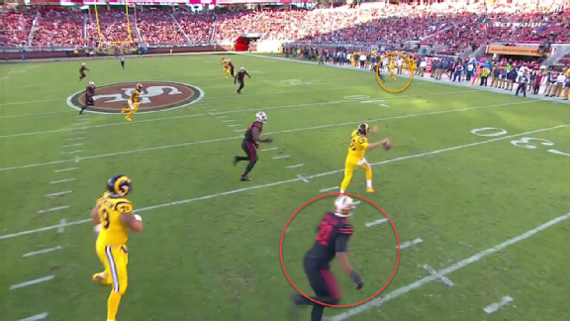
There may not be a more impressive Goff throw than this one, which somehow resulted in a 31-yard completion to Robert Woods.
Niners defensive lineman Arik Armstead found himself free on a stunt and was bearing down on Goff. But Goff moved to his right, then uncorked a deep ball to the right sideline off one foot. The throw was perfectly placed in Woods’ back shoulder, allowing him to make the catch despite very tight coverage.
Goff has only completed 36.7 percent of his passes outside the pocket this season (ranked 26th among 32 qualified quarterbacks) and only 37.7 percent of his passes when pressured (24th). But that throw was proof that he has the talent to get it done in those situations, too.
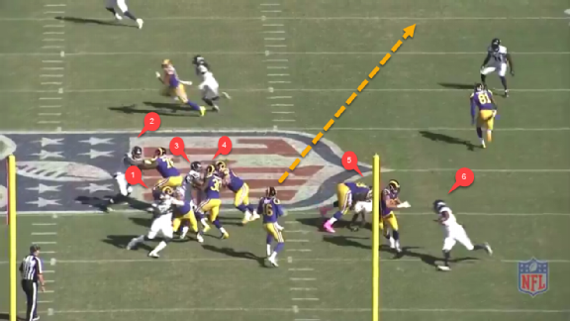
Goff may not have Carson Wentz’s athleticism, but he has been known to surprise people with the way he moves. And this year, his pocket awareness and overall patience has allowed him to run free when things break down.
The play above is a prime example. It was third-and-10 from midfield at the 13-minute mark of the third quarter, and the Seahawks brought the blitz. Six defenders went after Goff, but they left the middle of the field wide open. Goff dropped back, then immediately sprinted ahead, navigating towards the sideline and running safely out of bounds for a 22-yard run, the longest of his career.
Goff has run for 45 yards this year, nearly three times what he ran for as a rookie. Two weeks after that game, in a 33-0 win over the Arizona Cardinals from London, he had a 9-yard run that resulted in his first rushing touchdown of the season — on a read-option.
“I’ve been begging them to call that for a long time now,” Goff said. “For a few weeks. I keep going, ‘Call it, call it, call it.’ And so when it came in, I was like, ‘All right, here we go.'”
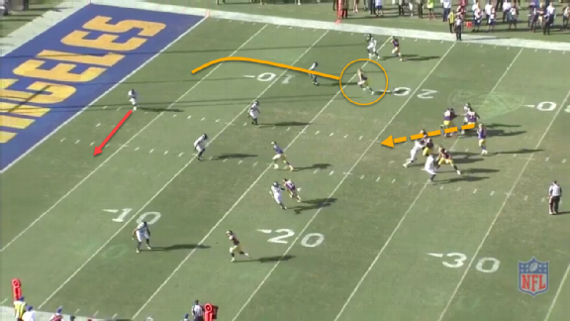
This play resulted in an incompletion, but it could’ve easily been the game-winning score — largely because of what Goff did before getting rid of the football. Trailing by six with 67 seconds remaining and no timeouts, Goff hit on a 35-yard pass and a 20-yard pass to get to the Seahawks’ 20-yard line. That brings us to the play pictured above, on third-and-10 with 12 seconds left.
Check out where Goff’s eyes were directed. Five-time Pro Bowler Earl Thomas, lined up as the single-high safety, was trying to bait Goff into an interception. But Goff looked him off, making Thomas dart to his right. That allowed Cooper Kupp to get free on a skinny post near the middle of the end zone. Goff reset, then delivered the throw on time and on target. But it went off Kupp’s fingertips and fell harmlessly to the ground.
The Rams lost, but Thomas was impressed with the way he was taken out of that play.
“Hats off to Goff,” Thomas said after the game. “He’s way better than last year.”
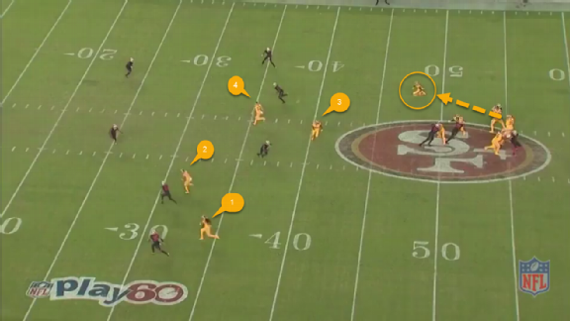
Of all the plays Goff made in that Thursday night game near his hometown, this is the one his coaches raved about.
It wasn’t flashy, but it came in a big spot and was the product of sensible decision-making. Facing third-and-10, with the Rams up by eight from the 49ers’ 46-yard line in the fourth quarter, Goff dropped back and scanned the field. He quickly went through all of his progressions, didn’t see anyone open and instead dumped it off to Todd Gurley, who turned it into a 27-yard gain to help set up another touchdown.
Goff kept it simple and didn’t force it, which might be the area where he has made the biggest strides as a second-year quarterback. Goff has combined for only three turnovers in six of his seven games. His 2.25 touchdown-to-interception ratio is only slightly above the NFL average (1.92), but it’s significantly better than the 0.71 mark he carried as a rookie.
McVay has made it a point not to heap effusive praise on Goff, but he has also made sure not to set the expectations too high.
“We just want him to continue to take those daily steps, and he’s done that and been receptive,” McVay said, crediting offensive coordinator Matt LaFleur and quarterbacks coach Greg Olson for Goff’s continued development. “We’re in a good place. By no means are we where we want to be, but I think he’s doing a great job of leading. And that’s a credit to Jared.”
znModeratorfrom Ranking the NFL’s Top 10 Defenses
https://www.msn.com/en-us/sports/nfl/ranking-the-nfls-top-10-defenses/ss-AAu3AHr?li=BBnba9I#image=8
…
5. LOS ANGELES RAMS
The sleeper factor in LA’s 5-2 start is not a resurgence by the offense but a top-five pass defense. The Rams held the Cardinals to 5.8 yards per attempt, no touchdowns, two interceptions and a rating of 39.1, albeit with 14 attempts coming from Drew Stanton after Carson Palmer broke his arm.\
LA came into the week ranked sixth against the pass by DVOA. Aaron Donald is one of the top five players in the NFL, while eight players on the Rams defense have at least two sacks this season. Since inserting rookie safety John Johnson into the starting lineup, LA has allowed just 34 points in three games.
znModeratorznModeratorI actually EXPECTED them to be an elite D this year and was surprised at the early results. They are coming around now though – lots of talent on that side of the ball.
I think at this point they finally have all their starters and everyone up to speed (Joyner missed time during the summer, so did Donald of course, etc.)
A Wade Phillips defense, when it’s clicking and playing effectively, is just so much fun to watch.
znModeratorThe league leaders in several signature stats among inside linebackershttps://t.co/3HgyvPNiS6 pic.twitter.com/EJ931qLoRq
— Pro Football Focus (@PFF) October 24, 2017
znModeratorZack Martin was our top graded guard in Week 7 💪 pic.twitter.com/ayyoT132Uy
— Pro Football Focus (@PFF) October 24, 2017
znModeratorThe top graded interior defenders through 7 weeks pic.twitter.com/5QLQETVq97
— Pro Football Focus (@PFF) October 25, 2017
znModeratorWhich team had the Offensive Line of the Week? https://t.co/9r8iOTZ3mQ (by @FordTrucks) pic.twitter.com/87HuaioZ8a
— NFL (@NFL) October 25, 2017
znModeratorfrom PFF: Ranking all 32 NFL offenses after Week 7
https://www.profootballfocus.com/news/pro-ranking-all-32-nfl-offenses-after-week-7
…
11. LOS ANGELES RAMS
BEST-GRADED STARTER: OT Andrew Whitworth, 83.2 overall grade
WORST-GRADED: OG Jamon Brown, 45.7 overall grade
The emergence of Jared Goff has catapulted the Rams to a 5-2 record this season. He currently sits with a 73.1 overall grade through seven weeks, much higher than his rookie season grade of 45.6. RB Todd Gurley’s sophomore slump is now behind him and with an improved rushing attack under head coach Sean McVay, Goff has benefited on play action passes. Despite recent struggles, new LT Andrew Whitworth has been a huge addition to a spotty offensive line from last year, as Whitworth holds the league’s 14th-highest pass block efficiency (96.2) among tackles.
znModeratorIt may be too soon for that. Cause I agree, they’re developing. In process.
BUT if I had to project from what they have shown so far, I would say 2 things. They will have 2 strengths:
1. The medium/deep medium pass. 11-25 yarders. Where suddenly they rip you downfield for big chunks at a time. IMO that’s both a McVay “thing” and a Goff talent.
2. On defense, pass rush & pressure. Right now they rank 5th in sack percentage and 4th in sacks. That’s with Quinn being less than his former self and with Donald growing into his role in the new D. That’s with Longacre being their leading sacker. So this will get even better across time.
znModeratorznModeratorEnh. Sounds like the corporate version of ‘life coaches.’ Sounds like stuff you could learn in “Everything you need to know you learn in Kindergarten” books.
At any rate, whatever the Patriots have is special. Year after year after year after year they continue to be great. Players change, and it doesnt matter. Its unlike anything else in pro football. No NFL team has duplicated it. Is it Belichick? Belichick and Brady? Something more?
w
vI honestly don’t think it’s unique. It’s just a version of what we already saw with the Shula Dolphins, the Noll Steelers, or the Walsh 9ers. And a coupla others too.
Heck Walsh did it with 2 different qbs. Shula did it with 3 different qbs (Griese, Morrall, Marino).
Yeah in terms of Forde I am not real big on “consultants” stuff. But apparently they had issues last year in the front office, not just on the field, and they were interested in getting everyone on the same page. So far that has worked. So…so be it. It worked. Forde gets his money, Rams get their “winning culture,” fans get to argue about it. Everyone’s happy.
 October 25, 2017 at 9:50 am in reply to: Rams Simulate Playing Giants by Pumping Crowd Groans Into Speakers #76523znModerator
Injured Cattle. Recordings of injured cattle. Something i didnt think i’d be reading today on the Rams board.
See this is why McV is a genius. Fisher would have used sounds of F-15s or Country Music.
w
vJust to be extra extra sure.
That’s an Onion piece.
You knew that right?
znModeratorThe Shared Vision That Saved the Atlanta Falcons
Albert Breer
February 01, 2017https://www.si.com/mmqb/2017/02/01/nfl-atlanta-falcons-thomas-dimitroff-dan-quinn-super-bowl-51
HOUSTON — Thomas Dimitroff’s awakening happened at the end of the 2006 season, when the Patriots beat the Chargers in the divisional round of the playoffs. Dimitroff, now the Falcons GM, was at the time New England’s college scouting director. By most measures San Diego had more talent and was the better team, having gone 14-2 despite resting its starters in Week 17.
Yet the Patriots won. And they won because, across the board, they had it together.
The Chargers didn’t. They had a talented GM (AJ Smith) and a decorated coach (Marty Schottenheimer) who couldn’t get along, and the team imploded. The coach was gone less than a month later. San Diego’s spectacular, precocious core never won a title.
Lesson learned: If the most important relationship in the building isn’t taken care of—and if the coaching and scouting philosophies aren’t aligned—you don’t stand much of a chance in the NFL, no matter how many great players you have on the roster.
Lesson applied: Dimitroff, the GM in Atlanta since 2008, was forced to work with new coach Dan Quinn at the start of 2015—a move that took away some of Dimitroff’s roster control. But the GM subjugated his ego, forged a relationship with Quinn and helped get the Falcons back to the Super Bowl for the first time since the 1999 season.
Were there trust issues? Did he feel undercut? Was the outside noise about his job security too much to handle?
“When those things crept into my mind or started to tug at my attention, I just … I was very determined to pull it back and focus on that really strong definitive goal to build that relationship and build the team,” Dimitroff said in a quiet moment on Tuesday. “The reality is, we all know we’re going to deal with critics. I knew what I signed up for many years ago.
“I knew about the proverbial hot seat, I didn’t know if it was going be only one year or three years. I probably didn’t expect that. I understand it. And I appreciate Arthur [Blank] sticking by me during those tough times.”
It sounds so easy, doesn’t it? Find a good coach and a good GM, come up with a vision, align coaching and scouting, and win a whole bunch of games.
Just like it’s a game for big people, pro football is also a game for outsized egos. And if there’s one common cause of internal chaos among NFL franchises, it’s egos clashing at the highest levels of football operations. The fallout is predictable. The coaches complain that players acquired by others don’t fit. The scouts, wanting to cover themselves, counter by collecting talent without regard to scheme. A mess follows.
This is the story of how it doesn’t have to be like that, and how the Falcons busted their asses to make sure it wouldn’t be like that when they made the decision to fire Mike Smith, retain Dimitroff and hire Quinn two years ago—a move that followed a 4-12 finish in 2013 and a 6-10 finish in ’14.
“It’s important that we hold each other accountable, that we’re holding up our end of the deal,” Quinn said. “Fortunate for us, we’ve seen some great models, not just in our own game, but also in basketball and baseball. It’s something we strive to keep moving forward. It doesn’t happen overnight, but he and I together, we work to keep growing stronger and stronger.”
Quinn saw Pete Carroll and John Schneider make it work in Seattle, and Dimitroff had a good view of how Bill Belichick and Scott Pioli (now the assistant GM in Atlanta) set up a dynasty in Foxborough. They’ve tapped their relationships with R.C. Buford and Greg Popovich (Spurs), and Bob Myers and Steve Kerr (Warriors) in the NBA, and Theo Epstein and Joe Maddon (Cubs) in MLB. But they’ve also done their own work.
As team president Rich McKay explains it, Quinn’s second interview, in 2015, was used as a relationship-building exercise between the coach-to-be and the GM, with the two working out how everything would be structured. Four months later, over a six-week period, Quinn and Dimitroff worked with a consultant, Mike Forde, on what’s called “corporate knowledge capture”—and they came out with mission statements on everything from team culture to athletic performance to coaching style and scouting structure. The idea was to have a singular vision.
“What blows up eventually, in my mind, is the word trust,” McKay says. “It’s the idea that somehow you begin to think that somebody else has a different agenda, that they’re not looking out for the same thing. And I think in many instances that comes from a lack of communication, and it winds up going to trust—and personnel winds up going to one side of the hall, coaching ends up on the other side of the hall, and it’s all bad … because then decisions are made for all the wrong reasons.”
After Dimitroff survived the 2015 purge, there was league-wide speculation that the Falcons would pair a new personnel man with their new coach in 2016; Seattle’s Trent Kirchner and Minnesota’s George Paton were even bandied about as candidates.
Dimitroff concedes now that his efforts to block out those reports were less than successful. He couldn’t avoid hearing it. “There were polls being run in the AJC that, two years in a row, were attempting to stir a lot up and suggest I shouldn’t be here,” he says. “I’d steer clear of it as much as possible. But there’s always going to be family and friends and loved ones calling: Did you see they wrote this about you?”
The results have spoken for themselves.
Offensive coordinator Kyle Shanahan inherited an offense that had cornerstones, and Dimitroff and Pioli added a center (Alex Mack), a game-breaker wideout (Taylor Gabriel), a reliable target (Mohammed Sanu), a pass-catching tight end (Austin Hooper) and a back (Tevin Coleman) to push the group and max out the scheme.
On defense, Keanu Neal—Atlanta’s version of what Quinn had in Seattle with Kam Chancellor—is as good an example as any of the collective vision coming together. But finding a pass rusher (Vic Beasley) and linebackers who can cover ground (Deion Jones, De’Vondre Campbell) was just as important to creating a unit built for short- and long-term success (seven first- or second-year players are starting).
Dimitroff explains why this has worked so well: “To me, it’s two very adept football men coming together, who are very confident, who are very secure, and who have an element of humility about them. And they understand they’re going to grow and learn together. I know that’s a long-winded way of saying it, but that’s what I believe. There were a number of things that were lined up, that’s why I think it worked.”
He and Quinn did the work to make sure they wouldn’t fall victim to what Dimitroff witnessed 10 years ago in San Diego. And so it makes sense that, with a team similarly stocked in potential, they’ve avoided a similar fate.
znModeratorHow Atlanta Falcons called on Premier League expertise for transformation that sent them to the top
Former Chelsea director of football Mike Forde helped trigger the changes that saved the Falcons, and he reveals why removing the ego among players is crucial to generating success
Ian Herbert
The relationship at the heart of the Atlanta Falcons, who seek to bloody the nose of the New England Patriots in Sunday‘s Super Bowl, is precisely the kind which the English Premier League has found almost impossibly difficult to sustain.
It was formed when Dan Quinn was hired, two years ago, to coach the team, seemingly removing at a stroke a substantial amount of roster control held by general manager Thomas Dimitroff. When that happens in Britain’s ego-fuelled division, two into one generally doesn’t go and a Dimitroff would be out the door.
In the build-up to hostilities in Houston, though, the relationship between Quinn and Dimitroff has been described by Sports Illustrated as “the vision that saved Atlanta” and Atlanta team president Rich McKay told the publication that it was a Briton steeped in the Premier League who has helped make it so.
Mike Forde was widely seen by many as a strong contender to become Chelsea chief executive when Ron Gourlay left three years ago, having modernised the business as its director of football operations. Before that, at Bolton Wanderers, he worked with Dr Bill Gerrard, one of the early exponents of the use of data in the transfer market, to help make Sam Allardyce’s tenure so successful. Dave Brailsford is among those to have looked for Forde’s insights, in his accretion of marginal gains.
It is Forde’s experience of the often dislocated relationships between executives and managers at the top of Premier League clubs – and the ways that rafts of staff cleared out as each new manager arrives – which has seen him build a reputation in the US though, as a consultant to the Falcons, Miami Dolphins and Philadelphia Eagles, with Brooklyn Nets, Philadelphia 76ers and others in basketball. Around 80 per cent have brought his consultancy in to prevent a change of coach creating holy hell and an unravelling which can set the club back years.
The Sportology consultancy, established with Aidan Halliwell, frequently sits the two individuals whose presence might seem mutually threatening in a room together and hammers out how they might co-exist. They go through the same process with owners to establish what kind of a team they are trying to establish, so that a new coach is not relying on signals and guesswork at his new organisation. “Corporate knowledge capture” is the term: the establishment of a singular vision of team culture, athletic performance, coaching style and scouting structure.
For the coaches, it is an exercise in subjugating ego – “leave your ego at the door,” is one of the mantras – and Forde can point to a very material example of how that might work. He has worked closely with Carlo Ancelotti, perhaps the ultimate example of management with the ego taken out.
“A strong coach will land grab and the ownership need to be strong enough about what their philosophy and aims are, to resist that,” Forde says. He cites Bayern Munich. ”A club of 25 players, 55 games [a season]. They tell their new managers: ‘This is us. We work the way we do.” It is a state of independent thinking that Manchester City aspired for after the Italian Roberto Mancini effectively set up a state within a state at the Etihad, insisting on bringing in a phalanx of his own staff. City spoke of a new “holistic” approach to running their business after Mancini left. They are still struggling to do that. Pep Guardiola’s arrival has coincided with a number of English ancillary staff leaving.
“What blows up eventually, in my mind, is the word trust,” McKay said this week, in the process of explaining why Forde had been so invaluable. “It’s the idea that somehow you begin to think that somebody else has a different agenda; that they’re not looking out for the same thing. And I think in many instances that comes from a lack of communication, and it winds up going to trust—and personnel winds up going to one side of the hall, coaching ends up on the other side of the hall, and it’s all bad … because then decisions are made for all the wrong reasons.”
Forde’s work in the Premier League transfer market has also fascinated the Americans. The potential risks attached to buying players in that division is far higher, with multiple nationalities and language and higher asset values. US sport, with its salary caps and principally American market for players, presents fewer surprises. The Americans want help with how they can extract better competitive advantage, and secure marginal gain, in how they spend on players.
The decreasing shelf life of the American sports coach makes the changes Forde helps supervise a more frequent challenge. The average NFL and NBA coach will last 3.2 years. The average tenure of the Premier League manager is 1.8 years, which suggest that the division’s own owners might want to investigate the process, too. English sport tends to think it knows best, though as Forde’s own departure from Chelsea in 2013 only went to show. Jose Mourinho returned as the new manager and within a week the director of football operations became surplus to requirement.
znModeratoralyoshamucci wrote:
Blinkscout Game 7 in London … Cardinals …
Honestly it’s harder to do these when we’re winning … I have no idea why. Feels foreign.
Now to be fair, there wasn’t much hope after Carson left. Also, seriously, how many times have we injured Carson Palmer?
The Great
1) Brockers. I haven’t had him this high, and I think this was his best game. Honestly, he and Donald are both playing like pro bowlers.
2) Barron being sure handed …
3) Turning the game off before it’s over … for a GOOD reason.
4) Run blocking. I can’t believe we are playing with any of the players we had last year.
5) AP 11 for 21? WOW.
The Good
6) Blythe coming in and not missing a beat. If he can play, we’ll save ourselves a freaking draft pick next year.
7) Getting Sammy some touches.
8) Robert Woods being Mr. dependable.
9) Gurley’s TDs are always highlight reel plays … seriously compiling just the TDs would be a great watch.
10) Kavon Webster has been steadily making plays. He’s not a #1 … but he’s likely a solid 2.
11) JJ3 with another solid game.
12) Quinn with a smart amount of high quality reps.
13) The announcers even mentioned how well Smart is playing.
14) I think we’ve found our Punt Returner.
15) Appropriate use of Tavon, albeit for wayyyyy overpaying.
16) Shutouts are always impressive.
The Bad
17) Kupp’s jitters. I know he’ll get himself calmed down … but I’d hate to lose another game because he’s shaky.
18) Goff and Sammy still not quite together on deep balls … hopefully they get that dealt with this week.
19) Goff still seems to be locking on to a target every 3-4 passes … and missing open guys while passing to someone covered.
znModeratorThe bye week is a nice time, with even sample sizes, to evaluate Jared Goff’s year-over-year progress with @RamsNFL. #LARams pic.twitter.com/hJs09TpS5N
— J.B. Long (@JB_Long) October 24, 2017
znModeratorI guess thats true. And i guess that means they dont have an ‘elite’ defense that can shut down great offenses, but they have a ‘good’ defense that can generally play well and be a top twelve defense.
Its only a franchise defense, not an elite defense.
There’s no way to tell until we actually play a great offense.
Dallas is 6th on offense.
Jax is 10th.
So they have played 2 top 10 offenses so far, fwiw
znModeratorNFL MMQB
Jared Goff Is Thriving at the Center of Les Snead’s Two-Phase PlanGreg Bishop
October 24, 2017When it comes to NFL quarterbacks, it’s not enough to just look at the quarterback’s talent—you need to take into consideration the reality of the situation. Tom Brady isn’t Tom Brady without the pieces around him. Same goes for Jared Goff who flailed on a dreadful team last year … and has the Rams rolling with a souped-up system in 2017.
Les Snead is the rare NFL general manager with a bicycle mounted on a trainer in the middle of his office. His immobilized Schwinn—sleek, white, decorated with stickers—appears stolen from a SoulCycle class, and its handlebars curl like ram horns toward a television mounted on the wall. That way Snead, 46, can get all Tour de France-y and watch film.
And whereas Snead might view the velocipede as a vehicle on which to multitask, a more cynical observer could find a metaphor here for the GM’s tenure. Since arriving in 2012, none of the teams he has assembled have won more than seven games, despite constant roster churn—the NFL equivalent of pedaling furiously and not going anywhere. This season, though, the Rams are 5–2 and riding atop the NFC West (with the tougher half of their schedule approaching) because of a two-part plan that Snead started in the spring of ’16, hoping to catapult a team returning to Los Angeles from St. Louis, the franchise at once going big and going home.
At the center of his strategy—because, duh, this is the NFL—was a quarterback. Phase 1 began in April 2016 when Snead made a calculated bet, trading six draft picks to obtain the No. 1 selection, which he used to grab Cal junior Jared Goff. The QB possessed a strong arm, a dream body type . . . and almost no experience running a pro-style offense. The ensuing NFL season unfolded about as well as could be expected. The Rams went 4–12, finishing with seven straight losses in Goff starts.
Phase 2 started this spring, with Snead’s laying out four goals, the first three of which concentrated on enhancing everything around his new QB: 1) Hire a new coach (after Jeff Fisher was fired last December); 2) review and perfect all processes, from meeting schedules to sleep patterns to organizational philosophies; 3) improve the offense; and 4) don’t forget about the defense!
Snead accomplished No. 1 quickly, stealing offensive prodigy Sean McVay from Washington last January. He hired Mike Forde, a high-performance consultant who was once Chelsea’s director of football operations, to calibrate the Rams’ approach to just about everything. (No. 2: check.) Then he added a left tackle, Andrew Whitworth; a center, John Sullivan; and three wideouts: Sammy Watkins, Robert Woods and third-round draft pick Cooper Kupp. (No. 3: check. As for No. 4, Aaron Donald is back on the field: good enough.)
The Rams did all this because they had to, because that’s how NFL teams win. Think of the QBs who defined this generation: Peyton Manning, Tom Brady, Drew Brees, Aaron Rodgers, Ben Roethlisberger. . . . They didn’t win on spirals alone. They were buttressed by teammates acquired specifically to help them, and they ran offenses tailored to their strengths. Brady isn’t Brady without Bill Belichick, the system he created around his QB and the teammates he obtained and improved. Now think of the next crop of promising passers: Goff, Winston, Mariota, Wentz, Watson. . . . Plenty of talent, sure, but each one lacks the infrastructure enjoyed by the likes of Brady and Rodgers. How those young guys develop—and how their organizations develop around them—will define football’s next generation.
Goff’s successful transformation appeared unlikely as he was yanked in the fourth quarter of the season finale, a 44–6 loss to the Cardinals. But the forces at work in the QB’s development crystallized for Snead this summer, when he received what he says was “the best birthday present” of his life. The GM’s wife, Kara, took him to Boulder, Colo., to meet with author Jim Collins, who writes about something he calls the Flywheel Effect: combinations of factors that work together to move companies from “good to great,” like a massive metal disk being propelled forward by momentum.
Every Flywheel is different, with varying factors influencing it. For this particular business, a football team, imagine a clock with different elements at noon, three, six and nine, with arrows connecting one element to the next in a circle, all working together, building momentum. Snead filled an entire legal pad with notes, beginning to imagine the Rams’ organization as a Flywheel. The hub? Goff. “Best six hours of my life,” he says, before realizing how that might sound to his wife and children.
He corrects this assessment. “Top 10 life moment,” he says—with the potential to climb.
As the 2016 NFL draft approached, Snead figured that the Titans, who held the top pick and had selected Marcus Mariota the year before, would be amenable to a trade. Having cycled through the likes of Shaun Hill and Austin Davis in the previous 48 games, Snead desperately needed a franchise passer, and he liked both Goff and North Dakota State’s Carson Wentz, who evoked a young Brett Favre.
The Rams visited Wentz first, and he had an impressive workout in perfect conditions—sunny, no wind—in Fargo. Snead and Co. then flew to the Bay Area, where on the night before a scheduled morning session with Goff they saw that rain was threatening their plans. The quarterback met Snead in the lobby of his Berkeley hotel, and the GM mentioned a few pockets of time the next day when it appeared the rain might abate. “We’re going at 8:30 a.m.,” Goff said. “And I hope it rains.”
The skies indeed opened that morning, but the workout went off as scheduled, and that was that. The Rams had found themselves a QB, and Snead saw for the first time how hard it was to rattle Jared Goff.
Rain was one thing. The debacle of 2016 was another. The five previous quarterbacks taken with the No. 1 pick—-Matthew Stafford, Sam Bradford, Cam Newton, Andrew Luck and Jameis Winston—each started his team’s season opener as a rookie. Early in his debut year, Goff did everything except play. He moved from Berkeley to Oxnard (for minicamps) to Irvine (for training camp) to Thousand Oaks (for the season). He sequestered himself, living alone so he could immerse himself in football. He learned a new offense and how to play under center, after years in the shotgun. He saw his competition (starter Case Keenum) benched and his coach fired.
His first start finally came on Nov. 20, against the Dolphins. It rained again, but Goff didn’t turn the ball over in an otherwise unremarkable debut. Still, the Rams lost, and then they lost six more, as Goff was sacked 26 times, compiling the lowest QBR (22.2) of anyone who started at least five games. He’d asked for rain and gotten it.
Still, Snead saw signs that he had put the right guy in the center of his Flywheel. Some of Goff’s throws—deep balls, passes into tight windows . . . and that zip!—made the GM’s heart palpitate. More important, the young quarterback never blamed his porous offensive line or the running game that moved like a car stripped of its tires. And he fought when only pride mattered. Late in one game, down 21 to the Seahawks in mid-December, he took off for the end zone and dropped a shoulder at cornerback Richard Sherman. Nearly decapitated, Goff still tried to wave off team doctors. “We already knew he could throw the football,” Snead says, “but I saw something that day under the California cool that made me say, Wow, it’s there.”
Not many shared Snead’s optimism. Fans mocked Goff and Snead across social media, a reaction the GM describes as “probably quick-triggered”—but “that’s the microwave world we live in.” Goff remained nonplussed. “Twitter doesn’t bother me,” he says. “When people that have never played the game have opinions, it doesn’t make a difference. It’s just a bunch of ignorance. In person, people are too scared [to say something].”
The QB refused to be deterred, in part because he remained vaguely aware that, years before, his own father’s professional baseball career had suffered from self-imposed pressure. In Jerry Goff’s last game in the majors, playing catcher for the Astros in 1996, he knew Houston’s front office doubted him and, confidence evaporating, he gave up six passed balls.
Twenty years later, father watched son suffer all those sacks and wondered whether his kid might end up like David Carr, the No. 1 pick in 2002, who was sacked out of the NFL. Instead, Jared found the calm his dad never did. “I was pretty hard on myself if I didn’t play well, and there were times that it affected my play,” Jerry says. “Jared and I are opposites in that regard.”
When the season ended, Goff needed distance—from football, physical pain, celebrity, chaos. He decamped to Cabo San Lucas in Mexico with his four best friends, a group known (to themselves, anyway) as the Fab Five. The Five had been childhood buddies who played sports; now they’re a consultant, an Arizona grad student working toward an MBA, a property manager, a budding NFL quarterback and his new (and unemployed) roommate. They spend most days on a group text-message thread, lobbing inside jokes back and forth.
In Mexico, Goff forgot about his unremarkable rookie season. He roamed the beach unnoticed, sipped blended beverages, lounged around his hotel pool and rode a banana boat. It was his first (semi)adult vacation.
Mind cleared, body healed, he flew back to the U.S. and hired Adam Dedeaux, a mechanics guru for what seems like half of the NFL’s passers. Goff provided a counterpoint to established stars like Brady and Matt Ryan, who visit Dedeaux in Southern California to refine their skills. For all the success Goff had in college and at Marin Catholic High, he’d never really put the microscope to his throwing motion. He didn’t need an overhaul, necessarily, but he required significant changes. For as hard and as far as he could throw, he lacked the basic foundation for NFL longevity: a consistent, repeatable motion.
Goff visited Dedeaux more than 30 times this offseason, undergoing physical and psychological assessments and making major alterations to the one thing he’d done best his entire life: throw. He focused on footwork, on driving passes with his body rather than with his arm to create torque, on generating power and efficiency by shortening his motion. Sometimes, as passes whistled by, Dedeaux thought, Oh, yeah, that’s the No. 1 pick.
On July 4, the Fab Five rented a house in Newport Beach and played two-on-two touch football on the sand before the sun dropped and the fireworks exploded. Goff was the all-time quarterback, naturally, and Patrick Conroy (the new roommate) says he noticed a glow of inner peace.
“His energy was noticeably different this offseason,” says Jared’s sister, Lauren. “He seemed more at ease.” The Rams’ Flywheel was starting to budge.
As part of his job interview last winter, McVay met with Goff at the Rams’ offices in Thousand Oaks. The two spoke for maybe half an hour. The coach wanted to know how his prospective QB had processed the fiasco of 2016. Did he blame the coaches? Did he demeaningly refer to the Rams’ old scheme as a “middle school offense,” the way running back Todd Gurley had last December?
“He took accountability, didn’t make any excuses,” McVay says. “He struck me as unfazed.”
Goff, in turn, wanted to know what McVay had done in Washington to turn Kirk Cousins into a starter worthy of consecutive franchise tags. The coach explained his usual approach, that he’d designed schemes around his quarterback and his particular strengths. He told Goff he would study him and mold the Rams’ offense around what he did best, accounting too for his teammates’ talents (Watkins’s speed, for example, and Gurley’s shiftiness). Goff texted his father immediately afterward. “He was ecstatic,” says Jerry.
McVay—now 31, he was the youngest NFL head coach ever hired—and his 23-year-old QB aren’t so far apart in age, but they don’t bond over Goff’s favorite pop artists, like Justin Bieber. Their relationship is built entirely around offensive football and only offensive football. They meet daily to go over plays and brainstorm strategy, two blond millennial bros who should be out enjoying the SoCal celebrity circuit.
Goff believes his new coach has held true to the philosophy he espoused in that initial meeting. McVay revamped the core of L.A.’s offense, which now mixes elements from the Patriots (heavy presnap motion), Falcons (outside runs) and Saints (downfield route combinations) with Goff-specific alterations. McVay tossed out the conservative Rams offense, which ranked last in the NFL in each of the past two years, incorporating more play-action, bootlegs and deep passes—all strengths that Goff refined with Dedeaux this spring.
“Jared’s not limited in anything,” McVay says.
“He’s very creative, super player-driven,” Goff says of his coach.
When Dedeaux looks at the offense, he sees a system adapted to its quarterback—not, as is more often the case, a quarterback adapting to a system. He calls McVay a “genius” and labels his approach “rare.”
“What people need to understand is how much a coach impacts his quarterbacks,” says 77-year-old Roman Gabriel, who threw 201 touchdowns in 16 seasons with the Rams and Eagles. “Goff took more shots than he had to [last year] because the design of that offense wasn’t conducive to a young quarterback being good. The style of offense Sean brought is more conducive to the kind of quarterback Goff is.”
Back in the office, beside his bicycle, Snead grabs his iPhone and dials up someone listed as ‘Sprint’ in his contacts. That’s Kara, his wife.
The Rams, at this point, are five games into the 2017 season. Their Flywheel is spinning, with roster additions blocking for and catching passes from an improved quarterback on newly designed plays. Momentum is building. Goff decimated the Colts for 306 passing yards in the opener, tossed three TDs against the 49ers in Week 3 and pulled off a comeback win at Dallas in Week 4. Through fives games L.A. scored 142 total points, third most under a first-year coach in the modern era. (In the subsequent weeks they will edge out the Jaguars 27–17 in the Revelation Bowl and hammer the Cardinals 33–0 in London.)
“This season is a derivative of our Flywheel,” Snead says as Kara picks up, on speakerphone. “What’s that foreword you had me read last night?” he asks.
“Malcolm Gladwell,” she responds. “From The Person and the Situation.”
“I [read it to mean] this,” he says. “It’s absurd to try to figure out the difference between Manning and Favre. To the naked eye, there’s not a huge difference. What’s probably the biggest variable is the situation they’re in.”
“That would be a perfect way to look at Jared,” Kara says. “The difference in his development between this year and last year: He’s playing well, he’s in a great situation.”
Snead nods and smiles as his better half gives voice to his thoughts. The Rams are no longer riding in place. Everything around Goff has changed: his teammates, his offensive scheme—he’s even altered his throwing mechanics. In order to elevate his QB from good to great, says Snead, “I have a sneaky suspicion that it takes all those things.” The Rams’ Flywheel is in full motion.
October 24, 2017 at 6:33 pm in reply to: Cardinals vs Rams – Highlights … & some Waldman & Baldinger (a lot here) #76503znModerator.@rams with great play design v the @Cardinal "robber" look on 3-9. I live the way McVay coaches this team. Hard & Precise #BaldyBreakdowns pic.twitter.com/35wLXWnueI
— Brian Baldinger (@BaldyNFL) October 24, 2017
.@RamsNFL @awhitworth77 has been the single greatest addition to this Rams team; just ask @JaredGoff16 #BaldyBreakdowns pic.twitter.com/437RBm0yKi
— Brian Baldinger (@BaldyNFL) October 24, 2017
.@rams @TG3II is benefitting from being a true tailback at 7 1/2 yards deep with some strong run blocking up front #BaldyBreakdowns pic.twitter.com/BrBvoKMKO7
— Brian Baldinger (@BaldyNFL) October 24, 2017
.@rams @Tayaustin01 benefits from McVays creative play designs. Designs are 1 thing, execution is another. LAR #1 in OFF! #BaldyBreakdowns pic.twitter.com/anDVwT1DTx
— Brian Baldinger (@BaldyNFL) October 24, 2017
.@RamsNFL @JaredGoff16 continues to develop and trusts what he sees. Better pinpoint accuracy is the next step #BaldyBreakdowns pic.twitter.com/tGcn3s9aEk
— Brian Baldinger (@BaldyNFL) October 24, 2017
.@RamsNFL @JaredGoff16 to @CooperKupp is a connection that Ram fans have to look forward to for a long time to come #BaldyBreakdowns pic.twitter.com/TtqWjKyve7
— Brian Baldinger (@BaldyNFL) October 24, 2017
.@RamsNFL @JaredGoff16 runs for a 9 yard TD run and it demoralized the Cards Sunday. The reaction of PP is all you need #BaldyBreakdowns pic.twitter.com/H6QrWVJjcO
— Brian Baldinger (@BaldyNFL) October 24, 2017
.@RamsNFL @AaronDonald97 will ruin your offense if you don't give him proper attention #BaldyBreakdowns pic.twitter.com/GhexcNOun2
— Brian Baldinger (@BaldyNFL) October 24, 2017
October 24, 2017 at 9:34 am in reply to: Cardinals vs Rams – Highlights … & some Waldman & Baldinger (a lot here) #76481znModerator -
AuthorPosts