
Forum Replies Created
-
AuthorPosts
-
 znModerator
Hey @NdamukongSuh,
Please come and play for our team.
Love,
The Punter— Johnny Hekker (@JHekker) March 19, 2018
March 19, 2018 at 3:43 pm in reply to: Dominique Easley signs one year contract with the Rams #84280znModeratorDominique Easley (Rams), $1.85M, $50K March 21 roster bonus, $45K 6-1 roster bonus, $50K Aug. 1, roster bonus, $62,500 per game active roster bonus, up to $1M sacks, playoffs incentive, salary $705K
— Aaron Wilson (@AaronWilson_NFL) March 19, 2018
znModeratorAgent’s Take: Five players who could reset the market value for non-quarterbacks
https://www.cbssports.com/nfl/news/agents-take-five-players-who-could-re-set-the-market-value-for-non-quarterbacks/The top of the non-quarterback market has largely remained stagnant since defensive tackle Ndamukong Suh signed a six-year, $114.375 million contract with the Dolphins in 2015 as an unrestricted free agent. Suh’s deal contained a then-record $59.955 million fully guaranteed at signing — still the second most in an NFL contract.
A little over a year later, Broncos linebacker Von Miller narrowly eclipsed Suh’s deal with the six-year, $114.5 million contract he received as a franchise player. Miller became the NFL’s highest paid non-quarterback at $19,083,333 per year. The Super Bowl 50 MVP’s $70 million in overall guarantees also established a new standard for non-quarterbacks. With $42 million fully guaranteed at signing, Miller ranked third among non-quarterbacks in this metric.
The 2017 non-quarterback market was somewhat disappointing. Cardinals outside linebacker Chandler Jones, who was given a franchise tag, set the tone by reaching an agreement at the start of free agency last March. Typical timing is when the annual July 15 deadline for franchise players to sign multi-year contracts is approaching. He signed a five-year, $82.5 million deal with $53 million in overall guarantees; $31 million was fully guaranteed at signing.
Jones, despite being more consistent, didn’t quite fare as well as Olivier Vernon did in 2016 as an unrestricted free agent. Vernon received a five-year, $85 million contract containing $52.5 million in guarantees from the Giants. $40 million of Vernon’s money was fully guaranteed at signing; $54 million is guaranteed over the first three years. Chargers defensive end Melvin Ingram, Giants defensive end Jason Pierre-Paul and Panthers defensive tackle Kawann Short, who were also designated as franchise players in 2017, weren’t able to reach Vernon’s financial level either after Jones defined their market with his deal.
Things are on the verge of changing. A $20 million per year non-quarterback is on the horizon. Here’s a look at the players in the best position to surpass Miller and Suh in some, if not all, important established contract metrics before the 2018 regular season begins. The group is dominated by 2014 first-round picks whose respective teams exercised options for a fifth year.
Khalil Mack
Raiders general manager Reggie McKenzie’s timetable for a Mack extension has been the 2018 offseason ever since locking up quarterback Derek Carr long-term last summer. There would have to be a complete breakdown in contract talks for Mack to play under his $13.846 million option.Mack’s play in 2017 wasn’t quite at the ridiculously high level of his previous two seasons, although he earned a third-consecutive Pro Bowl berth. The 2016 NFL Defensive Player of the Year was the first player in NFL history to earn first-team All-Pro honors at two different positions during the same season (defensive end and outside linebacker) in 2015.
The slight drop off won’t matter in negotiations. A new deal will likely make Mack a charter member of $20 million per year non-quarterback club. Contract security could be more of a sticking point than the overall dollars if the Raiders view Carr’s $70.2 million in overall guarantees and $40 million fully guaranteed at signing as a ceiling for Mack. Typically, the starting quarterback is a team’s standard bearer in most contract metrics when he has a lucrative deal in place.
The Raiders are facing a unique situation. It is rare for teams to have a high-priced quarterback while a non-quarterback is also commanding top dollar. The Raiders are likely to become the first team in league history with a $20 million per year non-quarterback and a $25 million per year quarterback.
Aaron Donald
The Rams won the battle in a contest of wills last preseason when Donald ended his lengthy holdout without getting a new contract. Rams general manager Les Snead now calls a new deal for Donald, who is scheduled to make $6.892 million in 2018 on his fifth-year option, a major priority but hasn’t set a timetable. Donald may ultimately win the war because it usually costs more to sign a great player the longer a team waits.
The 2014 NFL Defensive Rookie of the Year had the best season of his impressive four-year NFL career without the benefit of training camp. Donald solidified his standing as the league’s most disruptive force from the interior of a defensive line. He was named 2017 NFL Defensive Player of the Year. According to Pro Football Focus, Donald led the NFL with 91 quarterback pressures (combined sacks, quarterback hurries and quarterback hits) despite sitting out the season opener since his holdout had just ended and the season finale as a precautionary measure with the playoffs looming. His 82 quarterback pressures in 2016 were the third most in the league and led NFL interior defensive linemen.
Donald’s agents would be justified in raising the demands, which likely mean a landmark deal, that the Rams weren’t willing to meet a few months ago by at least 10 percent because of the season Donald had and the expected growth in the salary cap. Preliminary projections put the 2018 salary cap between $174.2 million and $178.1 million.
Both Donald and Mack should be the league’s highest paid non-quarterback with their new contracts. Whichever one signs first will probably have his contract leveraged by the other one into a more lucrative deal.
Odell Beckham
Beckham demonstrated that he didn’t understand the NFL pay scale last summer when suggesting he should be the highest-paid player in the league. A wide receiver has never been the NFL’s highest-paid player during the salary-cap era, which began in 1994. Quarterbacks have traditionally been atop the league’s salary hierarchy. This isn’t going to change in the foreseeable future.
A broken ankle in a Week 5 loss to the Chargers ended Beckham’s 2017 season prematurely. Beckham arguably had the best first three seasons for a wide receiver in league history. He had 288 receptions (tied for first), 4,112 receiving yards (second) and 35 touchdown catches (tied of fifth) in 43 games. Jerry Rice and Randy Moss are the only wide receivers with comparable production. Beckham is still in the top 10 though four seasons in these categories despite missing 17 out of 64 games.
Giants co-owner John Mara has indicated that Beckham’s contract will be addressed at an appropriate time. Presumably, this means Beckham doesn’t have to worry about playing on his $8.459 million option in 2018.
Beckham declared on the eve of Super Bowl LII that he wants a new deal sooner rather later. His impatience potentially could cost him money. Since Steelers wide receiver Antonio Brown’s $17 million per year and Texans wide receiver DeAndre Hopkins’ $49 million in overall guarantees and $36.5 million fully guaranteed at signing are the financial benchmarks for pass catchers, it may be smart for Beckham to let Donald and/or Mack raise the bar for a non-quarterback before signing.
Beckham becoming the NFL’s highest-paid non-quarterback wouldn’t be unprecedented. Larry Fitzgerald and Calvin Johnson have both held the distinction in recent years. The closest a wide receiver has come to being the league’s highest-paid player since the end of the lockout in 2011 is Fitzgerald. His seven-year, $113 million extension containing $45 million in guarantees with the Cardinals made him fourth by average yearly salary at just under $16.143 million per year. Tom Brady and Peyton Manning’s $18 million per year deals were the NFL standard in 2011.
Jadeveon Clowney
The injuries that defined Clowney’s first two NFL seasons are behind him. With good health, Clowney started living up to the potential that made him the first-overall pick in the 2014 NFL draft. He has been named to consecutive Pro Bowls and earned some first-team All-Pro/All-NFL honors in 2016.
Clowney is a notch below Donald and Mack. He posted a career high 9.5 sacks and 64 quarterback pressures in 2017. Donald and Mack routinely better these marks. Mack produced 10.5 sacks and 79 quarterback pressures in a “down” 2017 season.
New general manager Brian Gaine acknowledged last month at his introductory press conference that Clowney’s contract was on the offseason to-do list. Clowney, who is due a $13.846 million fifth-year option salary, can make a case that he should get more than Jets defensive end Muhammad Wilkerson after adjusting his deal to a 2018 salary cap environment. Wilkerson signed a five-year, $86 million deal in July 2016 right before the deadline for franchise players to sign long term. His contract contains $53.5 million in overall guarantees, of which $36.75 million was fully guaranteed at signing. At $17.2 million per year, Wilkerson became the NFL’s third highest paid non-quarterback. With the 2018 salary cap expected to be in the $180 million neighborhood, a deal equivalent to Wilkerson’s would average slightly under $20 million per year.
Demarcus Lawrence
Lawrence has perfect timing. Having a career year with an expiring contract has prompted Dallas to announce Lawrence will be given a franchise tag absent a long-term deal before the March 6 designation deadline because of the immense importance of players who can pressure opposing quarterbacks. Lawrence’s strong start to the 2017 season (6.5 sacks in the first three games) resulted in him being named NFC Defensive Player of the Month for September. He was selected to the Pro Bowl for the first time while tying for second in the NFL with 14.5 sacks.Lawrence shouldn’t have a lot of incentive to sign or reach an agreement quickly. Waiting until the mid-July deadline for franchise players to sign long-term draws near could work to Lawrence’s benefit. Donald and/or Mack getting a deal done before then may provide more ammunition for using the multiple franchise-tag approach. The defensive-end number should be $17.414 million if the salary cap exceeds projections and is set at $180 million. A second franchise tag in 2019 at a 20-percent increase would be almost $20.9 million. Potentially being franchised in consecutive years could be used as justification for a long-term deal averaging approximately $19.15 million.
znModerator znModerator
regardless you have three guys who can play at multiple positions on the line and two who are elite level talents.
invader, you are in the minority on this. Which is fine except you know what being in the minority on an issue means. It means you have to expect terrible reprisals and all posts by you will be delayed for inspection to make sure they are not causing any trouble.
We are for diversity of opinions, sure, but, that doesn;t mean people can disagree with the majority. You start allowing THAT and it’s anarchy.
Johnny Caspar, from Miller’s Crossing: It’s gettin’ so a businessman can’t expect no return from a fixed fight. Now, if you can’t trust a fix, what can you trust? For a good return, you gotta go bettin’ on chance – and then you’re back with anarchy, right back in the jungle.
Short version: who knows, invader, you could be right.
 znModerator
regardless you have three guys who can play at multiple positions on the line and two who are elite level talents.
See I don’t think that’s the case. I don’t think it IS a “can play multiple positions” thing. I think AD is a 3-tech, I think Suh is a 3-tech, and I think Brockers is a 3/4 end.
znModeratorI don’t see how they could afford both Suh and Donald.
And I don’t see him as a fit. In Wade’s D he would be a 3-tech, which is AD’s position.
Brockers wasn’t a fit at NT so I don’t see the advantage of putting Suh at DE.
This whole thing is just several differently shaped pegs for one round hole.
…
znModeratorNdamukong Suh to visit Los Angeles Rams
Kevin Patra
http://www.nfl.com/news/story/0ap3000000921989/article/ndamukong-suh-to-visit-los-angeles-rams
The Ndamukong Suh free agency tour presses on.
The defensive tackle told Jordan Schultz of Yahoo Sports he plans to visit the Los Angeles Rams. NFL Network’s Peter Schrager reported that the meeting is scheduled for Tuesday.
Suh, who ranks No. 3 on NFL.com’s Top 101 Free Agents of 2018, was released by the Miami Dolphins at the start of the free-agent signing period last week — three years after he signed a record six-year, $114 million contract.
The visit to L.A. will be Suh’s third. The 31-year-old made trips to New Orleans and Tennessee. Suh told Schultz that both visits “went well” and added money has not yet been discussed.
The Rams provide an intriguing destination for Suh, who would fit in with the glitz and glamour of L.A.
On the field, pairing Suh with Defensive Player of the Year Aaron Donald would be unfair to offenses. Good luck blocking one of those pocket-pushing behemoths one-on-one. Quarterbacks would be under siege from the snap of the ball.
Courting Suh is the latest move for general manager Les Snead that shows he’s going all-in on 2018. Already Snead landed a ball-hawking corner duo of Marcus Peters and Aqib Talib in trades. Pairing the game-wrecking interior rush of Suh and Donald with a corner duo that jumps the ball would give Wade Phillips endless options.
Outside of California’s high income tax — Florida’s lack of tax on salary famously played a role in Suh landing in Miami — Suh to L.A. makes sense on the field and off the field. The Rams would need to make the money work in the short term to ensure cash remains to lock down Donald, Todd Gurley and Jared Goff down the road. Thanks in part to many of their key contributors still being on rookie contracts, the Rams currently sit in the top three in cap space in 2019 and 2020, per Over The Cap.
znModeratorAlden Gonzalez@Alden_Gonzalez
If they end up with a Donald-Suh-Brockers D-line, to go along with a Peters-Talib-Joyner-Johnson secondary, I think the Rams’ beat writers could take up the linebacker spots and they’d be aight
==
Rams’ D-line: Aaron Donald, Michael Brockers … and Ndamukong Suh?
Alden Gonzalez
LOS ANGELES — The Los Angeles Rams have already added a couple of All-Pro corners in Marcus Peters and Aqib Talib, pairing them with safety Lamarcus Joyner to help form what might be the NFL’s best secondary.
Now, it seems, they’re trying to add the final piece to a devastating defensive line.
Ndamukong Suh — the 6-foot-4, 305-pound tormentor of opposing quarterbacks — will be flying to Southern California to visit with the Rams this week, a source said Sunday night, confirming an initial report from Yahoo! Sports. If the Rams sign Suh, they would probably plug him into the middle of a defensive line that already includes Aaron Donald and Michael Brockers.
Suh was released by the Miami Dolphins on Wednesday, then visited with the New Orleans Saints and the Tennessee Titans as part of a free-agency tour that could include several other teams before reaching its conclusion.
Suh, 31, might still be the game’s best interior lineman outside of Donald, the reigning AP Defensive Player of the Year. From 2010 to 2017, he has compiled 51.5 sacks, second only to Geno Atkins for the most among defensive tackles, and has been named first-team All-Pro on three occasions.
The 2010 No. 2 overall pick by the Detroit Lions has always played in a 4-3 system and is best utilized as a 3-technique, which means he lines up between the guard and the tackle. The Rams play a 3-4 system, overseen by defensive coordinator Wade Phillips, and Donald is their 3-tech. But Suh has displayed versatility throughout his career. He has steadily improved defending the run, continues to be a menace against the pass and has proven to be exceedingly durable, playing in at least 800 snaps in seven of his eight seasons.
The Rams could use Suh either as a nose tackle or a defensive end, with Brockers able to play both.
The Rams haven’t signed any new free agents since the league year began, but they recently brought back three of their players — center John Sullivan, wide receiver Tavon Austin and slot corner Nickell Robey-Coleman. Their remaining needs are edge rushers and run-stuffers. Suh may not fit the traditional mold of either, but he remains among the game’s best pass-rushers and is certainly big enough to fill the gaps to stop the run.
After accounting for their draft pool, the Rams have something in the neighborhood of $25 million in cap space for 2018. But they also need to save some room for Donald, who is looking to become the game’s highest paid defensive player — a title once held by Suh.
znModeratorAlden Gonzalez@Alden_Gonzalez
Can confirm: Ndamukong Suh will be visiting with the Rams this week. If he signs, he would join a defensive line that includes Aaron Donald and Michael Brockers.znModeratorThis is for the 2019 draft. This guy is usually right on.
Updated.
…
Compensatory Draft Picks Cancellation Chart
link: https://overthecap.com/compensatory-draft-picks-cancellation-chart/
To add clarity to how the compensatory draft pick formula works, this page will contain a list of all Compensatory Free Agents lost and gained by each team, and illustrate which players are paired together for cancellation. Players that are projected to be eligible to earn their former team a compensatory pick are highlighted in their former team’s colors. Please note that this chart does not include potential “net-value” compensatory picks for teams that lose and gain an equal amount of CFAs, nor does it account for compensatory picks that may not be awarded due to falling below the 32-pick limit or exceeding the maximum of four per team.
Sammy Watkins 3 $16,000,000
Trumaine Johnson 3 $15,000,000
Cody Davis 7 $2,500,000
Derek Carrier 7 $1,833,333March 18, 2018 at 3:04 pm in reply to: How knowledge about different cultures is shaking the foundations of psychology #84243znModeratorHow biology breaks the ‘cerebral mystique’
The Biological Mind explores how the brain, body and environment make us who we arelink: https://www.sciencenews.org/article/the-biological-mind-alan-jasanoff
Review of The Biological Mind
Alan JasanoffAt a small eatery in Seville, Spain, Alan Jasanoff had his first experience with brains — wrapped in eggs and served with potatoes. At the time, he was more interested in finding a good, affordable meal than contemplating the sheer awesomeness of the organ he was eating. Years later, Jasanoff began studying the brain as part of his training as a neuroscientist, and he went on, like so many others, to revere it. It is said, after all, to be the root of our soul and consciousness. But today, Jasanoff has yet another view: He has come to see our awe of the organ as a seriously flawed way of thinking, and even a danger to society.
In The Biological Mind, Jasanoff, now a neuroscientist at MIT, refers to the romanticized view of the brain — its separateness and superiority to the body and its depiction as almost supernatural — as the “cerebral mystique.” Such an attitude has been fueled, in part, by images that depict the brain without any connection to the body or by analogies that compare the brain to a computer. Admittedly, the brain does have tremendous computing power. But Jasanoff’s goal is to show that the brain doesn’t work as a distinct, mystical entity, but as a ball of flesh awash with fluids and innately in tune with the rest of the body and the environment. “Self” doesn’t just come from the brain, he explains, but also from the interactions of chemicals from our bodies with everything else around us.
To make his case, Jasanoff offers an extensive yet entertaining review of the schools of thought and representations of the brain in the media that led to the rise of the cerebral mystique, especially during the last few decades. He then tears down those ideas using contrary examples from recent research, along with engaging anecdotes. For instance, his clear, lively writing reveals how our emotions, such as the fight-or-flight response and the suite of thoughts and actions associated with stress, provide strong evidence for a brain-body connection. Exercise’s effect on the brain also supports this notion. Even creativity isn’t sacred, often stemming from repeated interactions with those around us.
Jasanoff is critical of how the cerebral mystique reduces problems of human behavior, such as drug addiction or eating disorders, to problems of the brain. Such problems are no longer viewed as “moral failings” but as a result of “broken brains.” This shifting view, its advocates argue, reduces the stigma associated with psychiatric disorders. But it also leads to other problems, Jasanoff notes: Society views broken brains as harder to fix than moral flaws, making life even more challenging for individuals already struggling with mental illness. People could benefit from a more comprehensive view of the brain, one that includes how biology, environment and culture shape behavior.
When mental processes are seen as transcending the body, society perceives people as “more independent and self-motivated than they truly are,” and that minimizes “the connections that bind us to each other and to the environment around us,” Jasanoff writes. As a result, he argues, we’re living in an age of self-absorption and self-centeredness, driven in part by our fascination with the brain.
In reality, the brain isn’t a miraculous machine, but instead a prism refracting countless internal and external influences. A few more specifics on how this prism works — details of what is going on at the cellular or molecular level, for instance — might have helped support Jasanoff’s arguments.
But he does leave readers with a thought-provoking idea: “You are not only your brain.” Grapple with that, he contends, and we could move toward communities that are much more socially minded and accepting of our interconnectedness.
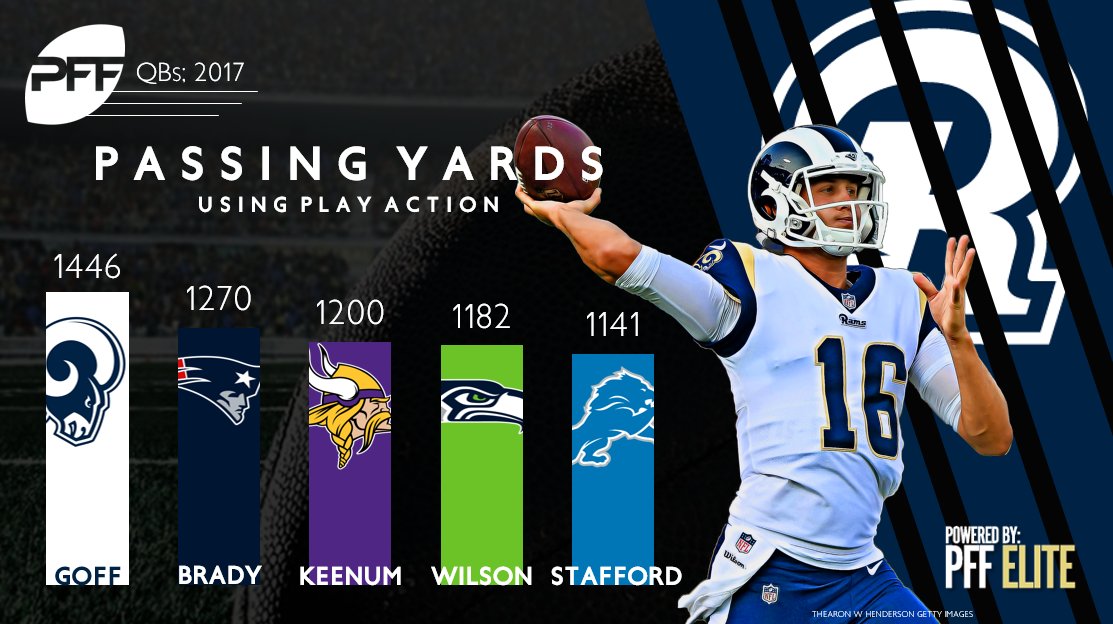
znModeratorJared Goff and the Rams were the Kings of play action in 2017!
Jared Goff led NFL in play-action yards in 2017, and it wasn't close
When you have a strong running game, it makes throwing the ball infinitely easier. Not only does it take pressure off of the quarterback, but it also sets up the play-action pass.
Jared Goff experienced exactly that in 2017 with Todd Gurley behind him in the backfield. Gurley, the Offensive Player of the Year, was second in the NFL with 1,305 rushing yards and 13 touchdowns, proving to be one of the best backs in football.
As a result, linebackers and safeties were constantly worried about him getting the ball. That made play-action far more effective. In fact, no quarterback had more yards off play-action than Goff, and it wasn’t particularly close.
 March 18, 2018 at 1:24 pm in reply to: sources say the Rams are now intent on keeping Tavon Austin #84238znModerator
Andersen Pickard@AndersenPickard
The Los Angeles #Rams have restructured WR Tavon Austin’s contract so his new base salary is $1M, and the deal includes a $4M roster bonus and $3M in incentives ($2M gameday, $1M stat totals). He can still make $8M, just as before ($3M base, $5M roster bonus).(CBS Sports) #NFL
znModerator znModerator
The "SlotGod" Nickell Robey-Coleman 2017 LA Rams Highlights pic.twitter.com/N5KDlFgNHs
— Clash Of The Horns (@RamfamPodcaster) March 18, 2018
znModeratora 1 and 3 2s.
Better be worth it.
…
znModeratorDOLPHINS RESCUING HUMANS
link: http://www.dolphins-world.com/dolphins-rescuing-humans/
If you’ve heard a story about dolphins rescuing a person at the ocean, you’re not the only one. For thousands of years, dolphins have interacted with humans in several ways that most animals do not. For example, what other animal helps fishers do their job? The intelligence of these cetaceans, highly developed and similar in some aspects to that of humans, places them in a position that no other species have.
A quick glance in the media shows a considerable amount of people who claims to have lived an incredible experience, in which a dolphin or a group of dolphins saves them from the danger that the sea involves, even without realizing it. Do you want to know some?
Why saving humans if they are different species? There are some theories.
A FEW STORIES
In 2002, a 36-year-old Australian man named Grant Dickson was fishing in northern Queensland along with other people. Hours later the vessel collapsed in the water, and Dickson found himself alone in the middle of the ocean, holding only to the remainings of the boat. He had some wounds bleeding profusely, and with horror, he discovered a group of sharks swimming around him. However, he watched with amazement how a pod of dolphins began to circle him, scaring away the sharks they might have attacked them by confusing his legs with some prey because of the blood. In the end, Grant Dickson was rescued safe and sound.
In 2004, a group of lifeguards and a young woman from New Zealand were training at sea when a white shark (Carcharodon carcharias) about 3 meters in length suddenly appeared in front of them. But fortunately soon a small pod of dolphins arrived surrounding the group and the woman. They waved their tails and created lots of noise to dissuade the shark from attack them until it decided to go away.
Todd Endris, a 24-year-old surfer, was practicing his favorite sport on August 28, 2007. He could not imagine that moments later a great white shark was going to wallop him and then gave him two severe bites. The terrified young man saw his death close when suddenly about 15 bottlenose dolphins (Tursiops truncatus) appeared and surrounded him to form a barrier between him and the shark. This protection allowed Todd to get safely to the shore, although with severe wounds from what he later recovered.
Hardy Jones is a wildlife activist. In 2003 he was filming a pod of dolphins when he realized that a shark approached him. Maybe he would have to get attacked if four dolphins had not approached to protect him.
In 2004, five British scuba divers were adrift in the Red Sea with no more company than the animals around. They feared dying right there until a boat rescued them. They believe that dolphins deserve their gratitude since the crew of the rescuing boat said they saw a group of these cetaceans swimming in the direction of divers, probably to draw attention to that place.
WHY DO DOLPHINS RESCUE PEOPLE?
Dolphins show behaviors at times similar to that of humans. In the wild they usually help the sick pod mates, supporting them to reach the surface so they can breathe. Females are loving mothers devoted to their offspring while they feed on breast milk and even long time after weaning.
But, why do dolphins save humans, if they are a different species? Many theories exists that try to explain the reason, but until now none is widely accepted.
Researchers think that sometimes the relationship between humans and dolphins have nothing to do with empathy and rather it is a symbiotic relationship of help-reward. A sample of this is the case of dolphins which help fishers to find fish or other prey since, in the end, these cetaceans receive a portion of the fish obtained. The question here is why did they begin to do this if no one taught them?
The act of defending humans from an animal that can attack them, like sharks, is similar to the behavior of mothers protecting their offspring. Many disabled swimmers or divers claim that were held and transported to the surface with the aid of a dolphin, action used with other cetaceans.
Another explanation may be related to the comparison between body characteristics of dolphins and humans since both are intelligent mammals. Thanks to its sense of echolocation, a dolphin can hear the heartbeat and realize when a person is helpless. It is the moment when they act as they would do it with a mate.
There are only two cetacean attacks on record against people, one from a killer whale that confused a surfboard for a seal and the other by a cranky dolphin mother who had just given birth and its calf was taken away from her.
DOLPHIN HEROES
In Greek and old sea stories, there are dozens of claims of dolphins helping drowning sailors, rescuing people from sharks, and making themselves useful as guides through treacherous waters.
Dolphins and other cetaceans also help injured members of their family groups and newborn babies to the surface by swimming under them and nudging upward, just as some reports describe them doing with humans. Interestingly, there are some real stories of dolphins helping other cetaceans. In 1983 at Tokerau Beach, Northland, New Zealand, a pod of pilot whales ran aground during ebb tide. The Zealanders who lived there came out and did their best to keep the whales alive, sponging their skin and calming them, until the tide came back in. But even then the whales were having trouble orienting themselves.
Dolphins came to the rescue. Somehow, a pod of dolphins who were nearby figured out what was happening. They swam into the shallows, putting themselves at risk, and “herded” the pilot whales out to sea, saving 76 of 80 whales. Five years earlier, a similar incident had occurred at Whangarei harbor. If dolphins are smart enough to help other cetaceans in that manner, why not humans.
OTHER CASES
Several years ago, in the Gulf of Akaba, a British tourist was rescued by three dolphins from sharks. Near the Sinai Peninsula, a ship captain had stopped his boat so several passengers could watch dolphins playing. Three of the passengers decided to swim with them, and one stayed a little longer than the others. To his horror, he was bitten by a shark – and more were coming. Suddenly, three dolphins placed themselves between the tourist and the sharks, smacking the water with their tails and flippers, driving the sharks off until the crew rescued the man.
In 2004, a ten-foot great white shark confronted a group of swimmers off the northern coast of new Zealand. A pod of dolphins “herded” them together, circling them until the great white fled. There are several other examples from the area of Australia about similar incidences.
In another case in the Red Sea, twelve divers lost for thirteen and a half hours were surrounded by dolphins for the entire time, repelling the many sharks that live in the area. When a rescue boat appeared, it seemed that the dolphins were showing them where the divers were, leaping in the air in front of them.
As we can’t talk to dolphins, we can’t understand what their motives are in these situations. It is, however, very possible that they are indeed trying to help and protect fellow mammals in the ocean to safety. If this is true, it means that they are the only animals, besides humans, which show true altruism.znModeratorMan I’m a big believer in Everett. Why are you all so down on him?
I think people are down on Higbee, not Everett.
yeah.
Agreed. On Everett you see a range anywhere from wait and see to optimistic. Higbee is the one people are skeptical about. Either way McV likes to use 2 types of TEs, if Washington is any indication—they had Reed, and that’s Everett with the Rams, and Davis, and Higbee was supposed to be that. So if they are looking for a TE, it’s more of a Davis guys who either pairs with or alternates with Everett.
znModeratorWasnt there a 49er fan that was a flamer?
w
vYeah. And we were discussing him. CaliforniaTom.
znModerator`
Well assuming the Whale actually thought about it and protected the diver,
how do we account for that?w
vMaybe people evoke “they;re like our babies” responses in whales the way dogs do with humans.
from: https://www.livescience.com/61380-humpback-whale-saves-diver-video.html
Aquatic altruists
This is not the first time a humpback whale has been observed intervening in a would-be marine ambush — in fact, the humpback’s so-called “altruism” is well-documented.
In 2009, for example, marine biologist Robert Pitman a whale shield a seal from a group of hungry killer whales.
Pitman went on to analyze 115 interactions between humpbacks and killer whales between 1951 and 2012, and determined the act of seal-saving derring-do he witnessed was hardly a freak occurrence. Humpbacks, Pitman wrote, frequently band together and sometimes travel great distances to interrupt killer whale attacks, regardless of what type of animal the orca is attacking.
The humpback’s shielding impulse likely comes from an instinct to protect its own calves from predators, Pitman said. Because massive humpbacks have little to fear from orcas, the risk of intervening in or even initiating a may be well worth the risk.
“A simple behavioral rule like ‘interfere with attacking killer whales’ may prevent a related calf from being killed,” Pitman previously told Live Science, “and it may also help out other species at times. I think we need to consider the possibility that altruism can be unintentional and arise out of self-interest.”
Researchers again caught a glimpse of a humpback’s seeming altruism in May 2017, when a group of orcas were stalking some baby gray whales off Monterey Bay in California.
Hauser thinks it’s likely that the whale that head-butted her was similarly trying to protect her from the predator in their midst (she later learned that, while one humpback was focused on her, another was swatting the water near the tiger shark, seemingly keeping it at bay). However, this marks the first known instance of a humpback intervening to shield a human from a shark, Hauser said.
znModeratorThe big mistake lots of NFL teams make in the draft, according to economists
Joseph Stromberg
[Old article:] Apr 30, 2015
https://www.vox.com/2015/4/30/8516007/nfl-draft-economics
In last year’s NFL draft, the Buffalo Bills traded up from the eighth pick to the fourth to take receiver Sammy Watkins. To do so, they gave up their first pick this year, 19th overall.
Watkins has had a solid start to his career. But the receiver the Bills could’ve taken if they’d stayed put — Odell Beckham Jr. — was named Offensive Rookie of the Year and already looks to be a generational talent.
TEAMS SHOULD NEVER TRADE UP — AND SHOULD TRADE DOWN WHENEVER THEY GET AN OFFER
It’s always easy to pick apart draft decisions in retrospect. But this mistake was utterly predictable — and it remains a mistake whether Watkins ends up a better player than Beckham or not.
A series of papers by economists Cade Massey and Richard Thaler has shown that at any given position, historically, the odds of the top player picked (Watkins) being better than the third player picked (Beckham) is just 55 percent or so.
“It’s basically a coin flip,” Massey, who serves as a draft consultant with several NFL teams, told me last year, “but teams are paying a great deal for the right to call which side of the coin.”
Because teams just aren’t that good at evaluating a player’s chance of success, Massey and Thaler’s analysis says in the current trade market, teams are better off trading down whenever they get an offer — that is, trading one high pick for multiple lower ones, in order to diversify risk. But many teams, like the Bills, become overconfident in their evaluation of one particular player and do the opposite: they package several slightly lower picks for the right to take one player very early.
Watch: The history of the NFL draft, explained in 2 minutes
It’s just not worth it to trade up
In their first paper, Massey and Thaler studied 1,078 draft pick trades made between 1990 and 2008. This let them determine the value teams got in return when they traded away each pick in the first five rounds of the draft:
The most important thing about this graph: the curve is very, very sharp in the first round. That means teams think the very top picks are extremely valuable: the value of the 10th pick is only about half that of the first pick.
Now, it’s worth pointing out that for years, most teams followed something called “the Chart,” which assigned values to each pick in the draft for trade purposes. Since 2008, many teams have smartly stopped treating the Chart as gospel, and the curve has become slightly less steep.
But Massey says it still hasn’t flattened out to anything near where it should be, in terms of the actual value derived from the players picked. He and Thaler calculated this value based on the odds that the first player picked at any given position will perform better — in terms of the number of games he starts in his first five seasons — than the second player drafted at that position.
TEAMS JUST AREN’T VERY GOOD AT FIGURING OUT WHO’S THE BEST PLAYER AT ANY POSITION
Lots of teams, like the Bills, will trade up when they identify a player they prefer at a needed position: they need a wide receiver, and a few highly rated ones are available, but they trade up because they’re certain Sammy Watkins is the best. But the data says that teams just aren’t very good at figuring out when this is true.
On average, the chance that first player will start more games than the second one picked at his position: 52 percent. Compared with the third player, it’s still only 55 percent, and compared with the fourth, it’s just 56 percent.
These numbers suggest that moving up eight picks (the average distance between the first and second players at the same position) should cost a small amount, since you’re only increasing the odds of a getting a more productive player by 4 percent or so. But as the steep curve shows, teams pay a ton to move up, especially at the top of the draft.
It really pays off to trade down
Given that some teams, like the Bills, are irrationally willing to pay a lot to trade up, smart teams can reap huge benefits by trading down. Even staying put and drafting from your original spot, the researchers’ analysis shows, isn’t the best strategy.
For each pick in the first round, Massey and Thaler calculated all of the different two-pick packages a team could’ve gotten by trading down, based on the historical data (a team with the first pick, for instance, could get the second and 181st picks, or the 14th and 15th picks, or any combination of picks in between that provide the same sum value).
STAYING PUT AND DRAFTING AT YOUR ORIGINAL POSITION IS NOT THE BEST STRATEGY EITHER
Then they calculated what teams have gotten out of these picks, on average, in terms of the number of starts a player picked at that spot has historically provided in his first five years, and the number of Pro Bowls he’s voted to. (They included Pro Bowls to counter the criticism that their analysis ignores the unique impact of superstar players only available in the first few picks.)
Again, the data was unequivocal. On average, trading down and getting two players gave a team five more starts per season and slightly more total Pro Bowls.
You could chalk this up to the simple fact that more players start more games, but it’s more than that. Even if you imagined that the team trading down could only keep the better one of the two players it drafted, it’d still get slightly more total starts and the same number of Pro Bowls. The truth is that teams are imperfect talent evaluators, so having two later picks is better than a single early one. It’s just risk diversification at work.
Teams that trade down more often win more games
The most straightforward piece of proof for all this is the fact that trading down correlates with more wins on the field.Massey and Thaler came to this conclusion by looking at the number of wins a team had in any given season between 1997 and 2008, and the total value of all picks they’d made in the previous four years (the amount of time, on average, for which a rookie is under contract).
They found that one standard deviation in pick value translated to 1.5 more wins per season on the field. Sure, it’s a small sample size, and there’s a lot of chance and other factors built into the system, such as a coach’s strategy. But trading down correlates with a significant amount of victories, given that there are only 16 games in a season.
So why don’t more NFL teams follow this advice?
If all teams took note of these findings and corrected their behavior, the principles would no longer apply. Teams would be much less interested in trading up, so the lucrative market for trading down would evaporate.
Why hasn’t this happened? One answer is a widely known psychological bias called the overconfidence effect. As people are given more information, the accuracy of their analysis often hits a ceiling, but their confidence in it continues to increase.
This tendency has been demonstrated in all sorts of areas, from bettors picking horses to psychologists making diagnoses. It’s not hard to imagine that NFL general managers — who are given scouting reports on players that cover everything from their body fat percentage to their home life — fall victim to the same sort of overconfidence.
“[TEAMS] FALL IN LOVE WITH PLAYERS, GET MORE AND MORE CONFIDENT IN THEIR ANALYSIS”
“In my experience, teams always say they’re on board with [trading down] in January,” Massey said. “Then when April rolls around, and they’ve been preparing for the draft for a long time, they fall in love with players, get more and more confident in their analysis, and fall back into the same patterns.”
There’s also the fact that the sports world as a whole tends to glamorize superstars — leading many to disproportionately attribute a 53-player roster’s success to one or two highly drafted players. For a struggling GM, it might seem easier to trade up and land a guaranteed superstar than to patiently fill a roster with competent players.
The problem, though, is that there are no guaranteed superstars — and Thaler and Massey have found that, given a long enough time frame, no teams are any better at accurately evaluating prospects than others. Sure, a GM might hit a hot streak over the course of a few drafts, but long term they estimate that 95 to 100 percent of the difference in teams’ odds of striking gold with any one pick is driven by chance.
So the key isn’t drafting better — it’s just drafting more.
As Massey noted, there are a few teams out there following his philosophy. In a recent interview, Eric DeCosta — assistant GM of the perennially successful Baltimore Ravens — dropped a hint about the identity of one of them:
We look at the draft as, in some respects, a luck-driven process. The more picks you have, the more chances you have to get a good player. When we look at teams that draft well, it’s not necessarily that they’re drafting better than anybody else. It seems to be that they have more picks. There’s definitely a correlation between the amount of picks and drafting good players.
znModeratorCalif-Tom.
Cal Tom demonstrated one of the great characteristics of the true flamer: be absolutely stone-deaf impervious not just to reason, or logic, or knowledge, or the ability to interact socially, but also, to any and all responses of any kind.
cal tom: it is snowing in SF
responses: the weather does not report snow there, and here are links to weather sites and current photos, plus some of us live there and there is no snow
cal tom: snow’s getting pretty deepznModeratorAn alternate headline could be…
‘Diabolical whale denies starving shark of life-sustaining snorkeler meat.’
But that would have made for a very different video.
And of course it completely stands to reason that the whale would know that.
znModeratorJesus was his agent?
Not sure I followed that one Z.

==========
Gurley said “thanku LORD”.
I’m guessing thats what Z was referring to.
I’d give zooey a two out of ten on the rate the flamer
chart for that one. It was hard to figure out. Lacked nuance as well.w
vNow it’s clear.
I wuzz being thikk. Sometimes, brane not work good.
znModeratorJesus was his agent?
Not sure I followed that one Z.
znModeratorTom Benson’s last will makes clear who was in, out of his inner circle late in his life
Here;s some more on that for whoever is interested. It;s an old thread on the board: http://theramshuddle.com/topic/more-hot-trending-owner-gossip-news-tom-benson-disowns-daughter/
znModeratorBtw sorry for my poor spelling / grammar post… but this site is not iPhone friendly…
No apologies necessary JM. Sorry about the lack of iPhone friendliness.
znModeratorLos Angeles Rams’ 2018 free agency: Center John Sullivan keeps O-line intact
Alden Gonzalez
John Sullivan, C
The Rams no longer have to worry about center. They brought back veteran John Sullivan with a two-year contract that is worth up to $15 million. Here’s a closer look at the signing:
Grade: B. Sullivan made only $999,999 last year, so he earned a big raise. But not that big. Sullivan’s contract will basically only reach $15 million if he plays in every game and the Rams do well in the playoffs, according to a source. It’s more like a two-year, $10 million contract with incentives and some protection against injury.
What it means: It means the Rams’ highly successful offensive line returns intact, with Andrew Whitworth and Rob Havenstein serving as the tackles and Rodger Saffold and Jamon Brown returning as guards. Sullivan was graded 10th among 36 centers by Pro Football Focus last season because of his blocking. But he was also a major asset for young quarterback Jared Goff because of his familiarity with Sean McVay’s offense and his ability to identify coverages before the snap.
What’s the risk: Sullivan will be 33 on Aug. 8, and he missed the entire 2015 season because of back issues. Yes, there are risks involved with this. But the Rams prepared for it in the framework of this deal. The second year of Sullivan’s contract comes with a low guarantee, with most of the money coming in per-game roster bonuses. Sullivan didn’t miss any starts because of injury last season, but the Rams know they can’t necessarily count on that again. They hope Austin Blythe continues to develop into a solid backup.
znModeratorThank you Lord🙌🏾 https://t.co/RQByupSwXc
— Todd Gurley II (@TG3II) March 17, 2018
-
AuthorPosts