
Forum Replies Created
-
AuthorPosts
-
 znModerator
Malcolm Gladwell: The strange tale of the Norden bombsight
Yes an interesting story of military/industrial hubris. It’s funny though that he keeps misprouncing bombardier. He makes it french but it’s anglicized.
A famous scene from Catch-22:
znModeratorThe @Eagles organization and its players are awful. I can see why Trump wouldn’t want them at the White House. pic.twitter.com/gTkTfATn98
— Normal Collar (@pmc1423) June 5, 2018
znModeratorNot enough Eagles wanted to visit the White House. And Trump isn’t happy about it pic.twitter.com/Ip7d6S7AGm
— Ben Volin (@BenVolin) June 4, 2018
==
Torrey Smith@TorreySmithWR
There are a lot of people on the team that have plenty of different views. The men and women that wanted to go should’ve been able to go. It’s a cowardly act to cancel the celebration because the majority of the people don’t want to see you. To make it about the anthem is foolishCris Carter@criscarter80
President Obama should invite the Eagles to his house for a barbecue.Brett Tessler@TesslerSports
Unlike the Philadelphia Eagles, the Washington Capitals will be more than welcome to the White House since all their top players are Russian.Vincent Bonsignore@DailyNewsVinny
The texts I’m getting from #NFL executives about Donald Trump tonight….wow.Appears there was a misunderstanding between #NFL and #Rams, and therefor a mistake on relaying that information to fans. As of today, it is three total betwen color rush and throwbacks
It’s not three times each. It’s three times total.
FYI on #Rams uniforms: #NFL has approved them to wear their throwbacks/color rush uniforms three times total in 2018 with no restrictions on when/where. The #Rams goal is to avoid the navy blues at all costs, and the flexibility they now have helps.
But with no restrictions. In other words, they are not obligated to wear the color rush on their Thursday game.
All that said on #Rams uniforms, I do not believe the #Rams are done petitioning the #NFL for more flexibility
Got a chance to talk to #Rams rookie DE Justin Lawler, who has been flashing throughout OTA’s. He’s made some instinctual/athletic plays that confirmed to him: “I’m not here by accident”
Given all the weapons #Rams have offensively, they may never replicate the TE production Sean McVay had in Washington. But worth noting McVay had praise today for the OTA work of young TE’s Gerald Everett and Tyler Higbee, as well as Temarrick Hemingway
And as it relates to all those weapons, if OTA’s offer any evidence, McVay is cooking up a whole lot of ways to get Brandin Cooks the ball. Some of which don’t involve throwing it to him
June 4, 2018 at 10:41 pm in reply to: Top 100: Whitworth, Peters, Suh, Talib, Goff, Gurley, Donald #87052znModeratorJune 4, 2018 at 10:40 pm in reply to: Top 100: Whitworth, Peters, Suh, Talib, Goff, Gurley, Donald #87051znModeratorGoff Earns First-Career Appearance on NFL’s Top 100 List
Kristen Lago
In 2017, the entire Rams roster experienced an incredible turnaround under first-year head coach Sean McVay. But perhaps the most impressive year-to-year development came from quarterback Jared Goff, who recorded 3,804 passing yards and 28 touchdowns, with just seven interceptions.
And while his stat line from 2017 was significant enough, many outside of the building expect Goff to be even better in 2018 — as evident from his first career appearance on the NFL’s Top 100 List.
The annual ranking system is determined by current NFL players and is based on an athlete’s projected performance for the next season. At No. 38, the Cal product became the fifth Ram to be named to the list, joining teammates Andrew Whitworth (No. 87), Marcus Peters (No. 79), Ndamukong Suh (No. 61) and Aqib Talib (No. 53).
Last season, Goff developed as a true leader on the Rams offense, effectively distributing the ball to a wide variety of receivers, while appearing more poised and confident on field. Not only did he finish with the league’s fifth-highest passer rating (100.5), but he also led the NFL with 12.9 yards per completion.
In his second year under McVay’s guidance and flanked by familiar faces at several different positions, Goff is projected to continue his development into one of the league’s brightest young quarterbacks.
The NFL Network will continue to air its “Top 100 Players of 2018” series every week, leading up to the final 10 athletes on Monday, June 25. Episodes will air live on NFL Network every Monday at 8 p.m. ET.
Fans can see the full list as it is revealed week-by-week, and can read the full analysis of each ranking at NFL.com/top100.
znModerator10 Observations from OTA No. 7
Myles Simmons
1) Legendary Rams wide receiver Torry Holt was on the field with the club as a coach on Monday afternoon. According to head coach Sean McVay, Holt is taking part in the league’s minority coaching internship program. But even though he’s serving as a coach, Holt went through dynamic stretching with the team — getting loose to run around during practice like another Rams coach.
2) Wide receiver Brandin Cooks’ speed comes across even in change-of-direction drills. With the wideouts working on a drill where each had to zig-zag through a few cones before catching a ball, Cooks’ feet appeared to move quicker than the rest of the group — including those of fellow starters Robert Woods and Cooper Kupp. That’s no knock on Woods or Kupp, who have proven themselves to be productive players, especially in McVay’s offense. But it was an example of how special Cooks appears to be.
3) When the wideouts were working with the quarterbacks on routes against air, Holt sometimes lined up against the receivers and gave them tips as the players were running. One overheard coaching point: “Head and eyes up.”
4) On the defensive field, safeties were working on taking different drops and making interceptions. They started out going deep down the field, having to make an over-the-shoulder pick or leap to catch the ball. Then they came in and worked on intermediate and short drops. As usual, takeaways are a significant focus for L.A.
5) Not that it’s happened often, but whenever a Rams receiver doesn’t make a catch when going over routes with quarterbacks, the QB will call the player back to get in a good rep after the rest of the line is finished. It’s an example of the little things needing to be right during this time of the year.
6) Wide receiver Robert Woods made a nice one-handed catch at the right sideline during group offense. The catch came against air, but still showed nice hand-eye coordination.
7) During one of the periods of 11-on-11, defensive lineman Michel Brockers ripped through the offensive lineman assigned to him and appeared suddenly right in front of Sean Mannion — the scout-team quarterback. Brockers stepped out of the way — obviously, he can’t hit the QB in practice — but it’s easy to imagine that was not the most appealing sight for a quarterback in the pocket.
8) Notably, kicker Greg Zuerlein practiced a few kickoffs and field goals with the entire operation — long snapper Jake McQuaide flinging the ball to punter/holder Johnny Hekker. Zuerlein was performing this without kicking through uprights, but it was still an encouraging sign. McVay said during his press conference that the club will continue to bring Zuerlein along slowly so as to not risk any setback.
9) During another 11-on-11 period, quarterback Jared Goff connected with Kupp on three sharp passes. The offense was moving down the field based on where the plays ended, and Goff hit the second-year wideout with a pair of passes to move the chains before one final completion that ostensibly would have gone for a touchdown.
10) A half-hour after practice ended, Brockers and fellow defensive lineman Omarius Bryant were both working with second-year D-lineman Tanzel Smart. Brockers and Bryant were serving as offensive lineman for Smart, who was presumably working on a couple moves to combat double teams.
znModeratorI’m not trying to read too much into lineups during OTAs, but if either Fox or Okoronkwo were available would Lawler still be lining up with the ones?
Don’t know about Obo but no Lawler was behind Fox.
June 4, 2018 at 8:21 pm in reply to: Top 100: Whitworth, Peters, Suh, Talib, Goff, Gurley, Donald #87045znModeratorQB1 makes his first #NFLTop100 appearance! Congratulations @jaredgoff!
A post shared by Los Angeles Rams (@rams) on
znModeratorfrom 2018 NFL season: One key homegrown player for each NFC team
Gregg Rosenthal
…
Los Angeles Rams: Cory Littleton and Samson Ebukam, linebackers
The starry approach to the Rams’ offseason had some less-discussed repercussions. After the team spent big on the secondary and the defensive line, general manager Les Snead turned over the linebacker group to young, unknown players.
Littleton, a third-year player who went undrafted in 2016, is getting the first crack at replacing middle linebacker Alec Ogletree. Ebukam is a 2017 fourth-round pick who looks locked into a starting edge-rusher job. In coordinator Wade Phillips’ system, the mammoth defensive line and sticky secondary should make the linebackers look better, just like Tom Brady makes his running backs look better every year. It’s the system. At least that’s the plan, and it’s up to Littleton and Ebukam to help make Snead look Belichickian with his strategic allocation of resources.
June 4, 2018 at 4:58 pm in reply to: Top 100: Whitworth, Peters, Suh, Talib, Goff, Gurley, Donald #87037znModeratorRams player No. 5 will be revealed on NFL Network’s Top 100 Players list tonight (40-31).
Who ya got?
We’re at 5?
And no Gurley yet, and no Donald.
I…don’t know. I would have to guess Donald would be rated higher than Gurley because Donald’s numbers aren’t just the best in the NFL for a DT, they are historically good. Gurley is a great player, but Donald’s production is historically rare.
No it’s not at 5. It’s at 31-40. It is the 5th player who is a Ram. There was Whitworth, Peters, Suh, Talib, and…now a 5th one.
…
June 4, 2018 at 12:46 pm in reply to: Top 100: Whitworth, Peters, Suh, Talib, Goff, Gurley, Donald #87035znModeratorRams player No. 5 will be revealed on NFL Network’s Top 100 Players list tonight (40-31).
Who ya got?
— Cameron DaSilva (@camdasilva) June 4, 2018
znModeratorAndrew Whitworth and Rodger Saffold were keys to the Rams rushing attack last season! pic.twitter.com/OycOOajH7v
— Pro Football Focus (@PFF) June 1, 2018
znModeratorCory Littleton is in the middle of Rams’ rebuilt defense at linebacker
Gary Klein
http://www.latimes.com/sports/rams/la-sp-rams-linebackers-20180603-story.html
The journey began at the outer fringes of the roster and included a delay in the Pacific Northwest.
Now Cory Littleton is suddenly right in the middle of the Rams’ defense.
Two years ago, after he signed as an undrafted free agent, Littleton sat out nearly all organized team activity workouts because he was required to finish the spring quarter at the University of Washington. He pored over the Rams’ playbook in Seattle, and when he finally joined the team he earned a roster spot as a valuable special teams contributor.
Last year during OTAs, Littleton studied and played behind veteran linebackers Alec Ogletree and Mark Barron, earning a role as a featured back-up and spot starter.
The Rams traded Ogletree in March, so Littleton has spent OTAs acclimating to new responsibilities.
He is a starting inside linebacker and signal caller for a remade, star-studded defense that is expected to help the Rams move beyond the first round of the playoffs.
“Basically,” he said of his role, “the quarterback of the defense.”
It’s a big promotion for a first-year starter in a unit that will include star defensive linemen Aaron Donald and Ndamukong Suh and cornerbacks Aqib Talib and Marcus Peters.
Littleton, 24, acknowledged that he was adjusting to fit the role.
“I’m not the most vocal person,” he said, smiling. “I do my best.”
The linebacker corps is the biggest question mark for a defense that appears stout along the front and talented and deep in the secondary.
The Rams finished 11-5 and made the playoffs last season with a defense that ranked 19th overall, 13th against the pass and 28th against the run. They allowed the 12th-fewest points.
General manager Les Snead made several offseason moves to provide defensive coordinator Wade Phillips with players that specifically fit his 3-4 scheme.
The makeover began when the Rams traded veteran linebacker/edge rusher Robert Quinn to the Miami Dolphins for draft picks. It continued when they shipped Ogletree to the New York Giants for picks to clear salary room for the acquisition of Talib. And they let veteran linebacker Connor Barwin leave to test free agency.
Barron, a six-year veteran, is attending but not participating in OTA workouts, the same model the Rams utilized last year to make sure he made it to and through the season without physical setbacks.
That has provided Phillips, coach Sean McVay and linebackers coach Joe Barry an opportunity to closely assess others.
Ramik Wilson, who started 17 games for the Kansas City Chiefs in his first three pro seasons, said he was adjusting quickly to a new system and teammates.
“A lot of the pass concepts and run fits are very similar to what we did in K.C.,” he said. “There’s a little more different terminology but it’s been great.”
Littleton, Wilson and veteran Bryce Hager also have helped rookies such as Micah Kiser, a fifth-round draft pick from Virginia.
“They’ve been very supportive of me asking them questions,” Kiser said. “When you come to this level, they don’t have to help you out, but they’ve been really good. The culture here is great.”
McVay said the inside linebackers have weathered tough situations against an offense that features 10 starters from last season, including ascending quarterback Jared Goff and reigning NFL offensive player of the year Todd Gurley.
“They’ve handled it well,” McVay said of the inside linebackers. “We’ll have a better feel toward the end of the offseason program and then going into training camp.”
Second-year pro Samson Ebukam is starting in Quinn’s vacated outside spot, showing the speed that enabled him to record two sacks as a back-up last season.
As with Littleton in 2016, Ebukam was unable to participate in OTA workouts immediately after the 2017 draft because classes at Eastern Washington were still in session.
So he is embracing the OTA opportunity.
“I don’t plan on giving it up,” Ebukam said of his starting role. “Just trying to be my best, be coachable and show what I got.”
With offenses having to account for Donald, Suh and Michael Brockers, Ebukam foresees regular chances for sacks.
“That’s heaven for me,” he said of the matchup problems created by the defensive line.
Littleton also should benefit from playing behind an experienced front.
But it will be his job to help direct the veterans, and carry out the directions of the coaching staff.
He did not envision the signal-calling responsibility when he began his pro career.
“It makes me feel good as a player,” he said, “that they believe in me.”znModeratorLast year they had this (LBs only, no DL).
Ebukam, 2 sacks. He was a rookie, and rookie pass rushers rarely make an impact. Plus he was a rookie who missed a lot of practice early on.
Tree. 2 sacks.
Barron. 1 sack.
Barwin. 5 sacks. He was not up to his previous level of play which is no doubt why they didn’t ask him back.
Quinn. 8.5 sacks, though in the first 10 games, it was just 3. He got it back together in the end, but most of the season, he didn’t have anything.
Littleton. 1 sack with minimal starts. In fact his sack came in the Tenn game when he replaced Tree. He played starting D for 121 total snaps in the last 2 games, and in the process got a sack and an INT. It’s promising.
Longacre. 5.5 sacks. He is what he is, effort guy.
That’s 25 sacks from 7 guys.
2018?
* I expect about the same from Longacre and Barron. Though there’s a hidden possibility. Longacre had only 377 defensive snaps last year with a sack percentage of 1.458%. Barwin had 658, Quinn had 634. Split the difference and that’s 646. So if we give Longacre 646 snaps, if he maintains his sack percentage, that’s now 9.4 sacks or roughly 4 more than in 2017. So Longacre is an effort guy but he did better than Barwin, who had a sack percentage of 0.76, roughly half of Longacre’s percentage.
* Littleton can provide more but I think at a minimum he equals the 3 from last year from both him and Tree. If he follows his own sack percentage per defensive snaps, actually, he could have between 7-8. IF Wade rushes the ILB.
* Barwin and Quinn are gone. Have to make up for 13.5 sacks. If we give Ebukam his 2 sacks at least, then where does the 13.5 come from? Well Ebukam mostly I suppose, Obo maybe late in the season, and Lawler (perhaps), plus as mentioned Longacre and Littleton. So can they get more out of those guys, plus Obo (later in the season) and maybe Lawler?
With a DL that includes Suh, plus Brockers and Donald, plus Easley, and Westbooks—quite possibly.
* What can Ebukam do? Last year he had 2 sacks on 351 defensive snaps, which is a lowly 0.569% sack percentage. On the same 646 snaps I gave Longacre, they would just be at best 4 sacks. So SE is one guy who actually has to step up and produce at another level. I will say this—rarely if ever are rookie pass rushers productive. All that says is that so far we have nothing to rule out him becoming more productive.
IMO the key, like last year, is Donald both attracting AND beating multiple blockers (he faced multiple blockers 83% of the time last year yet led the league in qb pressures).
znModeratorpresident can’t obstruct justice? That’s not quite right, legal scholars say.
Washington Post
The assertion by President Trump’s lawyers that he cannot obstruct justice because he has absolute authority over all federal investigations is legally problematic, analysts say, because it would essentially mean the nation’s commander in chief is above the law.
But the president’s powers are expansive, and many questions remain about how Trump’s office could protect him from the special counsel investigation examining whether his campaign coordinated with Russia to interfere with the 2016 presidential election.
“The fact is, everything that we’re seeing, there is no precedent for,” said Jacob Frenkel, who worked in the independent counsel’s office in the late 1990s and is now at the law firm Dickinson Wright.
[In secret memo, Trump’s lawyers argued he has complete power over Justice investigations and could not have committed obstruction]
In a 20-page letter submitted to the special counsel’s office this year, Trump’s attorneys asserted that “the President’s actions here, by virtue of his position as the chief law enforcement officer, could neither constitutionally nor legally constitute obstruction because that would amount to him obstructing himself.” They also asserted that “he could, if he wished, terminate the inquiry, or even exercise his power to pardon if he so desired.”
Legal analysts said that as the head of the executive branch, Trump could issue pardons, fire senior officials or order them to shut down investigations. But if his motives were corrupt, such actions could constitute obstruction.
The principle laid out in the letter is “a ludicrous legal theory,” said Neal Katyal, a former acting solicitor general who now works in private practice at Hogan Lovells. “The idea that a president can’t obstruct justice died with King George III, with a brief attempt at revival by Richard Nixon.”
The letter, signed by lawyers John M. Dowd and Jay A. Sekulow, was part of a bid to keep Trump from having to sit for an interview with special counsel Robert S. Mueller III, especially on questions about whether he obstructed justice. The attorneys asserted that Mueller’s team had “an ample record upon which to base your findings of no obstruction,” and thus there was no need for the president to talk with investigators.
“This memo is a polite way of taking 20 pages to say, ‘He’s not coming in without a subpoena, and even then, you’re in for a protracted fight,’ ” Frenkel said.
Mueller is exploring whether the president meant to thwart law enforcement by, among other things, asking then-FBI Director James B. Comey not to pursue a probe of former national security adviser Michael Flynn, firing Comey, and pressuring the attorney general, Jeff Sessions, to either resign or take command of Mueller’s probe. Sessions recused himself because of his role within the Trump campaign.
The letter aimed to rebut each piece of the case. The lawyers asserted that Comey’s firing was justified because it was recommended by the attorney general and deputy attorney general. They wrote that Trump disputes having told Comey to let go of the Flynn investigation, and that even if he had, the president could not have intended to obstruct justice because the White House had indications the Flynn investigation was not ongoing at the time.
The lawyers also made the technical argument that an FBI investigation, unlike a grand jury investigation, did not count under the law as a “proceeding” that could be obstructed. But that seemed to overlook a 2002 law that makes it illegal to obstruct even proceedings that have not yet begun.
Many of the legal issues the president’s team raised have little precedent, legal analysts said. No president, for example, has ever tried to pardon himself.
Rudolph W. Giuliani, an attorney for the president, said during television appearances Sunday that while Trump “probably” had the power to pardon himself, he had no intention of doing so. The move, Giuliani said, could spark impeachment proceedings.
[Giuliani says Trump probably has the constitutional power to pardon himself]
Jonathan Turley, a law professor at George Washington University, said he believed the president has the authority to pardon himself, and using pardons as a piece of an obstruction case might be problematic “because the nature of the act is to bar prosecutions or set aside convictions.”
“That has been something of a parlor game for constitutional scholars for years, and many of the fun hypotheticals that we used to enjoy over beers all seem to be coming to fruition under the Trump administration,” Turley said.
Jed Shugerman, a Fordham University Law School professor, said raising the idea of pardons could be read as a warning to Mueller that if he pushes to subpoena Trump, the president could escalate the fight by pardoning people under investigation.
“There is a real practical consequence for the republic if Trump is able to win the silence of other defendants with the use of these pardons,” Shugerman said. “If he’s making an implicit threat that he could escalate this with pardons, there’s nothing in the letter to indicate that he’s not willing to pardon himself.”
It is unclear, too, whether and to what extent Mueller might be able to compel Trump to testify, if the president will not agree to a voluntary interview. By virtue of his office, the president does enjoy special protections. The Justice Department has twice opined that a sitting president cannot be indicted, and Giuliani has said Mueller’s team conveyed to the president’s lawyers they will honor that guidance.
Those opinions, though, are not the same as a court decision, nor do they rule out a president being forced to testify. Independent counsel Kenneth W. Starr served President Bill Clinton with a subpoena to compel him to appear before a grand jury, but it was withdrawn after Clinton agreed to testify voluntarily.
Trump’s lawyers pointed to case law suggesting Mueller would have to show that investigators were unable to obtain the same information elsewhere before demanding an interview with Trump. Turley said, though, that because an obstruction case hinges on intent, Trump might have a hard time convincing a judge that investigators could get that information without talking to him.
“In issues of intent, there’s only one person on Earth that can conclusively speak to that issue, and that is the president himself,” Turley said.
If Trump were served with a subpoena, legal analysts said they expect he would challenge it, and the dispute would almost certainly escalate to the Supreme Court. They said that while the courts might ultimately limit what the president could be asked, it was unlikely they would agree with the president’s legal interpretation that he cannot obstruct justice.
“For me, it is difficult to believe that any Supreme Court justice would endorse the right of a president to be lawless, in the sense of being entirely above the application of law,” Frenkel said.
znModeratorMark Barron@M_B_24
“Mark Barron is a former safety..he is too small to play the inside lb position in a 3-4 scheme and be effective in the run” – bs media outlets- 🙄lol smh
Meanwhile…The most dominant linebacker in the NFL against the run. pic.twitter.com/fMyajSqSf2
— Pro Football Focus (@PFF) May 13, 2018
==
Look at my guy @M_B_24 chase the toss down and make the tackle for a minimal gain. That boy guud. 💪💪 pic.twitter.com/Y1k7XzMTqz
— Sosa (@QBsMVP) November 28, 2017
znModeratorBonifayRam sez
Just how often did Wade use his base 34 defense last season where he lined up four LB’ers in the standard base?
Wade runs more snaps in the Nickel (4 down linemen- 2 ILB’ers & Five DB’s) than his base with four LB’ers. Our DL cadre is solidly improved from last season with a front that could easily have all pro bowl players starting @ each post. The depth of the DL is as good as it comes. Wade is loaded with pass rushing DL’ers this season. Would I be out of line here to expect Wade to utilize more of his pass rushing talent from his defensive front this season?
This 2018 Rams secondary has two of last years pro bowl corners starting & the best Nickle-back in the NFL with an ex all pro corner waiting for some playtime. Our starting young safeties are excellent.. Our 5th & 6th CB’s now were par-time starters last season. By far the best secondary in the NFL. I would expect to see 6 DB’s (Dime) defense often thus making the use of only ONE LB’er who would be our most experienced LB Mark Barron. Why would any DC refrain from utilizing as much of his DB talent as possible by running Nickels & Dimes most of the time.
Wade uses only two inside LB’ers most of the time not four LB’ers.
znModeratorEbukam Ready to Fulfill Starting Role at OLB
Kristen Lago
It may be Samson Ebukam’s second year in the league, but 2018 still represents the outside linebacker’s first set of OTAs. Because of his school schedule, Ebukam missed the majority of the club’s Phase III activities last season.
As such, he is not taking this period for granted. Ebukam’s focused on continuing to understand the defensive system in order to play with a stronger sense of confidence.
“It’s my first time doing this, so kinda just taking everything as it comes and trying to get better every day,”
Ebukam said. “I’m able to learn the intricacies of the defense and see how everything fits more, instead of just how I came in last year when everything was happening so fast.”
It’s a fortunate situation for the second-year player who, at this point, is in line for a starting position at outside linebacker this season. Ebukam showed flashes of his potential in 2017, recording 31 tackles, 2.0 sacks and one forced fumble through 16 games.
He was also able to step in seamlessly for Connor Barwin in two games last season. But with both Barwin and former starter Robert Quinn no longer with the franchise, Ebukam will be asked to take on a much larger role in his second year.
“Whenever the starter gets traded or taken out of the team that just gives the next person the opportunity to step up,” he said recently.
“I’m just trying to be coachable as much as possible and show on film that I am getting better every day — just that one percent better,” Ebukam continued. “If I’m able to do that and everybody else is able to do that then we are gonna be tough to beat.”
By the end of minicamp, the Eastern Washington product is hoping to understand the playbook more fully, believing that if he “can play fast, then I can make more plays.”
“I want to be able to understand the playbook to the max, both SAM and WIL, and just ‘slap’ so that whatever they call I can click,” he said. “ So that when the offense, it’s going fast, I can be able to play football instead of thinking.”
And with the speed and tempo of the Rams offense, Ebukam will be challenged all throughout the offseason. Ebukam says that if he and the rest of the defense are able to “play as hard as we can without any mental mistakes” against their own teammates, then the unit will be in good shape come the regular season.
“In the game, it’s just going to be a lot easier because I don’t think any other offense does as [many] little things as this offense does,” he explained. “So, if we’re able to play against our offense and be good for it then we’re going to be in a good place.”
znModeratorI am actually taking a couple of months off this summer because I’m fairly burned-out on the opioid situation.
They say W.V. is ground zero of the opioid crisis.
I read a report about Seattle that said that opioids can be found in mussels in the bay, due simply to flushing traces that were in waste products.
==
“Pain Killer” Author Barry Meier on How West Virginia Became Ground Zero of Opioid Epidemic
https://www.democracynow.org/2018/6/1/pain_killer_author_barry_meier_on
West Virginia had the highest rate of opioid-related deaths in the U.S. in 2016, making the state ground zero for a national opioid epidemic that has killed more than 200,000 people in the past two decades. A record number of people in West Virginia died from overdosing on drugs in 2017. Between 2007 and 2012, the three biggest wholesalers of prescription drugs in the U.S. shipped some 780 million pain pills containing oxycodone or hydrocodone to the state of West Virginia alone—433 pills for every man, woman and child in the state. That’s according to Barry Meier, author of “Pain Killer: An Empire of Deceit and the Origin of America’s Opioid Epidemic,” published this week in an updated and expanded edition. We speak with Barry Meier, the first journalist to shed a national spotlight on the abuse of OxyContin.
Transcript
This is a rush transcript. Copy may not be in its final form.
AMY GOODMAN: So, let’s talk about ground zero, West Virginia. What was happening in some of these towns, in some of these small, independent drugstores—BARRY MEIER: Right.
AMY GOODMAN: —that were bringing in how much of this drug?
BARRY MEIER: They were bringing in huge amounts of this drug, I mean, tens and tens of millions of pills, annually, of this drug.
AMY GOODMAN: How did it start in West Virginia?
BARRY MEIER: I mean, OxyContin was being distributed to West Virginia, to Virginia and other states. Drugstores were prescribing it. But, you know, you had doctors there that were essentially running what are called pill mills. People would come in to the doctor and say, “Doctor, I hurt, I have pain.” “OK, fine, let me just write you a prescription. Oh, and, you know, OxyContin works really well for me, for my pain.” So, you had these doctors who were writing prescriptions for drugs at the request of the patient, which is, you know, a rare situation. And so then these patients, who are often drug abusers, would go to the pharmacy and get the prescriptions filled. Sometimes I—and, you know, in my travels on this story, I would go to small towns where the doctor had a pharmacy in his office. So he would write the prescription, you’d go next door to a pharmacy that he owned, and they would dispense the drug. So, you know, millions of these pills were being dispensed. They were ending up on the street. And these horror shows of crime and abuse and separated families and everything else would follow.
AMY GOODMAN: I’m looking at a piece, that you refer to in your piece. This is in the West Virginia Gazette-Mail. And it says, “In Southern West Virginia, many of the pharmacies that received the largest shipments of prescription opioids were small, independent drugstores like ones in Raleigh and Wyoming counties that ordered 600,000 to 1.1 million oxycodone pills a year. Or they were locally owned pharmacies in Mingo and Logan [counties], where wholesalers distributed 1.4 million to 4.7 million hydrocodone pills annually. By contrast, the Wal-Mart at Charleston’s Southridge Centre, one of the retail giant’s busiest stores in West Virginia, [was shipped] about 5,000 oxycodone and 9,500 hydrocodone pills each year.”
BARRY MEIER: Yeah. I mean, it’s startling. I think what—you know, one of the things that happened when the Justice Department did not crack down, really, on Purdue Pharma is it sent a signal that, “Drug companies, drug distributors, you can ship these drugs in whatever quantity you want, to wherever you want, and the worst that you’re going to face is a fine.” So they viewed it as a cost of doing business. There was never going to be any accountability for the corporate executives. It wasn’t going to be like the dealer or the drug addict who was going to end up in prison. All the corporate executives were going to have to pay was a small fine. And that was going to be a fraction of the profits that they were going to make by shipping huge quantities of the drugs to places like West Virginia.
AMY GOODMAN: We’re going to continue this conversation with Barry Meier, author of Pain Killer: An Empire of Deceit and the Origin of America’s Opioid Epidemic, after this break. I want to ask you about Art Van [Zee], a doctor in Virginia. Stay with us.
***
New York Mayor Bill de Blasio announced earlier this year that the city would sue manufacturers and distributors of prescription opioids to account for their part in the city’s ongoing deadly opioid epidemic. Firms named in the suit include Purdue Pharma, Johnson & Johnson and McKesson Corporation. The Guardian reports that more than 60 cities are suing Big Pharma over opioids. An explosive New York Times report has revealed that manufacturers of the drug OxyContin knew it was highly addictive as early as 1996, the first year after the drug hit the market. The Times published a confidential Justice Department report this week showing that Purdue Pharma executives were told OxyContin was being crushed and snorted for its powerful narcotic, but still promoted it as less addictive than other opioid painkillers. Purdue executives have testified before Congress that they were unaware of the drug’s growing abuse until years after it was on the market. Today, drug overdoses are the leading cause of death for Americans under age 50. We speak with Barry Meier, author of “Pain Killer: An Empire of Deceit and the Origin of America’s Opioid Epidemic.”
Transcript
This is a rush transcript. Copy may not be in its final form.AMY GOODMAN: This is Democracy Now! I’m Amy Goodman. Our guest is Barry Meier, author of Pain Killer: An Empire of Deceit and the Origin of America’s Opioid Epidemic. Tell us the story of Dr. Art Van Zee.
BARRY MEIER: You know, Art Van Zee is kind of the hero of my book. He’s a man I met him when I was reporting for the Times back in the early 2000s. He’s a small-town doctor. He lives in a town called Pennington Gap in very western Virginia, near the Kentucky border. And I met him. He was a—he’s a gracious, lovely person. He reminded me of kind of a Doctors Without Borders, but here in the U.S., you know, working in Appalachia, in an area that desperately needed medical care.
He realized that his town was being overrun by OxyContin abuse. He saw kids being addicted to it, went to the hospital on emergency visits. And he decided, eventually, that he had to do something. He couldn’t stand quiet and let this unfold. And he tried to lead a small-town campaign to get the FDA to pull this drug off the market, or at least to crack down on this drug. And Pain Killer kind of follows his saga and the saga of other people in the town, a wonderful nun there by the name of Sister Beth, who sort of try to take on this huge, powerful drug company and hold it to account.
AMY GOODMAN: And so, what happened to Dr. Art Van Zee?
BARRY MEIER: You know, Art Van Zee, like Laura Nagel, eventually got shouted down, got ignored. I mean, there was this rather pivotal Senate hearing, where he comes and he pleads with these senators to do something about this drug. And Chris Dodd, the Democratic senator from Connecticut at the time, starts raking him over the coals and sounds like he’s, you know, badgering him with talking points that had been given to him by Purdue Pharma. And lo and behold, when I started looking at campaign finance records and other documents, it turned out that Chris Dodd had met with Purdue Pharma prior to this hearing, and Purdue—and Chris Dodd had gotten a $10,000 contribution from Purdue Pharma shortly afterward. So, Purdue Pharma, you know, was spreading money around and going after its critics and co-opting them throughout this entire period. I mean, the U.S. attorney in Maine, who first sounded a public alarm about this—
AMY GOODMAN: First one in the country.
BARRY MEIER: In the country, in 2001. He went immediately onto the payroll of Purdue Pharma and became one of its biggest defenders. In fact, I found documents that suggested that he was discussing a job with them even before he left public office. He swore up and down that that wasn’t the case. But, in fact, there are emails, Purdue Pharma’s own emails, suggesting that he had reached out to them to discuss job opportunities.
AMY GOODMAN: Explain the nature of the settlement in 2007. Can the company—can individuals in the company be held criminally responsible today, what, 200,000 deaths later, in the last 20 years, though they would argue, “That’s not all us”?
BARRY MEIER: Right. So, the settlement was twofold. The company, Purdue Pharma, as a company, pled guilty to a felony charge called misbranding, which was essentially misrepresenting the drug, and paid $600 million in fines. The three executives, top executives, of the company pled guilty to a misdemeanor version of that charge. It was a sort of weird charge, because it only held him liable in their roles as corporate executives. It did not accuse them personally of any wrongdoing. They paid around—about $34 million in fines. But what we came to discover, and what was in the Times in the other day and in the expanded version of the book, is that the prosecutors on the case wanted to charge them also with very serious felonies, that could have put them in jail, had that case gone forward.
AMY GOODMAN: And talking about holding people responsible, you write about how those that do drugs together, a husband, could be found guilty of murdering his wife, etc. Talk about that.
BARRY MEIER: Well, you know, we have a different standard of justice in this country. One standard is for the person who gets caught with, you know, some drugs in their pocket. Another standard is for the person who’s caught selling drugs. And another standard is for the executives of corporations that allow these drugs to get into the wrong hands of people, or knowingly are aware that these drugs are being abused, and don’t say anything. And, you know, there seems to be very little punishment that those kinds of individuals face.
AMY GOODMAN: But what do people face on the ground, who are doing drugs?
BARRY MEIER: They face their—they face spending the rest of their life in prison.
AMY GOODMAN: Explain.
BARRY MEIER: You know, they can be sent away for 10 years, for 20 years. They can have their lives destroyed, whereas the corporate executives don’t see their bonuses going down. They don’t see their lives being ruined. They just go on with their lives.
AMY GOODMAN: Earlier this year, New York Mayor Bill de Blasio announced that New York would sue manufacturers and distributors of prescription opioids to account for their part in the city’s ongoing deadly opioid epidemic. Firms named in the suit include Purdue Pharma, Johnson & Johnson and McKesson Corporation.
MAYOR BILL DE BLASIO: This is a man-made crisis if ever there was one, fueled by corporate greed, fueled by the actions of big pharmaceutical companies that hooked millions of Americans on opioids to begin with. And some of them still are addicted to prescription drugs, and others have migrated to heroin. But we know where it began for so many people. And, bluntly, it was so a very few people could profit, and, obviously, the horrible actions of criminals who sell drugs and profit in death, as well. That combination has led to where we are today. We need to remember that those origins at the root of this problem means it’s a problem that can be defeated. We can fight back against the big pharmaceutical companies. We can fight back against the criminals who peddle drugs. We can change in so many ways, including changing the entire culture around this issue, so we can help people.
AMY GOODMAN: So that’s New York Mayor Bill de Blasio. More than 60 U.S. cities in over a dozen states are now suing Big Pharma over opioids. What does this mean?BARRY MEIER: Well, this could have happened a long time ago, Amy. You know, what’s startling to me is, as someone who’s watched this over almost two decades, is the issue of, you know, why did we wait this long to do this. We could have done this in 2003, in 2007, in 2010, in 2012. We have allowed this to morph into this horrible situation. It’s a good thing that it’s happening now. And I really do hope that these cities and states carry through and get to the truth, and not walk away with a simple settlement the way the Justice Department did in 2007. The only way that this problem is really going to be solved is if we really understand what happened, if the truth about what happened comes out. I mean, the fact that, you know, this confidential memo has now come out adds to the truth of what we know.
AMY GOODMAN: And again, say what is the essential point in this confidential memo.
BARRY MEIER: The essential point is that Purdue Pharma has claimed, from day one, and still claims today, that it first became aware of OxyContin’s growing abuse in 2000. This memo shows that prosecutors believe that they were aware of the drug’s abuse for years before that and concealed that information.
AMY GOODMAN: And what about the lawsuits of New York and 60 other cities and towns? What are they trying to accomplish with these lawsuits? What’s the premise of them?
BARRY MEIER: They’re trying to get money. They’re trying to get money to pay for some of the medical costs that they’ve had to absorb as a result of prescription drug overdoses and addictions. It’s very similar to the tobacco lawsuits, which I also covered for the Times. It’s essentially taxpayers have borne the brunt of the healthcare costs related to prescription painkillers. Purdue Pharma hasn’t paid for it. Johnson & Johnson hasn’t paid for it. These drug distributors haven’t paid for it. They’ve only profited from it. So now these states and towns are trying to recover some of the costs from the people who profited from this trade.
AMY GOODMAN: Barry Meier, what about the American Medical Association?
BARRY MEIER: It’s funny you should bring that up. The American Medical Association has been, over time, one of the big stumbling blocks to the solution of this problem. Back in 2001, I met a wonderful doctor, Dr. Nathaniel Katz. And he argued that doctors should be required to undergo some type of mandatory training as a condition for prescribing prescription drugs like OxyContin, like six hours of training, eight hours of training. You could do it on your home. You could do it through some sort of, you know, thing on the internet. Very simple.
The AMA fought this tooth and nail, as recently as the Obama administration. The White House Office of Drug Policy wanted to propose a law to make this happen. AMA lobbyists came to officials of the White House and to the—you know, to the Obama administration, and said, “If you do this, we will fight you tooth and nail. We will not allow this to happen. This is too much of a burden for our members. They don’t have six hours or eight hours to spend looking at information on how to prescribe these drugs more safely.” So, I think they have a lot on their shoulders here. You know, they basically blocked taking a very simple step, that would have been—would have provided tremendous good for patients and for doctors.
AMY GOODMAN: So, the Sacklers didn’t put their name on the drug company and are a very secretive family when it comes to that, but very public when it comes to supporting the big museums, like you said, the Met in New York and the Sackler Wing. Do you think, given that these big art institutions and universities around the country get federal funding, that they should have their name stripped from these wings?
BARRY MEIER: Well, that’s a—you know, that’s really up to the institutions and these medical schools to decide, you know.
AMY GOODMAN: Explain the medical school connection.
BARRY MEIER: Well, you know, they fund a lot of medical schools. They fund a lot of educational programs at medical schools. You know, there’s been a lot—you know, there was a wonderful piece that Christopher Glazek did in Esquire and Patrick Keefe did in The New Yorker about the Sacklers. And, you know, I wrote about them extensively in Pain Killer. They’ve now become the face of this problem. And so, you know, museums and—
AMY GOODMAN: Maybe name the wings after the victims of their drugs.
BARRY MEIER: Well, either that or have information about their donors.
AMY GOODMAN: So, next week begins the big push. The White House, in conjunction with the Ad Council, will be debuting public service messages that “should shock the conscience,” they say. What do you think needs to be done?
BARRY MEIER: Well, I think that we have a two-headed beast that we’re dealing with. One thing that is being done—and, unfortunately, it’s come about a decade too late, but it’s being done now—is a reassessment of the use of drugs like OxyContin in the treatment of medical conditions. As I said, it’s a valuable drug, but there are many other ways to treat pain and treat common types of pain that are just as effective as the use of pain pills. And employers and unions need to make sure that their members and employees are getting the best possible pain treatment, not pills, which are profitable for drug companies and cheap for insurers. So that’s one side of the problem.
AMY GOODMAN: We have 15 seconds.
BARRY MEIER: The other side of the problem is the illegal side, and that’s really a law enforcement enforcement issue, you know, cracking down on companies—countries like China and Mexico, that ship the chemicals that are used to make these horrible and dangerous illegal street drugs.
AMY GOODMAN: Well, I want to thank you for being with us, Barry Meier, author of Pain Killer: An Empire of Deceit and the Origin of America’s Opioid Epidemic, just out this week, updated and expanded, Pulitzer Prize-winning journalist formerly with The New York Times.
znModeratorTwo Weeks Into OTAs, Lawler Taking Reps with First-Team Defense
Kristen Lago
It’s not often that a seventh-round draft pick is thrust into the first-team lineup just one month into the offseason program. But such is the case for the Rams’ final draft pick, Justin Lawler, who is up for a tough challenge during the team’s OTAs.
“It’s been going good. I’m picking up the defense slowly,” he said this week. “As you can see we’ve had some injuries, so I’m going and kinda thrown in with the ones.”
The injuries Lawler referred to include Morgan Fox and Ogbonnia Okoronkwo, who suffered a season-ending knee
injury and a foot injury that required surgery, respectively. Both injuries occurred in the offseason program.
With both out for the remainder of the offseason, Lawler has been asked to step up in their place — something that may have surprised the rookie at first, but was not entirely unexpected.
“I knew they were thin [and] that’s why they drafted three of us,” Lawler said. “You never wish that upon anybody, but that’s football. It’s next man up. I get hurt, hopefully not, but the next man’s gotta play. That’s football and that’s the business we’re in.”
Through six OTAs, Lawler has been taking reps with the ones as the club’s strongside linebacker. While at SMU, he played the majority of his time on the weak side, representing yet another transition for the young player.
But with the help of linebacker’s coach Joe Barry, Lawler is hopeful that he will be able to not only learn the terminology and scheme, but also to improve his technique at a new position.
“I have to drop a lot more. So, the route combos, the motions, just the communication overall, that’s been the toughest to pick up,” he said. “I’ve got to get better as a pass rusher. Joe B always says that we’re paid to rush their quarterback and that’s something that I’ve gotta refine.”
Fortunately, Lawler says he has found a mentor in second-year outside linebacker Samson Ebukam — who has experience on the strong side from his first season with the franchise in 2017.
“He’s helped me out a lot — just in the huddle. Since I’m going and I’m already in the huddle with him, he kinda just says ‘hey, remember this’ or gives me little tips,” Lawler said. “So, he’s been a huge help, just kinda having someone in my pocket to go to on the field.”
And while it may seem daunting to be competing with and against some of the club’s top players, Lawler believes he is up for the challenge. The outside linebacker said he is happy to be “thrown into the fire” early on, recognizing that it will only help him down the line.
“That’s the good thing is I’m seeing it now. I’m making mistakes, but I’m trying not to make the same one twice and so it’s good to see it,” Lawler said. “I’m asking them to be patient with me as I pick up the defense, but it’s going well. I’m just getting better everyday, that’s my goal.”
znModeratorI think a lot about being able to go back to a medieval world, to its simplicity and relative order, though without any aristocracy in place. No capitalism. No ruling class. Just independent, small producer economies, democratically, cooperatively arranged.
znModeratorquote=den-the-coach sez
Offensive Line Breakdown….Who Will Make the Final 53?
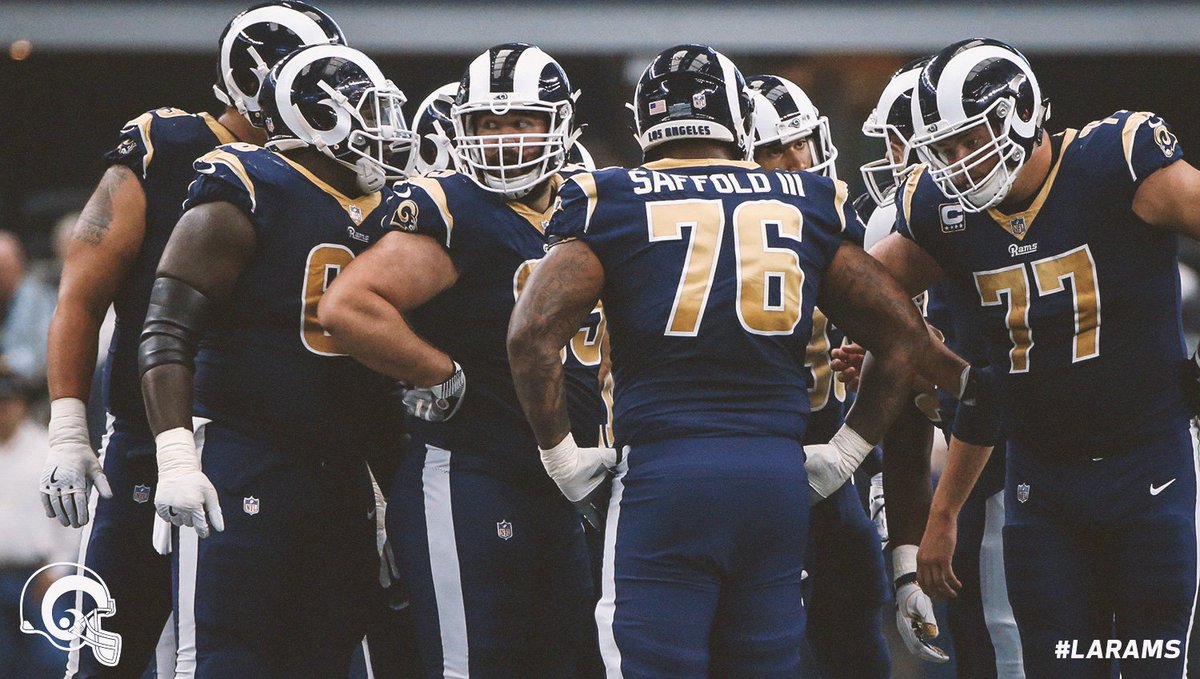
Still have a few more OTA’s then Mandatory Mini Camp prior to Training camp, however, presently the Los Angeles Rams have a total of 15 Offensive Linemen in Camp and on September Morn barring injury of course, I look for the Rams to keep 9 or in fact, 10 as the cuts will be tough with the draft upgrades.
The Starters:
LT…Andrew Whitworth…The linchpin to the OL and some will debate that Whitworth was less effective towards the end of the season including the playoff game against the Falcons, but there is no debating that Whit is a major locker room presence and will be look upon to assist some of the draft class in their transition into the NFL.
LG…Rodger Saffold….IMO, it was Saffold’s best year under Offensive Line Coach Aaron Kromer as Saffold was rock solid week in and week out. Playing in between established pros like Whitworth & Sullivan helped as Saffold did not have to cover for anyone and one will surmise is a contract extension in his future?
C…John Sullivan…Loved Sully all last year and there were a couple of games many of us were concerned about Sullivan getting injured, but Big John was always ready the following week. Sullivan really knows the offense, which assisted Goff greatly and I’m glad the Notre Dame alum is back and can teach new Center Brian Allen a few things about what it takes to be a professional.
RG…Jamon Brown….Some were tough on Brown, but I felt once he settled in at RG, he improved greatly week over week and created many holes for TGIII. Brown also improved in his pass protection and actually graded out well in the playoff game against the Falcons.
RT…Rob Havenstein…Big Rob came back after being dinged up in 2016 to play very solid at RT. Havenstein will always have us holding our breath against the speed rushers (The Texan Game) but he rallies to always just get enough of the guy to give Goff the opportunity to make a play and is one of the better run blockers on this team, really can create some gaps for the running backs and that was his claim to fame at Wisconsin.
The Draft Class:
LT…Joseph Noteboom….The more I read about Noteboom the more I liked, granted a third round pick, so there are going to be question marks, however, Noteboom is very athletic and under the tutelage of Aaron Kromer should be ready to contribute sooner rather than later. Also an Academic all American so all of us should not have to worry about Noteboom picking up the scheme and stunts that are run by the defense.
C…Brian Allen….This was the surprise pick of the draft for me as I knew the Rams might draft a Center, just did not realize Brian Allen was on their radar. Allen a leader that backs down to no one and has a wrestling background that seems to be preferred by OL Coach Aaron Kromer because of leverage combined with quick hands and feet to aid at the point of attack. Allen not a big as Sullivan, but was essential in the ground attack for the Spartans of Michigan State.
OG….Jamil Demby….One of my favorite picks, but I might be a tad biased because I work with several colleagues that played at the University of Maine and being a connect a dots guy with the addition of Liam Cohen to the coaching staff as he was the OC at Maine, felt good that Demby was headed to Southern California. Anyway big kid that played LT for the Black Bears and will transition to Guard and reminds me of Saffold, but will have to get stronger at the next level, but I feel really good about Demby making the team and being a future starter for many years to come.
First Man Up:
C/G…Austin Blythe…A real surprise to me last season as he was released by the Indianapolis Colts (who really need offensive linemen) and I did not expect him to make the team, but from the start of preseason, Blythe showcased the ability to play Center & Guard without much drop-off. Blythe another former wrestler that is very quick off the ball will have challenges again making the squad with the addition of Allen and the bigger Jake Eldrenkamp, but Blythe was very valuable last season and I don’t see things changing in 2018 for the former Hawkeye.
The Rest:
LT/RT…Cornelius Lucas….Did not expect much from the big man from Kansas State, but he caught my eye against the 49ers in the final game of the year as he played an excellent RT not allowing any pressures whatsoever. Lucas will be challenged as he will have an opportunity to play both positions come Training Camp, but he has the size that OL Coach Aaron Kromer covets in his tackles and one would surmise the Rams want to keep two tackles on the final 53 as they did all of last season.
LT/RT….Darrell Williams…Williams reminds me of the girl who is very attractive, but always not dating anyone. Williams has had his moments in preseason over the years and is still young at 24, however, against the San Francisco 49ers in the last game of the year was just awful and poor Sean Mannion could hardly get set before he was harassed by Williams’s look out blocks. Williams seems to be a better LT than RT and I knew he had more talent than Pace Murphy, but with the ability of Lucas to play RT and the addition of Noteboom I expect Williams to be given his walking papers on cut down day.
C/G….Jake Eldrenkamp….I loved this signing last season and much was written that the Rams almost drafted the former Huskie, however, Eldrenkamp was outplayed by Austin Blythe last preseason and released by the Rams and then added later to the practice squad for depth along the interior. There is much to like about Jake from State Farm as he has great size at 6’5 305 and very smart, but unless he can showcase the ability to be quick off the ball and create some gaps, Eldrenkamp could be on the outside looking in once again.
C/G…Aaron Neary….Another Offensive Lineman that IMHO, was just plain awful against the 49ers and besides Williams failing miserably at left tackle, the pressure up the middle in that game was unacceptable and much of that fell at the hands of Neary. The Rams claimed Neary from the Eagles and his only body of work was against San Francisco, but with the addition of Brian Allen to me that showcases the Rams came away as impressed as I was from the former Eastern Washington product.
LT/RT…Michael Dunn…IMHO, the Rams added Dunn before the start of the offseason because they only had only two tackles under contract at the time in Whitworth and Havenstein and needed somebody before they resigned Lucas and Williams, who could have signed elsewhere. In preseason Dunn looked overmatched whether he was at Left Tackle or Right Tackle and his surname underscores his opportunity to make this football team.
OG…Jeremiah Kolone…The only UDRFA added to the Offensive Line from San Jose State at 6’3 316lbs defiantly has the size, but will he get a chance? You never know, however if the former Spartan can make the practice squad, that would be an accomplishment.
znModeratorAs I’ve heard mentioned elsewhere, I wouldn’t be surprised if the Rams and Donald already have a handshake agreement. The Rams just need to free up cap space…maybe by cutting Barron.
They had to wait until June 1st to cut him but now they can save $7 million in cap space, if they choose to go that route.Rams don’t really need cap space to sign Donald. They already have it. They just have to convert part of his 6.9 M current cap hit into a pro-rated signing bonus. Or that’s one thing they could do anyway.
znModeratorBill Maher has the Roseanne twitter racism just right:
“Now, Roseanne will always be my friend but her world came crashing down this week with a series of tweets she put out on Tuesday that were so full of racism, conspiracy theories and personal attacks they were described as abhorrent bordering on presidential.”znModeratorWhat could it possibly be…
w
vI know the answer, but why would I just give it away for free?
Pay me and I;ll tell you.
znModeratorI thought support for single payer was a lot higher than that. I thought I’d seen 70%. Looks like that figure is among Democrats.
So while it’s a majority of Americans, it’s a pretty thin majority.
Well, that’s depressing.
This is the perfect political discussion.
One argument says Americans do not want it at all and that it is against their core beliefs.
Another argument says it’s depressing that only a 51-53% majority wants it, with 40-something percent against it.
znModeratorFor Suh, Communication is Key Throughout Offseason Program
Kristen Lago
Defensive tackle Ndamukong Suh joined the Rams just two months ago, but he has already made an impression on the defensive line.
While it may be his first offseason with the franchise, Suh still represents one of the few players on the unit with over five years of NFL experience. As such, he has been thrust into a leadership role early on, tasked with setting the example for younger players up front.
“A lot of it is going to come down to understanding the terminology for them, the speed of the game [and] allowing it to slow down,” he said. “But at the end of the day it’s going to be communication that’s going to be able to help them. As a young guy I remember you’re like a chicken with your head cut off so, you just try and take the basic things and elaborate on them each and every day.”
That process of daily improvement is something Suh not only hopes for the younger players on the Rams roster, but for himself as well, as he continues to take in the terminology of the defense.
“At the end of the day my biggest focus is understanding what I have to do on the defensive side of the ball —working with my teammates, understanding how they like to rush, how to play their base defense and going from there,” Suh said.
And as he continues to learn the system, that communication has also become an important theme for Suh in regards to teammate, Michael Brockers.
While Suh will be transitioning from three-technique to nose in the Rams system, he acknowledged that the differences in position are slight.
And because Suh will be playing a similar role, in terms of technique and scheme, his focus throughout OTAs has been about creating camaraderie with the players alongside him. The Nebraska product said he has made a point to talk with Brockers throughout each day, building chemistry with the main player who will be lining up alongside him.
“It’s pure communication at its best,” he said. “You probably don’t see it as much as you see it from a quarterback’s perspective, but as a front — for us all to be on the same front — we have to communicate.”
znModeratorWell i dunno what to think of those polls. Because Clinton got more votes than Bernie. Ya know. I mean voters had a choice between the two. And they voted for crooked hillary.
So either the polls are wrong, or people dont think its an important issue, or…?
w
vI dunno, man, that’s kind of a non sequitor.
Health care is just one issue among others…if it drove the election by itself that would be a different thing.
That doesn’t make the polls inaccurate.
All you have to ask is, what makes people vote against their own interests.
znModeratorOrigins of the Opioid Epidemic: Purdue Pharma Knew of OxyContin Abuse in 1996 But Covered It Up
https://www.democracynow.org/2018/6/1/origins_of_the_opioid_epidemic_purdue
An explosive New York Times report has revealed that manufacturers of the drug OxyContin knew it was highly addictive as early as 1996, the first year after the drug hit the market. The Times published a confidential Justice Department report this week showing that Purdue Pharma executives were told OxyContin was being crushed and snorted for its powerful narcotic, but still promoted it as less addictive than other opioid painkillers. This report is especially damning because Purdue executives have testified before Congress that they were unaware of the drug’s growing abuse until years after it was on the market. Today, drug overdoses are the leading cause of death for Americans under age 50. While President Trump claimed Tuesday that numbers relating to opioid addiction are “way down,” the latest statistics show there was an increase of opioid-related deaths and overdoses during Trump’s first year in office. According to the Centers for Disease Control and Prevention, drug overdose deaths involving opioids rose to about 46,000 for the 12-month period that ended October 2017, up about 15 percent from October 2016. The epidemic has been so widespread that life expectancy is falling in the United States for the first time in 50 years. We speak with Barry Meier, the reporter who broke this story for the Times, headlined “Origins of an Epidemic: Purdue Pharma Knew Its Opioids Were Widely Abused.” Meier was a reporter at The New York Times for nearly three decades and was the first journalist to shed a national spotlight on the abuse of OxyContin. His book “Pain Killer: An Empire of Deceit and the Origin of America’s Opioid Epidemic” was published this week in an updated and expanded edition.
Transcript
This is a rush transcript. Copy may not be in its final form.
AMY GOODMAN: Today we spend the hour looking at the ongoing opioid epidemic and how it spread across the United States. Drug overdoses are now the leading cause of death for Americans under the age of 50. But during a speech on Tuesday, President Trump claimed “the numbers are way down.” He spoke in Nashville, Tennessee.
PRESIDENT DONALD TRUMP: We got $6 billion for opioid and getting rid of that scourge that’s taking over our country. And the numbers are way down. We’re getting the word out. Bad, bad stuff. You go to the hospital. You have a broken arm. You come out. You’re a drug addict with this crap. It’s way down. We’re doing a good job with it. But we got $6 billion to help us with opioid.
AMY GOODMAN: In fact, the latest statistics show there was an increase of opioid-related deaths and overdoses during Trump’s first year in office. According to the Centers for Disease Control and Prevention, drug overdose deaths involving opioids rose to about 46,000 for the 12-month period that ended October 2017, up about 15 percent from October 2016. The epidemic has been so widespread that life expectancy is falling in the United States for the first time in 50 years.Meanwhile, the White House says it’s about to launch a series of public service announcements next week on opioid dangers, aimed at young people. The ads were developed with Kellyanne Conway, Trump’s point person on opioids.
This comes as The New York Times published a confidential Justice Department report this week that found manufacturers of the drug OxyContin had access to information showing it was addictive as early as 1996, the first year after the drug hit the market. Purdue Pharma executives were told OxyContin was being crushed and snorted for its powerful narcotic, but still promoted it as less addictive than other opioid painkillers. This report is especially damning because Purdue executives have testified before Congress that they were unaware of the drug’s growing abuse until years after it was on the market.
Well, for more, we’re joined by Barry Meier, the reporter who broke this story for The New York Times, which is headlined “Origins of an Epidemic: Purdue Pharma Knew Its Opioids Were Widely Abused.” Barry Meier was a reporter at The New York Times for nearly 30 years, the first journalist to shed a national spotlight on the abuse of OxyContin. His book Pain Killer: An Empire of Deceit and the Origin of America’s Opioid Epidemic was published this week in an updated and expanded edition. He’s won the Pulitzer Prize and two George Polk Awards for his past reporting on the intersection of business, medicine and public health.
Barry Meier, welcome to Democracy Now!
BARRY MEIER: Thank you, Amy. A pleasure.
AMY GOODMAN: It’s great to have you with us. Well, talk about this latest Justice document that you just got a hold of.
BARRY MEIER: Right. So, the basic outlines are this. As you noted, Purdue Pharma has claimed that it first became aware of OxyContin’s growing abuse in early 2000. That was about four years after its introduction. In fact, what this document showed is that the company had extensive information about OxyContin’s abuse in 1997, 1998, 1999.
AMY GOODMAN: Twenty years ago.
BARRY MEIER: Yes, and concealed that information, didn’t tell the FDA, didn’t tell doctors, didn’t tell patients. And this was a very damning report. I mean, the crimes were so significant that the prosecutors, who spent four years investigating the company, recommended that three top executives of Purdue Pharma be indicted on a—for a series of felony crimes, like conspiracy to defraud the United States, false statements and things of that nature. Unfortunately, their efforts were blocked by top administration officials within the Justice Department.
AMY GOODMAN: So, explain what actually took place.
BARRY MEIER: What took place is the following. Purdue Pharma was given permission to market OxyContin as less prone to abuse and addiction than competing narcotics. I mean, this sort of was like a gift—
AMY GOODMAN: Like drugs like Vicodin and others.
BARRY MEIER: Yes, exactly. It was a gift from the FDA. They took that gift, and they ran with it. They told doctors not only that it might be less prone to abuse and addiction, but that it would be less prone to abuse and addiction. In 2007, they admitted, basically, lying to doctors, lying to patients, by misrepresenting what they had been allowed to say.
What we didn’t know was that during the course of the investigation that led to that confession, the federal government had also uncovered information to show that not only had they mismarketed the drug, they were aware, almost from the beginning, that people were abusing OxyContin, significantly abusing OxyContin, and they concealed that information. Had they sent a warning about that to the public, OxyContin would have never become a billion-dollar drug, and thousands of peoples of lives—thousands of lives wouldn’t have been affected by it.
AMY GOODMAN: We’re going to talk about the origins of OxyContin, the Sackler family. We’re going to talk about how this drug company grew. But right now, your book came out like over 15 years ago, Pain Killer.
BARRY MEIER: Right.
AMY GOODMAN: That’s before the company was indicted and the corporate officials were indicted. Talk about Rudolph Giuliani—now once again in the headlines because he is Trump’s attorney—his role in the rise of OxyContin, in preventing a serious prosecution of this company.
BARRY MEIER: Well, Rudolph Giuliani was hired in 2002. A lot of the reporting I did for the Times in 2001 was aimed at the overaggressive marketing of OxyContin by Purdue Pharma, as well as, you know, the growing reports, public reports, about the drug’s abuse. They then came under scrutiny by the FDA, by the DEA, and they felt that they needed a public defender—a fixer, if you will. The person they brought in to do that was Rudolph Giuliani. And so he went in, with his reputation as a former prosecutor, mayor and so forth, and began—
AMY GOODMAN: It was right—I mean, you’re talking about right after the 2001 September 11th attacks, when he was called “America’s Mayor.”
BARRY MEIER: Exactly. And sort of he took that reputation, and he sold it to corporations. And one of the corporations he sold it to was Purdue Pharma. And so, he became their sort of front man, if you will, their fixer, went to meet with DEA officials, with other officials, and basically spouted the company’s line. I mean, I have no idea what Rudy knew about what was in the company’s files, whether he was privy to the information that prosecutors later discovered. But he became, essentially, the person who tried to smooth things over with government officials.
AMY GOODMAN: And was particularly powerful because he was a cancer survivor himself—
BARRY MEIER: Absolutely.
AMY GOODMAN: —and spoke about what it means to reduce pain.
BARRY MEIER: Exactly. And, you know, he made a very compelling argument. I mean, this drug has valuable uses. It’s needed in certain situations. But, you know, what Purdue had done was to basically market this drug as a cure-all for all kinds of pain. And with the vast availability of the drug, it poured out onto the streets, and that led to this wave of abuse and addiction.
AMY GOODMAN: So, who were the officials in Washington, the political appointees in the Justice Department, who intervened? And this also goes to the whole story of West Virginia and a really crusading prosecutor who took this case on.
BARRY MEIER: Right. So, basically, there were people at the very—at the senior levels of the Criminal Division. Alice Fisher was then the head of the Criminal Division.
AMY GOODMAN: This is under George W. Bush.
BARRY MEIER: Correct. And Alberto Gonzales was the head—was the—
AMY GOODMAN: Attorney general.
BARRY MEIER: —attorney general at that time. So, essentially, what happened was, in September of 2006, this very small group of prosecutors, as you noted, in far western Virginia, forwarded a report, a confidential report, to the Justice Department recommending that serious felony indictments be brought against the executives of Purdue. That report contained extensive exhibits, emails, records, that they planned to present to a grand jury to support the call for their indictments. It was backed by the local U.S. attorney there, and man by the name of John Brownlee. And it was backed, in fact, by mid-level officials within Justice Department headquarters.
But on October 11, 2006, two weeks before these prosecutors were scheduled to go before a grand jury and seek these indictments, there was an 11th hour meeting at the Justice Department. Purdue brought in its high-powered legal defense team, met with top Justice Department officials, like Alice Fisher. And after that meeting, there was a chill on the case. And basically, people like John Brownlee were told, “We are not going to give you the resources to support this prosecution. You’re on your own, if you want to do it.” And Brownlee had no resources. He had this small group of people who had spent four years, you know, 24 hours a day, investigating this company. They were facing a company of unlimited financial and legal firepower. And they really had no choice but to settle the case at that point.
AMY GOODMAN: I mean, the story of West Virginia is astounding. As you write in your New York Times piece, “Starting in 2007, the year of the settlement, distributors of prescription drugs sent enough pain pills to West Virginia over a five-year period to supply every man, woman and child … with 433 of them.” This is according to a report in the Charleston Gazette-Mail. And we’re going to talk about West Virginia as ground zero and exactly what happened to these communities, with Barry Meier, author of Pain Killer: An Empire of Deceit and the Origin of America’s Opioid Epidemic. It’s just out this week. Stay with us.
[break]
AMY GOODMAN: “Puppet Charm” by Two Ton Boa, here on Democracy Now! I’m Amy Goodman. Our guest for the hour is Barry Meier, the Pulitzer Prize-winning former New York Times journalist, whose book is out again. Well, it’s expanded, it’s updated. But this is particularly relevant. The book is called Pain Killer: An Empire of Deceit and the Origin of America’s Opioid Epidemic. It came out in 2003. Fifteen years, what a difference it makes in this country. How many deaths are we talking about? I mean, you have this incredible description of the death toll, writing, “In 2016, 64,000 Americans died from drug overdoses. That number equals the population of cities such as Portland, Maine; Lynchburg, Virginia; and Santa Fe, New Mexico. It was as if, in one year, a plague had entered one of these towns and killed every single inhabitant.”
BARRY MEIER: You know, we’re in the midst of the greatest public health disaster of the 21st century. It started out with the drug like OxyContin, and it has morphed, since then, into a kind of hydra-headed beast. On the one hand, you have the misuse and abuse of prescription drugs. And on the other hand, you have this growing death toll from counterfeit versions of drugs like fentanyl. So we’re in this very, very complicated situation. And, you know, the kind of policies that the government is now proposing may not get us out of it. I mean, we’re going to need a real extreme effort to get out of it.
AMY GOODMAN: We’re talking about, in 20 years, 250,000 people have died.
BARRY MEIER: That’s just from prescription painkillers alone. That’s from legal drugs. That’s from drugs that companies are allowed to produce, sell legally, and that are prescribed by doctors. And that alone is a stunning, startling figure.
AMY GOODMAN: So, I want to go to an ad from Purdue Pharma. This is from, oh, 1998, the ad to market OxyContin. It features Dr. Alan Spanos of North Carolina.
DR. ALAN SPANOS: There’s no question that our best, strongest pain medicines are the opioids. But these are the same drugs that have a reputation of causing addiction and other terrible things. Now, in fact, the rate of addiction amongst pain patients who are treated by doctors is much less than 1 percent. They don’t wear out. They go on working. They do not have serious medical side effects. And so, these drugs, which, I repeat, are our best, strongest pain medications, should be used much more than they are for patients in pain.
AMY GOODMAN: So, that is an ad put out by Purdue Pharma, the maker of OxyContin. Barry Meier?BARRY MEIER: Well, you know, there was—in the late 1990s, there was a movement to promote—you know, treat pain much more aggressively than it had been in the past. A lot of that movement was funded by Purdue Pharma, people like Dr. Alan Spanos. And there were these tropes, if you will, that the addiction rate is less than 1 percent. It was a total lie. There was no basis for that figure. But it was repeated, repeated, repeated, and it sort of got ingrained into the medical culture. And as a result of that, doctors prescribed more and more of these drugs, you know, in good belief.
AMY GOODMAN: The guy he was talking about?
BARRY MEIER: Dr. Spanos. In fact, that video—they made another video, I believe, with Dr. Spanos that involved a patient. And that patient wasn’t even on OxyContin. He was on a totally ’nother drug, it came out. So, I mean, it was this massive public relations campaign, that was funded, in large part, by Purdue Pharma, to sell OxyContin.
AMY GOODMAN: Talk about the growth of Purdue Pharma. Talk about the Sackler family, what was unusual about this company, what also makes it so difficult to investigate.
BARRY MEIER: Well, the Sackler family is a fascinating family. As you know, their names are, you know, on every museum in the United States—here in New York at the Metropolitan, and at the National Gallery in Washington.
AMY GOODMAN: Their names are on wings. Their names are very prominent.
BARRY MEIER: On the elevators, on everything, you name it.
AMY GOODMAN: But when it comes to the drug, where they make their fortune—
BARRY MEIER: Right.
AMY GOODMAN: —we don’t see their name.
BARRY MEIER: Right. And not only that, the—there were three brothers, Arthur, Raymond and Mortimer. Arthur was the eldest. And he was sort of this kind of, I guess, you know, evil genius, if you will. He invented the modern-day drug advertising industry. All the ads that we see on TV today or in print are kind of the result of Arthur Sackler’s genius, or lack thereof, as you see it. And he kind of wedded together the pharmaceutical industry and the medical profession. He made doctors shills for drug companies. He created medical journals that were really kind of fake medical journals, because drug advertisers had to pay to get their studies into those medical journals. So he created all these deceptive marketing and advertising practices that are commonplace today. He died in 1986, before OxyContin was created.
But to get his brothers into the drug industry, he bought this tiny little firm called Purdue Frederick, that was located here in New York, in Greenwich Village, as it turned out. They basically sold a lot of kind of crazy stuff. And eventually, in the mid-1990s, they decided to get into the pain medication business. They first bought a drug called MS Contin, which was a long-acting form of morphine, and they marketed it mainly to cancer specialists, where the drug was very, very valuable in dealing with cancer pain. But then, in the mid-1990s, as this drive to treat pain more aggressively began to unfold, they began to sell OxyContin, which is a long-acting form of the narcotic oxycodone. And this became the most aggressive, high-powered marketing campaign for a prescription narcotic in drug industry history. It was financed with Sackler money. The Sacklers were the principal beneficiaries of it. There were something like $31 billion worth of OxyContin sales in subsequent years. And the Sacklers became, I believe, the 14th or 15th richest family in the United States.
AMY GOODMAN: I want to go to 1998. Purdue Pharma distributes another video, featuring seven patients who used OxyContin to deal with chronic pain. One of the patients was named Johnny Sullivan.
JOHNNY SULLIVAN: I got my life back now. Now I can enjoy every day that I live. I can really enjoy myself. And before, even a good day was hell. I mean, I couldn’t enjoy nothing. But now I can enjoy myself. That’s when I say it’s wonderful. I look at the future the same way a young guy, 25-, 30-year-old, would.
AMY GOODMAN: After appearing in that promotional video for Purdue Pharma, Johnny Sullivan became a severe addict to OxyContin and other opioids. In 2008, he died in a car crash when he fell asleep at the wheel. His wife said, because of his addiction, he would often nod off. Barry?BARRY MEIER: You know, this drug, for some patients, has been a godsend. But for many, many others, it has turned into a nightmare. We focus a lot about—on the subject of addiction, and rightly so. But not long ago, I interviewed a pain specialist, who had been sort of on the bandwagon promoting these drugs when they first came out. And he said to me, “You know, addiction is not the real problem with these drugs. It’s not the only problem with these drugs.” These drugs caused patients to emotionally opt out of life, you know, to become couch potatoes, to become withdrawn, to reject their family members and lose social contact. They had all other—they have all other kinds of troubling side effects. And so, you know, there is now a generation of patients who, effectively, are emotionally dependent upon these drugs.
AMY GOODMAN: A spokesperson for Purdue Pharma said in a statement, in response to your article in The New York Times, his company is “involved in efforts to address opioid abuse,” and, quote, “Suggesting that activities that last occurred more than 16 years ago are responsible for today’s complex and multifaceted opioid crisis is deeply flawed.” Your response?
BARRY MEIER: You know, I’m not a $600-an-hour lawyer. I don’t come up with, you know, statements like that. But let me put it in simple terms. Purdue Pharma violated the trust of doctors and patients. It lied to them. The Justice Department discovered reams of information, which, in their minds, showed that this company also concealed extraordinarily powerful information pointing to the abuse of these drugs, early—early on, when it was first marketed.
AMY GOODMAN: What was the lie to the doctors?
BARRY MEIER: The lie was that OxyContin would be less prone to abuse and addiction than competing painkillers. They admitted that they had told that lie in 2007, and paid $600 million in fines. I mean, that was a drop in the bucket where OxyContin sales were concerned. But they admitted that they had lied.
AMY GOODMAN: You write about how Purdue sales reps used a chart to convince doctors that OxyContin was more stable than a traditional narcotic, even though the FDA had told Purdue that the information they were giving out was bogus.
BARRY MEIER: That was just one of many lies that they used. I mean, the entire predicate of the company’s marketing campaign was based on a lie. I mean, that’s the simplest way of putting it. The Food and Drug Administration had given them permission to say, “This drug might be less prone to abuse and addiction.” They trained their sales reps to say it was less prone to abuse and addiction. Sales reps would go—and sales reps didn’t know what the reality was, but they would go to doctors and pharmacists and say, “You know, you can’t inject OxyContin. You can’t extract the oxycodone from OxyContin and inject it, because like the junkie will get a heart attack, they’ll drop over and die. This is a safe drug. This is much safer.” It was all an incredible lie. And at the same time, the company was concealing what was probably the most significant information they needed to tell doctors, which was this drug was being widely abused.
AMY GOODMAN: Who is Laura Nagel?
BARRY MEIER: Laura Nagel was the head—a key figure within the DEA at the time of this episode. She was in charge of the division of DEA that went after the diversion of legal drugs onto the street. It wasn’t sort of the narcs, you know, the guys who busted people for selling heroin or cocaine, but it was the diversion division which dealt with the misuse of prescription drugs.
AMY GOODMAN: And what did she do?
BARRY MEIER: She was a hero. She was a fighter. She saw what was going on. She realized that this company, A, was overly aggressively—you know, was promoting this drug, you know, to the nines, that people were dying from this drug. She tried to call them to account. And they essentially unleashed as much legal and lobbying firepower on her to basically try to roll her over.
AMY GOODMAN: And what happened?
BARRY MEIER: She basically backed off, just like everyone else in those days who came up against Purdue Pharma.
znModerator– it’s a relatively small group of people who got rich off the current healthcare system, and therefore have a vested interest in maintaining the status quo that keeps us from having single payer.
It has nothing to do with “culture.” It has to do with the fact that combined, the pharmaceutical and insurance industries are the biggest lobbiests (in terms of amount spent) and campaign donors (in terms of amount spent) in the USA. Most of the time, you can’t run for office without their money, and they give to both parties.
Polls.
I restricted the search to the last year.
The Washington Post-Kaiser Family Foundation poll shows 51 percent of Americans support single-payer, while 43 percent oppose it. http://thehill.com/policy/healthcare/383015-poll-slim-majority-of-americans-support-single-payer-health-care
The latest Harvard-Harris Poll survey found 52 percent favor a single-payer system against 48 who oppose it. http://thehill.com/policy/healthcare/351928-poll-majority-supports-single-payer-healthcare
a growing share now supports a “single payer” approach to health insurance, according to a new national survey by Pew Research Center. http://www.pewresearch.org/fact-tank/2017/06/23/public-support-for-single-payer-health-coverage-grows-driven-by-democrats/
The June Kaiser Health Tracking poll finds that a slim majority of the public (53 percent) now favors a single-payer health plan in which all Americans would get their insurance from a single government plan https://www.kff.org/health-reform/poll-finding/data-note-modestly-strong-but-malleable-support-for-single-payer-health-care/
A new poll found 59% of Americans support a “national Medicare-for-all plan.” http://www.businessinsider.com/poll-medicare-for-all-public-option-bernie-sanders-plan-support-2018-3
Single-payer health care is surging with a majority of American voters — and Democrats are loving it the most, a new poll showed Wednesday. A POLITICO/Morning Consult survey said 49% of general voters support a proposal for a single-payer system, while 35% oppose it and 17% hold no opinion. http://www.nydailynews.com/news/politics/americans-dems-support-single-payer-health-care-poll-article-1.3509035
“Given all of the discontent with health care and desire for coverage, single-payer has more support than I have seen in the past, with the country split down the middle,” said Harvard-Harris Poll co-director Mark Penn. The poll also showed that 69 percent of respondents believe the single-payer system would “provide more coverage.” 54 percent of Republicans agree. https://www.salon.com/2017/09/22/majority-of-americans-support-single-payer-poll/
Citing simplicity, fewer hassles with insurers and more stable coverage for patients, U.S. physicians increasingly support a single-payer healthcare system, new reports indicate. https://www.forbes.com/sites/brucejapsen/2017/08/13/doctors-coming-around-to-single-payer-healthcare/#4cc41b824767
The Washington Post-Kaiser Family Foundation (KFF) poll asked: “Do you support or oppose having a national health plan—or a single-payer plan—in which all Americans would get their insurance from a single government plan?” More than half said they support it. The results align with other polls conducted within the past year. https://www.commondreams.org/news/2018/04/12/spreading-wildfire-majority-americans-including-74-democrats-now-support-single
That’s enough for now. There is more though.
..
-
AuthorPosts