
Forum Replies Created
-
AuthorPosts
-
 AgamemnonParticipant
2015 St. Louis Rams Roster: Team To Release WR Bud Sasser For Heart Condition After Signing Him On
@3k_ on Jun 4, 2015, 12:08p 7
Jeff Curry-USA TODAY SportsSad story, but classy move by the Rams.
On Tuesday, the Rams signed Missouri product and 2015 NFL Draft sixth-round pick WR Bud Sasser.
It was a bit of a strange move as the Rams, per custom under head coach Jeff Fisher and general manager Les Snead, have opted to sign their draft picks in unison. Well today, we found out why.
It’s a cold world sometimes. Here’s hoping Sasser is able to have it cleared and either make it with another team or move on from football.
On the other side, props to the Rams for doing the classy thing. By signing him to his rookie four-year deal, Sasser gets medical coverage to help him treat the condition. As much as we follow sports for the sports, it’s always heartening for your team to do something as charitable as this.
Sasser will pick up a signing bonus just less than $135k.
Best of luck, Bud.
 AgamemnonAgamemnonParticipantAgamemnonParticipant
Do those just end up on youtube 24 hours later or did you do something?
https://www.youtube.com/channel/UCrQ-22zY_vmS1Q5u-eh_gyg/videos
This account puts a lot of Rams videos on youtube. AgamemnonJune 4, 2015 at 6:59 am in reply to: If Rams' offense doesn't improve, it won't be for lack of trying #25814AgamemnonParticipantSnead, “The average starting LT gets drafted somewhere in the 2cd round.”…. “But, when you break it down from the guard to the center to the RT. You know, the average round that starters are drafted in is close to the 4th.”
The latest from Snead. The quote is 2 minutes in.
AgamemnonAgamemnonParticipantMatt McGuire’s NFL Draftology
Send Matt an e-mail here: mmcguire5@gmail.com
All other e-mail, including advertising and link proposals, send to: wpc112@gmail.com
NFL Draftology LecturesNFL Draftology 408: The 10-Year NFL Draft Study (updated 7/16)
NFL Draftology 234: The NFL Positional Value Pyramid (updated 7/4)
NFL Draftology 101: Introduction to NFL Draftology
NFL Draftology 112: Need Versus Value
NFL Draftology 205A: Positional Demand
NFL Draftology 205B: Positional Impact
NFL Draftology 205C: Positional Impact Continued (Updated 6/9/10)
NFL Draftology 320: Dissecting the Trade Value Chart
NFL Draftology 321: Revising the Trade Value Chart
NFL Draftology 378: The Safest Pick Myth
Read more at http://walterfootball.com/nfldraftology.php#GrCfDDsAjKBL5yRj.99
Go here for a bunch of links if you wish to investigate further. The links are the same, whatever. 😉 http://walterfootball.com/nfldraftology.php
AgamemnonAgamemnonParticipantMatt McGuire’s NFL Draftology 408: <br> The 10-Year NFL Draft Study: Round 2
Send Matt an e-mail here: mmcguire5@gmail.com
All other e-mail, including advertising and link proposals, send to: wpc112@gmail.comUpdated July 16, 2010
The NFL Draft has become more and more popular especially in the last five years partially because of this thing called the “Internet.” You might have heard of it before. The point is that fans are more educated on NFL Draft prospects than ever before. There is a brand new crop of Draftniks who really became enthused in the last couple of years, and this has lead to higher expectations for teams not juts in the first round; but in the following rounds as well.
The second round of the NFL Draft is now looked at the way the first round was in the 1990s. Well-informed fans know all about these prospects and there is now an expectation that teams should hit most to all of their second-round picks.
However, we all know that second-round picks don’t become superstars. These are certainly quality players, but fans look to their second-round picks to come onto their team and become high-impact starters in their first few years in the league.
NFL Draft research says this is much easier said than done. Consistently in the last 10 years there is a 50-percent hit rate on second-round picks, but you have to account for variance in that some NFL Drafts are stronger than others so there isn’t always your typical 50-percent hit rate every year.
image:
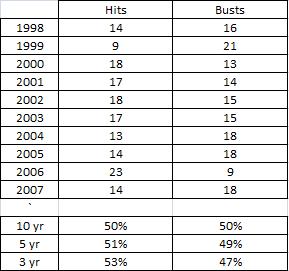
Busts in the NFL DraftThough I do believe that in the next 10 years this will increase closer to 60 percent, it doesn’t hide the fact that it is much harder to get impact players in the second round than most Draftniks can imagine.
Fans and Draftniks need to look at the second round as it is a bit of a coinflip, but as always teams make really dumb second-round picks, which should never have happened.
For example, let’s take the second round of the 2009 NFL Draft. I did not believe Pat White, Michael Mitchell, Ande Levitre or Richard Quinn should ever have been selected in the second round. This is only four players, but when you equate it into the statistics, it’s 12.5 percent of the second round.
We see three to five players drafted every year in the second round in which teams simply make stupid picks, and I’m not talking about “hindsight is 20-20;” I am talking about picks that were controversial the day they were selected.
Even if teams were never stupid in the second round, the hit rate is still a relative flip of the coin simply because of the talent level of the prospect we are dealing with. The top 32 picks are now off the board and teams are simply choosing from a lower tier of talent, and it is always harder to get impact players at an extremely high rate at that point.
This said, historically the second-round hit rate is less than 10 percent different from the first round over the past 10 years.
When I calculated “hits” and “busts” in the second round I certainly adjusted my expectations. If a player is a starter in the second round (or a very good backup), then I gave him a “hit.” We expect second-round players to be starters for our football team. Of course, sometimes I did give second-round starters the bust label if they are really, really bad, or they are simply on a team with no talent at their position and they would be a backup anywhere else. Take this into account when you compare the stats to the first round. Some second-round hits would be “busts” in the first round because we have lower expectations for second-rounders.
Please view the spreadsheet for the 10-year NFL Draft study of the second round here and e-mail me or tweet me if you have any questions or comments.
Now, I am going to discuss some of the borderline hits and busts that might be a bit controversial to clear the air:
Leon Bender, DT, Oakland, 1998: Bender never played a game in the NFL. He was died to due a seizure disorder. It’s impossible to know if the Raiders just did a bad job with the medical, but I didn’t count Bender as a bust or hit to be fair.
Reggie Kelly, TE, Atlanta, 1999: Kelly became a starter because of his blocking ability in Cincinnati, but he is a bust as a second-round tight end. He only has about 1,700 receiving yards in his 10-year career, and has never eclipsed 31 catches or 340 yards in a season.
Robert Ferguson, WR, Green Bay, 2001: I know Green Bay fans might hate this, but I think Ferguson was a bust. He was the No. 41 overall pick, and he never had a 600-yard or five-touchdown season in his career. Ferugson was nothing more than a No. 3 receiver for Green Bay, and he had a Hall of Famer at quarterback.
Gary Baxter, CB, Baltimore, 2001: Baxter had a short career because he tore his patella tendons in both knees in 2006 against the Broncos. This was a horrific injury that couldn’t have been forseen. He was a 2-year starter in Baltimore in which he totaled four interceptions, 25 pass breakups and 143 tackles. He had a very promising career and I think Baltimore made a great pick – he’s a “hit” in my book who just had some bad luck.
Josh Reed, WR, Buffalo, 2002: Reed has never been a gamebreaker and he hasn’t put up big stats, but he’s been a very reliable No. 2/No. 3 receiver in Buffalo who has consistently produced. He has 3,575 receiving yards and he’s been a starter. He’s been a marginal “hit,” but a hit nonetheless.
LeCharles Bentley, C, New Orleans, 2002: Bentley was a two-time Pro Bowler for New Orleans and started 57 games for them. He never got on the field for Cleveland due to injuries, but because the Saints got four really productive years out of a second-round pick I have to maintain that they got a sufficient return on their investment to call Bentley a “hit”.
Boss Bailey, LB, Detroit, 2003: Bailey was not very productive in Detroit as a starter and his career fizzled out in Denver. He only had more than 50 tackles in a season once (rookie year) and only got to start in Detroit because their talent level was so bad at linebacker. If he was productive in Denver, then I wouldn’t view him as a bust, but he was simply in a favorable situation in Detroit.
Julius Jones, RB, Dallas, 2004: Jones just might be the worst starting running back in the NFL in 2009, but he does have more than 5,800 total yards in his career, and has been a starter in Dallas and Seattle. Jones is a starter and he is barely a “hit” in my opinion.
Darrent Williams, CB, Denver, 2005: Williams’ first two years with the Broncos were very good (23 starts, 6 INTs, 19 pass breakups, 125 tackles, 8.4 punt return average), but he was murdered. He had a promising career, so I categorized him as a “hit.”
Tim Jennings, CB, Indianapolis, 2006: Jennings isn’t a solid starter in the NFL, but he’s been an excellent nickel in Indianapolis, and with 125 tackles over the past three years, I think he’s productive enough to be a “hit” as a late second rounder.
Darryl Tapp, DE, Seattle, 2006: Tapp has 18 sacks in his 4-year career including a seven-sack season in 2007. He hasn’t been ridiculously productive, but I consider him a hit.
Arron Sears, G, Tampa Bay, 2007: Sears was an extremely productive in Tampa and arguably a better player than first-round pick Davin Joseph, but he suffered from what is believed to be a mental illness and the Bucs cut him this offseason after he did not play in 2009. I don’t think Tampa or any other team could have forseen this and they just got unlucky with a short career. Therefore, Sears is a hit and not a bust.
Read more at http://walterfootball.com/nfldraftology408_2.php#u1oor7ufXIj1dmeV.99
http://walterfootball.com/nfldraftology.php
part B3
AgamemnonAgamemnonParticipanthttp://walterfootball.com/nfldraftology408_1.php
Matt McGuire’s NFL Draftology 408: <br> The 10-Year NFL Draft Study: Round 1
Send Matt an e-mail here: mmcguire5@gmail.com
All other e-mail, including advertising and link proposals, send to: wpc112@gmail.comUpdated July 12, 2010
The first round can make or break a team’s draft. This is where the top prospects fall most of the time. Casual fans watch the first round of the NFL Draft and then tune it out. However, have the expectations for how successful teams should be drafting in the first round become too high now?
I think they are based on my research in the NFL Draft Study. In the NFL Draft broadcast, sure a couple prospects are talked about as being overrated, but consistently in my study at least 10 players busted in the first round each time and we should expect this in the future. This means at least every third player will bust in the first round, and in some past drafts half the players busted in the first round.
Fans can’t comprehend that there is at least a 33-percent chance of their 2010 first-round pick busting, but it’s true (33% – giving the benefit of the doubt that the scouting in 2010 is better than in recent years).
Here are my numbers for the NFL Drafts from 1998-2007:
image:
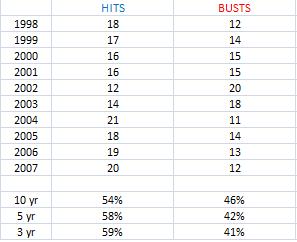
Busts in the NFL DraftThere are a number of ways you can use this. Go back into the 2009 and 2010 NFL Drafts, and you can scope out 10 or more players whom you think have a very legitimate possibility of busting. It’s annoying how some analysts (i.e. Jon Gruden) talk about every prospect like they will pan out, but the reality of the situation is that a lot of these players will bust.
Why is this? Is scouting this bad? I don’t think the scouting is bad, but I feel bad drafts are certainly made for teams.
Even though teams invest hundreds of thousands of dollars into their scouting department and spends thousands of hours evaluating prospects from January the April, the reality of the situation is that this is simply an extremely difficult process. It’s really hard to figure who will thrive in the NFL and who won’t.
Is it a crapshoot? It’s a little bit of a crapshoot because teams can only do so much and then players have to take some level of responsibility for their performance on and off the field. However, I think teams do make mistakes and while I feel like some of these busts can certainly be avoided, the bottom line is teams don’t want to deviate from the consensus on talent evaluation throughout the league.
There is good news. It looks as though evaluation is getting better and better as the percentages are going up. Is it this, or were the 2002 and 2003 NFL Drafts just so terrible that they skewed the stats? I think a little bit of both. Teams are doing more thorough background checks (often now to the point of over-analysis) and learning from some of the league’s mistakes. I am confident the percentages will improve in the future.
Here is how you can apply these statistics. For one, stop expecting every first-round pick – or even the vast majority – to be successful. Secondly, stop expecting your team to nail every first-round pick and give them the benefit of the doubt sometimes. Go back through your team’s drafts in the last five years. If your team only has one or no successful first-rounders (assuming you have five first-round picks – adjust accordingly if you have more or less) then you have a bad drafting team in the first round. Two is below average; three is solid; four or five is excellent.
You can access this 10-year NFL Draft study first round only (the six other rounds will be released eventually) by downloading it here. Every first-round pick from 1998 to 2007 is accounted for. If you have any comments or complaints about whether a player was a hit or a bust (and quite frankly this isn’t going to be perfect; I’m bound to be off on a couple) then please e-mail me.
Now I’m going to touch on some of the controversial players in my study as to whether I categorized them as a hit or bust, and explain why. Keep in mind this is an NFL Draft study – so even if the player presently has a successful career, he might have been a bust for the team that drafted him in his first 3-5 years in the league, then went on to success elsewhere.
Anthony Simmons, LB, Seattle, 1998: I thought the Seahawks made a good pick here with Simmons and he was productive enough to be a “hit” before succumbing to some bad luck with injuries. I have no idea if he had durability issues at Clemson, and if he did and this could have been more avoidable then he’d be categorized as a “bust.” Simmons started every game for the Seahawks from 1999 to 2001 racking up seven sacks, four interceptions, and 279 tackles. I think injuries really derailed his career and I’m not blaming the Seahawks here.
Shaun Williams, S, N.Y. Giants, 1998: Williams had a very promising career in New York before he suffered a season-ending knee injuries in 2003 and 2004. It is hard for me to label him a bust because he started every game for the Giants from 2000 to 2002 before having some bad luck.
Daunte Culpepper, QB, Minnesota, 1999: We all know who Culpepper is now and the argument can certainly be made he was a product of Randy Moss, Cris Carter and Dennis Green’s coaching with the Vikings. However, Culpepper did make the Pro Bowl three times, and he has more than 24,000 yards passing in his career. Who knows what would have happened if he hadn’t blown out his knee. He was very productive for the Vikings for five years. If you don’t like that he’s not a bust – tough. I think he was good enough to be a “hit.”
Thomas Jones, RB, Arizona, 2000: Jones spent his first three years in Arizona starting only 15 games there and only averaged 3.5 yards per carry. He had marginal success in Tampa, then has enjoyed a fairly successful career in Chicago and especially with the Jets. He has rushed for more than 2,700 yards with New York in the past two seasons. Despite all this, Jones was a bust for Arizona. This is an NFL Draft study, and he severely underperformed in Arizona and quite frankly I don’t think there are any excuses when you are drafted at No. 7 overall. Jets fans might not like this, but if Jones were enjoying success now in Arizona and he didn’t do anything for you if you drafted him in the top 10, then you would feel differently.
Leonard Davis, T, Arizona, 2001: Davis was drafted at No. 2 overall and expected to be an elite left tackle in the NFL. Davis couldn’t even handle playing offensive tackle in the NFL and has enjoyed success with the Cowboys at right guard. However, in this study we don’t account for positional changes. You don’t spend the No. 2 overall pick and the money coming with it hoping he works out at guard if he busts at tackle. If you are drafted as a tackle and you bust as a tackle, then you’re a bust in my book. You severely failed to live up to the expectations of the position you were drafted as.
Andre Carter, DE, San Francisco, 2001: Carter had an enormous 12.5-sack sophomore season in San Francisco and has 63.5 career sacks. He hasn’t lived up to the hype of being the No. 7 pick in the NFL Draft, but he hasn’t busted either. He’s a solid pass rusher though a bit inconsistent. I don’t think he’s a bust, but I can’t blame 49er fans for expecting a little more production in his time there.
Marc Colombo, T, Chicago, 2002: Colombo did nothing in Chicago because he had three years where injuries really held him back. He has enjoyed a lot of success with the Cowboys, though he missed a lot of games in 2009 due to injuries. Colombo has been in the NFL for eight years, but has only had three productive seasons. He has to be a bust.
Calvin Pace, DE, Arizona, 2003: Calvin Pace did absolutely nothing in his first four years in Arizona, then had a great season in his contract year and has been very good for the Jets. Arizona might have gotten screwed here. Pace had the talent all along, but he obviously lacked the work ethic and competitiveness to be great for the team that drafted him. He’s not a bust with the Jets now, but for his first four years he did nothing – and the drafting team that invested the No. 18 pick in the NFL Draft got burned.
Robert Gallery, T, Oakland, 2004: See Davis, Leonard.
Alex Smith, QB, San Francisco, 2005: The jury is still out on Alex Smith, but for the moment I’m giving him the benefit of the doubt.
Cedric Benson, RB, Chicago, 2005: See Pace, Calvin.
Antrel Rolle, CB, Arizona, 2005: Rolle was a bust at corner in Arizona. He is now a solid safety, but he greatly failed to live up to expectations as a cornerback. Bust.
Mark Clayton, WR, Baltimore, 2005: While Clayton hasn’t been extraordinarily productive in Baltimore, he has been able to lock up the No. 2 receiver position for most of his career and hold off other receivers. Clayton is certainly in the gray area, and I think you can make the case he has been both a “bust” and a “hit,” but because he has been able to hold onto the No. 2 receiver job I gave him the benefit of the doubt.
The second round will be coming later in the week, so stay tuned and do your duty as a Draftnik and look back at past drafts!
Read more at http://walterfootball.com/nfldraftology408_1.php#rIBKPvqTkaC8oLS2.99
AgamemnonAgamemnonParticipanthttp://walterfootball.com/nfldraftology408_1.php
Matt McGuire’s NFL Draftology 408: <br> Introduction to the 10-Year NFL Draft Study
Send Matt an e-mail here: mmcguire5@gmail.com
All other e-mail, including advertising and link proposals, send to: wpc112@gmail.comUpdated July 12, 2010
Welcome to the most recent lecture in my NFL Draftology course. In Draftology 408, we are going to explore our expectations for what is a bust and not a bust, as well as introduce WalterFootball.com’s 10-year Draft Study.
I think whenever you truly analyze something and break it down, you have to get back to the basics. What are our perceptions? Why do we believe what we believe? What the hell do we believe in the first place?
For example, how do we determine the difference between a bust and a non-bust in the NFL Draft?
As I have been working on my 10-year NFL Draft Study, I have realized there is a lot of gray area, and not everything is black and white in terms of players being busts or not. For example, they can endure injuries, do nothing for their first four or five years and then be productive, or simply have marginal careers where it is difficult to call them busts or not.
What is a bust? A bust is a player who greatly failed to live up to expectations. They generally were underproductive and made little impact.
The next question that must be asked is “What are our expectations?” and then “Are our expectations impractical?”
My 10-year NFL Draft Study is designed to give us some parameters to work with in terms of our expectations for teams and prospects. Often, fans and the media have very unrealistic expectations for how their teams perform in the NFL Draft. Every first-round pick needs to hit, and every top-10 pick needs to be a superstar. If this isn’t the case, then the media and fans simply go back and blame the team for passing on other prospects drafted later who excelled.
It simply isn’t this easy, and hindsight is always 20-20. Don’t get me wrong; teams definitely make mistakes, and criticism is often warranted. I am saying we need to re-evaluate ourselves and how we analyze the NFL Draft before critiquing teams because we would then be coming from an ignorant viewpoint.
The next question we must ask is what is an impact player? An impact player is a player who made a significant contribution to his team for an extended period of time (generally four years or more for first-round picks, but later-round picks hit if they have two good years) whether it was as a starter or backup regardless of position except for special teams personnel not including the kicker, punter or long snapper.
It must also be noted that first-round picks have higher expectations than other positions. A player has to be a bust if he has had a relatively short career unless it was cut off by injuries. In the case of injuries, we simply can’t blame teams unless the player had durability issues in college – teams can’t predict which players will get injuries in the future and which won’t because it is a part of the game.
I understand this process is incredibly subjective, but there is no other way to do it. If you want to criticize me for not having a supercomputer and program to digest all of this information in a very objective manner, then that’s fine but please understand it isn’t practical.
There are certainly debates on how we categorize players in hindsight in terms of their level or lack of success, but we need a starting point.
If you go on any NFL team message board prior to the NFL Draft, you will see fans have their own mocks for their teams. They believe their later-round picks will all hit and they have the recipe to complete the depth chart. As Lee Corso would say, “Not so fast my friend!” These expectations are ridiculously impractical. You can’t expect your team to hit every pick or even half their picks. I have been studying the NFL Draft religiously for the past six years, and from my research I have determined that a solid draft for a team is when you get two impact players from it. Just two. Three impact players is a good draft, and four or more is an amazing draft.
The 10-year NFL Draft study (it didn’t take me 10 years; it just uses the 1998 to 2007 NFL Drafts) breaks down each round in terms of “hits” and “busts,” and gives us some statistics to work with to help us better mold our expectations for the league.
Read more at http://walterfootball.com/nfldraftology408.php#ZDL4SlcRFwo6yMmj.99
AgamemnonAgamemnonParticipanthttp://www.nationalfootballpost.com/draft-probabilities-by-position/
Tony Villiotti
Draft probabilities by position
Posted April 11, 2014 · Add CommentIn an earlier article the probability of achieving certain milestones by draft choice range was reviewed. To refresh your memory, the seven draft choice ranges are (1) the first 13 draft selections, (2) draft selections 14-24, (3) draft selections 25-46, (4) draft selections 47-73, (5) draft selections 74-114, (6) draft selections 115-187 and (7) draft selections 188 and higher.
It only makes sense, though, that the probabilities are different depending on playing position. These differences can be caused by some combination of a varying level of injury or scouting risk and the number of available positions for drafted players. For example, there is only one starting quarterback but five starting offensive linemen. It makes sense, then, that offensive linemen have a higher success rate than quarterbacks, especially given that a disproportionate number of quarterbacks are drafted.
In this article I will review the probabilities by playing position. For purposes of this article, in certain cases, playing positions were combined and others were split into two. The position groupings are:
• Quarterbacks
• Smaller Running Backs (210 pound or less)
• Larger Running Backs (over 210 pounds)
• Wide Receivers
• Tight Ends
• Offensive Linemen
-I do have individual data for centers, guards and tackles but the degree of position switching along the line makes it, in my opinion, more meaningful to report the information for the combined positions
• Small defensive ends and outside linebackers
-Small defensive ends were defined as less than 265 pounds
-This grouping acknowledges that defensive ends and outside linebackers are to some degree interchangeable, with a player’s professional position dependent on the type of defense his pro team plays
• Large defensive ends and defensive tackles
-Large defensive ends are defined as weighing 265 pounds or more
-This grouping acknowledges that 3-4 defensive ends are more like defensive tackles
• Inside linebackers
• Cornerbacks
• SafetiesFullbacks and special teams players were excluded from the analysis due to the low number of draftees.
This article will address the playing position probabilities from two angles. First, I will address differences within the draft choice ranges for each of the first four ranges. This will take us into the beginning of the third round. Then, I will discuss observations by playing position. There may be some overlap between the two angles, but after much thinking about the subject I think it is the best way to proceed. The principle metric used in this review is the percentage of five-year starters, with the 1994 through 2008 draft classes used as the study period.
Selections 1-13
• Average % of five-year starters: 71.3%
• Among playing positions with at least 10 players drafted with these selections during the study period, the probability of drafting a five-year starter ranged from 60% to 95%
• Least risky: Offensive linemen (95%, or 20 of the 21 offensive linemen selected from 1994 through 2008 became five-year starters)
• Most risky: Large running backs (60.0% five-year starters), but quarterbacks (64.0%) and wide receivers (61.5%) were close
• Other observations:
-Over 51% of drafted offensive linemen made the Pro Bowl at least once compared to the 43.5% overall average
-80% of offensive linemen started as rookies compared to the average of 70%
-178 of 195 drafted players had careers of five years or moreSelections 14-24
• Average % of five-year starters: 63%
• Among playing positions with at least 10 players drafted with these selections during the study period, the probability of drafting a five-year starter ranged from 36% to 71%
• Quarterbacks, small running backs, tight ends, safeties and inside linebackers had too few selections to consider as part of the discussion
• Least risky: Offensive lineman with 71% of draftees becoming five-year starters
• Most risky: Large running backs with 36% of draftees becoming five-year starters
• Other observations:
-Biggest difference between 1-13 and 14-24 draft ranges is that 1-13 produces about 1.6 times as many Pro Bowl players
-Despite their overall higher risk profile, 32% of wide receivers drafted in this range were selected to the Pro Bowl at least once (versus 27% average)
-The outside linebacker/small defensive end group had only 16% of draftees selected to at least one Pro Bowl
-30% of drafted offensive linemen were selected to at least one Pro BowlSelections 25-46
• Average % of five-year starters: 48%
• Among playing positions with at least 10 players drafted with these selections during the study period, the probability of drafting a five-year starter ranged from 17% to 77%
• Least risky: Inside linebackers (76.5%), outside linebackers/defensive ends (64%), offensive lineman (61%)
• Most risky: Small running backs (16.7%), large running backs (23.5%) and defensive tackles/large defensive ends (35%)
• Other observations:
-Offensive linemen and inside linebackers were most likely to start as rookies
-Running backs and defensive tackles/large defensive end were least likely to start as rookies
-Only 58% of small running backs lasted five years in the versus the average of 73%
-Inside linebackers, safeties and tight ends were the most likely to play five years or moreSelections 47-73
• Average % of five-year starters: 34%
• Among playing positions with at least 10 players drafted with these selections during the study period, the probability of drafting a five-year starter ranged from 8% to 49%
• Least risky: Offensive linemen (49%) and safeties (46%)
• Most risky: Quarterbacks (8%), small and large running backs (combined percentage of 11%) and wide receivers (25%)
• Other observations:
-Offensive linemen were most likely to have five-year or longer careers
-Large running backs were least likely to last five years
-Offensive linemen and inside linebackers were most likely to start as rookiesThe rest of the article discusses individual playing positions. The tables in each section include information about the probability of (1) a player having a five-year or longer career and (2) a player starting for at least five years. The table shows the average across all positions, the number of players drafted at that position from 1994 through 2008 (which is the same for both five-year careers and five-year starters) and the probability for that draft choice range.

Observations:
• 13% of players drafted with selections 1-13 were QBs with almost as many QBs taken with those selections as with selections 14-73
-If a team wants a top rated QB it better take him early
• The small number of data points makes it difficult to draw many additional conclusions
• The number of All Pro QBs is very low because Peyton Manning “hogged” most of those honors, holding down the total number of QBs to earn All Pro honors
Observations:
• Not many small running backs are taken with early selections
• There is a low likelihood of grabbing a starter at any point in the draft but players in this group often return kicks
• The probability of drafting a five-year starter is lower than the average for each draft choice range
Observations:
• Drafting running backs is a risky propositions and the percentage of five-year starters is below the average in every data choice range
• Only two of the 92 large running backs selected after the 114th pick ended up as a five-year starter
• The probability of having a five-year career is considerably lower for large running backs than the average of all positions
Observations:
• There is virtually no difference in the results of drafting wide receivers between draft selection ranges 1-13 and 14-24
• Despite having one of the lowest percentages of five-year starters with selections 1-13, wide receivers have the third highest number of rookie starters
• There is a large drop-off in the percentage of five-year starters after selection #24 but wide receivers taken with draft selection ranges 25-46 and 47-73 are about the same
• Selections between 115 and 187 have probably the lowest probability of success across the board
Observations:
• Only 10 tight ends were selected in the first 24 picks over the 15-year study period
• Out of those 10, nine became five-year starters
• There is a higher percentage of drafting five-years starters at tight end than the average of all positions through the 114th selection
Observations:
• The % of offensive linemen who end up as five-year starters exceeds the average in all seven of the draft choice ranges
• The probability of an offensive lineman earning Pro Bowl honors at least once is significantly higher than the average through selections 46, but then drops below the average
• Offensive linemen, when all performance measures are considered, are probably the list risky position to draft regardless of draft position
• One-third of all five-years starters from picks 188 and higher are offensive linemen
Observations:
• The probability of drafting a five-year starter is pretty much the same through the first 46 selections of the draft
o The chances of drafting a rookie starters are about the same as well
• The probability of drafting a Pro Bowl player does drop off considerably after the first 13 selections
o The probability for selections 14-46 is below the average of all positions
• Outside Linebackers/Small Defensive Ends have the highest percentage of five-year careers with selections 115-187
Observations:
• 40 of 54 draftees with selections 1-13 were rookie starters, the most at any position
o This is based on a 1994-2013 study period
• There is a big drop-off in the probability of drafting five-year starters from choices 14-24 to 25-46
o 14-24 was exactly at average while 25-46 was considerably below average
o Defensive tackles/large defensive ends had the lowest percentage of five-year careers from selections 14-24
• There is another drop-off from 47-73 to 74-114, with 74-114 being considerably below average
• There is a better than average chance of drafting a five-year starter late in the draft (after selection 114)
Observations:
• Drafting inside linebackers has been a very safe selection pretty much anywhere in the draft
• All 10 selections in the first 24 picks became five-year starters and practically all have earned Pro Bowl honors
• None of the 32 inside linebackers selected after the 187th pick have become five-year starters
Observations:
• There has been very little difference between cornerbacks selected 1-13 and 14-24
o 14-24 has a higher % of five-year starters while 1-13 has a higher % of Pro Bowl selections
• Cornerback selections after the 73rd pick have not done well
• As a general rule, take cornerbacks earlier rather than later
Observations:
• Teams tend to stay away from safeties early (although that has been changing in recent years)
• Safeties have been a low-risk pick
• The probability of drafting a five-year starter has been higher than the average of all draft choice ranges in all groups except the 74-114 draft selections
• Safeties have the highest percentage of players with five-year careers from selections 188 and higherFollow Tony on Twitter @draftmetrics
Probably more information than you ever wanted to know. Taking coffee break. 😉
AgamemnonAgamemnonParticipanthttp://www.nationalfootballpost.com/Boom-or-bust-A-look-at-draft-probabilities/
Tony Villiotti
Boom or bust: A look at draft probabilities
Posted March 20, 2014 · Add CommentIn my last article, I laid out the case for splitting the NFL draft into seven draft choice ranges that do not correspond to present rounds. I further postulated that all draft choices within each range have about equal value in terms of future success. To refresh your memory, the seven draft choice ranges were:
1. Selections 1-13
2. Selections 14-24
3. Selections 25-46
4. Selections 47-73
5. Selections 74-114
6. Selections 115-187
7. Selections 188 and laterIn this article I review the probability of achieving various milestones for each draft choice range. Ten milestones were selected for review and are listed below, along with the draft years considered in the probability calculations.

Regarding the draft years included in each analysis, the general policy was to establish a measurement period that allows one extra year to achieve a milestone For example, in determining whether a player started for five seasons or more, he was allowed six years to achieve those five years as a starter. This meant cutting off the five-year starter analysis with the 2008 draft year so as to allow draftees from 2008 six seasons to achieve both five years in the league and five years as a starter.
I acknowledge that a full analysis cannot be done until after a player’s career is over. The methodology employed in this article, for instance, does not count the player who takes longer than the one-year grace period to achieve a milestone. Take Jordy Nelson of the Packers as an example. He was drafted in 2008 but did not achieve starter status until the 2011 season, his fourth year. While he has only three years as a starter right now, it is highly likely that Nelson will ultimately achieve five-year starter status but he is not counted as a five-year starter yet.
The following table shows the probability of achieving each of the milestones for each of the draft choice ranges. For example, 91.3% of the players selected in the 1-13 draft positions have historically played five years or more and 71.3% of them were starters for at least five years.

This table also demonstrates that the biggest change in going from one draft choice range to another is in drafting players who subsequently earn post-season honors. For example, the probability of drafting a five-year starter declines modestly (10% or so) going from the 1-13 group to the 14-24 group. The decline in players winning post-season honors, though, is about 40%.
Some may prefer data by draft round instead for draft choice range. This next table reports the same information by draft round.

Follow Tony on Twitter @draftmetrics
Tony uses history for his stuff. That means he gets an average of all the teams draft boards, which are specific to each team. My stuff is more general theory and not near as detailed. I like shorts cuts. 😉 (my tiers don’t equal his groups.)
AgamemnonAgamemnonParticipant AgamemnonJune 4, 2015 at 3:38 am in reply to: Les Snead on the draft, in a vid defined by its fake ambience lighting #25805AgamemnonParticipantAgamemnonParticipantBig 6’6″ qb, born in San Jose and played locally in Pleasanton…. what worries me is that Mannion threw a ton of picks in college…..
He did. But, he threw a lot of TDs and was good in the Red Zone. 83 TDs vs 57 ints. Over +20 TDs in the Red Zone. And that was far a non power house team, that was often behind.
AgamemnonAgamemnonParticipant
AgamemnonJune 3, 2015 at 6:41 pm in reply to: If Rams' offense doesn't improve, it won't be for lack of trying #25767AgamemnonParticipanti completely agree, ag. you and i are on the same wavelength. be afraid! ha!
i think they had plans to draft offensive linemen at various times in the past several drafts. off the top of my head, they were interested in drafting warford. they were also in line to draft zack martin. and i know that at least in the case of martin, the only reason they didn’t draft him was the fact that donald fell down to their spot. and i can hardly blame them for drafting him over martin.
it’s all how the drafts unfolded. so i don’t necessarily know how disingenuous fisher is being.
i do disagree on one small point. i would have drafted gurley over erving. although it would have been a very tough decision.
You also wanted the Glenn person, right?
AgamemnonAgamemnonParticipant
Maybe he some Anquan Boldin skills?
Maybe he just catches everything you throw at him?-
This reply was modified 10 years, 9 months ago by
 Agamemnon.
AgamemnonAgamemnonParticipantI believe he gets a lot of credit for Quinn developing.
AgamemnonAgamemnonParticipantFoles gets a chance to prove he is the guy. And we have another candidate, Mannion. He might be able to give Foles some competition. Keenum might be a decent backup?
AgamemnonJune 3, 2015 at 12:40 pm in reply to: If Rams' offense doesn't improve, it won't be for lack of trying #25732AgamemnonParticipantIt is hard to say how much is true and how much is spin. I was always looking for offensive linemen. I want the offensive line to be the strongest unit. But, until last year, I couldn’t find any fault with how they drafted or spent money on the offensive line. If they had not traded up for Austion, they could have gotten a good guard in that draft. That is the only thing I wish they had done differently.
Last year and this, the draft fell for them to get offensive linemen and they did that. They tried to keep Barksdale and they had drafted Jones before. Even this year they drafted a RB first. I would have drafted Erving, but taking Gurley is a good gamble. imo
This year there was value in the draft that fit what Fisher wants on the Oline. And they took advantage of that. Me, I still want to add some high quality players in next years draft. Guys like Collins and Erving or another true LT prospect. But, the value will have to be there compared to other positions. They did get some continuity on the Oline as a result of the draft. That is very good and it is very had to do if you don’t do it through the draft. imo
AgamemnonAgamemnonParticipant AgamemnonAgamemnonParticipantYou hear stuff like this. Why pick a RB when you need Oline help? Then after the Donnal pick. Why another OT, are they moving Robinson to guard? 😉
AgamemnonAgamemnonParticipant AgamemnonJune 2, 2015 at 11:43 pm in reply to: Joe Barksdale agrees to terms on one-year deal with San Diego – INTERESTING. #25717AgamemnonParticipantWas there any Rams offer to Joe Barksdale that was better than what he received from San Diego?
by Turf Toe Jones 2:11 PMBoth the Rams and Atlanta offered more money.
by jthomas 2:11 PMFrom Thomas chat. I guess his wifey liked SD? 😉
JT doesn’t really clarify if Barksdale just waited too long or if these offers were still there when he signed with SD.
AgamemnonJune 2, 2015 at 10:46 pm in reply to: Nick Foles' transition to Rams' offense an important piece of OTAs #25713AgamemnonParticipantI think for the Rams offense to work, it needs all of the above and the QB has to be able to step up in the pocket.
AgamemnonAgamemnonParticipantI think you need two backs. I don’t see how one back can carry the load for 16 or more games. He will wear down some and get a dinged.
AgamemnonAgamemnonParticipantWelcome back, Jim! Missed ya! I’m hearing reports that T Rob Havenstein and G Jamon Brown were over drafted by as much as 3 rounds early? Have you seen same? Can you report on contrary scouting?
by bfulton 3:24 PMI don’t know if Havenstein was over-drafted, but I’d say Brown was. But not by three rounds.
by jthomas 3:25 PMI will trust the Rams on this one. I think the Rams can draft OGs and Brown figures to be that and he is versatile. That is what the Rams like, me too. This was a draft for “Fit”. Fit is different than BPA, although what BPA means has subtly changed. Fit is somewhere between BPA and need. imo Teams like Pitt, Balt, and NE draft that way. This draft matched up well for the Rams in terms of Fit. imo The Rams get zinged for a luxury pick and reaching, when in fact they were drafting for Fit.
AgamemnonAgamemnonParticipantOnce again the Rams did a good job of bringing in players that can compete for roster spots or that they can develope on the practice squad. I saw one list that had Claiborne as the top CB of the udfas and close to the top of all the udfas.
AgamemnonJune 1, 2015 at 9:06 pm in reply to: Monday morning question: which Rams players can become elite at their position #25676AgamemnonParticipanthttp://www.foxsports.com/midwest/story/rams-mcdonald-playing-as-well-as-any-safety-in-the-league-111414
Rams’ McDonald playing as well as any safety in the league
Luke Thompson
FOX Sports MidwestNOV 14, 2014 4:32p ET
T.J. McDonald’s leadership in the secondary has been invaluable for the Rams this season.
ST. LOUIS — Through all of the changes in the Rams’ young secondary, one constant has been there to maintain stability.
Strong safety T.J. McDonald may be only a year removed from his rookie season, but he’s become something like the veteran leader of a group coach Jeff Fisher says continues to evolve through injuries, trades and shifting roles. As one of just two defensive backs to start all nine games, McDonald ranks third on the roster with 82 tackles, including 57 on his own, putting him just one behind linebacker Alec Ogletree for the team lead.
“I think T.J.’s playing the safety position right now as good as any safety in the league,” Fisher says. “The last couple weeks, I think his play, his body of work speaks for itself.”
McDonald made a team-high 12 tackles and played a big role in limiting Arizona to a season-low 28 rushing yards last week, and says it was the kind of game where opportunities kept coming his way. But his athleticism clearly created plenty of chances as well, and he even came away with his first sack on quarterback Carson Palmer.
Fisher says McDonald makes plays all over the field, and he’s shown no fear in wrapping up big running backs like Minnesota’s Adrian Peterson and Dallas’ DeMarco Murray. The experience of 10 starts a year ago has been evident for the third-round draft pick out of USC, and he says he’s still learning and improving each week.
The system of new defensive coordinator Gregg Williams has been a perfect fit for an aggressive, hard-hitting player like McDonald, who posted the Rams’ season high with 17 tackles earlier this season at Philadelphia. He’s enjoyed the heavy blitzing, which has meant plenty of chances to offer run support and make tackles in the backfield.
“It means a lot,” says Ogletree, another second-year player who has impressed Fisher the past two weeks. “He’s a very physical player and he comes downhill when he needs to and he plays the pass really well, too. He’s an all-around good player.”
Sep 21, 2014; St. Louis, MO, USA; A St. Louis Rams cheerleader performs during the second half at the Edward Jones Dome. The Dallas Cowboys defeat the St. Louis Rams 34-31. Mandatory Credit: Jasen Vinlove-USA TODAY Sports
Jasen Vinlove-USA TODAY SportsFlip through our photo album of NFL cheerleaders.
Fellow safety Mark Barron offers some similar attributes, and he’s feeling much more comfortable in his still-limited role after making six tackles, including a sack, in his second game since being traded from Tampa Bay. The duo has clearly strengthened a run defense that has given up well under its season average of 124.2 rushing yards in the last two games combined.
McDonald’s leadership has also been invaluable in the absence of cornerbacks Trumaine Johnson and Janoris Jenkins, who have missed a total of nine games with knee injuries. Even free safety Rodney McLeod has battled a calf injury, although he has still started and made at least five tackles in every game.
“Our secondary’s been evolving all year long,” Williams says. “It’s kind of created a good, versatile environment there. There’s guys knowing the big picture a little bit more because they’ve been asked to do more because they’ve been asked to play more than just one position.”
Rookies E.J. Gaines and Lamarcus Joyner have both seen significant playing time, with Gaines starting at corner every week. He moved to nickelback a week ago when Joyner went down with an injury, and that’s where Gaines expects to be against Denver with Johnson and Jenkins poised to start together for the first time all season.
By staying on top of his game, McDonald says he’s been able to offer plenty of leadership for the rookies, who have shown potential but often been inconsistent. Gaines turned in one of his best performances with three pass breakups, including two in the end zone, at Arizona, and he’s been eager to learn from McDonald and the other veterans in the secondary.
They’ll need to be at their best against Peyton Manning and the Broncos, who haven’t been held to fewer than 20 points and rank second behind Indianapolis with 317.9 passing yards per game. Barron says the challenge of facing the best should motivate the secondary, most of whom are young enough to have looked up to Manning in high school or earlier but haven’t gotten the chance to face him on the field.
“The last time I played him we came away from the game thinking maybe he had cheated or something the way he was calling it out for them,” says Barron, whose Buccaneers lost to Manning 31-23 in 2012. “He’s a smart guy. He knows the game, so you most definitely have to be disciplined and smart when you play them.”
There’s no good time for a secondary to face one of the best quarterbacks of all time, but the Rams could have hardly picked a better week this season. They’ll be as healthy and deep as they’ve been all year, even if Joyner’s groin keeps him on the sideline.
McDonald will undoubtedly be called upon again to fly all over the field and play physically with his 6-foot-2, 217-pound frame. Only this time, he’ll have a little more help.
AgamemnonJune 1, 2015 at 8:58 pm in reply to: Monday morning question: which Rams players can become elite at their position #25675AgamemnonParticipant AgamemnonJune 1, 2015 at 8:45 pm in reply to: Monday morning question: which Rams players can become elite at their position #25673AgamemnonParticipant Agamemnon -
This reply was modified 10 years, 9 months ago by
-
AuthorPosts