
Forum Replies Created
-
AuthorPosts
-
 AgamemnonParticipant
The site asked me who I voted for and then kicked me off?????????????????????????????
Fwiw that didn’t happen to me. I got a photo essay showing among other things that Pierre Garcon, at his current size as a WR, would have been an average offensive lineman in eras past.

The used this evil app thingy to block me, but I know it is all a conspiracy plot.
 AgamemnonAgamemnonParticipant
Interesting little piece on the growth of OLinemen over the decades.
w
vThe site asked me who I voted for and then kicked me off?????????????????????????????
AgamemnonAgamemnonParticipantI think 23 might be one of the years I don’t remember.
AgamemnonMay 29, 2017 at 9:02 pm in reply to: Donald not at OTAs…now morphed into, do you pay Donald & how much thread #69461AgamemnonParticipantYeah, let’s just make it a game of chicken. Where at least one person loses if not both. Or we can make a deal and find an option where both people gain. The Rams do ultimately hold the advantage if Donald plays for the Rams. But in practice, the player can force a trade. What the deal is, is what Donald gets paid over the next 2 years. Added to that is the security of knowning both sides have a longer term commitment. The Rams don’t get to have it both ways. Because there are other teams that will pay Donald if they won’t. imo
AgamemnonMay 28, 2017 at 5:16 am in reply to: Since so many of our draft picks played in the Senior Bowl…….. #69426AgamemnonParticipantI think this was a “McVay type player” draft
I certainly agree with that. I think there were two factors in play. Getting help for Goff, the kind of weapons he could depend on. Also, getting the “McVay type player” for locker room environment and the type of weapons to run his offense. No knuckleheads here. No red flags here. I wanted them to take a CB, but Johnson is almost a CB and I imagine a player that Phillips wanted. 😉
I think all the players they drafted were on a sort of wish list, except Reynolds. I think he was a talent they couldn’t pass up.
AgamemnonMay 28, 2017 at 1:14 am in reply to: Since so many of our draft picks played in the Senior Bowl…….. #69420AgamemnonParticipant
AgamemnonAgamemnonParticipantThe rule of 14. You shall have 14 playmakers on your roster. Add you WRs, TEs, and RBs. They should equal 14.
It will be interesting to see what they do with the FB spot…does he subtract from the TEs? Or do they just have 3 RBs plus the FB and still 4 TEs?
I see his competition being Harkey. But maybe hey want 2 Harkey’s? I looked at Wash’s roster for last year. They carried 3 TEs. I would like to keep my 14 best playmakers. It is never going to be exact, injuries, etc. It might depend on who they think they can put on the Practice Squad. Fisher was good at manipulating the roster. Playmakers are always going to be in flex. imo I have quit worrying about exact numbers.
00 Kupp, Cooper 17/3a
00 Reynolds, Josh 4/a
17 Woods, Robert U/Buf
11 Austin, Tavon 13/1
10 Cooper, Pharoh 16/400 Gerald Everett 17/2
89 Higbee, Tyler 16/4
84 Hemingway, T. 16/630 Gurley, Todd 15/1
25 Dunbar, Lance CF12
00 Rogers, Sam 17/6bThese 11 are assured of making the team. Maybe. LOL
3 more players will make the magic 14. imoYou would guess that it would be one of each, 1 WR, 1TE, and 1RB.
Even if the number starts out higher or lower, it
will end up being 14. It is like a law of nature. AgamemnonAgamemnonParticipant
The rule of 14. You shall have 14 playmakers on your roster. Add you WRs, TEs, and RBs. They should equal 14. 😉
AgamemnonAgamemnonParticipant AgamemnonMay 26, 2017 at 3:03 pm in reply to: Goff's ninth game? articles on Goff in OTAs & mini-camp & up to training camp #69362AgamemnonParticipantThat why I put up extra videos, because not all will see things like me. 😉
I think his arm is plenty strong and he has a quick release. I would characterize his throws as darts more than lasers. That is me though. AgamemnonMay 26, 2017 at 12:38 pm in reply to: Goff's ninth game? articles on Goff in OTAs & mini-camp & up to training camp #69360AgamemnonParticipant
AgamemnonMay 26, 2017 at 12:16 pm in reply to: Goff's ninth game? articles on Goff in OTAs & mini-camp & up to training camp #69359AgamemnonParticipant
I haven’t seen the big giant arm these guys talk about. I have seen him make good throws, but never seen the Elway arm. I have seen no highlight where the ball travels 50 yards in the air. But, I will have plenty of time to watch his arm strenght.

This guy doesn’t see it either. AgamemnonMay 26, 2017 at 2:00 am in reply to: Donald not at OTAs…now morphed into, do you pay Donald & how much thread #69324AgamemnonParticipantThe time has finally come to pay Aaron Donald what he rightfully deserves
May 23, 2017
| By: Jake Ellenbogen
The first day of Rams OTAs is in the books, but the fact the Rams were on the field all together for the first time including all of the rookies wasn’t the big headline however. It actually was the Rams elite interior defensive lineman Aaron Donald who was a no-show at OTAs.
Donald appears to be holding out of OTAs with an impending contract negotiation under way. The Rams picked up Donald’s fifth-year option, but it appears as though Donald has no interest in playing under that, and wants to be signed long-term. Can you really blame the player that was passed on by 12 teams including the one that picked him in the first round because of his undersized label? Donald was passed on for the likes of Jadeveon Clowney, Blake Bortles, Greg Robinson, Anthony Barr, Khalil Mack, Eric Ebron and Odell Beckham Jr. Donald has proven everyone who passed up on him wrong and now it’s time for him to receive that contract extension that is ever-so-rewarding for a transcendent player like Donald.
When asked about why Donald missed OTAs, Sean McVay said it was an internal and non-injury related matter. Les Snead finally came out and told us all just what we speculated originally as soon as we heard the news. Donald and the Rams were in serious contract negotiations. It remains to be seen how long the Rams versus Donald saga goes on til, but he did mention them being in ‘serious’ discussions.
Some fans and analysts have actually pitched the idea of trading Aaron Donald, but that is just incomprehensible for me to even pay much attention to. Donald, in my honest opinion, could retire as the greatest defensive lineman of all time. He just is unblock-able, he has a nonstop motor, passion, love for the game and he is an excellent character on and off the field. Any team would be lucky to call Donald their face of the franchise and the lucky team happens to be the Rams.
It may or may not be fair to say, but this team needs to get a deal done with Donald because they haven’t been able to do that in the past with the majority of their better players, most notably: Janoris Jenkins, Rodney McLeod and Trumaine Johnson. It doesn’t matter now what has happened in the past, all that matters is that the Rams give Donald his contract as soon as possible.
The Rams drafted Aaron Donald with their second of two picks in the first round of the 2014 NFL draft. Ever since then Donald has been a godsend for a struggling franchise. Donald has accumulated 164 tackles, 28 sacks and four forced fumbles at defensive tackle. He has picked up accolades such as Defensive Rookie of the Year, three Pro Bowls and was even named two first-team All-Pro. All while playing on a four-year, 10.13 million dollar rookie contract. The Rams have definitely received their bang for their buck and now it is time to pay back Donald.
It’s important to first realize Donald has not missed an NFL game yet, he averages more than a half of a sack per game, two and a half solo tackles per game, almost three stops per game and and three quarterback pressures a game. Spotrac puts his market value at 6 years. $109,903,154 million which averages out at $18,317,192 annually. Now take a look at how Donald stacks up against top notch peers.
They class him as a defensive tackle. He should really be the best defensive player. They don’t figure Suh in their market value. I am not sure that they figure Salary Cap inflation, either. So, I am going with $20 million per year.

Obviously these numbers shouldn’t surprise anyone who has seen Donald in action. According to Spotrac, Donald is projected to become the second highest paid defensive lineman in all of football only behind Ndamukong Suh. Now, in my honest and humble opinion, I think Spotrac is going to be wrong. Aaron Donald will sign a contract in some capacity that will make him the highest paid defensive lineman in the NFL.
What are your thoughts Rams fans? Do you think Donald should be the high paid player at his position? Let us know!
AgamemnonAgamemnonParticipant AgamemnonAgamemnonParticipantThat is the most comfortable I have seen Goff.
AgamemnonAgamemnonParticipantUnless the Rams get a stratospheric discount, it behooves them to wait at least one year before re-signing Donald.
The conditions for negotiating a deal will never be better than they are now. Nothing is improved by waiting. Both parties benefit by getting a deal done now. imo
AgamemnonAgamemnonParticipantthe Rams have those 2 guys as dependable assets at WR
The WRs knowing where to go and being able to read defenses should be a big help to McVay’s offense.
AgamemnonMay 25, 2017 at 8:27 am in reply to: Donald not at OTAs…now morphed into, do you pay Donald & how much thread #69286AgamemnonParticipant. I would cut, if I could, Trumaine Johnson
TruJo has signed his tender offer making that money fully guaranteed…unless he fails to maintain his excellent physical condition…that is the only out.
Teams can rescind a franchise tag up till the player signs it.
Maybe they can do a deal? If not, it is only one year. 😉
AgamemnonAgamemnonParticipanthttps://www.profootballfocus.com/pro-robert-woods-and-jared-goff-working-overtime-at-otas/
Robert Woods and Jared Goff working overtime at OTAs
The duo has been spending time together watching film, and working on routes and timing.
Early reports out of organized team activities in Los Angeles are that QB Jared Goff and WR Robert Woods have been spending extra time working on routes, timing and film study.
Woods saw 23 of his 71 targets running hitch routes last season, where he caught 19 of them for an average of 12.3 yards per reception.
Woods had an average depth of 9.4 yards on his 23 targets running hitch routes.
Jared Goff had completion percentage of 68.9 on crossing routes with two touchdowns and four drops by his receivers, the most on any route. Woods fielded his second highest passer rating (112.5) when targeted on crossing routes.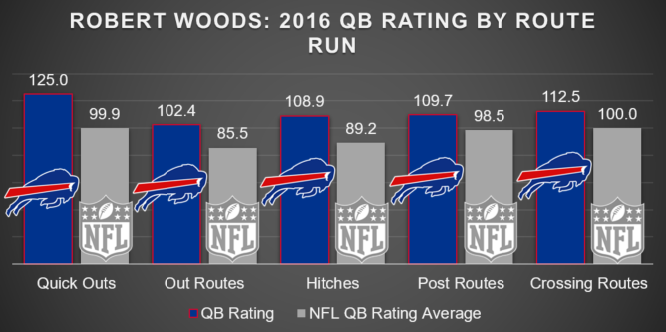 AgamemnonAgamemnonParticipant
link: http://www.nepatriotsdraft.com/2012/08/robert-woods-scouting-report.html
Robert Woods Scouting Report
Robert Woods 2013 NFL Draft
QB / RB / WR / TE / OT / OG / OC / DT / DE / OLB / ILB / CB / SAF
Prospect: Robert Woods, WR, USC
Height: 6’1″
Weight: 190
Grade: 7.6 (Grading Scale)Scouting Report:
Athleticism
+Above average speed. Runs in the 4.4s, but has been hampered by ankle injury. Shows the straight line speed to run by most CBs
+ All-State Track Star in HS – Ran a 21.01 200m and a 46.17 400m, both of which were top times in the state
+ Athletic frame with good muslce tone in the upper body
+ Possesses a 6’1″ frame with long arms and big hands, with very good leaping ability
+ Exhibits explosive burst off the line, can accelerate quickly reaching top speed after a couple strides
+ Is faster than quick, but displays good change of direction ability.
+ Often catches the ball going one way, but can stop change direction and get back up to speed quickly
+ Elusive in the open field, has had multiple touchdowns with 20+ YAC
+ Has a second gear, when it clicks in he separates easily and can run by “off” defenders and the deep safety
+ One of the best athletes in college football, will test well at the combine
– Woods weight has been reported anywhere from 185-190 pounds, he needs to add muscle and strength
– Not afraid to give out and take contact, leaves himself exposed to much and vulnerable to big hitHands/Catching
+ Has some of the best hands in America
+ Large soft hands, watches the ball in and does a good job at maintaining focus and adjusting to the ball
+ Makes the tough catches look easy, will go after every ball and put his body on the line
+ Catches the ball well in tight spaces, will go over the middle and lay out
+ Presents large catching target due to leaping ability and ability to go get it
+ Knows how to use his body to shield the defender from the ball
+ Will drift toward sideline to create separation on deep sideline/fade routes
– Has an occasional concentration drop, which he needs to clean up
– Sometimes he leaps or leaves his feet when it’s not necessary while the ball is being deliverRoute Running
+ Stong route runner, crisp clean breaks, explosive when running double moves
+ Doesn’t lose speed when coming in and out of breaks
+ Creates separation with long strides and sudden, quick breaks
+ Accelerates at the top of his routes and is fluid in change of direction
+ Well developed route tree, USC moves him all across the formation, including slot
+ Is lethel when running fade routes and red zone combinations
+ Does a good job of maintaining control and balance of his body and never looks out of control
+ Works back to the ball and keeps moving when the play breaks down
+ Is utilized in the short passing game a lot – quick passes, 3 step slants, bubble screens.\
+ Can make things happen after the catch
+ Possession type WR, but also has the ability to be a home run threat
+ When running vertical routes, Woods attacks the DB
+ Woods does a very good job of stemming his routes and getting position on the DB
+ Beats press coverage at the line with quickness and elusiveness
– Can and will struggle against stronger and more physical cornerbacks who can get their hands on him quickly
– He can clean up some of the unnessary shake and jukes while running routes and try to make each route look the sameIntelligence
+ Recognizes and understands different coverages
+ Finds soft spots in zone and works his way open
+ Has a great rapport with QB Matt Barkley, can adjust and break off a route based on coverages
+ Knows what the down and situation is and has shown good “in game” situational awarenessLeadership
+ Is an extreme competitor
+ Very tough on himself and thinks he should make each play
+ If he drops the ball or doesn’t make a play he can be seen yelling at himself
– Bitterly threw his USC coaching staff under the bus while declaring for draftBlocking
+ Shows a willingness to block, but lacks technique and form
– Needs to add some strength to his frameOverview:
Robert Woods is one of the best NFL prospects in college football. He is a well rounded and explosive wide receiving talent. On one play he could stretch the field over the top for a 60 yard touchdown. On the next play he can run a three yard slant over the middle and convert a first down. He is a player that has a polished route tree and understands how to get open. He is exciting with the ball in his hand and he can turn a five yard bubble screen into a 50 yard gain. Woods will leave it all out on the field, selling out his body to make a play. He excels in the red zone where he uses his close quarters explosiveness to get open. Woods will give the team everything he has and has high expectations for himself. He is the type of player who wants the ball in the biggest situations and knows how to make the big play.
Scouting Notesvs Notre Dame
He is able to get in and out of breaks so quickly, and always has a crispness to them. No rounding them off here. He has the ability to play every receiver spot on the field and USC uses him that way. Whether he lines up as the X, Y, slot, boundary, or field WR he produces. AgamemnonMay 24, 2017 at 11:42 pm in reply to: Donald not at OTAs…now morphed into, do you pay Donald & how much thread #69275AgamemnonParticipantI read that Donald is asking $125M over 6 yrs., with $70M guaranteed.
There’s a fear that they might have to cut someone in 2017 cause of this deal. I don’t see it. They could convert his 2017 money into a signing bonus and then park a huge guaranteed roster bonus in 2018. That is, as long as they have 2018 cap space (which of course they do) then they can leave 2017 relatively alone.
As I see it, the deal is “How do you want to model your Salary Cap?”. I prefer the “Keep your very best players if you get value.”. Value is subjective. They can certainly manipulate the salary, as you suggest. That is why I think the guaranteed money will be spread over 3 years. I think they prefer yearly roster bonuses to a signing bonus, although they might use both methods. And just guaranteeing the base salary for a number of years.
They still need to find 6 or 7 million for operating expenses for 2017. I would cut, if I could, Trumaine Johnson. I think his contract sux.
But, they can work the Salary Cap and fit it all in or just make a judgement on how they want to structure their Cap Model going forward. I don’t see it as a big deal.Ogletree is on the books for 8.4 million this year. They could extend him and work his figure to help the Cap for this year. Cut Harkey for minor savings. Convert Barron’s base salary of 5 million. They might be able to convert some salary to incentives? I am not sure that works, but maybe they can? I think they could do more, but I would not recommend it.&
I think they’ll give him a sizable signing bonus paid up front but prorated through the contract.
His cap hit is already only around 3 mil this year..he could end up taking home 20 mil this year but only cost around 6 mil…that would only be 3 mil of cap space they have to come up WITH.
I really don’t see it being a problem fitting it in….I think they may be having more of a hard time figuring out the guaranteed money at this point.
The Rams have been pretty stead fast with front loading all their contracts so they have an out around 3-4 years…I don’t see that trend ending now.
This is an extension, not a new contract. In fact, it is an unusual 2 year extension. That means the typical front loading won’t/can’t occur. Although they will still try to give themselves the earliest out possible. That is why you are seeing more and more roster bonuses as opposed to signing bonuses. imo
Also, signing bonuses are typically paid out in full at the front end of the contract. Teams would rather not do that. They prefer to spread it out. Andy benoit has some good stuff in various podcasts about how contracts are seen and negotiated. AgamemnonAgamemnonParticipantIn the audio, they talk about Quinn at about 16:30.
AgamemnonAgamemnonParticipantData reveals Ted Thompson’s draft success
Packers GM has documented record of success
Ryan Wood , USA TODAY NETWORK-Wisconsin
A month before the 2013 season, Green Bay Packers general manager Ted Thompson was in trouble. He needed someone to protect his quarterback’s blind side.
Bryan Bulaga, a former first-round pick, was poised to safeguard Aaron Rodgers. But Bulaga tore his ACL during the Packers’ Family Night scrimmage. One week into training camp, his season was done.
Thompson turned to David Bakhtiari, a rookie drafted in the fourth round three months earlier. Before the draft, analysts predicted Bakhtiari eventually would move inside to guard. Now he was an MVP quarterback’s most important blocker.
Franchise left tackles never are expected to be found in the fourth round. Bakhtiari has started all 32 games in his career, 35 counting playoffs. At a premier position, where salaries soar past $10 million, the man protecting Rodgers’ back is the NFL’s 83rd-highest paid offensive tackle.
It’s the kind of draft magic Thompson routinely conjures. Need a running back? Trade back into the second round, take Eddie Lacy. Out of options at inside linebacker? Insert Sam Barrington, a former seventh-rounder.
Since 2005, Thompson has built the Packers’ infrastructure through the NFL draft. He’s gained respect across the league, former Cleveland Browns general manager Phil Savage said, for his ability to find gems who competitors overlook.
“I think of all 32 teams,” Savage said, “they’re the ones that are the most devoted to the NFL draft.”
A request to speak with Thompson about his draft production was met with swift skepticism from a team spokesman, then declined. Thompson and Packers coach Mike McCarthy regard draft data as internal, strategic information, the spokesman said.
An imprint of Thompson’s draft success is available. It just takes some digging. In more than 50 research hours, Press-Gazette Media gauged 33 draft data categories for all 32 NFL teams. The data covers total games and starts from drafted players, snap counts from each of their first four seasons, retention of draft picks, their transition to starting roles and much more.
The study includes every drafted player since 2005, when Thompson opened his tenure by selecting Rodgers. It reveals Thompson as the NFL’s standard for building a roster through the draft, helping the Packers maintain success on the field and a sturdy salary cap structure.
‘Stellar’ draft management
Each year, the NFL draft promises 32 teams the closest thing possible to an equal playing field.
Players don’t get to choose which NFL city they’ll call home; they’re picked. Teams don’t stress over cap space; each player is handed a slotted salary. There is no negotiating. On the clock, a general manager simply must choose which player fits his team best.
“After the CBA change,” Savage said, “the draft is an attractive option for every team because you can draft good players at lower prices.”
Thompson has consistently maximized the draft’s impact.
He’s a volume shooter, ruthlessly hording an arsenal of picks. Thompson made more than 30 draft-day trades over the past decade, at least one every year except 2014. Those trades netted 10 extra picks, significant considering a draft has seven rounds.
Thompson doesn’t necessarily show more patience with his drafted players compared to the rest of the league, but his extra picks give him more chances to succeed. Thompson has drafted 104 players since 2005, more than any team. The Packers lead the NFL with 1,860 starts and 3,267 games played from drafted players.
They have 119 more starts and 106 more games played by drafted players than any NFL team.
From left, Green Bay Packers general manager Ted Thompson,“Stellar,” was how longtime NFL executive Bill Polian described Thompson’s draft record. “He’s outstanding, and he’s outstanding not only in terms of judging talent, but of managing the draft. Those are two completely different things.”
Even the best talent evaluators fail almost as often as they succeed. It’s inevitable to miss on draft picks, Polian said. Teams limit the damage with good draft management, ensuring they get production from their picks.
“Draft management is something that people simply do not focus on,” Polian said. “Nobody understands it — nobody understands it exists — because all we talk about in the media is, ‘This guy is an absolute first-rounder, and this guy belongs in the second round, and this guy is a third-rounder, and you can’t possibly draft Russell Wilson any higher than this round, and blah, blah, blah.’ That’s not true at all.”
Polian and former Packers GM Ron Wolf will become the first executives inducted into the Pro Football Hall of Fame next month. In more than three decades, Polian built the Super Bowl-champion Indianapolis Colts and four-time AFC-champion Buffalo Bills. Over time, he said, his front office developed measurements to track draft production.
The most successful NFL teams get significant contributions from roughly 58 percent of drafted players, Polian said. Struggling teams have a “hit rate” of 50 percent or below.
It’s impossible to know where the Packers’ internal data places them on that scale. Polian said the “hit rate” was simple, but arbitrary. Each team measures differently, but they follow the same concept. If a player helps the team win in any capacity, Polian said, they’re a successful draft pick.
“If you hit on five,” Polian said, “you’ve had a phenomenal draft whether you’re the Packers or you’re us. Those are the teams that are traditionally strong drafting teams, to hit on five.”
‘Keep your own players’
With long NFL careers being the exception, rosters are a revolving door. Free agency and the salary cap keep players coming and going. A general manager is tasked with retaining the right players and growing them in the system.
“You want to draft a guy, develop a guy and have that guy replace the declining vet,” Pittsburgh Steelers GM Kevin Colbert said. “You’re probably not going to replace the vet as long as he’s still performing at a functional level, but if he’s starting to decline, you want to keep the cycle working where you’ve got the replacements right there. They can step in, and then you’re hopefully drafting the next one.”
Among teams with the 10 best winning percentages since 2005, six rank in the top 10 of drafted players retained four full seasons. The five teams retaining the fewest draftees rank among the league’s 10 worst winning percentages.
In the past decade, 38.9 percent of the league’s drafted players stayed with their original team four seasons. Only two teams — the New York Giants and San Diego Chargers — retained more than half their draft picks that long.
In seven years of applicable data — between 2005 and 2011 — the Packers kept 32 drafted players four seasons (42.1 percent), second to the Tennessee Titans (35 players). They have 739 games played by drafted players after their first four seasons, second to the San Francisco 49ers (755).
From left, Green Bay Packers general manager Ted ThompsonThompson maintains a young roster, but not too young. The Packers got 18,839 fourth-year snaps from drafted players, according to Pro Football Focus. Only the Titans (19,110) got more.
Which means the Packers not only have more players experienced in pro football, but also specialized in their system.
“I think the draft is more unique to our game,” Colbert said, “because you have to have 11 guys on each side of the ball that can play cohesively. It’s not like other sports where maybe they’re not as much systematically driven, and you can sign a free agent, plug them in. You can probably sign players from other teams in free agency and plug them in a lot easier in the other three major sports more so than football.”
Wolf, more than Thompson, had a reputation for dipping into free agency.
The Packers made waves around the league when Wolf signed defensive end Reggie White in 1993. Wolf also added center Frank Winters, defensive end Sean Jones and return specialist/Super Bowl XXXI MVP Desmond Howard through free agency, and traded a first-round pick for quarterback Brett Favre.
Thompson has made a free-agency splash or two. He signed cornerback Charles Woodson in 2006, and outside linebacker Julius Peppers last offseason, but Wolf was more active on the open market. That doesn’t mean he disagrees with Thompson’s extreme draft approach.
“In the long run,” Wolf said, “it’s better to keep your own players. So I guess you could say that, in my opinion, it’s better to build through the draft. When I was here, I used trades and the waiver wire quite a bit. Once we kind of got it settled, we did everything in our power to keep our own.”
Rookies need ‘incubation time’
Savage and Thompson became general managers the same year, but they entered very different situations.
Starting with Wolf in 1992, the Packers have been a model of continuity. They’ve had three general managers in the past 23 years. In the same time, the Browns have had nine.
Thompson had a better opportunity to succeed, Savage said, because the pieces he inherited fit the same football philosophy. Savage did not have that luxury. When he took over the Browns, Savage said, personnel was fragmented into the remnants of old systems.
“That’s probably the biggest issue for the Browns over the years,” he said. “There’s never a stick-to-itiveness for any regime longer than a few years. With all the changing of coaches and personnel staffs, everybody has a vision of the world and what they think can make them successful. You end up with bits and pieces of different regimes, and people see the game one way, somebody else sees it another way. It really was very confusing and difficult to get everyone rowing in the same direction.”
Savage said losing teams follow a circular trend.
A new front office replaces the outgoing staff. With thin patience in today’s NFL, the pressure to turn around a franchise starts immediately. Teams with poor records pick high in the draft. Those players are expected to contribute as rookies, often before they’re ready. With underdeveloped players filling big roles, Savage said, teams keep losing.
The seven teams with the most rookie snaps since 2007 — the first year data is available — rank among the league’s 10 worst winning percentages. Winning teams, Savage said, are able to have more patience developing their draft players. That’s what he sees in Green Bay.
Green Bay Packers general manager Ted Thompson (left)The Packers lead the NFL with 844 games played by rookies, but they usually occupy minor roles. Green Bay ranks near the league’s middle with 16,045 rookie snaps, and its 14 rookies crossing the 400-snap mark are tied for 11th fewest. The Packers had only 10 rookies crossing the 400-snap mark before last season.
“The guys coming in from college to the NFL, they need some incubation time,” Savage said. “I think your hope is that opening day you’re going to get special teams contributions, and maybe a certain role in subpackages. Like for a defensive back, or a cover linebacker, or a slot receiver, or some kind of running back situation.”
The Steelers kept 25 drafted players four seasons, tied for 14th in the league. They don’t excel at retention, but Colbert found another way to ensure experienced players are on the field.
No team has been more frugal distributing snaps to first-year players. The Steelers had 10 rookies cross the 400-snap mark since 2005, tied for fewest in the league. Their 161 rookie starts and 9,615 rookie snaps are second-fewest in the NFL.
“I believe it’s always going to be beneficial the longer you can delay that,” Colbert said. “Not to a point where you find out about a guy in his fourth year, when he’s going to be a free agent. It’s too late because you probably want to sign him the year before. But the longer you can wait, the longer you can delay their play, I think the better a player’s chances for long-term success.”
Drafting with a franchise QB
Draft picks are Thompson’s currency, but they don’t necessarily buy rings.
In the past decade, no team had fewer picks than the New Orleans Saints (69), but that didn’t prevent them from winning Super Bowl XLIV. The Giants have won two Super Bowls since 2005 despite only 77 draft picks, fourth fewest in the league.
A franchise quarterback is the one requisite for any Super Bowl contender. For the Saints and Giants, it’s Drew Brees and Eli Manning. For the Packers, it’s Rodgers.
“It’s pretty simple,” Wolf said. “If you don’t have a quarterback, then you don’t have a chance. If you have a quarterback, you have a chance.”
At market value, a quarterback consumes the largest chunk of a team’s salary cap. Polian said a good GM knows how to maximize the remaining cap, surrounding the quarterback with a quality supporting cast.
After the quarterback, Polian said, teams maintain their core with roughly 12 players averaging $6 million against the cap. The remaining members of a team’s 53-man roster play at veteran-minimum salaries, one-year deals or rookie contracts, he said.
.
Rodgers, a two-time MVP, will have the Packers’ highest cap hit at $18.25 million next season. The next 12 players — from outside linebacker Clay Matthews to defensive tackle Letroy Guion — average $6.3 million against the cap. The rest of the Packers’ projected 53-man roster either play under rookie contracts or are entering the final year of their deal.13 players = 65% of the Cap. The QB = 12.7% of the Cap. This is for the 2015 season. This fits near the maximum of players within 65% of the cap. Seattle goes the other way, 8 or 9 players for 60 % of the Cap. This can vary year to year.Teams need more than 13 players to contribute, of course. Which only increases the draft’s importance. Colbert said he divides the draft into segments. Expectations change with the round.
“You want to hit on all of them,” Colbert said, “but (rounds) one, two and three are critical. Because if you miss on one, two or three, you’re probably going to have some salary cap problems down the road, because you’re going to have to sign some free agents to make up for it. Then rounds four and five, if you can get some backups out of that, that’s great. Six and seven, you’re usually either getting a special-teamer or practice-squad guys.”
Before Savage came to the Browns, he was a high-ranking executive with the Baltimore Ravens. He said the goal was to find three starters in every draft. Colbert said the chances of drafting a starter diminish with each round. The Steelers studied the breakdown of Pro Bowl rosters, he said, and roughly 70 percent of those players are drafted in the first three rounds.
Thompson breaks from the norm, finding starters at all levels of the draft. The Packers rank second in the league with 25 draft picks starting more than eight games in two years. They’ve had 10 two-year starters drafted later than the first three rounds.
Bakhtiari is just one example on the Packers’ offensive line. Its foundation is the guard tandem of Josh Sitton and T.J. Lang, a pair of fourth-round picks. Next season, center Corey Linsley will likely become the next two-year starter drafted after the first three rounds. He started all 16 games as a rookie last fall after being drafted in the fifth round.
“Because of the salary cap,” former Dallas Cowboys vice president of player personnel Gil Brandt said, “you have to be able to get players in the fifth round, sixth round, seventh round to come in and play for you. That’s why Green Bay has done a good job of drafting. They’ve got some of those players.”
If a team “hits” five draft picks, Polian said, it’s likely two will become part of their core dozen. The rest are usually lost in free agency, or rookies replace them.
Wolf said free agency is a “shame” now. Teams lose a third of the roster every year, he said, and only get seven rounds in the draft. He thinks there should be more.
That’s unlikely to happen, but here’s something you know about Thompson — he’d be quite fine with extra picks.
“Obviously,” Wolf said, “he’s comfortable with doing it that way. He’s had an awful lot of success. He’s very good. I think all you have to do is see the career he’s had. He left here and went to Seattle to build a team that went to the Super Bowl. He comes back here, and he’s had a team that’s won the Super Bowl. If you just look at what he did the last 10 years, I’d say it’s exceptional.”
There are a lot of good nuggets of information in this article.
-
This reply was modified 8 years, 9 months ago by
 Agamemnon.
AgamemnonMay 24, 2017 at 6:29 pm in reply to: Donald not at OTAs…now morphed into, do you pay Donald & how much thread #69251AgamemnonParticipantI read that Donald is asking $125M over 6 yrs., with $70M guaranteed.
There’s a fear that they might have to cut someone in 2017 cause of this deal. I don’t see it. They could convert his 2017 money into a signing bonus and then park a huge guaranteed roster bonus in 2018. That is, as long as they have 2018 cap space (which of course they do) then they can leave 2017 relatively alone.
As I see it, the deal is “How do you want to model your Salary Cap?”. I prefer the “Keep your very best players if you get value.”. Value is subjective. They can certainly manipulate the salary, as you suggest. That is why I think the guaranteed money will be spread over 3 years. I think they prefer yearly roster bonuses to a signing bonus, although they might use both methods. And just guaranteeing the base salary for a number of years.
They still need to find 6 or 7 million for operating expenses for 2017. I would cut, if I could, Trumaine Johnson. I think his contract sux.
But, they can work the Salary Cap and fit it all in or just make a judgement on how they want to structure their Cap Model going forward. I don’t see it as a big deal.Ogletree is on the books for 8.4 million this year. They could extend him and work his figure to help the Cap for this year. Cut Harkey for minor savings. Convert Barron’s base salary of 5 million. They might be able to convert some salary to incentives? I am not sure that works, but maybe they can? I think they could do more, but I would not recommend it.
AgamemnonMay 24, 2017 at 4:15 pm in reply to: Donald not at OTAs…now morphed into, do you pay Donald & how much thread #69248AgamemnonParticipantI read that Donald is asking $125M over 6 yrs., with $70M guaranteed.
I am ok with the $125M for 6 years. $70M guaranteed is too high. imo
But, not all guaranteed money is equal. What an agent brags about is not always what is an absolute guarantee.
What an agent asks for is not what he will settle for. imo
I see no problems at this time. AgamemnonMay 24, 2017 at 9:46 am in reply to: Goff's ninth game? articles on Goff in OTAs & mini-camp & up to training camp #69232AgamemnonParticipantIt is not just rookie QBs. It is anybody, anytime that adds something new to his game. First you have to learn the new technique, then you have integrate that into your game in real time under stress conditions. It is always beneficial to learn new stuff, but until you can use it without thinking, you will take a hit on performance. Coming from an Air Raid Offense and only 3 years of that, Goff has quite a bit to learn. Palmer is right on mark. Brother of Carson Palmer. btw, he was Mannion’s coach for his proday. Mannion comes from 4 years of a pro system, coached by an ex pro coach. That doesn’t prove one guy is better than the other, but one has a big head start.
Here is Palmer in video. I do like Goff, I just like Mannion better.
AgamemnonMay 24, 2017 at 2:51 am in reply to: Donald not at OTAs…now morphed into, do you pay Donald & how much thread #69226AgamemnonParticipant
The Rams have 11 players using
62% of the Cap. It should be 65%. Because when I checked they figured it on the total value of all the contracts for 90 players. It would be 65% on a Cap of $167 million.-
This reply was modified 8 years, 9 months ago by Agamemnon.
AgamemnonMay 23, 2017 at 10:05 pm in reply to: Donald not at OTAs…now morphed into, do you pay Donald & how much thread #69222AgamemnonParticipantLast year we did several posts on the Salary Cap, positional spending (franchise tag as % of the Cap), different Salary Cap Models. Some significant details are: the franchise number for DT’s is ~8.0% of the Cap. the highest paid defensive players are DEs @ 10.0% of the Cap, a QB gets ~13.0% of the cap.
The average Salary Cap over the next 6 or 7 years will approach $200M. So, for an average number, we are right at $20M/yr. But, Donald is under contract for $3M this year and $7M next year. The franchise number for 2019 will be about $19M.Donald would like to be paid what he is worth. Let’s say $20M/yr. But, he is under contract to get only $5M/yr for the next 2 years. That would leave him ~$30M dollars short of his value. He can’t make up that money by holding out, at least no the money he will lose this year. In theory Donald can get more money up front and the Rams can get a slightly lower number overall.
Talking about how this affects other players is in fact talking about how your want to structure your Salary Cap. That being how much and how many of your top players you want to fit under the Cap. Which can be 8, 10, 12, or even 14 players for as much as 60 to 64 percent of your cap.
link: http://theramshuddle.com/topic/some-thoughts-on-salary-cap-numbers-qb/
link: http://theramshuddle.com/topic/rams-53-man-roster-projection-includes-five-first-round-picks-on-defensive-line-2/
link: http://theramshuddle.com/topic/one-kind-of-roster-model/That is why I suggested that the guaranteed money should be about $45M for the first 3 years. If it isn’t close to that, then I think we should try to trade him.
Let’s project a $200M Salary Cap. With $120M used for the 8-14 premium players. Subtract 20M for Donald, 26M for a QB, that leaves 74M for the rest of the premium players. Maybe 7 more players at 10-11M/yr. That is the kind of Cap Model* Seattle runs.
The gross money for Donald’s contract has probably already been figured. They are probably working out how and how much the guaranteed money will be structured. imo
-
This reply was modified 8 years, 9 months ago by Agamemnon.
AgamemnonAgamemnonParticipantGerald Everett – better version of Kendricks
Cooper Kupp – solid starter
John Johnson – solid starter
Josh Reynolds – solid starter
Samson Ebukam – solid starter
————— any of these guys and any udfas that make the team are a big plus. imo
Tanzel Smart – solid starter or good rotational player
Ejaun Price – Ok starter
Sam Rogers – Harkey replacement
A solid fill in the gaps draft. More of a fit than a talent draft. Still, a better than average draft. A maintain the roster draft of a roster that is already good.I don’t have a favorite player. Well, maybe Kupp. Nah, it has got to be Mannion. 😉
AgamemnonAgamemnonParticipant Agamemnon -
This reply was modified 8 years, 9 months ago by
-
AuthorPosts