
Forum Replies Created
-
AuthorPosts
-
 AgamemnonParticipant
Posted: Jul 7, 2016
OTA Wired: Passing Coordinator Mike Groh
Follow passing coordinator and wide receiver coach Mike Groh as he is mic’d up for the sounds of Rams organized team activities. AgamemnonJuly 9, 2016 at 1:18 pm in reply to: Clayton about the QB battle shaping up for camp – Podcast #48326AgamemnonParticipant
North Carolina Tar Heels Defense' Report Card
The North Carolina Tar Heels defense was nothing short of impressive in 2009. The same and more will be expected of them in 2010. Here is a look at how good this defense is with a spring report card.
Defensive Line A
The best talent and overall depth can be found on the defensive line, even after losing Cam Thomas and Aleric Mullins.
Quinton Coples, Marvin Austin, Tydreke Powell and Robert Quinn are the clear front-runners to start.
Quinn, Coples, Thomas were all Tar Heels in 2009. I don’t know if they were on the field at the same time.
AgamemnonAgamemnonParticipantAgamemnonParticipant AgamemnonAgamemnonParticipant
tucking ball away,
I thought we did away with the tuck rule? Is this the evil scientists at CERN rewriting history?
AgamemnonAgamemnonParticipantWe used to know what a catch was, what a fumble was. Who, invented the tuck rule? At least it had an expiration date. I blame instant replay. 😉
AgamemnonAgamemnonParticipantI stayed busy with contracts, salary cap, and roster models. But, I think those subjects are about exhausted. I could do cake recipes.
When making a Pound Cake, weight the eggs first, then match the other ingredients to the eggs.
AgamemnonAgamemnonParticipantMo Alexander is among 2016 breakout player candidates
Mo Alexander is among 2016 breakout player candidates
By: Alex Alarcon | June 15, 2016 12:30 am ET
The Rams need an unsung hero to step up and replace Rodney McLeod at free safety.
Maurice Alexander might just be the answer. The third-year safety has developed enough to make Sports Illustrated’s list of 10 players fans should know about.
SI.com writer Chris Burke sees Alexander as the perfect replacement for Mark Barron, who shifted to linebacker full-time:
Mark Barron no longer need be discussed as a safety/linebacker hybrid. He is a linebacker, period. Alexander is the player on this Rams roster who could become what Barron once was. In fact, Alexander was a linebacker before converting to safety during his college days.
That’s exactly the kind of player head coach Jeff Fisher wanted when he added the Utah State product to his first Rams draft class. With his coverage skills matching his tackling skills, Fisher told Burke that Alexander is a “huge upside” candidate.
The team might ultimately choose to tab a veteran free-agent for the role. But they’re looking at young players for now, and Burke believes they’ll find a role for a versatile player like Alexander.
Add in Los Angeles’ usage of three-safety looks and it’s clear why Alexander’s versatility could appeal to the coaching staff. He could slot in as a starter next to incumbent starter T.J. McDonald; he could walk down in the box as an extra linebacker; he even could slide out and play coverage as a corner.
Alexander has played in 22 games with the Rams in two years, totaling 43 combined tackles, two sacks and one forced fumble. If Burke is right, Alexander could double that output in 2016.
AgamemnonAgamemnonParticipantWilliams OTA Press Conference – 6/10
Defensive coordinator Gregg Williams discusses his defense in Year 3 with the Rams and the changes at linebacker.Joiner looked good at CB. Williams said this defense is fast. Williams seemed to like alexander and hager.
AgamemnonAgamemnonParticipantI hope they get their problems fixed. A lot of good poster over there.
AgamemnonAgamemnonParticipant
Rams w/o Foles
top = 12 for 57.0% => 4.8%
mid = 18 for 28.7% => 1.6%
bot = 23 for 10.3% => 0.4%
cap = 4.0% AgamemnonJuly 7, 2016 at 9:46 am in reply to: More of Brandt – Podcasts: salary cap, contracts, franchise tage. updated 8/3 #48147AgamemnonParticipantAndrew Brandt talks about NFL vs. NBA and guaranteed contracts in the NFL
AgamemnonJuly 6, 2016 at 8:54 am in reply to: How the Seahawks revolutionary cap management transformed the le #48048AgamemnonParticipantI will be adding this to the model salary cap thread later.
AgamemnonAgamemnonParticipanthttp://www.thefootballeducator.com/build-an-nfl-roster-using-jack-welch%E2%80%99s-20-70-10-approach/
Build an NFL roster using Jack Welch’s 20-70-10 approach
It’s important to note the GM’s role keeping the big picture in focus when building an NFL roster. There are numerous avenues & angles to take when adding talent to your club; reserve futures, the draft, undrafted free agents, unrestricted free agents, trades. Like a master chef, the right combination of ingredients can bring success in the kitchen, for a GM – success on the football field.
The “Business” of Football
After reading former General Electric CEO Jack Welch’s Straight From The Gut, it appeared to me that there might a good recipe here with which to assemble a professional football team from the “big picture” aspect – the 20-70-10 approach.
Described on Welch’s official website, 20-70-10 or “Differentiation” is;
Very simply, …. based on the principle that the team with the best players wins.
So in a nut shell, Welch encouraged GE’s businesses to identify and categorize their senior executives into one of three distinct categories.
A (the top 20%) the Producers
B (the middle 70%) those Vital to group as they make up the majority
C (the bottome 10%) the Non ProducersWelch surmised your top 20% (A players) were the “best of the best” and all resources/top compensation should be thrown their way. The middle 70% (B players) were a vital part of operations, the core of your workforce. You should continue to motivate and train your B’s to eventually move into the A category and push other B’s down a level. The bottom 10% (C players) should be immediately replaced. Some call it the “rank and yank” method.
Relating it to Roster Building
.
For football purposes the “ranking” evaluation MUST be based entirely upon ability & production as evaluated by your personnel staff(coaches/scouts), then handed over to salary cap administrators for proper contract structuring and negotiation via market values (not the other way around).
.
A 53 man roster (in theory) should be made up with your top 10 to 11 players as the very best compensated. A club should lean hard on self-evaluation to ensure that the best stay in the top for a long while. It’s a burden on the club to drop out of the A (20%) category if a player is not performing (due to contract structuring and CAP hit). Not many alternatives are left other than to force a reduction or cut the player before he ever drops to the C level.Level B (70%), or approximately 35 players, should (in theory) have true potential to move into your A range. These players are nurtured and coached hard to maximize next level opportunity. They should be identified for future extensions & compensation, but GM’s might want to even break this group into 1/3’s.
1/3 – Your top players ready to be extended into the A range. (the core of youth of your team)
2/3 – Journeyman players, roll players, special teams contributors
3/3 – Young developmental types, vets knowingly in their final year or falling in production.The last level (C) should be targeted (5) players a club tries to replace throughout the season with street FA’s, practice squad raids & recently released players from other clubs. These players are the bottom performers as evaluated by Player Personnel. (In theory) They are lower salaried, but could be paid higher and out of their market value range as well. Hard decisions must be made to release and take the CAP hit, or restructure the contract down. Get these guys out at the end, replace them with better players when they become available.
To help rank players a club might want to require having coaches sort the squad from 1 to 53. Then have the defense rank the offense and vice versa (based on talent and not emotion). Finally, have the scouting staff do the same. An alternative could be to use an outside source for categorizing your roster.
*Note – Key must be to differentiate based on performance and ability and not just $’s being paid. Low $ players could be A level and deserving of a raise. C level players could be grossly overpaid and in need of restructure or cut.
It’s not the perfect recipe, but certainly a good menu with which to start.
AgamemnonAgamemnonParticipantThe Blueprint to Building a Successful NFL Franchise in the Salary Cap Era
The Blueprint to Building a Successful NFL Franchise in the Salary Cap Era
By Ty Schalter , NFL National Lead Writer Oct 25, 2013Building a winning NFL team isn’t like any other construction project.
NFL executives have a budget, a crew, equipment and raw materials—but the wrecking balls start swinging the instant they’re done; all they can do is hope more of their building survives 17 weeks of destruction than any of the other 31 buildings on the same block.
A year after they started, they salvage what they can from the wreckage and start all over again.
In today’s NFL, the salary cap is stubbornly flat, making budgets tight around the league. There’s only so much cap money to go around, and the average annual value of big-money contracts seems to go up with each new contract extension.
NFL executives can’t just try to get good players at every spot on the roster; market prices and the salary cap force them to approach roster-building with a clear philosophy. Which positions will be strengths? Which positions will have depth? If any positions have strength and depth, where will they skimp?
Surveying today’s NFL landscape, is there an ideal roster-building philosophy? Go big on a quarterback? Build a smothering defense? Hoard dominant playmakers?
Is there a way to invest your team’s resources that will give you an advantage over everyone else?
Offense vs. Defense vs. Both
The first question to answer is whether it’s best to invest more heavily in offense, defense or strive to be balanced.
Obviously, if we’re waving magic wands, it’s best to have a great offense and a great defense, but we’re not waving magic wands—we’re writing checks. Let’s take a look at the 2012 playoff teams and see how they built their mousetraps.
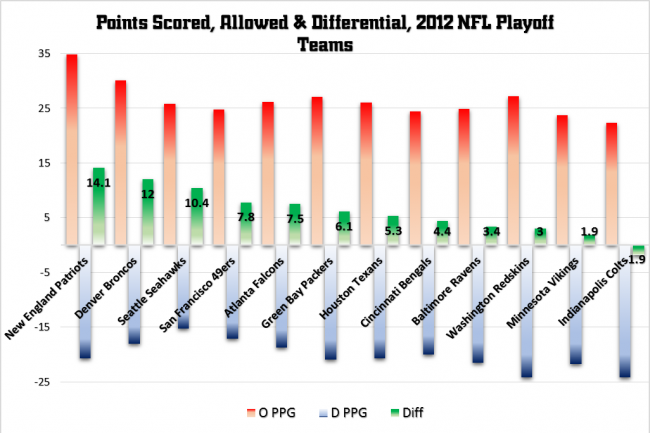
The surest sign of strength in the NFL is points differential: The total points a team’s offense has scored, minus the total points its defense has allowed. In 2012, 11 of the 12 playoff teams were among the top 13 teams in points differential.
Only the No. 6 Chicago Bears and No. 9 New York Giants finished in the top 13 in points differential and missed out on the playoffs; only the No. 21 Indianapolis Colts were outside of the top 13 and made the postseason.
Organized from left to right, we see the Patriots with the NFL’s highest-scoring offense and No. 9 scoring defense. Not surprisingly, they had the NFL’s best scoring differential. Second best in scoring differential were the Denver Broncos, who had the No. 2 offense and No. 4 defense.
Then the pendulum swings back toward defense, with the Seahawks, 49ers and Falcons finishing third through fifth in scoring differential. Those three teams all had top-five scoring defenses, but they finished ninth, 11th and seventh in scoring offense, respectively.
The Washington Redskins were an interesting case. They finished with the No. 4 scoring offense at 27.2 points per game, but 22nd in scoring defense, allowing 24.2 points per game. The 49ers had the highest disparity the other way, with the No. 2 defense and No. 11 offense.
Outside of the Redskins defense and both units from the Minnesota Vikings and Indianapolis Colts, every playoff team’s offense and defense finished in the top 12 of the league. Here’s the table feeding that chart.

Pro Football Reference
Unfortunately for NFL executives, it looks like the answer is “both.” Even teams with exceptional offenses or defenses are at a big disadvantage if the other unit isn’t at least above average.
How Do You Get Both?
There’s only $123 million in cap money to spend. If you want a top-10 quarterback, that’s going to eat up $15 to $20 million right off the top, per Spotrac.com.
Leaving $103 million for the rest of the pot sounds like plenty, but signing one player to a $20 million contract drops the average salary available per roster spot from $2.32 million to $1.98 million. That’s a $340,000 gap across 52 roster spots in a league where the minimum rookie salary is $405,000.
Many fans love the idea of forgoing the big quarterback and spending that money bolstering the running game and defense. When the 2000 Baltimore Ravens won a Super Bowl with unheralded quarterback Trent Dilfer at the helm, they proved this model could work.
The problem: In order to pull that off, the Ravens didn’t only need one of the best scoring defenses of all time, allowing just 10.3 points per game, they also needed a top-five running game to muster a scoring offense that ranked 14th in the NFL.
In order to make up for the drag a replacement-level quarterback puts on a team, the rest of the team has to be truly exceptional.
The quarterback market is extremely efficient. As this chart shows, only Joe Flacco’s monster deal (born of a negotiation where he had unprecedented leverage) and Tom Brady’s intentional discount vary from a tight correlation between performance and pay.
There’s a reason teams are spending so much on top quarterbacks; they do wonders for the rest of the team. Avoiding interceptions is the biggest part of maximizing a team’s turnover margin, and turnover margin is a huge driver of success, on both sides of the ball. Offenses that avoid turning it over turn more drives into points, and defenses that take the ball away stop other teams from scoring.
Just look at the correlation between points differential and turnover differential.
For those of you who aren’t stats geeks, that R-squared value is what’s called the “coefficient of determination,” and it goes from zero (a quarterback’s thrown interceptions have no effect on point differential) to one (thrown interceptions are the sole factor in determining point differential).
An R-squared of 0.4683 is a very, very strong correlation, and it’s about twice as strong as the still-significant R-squared of defensive interceptions to point differential (0.2354).
Fumbles are part of turnovers too, but it’s well established that fumble recovery rates are all but completely random, and forced fumbles not much less so. Football Outsiders even publishes an annual summary of fumble luck and highlights extremely unlucky and lucky teams due for a regression to the mean.
Investing money in defense hoping to snag more turnovers won’t bear as much win-loss fruit as investing money in a quarterback who’ll make plays without turning the ball over much.
Protecting Your Investment?
Let’s say you have your franchise quarterback. (In which case, congratulations! He’ll make you look smart for as long as your checks clear.) Is it better to maximize his performance by protecting him with quality pass-blocking or surrounding him with weapons?
It’s awfully hard to isolate quality quarterback play from quality receiver play. It’s also hard to isolate quality quarterback play from quality offensive line play. Pro Football Focus team offense stats (subscription required) can get us close, though.
Let’s regress 2012’s team-adjusted net yards per attempt (a great one-number passing effectiveness stat that incorporates touchdowns, sacks and interceptions) against Pro Football Focus team “Pass” grades (incorporating the play of the quarterback and all pass-catchers).
As with the correlation between thrown interceptions and point differential, we see a huge coefficient of determination: 0.4775. If you have good quarterback play and receivers who get open and make plays, you will move the ball effectively, with more touchdowns and fewer interceptions.
Not exactly rocket science, but it confirms that PFF’s subjective grading system correlates strongly with statistical reality.
Now let’s look at the same adjusted net yards per attempt, this time regressed against PFF’s team pass-block grades.
Again, we have a significant coefficient of determination (0.197), but not nearly as huge as the connection between passing game production and quality quarterback/receiver play.
This makes intuitive sense.
The Carolina Panthers have the fourth-best PFF team pass-block grade (subscription required) so far in 2013, but they aren’t getting great receiver play, and quarterback Cam Newton got off to a slow start. The Detroit Lions are getting surprisingly solid play from their patchwork offensive line—but have invested huge money and draft picks getting Stafford weapons.
Both quarterbacks are former No. 1 overall draft picks of surpassing physical talent a year apart in age, and they are experienced enough to have ironed out any rookie luck, good or bad.
So far this season, though, Newton’s adjusted net yards per attempt is 6.25, ranked 15th in the NFL; Stafford’s is 7.30, ranked seventh.
Moneyball
Of course, the best way to maximize your cap dollars is to get talent at less cost than it’s worth.
Detroit Lions guard Larry Warford keeps quarterback Matthew Stafford clean.
The Lions rolled with depth veterans and rookie Larry Warford at three of the five offensive line spots. Per PFF, they’re getting better pass-blocking (subscription required) than teams like the St. Louis Rams and Chicago Bears, who spent big free-agent money on veteran linemen.
The word “Moneyball” has jumped the shark, according to The Washington Post’s Lydia DePillis.
She may have a point when it comes to folks slapping the word “Moneyball” for any kind of statistical optimization. Its original use still holds water, though: Sports teams can beat their competition by getting worthwhile production from players they didn’t pay free-market price for.
As the Washington Redskins found out between the time owner Dan Snyder bought the team and current general manager Bruce Allen took over, there isn’t a direct correlation between money spent and on-field production.
Follow the Blueprint
The Chiefs are the toast of the town, a worst-to-first revival that’s as unexpected as it is spectacular. How did they do it?
Head coach Andy Reid inherited a stout running game and relentless pass defense, gave up a whole lot (likely two second-round picks) to get a quarterback whose best quality is that he doesn’t throw interceptions, and added veteran pass-catchers like receiver Donnie Avery and tight end Anthony Fasano.
Avery and Fasano haven’t panned out like Reid may have hoped. By refusing to fork over huge money to extend veteran left tackle Branden Albert, though, and drafting rookie Eric Fisher to eventually replace him on the cheap, Reid and the Chiefs are following our statistical blueprint to a “T.”
This refers to their conclusion that it is better to invest in good WRs than the offensive line. You get better YPA. That might not be the best metric, but it does emphasize a point.
It’s hard to argue with the results. AgamemnonAgamemnonParticipant
This is my latest attempt to create a Salary Cap Roster Model. I am looking for an Archetype, the original pattern or model from which all things of the same kind are copied or on which they are based; a model or first form; prototype. Just as I view the Pound Cake as the Archetype cake. This doesn’t mean it has to be the best cake or your favorite, it is just the model from which all cakes are derived.
With the invention of baking powder, the Pound Cake evolved into the Victoria Sponge.


See more victoria sponge recipes …
http://www.bbc.co.uk/food/recipes/mary_berrys_perfect_34317 AgamemnonAgamemnonParticipant
http://www.spotrac.com/nfl/los-angeles-rams/yearly/cap/
Really nice clear look at the Rams future FAs, RFAs, and ERFAs up to year 2020. AgamemnonJuly 5, 2016 at 5:35 am in reply to: 2016 Will Be Important For These Contract-Year Players on Los Angeles Rams #47883AgamemnonParticipantThere isn’t much incentive for Trumaine to sign a deal. He gets $14 million and a big pay day in FA. The Rams would have to give him a big contract with lots of guaranteed money. I am not sure they want to do that before they see what he does this year. If the Rams don’t sign Trumaine, they will have more than enough money for the cap next year. imo
I think the Rams could sign McDonald, but his future seems to be in limbo. How much do they want to gamble on that? $9 million/year? $10 million/year? They could franchise him for one year at about $12 million/year.
Quick? I doubt he is a Ram next year. I find it hard to see how that would happen.
Britt? Maybe for about what he gets this year, $5 million/year.
Brockers? It just depends on how much they value him. A franchise DT would get about $16 million/year for 5 years. They might pay him $8 or $10 million per year. I don’t know. They seem happy to pay him $6 million this year.
We have 7 draft choices next year. They will replace FAs that we let walk or players that we cut. We could look for a DT, CB, S, and a couple WRs in the draft.
What happens to Keenum next year? He is a FA.
I am not sure what the best plan is. The Rams are in good shape with cap space, so nothing that occurs will ruin them. imo
I would get the best value I could for my cap dollars. [best value is a subjective thing.] What talent I might lose, I would have to try to replace in the draft.
AgamemnonAgamemnonParticipantThat would be big if Tavon could be effective as a pure WR, possibly a #1 WR.
AgamemnonAgamemnonParticipanttop tier 12 [your best players. ?over ~6 million] 60% ~93.2M for 2016 [ ? Upper Limit ]
middle tier 12 [the rest of the starters. ?less than ~6 million] 26% ~40.4M for 2016 [ ? Lower Limit ]
bottom tier 36 [includes IR. less than 1 million] 14.0% ~21.7M for 2016 [ Lower Limit ]
.
I will need to check some rosters to see how this stuff fits what is actaully out there. I think the bottom tier is a limit.
All your RFAs and top draft choices[rounds 1 and 2] will be in the middle, at least ?10.
All your top and middle tier players figure to be starters.
.
Players 1 – 12 have an average salary of 7.7M.
Players 13 – 24 have an average salary of 3.37M.
Players 25 – 60 have an average salary of 603k.
.
.
The Rams top 12 at 53.8% = ~83.5 million
The Rams middle 18 at 28.9% = ~44.9 million
The Rams bottom 30 at 13.3% = ~20.7 million
Rams Cap Space = 4.0% = ~6.2 million
Total…………………. 100.0% ………. $155.3
.
The Rams, 10 of 18 are RFAs and top draft choices[rounds 1 and 2] in the middle tier.
.
Players 1 – 12 have an average salary of 7.0M.
Players 13 – 30 have an average salary of 2.5M.
Players 31 – 60 have an average salary of 690k
.
The Rams have plenty of cheap young players.top tier 10-12 [your best players. ?over ~6 million] 72.0% ~111.8M for 2016 [ Upper Limit ]
middle tier 12-14 [the rest of the starters. ?less than ~6 million] 14.0% ~21.7M for 2016 [ Lower Limit ]
12-14 players would make an average of $1.5 million/year.
bottom tier 36 [includes IR. less than 1 million] 14.0% ~21.7M for 2016 [ Lower Limit ]
36 players would make an average of $0.6 million/year. AgamemnonAgamemnonParticipantAll NFL players should be making at least $1 million per year
All NFL players should be making at least $1 million per year
Posted by Mike Florio and Neil Schwartz on March 29, 2016, 10:11 PM EDT[Editor’s note: Agent Neil Schwartz recently approached me with an idea to make veteran players more attractive to teams and, more importantly, to ensure that all NFL players make a very comfortable living. The end result is a column on which Schwartz and I collaborated. Any typos are his fault.]
As the NFL and its players learn more about the realities of playing pro football, it’s more important than ever that all players receive fair compensation for the risks they assume. And by all players, that means every player. Which means that each player should have a minimum salary that reflects the maximum toll the game can take on the human body.
Currently, the league ties minimum salary to experience. For new players, it’s $450,000. For players with 10 or more years of experience, the minimum rises to $985,000. This disparity makes younger players more attractive than older ones, even with the “minimum salary benefit,” a device that provides teams with a salary-cap break on older players with minimum-salary deals, but not a cash break.
When it comes to the 29 positions on the 53-man roster that don’t go to offensive and defensive starters, cheaper is usually better. And younger is always cheaper.
Note* IR is sort of a hidden cost. You need ~7 more minimum wage players to replace players that go on IR. Let’s say 29 + 7 = 36 players on a roster of 53, which is really ~60 players that you have to account for. imo
The gap between young/cheap and old/costly gets partially bridged under the existing labor deal through the performance-based pool, which gives the lowest-paid players more money based on how much they play. Still, that money comes from the league at large; at the team level, going young on the back half of the roster means saving money. Which gives the teams even more leverage when squeezing veteran players to take less.
So why not guarantee every NFL player who is on an active roster more? The floor should be the same for all players, and the best place to start is the number that still exudes “rich.” One million dollars.
Yes, the minimum salary for all players should be the same, regardless of experience. And it should be $1 million dollars for now, with increases based upon the annual increases in the salary cap.
The adjustment will cost the owners nothing, since they’re already operating in a salary-capped environment. It will, as a practical matter, pick the pockets of some the NFL’s richest players, but maybe the league needs a dash of Robin Hood in order to ensure that all players are able to exit the sport with enough money to have made it worth their while.
As a practical matter, non-superstars who currently are making a significant amount of money would likely lose the most. But that group isn’t nearly big enough to dictate policy for the union at large. As a matter of basic fairness, those players still have every right to negotiate competitively the best possible deal within the confines of the salary cap — a dynamic that all players currently face.
Increasing the minimum salary regardless of experience will create an incentive both for teams to keep older players and for older players to keep playing. It also will make the sport even more attractive for the vast majority who currently won’t get truly rich but could die prematurely for the trying.
That latter angle could be the most important one. At a time when a smattering of veterans are walking away from the game due to concussion concerns, no rookies currently are opting out of the chance to get drafted. At some point, that could change. Putting more money on the table sooner than later could keep that from happening.
Although the current labor agreement has five years remaining on it, side deals can be reached at any time. This is a potential side deal that will help both sides significantly, a true win-win for management and labor that in turn can be a big win for most players.
AgamemnonAgamemnonParticipant. https://www.spotrac.com/blog/nfl-minimum-salaries-for-2016-and-the-veteran-cap-benefit-rule/
.
NFL Minimum Salaries for 2016 and the Veteran Cap Benefit Rule
By Michael Ginnitti • Jan 11, 2016Each year the NFL minimum salaries increase by $15,000, up to $435k for a rookie in 2015. A player’s minimum salary is determined by his years of experience (YOE), ranging from 0 to 10 or more. The chart below shows the minimum (P5) salaries a team can contract a player to based on Years of Experience (credited seasons).

Veteran Minimum Benefits
When qualified, a player with four (4) or more years of NFL experience can earn his total minimum salary, but have a cap figure that reflects two years of experience – or in 2016, $600,000. The contract must be for only one year, and must not contain combined bonus money (signing, roster, workout) that exceeds $80,000.
For instance, let’s pretend Matt Cassel resigns with the Dallas Cowboys in 2016 on a 1 year, minimum salary contract. With 10+ years of experience, he’ll be slotted for a $985,000 base salary. With four or more years of experience (11), and a 1 year contract, Cassel qualifies for the cap hit benefit. His 2016 cap figure with the Cowboys would be $600,000
Had he received a bonus (signing, roster, workout) up to the maximum $80,000, he would have received a total $1.065M contract, with a $985,000 base salary, an $80,000 signing bonus, and a cap figure of $680,000 (600+80).
With plenty of veterans being released, or not signed back thus far in 2016, the use of the Minimum Salary Benefit Rule becomes useful both for older players looking for jobs, and teams looking to minimize their cap dollars.
Reserve/Future Contracts
The majority of Reserve/Futures contracts, as well as nearly all Un-drafted Free Agent signings this summer will include a minimum salary base contract. In the 2016 season that would include a salary of $450,000 in 2016, $540,000 in 2017, and if applicable $630,000 in 2018.
Restricted Free Agent Tenders
Most restricted free agents will be offered 1-year tenders this offseason rather than long-term extensions. Each year these tenders rise according to CBA regulation. In 2016, teams will have the right to tender their RFA as:
1st Round: $3.635M
2nd Round: $2.553M
3rd Round: $1.671M <= I think this is only right of first refusal. I will have to check that.NFL sets restricted free agency tenders for 2016
Restricted free agents can be held in place through the application of one of three tenders. The lowest level provides a right or first refusal. The second-round tender provides a right of first refusal and (duh) a second-round pick as compensation if the original team doesn’t match. The first-round tender carries a right of first refusal and a first-round pick as compensation.
AgamemnonAgamemnonParticipant AgamemnonJuly 3, 2016 at 6:45 am in reply to: How Doug Baldwin's contract extension could impact Tavon Austin #47705AgamemnonParticipantThe Rams need to do like Seattle and extend their young talent before they become FAs(Doug Baldwin). They have done it in the past(Long, Quinn, etc.).They didn’t do that last year. It hurt them. Maybe they will do it this year?
Wait…… they did extend Foles. 😉
AgamemnonAgamemnonParticipantIn 2020, the Salary Cap is projected to be 200M. If the Franchise Tag holds steady at 12.8%, it would be $25.6M in 2020.
If we use Luck’s number of 13.2%, we get $26.4M
AgamemnonAgamemnonParticipantThis what his rookie season looked like.
AgamemnonAgamemnonParticipantSince there is so much turnover on NFL rosters, I think drafting well is the most important thing. I think it trumps everything.
AgamemnonAgamemnonParticipantWe have 2 players on offense that the other team has to account for, Gurley and Tavon. Tavon can score from anywhere, from more than one position, rb, wr, returner. That means the other team is never safe. I would like to have a number 1 WR. Until I get that, I will take Tavon.
A great QB, Donald, Quinn, a good QB, Gurley.
AgamemnonAgamemnonParticipantBut, it also says(above) the roster bonus was due on the 3rd day of the league year. That was March 11th this year. ??????????
2016 Roster Bonus: $6M (3/11/16, guaranteed) This from sportac. Not due, just guaranteed.
Where is JT when you need him. 😉
-
This reply was modified 9 years, 8 months ago by
 Agamemnon.
AgamemnonAgamemnonParticipantThe green bit above might make the difference. I remember Snead said something in an interview, to the effect that people don’t really know contracts and they weren’t necessarily on the hook for Foles. But, I never saw or could find anything after that. I always assumed that it was already paid, but maybe not. Maybe it gets paid on the 15th of August?
So, if it is already guaranteed, but payment isn’t due yet, then, yes, it could transfer in a trade. imo
Of course, the Rams could pay a portion to help the trade get done.
I figured the Rams had already paid the 6M, but if it isn’t due until the 15 of August? Then if Foles is traded before then the other team gets to pay. If they cut him, it is all on the Rams. We will see.
August 15, is 2 games into the preseason.
-
This reply was modified 9 years, 8 months ago by Agamemnon.
-
This reply was modified 9 years, 8 months ago by Agamemnon.
Agamemnon -
This reply was modified 9 years, 8 months ago by
-
AuthorPosts